Gulf Careers Hub

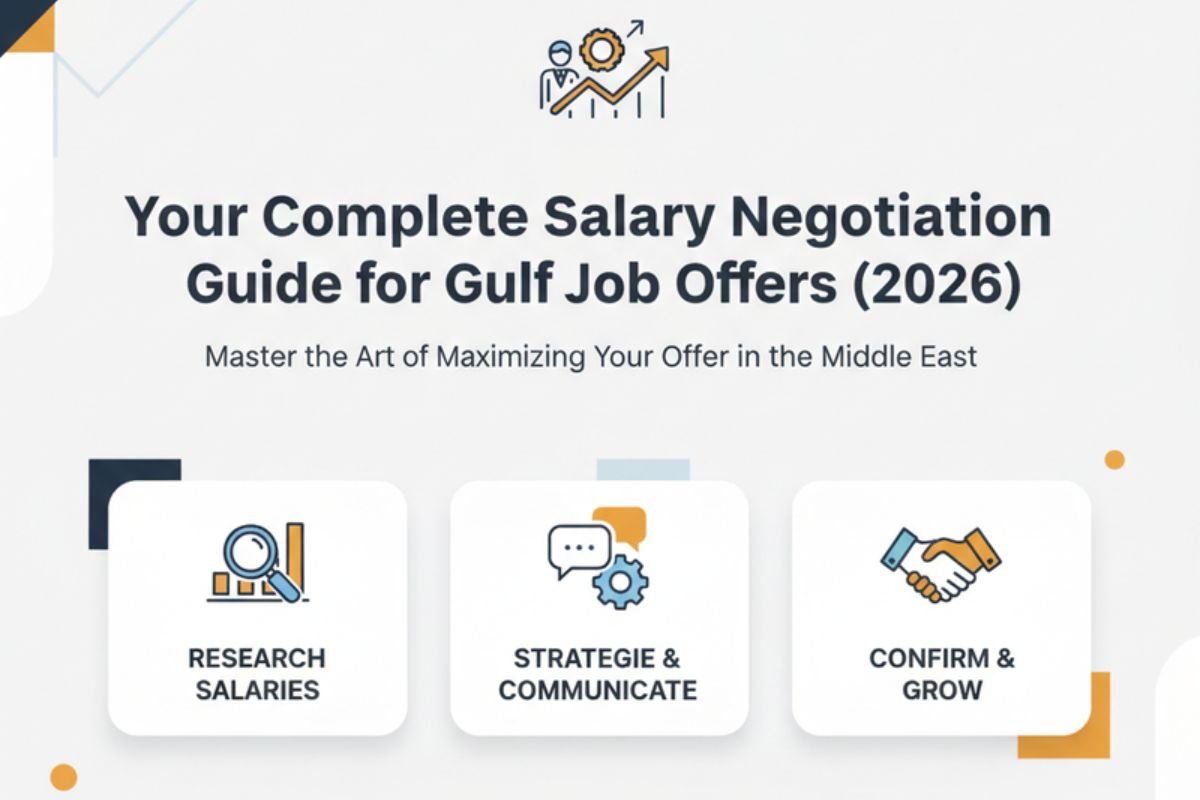
Your Complete Salary Negotiation Guide for Gulf Job Offers (2026)

Salary Negotiation Guide for Gulf Job Offers 2026

How you handle this question in a Gulf job interview can mean the difference between landing a package that sets you up for years, or leaving thousands on the table. The good news? Salary negotiation in the UAE, Saudi Arabia, and Qatar follows predictable rules. Learn them, and you’ll negotiate with confidence.

Step 1: Do Your Homework Before the Interview

Preparation is everything. Before any Gulf job interview, you need to know what you’re worth in today’s market.

Research market rates. The 2026 salary landscape shows modest increases across the region—around 4.1% in the UAE and 4.6% in Saudi Arabia . But averages hide big differences. Specialist roles in technology, finance, and project management are seeing 5-9% increases .

Know the sectors that are hiring. Financial services, industrial sectors, banking, real estate, and technology are leading salary growth in 2026 . If you’re in these fields, you have stronger negotiating power.

Understand total compensation. Gulf packages often include:

  • Base salary
  • Housing allowance (a major component)
  • Transport allowance
  • Annual flight tickets home
  • Education allowance for children
  • Health insurance
  • Bonus potential (typically 2-3 months’ salary) 

Step 2: Master the “Salary Expectations” Question

This is the moment most candidates dread. Here’s how to handle it professionally.

If they ask early in the process: deflect politely.

“I’d be happy to discuss salary once we’ve both confirmed there’s a good fit and I fully understand the scope of the role. Could you share the budgeted range for this position?”

This approach—asking about their budget first—puts you in a stronger position . If their range aligns with your expectations, you’re set. If it’s lower, you can decide whether to continue or politely withdraw.

If they insist on a number: provide a range.

“I’m looking for a package between AED 25,000 and AED 30,000 per month, with flexibility based on the total benefits and role scope.”

Notice the strategy: your ideal figure is at the lower end, showing flexibility while anchoring the conversation where you want it .

Step 3: Know What NOT to Say

Avoid these common mistakes that can cost you thousands.

Never say: “I’m flexible—whatever you think is fair.”

This signals you haven’t done research and gives away your power. Employers may offer well below market rate .

Never get personal: “I need this job because I have rent to pay.”

Shift the conversation from your needs to your value. Focus on what you’ll contribute .

Never respond emotionally: “That’s not enough.”

Instead, say: “Thank you for the offer. Based on my research and the responsibilities we discussed, I was hoping for something closer to X. Is there flexibility?” 

Step 4: Consider the 2026 Market Realities

The Gulf job market in 2026 has some unique dynamics that affect negotiation.

Skills shortages work in your favor. With 90% of employers reporting skills gaps, qualified professionals are in demand . Roles in project management, data science, AI, and engineering are especially hard to fill .

AI skills matter. Around 66% of professionals now use AI regularly at work . Showing genuine AI capability—without exaggerating—can strengthen your position .

Nationalization targets are real. In the UAE, Emiratisation targets for skilled roles are now 10%, with 42% of companies planning to increase Emirati hires . In Saudi Arabia, 93% of employers already hire Saudi nationals, and 75% plan further increases . If you’re an expat, emphasize how you’ll support and develop local talent.

Job switching is common. Nearly 98% of professionals are open to new roles in 2026 . Employers know this, so they’re often willing to negotiate to secure top talent.

Step 5: Negotiate the Whole Package

Salary is important, but don’t overlook other elements that can add significant value.

Housing and transport allowances can be negotiated separately. In Saudi Arabia, family-related benefits (visas, medical cover, flights) are highly valued by 70% of professionals .

Flexible working matters more than ever. Nearly half of professionals rank time-off and flexibility as top benefits . If the base salary is firm, ask about remote work options or additional leave.

Bonuses and reviews. Ask about performance bonus structures (typically 2-3 months’ salary) and when your first salary review will happen .

Step 6: Handle the Offer Professionally

When the offer arrives, here’s your script:

“Thank you for the offer. I’m very excited about this role and the team. I’d like to take 24-48 hours to review the full package carefully.”

Never accept on the spot. Even if you’re thrilled, taking time shows you’re thoughtful and gives you space to prepare counter-arguments.

When you counter, be specific:

“Based on my 8 years of experience and current market rates for this role in Dubai, I was hoping for a base salary of AED 28,000. Is that achievable within your budget?”

Common Questions, Answered

Is negotiation expected in the Gulf?
Yes. Employers often start with a conservative offer, expecting candidates to negotiate professionally .

What if they say the budget is fixed?
Ask about other elements: signing bonus, earlier review date, additional leave, or professional development budget.

How transparent should I be about my current salary?
Be honest about your current package, including all components. Transparency builds trust .

When is the best time to negotiate?
After you’ve received a formal offer, but before you’ve accepted. That’s when you have maximum leverage.

Final Thought: You’re Worth It

Negotiation isn’t rude—it’s expected. In the Gulf’s competitive 2026 job market, employers want candidates who know their worth and communicate it professionally.

Do your research, stay confident and polite, and remember: the best time to negotiate your lifetime earnings is right now, before you accept.

Your next opportunity is waiting. Go get what you deserve.


Frequently Asked Questions (FAQs)

1. What’s the average salary increase in the Gulf for 2026?

Average increases range from 4.1% in the UAE to 4.6% in Saudi Arabia, with Qatar and Oman at 4.3% . However, specialist roles in technology, finance, and project management can see 5-9% increases .

2. How do I research fair salaries before a Gulf job interview?

Use resources like the Hays GCC Salary Guide (covering 400+ roles), Korn Ferry forecasts, and platforms like Bayt.com‘s salary calculator . Talk to recruiters and professionals in your network who know the local market.

3. What should I do if the initial offer is below my expectations?

Thank them politely, then respond with: “Based on my research and the responsibilities we discussed, I was hoping for something closer to X. Is there flexibility in the budget?” This invites conversation rather than confrontation 

4. Are housing and transport allowances negotiable?

Yes. In fact, these are often separate line items in Gulf compensation packages. If base salary is firm, focus negotiations on allowances, bonuses, annual flights, or education benefits 

5. How important are AI skills for Gulf job seekers in 2026?

Very important. Around 66% of professionals now use AI regularly at work . Demonstrating genuine AI capability—through courses, pilot projects, or practical experience—can strengthen your negotiating position .

Cultural Etiquette for Gulf Job Interviews: Do’s and Don’ts

Gulf Job Interview Etiquette: Do's & Don'ts 2026

Landing a job interview in the Gulf region—whether in the UAE, Saudi Arabia, Qatar, or Kuwait—is a significant achievement. The competition is fierce, and your qualifications are just the starting point. What often separates successful candidates from the rest is cultural intelligence: the ability to navigate the unique blend of Islamic traditions, Bedouin customs, and modern business practices that define the Gulf workplace .

The Foundation: Respect and Preparation

Before stepping into any interview room, understand that Gulf business culture places immense value on personal relationships and respect. Your behavior, dress, and words all signal your suitability—not just as an employee, but as a colleague .

Preparation is Key:

  • Research the company thoroughly. Understand its values, recent projects, and position in the local market .
  • Know the local context. Familiarize yourself with key national initiatives like Saudi Vision 2030 or UAE’s economic goals. Mentioning these shows genuine interest .
  • Prepare your documents. Bring multiple copies of your CV, educational certificates, and references .

The Golden Do’s for Gulf Job Interviews

1. Dress Conservatively and Professionally

In the Gulf, modesty equals respect. Your attire sends an immediate signal about your professionalism.

  • Men: Wear a formal suit and tie. Dark, neutral colors are safest .
  • Women: Opt for business attire that is loose-fitting and covers shoulders and knees. Avoid revealing necklines or tight clothing. A headscarf is not typically required for non-Muslim women in private sector interviews, but having one handy is advisable for certain settings .

2. Master the Art of Greeting

First impressions are formed in seconds. Get this right.

  • Be punctual. Aim to arrive 10–15 minutes early. Tardiness is seen as disrespectful and unprofessional .
  • Wait for the handshake. Do not initiate a handshake with someone of the opposite gender. Wait to see if they extend their hand first. If not, a polite nod and a smile, with your right hand placed over your heart, is a gesture of sincere respect .
  • Use proper greetings. Starting with “Assalamu Alaikum” (peace be upon you) is a kind and respectful gesture. Use formal titles like “Mr.,” “Ms.,” “Doctor,” or “Engineer” until invited to use first names .

3. Communicate with Politeness and Patience

Communication in the Gulf tends to be more indirect and relationship-focused than in Western cultures .

  • Engage in small talk first. Be prepared for a few minutes of pleasant conversation about general well-being before business begins. This builds rapport .
  • Listen more than you speak. Avoid interrupting. Allow the interviewer to finish their thoughts completely before responding .
  • Highlight adaptability. Emphasize your experience working in diverse, multicultural environments. This is highly valued across the GCC .
  • Use the STAR method (Situation, Task, Action, Result) for behavioral questions to provide clear, structured answers about your past experiences .

4. Ask Thoughtful Questions

At the end of the interview, you will be asked if you have questions. Never say no .

  • Ask about the company’s growth plans, team culture, or the biggest challenges for the role .
  • Inquire about work-life balance or team dynamics in a respectful way .

5. Follow Up Professionally

A thank-you email within 24 hours is a simple yet powerful way to stand out .

  • Express gratitude for the opportunity.
  • Reiterate your enthusiasm for the role and the company.

The Critical Don’ts: What to Avoid at All Costs

1. Don’t Be Overly Casual

The Gulf workplace values formality and professionalism, especially in initial interactions .

  • Avoid slang and informal language. Don’t say “Yeah, that’s cool.” Say “That sounds great, I’d love to learn more” .
  • Don’t slouch or fidget. Maintain confident, upright posture and respectful eye contact .

2. Don’t Speak Negatively About Past Employers

This is a universal rule, but it carries extra weight in the well-connected Gulf job market . Badmouthing a previous employer or manager signals disloyalty and poor judgment .

  • Fix it: Frame past experiences positively. Instead of “My last boss was terrible,” say “I’m looking for a role where I can contribute more effectively and grow” .

3. Don’t Discuss Salary Too Early

Asking about compensation before the employer raises the topic can make you appear solely money-focused .

  • Fix it: If asked about expectations, you can say, “I’d love to understand the full compensation package as we move forward” . Focus first on the value you can bring.

4. Don’t Bring Up Controversial Topics

Avoid discussing politics, religion, or sensitive social issues entirely . The workplace is for professionalism and respect.

5. Don’t Ignore Local Customs and Practices

Showing awareness of local culture demonstrates deep respect.

  • Don’t use your left hand to give or receive items. The left hand is considered unclean. Always use your right hand .
  • Don’t show impatience if a meeting starts late or is interrupted for prayer times. Flexibility and understanding are expected .
  • During Ramadan, don’t eat, drink, or smoke in public or in front of colleagues who are fasting .
  • Don’t refuse hospitality. If offered Arabic coffee (Gahwa) or tea, accept it gracefully with your right hand, even if you only take a small sip .

Country-Specific Nuances

While the core principles apply across the Gulf, small distinctions exist:

  • Saudi Arabia: The culture is deeply rooted in Islamic traditions and tribal customs . Observing prayer times and showing utmost respect for hierarchy is critical. Gender dynamics are more formal .
  • UAE (especially Dubai): The environment is highly multicultural and fast-paced. Punctuality and a polished, international profile are highly valued .
  • Qatar: Similar to the UAE in its international mix, but with a more conservative undercurrent. Punctuality and formal dress are essential .

Conclusion: Your Competitive Advantage

In the Gulf job market, your technical skills get you the interview, but your cultural intelligence gets you the job. By following these do’s and avoiding the don’ts, you demonstrate not just competence, but respect—the ultimate currency in Gulf business culture.

Approach your interview with preparation, humility, and a genuine willingness to understand and adapt. That is the formula for success.


Frequently Asked Questions (FAQs)

1. Is a handshake always appropriate in Gulf job interviews?

No. Do not initiate a handshake with someone of the opposite gender. Wait for them to extend their hand first. For same-gender greetings, a firm but gentle handshake with eye contact is common. When in doubt, a polite nod with your right hand placed over your heart is a safe and respectful gesture 

2. What should I wear for a job interview in Saudi Arabia vs. the UAE?

In both countries, conservative business attire is essential. Men should wear a formal suit and tie. Women should wear modest, loose-fitting business attire that covers shoulders and knees. In Saudi Arabia, the environment is more conservative, so err on the side of greater coverage. In the UAE, especially Dubai, the dress code is still professional but may allow for slightly more modern cuts, while remaining modest .

3. Is it acceptable to discuss salary during the first interview?

It is generally best to avoid bringing up salary and benefits until the employer initiates the conversation. Asking too early can make you seem focused on compensation over contribution. Wait for the appropriate moment, usually in later interview rounds 

4. What topics should I absolutely avoid in a Gulf job interview?

Avoid discussing politics, religion, and any controversial social topics. Also, never speak negatively about past employers or colleagues. Keep the conversation focused on your professional qualifications, your interest in the role, and your ability to contribute to the company’s success 

5. How important is it to speak Arabic for a job interview in the Gulf?

For most private sector roles, especially in multinational companies, English is the primary business language and interviews are conducted in English. However, learning a few polite phrases in Arabic, such as “Assalamu Alaikum” (peace be upon you) and “Shukran” (thank you), is a powerful sign of respect and cultural awareness that will be greatly appreciated . For government roles or positions with a strong local focus, Arabic fluency may be required.

Common Gulf Job Interview Questions & How to Answer Them (2026 Guide for Pakistani Candidates)

Gulf Job Interview Questions 2026 | Answers for Pakistanis

For millions of Pakistani workers, the Gulf region—Saudi Arabia, UAE, Qatar, Kuwait, Oman, and Bahrain—represents a life-changing opportunity. Better salaries, tax-free income, and career growth await those who successfully clear the interview stage .

Question 1: “Tell Me About Yourself”

Why they ask this: This is your 60-second commercial. Recruiters want to know if you can present yourself clearly and professionally. Many candidates are filtered out right here .

What NOT to do: Don’t start with “I was born in…” or give your entire life story. Don’t ramble for 5-7 minutes .

How to answer (The Professional Summary):

“I am a certified HVAC technician with five years of experience working on both commercial and residential projects in Pakistan. I recently completed a major contract at a large hospital in Lahore, where I maintained over 200 air conditioning units. I am now looking for an opportunity to bring my skills to a dynamic team in the Gulf and continue growing professionally.” 

For Pakistani candidates: Mention specific projects or employers in Pakistan that demonstrate your experience level. Gulf employers respect hands-on, verifiable experience.

Question 2: “Why Do You Want to Work in the Gulf?”

Why they ask this: Employers want to know you’ve thought this through. Are you running away from problems in Pakistan, or genuinely seeking growth? 

What NOT to do: Don’t say “I just need a job” or “The salary is better.” This makes you sound desperate.

How to answer:

“The Gulf region is known for its rapid development and professional work culture. I have followed Saudi Vision 2030 and the UAE’s infrastructure projects with great interest. I want to contribute my skills to these exciting developments while gaining international experience in a competitive environment. I am ready to adapt and work hard.” 

For Pakistani candidates: Show that you have researched the specific country you are applying to. Mentioning “Saudi Vision 2030” or “Expo City Dubai” demonstrates genuine interest.

Question 3: “Why Are You Leaving Your Current Job?”

Why they ask this: This is a test of your professionalism and loyalty. Never—ever—badmouth your previous employer, even if they were terrible .

What NOT to do: Don’t complain about your boss, salary, or company politics. This immediately raises red flags.

How to answer (Growth opportunity):

“I have learned a great deal in my current role and I am grateful for the experience. However, I feel I have reached a point where I am ready for more responsibility and new challenges. Working in the Gulf is the natural next step in my career growth.” 

Alternative answer (Company change):

“My current company is shifting its focus away from international markets. I am committed to building my career in the Gulf region, so I am looking for an employer with strong regional presence.” 

Question 4: “Are You Comfortable Working in a Diverse Team with Different Nationalities?”

Why they ask this: Gulf workplaces are melting pots—you will work alongside Indians, Filipinos, Egyptians, Westerners, and many others. Employers need to know you can collaborate respectfully .

What NOT to do: Don’t hesitate or sound uncertain. Don’t say “I prefer working with Pakistanis only.”

How to answer:

“Yes, absolutely. I have worked with teams from various backgrounds on large projects in Pakistan. I respect different cultures and believe that collaboration brings out the best ideas. I am comfortable learning from colleagues of any nationality and sharing my own knowledge as well.” 

For Pakistani candidates: If you have experience working with foreign engineers, consultants, or NGOs in Pakistan, mention it. This is a strong plus point.

Question 5: “What Are Your Strengths?”

Why they ask this: Anyone can say “I am hardworking.” Employers want proof .

What NOT to do: Don’t give generic adjectives without evidence.

How to answer (Skill + Proof):

“My greatest strength is solving problems under pressure. Last year, a critical machine broke down at our factory and the spare part would take three weeks to arrive. I improvised a repair using locally available materials, and we met our production deadline with zero customer impact. The repair lasted until the official part arrived.” 

For Pakistani candidates: Gulf employers value jugar (improvisation skills) when applied professionally. Frame it as resourcefulness and quick thinking.

Question 6: “What Are Your Weaknesses?”

Why they ask this: This is NOT a trick. They want self-awareness and a growth mindset .

What NOT to do: Don’t say “I am a perfectionist” or “I work too hard.” Recruiters hear this constantly and it means nothing.

How to answer (Real weakness + How you fix it):

“I used to struggle with delegating tasks. I felt I had to do everything myself to ensure quality. But I realized this doesn’t scale and it burns me out. Over the past year, I have focused on training junior team members and trusting them with more responsibility. It has made me a better supervisor and freed me up for更重要 tasks.” 

For Pakistani candidates: Choose a genuine weakness related to technical skills (e.g., “I was not comfortable with computerized maintenance systems, so I took a short course and now I use them daily”).

Question 7: “Can You Work Under Pressure or During Peak Hours?”

Why they ask this: Gulf industries like construction, hospitality, and logistics often require long shifts and deadline-driven work .

What NOT to do: Don’t say “I don’t like overtime” or look uncomfortable.

How to answer:

“Absolutely. I understand that project deadlines and peak seasons may require extra effort. In my previous job, we often worked six days a week during the summer season. I stay calm under pressure and focus on time management to complete tasks efficiently.” 

Question 8: “Where Do You See Yourself in Five Years?”

Why they ask this: Are you a flight risk? Will you jump to another company as soon as you arrive? Or will you stay and grow with them? 

What NOT to do: Don’t say “I want your job” or “I want to start my own business.” Don’t say “I don’t know.”

How to answer (Commitment track):

“I want to grow into a senior technician or supervisor role, ideally within the same company. I am looking for an employer that invests in training and promotes from within. In five years, I see myself as a valuable, long-term member of the team here.” 

For Pakistani candidates: Gulf employers appreciate workers who stay for multiple contract cycles. Show you are looking for stability, not just a quick income.

Question 9: “Tell Me About a Time You Faced Conflict at Work.”

Why they ask this: Conflict is normal. How you handle it shows emotional maturity .

What NOT to do: Don’t say “I avoid conflict.” Don’t blame others.

How to answer (STAR Method):

Situation: Two of my team members disagreed on how to approach a repair job.
Task: As the senior technician, I needed to resolve this so we could meet our deadline.
Action: I brought both colleagues together and let each explain their approach. We tested both ideas on a small scale. One method was faster, but both felt heard.
Result: The project succeeded, and the working relationship remained strong. I learned that listening is more important than being right.” 

Question 10: “Do You Have Any Questions for Us?”

Why they ask this: If you say “no,” you look uninterested. Always prepare questions .

Good questions to ask:

  • “What does a typical working day look like for this role?”
  • “What are the biggest challenges your team is facing right now?”
  • “Is there opportunity for overtime or additional training?”
  • “How does the company support workers who are new to the Gulf?”

Questions to avoid: Salary, leave, and accommodation details in the first interview (unless the employer brings it up first) .

7 Practical Tips for Pakistani Candidates

1. Research the Employer Thoroughly
Visit their website. Check their LinkedIn page. Know what they do and where they operate. Mentioning specific projects shows you are serious .

2. Improve Your English Communication
You don’t need perfect grammar. You need confidence. Practice speaking English daily with friends or family. Watch English news channels .

3. Learn Basic Arabic Phrases
Simple greetings like “Assalamu Alaikum” (peace be upon you), “Shukran” (thank you), and “Afwan” (you’re welcome) demonstrate cultural respect. This leaves a strong impression .

4. Prepare Your Documents
Keep your passport, educational certificates, experience letters, and trade test certificates neatly organized in a folder. Bring both original and photocopies .

5. Dress Professionally and Modestly
First impressions matter. For men: clean shave or well-trimmed beard, ironed shirt, formal trousers. For women: modest formal wear. Even for online interviews, dress professionally from head to toe .

6. Be Honest, Never Exaggerate
Gulf employers often verify credentials. If you claim experience you don’t have, it will be discovered—and you will lose the job opportunity permanently .

7. Follow Up After the Interview
Send a short thank-you email or WhatsApp message within 24 hours:

“Dear [Interviewer Name], thank you for your time today. I enjoyed learning about your company and I am very interested in this opportunity. I look forward to hearing from you.” 

How Recruitment Agencies in Pakistan Can Help

Many Pakistani workers secure Gulf jobs through registered recruitment agencies. These agencies:

  • Match your skills with genuine employer requirements
  • Provide pre-interview training and mock interviews
  • Help with documentation and visa processing
  • Offer cultural orientation about Gulf work life 

Important Warning: Never pay large sums of money upfront to an agent. Legitimate agencies charge regulated fees, often deducted after you join. Always verify the agency is licensed by the Bureau of Immigration (Pakistan) .

Medical Tests & Visa Process (Brief Overview)

If you pass the interview, the next steps typically include:

  1. Medical Examination: Conducted at GAMCA/Wafid approved centers. Tests include blood work, chest X-ray, and general physical examination .
  2. Visa Processing: Your employer sponsors your employment visa. This usually takes 2-6 weeks .
  3. Final Departure: Once visa is stamped, your flight is arranged (usually paid by employer). Keep all documents in your hand luggage .

Conclusion: Be Prepared, Be Confident, Be Honest

Gulf job interview is your opportunity to show an employer that you are not just a skilled worker, but a reliable professional who will represent their company well.

The questions in this guide appear in nearly every interview across Saudi Arabia, UAE, Qatar, Kuwait, and Oman . Practice your answers out loud. Record yourself. Ask a friend to do a mock interview.

Remember: Gulf employers value directness, honesty, and a positive attitude. Show them you are ready to work hard, respect their culture, and grow with their company.

Your dream job in the Gulf is closer than you think. Prepare today.


Frequently Asked Questions (FAQs)

1. Do I need to speak fluent English for a Gulf job interview?

Not necessarily. You need to communicate confidently and clearly. Employers understand that English may not be your first language. Focus on simple, direct sentences rather than complex vocabulary. Confidence matters more than perfection 

2. What documents should I bring to a Gulf job interview in Pakistan?

Bring your original passport, CNIC, educational certificates (degrees/diplomas), experience letters from previous employers, and any trade test or technical training certificates. Keep photocopies organized in a separate folder. For online interviews, have digital scans ready .

3. Should I mention my expected salary in the first interview?

Avoid it unless the employer asks directly. Focus first on demonstrating your value and skills. If asked, research the typical salary for your role in that specific Gulf country and provide a realistic range. Be tactful 

4. How long does the entire Gulf recruitment process take?

The interview itself is 20-45 minutes. If selected, medical and visa processing typically takes 2 to 6 weeks, depending on the country and employer. Some government sector jobs may take longer .

5. What if I don’t understand a question during the interview?

It is perfectly acceptable to politely ask for clarification. Say: “I’m sorry, could you please repeat the question?” or “Could you explain what you mean?” This is much better than answering incorrectly or freezing up. Honest communication is valued 

7 Proven Strategies to Ace Your Interview with a Gulf-Based Company

7 Proven Strategies to Ace Your Gulf Job Interview | Career Success in UAE & Middle East

Landing a job in the Gulf region — whether in the UAE, Saudi Arabia, Qatar, or Kuwait — can be a life-changing opportunity. The Gulf job market is highly competitive, with employers seeking not only technical skills but also adaptability, cultural awareness, and professionalism. To stand out, candidates must prepare strategically for interviews that often blend global standards with region-specific expectations

Understanding the Gulf Job Market

Before diving into strategies, it’s important to understand the Gulf hiring landscape:

  • Employers value reliability, adaptability, and cultural awareness as much as technical expertise.
  • Interviews often include questions about relocation, cultural fit, and long-term commitment.
  • Many companies emphasize professional appearance, punctuality, and respect for hierarchy.

With this context, let’s explore the strategies.

Strategy 1: Research the Company and Industry

One of the most common mistakes candidates make is failing to research the employer. Gulf-based companies expect candidates to demonstrate knowledge of their business, industry, and regional context.

  • Study the company’s website, annual reports, and press releases.
  • Understand their regional footprint — e.g., operations in Dubai, Riyadh, or Doha.
  • Learn about industry trends, such as oil & gas diversification, fintech growth, or healthcare expansion.

Tip: Be ready to answer, “Why do you want to work with us in the Gulf?” with specific references to the company’s projects or values.

Strategy 2: Prepare for Common Gulf Interview Questions

According to AnyGulfJobs, candidates often face questions like:

  • “Why do you want to relocate to the Gulf?”
  • “How do you adapt to multicultural environments?”
  • “What do you know about labor laws and work culture here?”
  • “Can you commit to a long-term contract?”

Action: Practice concise, confident answers that highlight adaptability, respect for diversity, and long-term commitment.

Strategy 3: Showcase Cultural Awareness

Employers in the Gulf value candidates who respect local traditions and workplace norms. Demonstrating cultural sensitivity can set you apart.

  • Learn basic etiquette: greetings, dress codes, and workplace hierarchy.
  • Show respect for Islamic values, holidays, and prayer times.
  • Highlight past experiences working in multicultural teams.

Example: If asked about teamwork, mention how you collaborated with colleagues from different backgrounds and adapted communication styles.

Strategy 4: Highlight Soft Skills Alongside Technical Expertise

While technical skills are crucial, Gulf employers emphasize soft skills such as communication, problem-solving, and adaptability.

  • Stress your ability to work under pressure and meet deadlines.
  • Demonstrate leadership qualities, even if applying for entry-level roles.
  • Share examples of conflict resolution or cross-cultural collaboration.

Tip: Use the STAR method (Situation, Task, Action, Result) to structure your answers.

Strategy 5: Dress Professionally and Mind First Impressions

Appearance matters significantly in Gulf interviews. Employers expect candidates to present themselves with professionalism.

  • Men: Wear a suit or formal attire.
  • Women: Opt for modest, professional clothing.
  • Ensure punctuality — arriving late is considered disrespectful.

Note: In virtual interviews, maintain the same standards: professional attire, clean background, and good lighting.

Strategy 6: Demonstrate Long-Term Commitment

High turnover is a concern in the Gulf job market. Employers want assurance that candidates will stay and grow with the company.

  • Express willingness to relocate and adapt to Gulf life.
  • Emphasize career goals aligned with the company’s growth.
  • Avoid sounding like you’re seeking a short-term opportunity.

Example: “I see this role as a long-term opportunity to contribute to your regional expansion and grow my career in the Gulf.”

Strategy 7: Follow Up Professionally

Post-interview etiquette is critical. A thoughtful follow-up can reinforce your interest.

  • Send a thank-you email within 24 hours.
  • Reiterate enthusiasm for the role and highlight one key strength.
  • Keep communication professional and concise.

Summary Table of Strategies

#StrategyKey Action
1Research the company and industryStudy operations, projects, and values
2Prepare for common Gulf interview questionsPractice answers on relocation, culture, and commitment
3Showcase cultural awarenessRespect traditions, highlight multicultural teamwork
4Highlight soft skillsUse STAR method to demonstrate adaptability
5Dress professionallyFormal attire, punctuality, modest presentation
6Demonstrate long-term commitmentAlign career goals with company growth
7Follow up professionallySend thank-you email, reinforce interest

FAQs

What makes Gulf interviews different from Western interviews?

Gulf interviews emphasize cultural fit, adaptability, and long-term commitment, alongside technical skills.

Do I need to know Arabic to work in the Gulf?

Not always. English is widely used in business, but basic Arabic phrases can demonstrate respect and adaptability.

How should I address salary expectations?

Research average salaries in the Gulf for your role. Be flexible but informed, and avoid discussing salary too early.

What if I have limited Gulf experience?

Highlight transferable skills, multicultural teamwork, and willingness to adapt. Employers value attitude as much as experience.

How do I prepare for virtual interviews with Gulf companies?

Treat them like in-person interviews: dress professionally, ensure good lighting, and maintain eye contact through the camera.

Final Thoughts

Acing an interview with a Gulf-based company requires more than technical expertise. It’s about cultural awareness, adaptability, and professionalism. By applying these seven strategies — from thorough research to professional follow-ups — you’ll position yourself as a candidate who not only fits the role but also thrives in the Gulf’s dynamic work environment.

Post a Job Opening

Fill in the details below. Your job posting will be reviewed by our team.

Basic Information

Specify years of experience required

Location & Salary

Qualifications & Skills

Specify educational requirements
Separate skills with commas

Company Details

Job Details

Contact Information