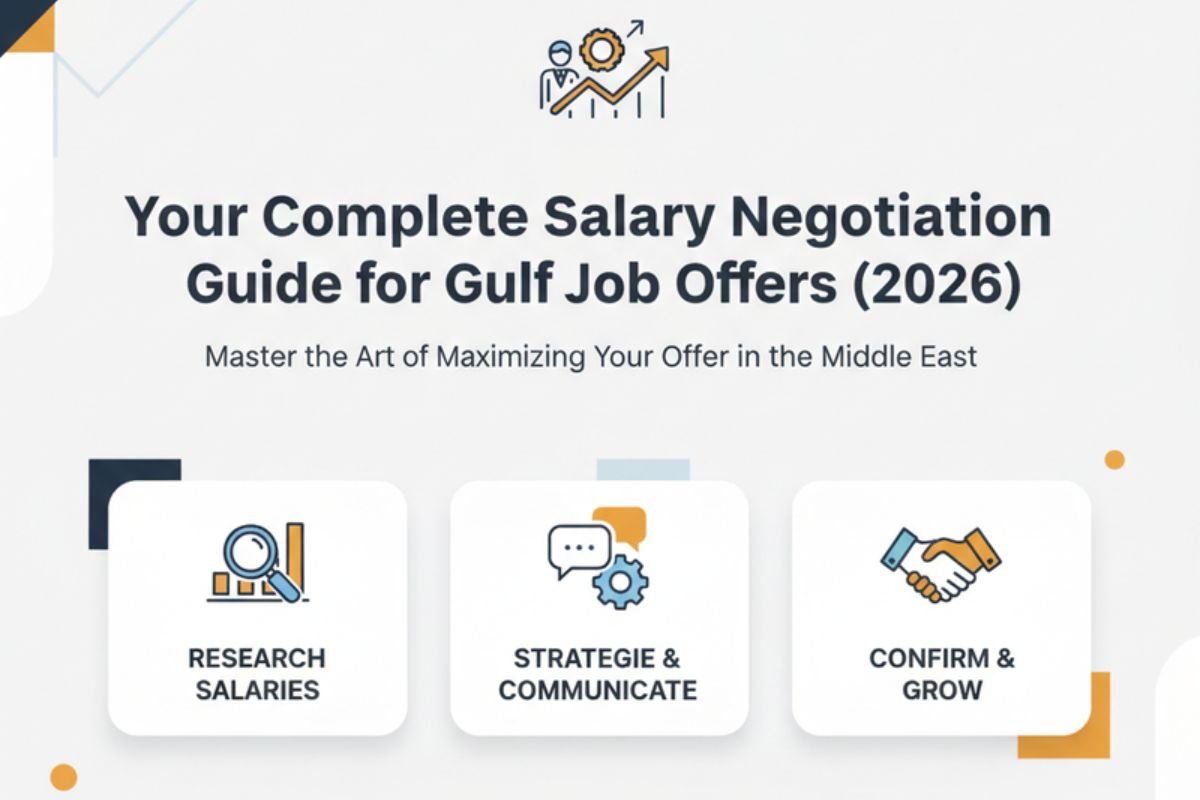
How you handle this question in a Gulf job interview can mean the difference between landing a package that sets you up for years, or leaving thousands on the table. The good news? Salary negotiation in the UAE, Saudi Arabia, and Qatar follows predictable rules. Learn them, and you’ll negotiate with confidence.
Step 1: Do Your Homework Before the Interview
Preparation is everything. Before any Gulf job interview, you need to know what you’re worth in today’s market.
Research market rates. The 2026 salary landscape shows modest increases across the region—around 4.1% in the UAE and 4.6% in Saudi Arabia . But averages hide big differences. Specialist roles in technology, finance, and project management are seeing 5-9% increases .
Know the sectors that are hiring. Financial services, industrial sectors, banking, real estate, and technology are leading salary growth in 2026 . If you’re in these fields, you have stronger negotiating power.
Understand total compensation. Gulf packages often include:
Base salary
Housing allowance (a major component)
Transport allowance
Annual flight tickets home
Education allowance for children
Health insurance
Bonus potential (typically 2-3 months’ salary)
Step 2: Master the “Salary Expectations” Question
This is the moment most candidates dread. Here’s how to handle it professionally.
If they ask early in the process: deflect politely.
“I’d be happy to discuss salary once we’ve both confirmed there’s a good fit and I fully understand the scope of the role. Could you share the budgeted range for this position?”
This approach—asking about their budget first—puts you in a stronger position . If their range aligns with your expectations, you’re set. If it’s lower, you can decide whether to continue or politely withdraw.
If they insist on a number: provide a range.
“I’m looking for a package between AED 25,000 and AED 30,000 per month, with flexibility based on the total benefits and role scope.”
Notice the strategy: your ideal figure is at the lower end, showing flexibility while anchoring the conversation where you want it .
Step 3: Know What NOT to Say
Avoid these common mistakes that can cost you thousands.
Never say: “I’m flexible—whatever you think is fair.”
This signals you haven’t done research and gives away your power. Employers may offer well below market rate .
Never get personal: “I need this job because I have rent to pay.”
Shift the conversation from your needs to your value. Focus on what you’ll contribute .
Never respond emotionally: “That’s not enough.”
Instead, say: “Thank you for the offer. Based on my research and the responsibilities we discussed, I was hoping for something closer to X. Is there flexibility?”
Step 4: Consider the 2026 Market Realities
The Gulf job market in 2026 has some unique dynamics that affect negotiation.
Skills shortages work in your favor. With 90% of employers reporting skills gaps, qualified professionals are in demand . Roles in project management, data science, AI, and engineering are especially hard to fill .
AI skills matter. Around 66% of professionals now use AI regularly at work . Showing genuine AI capability—without exaggerating—can strengthen your position .
Nationalization targets are real. In the UAE, Emiratisation targets for skilled roles are now 10%, with 42% of companies planning to increase Emirati hires . In Saudi Arabia, 93% of employers already hire Saudi nationals, and 75% plan further increases . If you’re an expat, emphasize how you’ll support and develop local talent.
Job switching is common. Nearly 98% of professionals are open to new roles in 2026 . Employers know this, so they’re often willing to negotiate to secure top talent.
Step 5: Negotiate the Whole Package
Salary is important, but don’t overlook other elements that can add significant value.
Housing and transport allowances can be negotiated separately. In Saudi Arabia, family-related benefits (visas, medical cover, flights) are highly valued by 70% of professionals .
Flexible working matters more than ever. Nearly half of professionals rank time-off and flexibility as top benefits . If the base salary is firm, ask about remote work options or additional leave.
Bonuses and reviews. Ask about performance bonus structures (typically 2-3 months’ salary) and when your first salary review will happen .
Step 6: Handle the Offer Professionally
When the offer arrives, here’s your script:
“Thank you for the offer. I’m very excited about this role and the team. I’d like to take 24-48 hours to review the full package carefully.”
Never accept on the spot. Even if you’re thrilled, taking time shows you’re thoughtful and gives you space to prepare counter-arguments.
When you counter, be specific:
“Based on my 8 years of experience and current market rates for this role in Dubai, I was hoping for a base salary of AED 28,000. Is that achievable within your budget?”
Common Questions, Answered
Is negotiation expected in the Gulf? Yes. Employers often start with a conservative offer, expecting candidates to negotiate professionally .
What if they say the budget is fixed? Ask about other elements: signing bonus, earlier review date, additional leave, or professional development budget.
How transparent should I be about my current salary? Be honest about your current package, including all components. Transparency builds trust .
When is the best time to negotiate? After you’ve received a formal offer, but before you’ve accepted. That’s when you have maximum leverage.
Final Thought: You’re Worth It
Negotiation isn’t rude—it’s expected. In the Gulf’s competitive 2026 job market, employers want candidates who know their worth and communicate it professionally.
Do your research, stay confident and polite, and remember: the best time to negotiate your lifetime earnings is right now, before you accept.
Your next opportunity is waiting. Go get what you deserve.
Frequently Asked Questions (FAQs)
1. What’s the average salary increase in the Gulf for 2026?
Average increases range from 4.1% in the UAE to 4.6% in Saudi Arabia, with Qatar and Oman at 4.3% . However, specialist roles in technology, finance, and project management can see 5-9% increases .
2. How do I research fair salaries before a Gulf job interview?
Use resources like the Hays GCC Salary Guide (covering 400+ roles), Korn Ferry forecasts, and platforms like Bayt.com‘s salary calculator . Talk to recruiters and professionals in your network who know the local market.
3. What should I do if the initial offer is below my expectations?
Thank them politely, then respond with: “Based on my research and the responsibilities we discussed, I was hoping for something closer to X. Is there flexibility in the budget?” This invites conversation rather than confrontation
4. Are housing and transport allowances negotiable?
Yes. In fact, these are often separate line items in Gulf compensation packages. If base salary is firm, focus negotiations on allowances, bonuses, annual flights, or education benefits
5. How important are AI skills for Gulf job seekers in 2026?
Very important. Around 66% of professionals now use AI regularly at work . Demonstrating genuine AI capability—through courses, pilot projects, or practical experience—can strengthen your negotiating position .
If you’re eyeing a career move to the UAE, Saudi Arabia, Qatar, or Oman this year, you need current, reliable information. This guide consolidates the latest salary forecasts, in-demand sectors, hiring trends, and practical job-seeking strategies—all sourced from 2026 reports—to help you navigate the Gulf job market with confidence.
The Big Picture: Why the Gulf Job Market Is Booming in 2026
Let’s start with the fundamentals. The GCC economy is projected to grow at approximately 4.5% in 2026, driven by two powerful forces: the continued expansion of non-oil sectors and the rollback of OPEC+ production cuts . This isn’t just oil money recycling; it’s genuine economic diversification.
Saudi Arabia is leading the charge with projected average salary increases of 4.6% , the highest in the region . The Kingdom’s Vision 2030 agenda continues to drive massive infrastructure, technology, and tourism investments, creating hundreds of thousands of new roles.
Qatar and Oman follow closely, both forecasting 4.3% average salary growth . Qatar’s LNG sector expansion is gathering momentum, while Oman’s economic reform program is opening new opportunities across logistics, tourism, and renewable energy.
The UAE, with a forecasted 4.1% salary increase, remains the region’s most mature and diverse job market . Dubai and Abu Dhabi continue to attract global talent through world-class infrastructure, competitive tax-free salaries, and exceptional quality of life.
The 2026 Reality: What Job Seekers Need to Know
Here’s the honest truth: the Gulf job market in 2026 rewards strategy, specialization, and patience. According to the Hays GCC Salary Guide 2026, 66% of employers increased headcount in 2025, and hiring momentum remains strong . However, 90% of organizations report skills shortages, creating intense competition for qualified professionals .
Key Market Dynamics:
1. The Salary Paradox: While 58% of professionals received pay increases in 2025 (up from 51% in 2024), 60% feel their compensation doesn’t match their responsibilities. This disconnect is driving unprecedented workforce mobility.
2. The AI Revolution Is Here:66% of professionals now use AI regularly at work. This isn’t future speculation—it’s current reality. Employers are actively seeking candidates who demonstrate AI literacy and practical application skills.
3. Talent Shortages Are Acute: Roles in data science, artificial intelligence, project management, engineering, software development, and specialized finance remain extremely difficult to fill . If you have expertise in these areas, you’re in the driver’s seat.
4. Nationalization Goals Are Real: Saudi Arabia’s Saudization and the UAE’s Emiratisation targets are not cosmetic. In the UAE, Emiratisation targets for skilled roles have increased to 10% , with 42% of companies planning to grow Emirati headcount in 2026 . In Saudi Arabia, 93% of employers already employ Saudi nationals, and 75% plan further increases this year .
Country-by-Country Breakdown: Where the Jobs Are
🇦🇪 United Arab Emirates: The Region’s Talent Hub
The UAE economy grew by roughly 4% in 2025 and is expected to accelerate to 4.5% in 2026 , driven primarily by non-oil sectors . Workforce growth has risen by 9% , and new business formations are up 14%.
Top Industries in Demand:
Technology, AI, and Automation: The UAE leads globally in AI hiring growth, with a 48% increase in 2024–25
Cybersecurity and Data Analytics: Critical skills gap across banking, government, and enterprise
Finance and FinTech: DIFC now hosts over 1,500 AI, fintech, and innovation firms
Healthcare: Ongoing expansion of world-class medical infrastructure
Engineering and Project Management: Driven by real estate and infrastructure pipelines
Sales, Retail, and E-commerce: Consumer spending remains strong
Logistics and Supply Chain: Dubai’s position as a global trade hub continues to strengthen
Salary Snapshot (Monthly, AED):
Role
Salary Range
Head of Wholesale Banking (EVP)
110,000 – 240,000
CMO
80,000 – 130,000
Regional Sales Director
55,000 – 85,000
Compliance Head
70,000 – 120,000
Senior Relationship Manager
50,000 – 70,000
Marketing Manager
30,000 – 65,000
Investment Banking Analyst
32,000 – 45,000
Source: Korn Ferry UAE Salary Forecast 2026
🇸🇦 Saudi Arabia: The Mega-Project Powerhouse
Saudi Arabia recorded estimated employment growth of 4.5% in 2025 , with long-term demand projecting hundreds of thousands of additional workers by 2030 . The replacement of the Kafala system with a contract-based framework has given 13 million foreign workers greater freedom and mobility .
Hot Sectors:
Giga-Projects: NEOM, Red Sea Project, Qiddiya, and Diriyah Gate continue massive hiring
Construction and Engineering: Project managers, commercial managers, design specialists
Technology and Digital Transformation: Government and private sector digitization
Tourism and Hospitality: Opening to international visitors creates thousands of roles
Renewable Energy: Saudi Green Initiative driving solar and wind projects
Healthcare: Expansion of medical cities and specialized facilities
Salary Outlook: Saudi leads the region with 4.6% projected average salary increases .
🇶🇦 Qatar: LNG Expansion Drives Growth
Qatar’s hiring grew at 0.5% in 2025, but significant workforce expansion from LNG projects is anticipated through 2026 . The North Field expansion project—one of the world’s largest natural gas developments—is creating thousands of direct and indirect roles.
Key Opportunities:
Oil & Gas Engineering: Process, mechanical, and safety engineers
Construction and Infrastructure: Post-World Cup development continues
Healthcare: Hamad Medical Corporation and Sidra Medicine expansion
Education and Research: Qatar Foundation and Education City
Hospitality and Tourism: Preparing for continued visitor growth
Salary Outlook: Projected 4.3% average increase .
🇴🇲 Oman: Steady Diversification
Oman’s job market is smaller but offers genuine opportunities for professionals seeking a balanced lifestyle. The country’s logistics, tourism, and renewable energy sectors are growing steadily under Vision 2040.
Growing Sectors:
Logistics: Duqm and Sohar port development
Tourism: Salalah and coastal resort expansion
Renewable Energy: Solar and wind projects
Fisheries and Food Processing: Strategic priority sectors
Mining: Mineral extraction and processing
Salary Outlook: Tied with Qatar at 4.3% projected average increase .
The Most In-Demand Roles Across the Gulf in 2026
Based on multiple 2026 reports, these roles face the most acute talent shortages:
1. Artificial Intelligence & Data Science
Data Scientists: 43% year-on-year hiring growth
AI Engineers: 31% hiring increase
AI Product Managers: 37% growth
Business Analysts with AI implementation experience
While these figures represent top-tier compensation, it’s essential to understand that over 30% of professionals in construction and real estate received no pay increase in 2025. Salary growth across most roles is forecast between 0–5%. The market rewards specialization, not just presence.
The 2026 Job Seeker’s Playbook: How to Actually Get Hired
The days of blasting generic CVs across job boards are over. Here’s what works in 2026.
1. Understand How Gulf Hiring Works
The Gulf market operates differently from Europe or North America :
Hiring is need-based and fast-paced. Companies hire when they have an immediate requirement, not for future pipelines.
Immediate availability is prized. Candidates already in the UAE or Saudi Arabia, or those ready to relocate within weeks, have significant advantages.
Clarity matters. Be explicit about your role, expected salary, visa status, and availability.
Avoid agents asking for money. Legitimate recruiters never charge candidates .
2. Build a Region-Specific CV
Your CV must be tailored for the Gulf market :
Length: 2–3 pages maximum (not 1 page—Gulf recruiters expect detail)
Format: Clean, professional, no graphics, no emojis, no fancy templates
Photo: Still expected in the UAE and Saudi Arabia (professional headshot)
Must Include:
Nationality
Current location
Visa status (Visit/Employment/Outside UAE)
Current salary + expected salary
Availability/notice period
Content: Achievement-driven bullets with numbers and measurable results
Keywords: Mirror the language from job descriptions—ATS systems filter ruthlessly
3. Optimize Your LinkedIn Presence
LinkedIn is not optional in the Gulf. It’s your primary job search tool .
Headline: Must include your role + years of experience + region preference. *Example: “Senior Project Manager | 12+ Years GCC Experience | PMP Certified | Based in Dubai”*
About Section: Focus on value, not biography. What problems do you solve? What results have you delivered?
Experience: Write in achievement-driven bullets. Quantify everything.
Skills: Add skills that match UAE job descriptions. Get endorsements.
Activity: Engage with UAE and Saudi recruiters, companies, and industry groups.
Open to Work: Enable this feature—recruiters actively search for it.
Hiring Manager Interview: Technical and experience deep-dive
Panel Interview or Case Study: For senior or specialized roles
Common Questions:
Why do you want to work in Dubai/Riyadh/Doha now?
What value will you bring in your first 90 days?
What is your visa status and when can you start?
What are your salary expectations (monthly, all-inclusive)?
Pro Tip: Research the company thoroughly before applying. 47% of candidates fail because they don’t know enough about the organization.
8. Set Realistic Timelines
Job searching in the Gulf requires patience :
Job search duration: 2–5 months typical
Interview process: 3–6 weeks
Offer to start date: 2–4 weeks
Plan financially. Ensure you have savings to support yourself during the search period.
Critical Challenges to Navigate in 2026
The AI Disruption
43% of companies plan to replace some roles with AI , targeting operations, back-office positions (58%), and entry-level roles (37%) . This isn’t a future threat—it’s happening now. Upskilling is not optional.
Workload and Burnout
Across the UAE and Saudi Arabia, 32% to 44% of employers report employees experiencing high workloads or burnout. The pace of giga-project delivery and digital transformation is intense. Candidates should probe work-life balance during interviews.
Stagnant Pay for Many
While headlines focus on 4-5% average increases, over 30% of professionals received no pay increase in 2025. 98% of professionals are open to new roles in 2026, reflecting both opportunity and frustration .
Your Action Plan: How to Approach the Gulf Job Market in 2026
Step 1: Audit Your Skills Are you in a high-demand specialization (AI, data, project management, engineering, specialized finance)? If not, consider certification or upskilling before applying.
Step 2: Prepare Your Documentation Create a Gulf-specific CV. Update your LinkedIn headline, about section, and experience. Get a professional headshot.
Step 3: Research Your Target Market Choose your primary country focus. Each Gulf state has different dynamics, salary levels, and cultural expectations.
Step 4: Register with Recruitment Agencies Submit your CV to Hays, Michael Page, Robert Half, Nadia Global, Cooper Fitch, and sector-specific recruiters.
Step 5: Apply Strategically Target 5-10 relevant jobs daily. Customize each CV and cover letter. Track applications in a spreadsheet.
Step 6: Network Intentionally Connect with Gulf-based professionals in your industry. Attend virtual and in-person events. Seek informational interviews.
Step 7: Prepare for Interviews Research companies thoroughly. Prepare specific examples of achievements. Practice answering “Why the Gulf now?”
Step 8: Be Patient and Persistent The Gulf job market rewards consistency. Keep applying, keep networking, keep improving your approach.
Conclusion: The Gulf Still Rewards Excellence
The Gulf job market in 2026 is more competitive, more sophisticated, and more selective than ever before. But for qualified professionals who understand the market dynamics and approach their search strategically, the opportunities remain exceptional.
Tax-free salaries, world-class infrastructure, multicultural work environments, and proximity to emerging markets continue to make the UAE, Saudi Arabia, Qatar, and Oman compelling career destinations. The difference today is that intention alone is insufficient. Strategy, preparation, and patience separate successful candidates from hopeful applicants.
The Gulf doesn’t promise easy jobs. It promises rewarding careers for those who earn them.
Frequently Asked Questions (FAQs)
1. Which Gulf country offers the highest salaries in 2026?
Saudi Arabia is projected to offer the highest average salary increase at 4.6% , followed by Qatar and Oman at 4.3% , and the UAE at 4.1%. However, “highest salary” depends on your industry and role. The UAE offers the widest range of opportunities across diverse sectors, while Saudi Arabia offers premium compensation for giga-project and specialized roles.
2. Is it easier to find a job in Dubai or Abu Dhabi?
Neither is “easy”—both require strategic effort. Dubai’s private sector is larger and more diverse, with more roles in technology, sales, marketing, and SMEs. Abu Dhabi offers strong opportunities in government, semi-government entities, energy, and finance. Your chances depend on your industry, specialization, and whether you’re already in the UAE. Candidates already in-country have significant advantages.
3. Can I get a Gulf job while living outside the region?
Yes, but it’s harder. Many employers prefer candidates already in the UAE or Saudi Arabia due to faster onboarding. Successful strategies include: applying for roles with global companies and seeking internal transfer; securing a jobseeker visa to enter and interview locally; working with recruitment agencies that specialize in international placement; and demonstrating exceptional, hard-to-find skills that justify relocation.
4. What are the red flags to avoid when applying for Gulf jobs?
Never pay an agent or recruiter for job placement —legitimate agencies are paid by employers . Avoid vague job descriptions with unrealistic promises. Verify company credentials through LinkedIn and official registrations. Be cautious of offers that seem too good to be true. Always clarify visa terms, salary inclusions (housing, transport, flights), and contract duration before accepting.
5. How important is Arabic language for Gulf jobs?
For most private sector expatriate roles, Arabic is not required but is increasingly valued. For customer-facing roles, government positions, and certain industries (media, legal, HR), Arabic fluency is often mandatory or strongly preferred. For technical, engineering, IT, and specialist finance roles, English proficiency is typically sufficient. Demonstrating even basic Arabic language skills can differentiate you from other candidates.
Saudi Arabia’s real estate and infrastructure sectors are undergoing rapid transformation, driven by Vision 2030, NEOM, and other mega-projects. As digital construction becomes the norm, BIM (Building Information Modeling) roles are in high demand—especially in Riyadh, where smart city planning and sustainable development are top priorities.
This BIM Coordinator role offers a chance to work with a leading real estate developer (Confidential Company) and contribute to high-impact projects across architecture, structure, and MEP disciplines.
Table of Contents
Job title: Bim Coordinator
📍Location: Riyadh, Saudi Arabia 💼 Industry: Real Estate 💰 Salary: $2,000–$3,000/month
As a BIM Coordinator, you’ll be responsible for managing and optimizing BIM models throughout the project lifecycle. You’ll work closely with the BIM Manager to ensure coordination, clash detection, and execution plans are implemented effectively.
This is a full-time, entry-level role ideal for professionals with 3–6 years of experience in architecture or construction technology.
Key Responsibilities
Oversee BIM models across all project phases
Perform clash detection and resolve coordination issues
Support the BIM Manager in developing and enforcing execution plans
Collaborate with architects, engineers, and contractors to ensure model accuracy
Maintain documentation and version control of BIM files
Ensure compliance with LOD 400 standards and project protocols
Required Skills & Qualifications
Bachelor’s degree in Architecture
3–6 years of experience in BIM coordination or related roles
Proficiency in Autodesk Revit and other BIM authoring tools
Strong understanding of LOD 400 standards
Ability to coordinate across Architecture, Structure, and MEP disciplines
Excellent communication skills—able to explain technical issues to non-technical stakeholders
Analytical mindset with strong problem-solving skills
Preferred Candidate Profile
Entry-level career stage with hands-on BIM experience
Familiarity with Saudi building codes and project workflows
Ability to work independently and within cross-functional teams
Fluent in English (Arabic is a plus)
Based in Riyadh or willing to relocate
Why This Role Matters
BIM Coordinators are the backbone of modern construction projects. In Saudi Arabia, where digital twin technology and smart infrastructure are gaining traction, this role offers:
Exposure to cutting-edge real estate projects
Opportunities to work with multidisciplinary teams
Career growth in a digitally driven construction environment
Competitive salary and benefits
FAQs
Is this a remote or on-site role?
This is an on-site role based in Riyadh.
What BIM tools should I know?
Autodesk Revit is essential. Knowledge of Navisworks, BIM 360, and AutoCAD is a plus.
Is this role open to expats?
Yes, qualified candidates from all backgrounds are welcome to apply.
What does LOD 400 mean?
Level of Development 400 refers to fabrication-level modeling, including detailed geometry and documentation.
Will I work on residential or commercial projects?
The company handles a mix of real estate developments—details will be shared during the interview.
Ready to Apply?
If you’re passionate about digital construction and want to be part of Riyadh’s real estate transformation, this is your opportunity.
Receiving a job offer is a moment of pride. It validates your skills, your preparation, and your potential. But what happens when the offer isn’t the right fit? Whether it’s due to salary, location, company culture, or a better opportunity elsewhere, declining a job offer is sometimes necessary — and it must be done with tact.
In the Gulf region, where professional networks are tightly knit and reputation matters, how you decline an offer can impact future opportunities. Employers appreciate honesty, but they value professionalism even more. This guide walks you through how to decline a job offer gracefully while preserving relationships and your reputation.
Why Declining Professionally Matters in the Gulf
The Gulf job market — spanning the UAE, Saudi Arabia, Qatar, Kuwait, Bahrain, and Oman — is built on trust, referrals, and long-term relationships. Many companies operate in close-knit industries, and word travels fast.
Declining an offer poorly can:
Damage your reputation with recruiters and HR teams.
Close doors to future roles in the same organization.
Affect how other companies perceive your professionalism.
Declining with respect and clarity, however, can:
Leave the door open for future collaboration.
Strengthen your credibility as a thoughtful professional.
Build goodwill with hiring managers and recruiters.
Step 1: Decide with Clarity and Confidence
Before you decline, be absolutely sure of your decision. Common reasons include:
Better offer elsewhere: Higher salary, stronger benefits, or better career growth.
Misalignment with role or culture: The job doesn’t match your goals or values.
Personal circumstances: Relocation, family, or timing issues.
Contract terms: Unfavorable clauses, probation period, or lack of visa support.
Tip: Don’t rush. Take 24–48 hours to evaluate the offer thoroughly before responding.
Step 2: Respond Promptly
Once you’ve made your decision, don’t delay. Gulf employers often operate on tight hiring timelines.
Aim to respond within 2–3 business days.
If you need more time, communicate that respectfully.
Example: “Thank you for the offer. I’m reviewing all aspects carefully and will respond by [date]. I appreciate your patience.”
Step 3: Use a Professional Tone
Your message should be respectful, appreciative, and clear. Avoid emotional language or excessive detail.
Structure your response like this:
Express gratitude: Thank them for the offer and the time invested.
Decline politely: Be direct but courteous.
Optional explanation: Briefly mention your reason (without overexplaining).
Maintain goodwill: Express interest in future opportunities or staying in touch.
Example Email:
Subject: Job Offer Response – [Your Name]
Dear [Hiring Manager’s Name],
Thank you very much for offering me the [Job Title] position at [Company Name]. I truly appreciate the time and effort you and your team invested throughout the interview process.
After careful consideration, I’ve decided to decline the offer. While I hold your organization in high regard, I believe another opportunity aligns more closely with my current career goals.
I hope we can stay in touch, and I would welcome the chance to collaborate in the future.
Warm regards, [Your Full Name] [Your LinkedIn Profile or Contact Info]
Step 4: Avoid Common Mistakes
Ghosting: Never ignore an offer. Silence is unprofessional and disrespectful.
Overexplaining: You don’t need to justify every detail. Keep it concise.
Being vague: Avoid unclear language like “I’m not sure” or “Maybe later.”
Burning bridges: Don’t criticize the company or compare offers negatively.
Step 5: Stay Connected
Declining an offer doesn’t mean ending the relationship.
Connect with the hiring manager or recruiter on LinkedIn.
Send a follow-up message a few months later to check in.
Refer other candidates if appropriate — it shows goodwill.
Tip: Gulf recruiters often remember candidates who were respectful and proactive, even if they declined.
Sample Phrases for Declining Offers
Situation
Sample Phrase
Better offer elsewhere
“I’ve accepted another opportunity that aligns more closely with my long-term goals.”
Salary concerns
“After reviewing the package, I’ve decided to pursue roles that better match my financial expectations.”
Role mismatch
“I’ve realized the position doesn’t fully align with my current career direction.”
Personal reasons
“Due to personal circumstances, I’m unable to proceed at this time.”
Timing issues
“The timing isn’t right for me to make a move, but I appreciate the offer.”
Gulf-Specific Considerations
Visa and relocation clauses: If these are unclear or unfavorable, it’s okay to cite them as part of your decision.
Probation periods: Some Gulf contracts have strict probation terms. Declining due to these is valid.
Family sponsorship: If the offer doesn’t support dependents, mention this respectfully.
Cultural fit: Gulf companies value loyalty and respect. If you feel misaligned, it’s better to decline than accept and resign early.
FAQs
Is it okay to negotiate before declining?
Yes. If the offer is close to acceptable, you can negotiate first. Only decline once you’re sure the gap can’t be bridged.
Should I give detailed reasons for declining?
No. A brief, respectful explanation is enough. Avoid personal or emotional details.
Can I decline and still apply to the same company later?
Absolutely — if you decline professionally. Many Gulf employers appreciate candidates who return with stronger alignment.
What if I already accepted but want to back out?
This is delicate. Inform the employer immediately, apologize sincerely, and explain your change in circumstances. Be prepared for reputational impact.
Should I call or email to decline?
Email is standard and preferred. If you had a close rapport with the hiring manager, a follow-up call can be a thoughtful gesture.
Final Thoughts
Declining a job offer is a professional decision — not a personal rejection. In the Gulf region, where relationships and reputation carry weight, how you say “no” matters as much as why.
By responding promptly, using respectful language, and maintaining goodwill, you demonstrate maturity, integrity, and strategic thinking. These are the very traits Gulf employers value — and they’ll remember you for them.
Whether you’re declining due to a better offer, personal reasons, or misalignment, do it with grace. The opportunity you turn down today could lead to a better one tomorrow — especially if you leave the door open.
Reaching the final round of interviews in a Gulf-based company is a significant achievement. It means you’ve passed the technical assessments, HR screenings, and initial managerial evaluations. Now, you’re face-to-face — virtually or in person — with senior leadership: managing directors, board members, or even the CEO.
In the Gulf region, especially in the UAE, Saudi Arabia, and Qatar, many companies are family-owned, founder-led, or hierarchical in structure. Final interviews are often decisive. They’re not just about validating your skills — they’re about assessing your mindset, loyalty, and ability to contribute to the company’s long-term goals.
What Makes Final Interviews in the Gulf Unique?
Cultural fit is paramount: Gulf employers value respect, humility, and alignment with company values.
Leadership wants strategic thinkers: Expect questions about vision, growth, and your role in shaping the future.
Trust matters more than credentials: Senior leaders assess attitude, reliability, and long-term commitment.
Formality and etiquette count: Professional attire, respectful language, and punctuality are non-negotiable.
Strategy 1: Understand the Company’s Vision and Leadership Style
Before the interview, research the company’s leadership — especially the person interviewing you.
Read CEO or MD interviews, press releases, and LinkedIn profiles.
Understand the company’s expansion plans, values, and recent milestones.
Prepare to speak about how your role supports their strategic direction.
Example: “I noticed your recent expansion into the Saudi market. I’d love to contribute by leveraging my regional experience and stakeholder management skills.”
✅ Strategy 2: Prepare for Strategic, Values-Based Questions
Final interviews are rarely technical. Expect questions like:
“Where do you see yourself in five years — and how does that align with our company?”
“What would you do differently in your first 90 days here?”
“How do you handle ambiguity and change?”
“What does loyalty mean to you in a professional context?”
Tip: Use the STAR method (Situation, Task, Action, Result) to structure answers, but focus on strategic thinking and leadership impact.
Strategy 3: Demonstrate Cultural Awareness and Emotional Intelligence
Senior leaders in the Gulf value candidates who respect local customs and workplace norms.
Be mindful of Islamic values, prayer times, and Ramadan etiquette.
Use formal greetings and titles (e.g., “Mr. Al-Fahad” or “Dr. Al-Mansoori”).
Avoid overly casual language or humor unless the tone is clearly informal.
Example: “I’ve worked in multicultural teams and always prioritize respectful communication, especially in culturally diverse environments like the Gulf.”
Strategy 4: Ask Insightful Questions That Reflect Strategic Thinking
Final interviews are a two-way street. Asking thoughtful questions shows you’re serious about the role.
“What are the biggest challenges facing the company in the next 12 months?”
“How does this role contribute to your long-term vision?”
“What qualities do you value most in your leadership team?”
Tip: Avoid asking about salary or vacation at this stage. Focus on impact, growth, and alignment.
Strategy 5: Show Commitment and Long-Term Vision
Gulf employers are wary of short-term hires. They want candidates who will stay and grow.
Express your desire to build a career in the region.
Mention your adaptability and willingness to relocate.
Align your personal goals with the company’s trajectory.
Example: “I’m looking for a long-term opportunity where I can contribute meaningfully and grow with the organization — and I see that potential here.”
Strategy 6: Master Your Presence — Online or In Person
Whether virtual or face-to-face, your presence matters.
Dress professionally — suit and tie for men, modest formal wear for women.
Maintain eye contact, sit upright, and speak clearly.
In virtual interviews, ensure good lighting, a clean background, and stable internet.
Tip: First impressions are lasting. Treat this interview like a boardroom presentation.
Strategy 7: Follow Up with Professional Gratitude
After the interview, send a concise thank-you email.
Reaffirm your interest in the role.
Mention one key takeaway from the conversation.
Keep it formal, respectful, and brief.
Example: “Thank you for the opportunity to discuss the role. I appreciated learning more about your vision for regional expansion and would be honored to contribute.”
Summary Table of Final Interview Strategies
#
Strategy
Key Action
1
Understand leadership style
Research CEO/MD and company vision
2
Prepare strategic answers
Focus on growth, alignment, and leadership impact
3
Show cultural awareness
Respect Gulf customs and formal etiquette
4
Ask insightful questions
Focus on challenges, vision, and leadership values
Send a thank-you email with strategic reinforcement
FAQs
What do Gulf CEOs look for in final interviews?
They assess strategic thinking, cultural fit, and long-term alignment. It’s less about skills and more about trust and vision
Should I talk about salary in the final round?
No. Focus on impact and alignment. Salary discussions are best reserved for HR or post-offer stages.
What if the final interview is virtual?
Treat it like an in-person meeting. Dress formally, ensure good lighting, and maintain eye contact through the camera.
How long do final interviews usually last?
Anywhere from 30 minutes to an hour, depending on the role and leadership style.
Can I ask about company challenges or future plans?
Yes. Thoughtful questions about strategy and growth show maturity and engagement.
Final Thoughts
Final round interviews in Gulf companies are not just about landing a job — they’re about earning leadership trust. By preparing strategically, demonstrating cultural awareness, and aligning with the company’s vision, you position yourself as a future leader, not just an employee.
Approach this stage with confidence, humility, and clarity. The Gulf region rewards professionals who think long-term, respect tradition, and contribute meaningfully to organizational growth.
The Gulf region — including the United Arab Emirates, Saudi Arabia, Qatar, Kuwait, Bahrain, and Oman — is one of the most attractive destinations for professionals worldwide. With tax-free salaries, modern infrastructure, and diverse workforces, thousands of job seekers relocate to the Gulf every year.
But before you pack your bags, there’s one critical step you must not overlook: reading and understanding your offer letter.
An offer letter is more than a formality. It’s a legally binding document that outlines your rights, responsibilities, and benefits as an employee. Many professionals, eager to secure a Gulf role, skim through the details and sign quickly. This can lead to misunderstandings, disputes, or even early resignation.
Why Offer Letters Matter in the Gulf
Legal binding: Once signed, your offer letter becomes part of your employment contract.
Visa processing: The details in your offer letter are used for work permit and residency applications.
Employer expectations: Clauses define your role, responsibilities, and performance standards.
Employee rights: Benefits, allowances, and termination conditions are all governed by the offer letter.
Clause 1: Job Title and Responsibilities
Your offer letter should clearly state your job title and a summary of responsibilities.
Ensure the title matches what was discussed during interviews.
Vague descriptions can lead to role confusion.
If responsibilities are too broad, clarify before signing.
Tip: A mismatch between your expectations and the employer’s description can cause frustration later.
Clause 2: Salary and Allowances
Salary packages in the Gulf are often structured differently than in other regions.
Base Salary: Usually tax-free, but confirm the currency (AED, SAR, QAR, or USD).
Housing Allowance: Many companies provide accommodation or a monthly allowance.
Transportation Allowance: Check if commuting costs are covered.
Education Allowance: Important for employees with children.
Annual Bonus: Some firms offer performance-based bonuses.
Tip: Calculate the total package value, not just the base salary.
Clause 3: Benefits and Perks
Benefits can significantly impact your quality of life in the Gulf.
Medical Insurance: Confirm if coverage extends to dependents.
Annual Flights: Many employers pay for return flights to your home country.
Leave Policy: Compare annual leave days and public holiday entitlements.
End-of-Service Gratuity: Mandatory in most Gulf countries, calculated based on years of service.
Tip: A lower salary with strong benefits may be better than a higher salary with minimal perks.
Clause 4: Contract Duration and Renewal
Most Gulf contracts are fixed-term, typically 2–3 years.
Check the duration and renewal conditions.
Understand whether renewal is automatic or requires renegotiation.
Clarify probation period terms (usually 3–6 months).
Tip: During probation, termination is easier for both parties.
Clause 5: Working Hours and Overtime
Work hours in the Gulf can differ from your home country.
Standard hours: 40–48 per week, depending on the country.
Ramadan hours: Reduced for Muslim employees.
Overtime: Clarify rates and eligibility.
Tip: Ensure overtime policies are clearly stated to avoid disputes.
Clause 6: Termination and Notice Period
Termination clauses define how either party can end the contract.
Notice Period: Usually 30–90 days.
Termination Conditions: Check if termination is possible during probation without notice.
Severance Pay: Understand entitlements if terminated after probation.
Tip: A longer notice period provides more security but may limit flexibility.
Clause 7: Non-Compete and Mobility Clauses
Some Gulf employers include restrictions on future employment.
Non-Compete: May prevent you from joining competitors for a set period.
Geographic Restrictions: Some clauses limit where you can work after leaving.
Internal Mobility: Clarify if transfers within the company are possible.
Tip: Seek clarification on restrictive clauses before signing.
Clause 8: Relocation and Visa Sponsorship
Your offer letter should outline relocation support.
Visa Sponsorship: Confirm the employer will handle work permit and residency.
Relocation Allowance: Some companies cover moving expenses.
Family Sponsorship: Check if dependents are included.
Tip: Ensure visa sponsorship is explicitly mentioned to avoid complications.
Clause 9: Performance Evaluation
Performance reviews affect promotions and bonuses.
Clarify how often evaluations occur.
Understand criteria for promotions and salary increases.
Check if performance targets are realistic.
Tip: Ask about career development opportunities during discussions.
Clause 10: Governing Law and Jurisdiction
Offer letters in the Gulf often specify which country’s labor laws apply.
UAE, Saudi Arabia, and Qatar each have distinct labor laws.
Disputes are resolved under local jurisdiction.
Ensure you understand the governing law before signing.
Tip: Familiarize yourself with basic labor rights in the country of employment.
Summary Table of Key Clauses
Clause
What to Check
Why It Matters
Job Title
Matches interview discussion
Prevents role confusion
Salary & Allowances
Base + housing + transport
Total package value
Benefits
Insurance, flights, leave
Quality of life
Contract Duration
Term length, probation
Stability and renewal
Working Hours
Weekly hours, overtime
Work-life balance
Termination
Notice period, severance
Security and flexibility
Non-Compete
Restrictions on future jobs
Career mobility
Relocation
Visa sponsorship, family support
Smooth transition
Performance
Evaluation criteria
Career growth
Governing Law
Applicable labor laws
Legal protection
Common Mistakes to Avoid
Signing without reading the fine print.
Ignoring probation period terms.
Overlooking benefits in favor of salary.
Accepting restrictive non-compete clauses.
Failing to confirm visa sponsorship.
FAQs
Can I negotiate my Gulf offer letter?
Yes. Employers expect some negotiation, especially around allowances and benefits. Be respectful and realistic.
What happens if I resign during probation?
You may be required to give short notice or none at all, depending on the contract.
Is end-of-service gratuity mandatory in the Gulf?
Yes, but calculation methods vary by country. It’s based on years of service.
Should I worry about non-compete clauses?
Yes. They can restrict future opportunities. Clarify terms before signing.
How do I verify if benefits apply to dependents?
Ask HR directly and request written confirmation in the offer letter.
Final Thoughts
Your offer letter is the foundation of your employment in the Gulf. It defines your rights, responsibilities, and future career path. By carefully reviewing clauses on salary, benefits, contract terms, and legal jurisdiction, you can avoid unpleasant surprises and ensure a smooth transition.
Remember: a job in the Gulf is not just a career move — it’s a life-changing decision. Take the time to decode your offer letter, ask questions, and negotiate where necessary. The right preparation will set you up for success in one of the world’s most dynamic regions.
The Gulf region — covering the United Arab Emirates, Saudi Arabia, Qatar, Kuwait, Bahrain, and Oman — has become one of the most attractive destinations for professionals worldwide. With tax-free salaries, modern infrastructure, and diverse work environments, it’s no surprise that many job seekers find themselves with more than one offer on the table.
But having multiple job offers, while exciting, can also be overwhelming. Each opportunity may look appealing, yet the right choice depends on more than just salary. You need to weigh factors like career growth, company culture, benefits, location, and long-term stability.
Why Choosing the Right Offer Matters
Accepting a job in the Gulf often means relocating, adapting to a new culture, and committing to a contract that could last two or more years. Making the wrong choice can lead to dissatisfaction, financial strain, or even early resignation — which can hurt your career reputation in the region.
Employers value loyalty and stability. Choosing wisely ensures you not only thrive professionally but also enjoy your personal life in the Gulf.
Step 1: Compare Salary Packages Beyond the Numbers
Salary is often the first thing candidates look at, but Gulf compensation packages are more complex.
Base Salary: Tax-free income is a major advantage, but check if it’s competitive for your role.
Allowances: Many companies provide housing, transportation, or education allowances.
Bonuses: Annual performance bonuses or profit-sharing can significantly boost income.
Currency Stability: Consider whether your salary is paid in local currency (AED, SAR, QAR) or USD.
Tip: Don’t just compare numbers. Calculate the total value of each package, including allowances and benefits.
Step 2: Evaluate Benefits and Perks
Benefits in the Gulf can vary widely between employers.
Medical Insurance: Check if coverage extends to dependents.
Annual Flights: Many companies pay for return flights to your home country.
Education Allowance: Crucial if you have children.
Leave Policy: Compare annual leave days and public holiday entitlements.
End-of-Service Gratuity: Mandatory in most Gulf countries, but amounts differ.
Tip: A slightly lower salary with strong benefits may be better than a higher salary with minimal perks.
Step 3: Assess Career Growth Opportunities
Think long-term. Ask yourself: Will this job help me grow?
Training & Development: Does the company invest in employee learning?
Promotion Pathways: Are there clear opportunities for advancement?
Industry Stability: Is the sector growing (e.g., healthcare, fintech) or shrinking?
Company Reputation: A well-known employer can boost your CV for future roles.
Tip: Research the company’s track record of internal promotions and employee retention.
Step 4: Consider Location and Lifestyle
The Gulf is diverse, and lifestyle varies by country and city.
UAE (Dubai, Abu Dhabi): Cosmopolitan, multicultural, with high living costs.
Saudi Arabia (Riyadh, Jeddah): Rapidly modernizing, more conservative but growing opportunities.
Kuwait & Bahrain: Smaller markets, but close-knit communities.
Oman (Muscat): Relaxed lifestyle, scenic environment, slower pace.
Tip: Factor in cost of living, cultural fit, and family needs when choosing location.
Step 5: Analyze Company Culture and Work Environment
Company culture can make or break your experience.
Work-Life Balance: Some Gulf companies expect long hours; others promote flexibility.
Management Style: Hierarchical vs. collaborative approaches vary.
Diversity: Multicultural teams are common, but inclusivity differs.
Employee Reviews: Check platforms like Glassdoor or LinkedIn for insights.
Tip: During interviews, ask about team dynamics, leadership style, and turnover rates.
Step 6: Check Contract Terms Carefully
Contracts in the Gulf are legally binding and often include clauses that affect mobility.
Duration: Most contracts are 2–3 years.
Probation Period: Usually 3–6 months, during which termination is easier.
Notice Period: Varies from 30 to 90 days.
Non-Compete Clauses: May restrict you from joining competitors.
Termination Conditions: Understand your rights if the employer ends the contract early.
Tip: Never sign without reading the fine print. Seek clarification on unclear clauses.
Step 7: Think About Long-Term Stability
Consider the employer’s financial health and industry outlook.
Government vs. Private Sector: Government jobs often offer stability but slower growth.
Industry Trends: Oil & gas, healthcare, and tech are strong; retail and hospitality fluctuate.
Company Size: Larger firms may offer more resources, while smaller firms may provide flexibility.
Tip: Choose an employer aligned with your career goals and industry trends.
Comparison Framework
Factor
Offer A
Offer B
Offer C
Base Salary
AED 18,000
AED 20,000
AED 17,000
Housing Allowance
Included
Not included
Included
Medical Insurance
Family coverage
Self only
Family coverage
Annual Flights
Yes
No
Yes
Career Growth
Strong training
Limited
Moderate
Location
Dubai
Riyadh
Doha
Contract Terms
2 years, 90-day notice
3 years, 60-day notice
2 years, 30-day notice
Cultural Considerations
Respect Islamic traditions and local laws.
Understand workplace hierarchy and formal communication styles.
Be mindful of Ramadan etiquette and prayer times.
Adapt to multicultural teams with diverse communication styles.
FAQs
Should I always choose the highest-paying offer?
Not necessarily. Consider benefits, career growth, and stability. A balanced package often outweighs raw salary.
How do I know if a company is stable?
Research financial reports, industry news, and employee reviews. Larger firms or government-backed companies tend to be more stable.
What if I accept one offer and then get a better one?
Be cautious. Reneging on an accepted offer can damage your reputation. Decide carefully before signing.
Is it okay to negotiate in the Gulf?
Yes, but do so respectfully. Employers expect some negotiation, especially around allowances.
How do I factor in family needs?
Prioritize housing, medical insurance, education allowances, and location safety when evaluating offers.
Final Thoughts
Having multiple job offers in the Gulf is a privilege, but it requires careful decision-making. The right choice balances salary, benefits, career growth, lifestyle, and stability. Remember, a job in the Gulf isn’t just a career move — it’s a life-changing experience.
By using this framework, you can evaluate offers systematically and choose the one that aligns best with your professional goals and personal needs.
The Gulf region — encompassing countries like the United Arab Emirates, Saudi Arabia, Qatar, Kuwait, Bahrain, and Oman — has long been a magnet for professionals seeking career growth, financial stability, and international exposure. With tax-free salaries, world-class infrastructure, and diverse work environments, the Gulf job market attracts millions of applicants every year.
But landing a job here isn’t just about submitting your CV. The hiring process in the Gulf is structured, competitive, and often involves multiple stages. Understanding this process can help you prepare strategically and increase your chances of success.
Step 1: Submitting the Application
The journey begins with the application. Gulf employers typically advertise vacancies through:
Company websites and career portals
Recruitment agencies specializing in Gulf placements
Job boards like Bayt, Naukrigulf, and GulfTalent
LinkedIn and other professional networks
Tips for success:
Tailor your CV to highlight relevant skills and Gulf-specific experience.
Use keywords from the job description to pass Applicant Tracking Systems (ATS).
Include a professional photo if applying in the UAE or Saudi Arabia, where it’s often expected.
Keep your CV concise (2–3 pages maximum).
Step 2: Initial Screening
Recruiters or HR teams conduct an initial screening to shortlist candidates. This may involve:
Reviewing CVs for qualifications and experience
Checking language proficiency (English is essential; Arabic is a plus)
Assessing relocation readiness and visa eligibility
Tip: Ensure your CV clearly states your willingness to relocate and your current visa status.
Step 3: Phone or Video Interview
Shortlisted candidates are often invited for a preliminary interview. This stage assesses:
Communication skills
Motivation for working in the Gulf
Basic knowledge of the company and industry
Common questions:
“Why do you want to work in the Gulf?”
“What do you know about our company?”
“Are you willing to relocate within short notice?”
Tip: Treat video interviews as seriously as in-person ones. Dress professionally, ensure good lighting, and maintain eye contact.
Step 4: Technical or Skills Assessment
Depending on the role, employers may require candidates to complete:
Written tests (e.g., aptitude, language, or technical knowledge)
Case studies or presentations
Practical demonstrations (common in engineering, IT, or healthcare roles)
Tip: Practice industry-specific assessments beforehand. For example, accountants may face IFRS-related questions, while engineers may be tested on project management scenarios.
Step 5: Formal Interview(s)
This is the most critical stage. Gulf employers often conduct multiple rounds:
HR Interview: Focuses on cultural fit, relocation, and long-term commitment.
Tip: Be prepared for questions about multicultural teamwork, adaptability, and conflict resolution. Employers want to know you can thrive in diverse environments.
Step 6: Background and Reference Checks
Employers in the Gulf take background verification seriously. This may include:
Contacting previous employers for references
Verifying educational qualifications
Checking criminal records or financial history (especially in banking roles)
Tip: Ensure your references are informed and available. Provide accurate contact details to avoid delays.
Step 7: Offer Letter and Negotiation
Once selected, you’ll receive a formal offer letter outlining:
Job title and responsibilities
Salary package (often tax-free)
Benefits (housing allowance, medical insurance, annual flights)
Contract duration (usually 2–3 years)
Tip: Research average salaries in the Gulf for your role before negotiating. Be respectful and realistic — employers value professionalism during this stage.
Step 8: Visa and Onboarding Process
After accepting the offer, the employer initiates visa processing. This involves:
Medical tests (mandatory for residence visas)
Submission of documents (passport, educational certificates, etc.)
Issuance of work permit and residence visa
Tip: Keep scanned copies of all documents ready. Delays often occur due to incomplete paperwork.
Summary Table of the Gulf Hiring Process
Step
Stage
Key Actions
1
Application
Submit tailored CV via portals or agencies
2
Screening
HR reviews qualifications, visa status
3
Initial Interview
Phone/video to assess motivation & communication
4
Skills Assessment
Written tests, case studies, technical tasks
5
Formal Interviews
HR, technical, and panel rounds
6
Background Checks
Verify employment, education, references
7
Offer Letter
Salary, benefits, contract negotiation
8
Visa & Onboarding
Medical tests, permits, relocation
Cultural Considerations in Gulf Hiring
Respect for hierarchy: Address interviewers formally and avoid casual language.
Awareness of Islamic values: Be mindful of prayer times, Ramadan etiquette, and modest dress codes.
Multicultural teamwork: Highlight experiences working with diverse colleagues.
FAQs
How long does the Gulf hiring process usually take?
It varies by company and role. On average, 4–8 weeks from application to offer, depending on visa processing.
Do Gulf employers prefer candidates with prior regional experience?
Yes, but it’s not mandatory. Employers value adaptability and willingness to learn.
What benefits are typically included in Gulf job offers?
Housing allowance, medical insurance, annual flights home, and sometimes education allowance for children.
Is Arabic required for Gulf jobs?
Not always. English is widely used, but basic Arabic phrases can demonstrate respect and adaptability.
How should I prepare for relocation after receiving an offer?
Research local culture, housing options, and cost of living. Ensure all documents (passport, certificates) are valid and ready.
Final Thoughts
The Gulf hiring process is structured, thorough, and designed to ensure employers find candidates who are not only skilled but also culturally adaptable and committed. By understanding each stage — from application to offer — you can prepare strategically, avoid common pitfalls, and present yourself as the ideal candidate.
Remember: success in the Gulf job market isn’t just about technical expertise. It’s about professionalism, cultural awareness, and long-term vision. Approach the process with confidence, respect, and preparation, and you’ll be well on your way to securing your dream role in the region.
Securing a job in the Gulf region — whether in the UAE, Saudi Arabia, Qatar, Kuwait, or Oman — is a dream for many professionals. The Gulf offers competitive salaries, tax-free income, and opportunities to work in multicultural environments. But before you can land that role, you must navigate one of the most critical steps: the interview.
Interviews in the Gulf are unique. They blend global corporate standards with region-specific expectations, often focusing on adaptability, cultural awareness, and long-term commitment. Employers want to ensure that candidates not only have the right skills but also the right mindset to thrive in the region.
Why Gulf Interviews Are Different
Unlike interviews in Western markets, Gulf employers emphasize:
Cultural fit: Respect for traditions, values, and workplace etiquette.
Adaptability: Ability to work in diverse, multicultural teams.
Commitment: Willingness to stay long-term, as turnover is a major concern.
Professionalism: Punctuality, appearance, and communication style.
Understanding these priorities will help you tailor your answers and stand out.
Common Interview Questions Asked by Gulf Employers
1. Why do you want to work in the Gulf?
This is often the first question. Employers want to know if you’re motivated by more than just salary. How to answer: Highlight professional growth, exposure to international markets, and interest in contributing to the region’s development. Avoid focusing solely on financial benefits.
2. What do you know about our company and industry?
Employers expect candidates to have done their homework. How to answer: Mention specific projects, achievements, or industry trends. For example, if interviewing with a construction firm in Dubai, reference Expo 2020 projects or regional infrastructure growth.
3. How do you adapt to multicultural environments?
The Gulf workforce is highly diverse, with employees from Asia, Africa, Europe, and the Middle East. How to answer: Share examples of working with colleagues from different backgrounds, emphasizing communication and collaboration skills.
4. Can you commit to a long-term contract?
High turnover is costly. Employers want assurance that you’ll stay. How to answer: Express willingness to relocate and grow with the company. Align your career goals with the organization’s vision.
5. How do you handle pressure and deadlines?
Many Gulf industries, such as construction, healthcare, and hospitality, operate under tight timelines. How to answer: Use the STAR method (Situation, Task, Action, Result) to describe a time you managed stress effectively.
6. What is your understanding of Gulf labor laws and work culture?
Employers want to ensure you’re aware of local regulations and norms. How to answer: Demonstrate basic knowledge of visa processes, probation periods, and respect for Islamic values (e.g., prayer times, Ramadan etiquette).
7. Tell us about a time you resolved a conflict at work.
Conflict resolution is key in multicultural teams. How to answer: Share a real example where you listened, mediated, and achieved a positive outcome.
8. What salary expectations do you have?
Salary discussions are common but tricky. How to answer: Research average salaries for your role in the Gulf. Be flexible but informed. Avoid discussing salary too early unless asked.
9. How do you stay updated with industry trends?
Employers value continuous learning. How to answer: Mention professional courses, certifications, or industry publications you follow.
10. Do you have experience working in the Gulf or similar regions?
If you don’t, employers want to know how you’ll adapt. How to answer: Highlight transferable skills, multicultural teamwork, and willingness to learn.
Summary Table of Common Questions
#
Interview Question
Why Employers Ask
How to Answer
1
Why do you want to work in the Gulf?
Assess motivation beyond salary
Highlight growth, exposure, contribution
2
What do you know about our company?
Test preparation and interest
Mention projects, achievements, industry trends
3
How do you adapt to multicultural environments?
Evaluate teamwork skills
Share examples of cross-cultural collaboration
4
Can you commit to a long-term contract?
Reduce turnover risk
Express willingness to relocate and grow
5
How do you handle pressure?
Test resilience
Use STAR method with real example
6
Understanding of Gulf labor laws
Ensure compliance
Show awareness of visa, probation, Islamic values
7
Conflict resolution example
Assess interpersonal skills
Share mediation and positive outcome
8
Salary expectations
Align compensation
Research averages, be flexible but informed
9
Staying updated with trends
Value continuous learning
Mention courses, certifications, publications
10
Gulf experience
Test adaptability
Highlight transferable skills and openness
Cultural Awareness Tips
Respect Islamic traditions: avoid scheduling meetings during prayer times.
Be mindful of Ramadan etiquette: no eating or drinking in public during fasting hours.
Understand hierarchy: Gulf workplaces often value seniority and formal titles.
FAQs
Do Gulf employers prefer candidates with prior regional experience?
Yes, but it’s not mandatory. Employers value adaptability and willingness to learn.
How should I prepare for virtual interviews with Gulf companies?
Dress professionally, ensure good lighting, and maintain eye contact through the camera.
Is Arabic required for Gulf jobs?
Not always. English is widely used, but basic Arabic phrases can demonstrate respect.
How do I address relocation concerns?
Show enthusiasm for living in the Gulf, mention adaptability, and highlight past relocations if applicable.
What is the biggest mistake candidates make in Gulf interviews?
Focusing only on salary or failing to research the company. Employers want commitment and preparation.
Landing a job in the Gulf region — whether in the UAE, Saudi Arabia, Qatar, or Kuwait — can be a life-changing opportunity. The Gulf job market is highly competitive, with employers seeking not only technical skills but also adaptability, cultural awareness, and professionalism. To stand out, candidates must prepare strategically for interviews that often blend global standards with region-specific expectations
Understanding the Gulf Job Market
Before diving into strategies, it’s important to understand the Gulf hiring landscape:
Employers value reliability, adaptability, and cultural awareness as much as technical expertise.
Interviews often include questions about relocation, cultural fit, and long-term commitment.
Many companies emphasize professional appearance, punctuality, and respect for hierarchy.
With this context, let’s explore the strategies.
Strategy 1: Research the Company and Industry
One of the most common mistakes candidates make is failing to research the employer. Gulf-based companies expect candidates to demonstrate knowledge of their business, industry, and regional context.
Study the company’s website, annual reports, and press releases.
Understand their regional footprint — e.g., operations in Dubai, Riyadh, or Doha.
Learn about industry trends, such as oil & gas diversification, fintech growth, or healthcare expansion.
Tip: Be ready to answer, “Why do you want to work with us in the Gulf?” with specific references to the company’s projects or values.
Strategy 2: Prepare for Common Gulf Interview Questions
According to AnyGulfJobs, candidates often face questions like:
“Why do you want to relocate to the Gulf?”
“How do you adapt to multicultural environments?”
“What do you know about labor laws and work culture here?”
“Can you commit to a long-term contract?”
Action: Practice concise, confident answers that highlight adaptability, respect for diversity, and long-term commitment.
Strategy 3: Showcase Cultural Awareness
Employers in the Gulf value candidates who respect local traditions and workplace norms. Demonstrating cultural sensitivity can set you apart.
Learn basic etiquette: greetings, dress codes, and workplace hierarchy.
Show respect for Islamic values, holidays, and prayer times.
Highlight past experiences working in multicultural teams.
Example: If asked about teamwork, mention how you collaborated with colleagues from different backgrounds and adapted communication styles.
What makes Gulf interviews different from Western interviews?
Gulf interviews emphasize cultural fit, adaptability, and long-term commitment, alongside technical skills.
Do I need to know Arabic to work in the Gulf?
Not always. English is widely used in business, but basic Arabic phrases can demonstrate respect and adaptability.
How should I address salary expectations?
Research average salaries in the Gulf for your role. Be flexible but informed, and avoid discussing salary too early.
What if I have limited Gulf experience?
Highlight transferable skills, multicultural teamwork, and willingness to adapt. Employers value attitude as much as experience.
How do I prepare for virtual interviews with Gulf companies?
Treat them like in-person interviews: dress professionally, ensure good lighting, and maintain eye contact through the camera.
Final Thoughts
Acing an interview with a Gulf-based company requires more than technical expertise. It’s about cultural awareness, adaptability, and professionalism. By applying these seven strategies — from thorough research to professional follow-ups — you’ll position yourself as a candidate who not only fits the role but also thrives in the Gulf’s dynamic work environment.
Post a Job Opening
Fill in the details below. Your job posting will be reviewed by our team.