Gulf Careers Hub

Gulf Interview Success 2026: Cracking UAE, Saudi & Qatar Behavioral & Technical Rounds

Gulf Interview Success 2026: UAE, Saudi & Qatar Interview Guide

The Gulf region has never been more attractive for global talent. With Saudi Arabia’s Vision 2030 transforming the economy, Qatar’s post-World Cup infrastructure boom, and the UAE cementing its status as a business hub, 2026 presents unprecedented opportunities. But landing that dream role in Dubai, Riyadh, or Doha requires more than just an impressive CV—you need to master the unique interview culture that defines Gulf recruitment.

Having coached hundreds of professionals through this process, I’ve noticed that success comes down to understanding three critical dimensions: cultural intelligence, technical demonstration, and behavioral alignment. Let’s break down exactly how to approach interviews in each of these powerhouse economies.

Understanding the Gulf Interview Landscape in 2026

Before diving into tactics, you need to grasp what makes Gulf interviews distinct. The region blends Western corporate practices with deep-rooted Arab business traditions. This hybrid creates an interview environment where relationship-building often precedes technical evaluation, and cultural fit carries equal weight to your qualifications.

The post-pandemic shift has normalized hybrid interview formats, but Gulf employers increasingly favor in-person final rounds—especially for senior positions. Companies want to assess how you’ll navigate the physical workplace culture, not just your Zoom presence.

Key insight for 2026: Saudi Arabia’s Saudization policies continue evolving, meaning companies prioritize candidates who demonstrate commitment to local workforce development. UAE employers increasingly emphasize Emiratization goals in their hiring criteria. Understanding these national agendas isn’t optional—it’s interview essential.

Mastering Behavioral Rounds: The Relationship Test

Behavioral interviews in the Gulf serve a dual purpose. Yes, employers assess your past performance, but they’re simultaneously evaluating your interpersonal approach. In relationship-driven business cultures, how you handle conflict, collaborate, and show respect matters enormously.

The STAR Method with Gulf Adaptations

You already know the STAR framework (Situation, Task, Action, Result). But Gulf interviewers add an implicit “R”—Relationships. When structuring responses:

  • Situation: Set context quickly, but acknowledge hierarchies involved
  • Task: Clarify your responsibility without diminishing team contributions
  • Action: Emphasize diplomatic communication and consensus-building
  • Result: Quantify outcomes when possible, but include stakeholder satisfaction
  • Relationships: Explicitly mention how you maintained or strengthened professional bonds

Example transformation: Instead of “I resolved the conflict by implementing a new system,” try “I facilitated discussions between departments, ensuring all voices were heard before introducing the solution that increased efficiency by 30% while preserving cross-functional trust.”

Common Behavioral Questions with Regional Nuances

“Describe a time you worked with diverse teams”

This isn’t generic DEI checking. Gulf workplaces are genuinely multicultural—Emirati, Saudi, and Qatari companies employ professionals from dozens of nationalities. Your answer should demonstrate cultural sensitivity, adaptability to different communication styles, and respect for local customs while maintaining productivity.

“How do you handle pressure and tight deadlines?”

Gulf business moves fast, especially in project-driven economies. However, emphasize sustainable pace and quality over pure speed. The region’s business culture values thoroughness and reputation preservation—rushing to failure damages relationships permanently.

“Tell us about a professional failure”

Humility resonates deeply here. Acknowledge mistakes without excessive self-deprecation, focus on lessons learned, and—crucially—explain how you restored trust with affected parties. Saving face, yours and others’, remains culturally significant.

Technical Rounds: Demonstrating Competence with Cultural Awareness

Technical assessments in the Gulf have grown more rigorous as markets mature. However, pure technical excellence rarely suffices. Interviewers evaluate how you’ll apply expertise within local business contexts.

Preparation Strategies by Sector

Energy & Infrastructure (Saudi Arabia, UAE)

With NEOM, Red Sea Project, and continued oil sector evolution, technical roles demand cutting-edge knowledge combined with mega-project experience. Prepare to discuss:

  • Working within complex stakeholder environments (government, international partners, local contractors)
  • Adapting global best practices to regional regulatory frameworks
  • Sustainability integration—Gulf nations are serious about green transitions

Finance & Investment (Dubai, Riyadh)

The region’s financial centers require deep regulatory understanding. Expect questions on:

  • Islamic finance principles (even for conventional roles—basic literacy matters)
  • Regional market dynamics and geopolitical risk assessment
  • Adaptation to evolving tax and compliance frameworks

Technology & Innovation (UAE, Qatar)

Gulf tech sectors prioritize practical implementation over theoretical knowledge. Prepare to demonstrate:

  • Experience scaling solutions in emerging markets
  • Understanding of localization requirements (Arabic language support, right-to-left interfaces, regional payment systems)
  • Cybersecurity awareness given regional threat landscapes

The Technical Presentation Component

Many Gulf employers now include presentation rounds, especially for mid-to-senior positions. Treat these as collaborative sessions, not lectures. Invite questions, acknowledge local expertise in the room, and demonstrate how your technical solutions address specific regional challenges.

Country-Specific Interview Intelligence

UAE: Speed and Professionalism

Dubai and Abu Dhabi employers move quickly—often scheduling multiple rounds within days. Punctuality is non-negotiable; arriving even five minutes late can disqualify you. Dress codes lean conservative despite the cosmopolitan environment—formal business attire remains standard.

2026 update: With the UAE introducing unemployment insurance and evolving labor laws, expect questions about long-term commitment and career progression within the region. Job-hopping carries more stigma than in Western markets.

Saudi Arabia: Vision Alignment and Patience

Saudi recruitment processes have lengthened as companies professionalize under Vision 2030. Multiple interview rounds are standard, often involving senior leadership. Demonstrate knowledge of Vision 2030’s specific targets relevant to your sector—this isn’t optional cultural awareness; it’s expected business literacy.

Hierarchy matters profoundly. Address the most senior person in the room first, even if they ask fewer technical questions. Show deference while maintaining professional confidence—balance is key.

Qatar: Relationship-First Evaluation

Qatari business culture remains deeply relationship-oriented. Initial interviews may feel more conversational than interrogative—this is assessment, not casual chat. They’re evaluating your communication style, cultural sensitivity, and genuine interest in the region.

Post-World Cup, Qatar’s diversification accelerates. Employers seek professionals committed to building long-term careers, not those treating the country as a temporary stop.

Practical Preparation Checklist

Research depth:

  • Study the company’s local ownership structure and government relationships
  • Understand recent regional news affecting your industry
  • Review the interviewer’s background (LinkedIn is widely used in the Gulf)

Cultural preparation:

  • Learn basic Arabic greetings—effort matters even if fluency isn’t expected
  • Research appropriate business etiquette (handshake protocols vary by nationality and gender)
  • Prepare questions about team composition and workplace culture

Logistics:

  • Confirm time zones (Gulf Standard Time is UTC+4)
  • Test technology thoroughly for virtual rounds—internet reliability is assumed
  • Plan for potential in-person follow-ups; visa processes can be arranged quickly for serious candidates

Final Thoughts: The Authenticity Factor

Here’s what separates successful Gulf candidates from the rest: genuine regional interest. Employers detect mercenary attitudes immediately. The most successful professionals I’ve placed share common traits—they’ve researched neighborhoods, considered family implications, and can articulate why this specific region aligns with their career trajectory.

The Gulf offers extraordinary professional opportunities in 2026, but success requires more than technical competence. Master the behavioral nuances, respect the cultural context, and demonstrate authentic commitment to contributing to these dynamic economies. Do this, and you’ll find doors opening across the Arabian Peninsula.

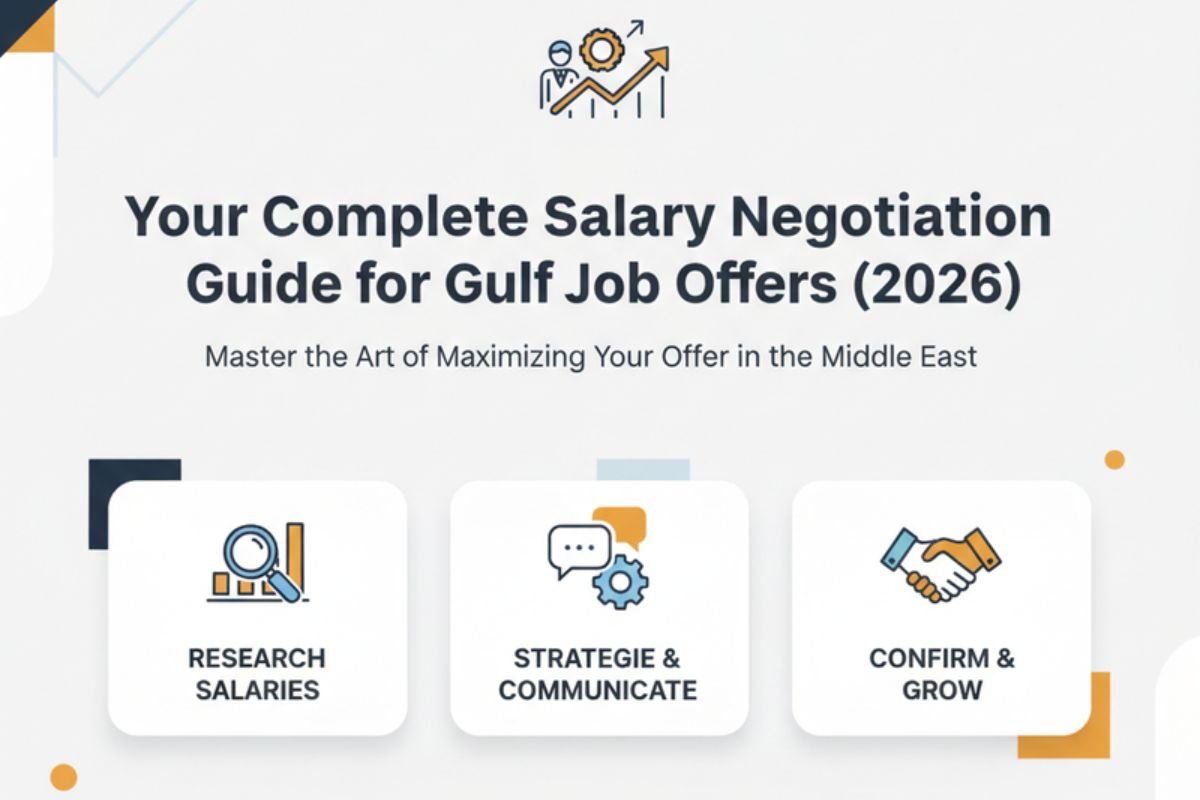
Your Complete Salary Negotiation Guide for Gulf Job Offers (2026)

Salary Negotiation Guide for Gulf Job Offers 2026

How you handle this question in a Gulf job interview can mean the difference between landing a package that sets you up for years, or leaving thousands on the table. The good news? Salary negotiation in the UAE, Saudi Arabia, and Qatar follows predictable rules. Learn them, and you’ll negotiate with confidence.

Step 1: Do Your Homework Before the Interview

Preparation is everything. Before any Gulf job interview, you need to know what you’re worth in today’s market.

Research market rates. The 2026 salary landscape shows modest increases across the region—around 4.1% in the UAE and 4.6% in Saudi Arabia . But averages hide big differences. Specialist roles in technology, finance, and project management are seeing 5-9% increases .

Know the sectors that are hiring. Financial services, industrial sectors, banking, real estate, and technology are leading salary growth in 2026 . If you’re in these fields, you have stronger negotiating power.

Understand total compensation. Gulf packages often include:

  • Base salary
  • Housing allowance (a major component)
  • Transport allowance
  • Annual flight tickets home
  • Education allowance for children
  • Health insurance
  • Bonus potential (typically 2-3 months’ salary) 

Step 2: Master the “Salary Expectations” Question

This is the moment most candidates dread. Here’s how to handle it professionally.

If they ask early in the process: deflect politely.

“I’d be happy to discuss salary once we’ve both confirmed there’s a good fit and I fully understand the scope of the role. Could you share the budgeted range for this position?”

This approach—asking about their budget first—puts you in a stronger position . If their range aligns with your expectations, you’re set. If it’s lower, you can decide whether to continue or politely withdraw.

If they insist on a number: provide a range.

“I’m looking for a package between AED 25,000 and AED 30,000 per month, with flexibility based on the total benefits and role scope.”

Notice the strategy: your ideal figure is at the lower end, showing flexibility while anchoring the conversation where you want it .

Step 3: Know What NOT to Say

Avoid these common mistakes that can cost you thousands.

Never say: “I’m flexible—whatever you think is fair.”

This signals you haven’t done research and gives away your power. Employers may offer well below market rate .

Never get personal: “I need this job because I have rent to pay.”

Shift the conversation from your needs to your value. Focus on what you’ll contribute .

Never respond emotionally: “That’s not enough.”

Instead, say: “Thank you for the offer. Based on my research and the responsibilities we discussed, I was hoping for something closer to X. Is there flexibility?” 

Step 4: Consider the 2026 Market Realities

The Gulf job market in 2026 has some unique dynamics that affect negotiation.

Skills shortages work in your favor. With 90% of employers reporting skills gaps, qualified professionals are in demand . Roles in project management, data science, AI, and engineering are especially hard to fill .

AI skills matter. Around 66% of professionals now use AI regularly at work . Showing genuine AI capability—without exaggerating—can strengthen your position .

Nationalization targets are real. In the UAE, Emiratisation targets for skilled roles are now 10%, with 42% of companies planning to increase Emirati hires . In Saudi Arabia, 93% of employers already hire Saudi nationals, and 75% plan further increases . If you’re an expat, emphasize how you’ll support and develop local talent.

Job switching is common. Nearly 98% of professionals are open to new roles in 2026 . Employers know this, so they’re often willing to negotiate to secure top talent.

Step 5: Negotiate the Whole Package

Salary is important, but don’t overlook other elements that can add significant value.

Housing and transport allowances can be negotiated separately. In Saudi Arabia, family-related benefits (visas, medical cover, flights) are highly valued by 70% of professionals .

Flexible working matters more than ever. Nearly half of professionals rank time-off and flexibility as top benefits . If the base salary is firm, ask about remote work options or additional leave.

Bonuses and reviews. Ask about performance bonus structures (typically 2-3 months’ salary) and when your first salary review will happen .

Step 6: Handle the Offer Professionally

When the offer arrives, here’s your script:

“Thank you for the offer. I’m very excited about this role and the team. I’d like to take 24-48 hours to review the full package carefully.”

Never accept on the spot. Even if you’re thrilled, taking time shows you’re thoughtful and gives you space to prepare counter-arguments.

When you counter, be specific:

“Based on my 8 years of experience and current market rates for this role in Dubai, I was hoping for a base salary of AED 28,000. Is that achievable within your budget?”

Common Questions, Answered

Is negotiation expected in the Gulf?
Yes. Employers often start with a conservative offer, expecting candidates to negotiate professionally .

What if they say the budget is fixed?
Ask about other elements: signing bonus, earlier review date, additional leave, or professional development budget.

How transparent should I be about my current salary?
Be honest about your current package, including all components. Transparency builds trust .

When is the best time to negotiate?
After you’ve received a formal offer, but before you’ve accepted. That’s when you have maximum leverage.

Final Thought: You’re Worth It

Negotiation isn’t rude—it’s expected. In the Gulf’s competitive 2026 job market, employers want candidates who know their worth and communicate it professionally.

Do your research, stay confident and polite, and remember: the best time to negotiate your lifetime earnings is right now, before you accept.

Your next opportunity is waiting. Go get what you deserve.


Frequently Asked Questions (FAQs)

1. What’s the average salary increase in the Gulf for 2026?

Average increases range from 4.1% in the UAE to 4.6% in Saudi Arabia, with Qatar and Oman at 4.3% . However, specialist roles in technology, finance, and project management can see 5-9% increases .

2. How do I research fair salaries before a Gulf job interview?

Use resources like the Hays GCC Salary Guide (covering 400+ roles), Korn Ferry forecasts, and platforms like Bayt.com‘s salary calculator . Talk to recruiters and professionals in your network who know the local market.

3. What should I do if the initial offer is below my expectations?

Thank them politely, then respond with: “Based on my research and the responsibilities we discussed, I was hoping for something closer to X. Is there flexibility in the budget?” This invites conversation rather than confrontation 

4. Are housing and transport allowances negotiable?

Yes. In fact, these are often separate line items in Gulf compensation packages. If base salary is firm, focus negotiations on allowances, bonuses, annual flights, or education benefits 

5. How important are AI skills for Gulf job seekers in 2026?

Very important. Around 66% of professionals now use AI regularly at work . Demonstrating genuine AI capability—through courses, pilot projects, or practical experience—can strengthen your negotiating position .

Cultural Etiquette for Gulf Job Interviews: Do’s and Don’ts

Gulf Job Interview Etiquette: Do's & Don'ts 2026

Landing a job interview in the Gulf region—whether in the UAE, Saudi Arabia, Qatar, or Kuwait—is a significant achievement. The competition is fierce, and your qualifications are just the starting point. What often separates successful candidates from the rest is cultural intelligence: the ability to navigate the unique blend of Islamic traditions, Bedouin customs, and modern business practices that define the Gulf workplace .

The Foundation: Respect and Preparation

Before stepping into any interview room, understand that Gulf business culture places immense value on personal relationships and respect. Your behavior, dress, and words all signal your suitability—not just as an employee, but as a colleague .

Preparation is Key:

  • Research the company thoroughly. Understand its values, recent projects, and position in the local market .
  • Know the local context. Familiarize yourself with key national initiatives like Saudi Vision 2030 or UAE’s economic goals. Mentioning these shows genuine interest .
  • Prepare your documents. Bring multiple copies of your CV, educational certificates, and references .

The Golden Do’s for Gulf Job Interviews

1. Dress Conservatively and Professionally

In the Gulf, modesty equals respect. Your attire sends an immediate signal about your professionalism.

  • Men: Wear a formal suit and tie. Dark, neutral colors are safest .
  • Women: Opt for business attire that is loose-fitting and covers shoulders and knees. Avoid revealing necklines or tight clothing. A headscarf is not typically required for non-Muslim women in private sector interviews, but having one handy is advisable for certain settings .

2. Master the Art of Greeting

First impressions are formed in seconds. Get this right.

  • Be punctual. Aim to arrive 10–15 minutes early. Tardiness is seen as disrespectful and unprofessional .
  • Wait for the handshake. Do not initiate a handshake with someone of the opposite gender. Wait to see if they extend their hand first. If not, a polite nod and a smile, with your right hand placed over your heart, is a gesture of sincere respect .
  • Use proper greetings. Starting with “Assalamu Alaikum” (peace be upon you) is a kind and respectful gesture. Use formal titles like “Mr.,” “Ms.,” “Doctor,” or “Engineer” until invited to use first names .

3. Communicate with Politeness and Patience

Communication in the Gulf tends to be more indirect and relationship-focused than in Western cultures .

  • Engage in small talk first. Be prepared for a few minutes of pleasant conversation about general well-being before business begins. This builds rapport .
  • Listen more than you speak. Avoid interrupting. Allow the interviewer to finish their thoughts completely before responding .
  • Highlight adaptability. Emphasize your experience working in diverse, multicultural environments. This is highly valued across the GCC .
  • Use the STAR method (Situation, Task, Action, Result) for behavioral questions to provide clear, structured answers about your past experiences .

4. Ask Thoughtful Questions

At the end of the interview, you will be asked if you have questions. Never say no .

  • Ask about the company’s growth plans, team culture, or the biggest challenges for the role .
  • Inquire about work-life balance or team dynamics in a respectful way .

5. Follow Up Professionally

A thank-you email within 24 hours is a simple yet powerful way to stand out .

  • Express gratitude for the opportunity.
  • Reiterate your enthusiasm for the role and the company.

The Critical Don’ts: What to Avoid at All Costs

1. Don’t Be Overly Casual

The Gulf workplace values formality and professionalism, especially in initial interactions .

  • Avoid slang and informal language. Don’t say “Yeah, that’s cool.” Say “That sounds great, I’d love to learn more” .
  • Don’t slouch or fidget. Maintain confident, upright posture and respectful eye contact .

2. Don’t Speak Negatively About Past Employers

This is a universal rule, but it carries extra weight in the well-connected Gulf job market . Badmouthing a previous employer or manager signals disloyalty and poor judgment .

  • Fix it: Frame past experiences positively. Instead of “My last boss was terrible,” say “I’m looking for a role where I can contribute more effectively and grow” .

3. Don’t Discuss Salary Too Early

Asking about compensation before the employer raises the topic can make you appear solely money-focused .

  • Fix it: If asked about expectations, you can say, “I’d love to understand the full compensation package as we move forward” . Focus first on the value you can bring.

4. Don’t Bring Up Controversial Topics

Avoid discussing politics, religion, or sensitive social issues entirely . The workplace is for professionalism and respect.

5. Don’t Ignore Local Customs and Practices

Showing awareness of local culture demonstrates deep respect.

  • Don’t use your left hand to give or receive items. The left hand is considered unclean. Always use your right hand .
  • Don’t show impatience if a meeting starts late or is interrupted for prayer times. Flexibility and understanding are expected .
  • During Ramadan, don’t eat, drink, or smoke in public or in front of colleagues who are fasting .
  • Don’t refuse hospitality. If offered Arabic coffee (Gahwa) or tea, accept it gracefully with your right hand, even if you only take a small sip .

Country-Specific Nuances

While the core principles apply across the Gulf, small distinctions exist:

  • Saudi Arabia: The culture is deeply rooted in Islamic traditions and tribal customs . Observing prayer times and showing utmost respect for hierarchy is critical. Gender dynamics are more formal .
  • UAE (especially Dubai): The environment is highly multicultural and fast-paced. Punctuality and a polished, international profile are highly valued .
  • Qatar: Similar to the UAE in its international mix, but with a more conservative undercurrent. Punctuality and formal dress are essential .

Conclusion: Your Competitive Advantage

In the Gulf job market, your technical skills get you the interview, but your cultural intelligence gets you the job. By following these do’s and avoiding the don’ts, you demonstrate not just competence, but respect—the ultimate currency in Gulf business culture.

Approach your interview with preparation, humility, and a genuine willingness to understand and adapt. That is the formula for success.


Frequently Asked Questions (FAQs)

1. Is a handshake always appropriate in Gulf job interviews?

No. Do not initiate a handshake with someone of the opposite gender. Wait for them to extend their hand first. For same-gender greetings, a firm but gentle handshake with eye contact is common. When in doubt, a polite nod with your right hand placed over your heart is a safe and respectful gesture 

2. What should I wear for a job interview in Saudi Arabia vs. the UAE?

In both countries, conservative business attire is essential. Men should wear a formal suit and tie. Women should wear modest, loose-fitting business attire that covers shoulders and knees. In Saudi Arabia, the environment is more conservative, so err on the side of greater coverage. In the UAE, especially Dubai, the dress code is still professional but may allow for slightly more modern cuts, while remaining modest .

3. Is it acceptable to discuss salary during the first interview?

It is generally best to avoid bringing up salary and benefits until the employer initiates the conversation. Asking too early can make you seem focused on compensation over contribution. Wait for the appropriate moment, usually in later interview rounds 

4. What topics should I absolutely avoid in a Gulf job interview?

Avoid discussing politics, religion, and any controversial social topics. Also, never speak negatively about past employers or colleagues. Keep the conversation focused on your professional qualifications, your interest in the role, and your ability to contribute to the company’s success 

5. How important is it to speak Arabic for a job interview in the Gulf?

For most private sector roles, especially in multinational companies, English is the primary business language and interviews are conducted in English. However, learning a few polite phrases in Arabic, such as “Assalamu Alaikum” (peace be upon you) and “Shukran” (thank you), is a powerful sign of respect and cultural awareness that will be greatly appreciated . For government roles or positions with a strong local focus, Arabic fluency may be required.

Common Gulf Job Interview Questions & How to Answer Them (2026 Guide for Pakistani Candidates)

Gulf Job Interview Questions 2026 | Answers for Pakistanis

For millions of Pakistani workers, the Gulf region—Saudi Arabia, UAE, Qatar, Kuwait, Oman, and Bahrain—represents a life-changing opportunity. Better salaries, tax-free income, and career growth await those who successfully clear the interview stage .

Question 1: “Tell Me About Yourself”

Why they ask this: This is your 60-second commercial. Recruiters want to know if you can present yourself clearly and professionally. Many candidates are filtered out right here .

What NOT to do: Don’t start with “I was born in…” or give your entire life story. Don’t ramble for 5-7 minutes .

How to answer (The Professional Summary):

“I am a certified HVAC technician with five years of experience working on both commercial and residential projects in Pakistan. I recently completed a major contract at a large hospital in Lahore, where I maintained over 200 air conditioning units. I am now looking for an opportunity to bring my skills to a dynamic team in the Gulf and continue growing professionally.” 

For Pakistani candidates: Mention specific projects or employers in Pakistan that demonstrate your experience level. Gulf employers respect hands-on, verifiable experience.

Question 2: “Why Do You Want to Work in the Gulf?”

Why they ask this: Employers want to know you’ve thought this through. Are you running away from problems in Pakistan, or genuinely seeking growth? 

What NOT to do: Don’t say “I just need a job” or “The salary is better.” This makes you sound desperate.

How to answer:

“The Gulf region is known for its rapid development and professional work culture. I have followed Saudi Vision 2030 and the UAE’s infrastructure projects with great interest. I want to contribute my skills to these exciting developments while gaining international experience in a competitive environment. I am ready to adapt and work hard.” 

For Pakistani candidates: Show that you have researched the specific country you are applying to. Mentioning “Saudi Vision 2030” or “Expo City Dubai” demonstrates genuine interest.

Question 3: “Why Are You Leaving Your Current Job?”

Why they ask this: This is a test of your professionalism and loyalty. Never—ever—badmouth your previous employer, even if they were terrible .

What NOT to do: Don’t complain about your boss, salary, or company politics. This immediately raises red flags.

How to answer (Growth opportunity):

“I have learned a great deal in my current role and I am grateful for the experience. However, I feel I have reached a point where I am ready for more responsibility and new challenges. Working in the Gulf is the natural next step in my career growth.” 

Alternative answer (Company change):

“My current company is shifting its focus away from international markets. I am committed to building my career in the Gulf region, so I am looking for an employer with strong regional presence.” 

Question 4: “Are You Comfortable Working in a Diverse Team with Different Nationalities?”

Why they ask this: Gulf workplaces are melting pots—you will work alongside Indians, Filipinos, Egyptians, Westerners, and many others. Employers need to know you can collaborate respectfully .

What NOT to do: Don’t hesitate or sound uncertain. Don’t say “I prefer working with Pakistanis only.”

How to answer:

“Yes, absolutely. I have worked with teams from various backgrounds on large projects in Pakistan. I respect different cultures and believe that collaboration brings out the best ideas. I am comfortable learning from colleagues of any nationality and sharing my own knowledge as well.” 

For Pakistani candidates: If you have experience working with foreign engineers, consultants, or NGOs in Pakistan, mention it. This is a strong plus point.

Question 5: “What Are Your Strengths?”

Why they ask this: Anyone can say “I am hardworking.” Employers want proof .

What NOT to do: Don’t give generic adjectives without evidence.

How to answer (Skill + Proof):

“My greatest strength is solving problems under pressure. Last year, a critical machine broke down at our factory and the spare part would take three weeks to arrive. I improvised a repair using locally available materials, and we met our production deadline with zero customer impact. The repair lasted until the official part arrived.” 

For Pakistani candidates: Gulf employers value jugar (improvisation skills) when applied professionally. Frame it as resourcefulness and quick thinking.

Question 6: “What Are Your Weaknesses?”

Why they ask this: This is NOT a trick. They want self-awareness and a growth mindset .

What NOT to do: Don’t say “I am a perfectionist” or “I work too hard.” Recruiters hear this constantly and it means nothing.

How to answer (Real weakness + How you fix it):

“I used to struggle with delegating tasks. I felt I had to do everything myself to ensure quality. But I realized this doesn’t scale and it burns me out. Over the past year, I have focused on training junior team members and trusting them with more responsibility. It has made me a better supervisor and freed me up for更重要 tasks.” 

For Pakistani candidates: Choose a genuine weakness related to technical skills (e.g., “I was not comfortable with computerized maintenance systems, so I took a short course and now I use them daily”).

Question 7: “Can You Work Under Pressure or During Peak Hours?”

Why they ask this: Gulf industries like construction, hospitality, and logistics often require long shifts and deadline-driven work .

What NOT to do: Don’t say “I don’t like overtime” or look uncomfortable.

How to answer:

“Absolutely. I understand that project deadlines and peak seasons may require extra effort. In my previous job, we often worked six days a week during the summer season. I stay calm under pressure and focus on time management to complete tasks efficiently.” 

Question 8: “Where Do You See Yourself in Five Years?”

Why they ask this: Are you a flight risk? Will you jump to another company as soon as you arrive? Or will you stay and grow with them? 

What NOT to do: Don’t say “I want your job” or “I want to start my own business.” Don’t say “I don’t know.”

How to answer (Commitment track):

“I want to grow into a senior technician or supervisor role, ideally within the same company. I am looking for an employer that invests in training and promotes from within. In five years, I see myself as a valuable, long-term member of the team here.” 

For Pakistani candidates: Gulf employers appreciate workers who stay for multiple contract cycles. Show you are looking for stability, not just a quick income.

Question 9: “Tell Me About a Time You Faced Conflict at Work.”

Why they ask this: Conflict is normal. How you handle it shows emotional maturity .

What NOT to do: Don’t say “I avoid conflict.” Don’t blame others.

How to answer (STAR Method):

Situation: Two of my team members disagreed on how to approach a repair job.
Task: As the senior technician, I needed to resolve this so we could meet our deadline.
Action: I brought both colleagues together and let each explain their approach. We tested both ideas on a small scale. One method was faster, but both felt heard.
Result: The project succeeded, and the working relationship remained strong. I learned that listening is more important than being right.” 

Question 10: “Do You Have Any Questions for Us?”

Why they ask this: If you say “no,” you look uninterested. Always prepare questions .

Good questions to ask:

  • “What does a typical working day look like for this role?”
  • “What are the biggest challenges your team is facing right now?”
  • “Is there opportunity for overtime or additional training?”
  • “How does the company support workers who are new to the Gulf?”

Questions to avoid: Salary, leave, and accommodation details in the first interview (unless the employer brings it up first) .

7 Practical Tips for Pakistani Candidates

1. Research the Employer Thoroughly
Visit their website. Check their LinkedIn page. Know what they do and where they operate. Mentioning specific projects shows you are serious .

2. Improve Your English Communication
You don’t need perfect grammar. You need confidence. Practice speaking English daily with friends or family. Watch English news channels .

3. Learn Basic Arabic Phrases
Simple greetings like “Assalamu Alaikum” (peace be upon you), “Shukran” (thank you), and “Afwan” (you’re welcome) demonstrate cultural respect. This leaves a strong impression .

4. Prepare Your Documents
Keep your passport, educational certificates, experience letters, and trade test certificates neatly organized in a folder. Bring both original and photocopies .

5. Dress Professionally and Modestly
First impressions matter. For men: clean shave or well-trimmed beard, ironed shirt, formal trousers. For women: modest formal wear. Even for online interviews, dress professionally from head to toe .

6. Be Honest, Never Exaggerate
Gulf employers often verify credentials. If you claim experience you don’t have, it will be discovered—and you will lose the job opportunity permanently .

7. Follow Up After the Interview
Send a short thank-you email or WhatsApp message within 24 hours:

“Dear [Interviewer Name], thank you for your time today. I enjoyed learning about your company and I am very interested in this opportunity. I look forward to hearing from you.” 

How Recruitment Agencies in Pakistan Can Help

Many Pakistani workers secure Gulf jobs through registered recruitment agencies. These agencies:

  • Match your skills with genuine employer requirements
  • Provide pre-interview training and mock interviews
  • Help with documentation and visa processing
  • Offer cultural orientation about Gulf work life 

Important Warning: Never pay large sums of money upfront to an agent. Legitimate agencies charge regulated fees, often deducted after you join. Always verify the agency is licensed by the Bureau of Immigration (Pakistan) .

Medical Tests & Visa Process (Brief Overview)

If you pass the interview, the next steps typically include:

  1. Medical Examination: Conducted at GAMCA/Wafid approved centers. Tests include blood work, chest X-ray, and general physical examination .
  2. Visa Processing: Your employer sponsors your employment visa. This usually takes 2-6 weeks .
  3. Final Departure: Once visa is stamped, your flight is arranged (usually paid by employer). Keep all documents in your hand luggage .

Conclusion: Be Prepared, Be Confident, Be Honest

Gulf job interview is your opportunity to show an employer that you are not just a skilled worker, but a reliable professional who will represent their company well.

The questions in this guide appear in nearly every interview across Saudi Arabia, UAE, Qatar, Kuwait, and Oman . Practice your answers out loud. Record yourself. Ask a friend to do a mock interview.

Remember: Gulf employers value directness, honesty, and a positive attitude. Show them you are ready to work hard, respect their culture, and grow with their company.

Your dream job in the Gulf is closer than you think. Prepare today.


Frequently Asked Questions (FAQs)

1. Do I need to speak fluent English for a Gulf job interview?

Not necessarily. You need to communicate confidently and clearly. Employers understand that English may not be your first language. Focus on simple, direct sentences rather than complex vocabulary. Confidence matters more than perfection 

2. What documents should I bring to a Gulf job interview in Pakistan?

Bring your original passport, CNIC, educational certificates (degrees/diplomas), experience letters from previous employers, and any trade test or technical training certificates. Keep photocopies organized in a separate folder. For online interviews, have digital scans ready .

3. Should I mention my expected salary in the first interview?

Avoid it unless the employer asks directly. Focus first on demonstrating your value and skills. If asked, research the typical salary for your role in that specific Gulf country and provide a realistic range. Be tactful 

4. How long does the entire Gulf recruitment process take?

The interview itself is 20-45 minutes. If selected, medical and visa processing typically takes 2 to 6 weeks, depending on the country and employer. Some government sector jobs may take longer .

5. What if I don’t understand a question during the interview?

It is perfectly acceptable to politely ask for clarification. Say: “I’m sorry, could you please repeat the question?” or “Could you explain what you mean?” This is much better than answering incorrectly or freezing up. Honest communication is valued 

Your Complete 2026 Gulf Job Interview Preparation Guide: UAE & Saudi Arabia

Gulf Job Interview Preparation Guide

This guide is written specifically for you—candidates from Pakistan and India targeting jobs in the UAE and Saudi Arabia in 2026. We will walk you through exactly what recruiters are looking for, the specific questions you will face, how to answer them with confidence, and what happens after the interview. No fluff. No generic advice. Just practical, human, step-by-step preparation.

Section 1: Understanding the 2026 Gulf Job Market (Before You Even Interview)

Before you sit in that chair, you need to understand the landscape. The Gulf in 2026 is not the Gulf of 2016. Things have changed.

What Is Happening in Saudi Arabia?

Saudi Arabia is in the middle of the most ambitious economic transformation in its history. Vision 2030 is real, and it is driving massive demand for expatriate talent in specific sectors .

Industries hiring now in KSA:

  • Construction & Engineering: NEOM, The Red Sea Project, Qiddiya—these giga-projects need project managers, civil engineers, and skilled tradespeople.
  • Technology & AI: Cybersecurity, data science, and software engineering are booming. If you have AI skills, you are in high demand .
  • Healthcare: Specialists, nurses, and medical researchers are urgently needed.
  • Renewable Energy: Solar and hydrogen energy experts are being recruited globally.

The Saudization (Nitaqat) Reality:
Here is something you must understand. The Saudi government has a color-coded system called Nitaqat that rates companies based on how many Saudis they employ . This means:

  • Certain roles (HR Manager, Secretary, some sales positions) are now reserved for Saudi nationals. You will not get these jobs.
  • However, companies in the “Green” or “Platinum” zones can sponsor expats easily for specialized technical roles.
  • In 2026, new localization quotas are being enforced for engineering consultancy and project management .

What this means for you: Do not apply for roles that are clearly being localized. Target positions where your specialized skills are scarce locally.

What Is Happening in the UAE?

The UAE market is equally competitive but slightly different.

AI and Tech Talent War:
Demand for AI-capable talent has doubled in the UAE. But here is the catch—employers are now conducting extremely rigorous background and credential verification . Why? Because AI skills command high salaries, and companies have been burned by candidates who exaggerated their abilities.

James Randall of HireRight told Khaleej Times: “When AI-related skills carry higher commercial value, employers are placing greater emphasis on validating credentials, employment history, and technical experience to ensure they are hiring genuine capability, not just well-presented CVs” .

What this means for you: Your certificates, degrees, and experience letters will be verified. Do not fake anything. It will be caught.

Sharjah Government Jobs:
In a major development, the Sharjah Ruler has approved 1,000 new government jobs under the 2026 budget, bringing the total to 2,000 positions . However—and this is important—these are primarily for Emirati nationals. This is part of their Emiratization drive. If you are an expat, do not focus your energy here. Target the private sector and mega-projects instead .

Section 2: The 9 Key Factors Gulf Employers Actually Evaluate

When you walk into that interview room (or log into that Zoom call), the employer is scoring you on these nine factors. Understand them now .

1. Relevant Skills and Experience (The Obvious One)

This is the ticket to entry. If you are a welder applying for a 6G welding job, you must have the certification. If you are an accountant, you must know VAT and IFRS. There is no shortcut .

2. Language Proficiency

English is the business language of the Gulf. You must be able to understand instructions and communicate clearly. For Pakistani and Indian candidates, this is usually a strength—but do not be overconfident. Practice speaking clearly and slowly .

Bonus: Basic Arabic phrases ( greetings like “Assalamu Alaikum,” numbers, common workplace terms) give you a genuine edge .

3. Valid Certifications and Licenses

This is non-negotiable. For the UAE, this might mean DHA for healthcare workers. For Saudi, it means verifying your degree through the proper accreditation channels. For tradespeople, it means passing the GCC trade test .

4. Cultural Adaptability

This is where many candidates fail. Gulf employers need to know you will respect local customs, dress modestly, and work harmoniously with people from dozens of nationalities. They have hired Filipinos, Egyptians, Brits, Pakistanis, and Indians all on one site. Can you adapt? 

5. Work Ethics and Professional Behavior

Employers spend thousands of dollars on your visa, flight, and accommodation. They want to know you will show up on time, work honestly, and not jump to another company after three months. Your interview answers must convey stability and reliability .

6. Health and Fitness

For construction, oil and gas, and industrial roles, you will need to pass a GAMCA medical test. This checks for infectious diseases and overall fitness. Take this seriously .

7. Clean Legal and Employment History

A police clearance certificate is required. Do not hide previous employment issues. If you have broken a contract before, be honest and explain what happened .

8. Willingness to Learn

The best candidates are those who say, “I don’t know that yet, but I am ready to learn.” Arrogance is a red flag. Humility is a green flag .

9. Professional CV and Presentation

Your CV is your first impression. Keep it clean, chronological, and focused on achievements, not just duties. And for the interview—dress professionally. Even for a video call. It shows respect .

Section 3: UAE Interview Questions – What They Ask and How to Answer

Based on 2026 interview trends, here are the specific questions you are likely to face in the UAE.

For Accounting and Finance Professionals

Question: What do you know about VAT in the UAE?
This is non-negotiable. You must know the standard rate (5%), what is zero-rated, and what is exempt. Do not bluff .

Strong Answer:
*”VAT in the UAE was introduced in 2018 at a standard rate of 5%. I have experience preparing VAT returns, reconciling input and output tax, and ensuring compliance with FTA regulations. For example, in my previous role, I handled VAT filing for a trading company with cross-border transactions, which required understanding zero-rated supplies.”*

Question: How do you calculate End of Service Benefits (EOSB)?
This is a classic UAE interview question. It tests whether you understand local labor law .

Strong Answer:
“For the first five years, EOSB is calculated as 21 days of basic salary per year. Beyond five years, it is 30 days per year. I also adjust for whether the employee resigned or was terminated, and whether the contract is limited or unlimited. I have handled these calculations using ERP systems and ensured full compliance with MOHRE regulations.”

Question: What is your experience with IFRS in the UAE?
IFRS is mandatory in the UAE, especially for large companies. Mention IFRS 9, 15, or 16 if you have exposure .

For Senior Project Managers

Question: How do you manage multi-million dirham projects with aggressive timelines?
UAE project managers are expected to deliver fast, but safely. They are testing your planning depth and execution discipline .

Strong Answer (STAR Method):
*”In my previous role, I managed a AED 50 million residential tower project with an 18-month deadline. I used a phased planning approach, aligned procurement with the construction schedule, and held daily stand-up meetings to track progress. When a delay in material supply threatened the timeline, I worked with procurement to source alternatives without compromising quality. We delivered three weeks early and under budget.”*

Question: How do you handle senior stakeholders from different nationalities and cultures?
Cultural intelligence is not optional in the UAE. You will report to a Lebanese CEO, work with an Egyptian engineer, and manage a Pakistani foreman. They need to know you can navigate this .

Strong Answer:
*”I adapt my communication style to the individual. Some stakeholders want detailed written reports; others prefer a 5-minute verbal update. I make it a point to understand cultural norms—for example, building personal rapport before diving into business with certain nationalities. I believe respect and clarity are universal.”*

For IT and AI Roles

Question: How do you ensure your AI skills add business value, not just technical capability?
This is the big question in 2026. UAE employers are moving away from pure coders and toward professionals who can apply AI to solve business problems .

Strong Answer:
“I focus on outcomes, not just algorithms. In my last project, I developed a predictive maintenance model for manufacturing equipment. Instead of just building the model, I worked with the operations team to understand their workflow and integrated the predictions into their existing dashboard. This reduced unplanned downtime by 18% and was adopted immediately because it solved a real problem.”

Section 4: Saudi Arabia Interview Questions – What They Ask and How to Answer

Saudi interviews place heavy emphasis on cultural alignment and respect for hierarchy.

The “Cultural Fit” Questions

Question: Why do you want to work in Saudi Arabia?
Never say “just for the money.” They know the money is good. They want to hear that you respect the country’s vision.

Strong Answer:
“I have been following Saudi Vision 2030 closely, and I am inspired by the transformation happening here. I want to be part of a country that is building the future. I also respect the culture and values, and I am confident I can adapt and contribute professionally.”

Question: How do you handle working in a conservative environment?
Strong Answer:
“I believe in respecting the laws and customs of the country I work in. I dress modestly, I am mindful of public behavior, and I treat all colleagues with respect regardless of gender or nationality. I see it as a sign of professionalism, not restriction.”

Technical Questions with a Saudi Twist

Question: Are you familiar with the verification requirements for expat engineers in Saudi?
This tests whether you have done your homework. In 2026, skilled expats in engineering and project management must pass professional verification exams .

Strong Answer:
“Yes, I understand that the Saudi Council of Engineers requires credential verification, and I have already prepared my degree attestation and experience certificates. I am ready to begin the process as soon as I receive an offer.”

Section 5: Trade Tests – The Practical Exam for Skilled Workers

If you are a plumber, electrician, HVAC technician, or welder, your “interview” might actually be a GCC trade test. This is a hands-on practical exam. You will be asked to demonstrate your skills in front of an assessor .

What They Check in a Trade Test

  1. Practical Skill: Can you install a PVC pipe without leaks? Can you braze a copper joint properly?
  2. Tool Knowledge: Do you know the correct tool for the job?
  3. Drawing Reading: Can you read a simple plumbing or mechanical drawing?
  4. Safety Awareness: Do you wear PPE? Do you work safely? This is the #1 reason candidates fail. 

How to Prepare

  • Practice daily. Muscle memory matters.
  • Work cleanly. Neatness and finishing matter more than speed.
  • Know your fittings. For plumbers: PPR, PVC, GI, copper. For HVAC: manifold gauges, vacuum pumps, refrigerant types (R32, R410A).
  • If you are a welder: Practice vertical and overhead positions. Clean weld beads with good penetration will pass you. Messy, splattered welds will fail you .

Section 6: The Process – From Interview to Arrival (For PK & IN Candidates)

Understanding what happens after the interview is just as important as the interview itself. This is where many candidates get anxious. Here is the roadmap .

Step 1: The Job Offer

You pass the interview. You receive an offer letter. Do not sign immediately. Check:

  • Salary (is it what was discussed?)
  • Housing allowance or accommodation
  • Medical insurance
  • Transportation
  • Contract duration (2 years is standard)
  • Annual leave and ticket entitlement 

Step 2: Medical Tests (GAMCA/Wafid)

You must visit an approved medical center in Pakistan or India. Tests include blood work, chest X-ray, and physical examination. Certain conditions (like tuberculosis or hepatitis) can lead to visa rejection. Be honest about your health .

Step 3: Visa Processing

Your employer applies for your work visa. Once approved, you receive a visa stamp in your passport. Never pay for your visa. A legitimate employer covers this cost. If an agent asks you for money to “process the visa,” it is a scam .

Step 4: Final Departure

Book your flight. Keep these documents in your hand carry:

  • Passport with visa
  • Offer letter / employment contract
  • Educational certificates (attested)
  • Experience certificates
  • Passport-size photographs 

Step 5: Arrival and Iqama

Upon arrival, your employer will process your residency permit (Iqama in Saudi, Emirates ID in UAE). This is your legal identity in the country. You cannot leave or work without it .

Section 7: Cultural Etiquette – The Silent Dealbreaker

You can answer every technical question perfectly and still lose the job if the interviewer senses you do not “fit” culturally. Here are the unspoken rules.

In Saudi Arabia

  • Dress conservatively. Men: dark suit and tie. Women: loose-fitting business attire covering arms and knees .
  • Body language matters. Do not sit with the sole of your shoe facing the interviewer. It is considered highly disrespectful .
  • Be patient. Saudi hiring processes can be slow. A delay does not mean rejection. Do not send angry follow-up emails .
  • Show respect for hierarchy. Address senior people by their title. Do not interrupt.

In the UAE

  • Punctuality is mandatory. Being late is seen as disrespectful.
  • Confidence is good; arrogance is fatal. There is a fine line. State your achievements clearly, but always credit your team.
  • Commercial awareness matters. Ask thoughtful questions: “How is your company preparing for the UAE’s evolving tax landscape?” This single question can make you unforgettable .

Section 8: Scam Alert – How to Protect Yourself

The Gulf job market attracts scammers. They target desperate job seekers in Pakistan and India. Here is how to protect yourself .

Red Flags:

  • An agent asks you for money for visa processing, job guarantee, or “registration.”
  • The salary is unbelievably high for your role.
  • The company name is vague or cannot be verified online.
  • They contact you via WhatsApp only, with no official email or office.
  • They pressure you to pay quickly or “lose the opportunity.”

Green Flags:

  • The interview is conducted professionally (video call or in-person at a reputable agency).
  • The offer letter is on company letterhead with clear terms.
  • Your employer pays for your visa and flight (this is standard, though sometimes deducted later).
  • You can verify the recruiter on LinkedIn and they have genuine connections.

Final Thoughts: Preparation Is Respect

Here is the mindset shift that will change your interview results.

When you prepare thoroughly—researching the company, practicing your answers, dressing professionally, and understanding the culture—you are not just helping yourself. You are showing respect for the opportunity and for the people interviewing you.

Gulf employers have interviewed thousands of candidates. They can immediately tell who prepared and who is “winging it.” The prepared candidate signals: “I value this opportunity. I will value this job. I am a safe investment.”

In 2026, with competition fiercer than ever, that signal is your competitive advantage.

Your next step: Take one section of this guide and act on it today. Update your CV. Practice one STAR answer. Verify your certificate attestation requirements. The interview is coming. Be ready.


Frequently Asked Questions (FAQs)

Q1: I am from Pakistan. How long does the visa process take after I clear the interview?

Typically, the entire process—from accepting the offer to landing in the Gulf—takes 2 to 6 weeks. This includes medical tests at a GAMCA center, visa stamping, and flight booking. Delays usually happen due to document attestation or medical report processing. Stay in touch with your employer but be patient .

Q2: Do I need to speak Arabic to get a job in Saudi Arabia or the UAE?

No, English is the primary business language. However, learning basic Arabic phrases (greetings, numbers, polite expressions) is a significant advantage. It shows respect for the culture and helps you stand out from other candidates 

Q3: I have a diploma, not a degree. Can I still get a high-paying job in the Gulf?

Yes, absolutely. The Gulf relies heavily on skilled technicians, tradespeople, and diploma-holders in construction, HVAC, plumbing, electrical work, and oil and gas. Your focus should be on certifications (e.g., welding certifications, OSHA safety, trade test passing) and experience letters. Practical skill often outweighs academic degrees in these fields .

Q4: What medical conditions can disqualify me from a Gulf work visa?

The standard GAMCA medical test screens for infectious diseases such as tuberculosis (TB), Hepatitis B and C, and HIV/AIDS. Pregnancy is not a disqualifier, but it may affect your ability to pass certain X-ray requirements. If you have a chronic condition, consult with your recruiting agency for specific country rules 

Q5: Is it true that UAE companies are now verifying all past employment and degrees?

Yes. This trend has intensified sharply in 2026, especially for high-salary roles in AI, finance, and project management. Companies are using third-party verification services to check credential authenticity. Never falsify your CV or experience letters. It will be discovered, and you will be blacklisted 

How to Verify a Gulf Job Offer Letter 2026: A Complete Guide to Avoid Scams

Verify Gulf Job Offer Letter

Receiving a job offer from a Gulf Cooperation Council (GCC) country is an exciting milestone. However, the region’s lucrative job market is also a prime target for sophisticated recruitment scams. In 2026, fraudulent job offers are more convincing than ever, often leading to financial loss, wasted time, and significant emotional distress for hopeful candidates.

Protecting yourself starts with rigorous verification. This comprehensive guide provides a step-by-step checklist to authenticate every aspect of a Gulf job offer in 2026, empowering you to distinguish between a genuine opportunity and a dangerous scam.

Why Verification is Non-Negotiable in 2026

The consequences of accepting a fake offer are severe:

  • Financial Loss: Scammers often demand fees for “visa processing,” “medical insurance,” or “document clearance.”
  • Identity Theft: Sharing passport copies, bank details, and personal documents with criminals.
  • Legal Trouble: Unknowingly entering a country on an incorrect visa or working illegally.
  • Career Disruption: Leaving a secure job for a non-existent position.

A legitimate Gulf employer will never find your verification efforts offensive; they will see them as a sign of your professionalism and diligence.

The 2026 Verification Checklist: Step-by-Step

Do not sign, resign from your current job, or send money until you complete these checks.

Step 1: Scrutinize the Offer Letter & Communication

The document itself holds the first clues.

  • Sender’s Email Address: Does it come from a professional domain (e.g., @companyname.com or @companyname.ae)? Be extremely wary of offers from free email services like Gmail, Yahoo, or Hotmail. Check for subtle misspellings (e.g., @companey.com).
  • Company Details: The letter must include the full, official company name, a physical office address in the Gulf (not just a PO Box), and a landline telephone number with the correct country code.
  • Job Details & Contract Terms: A genuine offer is specific and legally binding. It must clearly state:
    • Your exact job title and duties.
    • The work location (city, country).
    • Start date and contract duration.
    • Complete Compensation Breakdown:
      • Monthly Basic Salary (in local currency: AED, SAR, QAR, etc.).
      • Housing Allowance (amount or “company-provided”).
      • Transportation Allowance.
      • Annual Air Ticket entitlement (for employee/family).
      • End of Service Benefits (Gratuity) calculation.
    • Working Hours & Leave Policy.
  • Language & Professionalism: Poor grammar, spelling mistakes, and an unprofessional tone are major red flags.

Step 2: Verify the Employer’s Legitimacy

This is the most critical step.

  1. Check the Official Government Commercial Registries:
    Every legitimate business in the Gulf has a unique Commercial Registration (CR) Number. The offer letter should include this. Use it to verify the company on the official government portals:
    • UAE: Ministry of Economy’s “Verified” platform or the respective Department of Economic Development (DED) website for each emirate (e.g., Dubai DED).
    • Saudi Arabia: Ministry of Commerce’s “Qawaem” business directory.
    • Qatar: Ministry of Commerce and Industry’s company search portal.
    • Kuwait: Ministry of Commerce & Industry’s Commercial Registry.
    • Search the company name and CR number. Confirm its active statusactivities (should match your job), and address.
  2. Verify the Company’s Online Presence:
    • Official Website: Does it look professional, updated, and contain details about leadership, projects, and contact info that match the offer?
    • LinkedIn: Search for the company’s official LinkedIn page. Are there employees? Does the HR/recruiter who contacted you have a legitimate-looking profile connected to the company? Check employee count and activity.
    • News & Press Releases: Search for recent news about the company. A real company will have some digital footprint.
  3. Confirm the Recruiter/HR Contact:
    • Call the company’s main switchboard number (found on their official website, not the number on the offer letter) and ask to be connected to the HR department or the person who signed your offer.
    • Use LinkedIn to see if the contact person is listed as an employee.

Step 3: Understand the Legitimate Visa & Hiring Process

Scammers exploit confusion about how Gulf work visas work.

  • No Upfront Fees: A legitimate employer covers all visa and government processing fees. You are only responsible for attesting your personal documents (degree, police clearance) in your home country. Never wire money for “visa processing,” “insurance,” or “legal fees.”
  • Visa is Issued FROM ABROAD: You must receive an official Employment Entry Permit/Visa stamped in your passport by the Gulf country’s Embassy/Consulate in your home country before you travel. The “Tourist Visa Switch” Scam is common: you’re told to enter on a tourist visa and it will be converted. This is illegal and a sure sign of fraud.
  • Interview Process: Be skeptical of offers after a single, casual chat on WhatsApp or Telegram. Legitimate hiring involves formal interviews (often video calls), technical assessments, and multiple rounds with different managers.

Step 4: Conduct Direct Due Diligence

Go the extra mile with these proactive steps:

  1. Request a Video Call: Suggest a video meeting at the company’s office or with the hiring team. Scammers will often avoid this or make excuses.
  2. Ask for an Employment Contract: The offer letter is a precursor. Request the full, detailed employment contract that will be filed with the Ministry of Labour. Review it carefully.
  3. Use Google Earth/Maps: Look up the company’s listed physical address. Does a credible office building exist there?
  4. Network Check: Use your professional network on LinkedIn. Do you have any 2nd-degree connections who work or have worked at the company? Reach out for an informal chat.

Red Flags: Immediate Indicators of a Fake Offer

If you see any of these, cease communication immediately:

  • Pressure to Act Quickly: Urging you to sign, pay, or resign within days.
  • Request for Money: Any request for payment via wire transfer, gift cards, or cryptocurrency.
  • Vague Job Description: Lack of specific duties, reporting structure, or project details.
  • Overly Generous Offer: A salary and package far above market rate for your experience, with an easy application process.
  • Poor Quality Documents: Blurry logos, mismatched fonts, lack of official letterhead.
  • Communication Exclusively on Messaging Apps: Legitimate HR uses official email. WhatsApp/Telegram are for coordination, not formal offers.

What to Do If You Suspect a Scam

  1. STOP: Do not respond to further requests, especially for money or documents.
  2. REPORT:
    • Report the fake company to the official government authorities in the target Gulf country (e.g., UAE’s Ministry of Human Resources and Emiratisation, Saudi’s Ministry of Human Resources).
    • Report the email/phishing attempt to your email provider.
    • Warn others by posting (without sharing personal details) on professional forums like Bayt.com or expat communities.
  3. PROTECT: If you’ve already shared personal documents (passport copy), consider placing a fraud alert with relevant authorities in your home country.

The Hallmarks of a Genuine Gulf Job Offer in 2026

A real offer will be transparent and process-driven:

  1. Comes from a verifiable, established company.
  2. Provides a clear, detailed contract with a fair, market-aligned package.
  3. Involves a professional, multi-stage interview process.
  4. Sponsors your visa and does not ask for processing fees.
  5. The employer communicates patiently and is open to your verification questions.

Conclusion: Trust, But Verify

In the pursuit of a dream career in the Gulf, optimism must be balanced with caution. The verification process outlined here is not about paranoia; it is an essential exercise in professional risk management.

By methodically checking the employer’s credentials, understanding the legal visa pathway, and refusing to be rushed, you protect your career, finances, and well-being. A legitimate employer will respect your due diligence. Let this guide be your shield, ensuring that your journey to the Gulf begins with a secure and genuine opportunity, not a devastating scam.

5 Frequently Asked Questions (FAQs)

1. The company asked for a small “visa processing fee” of $200, promising to reimburse it later. Is this normal?

NO. This is a classic scam tactic. Legitimate employers in the Gulf never ask candidates to pay for visa or government processing fees. The sponsoring company is legally responsible for all associated costs. Any request for payment, no matter how small, is a major red flag and you should immediately cease communication.

2. How can I verify a recruitment agency that made the offer?

Apply the same rigorous checks. Verify if the agency is licensed by the Ministry of Labour/Human Resources in the Gulf country they operate from. Check their physical address, website, and online reviews. Reputable agencies (like Michael Page, Hays, Charterhouse) have long-standing global reputations. Be extremely cautious with agencies you cannot thoroughly verify or that charge you fees.

3. The offer letter looks perfect and the company checks out online, but the interview was very brief. Should I be worried?

Yes, this is suspicious. A genuine hiring process for a professional role in the Gulf typically involves multiple interviews (HR screening, technical interview with the hiring manager, sometimes a senior management interview). A very brief, casual interview for a well-paid position is a common scam indicator. It suggests the “interview” was merely a facade to make the fake offer seem legitimate.

4. What if the employer says they will apply for my visa after I arrive in the country on a tourist visa?

This is illegal and a definitive scam. You must have the correct Employment Entry Permit/Visa stamped in your passport before you travel to the Gulf country. Any employer suggesting otherwise is either involved in illegal practices or is not a real employer. Do not accept this condition under any circumstances.

5. I’ve already sent my passport copy and signed the offer. What should I do now?

Stop all further interaction immediately. Do not send any money or more documents. If you have only shared your passport copy, monitor your identity. If you have signed a document, understand it is likely not legally binding as it’s with a fraudulent entity. Report the details to the authorities in the target Gulf country and your home country to help prevent others from being scammed.

Gulf Job Interview Questions and Best Answers 2026: How to Impress and Get Hired

Gulf Job Interview Questions

The Gulf job market is fiercely competitive, attracting top talent from across the globe. While your CV may open the door, the interview is where you secure the offer. Gulf-based interviews blend international business practices with distinct regional cultural expectations. Success requires more than just rehearsing answers; it demands an understanding of what employers in the UAE, Saudi Arabia, Qatar, and other GCC nations truly value.

This 2026 guide provides a deep dive into the most common and critical Gulf job interview questions. We’ll explain why they’re asked and deliver strategic, culturally-aware answers that will set you apart.

The Gulf Interview Mindset: What Are They Really Looking For?

Before we dive into questions, understand the core evaluation criteria:

  1. Cultural Fit & Adaptability: Can you thrive in a hierarchical, diverse, and often fast-paced environment?
  2. Stability & Long-Term Commitment: Are you looking for a career or just a short-term, tax-free stint? High turnover is costly.
  3. Professionalism & Respect: Do you understand and respect the local business etiquette and cultural norms?
  4. Delivering Tangible Results: Beyond qualifications, can you handle responsibility and deliver on major projects common in the region?

Top Gulf Interview Questions and Winning Answer Strategies

1. “Tell me about yourself.” (The Opening Pitch)

  • Why they ask: This is not a casual ice-breaker. It’s your chance to deliver a concise, compelling professional narrative that connects your past directly to this specific role and company in the Gulf.
  • The Gulf-Focused Strategy (Present-Past-Future Formula):
    • Present: Start with your current role and one key achievement. “I am currently a Senior Project Engineer with X Constructions, where I lead the mechanical systems delivery for large-scale commercial developments across the Middle East.”
    • Past: Highlight 2-3 key, quantifiable achievements most relevant to this Gulf role. *”Over the past eight years, I’ve specialized in managing multi-disciplinary teams, most notably delivering a $50M hotel project in Dubai 15% under budget and pioneering sustainable MEP solutions adopted on three subsequent projects.”*
    • Future: Explicitly connect your goals to this company and the Gulf’s vision. “I am now keen to bring my expertise in sustainable engineering to a visionary developer like yours, particularly as I’m impressed by your commitment to NEOM/green building standards and believe I can contribute significantly to your upcoming projects in Riyadh.”
  • Key Tip: Mention any prior GCC experience. If you don’t have it, express a researched understanding of the market.

2. “Why do you want to work in the UAE/Saudi Arabia/Qatar?” (Testing Motivation & Intent)

  • Why they ask: They need to filter candidates attracted only by “tax-free salaries” from those genuinely interested in contributing to the region’s growth and adapting to its culture.
  • The Winning Answer (Combine Professional & Cultural Insight):
    • Professional Pull: Reference the company’s specific projects, the country’s national vision (e.g., Saudi Vision 2030, UAE’s We the UAE 2031), or the sector’s explosive growth. *”Saudi Arabia’s Vision 2030 and its focus on giga-projects is reshaping the global engineering landscape. I am specifically drawn to your company’s role in developing NEOM and want to be part of this transformative period.”*
    • Cultural & Personal Interest: Show genuine respect and curiosity. “Professionally and personally, I am drawn to the unique blend of rapid innovation and rich heritage in the Gulf. I see it as a dynamic environment for long-term career and personal growth.”
  • Avoid: Leading with “for the tax-free income” or “for a better lifestyle.” While understood, it should not be your primary stated reason.

3. “Why do you want to work for our company specifically?” (Testing Your Homework)

  • Why they ask: This separates generic applicants from genuinely interested ones. In the Gulf, where personal networks and reputation matter deeply, knowing about the company is non-negotiable.
  • The “I Have Done My Homework” Answer:
    • Mention a specific recent project, award, or initiative“I’ve followed your company’s strategic shift towards smart city technologies, and I was particularly impressed by the recent completion of the [Project Name] district, which aligns perfectly with my experience in IoT integration.”
    • If it’s a well-known family-owned business, acknowledge its reputation and legacy respectfully. “Your company’s reputation for quality and its century-long legacy in the region are highly respected, and I want to contribute to that tradition of excellence.”

4. “Describe a time you faced a major challenge at work and how you handled it.” (Behavioral & Problem-Solving)

  • Why they ask: Gulf projects are large, complex, and involve stakeholders from dozens of nationalities. They need proof you can handle pressure, solve problems, and navigate difficulties professionally.
  • The Winning Formula (Use the STAR Method):
    • Situation: Set the context briefly. “While managing a tight-deadline tower project in Doha, our main subcontractor failed to deliver critical materials on schedule.”
    • Task: What was your specific responsibility? “I was tasked with resolving the supply issue without delaying the critical path or exceeding the budget.”
    • Action: What steps did YOU take? This is the core. *”I immediately convened the team, audited three alternative local suppliers, negotiated a new contract within 48 hours that met our specs, and re-sequenced the construction schedule to absorb the initial two-day delay.”*
    • Result: Quantify the positive outcome. *”We secured a more reliable partner, completed the phase only 3 days behind the original schedule—avoiding a potential 3-week delay—and kept costs within the contingency budget.”*
  • Gulf-Specific Tip: Choose an example that highlights cross-cultural negotiation, adapting to client needs, or managing strict compliance/regulations.

5. “How do you handle working in a multicultural team?” (Cultural Competence)

  • Why they ask: Your colleagues and clients will be from dozens of nationalities. Harmony is critical for productivity.
  • The Winning Answer (Show, Don’t Just Tell):
    • Provide a specific example. *”In my last role, my team of 12 represented 8 nationalities. I learned that while consensus took longer, it led to better solutions. I instituted a practice of written meeting summaries to ensure clarity and followed up with one-on-one check-ins to ensure everyone was comfortable voicing concerns.”*
    • Emphasize active listening, patience, and respect for different communication styles.
    • Frame it as a positive advantage“I find diverse teams bring a wider range of perspectives, which is essential for innovation, especially on international projects here in the Gulf.”

6. “Where do you see yourself in 5 years?” (Testing Long-Term Commitment)

  • Why they ask: Recruitment and visa sponsorship are major investments. They want to know you plan to grow with them.
  • The Winning Answer (Align with the Company’s Growth):
    • Frame your ambitions within the company’s trajectory“In five years, I see myself having grown into a leadership role within the project management office, directly contributing to the expansion of your business in the Saudi market, and mentoring new talent joining the company.”
    • Show a desire for continuous learning and deeper contribution“I aim to be a subject matter expert in [your field] within the company, helping to shape strategy and standards.”
  • Avoid: Mentioning plans to move to another company, start your own business, or relocate to another country.

7. “What are your salary expectations?” (The Negotiation Question)

  • Why they ask: To see if your expectations align with their budget and the local market rate.
  • The Strategic Answer:
    1. Research: Know the market rate for your role, experience, and the specific city (salaries differ between Dubai and Abu Dhabi, Riyadh and Jeddah). Use GulfTalent, Bayt.com salary surveys, and LinkedIn Salary.
    2. Defer if Possible: If early in the interview: “Based on my research and the responsibilities outlined, I’m confident we can reach a competitive number. Could you share the salary range you have budgeted for this role?”
    3. Give a Researched Range: If pressed: *”Considering the total compensation package for a role of this scope in [Dubai/Riyadh], I am looking for a range between [AED 25,000 to AED 30,000] per month, which I believe is aligned with the market.”* Always quote a monthly figure for the Gulf.

8. “How do you deal with a disagreement with your manager or a client?” (Professionalism & Hierarchy)

  • Why they ask: Gulf corporate culture can be hierarchical. They need to know you can handle disagreements with utmost respect.
  • The Respectful Resolution Framework:
    • Emphasize private communication and seeking first to understand“I believe in addressing concerns directly but respectfully. I would request a private meeting to understand their perspective fully, then present my data or viewpoint calmly, focusing on the project’s best interest.”
    • Always conclude with deference to authority. *”Ultimately, I respect the chain of command and would support the final decision once made, ensuring the team is aligned.”

Final Tips for Gulf Interview Success in 2026

  • Dress Conservatively: Formal business attire is expected. When in doubt, overdress.
  • Punctuality is Sacred: Being on time is a sign of respect. For virtual interviews, test your tech early.
  • Mind Your Body Language: Offer a firm handshake if appropriate (follow the interviewer’s lead, especially in conservative settings). Maintain respectful eye contact.
  • Prepare Questions for Them: Asking insightful questions shows engagement. Ask about team culture, key challenges for the role, or how success is measured in the first 6 months.
  • Send a Thank-You Email: Within 24 hours, send a polite email thanking the panel, reiterating your key strength, and your enthusiasm for the role and contribution to the company/region.

Conclusion

Mastering the Gulf job interview is about demonstrating a powerful combination: professional excellence, cultural intelligence, and genuine commitment. By preparing strategic, nuanced answers to these common questions, you show employers that you are not just a skilled candidate, but the right expat professional who will integrate smoothly, deliver results, and contribute to their long-term success in one of the world’s most dynamic regions.

Prepare, practice, and present yourself as the complete package. Your next career opportunity in the Gulf awaits.

5 Frequently Asked Questions (FAQs)

1. Are interviews in the Gulf more formal than in Western countries?

Generally, yes. The tone is typically more formal and respectful, especially in initial meetings. Hierarchy is acknowledged. Use titles (Mr., Ms., Dr., Eng.) unless invited to use first names. Dress is always formal business attire.

2. How many interview rounds can I expect for a Gulf job?

It’s common to have 2-4 rounds. This may include a phone screening with HR, a technical interview with a department head, an interview with senior management, and sometimes a final meeting with a sponsor or CEO, especially for senior roles. The process can take several weeks.

3. Should I bring hard copies of my documents to the interview?

Always. Bring multiple, neatly organized copies of your CV, attested educational certificates, professional licenses, and passport. This shows preparedness and is often expected, even if you submitted them online.

4. Is it appropriate to discuss salary and benefits in the first interview?

Let the interviewer lead. If they ask, be prepared. If not, it’s often best to wait until a later round (e.g., second interview or offer stage) to discuss details, unless you have a specific deal-breaker. Your initial focus should be on proving your value.

5. How important is it to have a “wasta” (connection) in Gulf interviews?

While professional merit is increasingly paramount, especially in large multinationals and government-linked entities, networking and referrals (“wasta”) can certainly help get your foot in the door. However, it will not substitute for being unprepared or unqualified in the interview itself. Focus on building a genuine professional network and a stellar interview performance.

10 Common Interview Questions in Gulf Companies: How to Answer & Impress in 2026

10 Common Interview Questions in Gulf Companies

Securing an interview with a Gulf company is a significant achievement. Whether you’re targeting Dubai’s dynamic tech scene, Riyadh’s mega-projects, or Doha’s energy sector, the interview is your pivotal moment to shine. The Gulf’s unique blend of international business practices and strong local culture creates a distinct interviewing style. Being prepared for the specific questions you’ll face is the key to converting that interview into a job offer.

This guide details the 10 most common interview questions asked by Gulf companies, explains why they ask them, and provides you with a strategic framework for crafting winning answers that will resonate with hiring managers from Abu Dhabi to Jeddah.

Understanding the Gulf Interview Mindset

Before we dive into the questions, it’s crucial to understand what Gulf employers are looking for:

  • Cultural Fit & Adaptability: Can you thrive in a highly diverse, often hierarchical, and fast-paced environment?
  • Stability & Commitment: Are you looking for a long-term career, or just a short-term stint? High turnover is costly.
  • Respect & Professionalism: Do you understand the business etiquette and cultural norms of the region?
  • Delivering Results: Beyond qualifications, can you handle responsibility and deliver on major projects?

With this in mind, let’s explore the questions.

1. “Tell me about yourself.” (The Opening Pitch)

  • Why they ask: This is not an invitation to your life story. They want a concise, compelling professional summary that connects your past experience directly to the role you’re interviewing for. It sets the tone for the entire interview.
  • How to answer (The Present-Past-Future Formula):
    1. Present: Start with your current role and key responsibility. “I’m currently a Senior Project Engineer with X Constructions, where I lead the mechanical systems delivery for large-scale commercial developments.”
    2. Past: Highlight 2-3 key achievements from your past that are most relevant to this Gulf role. Use numbers. *”Over the past five years, I’ve specialized in managing multi-disciplinary teams, most notably delivering a $50M hotel project in Dubai 15% under budget.”*
    3. Future: Explicitly connect your goals to this specific company and role in the Gulf. “I’m now looking to bring my expertise in sustainable MEP solutions to a visionary developer like yours, particularly as I’m impressed by your NEOM/Sustainability City portfolio and believe I can contribute significantly.”
  • Gulf-Specific Tip: Mention any prior GCC experience or cross-cultural work you’ve done. If you don’t have it, express your researched understanding of the market.

2. “Why do you want to work in the UAE/Saudi Arabia/Qatar?” (Testing Your Motivation)

  • Why they ask: They need to know your move is well-considered. They want to filter out candidates who are just attracted by “tax-free salaries” and seek those genuinely interested in contributing to the region’s growth.
  • How to answer (Combine Professional & Personal Insight):
    • Professional Pull: Reference the company’s specific projects, the country’s vision (e.g., Saudi Vision 2030, UAE Centennial 2071), or the sector’s growth. *”Saudi Arabia’s Vision 2030 and its focus on giga-projects is reshaping the global construction landscape. I want to be part of this transformative period with a market leader like yours.”*
    • Cultural Interest: Show genuine curiosity and respect. “I’m deeply impressed by the blend of innovation and heritage in the Gulf. Professionally and personally, I see it as a unique environment to grow.”
  • Avoid: Saying only “for the tax-free income” or “for a better lifestyle.” While understood, it shouldn’t be your primary stated reason.

3. “Why do you want to work for our company specifically?” (Testing Your Research)

  • Why they ask: This separates the generic applicants from the truly interested ones. In the competitive Gulf market, knowing the company’s projects, values, and recent news is non-negotiable.
  • How to answer (The “I Have Done My Homework” Answer):
    • Mention a specific recent project, initiative, or award they’ve received.
    • Align your skills with their stated values or strategic goals“I’ve followed your company’s shift towards smart city technologies. My experience in IoT integration for facility management aligns perfectly with your new ‘Future Living’ division announced last quarter.”
    • If it’s a family-owned Gulf business, acknowledge its reputation and legacy respectfully.

4. “Describe a challenging work situation and how you handled it.” (Behavioral & Problem-Solving)

  • Why they ask: Gulf projects are large, complex, and involve diverse teams. They need proof you can handle pressure, solve problems, and navigate difficulties professionally.
  • How to answer (Use the STAR Method):
    • Situation: Briefly describe the context. “While working on a tight-deadline tower project in Doha, our main subcontractor suddenly failed to deliver.”
    • Task: What was your specific responsibility? “I was tasked with finding a solution without delaying the critical path.”
    • Action: What steps did YOU take? This is the core. “I immediately audited local supplier options, negotiated a new contract within 48 hours, and reorganized the team’s schedule to absorb the initial delay.”
    • Result: Quantify the positive outcome. *”We secured a more reliable partner and completed the phase only 3 days behind the original schedule, avoiding a potential 3-week delay and significant cost overrun.”*
  • Gulf-Specific Tip: Choose an example that highlights cross-cultural communication, adapting to client needs, or managing strict compliance/regulations.

5. “How do you handle working in a multicultural team?” (Cultural Competence)

  • Why they ask: Your colleagues and clients will likely be from dozens of nationalities. The ability to work harmoniously is critical for productivity and workplace morale.
  • How to answer (Show, Don’t Just Tell):
    • Provide a specific example of a successful multicultural collaboration. *”In my last role, my team comprised 12 nationalities. I learned that clear, written communication combined with regular in-person check-ins was key to ensuring everyone was aligned, regardless of their first language.”*
    • Emphasize active listening, patience, and respect for different working styles and communication norms.
    • Express it as a positive advantage“I find diverse teams bring a wider range of solutions, which ultimately leads to more innovative outcomes.”

6. “Where do you see yourself in 5 years?” (Long-Term Commitment)

  • Why they ask: Recruitment and visa sponsorship are significant investments for Gulf companies. They want to know you plan to grow with them, not use them as a stepping stone.
  • How to answer (Align with the Company’s Growth):
    • Frame your ambitions within the context of the company’s trajectory“In five years, I see myself having grown into a leadership role within the project management office, contributing to the expansion of your business in the Saudi market, and mentoring new talent joining the company.”
    • Show a desire for continuous learning and deeper contribution. Avoid mentioning plans to move to another company or country.

7. “What are your salary expectations?” (The Negotiation Question)

  • Why they ask: To see if your expectations align with their budget and the market rate for the role in that specific Gulf country.
  • How to answer (Do Your Research & Be Strategic):
    1. Research: Know the market rate for your role, experience, and the specific city (e.g., salaries differ between Dubai and Abu Dhabi, Riyadh and Al Khobar). Use platforms like Bayt.com, GulfTalent, and LinkedIn Salary.
    2. Defer if Possible: If early in the interview, you can say: “Based on my research and the responsibilities outlined, I’m confident we can reach a competitive number. Could you share the salary range you have budgeted for this role?”
    3. Give a Range: If pressed, provide a researched, realistic range based on the total package (basic salary, housing allowance, transportation, flight tickets, etc.). “Considering the comprehensive package, I am looking for a range between AED 25,000 to AED 30,000 per month, which I believe is aligned with the market for this level of responsibility.”

8. “How do you deal with a disagreement with your manager or a client?” (Professionalism & Hierarchy)

  • Why they ask: Gulf corporate culture can be hierarchical. They need to know you can handle disagreements with utmost respect and professionalism, without causing conflict.
  • How to answer (The Respectful Resolution Framework):
    • Emphasize private communication and seeking first to understand“I believe in addressing concerns directly but respectfully. I would request a private meeting to understand their perspective fully, then present my data or viewpoint calmly, focusing on finding the best solution for the project or company.”
    • Always conclude with deference to final decision-making authority. *”Ultimately, I respect the chain of command and would support the final decision once made.”

9. “What do you know about our work culture/local business practices?” (Local Awareness)

  • Why they ask: To gauge how quickly you can integrate and whether you’ll experience severe culture shock.
  • How to answer (Demonstrate Informed Respect):
    • Mention observable practices: “I understand the workweek in KSA is Sunday-Thursday,” or “I appreciate the importance of building strong personal rapport with clients and colleagues in the region.”
    • You can discuss the blend of global standards with local traditions“I see that your company operates with international best practices while maintaining a strong focus on local partnership and community engagement, which I admire.”

10. “Do you have any questions for us?” (Your Final Opportunity to Impress)

  • Why they ask: It tests your engagement and critical thinking. Having no questions is a major red flag.
  • How to answer (Ask Insightful Questions):
    • Ask about growth: “Can you describe the career path for someone who excels in this role?”
    • Ask about team dynamics: “How would you describe the culture of the team I’d be joining?”
    • Ask about expectations: “What would you define as success in this position over the first 6 months?”
    • Ask about challenges: “What are the biggest challenges the department is facing right now that this role will help solve?”

Final Tips for Gulf Interview Success

  • Dress Conservatively: Opt for formal business attire. When in doubt, it’s better to be overdressed.
  • Punctuality is Sacred: Being on time is a sign of respect. For virtual interviews, test your tech early.
  • Mind Your Body Language: Offer a firm handshake if appropriate (note: some conservative settings may avoid handshakes across genders; follow the interviewer’s lead). Maintain respectful eye contact.
  • Send a Thank-You Email: Within 24 hours, send a polite email thanking the panel, reiterating your key strength, and your enthusiasm for the role.

By mastering your answers to these 10 common questions, you demonstrate not just your professional competence, but also your cultural intelligence and commitment—the exact combination that makes an expat professional successful in the Gulf.

5 Frequently Asked Questions (FAQs)

1. Are interviews in the Gulf more formal than in Western countries?

Generally, yes. The tone is typically more formal and respectful, especially in initial meetings. Hierarchy is acknowledged. It’s advisable to use titles (Mr., Ms., Dr., Eng.) unless invited to use first names. Dress is always formal business attire.

2. How many interview rounds can I expect for a Gulf job?

It’s common to have 2-4 rounds. This may include a phone screening with HR, a technical interview with a department head, an interview with senior management, and sometimes a final meeting with a sponsor or CEO, especially for senior roles. The process can take several weeks.

3. Should I bring hard copies of my documents to the interview?

Always. Bring multiple, neatly organized copies of your CV, educational certificates, professional licenses, and passport. This shows preparedness and is often expected, even if you submitted them online.

4. Is it appropriate to discuss salary and benefits in the first interview?

Let the interviewer lead. If they ask, be prepared. If not, it’s often best to wait until a later round (e.g., second interview or offer stage) to discuss details, unless you have a specific deal-breaker. Your initial focus should be on proving your value.

5. How important is it to have a “wasta” (connection) in Gulf interviews?

While professional merit is increasingly paramount, especially in large multinationals and government-linked entities, networking and referrals (“wasta”) can certainly help get your foot in the door. However, it will not substitute for being unprepared or unqualified in the interview itself. Focus on building a genuine professional network.

The ‘Final Interview’ Checklist: 7 Things Gulf HR Managers Verify Before Sending the Offer Letter

Final Interview Checklist Gulf HR | Offer Letter Prep Guide

Introduction: Why the Final Interview Is a Make-or-Break Moment

You’ve passed the screening, aced the technical rounds, and impressed the department head. Now comes the final interview—often with HR or senior leadership. In the Gulf region, this isn’t just a formality. It’s a strategic checkpoint where hiring managers verify your readiness, compliance, and fit before issuing the offer letter.

Whether you’re applying in Dubai, Riyadh, Doha, or Muscat, this final stage is where many candidates stumble—not because they lack skills, but because they miss the signals HR is trained to detect.

This blog breaks down the 7-point checklist Gulf HR managers use to validate candidates before sending the offer letter. If you understand this framework, you can prepare smarter, answer sharper, and get hired faster.

1. Visa Status & Joining Availability

Why it matters: In the Gulf, hiring timelines are tight. Companies want to know if you can join immediately, need a notice period, or require visa sponsorship. HR managers verify:

  • Your current visa type (Visit Visa, Employment Visa, Freelance Visa)
  • Whether you’re inside the country or abroad
  • If you need relocation support
  • Your notice period and earliest joining date
  • Whether you’re eligible for a transfer, cancellation, or new work permit

How to prepare:

  • Be honest and specific: “I’m on a Visit Visa valid until Jan 15, available to join immediately.”
  • If you’re abroad, mention your relocation timeline and readiness.
  • Know your visa rules—especially in UAE and Saudi Arabia, where sponsorship and labor law compliance are strict.

2. Salary Expectations & Budget Alignment

Why it matters: HR needs to ensure your expectations match their budget. If you’re too high, they may drop you. If you’re too low, they may question your experience.

What they verify:

  • Your expected gross salary (monthly or annual)
  • Whether it includes housing, transport, or other allowances
  • Bonus expectations or commission structures
  • Comparison with internal salary bands for the role
  • Whether you’re flexible or fixed on your number

How to prepare:

  • Research market rates on Bayt, Glassdoor, and GulfTalent.
  • Give a range: “I’m targeting AED 10,000–12,000 depending on benefits.”
  • Mention if you’re open to negotiation or performance-based increments.
  • Avoid vague answers like “as per company policy”—they signal indecision.

3. Background Verification & Document Readiness

Why it matters: According to ScreeningStar, 42% of resumes contain discrepancies. Gulf HR teams are trained to spot inflated titles, fake degrees, and unverifiable experience.

What they verify:

  • Your educational certificates (attested if required)
  • Previous employment letters or contracts
  • Reference contacts (email + phone)
  • National ID, passport, and visa copies
  • Criminal record or civil litigation history (if applicable)

How to prepare:

  • Keep scanned copies of all documents ready in a single folder.
  • Ensure your degree is attested by the Ministry of Foreign Affairs and UAE Embassy (if applying in UAE).
  • Inform your references in advance—they may be contacted.
  • Be transparent about any gaps or issues in your history.

4. Cultural Fit & Team Compatibility

Why it matters: Gulf companies value team harmony, especially in multicultural environments. HR wants to know if you’ll adapt to their work culture, hierarchy, and pace.

What they assess:

  • Your attitude toward teamwork, feedback, and leadership
  • Your ability to work with diverse nationalities
  • Whether you’re proactive, respectful, and collaborative
  • How you handle pressure, deadlines, and ambiguity
  • Your alignment with company values and mission

How to prepare:

  • Share examples of working in diverse teams: “I’ve led projects with Indian, Filipino, and Arab colleagues.”
  • Show emotional intelligence: “I value feedback and adapt quickly to new environments.”
  • Avoid rigid or overly assertive language—Gulf HR prefers humility with confidence.

5. Role Clarity & Expectation Alignment

Why it matters: HR wants to confirm you understand the job scope, KPIs, and reporting structure. Misalignment here leads to early exits and wasted onboarding.

What they verify:

  • Your understanding of the role’s responsibilities
  • Whether you’ve researched the company and department
  • Your expectations around growth, training, and promotions
  • Your willingness to take on cross-functional tasks
  • Whether you’ve read the job description carefully

How to prepare:

  • Re-read the job post and mention specific tasks: “I saw the role includes vendor negotiations and ERP reporting.”
  • Ask smart questions: “How is performance measured in this role?”
  • Clarify any doubts about reporting lines or team structure.
  • Avoid generic answers like “I’ll do whatever is needed”—be specific.

6. Language & Communication Skills

Why it matters: In the Gulf, English is the business language—but Arabic, Hindi, Tagalog, and Urdu are often spoken in teams. HR checks if you can communicate clearly and professionally.

What they assess:

  • Your spoken and written English fluency
  • Ability to write emails, reports, and presentations
  • Comfort with video calls and in-person meetings
  • Accent clarity and listening skills
  • Multilingual ability (Arabic is a bonus)

How to prepare:

  • Practice your elevator pitch: “I’m a procurement specialist with 8 years in FMCG across UAE and KSA.”
  • Use professional vocabulary: “I optimized vendor contracts and reduced costs by 18%.”
  • Avoid filler words (“like,” “you know”) and slang.
  • Mention any language certifications or fluency levels.

7. Compliance & Policy Awareness

Why it matters: Gulf companies operate under strict labor laws, especially in regulated sectors like healthcare, finance, and alcohol. HR ensures you understand the rules.

What they verify:

  • Your awareness of local labor laws (UAE, Saudi, Qatar)
  • Whether you’ve worked under similar compliance frameworks
  • Your understanding of confidentiality, data protection, and ethics
  • Willingness to sign NDAs or non-compete clauses
  • Whether you’ve had any past compliance violations

How to prepare:

  • Mention previous compliance experience: “I ensured all imports met KEZAD and DCT alcohol regulations.”
  • Ask about onboarding policies: “Will there be compliance training during induction?”
  • Be ready to sign documents and provide ID verification.
  • Avoid casual or dismissive attitudes toward rules—Gulf HR takes compliance seriously.

Final Interview Tips from Gulf HR Managers

  • Dress professionally, even for video calls.
  • Arrive early and test your tech setup.
  • Speak clearly, avoid jargon, and stay concise.
  • Show gratitude: thank the interviewer and express enthusiasm.
  • Follow up with a polite email summarizing your interest and availability.

What Happens After the Final Interview?

If you pass all seven checks, HR will:

  • Prepare the offer letter with salary, benefits, and joining date
  • Send it via email or recruitment portal
  • Request final documents and references
  • Begin visa processing or onboarding steps

If there’s a delay, it may be due to:

  • Budget approvals
  • Internal restructuring
  • Pending reference checks
  • Visa quota limitations

Tip: If you haven’t heard back in 5–7 days, send a polite follow-up email.

FAQs

Can I negotiate the offer after the final interview?

Yes, but do it respectfully. Mention your value and market benchmarks.

What if I’m waiting on another offer?

Be transparent: “I’m in final stages with another company but very interested in your role.”

Will HR ask personal questions?

Sometimes—about relocation, family, or housing. Answer professionally and briefly.

Can I ask about career growth?

Absolutely. Ask: “What does the growth path look like for this role over 2–3 years?”

What if I fail the final interview?

Request feedback. Use it to improve. Many candidates get hired in second attempts.

Final Thoughts

The final interview isn’t just a wrap-up—it’s a strategic filter. Gulf HR managers are trained to verify readiness, compliance, and fit before sending the offer letter. If you understand their checklist, you’ll walk in prepared, confident, and aligned.

Remember:

  • Be clear about your visa and salary
  • Prepare your documents
  • Show cultural and role alignment
  • Communicate professionally
  • Respect compliance protocols

Master these seven areas, and you’ll not only pass the final interview—you’ll start your Gulf career with confidence.

Navigating a Job Offer Decline: How to Professionally Say No and Maintain Relationships

How to Decline a Gulf Job Offer Professionally | Maintain Relationships and Reputation

Receiving a job offer is a moment of pride. It validates your skills, your preparation, and your potential. But what happens when the offer isn’t the right fit? Whether it’s due to salary, location, company culture, or a better opportunity elsewhere, declining a job offer is sometimes necessary — and it must be done with tact.

In the Gulf region, where professional networks are tightly knit and reputation matters, how you decline an offer can impact future opportunities. Employers appreciate honesty, but they value professionalism even more. This guide walks you through how to decline a job offer gracefully while preserving relationships and your reputation.

Why Declining Professionally Matters in the Gulf

The Gulf job market — spanning the UAE, Saudi Arabia, Qatar, Kuwait, Bahrain, and Oman — is built on trust, referrals, and long-term relationships. Many companies operate in close-knit industries, and word travels fast.

Declining an offer poorly can:

  • Damage your reputation with recruiters and HR teams.
  • Close doors to future roles in the same organization.
  • Affect how other companies perceive your professionalism.

Declining with respect and clarity, however, can:

  • Leave the door open for future collaboration.
  • Strengthen your credibility as a thoughtful professional.
  • Build goodwill with hiring managers and recruiters.

Step 1: Decide with Clarity and Confidence

Before you decline, be absolutely sure of your decision. Common reasons include:

  • Better offer elsewhere: Higher salary, stronger benefits, or better career growth.
  • Misalignment with role or culture: The job doesn’t match your goals or values.
  • Personal circumstances: Relocation, family, or timing issues.
  • Contract terms: Unfavorable clauses, probation period, or lack of visa support.

Tip: Don’t rush. Take 24–48 hours to evaluate the offer thoroughly before responding.

Step 2: Respond Promptly

Once you’ve made your decision, don’t delay. Gulf employers often operate on tight hiring timelines.

  • Aim to respond within 2–3 business days.
  • If you need more time, communicate that respectfully.

Example: “Thank you for the offer. I’m reviewing all aspects carefully and will respond by [date]. I appreciate your patience.”

Step 3: Use a Professional Tone

Your message should be respectful, appreciative, and clear. Avoid emotional language or excessive detail.

Structure your response like this:

  1. Express gratitude: Thank them for the offer and the time invested.
  2. Decline politely: Be direct but courteous.
  3. Optional explanation: Briefly mention your reason (without overexplaining).
  4. Maintain goodwill: Express interest in future opportunities or staying in touch.

Example Email:

Subject: Job Offer Response – [Your Name]

Dear [Hiring Manager’s Name],

Thank you very much for offering me the [Job Title] position at [Company Name]. I truly appreciate the time and effort you and your team invested throughout the interview process.

After careful consideration, I’ve decided to decline the offer. While I hold your organization in high regard, I believe another opportunity aligns more closely with my current career goals.

I hope we can stay in touch, and I would welcome the chance to collaborate in the future.

Warm regards, [Your Full Name] [Your LinkedIn Profile or Contact Info]

Step 4: Avoid Common Mistakes

  • Ghosting: Never ignore an offer. Silence is unprofessional and disrespectful.
  • Overexplaining: You don’t need to justify every detail. Keep it concise.
  • Being vague: Avoid unclear language like “I’m not sure” or “Maybe later.”
  • Burning bridges: Don’t criticize the company or compare offers negatively.

Step 5: Stay Connected

Declining an offer doesn’t mean ending the relationship.

  • Connect with the hiring manager or recruiter on LinkedIn.
  • Send a follow-up message a few months later to check in.
  • Refer other candidates if appropriate — it shows goodwill.

Tip: Gulf recruiters often remember candidates who were respectful and proactive, even if they declined.

Sample Phrases for Declining Offers

SituationSample Phrase
Better offer elsewhere“I’ve accepted another opportunity that aligns more closely with my long-term goals.”
Salary concerns“After reviewing the package, I’ve decided to pursue roles that better match my financial expectations.”
Role mismatch“I’ve realized the position doesn’t fully align with my current career direction.”
Personal reasons“Due to personal circumstances, I’m unable to proceed at this time.”
Timing issues“The timing isn’t right for me to make a move, but I appreciate the offer.”

Gulf-Specific Considerations

  • Visa and relocation clauses: If these are unclear or unfavorable, it’s okay to cite them as part of your decision.
  • Probation periods: Some Gulf contracts have strict probation terms. Declining due to these is valid.
  • Family sponsorship: If the offer doesn’t support dependents, mention this respectfully.
  • Cultural fit: Gulf companies value loyalty and respect. If you feel misaligned, it’s better to decline than accept and resign early.

FAQs

Is it okay to negotiate before declining?

Yes. If the offer is close to acceptable, you can negotiate first. Only decline once you’re sure the gap can’t be bridged.

Should I give detailed reasons for declining?

No. A brief, respectful explanation is enough. Avoid personal or emotional details.

Can I decline and still apply to the same company later?

Absolutely — if you decline professionally. Many Gulf employers appreciate candidates who return with stronger alignment.

What if I already accepted but want to back out?

This is delicate. Inform the employer immediately, apologize sincerely, and explain your change in circumstances. Be prepared for reputational impact.

Should I call or email to decline?

Email is standard and preferred. If you had a close rapport with the hiring manager, a follow-up call can be a thoughtful gesture.

Final Thoughts

Declining a job offer is a professional decision — not a personal rejection. In the Gulf region, where relationships and reputation carry weight, how you say “no” matters as much as why.

By responding promptly, using respectful language, and maintaining goodwill, you demonstrate maturity, integrity, and strategic thinking. These are the very traits Gulf employers value — and they’ll remember you for them.

Whether you’re declining due to a better offer, personal reasons, or misalignment, do it with grace. The opportunity you turn down today could lead to a better one tomorrow — especially if you leave the door open.

Post a Job Opening

Fill in the details below. Your job posting will be reviewed by our team.

Basic Information

Specify years of experience required

Location & Salary

Qualifications & Skills

Specify educational requirements
Separate skills with commas

Company Details

Job Details

Contact Information