Gulf Careers Hub

NEOM, Red Sea Project & Qiddiya 2026: Massive Saudi Projects Creating 100K+ Jobs

NEOM & Saudi Mega Projects 2026: 100K+ New Jobs Available

If you’ve been watching the Middle East job market lately, you’ve probably noticed something big happening in Saudi Arabia. And I mean literally big. We’re talking about three of the most ambitious construction projects on the planet—NEOM, The Red Sea Project, and Qiddiya—collectively generating over 100,000 employment opportunities this year alone.

As someone who’s been tracking Gulf employment trends for years, I can tell you this isn’t just another infrastructure boom. This is a fundamental reshaping of how an entire economy operates. Whether you’re an engineer looking for your next challenge, a hospitality professional seeking something extraordinary, or simply curious about where the world’s talent is flowing in 2026, here’s what you need to know about these game-changing developments.

NEOM: Where the Future is Being Built Today

Let’s start with the one everyone’s talking about. NEOM isn’t just a project; it’s a $500 billion bet on the future of human civilization

. When Crown Prince Mohammed bin Salman first announced this vision back in 2017, plenty of skeptics dismissed it as fantasy. Fast forward to 2026, and those renderings of floating cities and linear urban developments? They’re becoming reality.

The Scale is Mind-Boggling

NEOM currently represents the largest active construction site on Earth

. But here’s what makes 2026 different from previous years: we’ve moved from the “dreaming phase” to the “doing phase.” The first modules of The Line are actually operational now, Sindalah luxury island is welcoming guests, and Oxagon’s industrial zones are coming online

.

What does this mean for jobs? Massive demand for mid-level operations managers—the people who actually keep these futuristic cities running. We’re seeing salary packages 35% higher than Dubai and 50% above UK/EU standards, completely tax-free

. Senior project managers are pulling in 35,000–55,000 SAR monthly, while specialized engineers command 15,000–30,000 SAR plus remote location allowances

.

Who’s Actually Hiring?

Here’s a pro tip most people miss: don’t just apply through NEOM’s official portal. About 90% of the workforce is employed through major contractors like Bechtel, AECOM, Parsons, and WSP

. These companies have the mandate to hire thousands of expats right now, particularly for:

  • The Line: Civil engineers, tunneling experts, and geotechnical specialists for the underground “Spine” infrastructure
  • Oxagon: Marine engineers and logistics managers for the floating industrial port
  • Trojena: Structural engineers and hospitality staff for the mountain ski resort (yes, skiing in Saudi Arabia)
  • Sindalah: Hotel staff, chefs, and marine crew for the luxury island destination

The lifestyle isn’t for everyone—think 10-hour shifts, six days a week, living in temporary camps far from traditional cities. But with housing, meals, laundry, and gym access completely covered, professionals are saving nearly 100% of their tax-free salaries

.

The Red Sea Project: Sustainable Luxury at Scale

While NEOM grabs headlines, The Red Sea Project (now operated by Red Sea Global) is quietly becoming one of the most fascinating sustainable tourism developments anywhere. This isn’t your typical beach resort construction. We’re talking about 28,000 square kilometers of islands, beaches, desert, mountains, and volcanic areas being transformed into an eco-friendly luxury destination

.

2026: The Operational Shift

Like NEOM, The Red Sea Project has transitioned from pure construction to operational readiness. With the Red Sea International Airport now operational and the first resorts welcoming guests, the hiring focus has shifted dramatically

.

Current job openings (over 159 vacancies as of March 2026) include everything from dive masters and adventure operations managers to aviation security specialists and logistics directors

. What makes these roles unique is the emphasis on “cognitive hospitality”—blending traditional white-glove service with AI-integrated systems and predictive guest management

.

The project aims to set a new global standard for sustainable luxury tourism. That means professionals here aren’t just building hotels; they’re pioneering how high-end tourism operates in harmony with environmental preservation

.

Qiddiya: The Entertainment Capital Taking Shape

Just outside Riyadh, something equally impressive is happening. Qiddiya Investment Company is building what will become the world’s largest entertainment, sports, and cultural destination

. Think theme parks, motorsports facilities, sports stadiums, and cultural venues spanning an area larger than some small countries.

The Numbers Behind the Vision

Qiddiya Investment Company currently employs 1,200 direct staff, but that’s just the tip of the iceberg

. Through infrastructure partnerships and contractor networks, the project is generating thousands of additional construction and operational roles. Parsons Corporation alone is actively recruiting senior construction managers for workers’ villages and logistics coordination

.

Recent job postings show demand for:

  • Rail station design and construction directors
  • Modern methods of construction specialists
  • Commercial managers (30,000–35,000 SAR monthly)
  • Street lighting and generator technicians
  • Sports and entertainment instructors

What makes Qiddiya particularly interesting for job seekers is its proximity to Riyadh. Unlike NEOM’s remote location, Qiddiya offers the excitement of a giga-project with the accessibility of a major metropolitan area. You get the career acceleration without the isolation.

The Bigger Picture: Saudi Arabia’s Employment Transformation

These three projects represent just the most visible elements of Saudi Vision 2030’s economic diversification strategy. What’s happening here goes beyond construction—it’s a deliberate, systematic transfer of skills and expertise into the Kingdom.

For international professionals, 2026 presents a unique window. The projects are mature enough to offer stable, well-compensated roles, but still early enough that early joiners can shape foundational systems and processes. The “pioneer” phase (complete with shipping container accommodation) is largely over; today’s workers enjoy proper housing, international schools, and developing community infrastructure

.

What Employers Are Really Looking For

Having reviewed hundreds of job postings across these projects, I notice consistent patterns in what recruiters prioritize:

1. Data Literacy: Even non-technical managers need to interrogate dashboards and make data-driven decisions

. If you can’t navigate PowerBI or Tableau, you’re at a disadvantage.

2. Sustainability Fluency: Carbon credits, circular economy principles, and ESG standards aren’t buzzwords here—they’re operational requirements

.

3. Agile Leadership: These projects move at what insiders call “Vegas speed.” If you need six months of committee meetings to make decisions, you’ll struggle

.

4. Cross-Cultural Competence: With over 100 nationalities working across these sites, cultural intelligence isn’t optional—it’s essential for career progression.

Is 2026 Your Year to Make the Move?

The opportunity is real, but so are the challenges. These projects demand professionals who can handle intensity, isolation (particularly at NEOM), and the pressure of delivering while the world watches. The rewards—financial and professional—are substantial for those who thrive in such environments.

My advice? Don’t wait for the perfect moment. These projects are actively recruiting right now, with contractors holding regular career fairs in London, Dubai, and Singapore

. Update your portfolio to include specific case studies and outcomes, consider recording a brief video introduction explaining your “why,” and target department heads directly on LinkedIn rather than waiting for HR portals

.

The Saudi giga-projects of 2026 aren’t just creating jobs—they’re creating the future of urban development, sustainable tourism, and entertainment. Whether you see yourself managing autonomous delivery fleets in a car-free city, overseeing AI-integrated luxury hospitality, or building the infrastructure for tomorrow’s entertainment experiences, there’s probably a role with your name on it.
2027 Gulf Job Market Predictions: What UAE, Saudi & Qatar Employers Plan Next

2027 Gulf Job Market Predictions: UAE, Saudi & Qatar Trends

The Gulf Cooperation Council (GCC) job market stands at a transformative crossroads as we approach 2027. With ambitious national visions maturing, demographic pressures mounting, and automation reshaping traditional employment models, employers across the UAE, Saudi Arabia, and Qatar are fundamentally rethinking their workforce strategies. Whether you’re an expatriate professional planning your next career move or a business leader preparing for regulatory shifts, understanding these emerging patterns isn’t just helpful—it’s essential for staying competitive in one of the world’s most dynamic labor markets.

The UAE: Emiratisation Reaches Its Tipping Point

The Emirates has spent the past decade gradually tightening Emiratisation requirements, but 2027 marks a genuine inflection point. By December 2026, private sector companies with 50 or more employees must achieve a 10% Emirati workforce representation—a target that sounds modest until you consider the penalties for non-compliance now reach AED 10,000 monthly per unfilled position (approximately $2,720 USD)

.

What’s changing for 2027? The Nafis programme—which currently subsidizes employers with up to AED 7,000 monthly per Emirati hire—terminates at year-end 2026

. This creates a stark financial reality: companies that delayed Emiratisation will face full employment costs without government support starting January 2027. For construction and logistics firms operating on thin margins, this represents the difference between manageable compliance and genuine financial strain.

The minimum wage floor is also shifting. Effective January 2026, Emirati employees must earn at least AED 6,000 monthly (roughly $1,635 USD), with enforcement mechanisms including work permit suspensions activating July 2026

. Looking ahead, industry insiders anticipate the insurance sector specifically will face 50-60% Emiratisation targets between 2027 and 2030, depending on company size

.

For expatriate professionals, this doesn’t signal an exodus—but it does demand adaptation. UAE employers are increasingly prioritizing skills that complement rather than compete with Emirati talent. Technical specialists in AI, blockchain, and green energy remain in high demand, particularly as Abu Dhabi implements its new merit-based HR legislation positioning government as an “employer of choice” for high performers in these fields

.

Saudi Arabia: Vision 2030’s Workforce Revolution

While specific 2027 policy documents remain closely held, Saudi Arabia’s trajectory is unmistakable. The Kingdom’s localization program (Nitaqat) continues evolving beyond simple quota compliance toward genuine workforce transformation. By 2027, we expect to see:

Sector-specific localization intensification. Industries previously enjoying exemptions—particularly tech, entertainment, and tourism—will likely face tailored Saudization requirements reflecting their strategic importance to economic diversification. The entertainment sector alone, projected to contribute $64 billion annually by 2030, will need tens of thousands of skilled Saudi professionals in event management, creative production, and hospitality leadership.

Female workforce integration acceleration. Having shattered participation barriers, Saudi employers now face the challenge of retention and advancement. By 2027, expect mandatory female representation targets in leadership pipelines and board positions for listed companies, mirroring trends already emerging in the UAE and Kuwait.

Skills-based immigration reform. Saudi Arabia is quietly developing a points-based residency system similar to UAE’s Green Visa, designed to attract specialized talent while reducing dependence on low-skill expatriate labor. This aligns with broader GCC trends toward “quality over quantity” in foreign workforce composition.

Qatar: Automation, Nationalization, and the Skills Divide

Qatar presents perhaps the most complex 2027 outlook. The peninsula’s labor market faces simultaneous pressure from Qatar National Vision 2030 localization mandates and accelerating automation adoption—forces that are not always complementary.

Research indicates Qatar’s automation drive could displace approximately 68,060 workers by 2027, representing 3.2% of the 2.13 million-strong labor force

. Critically, these displaced positions cluster among low-skilled expatriate workers who constitute roughly 94% of Qatar’s workforce—a demographic particularly vulnerable to robotics adoption in logistics, warehousing, and manufacturing.

However, the same automation wave creates countervailing demand. Projections suggest robotics adoption will generate 2.3 new technology jobs per 10 displaced workers, primarily in robot maintenance (requiring 850+ certified technicians by 2027) and AI oversight roles

. Hamad Bin Khalifa University currently trains just 200 nationals annually for these positions—a significant gap given the 30% local staffing mandate embedded in QNV 2030.

The challenge? These emerging roles demand advanced technical competencies that most displaced workers lack. Without substantial public investment in vocational retraining and credential recognition, Qatar risks what the International Labour Organization terms “skills apartheid”—a bifurcated labor market where nationals access high-skill technology roles while expatriates face displacement without transition pathways

.

For employers, 2027 planning must address this tension. Companies investing now in human-machine collaboration models—rather than pure automation—will likely find smoother regulatory sailing and more sustainable workforce transitions.

Cross-Cutting Trends: What Employers Actually Want

Beyond country-specific policies, several universal themes emerge from employer surveys and government whitepapers across the GCC:

1. Digital Fluency as Baseline Competency

By 2027, “digital skills” won’t be a CV highlight—they’ll be assumed. The differentiation lies in applied technology expertise: cybersecurity for finance professionals, data analytics for marketers, AI integration for operations managers. Abu Dhabi’s new HR legislation explicitly targets “AI Native Government” capabilities

, signaling where public and private sector priorities align.

2. Green Economy Preparedness

With COP28 legacy commitments and Saudi Green Initiative milestones approaching, sustainability expertise is transitioning from niche specialization to core business function. Employers are recruiting ESG compliance officers, renewable energy project managers, and circular economy specialists at premiums exceeding traditional roles by 15-25%.

3. Hybrid Work Infrastructure

The pandemic-era remote work experiment yielded mixed results in the GCC, where collaborative culture and supervision norms differ from Western models. By 2027, expect structured hybrid policies—typically 3-2 office-remote splits—with heavy investment in digital collaboration tools and asynchronous workflow management.

4. Regulatory Technology (RegTech) Compliance

As Emiratisation, Saudization, and Qatarization monitoring becomes increasingly AI-driven (MOHRE already deploys algorithms detecting “fictitious Emiratisation”), employers need compliance technology as much as compliance personnel. The fines for violations—now reaching AED 1 million for serious labor law breaches in the UAE

—make this a board-level priority.

Strategic Recommendations for 2027 Preparation

For Expatriate Professionals:

  • Upskill in automation-adjacent roles that manage, maintain, or complement AI systems rather than compete with them
  • Develop cross-cultural competency specifically around working effectively with national colleagues as localization intensifies
  • Consider free zone opportunities where Emiratisation requirements currently don’t apply, though monitor closely as these exemptions may narrow

For Employers:

  • Front-load Emiratisation compliance before Nafis subsidies expire and penalties escalate
  • Invest in national talent pipelines through university partnerships and structured internship programs
  • Automate thoughtfully, ensuring displacement mitigation strategies are in place before robotics implementation
  • Audit HR policies against the two-year limitation period for labor claims now active in the UAE

For Policymakers:

  • Expand vocational bridging programs connecting displaced low-skill workers to emerging technical roles
  • Harmonize credential recognition across GCC states to facilitate labor mobility
  • Incentivize human-machine collaboration over pure automation to preserve employment while boosting productivity

The Bottom Line

The 2027 Gulf job market won’t resemble today’s landscape. Nationalization targets are hardening from aspirational to enforced. Automation is shifting from threat to reality for specific worker categories. And the traditional expatriate employment model—characterized by temporary residency tied to single employers—is giving way to more flexible, skills-based immigration frameworks.

Yet opportunity persists for those who adapt. The same forces displacing some workers are creating unprecedented demand for others—particularly professionals who combine technical depth with cultural fluency, and businesses that balance efficiency with compliance. The employers thriving in 2027 will be those treating workforce planning not as a cost center to minimize, but as a strategic capability to optimize.

The desert has always rewarded preparation. In the GCC labor market of 2027, that ancient truth applies more than ever.

Failed Diplomacy: How the Geneva Talks Collapsed Into War in Just 48 Hours

Failed Diplomacy: How Geneva Talks Collapsed Into US-Iran War 2026

On Thursday, February 26, mediators in Geneva were speaking of “significant progress” and “unprecedented openness.” Iranian and American negotiators, sitting in separate rooms while Omani diplomats shuttled between them, appeared to be inching toward a breakthrough . By Saturday morning, February 28, US and Israeli warplanes were striking Tehran, and the Middle East was plunged into its most devastating conflict in decades .

The Geneva Talks: A Glimmer of Hope

The third round of US-Iran indirect talks, mediated by Oman, convened in Geneva on February 26 against a backdrop of extraordinary military tension. Two US aircraft carrier strike groups and over 150 combat aircraft, including F-35 stealth fighters, were positioned in the region—one of the largest American military buildups in decades . Yet inside the negotiating rooms, the atmosphere was surprisingly constructive.

Iranian Foreign Minister Abbas Araghchi, leading Tehran’s delegation, described the talks as “the most serious and longest so far” . Both sides had progressed from general principles to discussing the actual elements of a potential agreement on nuclear issues and sanctions relief .

Omani Foreign Minister Badr al-Busaidi, the mediator, struck an unexpectedly optimistic tone. He spoke of “significant progress” and noted that both delegations had demonstrated “unprecedented openness to new and creative ideas and solutions” . After the talks, al-Busaidi confirmed that technical-level negotiations would begin the following week in Vienna, with political talks expected to resume soon after .

Perhaps most significantly, al-Busaidi revealed that Iran had offered assurances that it would not seek to acquire nuclear material for the production of an atomic bomb—a commitment he called a “very important breakthrough” that had “never been achieved any time before” . The Omani diplomat went public with this achievement, telling CBS News and posting on X about the progress .

Araghchi himself highlighted “progress” and “mutual understanding” in his own post on X . By all accounts, Thursday was a day of genuine diplomatic movement.

The Fault Lines: Why Agreement Remained Elusive

Yet beneath the positive rhetoric lay irreconcilable differences that would ultimately shatter any hope of peace.

The Nuclear Core: The Trump administration demanded nothing less than the total dismantlement of Iran’s key nuclear facilities at Fordow and Natanz, along with the permanent removal of all enriched uranium from the country . According to The Wall Street Journal, US negotiators Steve Witkoff and Jared Kushner required Tehran to deliver its remaining enriched uranium to the United States and enforce “zero enrichment” permanently .

For Iran, these demands crossed every red line. “Iran will under no circumstances ever develop a nuclear weapon; neither will we Iranians ever forgo our right to harness the dividends of peaceful nuclear technology for our people,” Araghchi stated firmly . Tehran viewed the US proposal not as a diplomatic compromise but as a demand for unconditional surrender .

The Scope Creep: Washington insisted that any agreement must also address Iran’s ballistic missile program and its regional influence—support for groups like Hamas and Hezbollah . Iran rejected this expansion categorically, calling missiles a defensive matter that is “never negotiable” .

A senior Iranian official told Reuters that the two sides could reach a framework if Washington would separate “nuclear and non-nuclear issues” . But the Trump administration refused to narrow the scope.

Sanctions Relief: Iran demanded the lifting of all US sanctions and UN Security Council resolutions . Washington, however, signaled a far more limited approach, offering only minimal sanctions relief upfront, with the possibility of more if Iran complied over time .

These fundamental gaps meant that even as negotiators exchanged “creative ideas,” they were speaking past each other. Analysts warned that the mismatch in negotiating scope remained a major obstacle, and past diplomatic experience suggested that talks often falter when parties enter with fundamentally different objectives .

The 48-Hour Collapse

The atmosphere in Geneva turned toxic within two days. According to WION’s detailed timeline, both sides dug into their red lines :

February 26: Talks conclude with both sides claiming progress, but no agreement reached. US negotiators express deep disappointment when Iran rejects “sunset-free” clauses and a permanent ban on enrichment .

February 27: The diplomatic window rapidly closes. Trump administration rhetoric shifts toward military readiness, with officials citing intelligence—never publicly detailed—that Iran was secretly reviving its weapons program . By the time parties prepared to leave Geneva, the “window” had been replaced by a “war footing” . The massive naval armada remained positioned in the Persian Gulf.

February 28, Early Morning: The United States and Israel launch “Operation Epic Fury,” a daylight offensive designed to maximize tactical surprise . The joint campaign targets not only nuclear infrastructure but also high-level command centers in Tehran. Strikes hit the district housing the Supreme Leader’s office and the National Security Council—signaling that the objective had evolved beyond non-proliferation into a concerted effort toward regional regime change .

President Trump justified the airstrikes by citing “threats” from Tehran. “Our objective is to defend the American people by eliminating imminent threats from the Iranian regime,” he said in a video message . Shortly after the strikes began, Trump urged the Iranian people to “take over” their government, promising immunity to any military personnel who laid down their arms .

Israeli Prime Minister Benjamin Netanyahu made a parallel argument: “This murderous terrorist regime must not be allowed to arm itself with nuclear weapons that would enable it to threaten all of humanity” .

Was It a Misunderstanding? Expert Analysis

The dramatic collapse—from “significant progress” to war in under 48 hours—raises an urgent question: Could this have been a tragic misunderstanding?

Marcus Schneider, head of the Friedrich Ebert Foundation’s Regional Peace and Security Project in the Middle East, considers this unlikely. “I don’t think it was a misunderstanding,” he told DW. Instead, it was “a last-ditch attempt by the Omanis to prevent this war, which is now beginning, from happening” . Schneider noted that the Americans had expressed “significantly less enthusiasm” about the negotiations all along .

Diba Mirzaei, an Iran expert at the German Institute for Global and Area Studies in Hamburg, shares this view. “I don’t think these negotiations have been interpreted differently,” she said . The Omani foreign minister’s strong public statements about potential breakthroughs showed “what is actually at stake here”—a final effort to avert catastrophe .

The fundamental problem, Schneider argues, was not misunderstanding but incompatible positions. “Fundamentally, the negotiations could never have been successful because the positions were so extremely different,” he said. What Washington demanded was “tantamount to complete surrender”—something an ideologically driven regime like Iran’s was never prepared to accept .

Mirzaei noted that the US had been deploying massive military assets to the region for weeks, making it “implausible” that this was merely a show of force . The attack, while shocking in its timing, was not surprising.

Schneider also suggested the US may have misjudged Iran’s resolve. Washington apparently expected Tehran to give in under military pressure. “But such an ideologically driven regime is not prepared to do such a thing,” he said .

The Strategy of Escalation

Mirzaei offered a sobering analysis of Trump’s approach. “These were serious talks with the aim of negotiating a new agreement—or, in Trump’s words, a ‘better deal,'” she said . But experience has shown that the US president relies on a strategy of escalation, increasing pressure to encourage concessions .

The military buildup, the tight deadlines, the maximalist demands—all were designed to force Tehran to bend. Instead, they pushed both sides toward the abyss.

Schneider noted that the near-simultaneous attacks by Israel and the US appeared coordinated. “Basically, one can assume that both sides attacked at almost the same time,” with the Israelis striking just about “two seconds earlier” .

Iran’s Response and the Regional Fallout

Iran retaliated swiftly, launching “Operation Roaring Lion”—missile barrages targeting US bases in Bahrain, Qatar, and Kuwait . The strikes caused civilian casualties in Abu Dhabi and triggered the closure of several national airspaces . Saudi Arabia and other Gulf states condemned the escalation, fearing a “weeks-long” campaign that could permanently destabilize the global energy market .

The human toll continues to mount. Reports indicate that Supreme Leader Ali Khamenei was killed in the initial strikes, with Iran’s government now assuming interim leadership . Universities have shifted to online classes amid ongoing protests and chaos .

Mirzaei warned of the road ahead: “The problem is that Iran is not Venezuela. Iran is also not the Iraq of 2003” . Trump has maneuvered the US and the region “into a situation where an agreement can only be reached with the greatest difficulty” .

Could It Have Been Different?

The Geneva talks are now viewed by historians as a mere prelude to conflict—a final, failed attempt to prevent a war that many now believe was inevitable . But was it truly inevitable?

Analysts point to several moments where a different outcome was possible:

  • If Washington had separated nuclear and non-nuclear issues, as Iran requested 
  • If Tehran had shown more flexibility on enrichment verification
  • If the massive military buildup had not created such intense pressure
  • If both sides had taken more time, rather than racing toward artificial deadlines

Yet given the profound trust deficit and maximalist positions on both sides, the path to peace was always narrow. The Institute for Peace and Diplomacy noted in a recent report that “any pathway toward de-escalation would require a credible off-ramp—a mechanism that allows both sides to claim strategic success domestically.” But “designing such a framework, amid mutual suspicion and maximalist rhetoric, will be extraordinarily difficult” .

Conclusion: Lessons from a Diplomatic Tragedy

The collapse of the Geneva talks into war offers sobering lessons for international diplomacy. It demonstrates that “significant progress” means little when fundamental positions remain irreconcilable. It shows how military buildups, intended as leverage, can become self-fulfilling prophecies. And it reveals the tragic gap between what mediators can achieve and what political leaders will accept.

As the Middle East enters its most volatile chapter since the turn of the century, one question haunts the region: What if those 48 hours had gone differently? What if the Omani mediator’s last-ditch plea had been heard?

The Geneva talks will be studied for years as a case study in failed diplomacy. But for the millions now caught in the crossfire, the lessons are not academic—they are written in fire and ash across a shattered landscape.


Frequently Asked Questions (FAQs)

1. What actually happened in the Geneva talks before the attack?

The talks, mediated by Oman on February 26, 2026, showed “significant progress” according to mediators. Iran offered assurances it would not seek nuclear weapons—called a “very important breakthrough” by Oman’s foreign minister. Both sides exchanged creative ideas and agreed to technical talks in Vienna. However, fundamental disagreements remained over uranium enrichment, dismantling nuclear facilities, and the scope of negotiations .

2. What were the key demands that couldn’t be resolved?

The US demanded total dismantlement of Iran’s Fordow and Natanz facilities, permanent zero enrichment, and removal of all enriched uranium from Iran—effectively demanding unconditional surrender. Iran insisted on its “nuclear rights” to peaceful enrichment. The US also wanted to include Iran’s missile program and regional influence in talks, which Tehran rejected categorically .

3. Was the attack a surprise, or was it expected?

While the timing shocked many, experts were not surprised. The US had deployed two aircraft carrier strike groups and over 150 combat aircraft to the region for weeks—a buildup too massive to be merely a show of force. Military options had been briefed to President Trump shortly before the attack .

4. Could the Omani mediator’s “progress” claims have been misunderstood?

Experts doubt fundamental misunderstanding. Marcus Schneider called the Omani statements “a last-ditch attempt to prevent war,” noting the Americans showed “significantly less enthusiasm” throughout. Diba Mirzaei added that Oman’s diplomat wouldn’t go public without solid evidence—he was highlighting what the US stood to lose .

5. What happens now? Can diplomacy still work?

Iran has retaliated with “Operation Roaring Lion,” striking US bases in Bahrain, Qatar, and Kuwait. Both sides vow “crushing response.” Experts warn this is more dangerous than the 12-day war in June 2025—Iran is not Venezuela or Iraq 2003. With maximalist goals including possible regime change, a diplomatic off-ramp will be extraordinarily difficult, though some analysts still hope for technical understandings to reduce immediate confrontation .

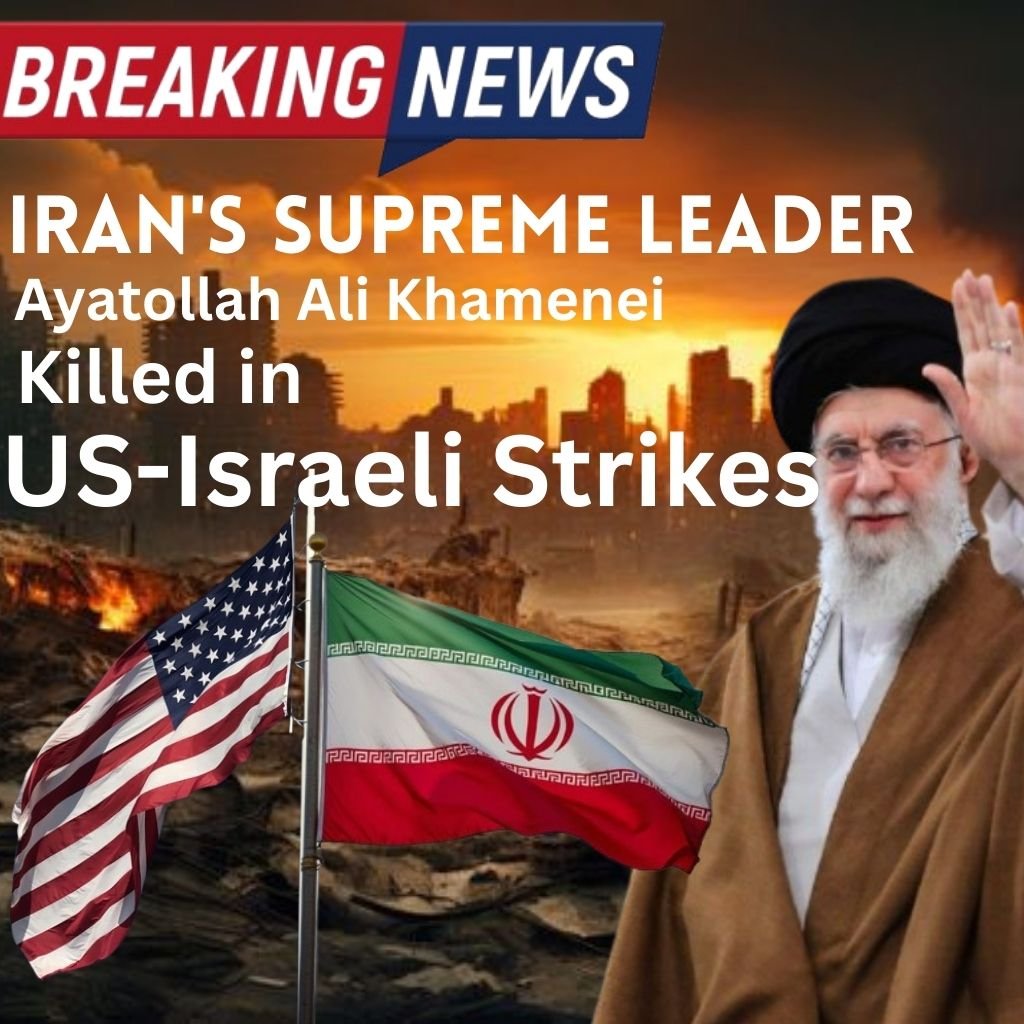
Breaking News: Iran’s Supreme Leader Ayatollah Ali Khamenei Killed in US-Israeli Strikes

Iran's Supreme Leader Khamenei Killed in US-Israeli Strikes

In a dramatic escalation of Middle East tensions, Iran has confirmed the death of its Supreme Leader, Ayatollah Ali Khamenei, following joint US-Israeli airstrikes on Tehran. The 86-year-old leader, who ruled Iran with an iron fist for nearly four decades, was killed at his office during the coordinated attacks on Saturday, February 28, 2026 .

What Happened: The Attacks

The joint military operation, named “Operation Epic Fury” by the US and “Operation Lion’s Roar” by Israel, began on Saturday morning . Israeli officials reported that 200 fighter jets took part in the “extensive attack,” hitting more than 500 targets across 24 provinces .

Key targets included:

  • Khamenei’s residential compound in Tehran, which satellite imagery confirms sustained significant damage 
  • Multiple sites where senior Iranian officials had gathered 
  • Iranian missile launchers and air defense systems 
  • Facilities associated with Iran’s nuclear program 

An intelligence source and military source told CBS News that around 40 Iranian officials were killed in the strikes, including Khamenei .

Casualties and Human Toll

The human cost has been severe:

  • At least 200+ people killed across Iran, according to the Red Crescent 
  • 108 people reported killed when a girls’ school in Minab, southern Iran, was struck 
  • Khamenei’s daughter, son-in-law, and grandchild were also killed in the attacks, according to Iran’s Fars News Agency 
  • Additional casualties reported at a school east of Tehran 

Iran’s Response and Retaliatory Strikes

Iran has launched waves of retaliatory strikes across the Middle East :

The Islamic Revolutionary Guard Corps (IRGC) announced it targeted:

  • The US Fifth Fleet in Bahrain
  • Other American bases in the Gulf region
  • Multiple locations in Israel

The IRGC also closed the Strait of Hormuz, a vital waterway through which much of the world’s oil and gas passes .

Regional Impact:

UAE: Two people killed in Abu Dhabi, including a Pakistani civilian. The defence ministry reported intercepting 137 missiles and 209 drones. Witnesses in Dubai reported explosions and saw missiles streak across the sky, with four people injured .

Qatar: The defence ministry intercepted several missile attacks targeting the Gulf state .

Saudi Arabia: Loud explosions heard in Riyadh .

Bahrain: Explosions reported across the capital Manama .

Iraq: Two people killed in air strikes on an Iraqi military base housing Kataeb Hezbollah, a powerful pro-Iran group .

Israel: A woman was killed and at least 21 injured in the Tel Aviv area from Iranian missile and drone attacks .

Iran Declares 40 Days of National Mourning

In response to Khamenei’s death, the Iranian cabinet has declared 40 days of national mourning . The official statement described Khamenei’s killing as following a “brutal attack by the criminal U.S. government and the sinister Israeli regime” and praised the late leader for having led the country “sagaciously” for more than 37 years .

Thousands have taken to the streets in Tehran, Isfahan, and Mashhad to mourn, with state media showing crowds chanting “God is great” and gathering at holy sites .

Mixed Reactions Inside Iran

The attacks have produced starkly divided reactions within Iran:

Celebrations: Social media videos verified by BBC Persian show some Iranians in Karaj and Tehran celebrating the reported death, with residents dancing in streets and cheering from balconies as smoke rose from Khamenei’s compound .

Mourning and Anger: Meanwhile, regime loyalists have gathered in large numbers to protest the strikes and mourn what state media terms the “martyrdom” of their leader .

Succession: Who Will Lead Iran Now?

With Khamenei’s death, Iran faces a leadership vacuum at the most critical moment in the Islamic Republic’s history .

How Succession Works

An 88-member panel called the Assembly of Experts—entirely composed of Shiite clerics—is responsible for appointing the new supreme leader .

Temporary leadership: Until the assembly can convene, a temporary leadership council will assume duties, consisting of:

  • Iran’s president
  • The head of the judiciary
  • A jurist from the Constitutional Council 

Potential Successors

Several names have emerged as possible contenders :

CandidateAgeProfile
Mojtaba Khamenei56The late leader’s second son; wields significant influence with IRGC but father-to-son succession is controversial
Alireza Arafi67Deputy chairman of Assembly of Experts; established cleric with government track record
Hashem Hosseini BushehriLate 60sFirst deputy chairman of Assembly of Experts; close to Khamenei
Mohammad Mehdi MirbagheriEarly 60sHardline cleric; represents most conservative wing
Hassan KhomeiniEarly 50sGrandson of revolution founder Ayatollah Khomeini; less hardline but lacks security establishment ties

According to constitutional expert analysis, the new leader must be male, a cleric with political competence, moral authority, and loyalty to the Islamic Republic .

International Reactions

United States

President Trump has indicated that bombing operations will continue “as long as necessary to achieve our objective of PEACE THROUGHOUT THE MIDDLE EAST AND, INDEED, THE WORLD” . He called on Iranian forces to surrender in exchange for immunity, stating: “Now they can have Immunity, later they only get Death!” .

Pentagon chief Pete Hegseth said the campaign sent a clear message: “We will hunt you down and we will kill you” .

Israel

Prime Minister Benjamin Netanyahu indicated there were “growing signs” of Khamenei’s death and warned that thousands more targets would be struck in coming days .

United Nations

Secretary-General António Guterres said he was “not in a position to confirm” reports of Khamenei’s death during an emergency Security Council meeting, but warned that military action “carries the risk of igniting a chain of events that no one can control” .

China

China’s UN envoy Fu Cong expressed deep concern, calling for immediate cessation of military action and stating: “At all times, the red line for protecting civilians in armed conflict must not be crossed” .

Russia

Russia slammed the US-Israeli strikes as a “dangerous adventure” that could spark regional “catastrophe” .

Gulf States

Gulf Cooperation Council states condemned Iran’s retaliatory attacks in a joint statement read at the UN Security Council, calling them “cowardly” .

What Happens Next: Scenarios and Implications

Experts warn of several possible trajectories :

1. Continued Conflict

The IRGC has vowed “a hard, decisive, and regret-inducing” punishment on the “murderers” . Trump has pledged bombing will continue “uninterrupted throughout the week” .

2. Regime Change Attempt

Trump framed the moment as “the single greatest chance for the Iranian people to take back their country” . However, analysts caution that while Iranian society broadly wants change, the opposition remains unarmed and disorganized compared to the security forces .

3. Power Vacuum and Potential Instability

The regime could close ranks behind a new hardline leader, or the country could fracture along ethnic lines (Azeris, Kurds, Arabs, Baluch) .

4. Regional War

The closure of the Strait of Hormuz threatens global oil supplies. Iran may target Gulf oil installations to spike prices .

Practical Impact on the Gulf Region

For professionals and residents across the Gulf, immediate effects include:

  • Airspace closures: Iran, Iraq, Kuwait, Syria, UAE, and Israel have closed airspace to civilian traffic 
  • Flight cancellations: Multiple airlines have cancelled flights; Russia cancelled all flights to Iran and Israel 
  • Security alerts: Gulf states remain on high alert 
  • Internet blackout: Iran is under near-total internet blackout, with NetBlocks reporting connectivity severely restricted 

Conclusion: A Watershed Moment

The death of Ayatollah Ali Khamenei marks an unprecedented turning point in Middle Eastern history. As the region holds its breath, the coming days will determine whether this moment leads to meaningful change for the Iranian people or deeper conflict.

What remains clear is that the Islamic Republic faces its most severe challenge since its founding in 1979—and the world watches as events continue to unfold.

Frequently Asked Questions (FAQs)

1. Has Iran officially confirmed Khamenei’s death?

Yes. Iranian state television confirmed the news early Sunday, March 1, 2026, broadcasting archive images with a black banner. The announcement followed earlier claims by US President Donald Trump .

2. How did Khamenei die?

According to Iranian state media, Khamenei was killed at his office during joint US-Israeli airstrikes on Tehran. The strikes targeted multiple locations where senior Iranian officials had gathered .

3. Who will replace Khamenei as Supreme Leader?

An 88-member clerical body called the Assembly of Experts is responsible for selecting a new leader. Potential successors include Khamenei’s son Mojtaba, Alireza Arafi, and Hashem Hosseini Bushehri. Until a replacement is chosen, a temporary leadership council will assume duties .

4. How has Iran responded to the attacks?

Iran has launched waves of missile and drone strikes targeting US military installations in the Gulf and Israel. The IRGC has closed the Strait of Hormuz and vowed harsh punishment. A 40-day national mourning period has been declared .

5. Is it safe to travel to the Gulf region right now?

Multiple countries including Iran, Iraq, Kuwait, UAE, and Israel have closed their airspace to civilian traffic. Airlines have cancelled flights. Travelers should check with their airlines and government travel advisories before any planned travel to the region .

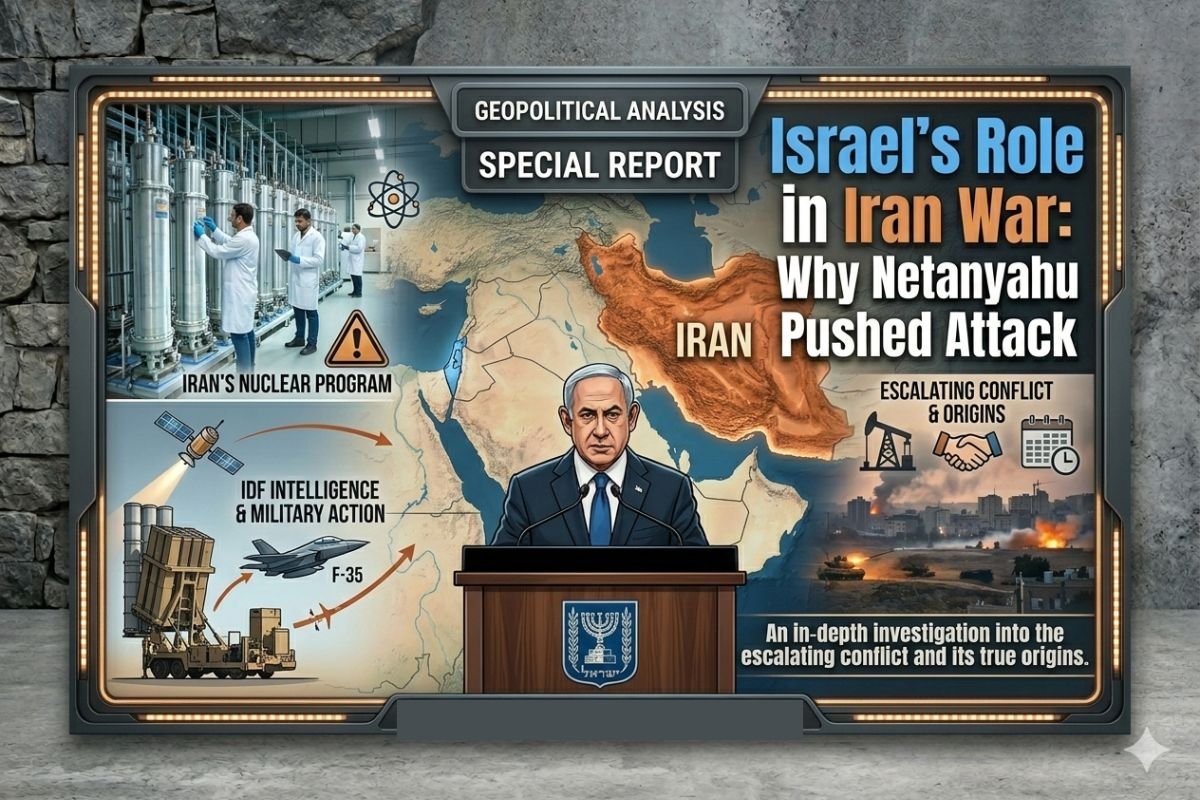
Israel’s Role in Iran War: Why Netanyahu Pushed for Attack

Why Netanyahu Pushed for Iran Attack | Israel's Role Explained

On February 28, 2026, the world woke up to a dramatic escalation in the Middle East. Israel and the United States launched coordinated airstrikes against multiple targets across Iran—an operation described by the Israel Defense Forces as the largest in the Israeli Air Force’s history . Explosions rocked Tehran, and within hours, Iran retaliated with missile strikes toward Israel and US bases across the Gulf .

The Man Who Made Iran His Life’s Mission

To understand why Israel attacked, you have to understand Benjamin Netanyahu. He hasn’t just been a prime minister dealing with Iran as one issue among many—he has made confronting Iran the defining mission of his political career .

For more than three decades, Netanyahu has portrayed Iran’s Islamic regime as an existential threat to Israel—not just a strategic rival, but a modern-day incarnation of the enemies that sought to destroy the Jewish people throughout history. He has repeatedly likened Iran’s leaders to Hitler’s Germany, arguing that their genocidal rhetoric (“wiping Israel off the map”) must be taken literally and seriously .

In Netanyahu’s worldview, a nuclear-armed Iran is not a problem to be managed or contained. It’s a red line that must never be crossed. He has argued this at the United Nations, in speeches to the US Congress, and in countless interviews over three decades.

So when Israel and the US launched Operation Lion’s Roar (the Israeli name) and Operation Epic Fury (the US name), Netanyahu was finally taking the shot he had been positioning himself for his entire career .

The October 7 Earthquake: Why Deterrence Died

But 2026 is different from previous years—and that difference has a name: October 7.

When Hamas launched its devastating attack on October 7, 2023, it didn’t just start a war in Gaza. It shattered a foundational assumption that had guided Israeli strategic thinking for years: that enemies could be managed, contained, and deterred .

For a decade, Israel had tolerated dangerous capabilities from its enemies, believing that so long as intentions appeared constrained, the threat could be managed. Hamas had rockets, but they were mostly intercepted. Hezbollah had missiles, but they stayed north of the border. Iran had proxies, but they operated at a distance.

October 7 demolished that premise .

“The lesson drawn across Israel’s political and security establishment was clear: you do not allow a sworn enemy to accumulate the capacity to destroy you and trust that deterrence will indefinitely hold,” wrote analysts at The Jerusalem Post .

Hamas was a proxy. Hezbollah is a proxy. At the center of that network sits Iran—the architect, financier, trainer, and supplier . If the massacre exposed the cost of underestimating a proxy’s intent, it sharpened attention on the patron’s capabilities.

There’s a deep irony here that analysts have noted: Yahya Sinwar, the Hamas leader, sought to derail Israel’s normalization in the region and restore the “axis of resistance” to center stage. He wanted to light a fire. He did—but the flames didn’t consume Israel as he had hoped. They consumed Gaza, then spread to Lebanon, and now they have drawn Israel and the United States into direct confrontation with the regime that empowered him .

A Window of Opportunity: Iran’s Vulnerability

Timing matters in war. Israel and the US didn’t attack now by accident. They saw a strategic window .

Iran in early 2026 is genuinely vulnerable:

  • Economic crisis: Severe sanctions and mismanagement have crippled the economy .
  • Domestic dissent: The regime has faced waves of protests, most recently in January 2026, and has demonstrated its willingness to shoot and kill thousands of fellow citizens to stay in power .
  • Military degradation: Iran’s defenses are still badly damaged from the 12-day war with Israel in June 2025 .
  • Proxy network weakened: Israel’s campaigns since October 7 have severely degraded Hamas, Hezbollah, and Iranian assets across the region .

BBC’s international editor Jeremy Bowen put it bluntly: “Israel and the United States have calculated that the Islamic regime in Iran is vulnerable… Their conclusion seems to have been that this was an opportunity that should not be squandered” .

In other words, this is a war of choice, not a response to an imminent threat. The word “pre-emptive” was used in official statements, but the evidence suggests this is about seizing a moment of Iranian weakness .

The Nuclear Factor: Red Lines and Broken Talks

Iran’s nuclear program has always been the core of the conflict. Iran insists it has no intention of building a bomb—a position repeated for years . But it has enriched uranium to levels that have no civilian use, and at minimum, it seems to want the option of building a weapon .

Talks between Washington and Tehran had been ongoing, mediated by Oman. A new round in Geneva had just ended on Thursday—two days before the strikes .

What happened in those talks? Analysts point to a fundamental disconnect. “Iran believes it made great concessions, but that clashed sharply with US and Israeli views,” one analyst told CGTN. “Continuing talks would be a waste of time” .

US President Donald Trump had set a 10-15 day deadline for meaningful diplomatic progress. When that deadline passed without a breakthrough, military pressure became the chosen path . Some analysts go further, arguing that “the negotiations were completely a smokescreen”—that the military buildup was already in place and the decision to strike was made regardless of diplomatic outcomes .

Either way, the nuclear program remains the stated justification. Netanyahu said plainly: the “murderous terror regime” in Tehran must not be armed with nuclear weapons capable of threatening “all of humanity” .

Regime Change: The New, Ambitious Goal

Here’s where this conflict differs from previous rounds. The goal now appears to be not just nuclear containment, but regime change .

In a video message, Netanyahu called on Iran’s diverse ethnic groups—Persians, Kurds, Azeris, Baloch, Ahwazi—to throw off “the yoke of tyranny” and establish a “free and peace-loving Iran” . Trump went further: “When we are finished, take over your government. It will be yours to take. This will be, probably, your only chance for generations” .

Nothing would burnish Netanyahu’s legacy more than toppling the Islamic Republic . It would be the ultimate validation of his decades-long crusade.

But analysts warn this is enormously ambitious—and enormously risky . Iran is a nation of 93 million people, with around 15 million considered devoted supporters of the Supreme Leader, backed by well-armed security forces . Decapitating leadership doesn’t automatically trigger a popular uprising. And if the regime fights for its life, it has nothing left to lose .

As one former Israeli intelligence official put it: “Let’s assume the people won’t go into the streets, and the supreme leader is still alive, and Iran will continue launching missiles. Then what? You can continue the war for how long?” 

Domestic Politics: Netanyahu’s Election Calculus

We can’t ignore the political dimension. Israel faces a general election later in 2026 . Netanyahu’s political position has been weakened by the costly two-year war with Hamas and the trauma of October 7 .

History shows that Israeli leaders often benefit politically when the nation is at war. The 2023-2025 Gaza war demonstrated that Netanyahu “believes his political position strengthens when Israel is at war” .

Analysts note that Netanyahu has “strong incentives to sustain a posture of external confrontation, which can consolidate political support and prolong his governing viability” . A major military win—especially one that neutralizes Iran’s nuclear threat or even topples the regime—would dramatically reshape the electoral landscape in his favor.

This doesn’t mean the war is only about domestic politics. The strategic threats are real. But political timing is rarely coincidental in the Middle East.

The US-Israel Alignment: Hand in Glove

Previous Israeli strikes faced US opposition. In 1956, Eisenhower forced a withdrawal. In 1967, Johnson warned Israel would stand alone . In June 2025, the US participated but played a supporting role, mainly “under Israel’s persuasion” .

This time is different. Washington and Jerusalem acted together, “hand in glove,” with extensive coordination and two US carrier strike groups deployed to the region . The US is playing the main role, and the scale and targets have expanded significantly .

Trump framed Iran not as Israel’s problem alone, but as a wider threat to global security . This alignment gives Israel strategic depth it has rarely enjoyed in past confrontations.

The Risks: A War That Could Spiral

For all the confidence, the dangers are enormous. Iran has already struck US bases in Qatar, Kuwait, UAE, Bahrain, and Jordan . The Strait of Hormuz—a chokepoint for global energy supplies—is now a potential flashpoint .

Analysts warn that a “single misinterpreted strike, an overzealous militia commander, or a cyber operation that crosses an unseen red line could ignite a chain reaction” . Unlike last June’s limited exchange, this conflict carries “significantly greater escalation” risks .

If the regime genuinely fears for its survival, Iranian allies in Lebanon, Yemen, and Iraq could join the fight in earnest . What began as an air campaign could expand into a broader regional war with unpredictable consequences.

The Bottom Line

So why did Netanyahu push for this attack?

  • Ideological conviction: He has spent his career arguing Iran is an existential threat.
  • October 7 trauma: The assumption that enemies can be deterred is dead.
  • A window of opportunity: Iran is economically weak, domestically divided, and militarily degraded.
  • Nuclear red lines: Diplomacy failed, and Israel won’t accept a nuclear-armed Iran.
  • Regime change ambition: For the first time, this is an explicit goal.
  • Domestic politics: A major win could reshape elections in his favor.

In Netanyahu’s calculation, the stars have aligned. Whether that calculation proves correct—or whether it unleashes consequences nobody can control—is the question that will define the Middle East for years to come.

As one analyst put it: “The current situation is a reaction to years of the Iranian regime’s proxy strategy… Effectively, a strategy meant to keep war at bay has invariably returned home” .

The war is here. And its end is nowhere in sight.

Frequently Asked Questions (FAQs)

1. Did Iran actually attack Israel first, or was this a “pre-emptive” strike?

Israel and the US described their action as “pre-emptive,” but evidence suggests this was a war of choice based on a perceived window of opportunity . Iran had not launched an imminent attack before the US-Israeli strikes, though it did retaliate afterward. Analysts point to the collapse of nuclear talks and Iran’s vulnerabilities—not an imminent threat—as the real triggers .

2. What does Israel hope to achieve militarily?

Israel aims to eliminate Iran’s nuclear threat, degrade its ballistic missile and drone capabilities, and potentially trigger regime change by encouraging internal uprisings . Unlike previous limited strikes, this operation explicitly targets leadership and seeks to create conditions for a new government in Tehran .

3. How is this different from the June 2025 Israel-Iran war?

The scale and goals are dramatically different. Last June’s 12-day war was more limited and Israel-led. This time, the US is playing the main role with two carrier strike groups, targets are expanded to include leadership and infrastructure, and regime change is an explicit—not just implicit—objective .

4. Could this lead to a broader regional war?

Yes, and risks are significantly higher than last year. Iran has already struck US bases across the Gulf . The Strait of Hormuz, global energy supplies, and multiple regional actors could be drawn in. Analysts warn that miscalculation by any party could spiral beyond anyone’s control .

5. What happens if Iran’s Supreme Leader is killed?

Khamenei’s death would trigger a succession battle within Iran’s complex political system. He would likely be replaced by another cleric supported by the IRGC, not a liberal democracy . While succession could create internal turmoil, it doesn’t automatically mean regime collapse. The IRGC remains the ultimate arbiter of power .

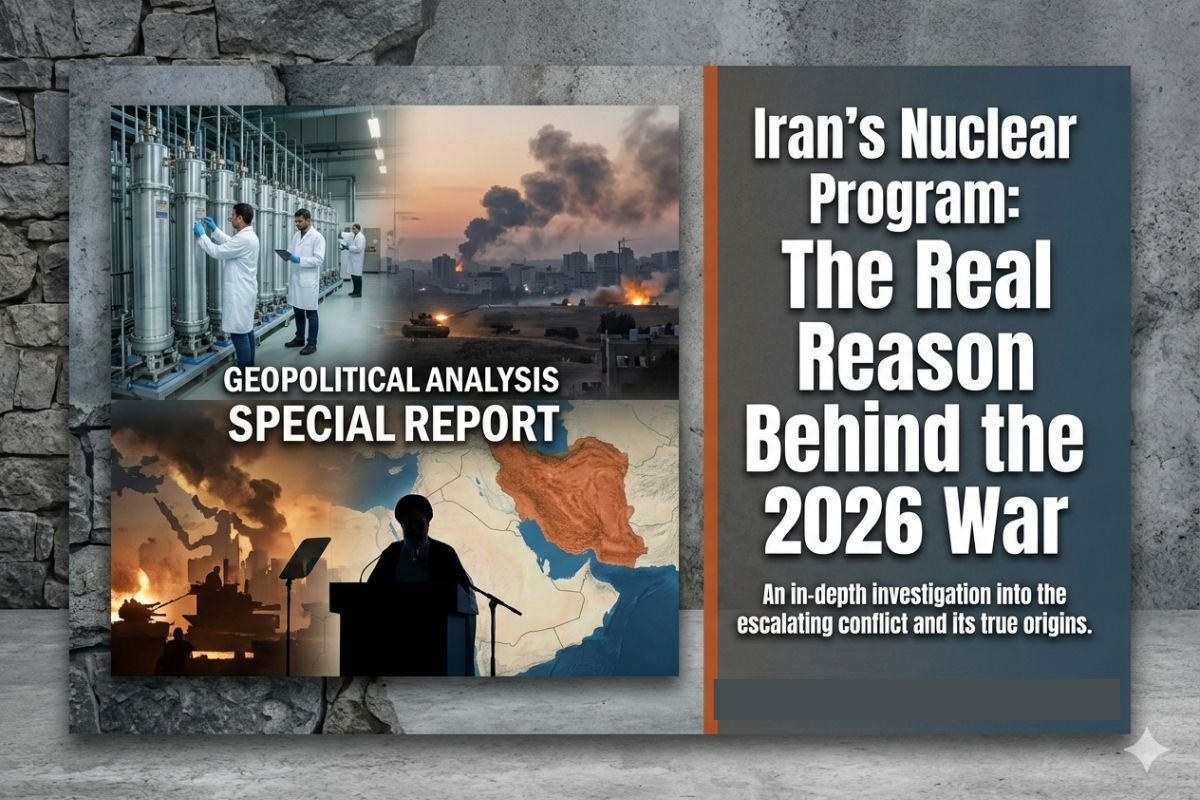
Iran’s Nuclear Program: The Real Reason Behind the 2026 War

Iran's Nuclear Program Explained: The Real Reason Behind 2026 War

In June 2025, the Middle East erupted into its most devastating conflict in decades. Israel launched strikes on Iran’s nuclear facilities, triggering a 12-day war that drew the United States into direct military action against Iranian targets . By early 2026, tensions remained sky-high, with a massive US naval buildup in the region and urgent diplomatic efforts to prevent further escalation .

A Quick History: How Did We Get Here?

Iran’s nuclear story didn’t start with conflict. In fact, it began with American support.

The 1950s-1970s: Friends with Benefits
The United States actually launched Iran’s nuclear program in 1957 under the Western-friendly Shah . Iran began developing nuclear power in the 1970s with US backing. But everything changed with the 1979 Islamic Revolution, which transformed Iran into an Islamic Republic and turned former allies into adversaries .

The 2000s: Suspicion Grows
In 2002, international inspectors discovered secret nuclear facilities in Iran—a violation of the Nuclear Non-Proliferation Treaty (NPT), which Iran had signed . The NPT allows countries to develop nuclear technology for peaceful purposes (medicine, agriculture, energy) but explicitly bans developing nuclear weapons . This discovery triggered years of international sanctions.

2015: The Nuclear Deal (JCPOA)
After years of negotiations, Iran and six world powers (US, China, France, Russia, Germany, UK) agreed to the Joint Comprehensive Plan of Action—the JCPOA . Under this deal:

  • Iran could only enrich uranium to 3.67% (enough for civilian power, not bombs)
  • Iran’s uranium stockpile was capped at 300kg
  • International inspectors gained access to all nuclear facilities
  • In return, economic sanctions were lifted 

2018: The Deal Collapses
President Donald Trump withdrew the US from the JCPOA, calling it a “bad deal” that wasn’t permanent and didn’t address Iran’s missile program . He reimposed crippling sanctions as part of a “maximum pressure” campaign.

Iran’s Response: Escalation
In retaliation, Iran began breaching the deal’s limits—installing advanced centrifuges, increasing enrichment levels, and growing its uranium stockpile . By 2023, the IAEA found uranium particles enriched to 83.7% purity—just below weapons-grade .

What Is Uranium Enrichment? (And Why Does It Matter?)

To understand the crisis, you need to understand enrichment. Let’s keep it simple.

Natural uranium is mostly uranium-238 (about 99.3%), which isn’t useful for nuclear reactions. Only about 0.7% is uranium-235—the special type that can release energy .

Enrichment is the process of increasing the concentration of uranium-235. It’s done by spinning uranium gas at high speeds in machines called centrifuges, which separate the lighter uranium-235 from the heavier uranium-238 .

The Key Levels:

  • 3.67% enrichment: Enough for nuclear power plants (the JCPOA limit)
  • 20% enrichment: Considered the threshold for weapons capability
  • 60% enrichment: Not bomb-grade, but dangerously close—and no country has uranium at this level without a weapons program, according to the IAEA 
  • 90% enrichment: Weapons-grade—what you need for an actual nuclear bomb 

Think of it like boiling water. 60% isn’t boiling yet, but you’re certainly getting the kettle hot. And the journey from 60% to 90% is much faster than from 0% to 60%.

How Close Is Iran to a Nuclear Bomb?

This is the million-dollar question. Here’s the 2026 reality.

Current Stockpile:
As of early 2026, Iran has approximately 275kg of uranium enriched to 60% purity . According to IAEA yardsticks, that’s theoretically enough—if enriched further—for about half a dozen nuclear weapons .

Breakout Time:
“Breakout time” is how long Iran would need to produce enough weapons-grade material for one bomb. US officials estimate Iran could turn its 60% stockpile into weapons-grade material in as little as one week . However, building an actual deliverable weapon would take longer—estimates range from six months to 18 months .

But Does Iran Want a Bomb?
Iran insists it does not. Supreme Leader Ali Khamenei has issued a religious decree (fatwa) against nuclear weapons, and Iran maintains its program is for peaceful energy purposes . A senior advisor recently stated that if not making nuclear weapons is the main issue, “an immediate agreement is within reach” .

However, Western countries remain deeply skeptical. The IAEA has declared Iran in breach of its non-proliferation obligations, and the combination of high enrichment levels, restricted inspector access, and past secret facilities fuels suspicion .

The 2025 War: What Actually Happened?

In June 2025, after years of shadow war and rising tensions, Israel launched a major military operation against Iran’s nuclear infrastructure .

The Strikes:

  • Israeli forces targeted Natanz—Iran’s largest uranium enrichment facility—setting it ablaze 
  • Six Iranian nuclear scientists were killed 
  • The United States joined the conflict, dropping massive bunker-buster bombs on two underground nuclear facilities and striking a third with submarine-launched missiles 

The Aftermath:

  • Iran launched waves of missiles at Israel in retaliation 
  • At least 610 civilians were killed in Iran, with thousands wounded 
  • Iran suspended some cooperation with the IAEA and restricted inspectors from accessing bombed sites 
  • A ceasefire was declared after 12 days of fighting 

The Damage Debate:
How much damage was actually done? Opinions differ dramatically:

  • President Trump claimed the strikes set Iran’s program back by “decades” 
  • Israel’s military said it had delayed the program “by several years” 
  • Leaked US intelligence suggested the damage was much less—just a few months’ setback, with centrifuges and enriched uranium stockpiles not fully eliminated 

The 2026 Crisis: Why War Threatens Again

Despite the ceasefire, 2026 has brought renewed tensions. Here’s what’s happening now.

The Military Build-Up:
President Trump has deployed a massive naval force to the region—what he calls an “armada”—including two aircraft carrier strike groups (USS Abraham Lincoln and USS Gerald Ford) . Iran has responded with its own military drills in the Gulf and around the strategic Strait of Hormuz .

The Diplomatic Dance:
Multiple rounds of indirect talks, mediated by Oman, have been held in Geneva . Both sides have presented “practical proposals” covering nuclear issues and sanctions relief .

The Key Disagreement:

  • The US position: Trump demands “zero enrichment”—the full dismantlement of Iran’s nuclear program, including enrichment, weaponization, and ballistic missiles 
  • Iran’s position: Foreign Minister Abbas Araghchi says the US has not actually asked for zero enrichment in negotiations, and Iran is willing to guarantee its program remains peaceful—but not to abandon enrichment entirely 

A Potential Breakthrough?
On February 27, 2026, Oman’s Foreign Minister announced that Iran has agreed “never again to possess nuclear materials that could be used to make a nuclear bomb” . Under this framework:

  • Existing enriched uranium would be diluted in purity and converted into fuel in an irreversible process
  • Iran would allow IAEA inspectors “full access” to its nuclear facilities
  • The agreement could take up to three months to implement 

If confirmed, this would represent a major diplomatic victory—but skepticism remains about whether it will hold.

The Regional Reaction: Who Stands Where?

The conflict has exposed deep global divisions.

US Allies (UK, Germany, France): They did not participate in the strikes and didn’t explicitly condemn them, but their statements placed blame on Iran, urging it to end its nuclear program .

Russia: Strongly condemned the US and Israel, calling it “premeditated armed aggression,” but offered only words, not concrete support .

China: Expressed “high concern” and warned of unpredictable consequences, but stopped short of strong action .

Saudi Arabia: Perhaps most significantly, Riyadh—which had been pursuing rapprochement with Tehran—threw its weight behind Gulf allies, condemning Iranian attacks on their territories and offering its capabilities for their defense . This represents a major strategic setback for Iran.

So, What’s the Real Reason Behind the 2026 War?

After all this, here’s the honest answer: Iran’s nuclear program is the trigger, but not the root cause.

The real reasons run deeper:

1. Red Lines Crossed
For Israel, a nuclear-armed Iran is an existential threat. Iranian leaders have repeatedly called for Israel’s destruction. From Jerusalem’s perspective, allowing Tehran to reach weapons capability is simply unacceptable .

2. The Deal Died
The JCPOA created a framework for containment. When the US withdrew in 2018, that framework collapsed—and no viable alternative emerged. Both sides blame each other, but the result is the same: escalation .

3. Trust Is Dead
Decades of shadow war, secret facilities, and broken promises mean neither side trusts the other. Iran doesn’t believe US guarantees. The US and Israel don’t believe Iran’s peaceful intentions. Without trust, diplomacy struggles .

4. Regional Rivalry
The Iran-Saudi Arabia cold war, the Israel-Iran proxy conflicts across the region, and the struggle for dominance in the Gulf all feed into the nuclear crisis. It’s never just about the bomb .

What Happens Next?

As of March 2026, the world watches three scenarios unfold:

Scenario A: Diplomatic Breakthrough
The Oman-mediated framework holds. Iran dilutes its uranium, opens its facilities, and sanctions are gradually lifted. Peace holds—for now .

Scenario B: Managed Tension
Talks drag on. Both sides continue posturing, but avoid all-out war. The US armada remains in the region. Iran enriches but stops short of weaponization. A tense, cold peace continues.

Scenario C: Renewed Conflict
Diplomacy fails. Trump’s 15-day ultimatum expires. The US and Israel strike again—this time harder. Iran retaliates. The region spirals into wider war .

The next few weeks will determine which path we take.

Conclusion

Iran’s nuclear program is one of the most complex, high-stakes issues in global politics. It’s a story of shifting alliances, broken deals, genuine security concerns, and profound mistrust.

Understanding the enrichment levels, the breakout timelines, and the historical context doesn’t make the situation simpler—but it does make it clearer. And in a world where misinformation spreads faster than facts, clarity matters.

Whether you’re following from the Gulf, tracking for work, or simply trying to make sense of the headlines, knowing what’s really happening with Iran’s nuclear program is the first step toward understanding what comes next.


Frequently Asked Questions (FAQs)

1. Does Iran currently have a nuclear bomb?

No. International assessments, including by the US intelligence community, confirm that Iran’s nuclear program is not currently weaponized . However, Iran has enough 60%-enriched uranium that, if further enriched to 90%, could theoretically produce multiple weapons .

2. How close is Iran to being able to build a bomb?

The “breakout time”—producing enough weapons-grade material for one bomb—is estimated at one to two weeks starting from Iran’s current 60% stockpile . Building an actual deliverable weapon would take longer: estimates range from six months to 18 months .

3. Why did the US withdraw from the nuclear deal in 2018?

President Trump called the JCPOA a “bad deal” because it wasn’t permanent, didn’t address Iran’s ballistic missile program, and didn’t restrict Iran’s regional activities. He sought to negotiate a new, expanded agreement through “maximum pressure” sanctions .

4. Can Iran enrich uranium for peaceful purposes without building a bomb?

Technically, yes. Many countries enrich uranium for nuclear power. But Iran’s enrichment to 60%—far beyond the 3.67% needed for power plants—is what raises alarm. The IAEA states that no country has uranium at this level without also having a weapons program .

5. What would it take to reach a new agreement?

The key sticking point is enrichment. The US demands “zero enrichment”—full dismantlement. Iran insists on maintaining some enrichment capability but has offered guarantees it will never seek weapons. The Oman-mediated framework announced in late February 2026 suggests Iran may have agreed to eliminate weapons-grade material in exchange for verified peaceful use .

Why Did US & Israel Attack Iran in 2026? Complete Reasons Explained

Title: Why US & Israel Attacked Iran 2026: Complete Reasons

On February 28, 2026, the world woke to a different Middle East. Explosions lit up the night sky over Tehran. Air raid sirens wailed across Iranian cities. Communications went dark. Within hours, news emerged that Supreme Leader Ayatollah Ali Khamenei had been killed in the strikes, and the United States and Israel had launched their most ambitious military operation against Iran in decades .

Reason 1: The Nuclear Impasse—When Diplomacy Hit a Wall

At the heart of the conflict lies Iran’s nuclear program—a source of tension for over two decades. By early 2026, US and Israeli intelligence assessed that Tehran was dangerously close to having enough material for a nuclear bomb .

The Geneva Talks That Went Nowhere

Just days before the strikes, Omani mediators announced what looked like a breakthrough in Geneva. Iran had reportedly agreed to “zero uranium stockpiling” and full IAEA verification . But neither Washington nor Jerusalem trusted the deal.

The United States had taken a hardline position: demanding that Iran surrender all enriched uranium, dismantle key nuclear facilities, and accept unrestricted inspections . For Iran, which views its nuclear program as a matter of national sovereignty and pride, this was a non-starter.

“The negotiations were completely a smokescreen,” said Tang Zhichao, a Middle East analyst at the Chinese Academy of Social Sciences . The massive US military buildup in the region—including a second aircraft carrier—was already in place. “This was a carefully planned result. It shows that the United States and Israel have completely lost hope in negotiations.”

Why the US Shifted from Dialogue to Force

The United States had historically preferred engagement with Iran, applying sustained diplomatic pressure to extract concessions . But by February 2026, that approach had run its course. US negotiators—including Middle East envoy Steve Witkoff and Jared Kushner—returned from Geneva deeply disappointed. Iran’s position largely adhered to its established framework: refusing to abandon nuclear development, making no substantive concessions on transferring highly enriched uranium, and continuing to reject discussions of its missile technology and regional policies .

President Donald Trump set a 10-15 day deadline for meaningful diplomatic progress. When that deadline passed with no breakthrough, the military option was activated .

Reason 2: The US-Israel Dynamic—Convergence After Years of Divergence

For years, the United States and Israel had disagreed on how to handle Iran. Washington preferred communication and engagement. Israel, viewing Iran as an existential threat, advocated for decisive military pressure .

Israel’s Long Campaign

Israel had spent the previous two years systematically dismantling Iran’s proxy network—crushing Hamas in Gaza, severely degrading Hezbollah in Lebanon, and watching the Assad regime fall in Syria . With Iran’s “Axis of Resistance” shattered, Prime Minister Benjamin Netanyahu saw a strategic window to strike at the source directly.

Netanyahu had long argued that diplomacy alone couldn’t stop Iran. The strikes, code-named “Roaring Lion” by Israel, were framed as pre-emptive self-defence against an existential threat .

Trump’s Shift Toward Israel’s Position

When Trump returned to office in 2025, he restored his “maximum pressure” campaign against Tehran while paradoxically opening direct negotiations—the first such talks since he pulled the US out of the JCPOA in 2018 . But by February 2026, Trump had moved decisively toward Israel’s harder line.

The joint operation, with US forces playing the main role (in contrast to June 2025, when Israel led the strikes), marked a significant shift. Analysts note that while the two allies’ objectives are more aligned now than ever, they still differ in emphasis: Israel wants to completely eliminate Iran’s strategic threat across nuclear, missile, and proxy dimensions, while Trump primarily wants to eliminate the nuclear threat—though he doesn’t rule out regime change if conditions are favorable .

Reason 3: Domestic Politics—Elections, Legitimacy, and Distraction

Wars aren’t always about foreign policy. Sometimes, they’re about votes.

Trump’s Calculation

The 2026 midterm elections were approaching, and Iran-related issues occupy a critical place in US foreign policy and national security discourse . By taking a strong stance on Iran—either by weakening its strategic capabilities through military means or by pressuring it into greater concessions—the administration could bolster its diplomatic and governance credibility.

Trump framed the operation in sweeping, historic terms. In a video message, he listed grievances stretching back to the 1979 Islamic Revolution, which turned Iran from one of America’s closest allies into one of its most persistent enemies . His stated goals were extraordinary: destroy Iran’s nuclear program, obliterate its missile industry, sink its navy, and trigger regime change from within .

He addressed the Iranian public directly: “The hour of your freedom is at hand. When we are finished, take over your government. It will be yours to take.” 

This was not just a military strike. It was a political bet from a president who campaigned on ending foreign wars but chose to launch arguably the most consequential US military operation since Iraq in 2003 .

Netanyahu’s Unfinished Business

For Netanyahu, the political timing was equally significant. With Israeli elections approaching in October 2026, demonstrating resolve in safeguarding national security helps consolidate support from the right-wing political base . It also diverts attention from domestic pressures such as corruption allegations .

Sun Taiyi, a political scientist at Christopher Newport University, noted that “domestic political considerations cannot be ignored, with Netanyahu having strong incentives to sustain a posture of external confrontation, which can consolidate political support and prolong his governing viability” .

Reason 4: Iran’s Weakened Position—A Window of Opportunity

For Washington and Tel Aviv, the strategic calculus included a hard-headed assessment: Iran had never been weaker.

The Collapse of the “Axis of Resistance”

Over the previous two years, Israel had systematically dismantled Iran’s proxy network. Hamas was crushed in Gaza. Hezbollah was severely degraded in Lebanon. The Assad regime in Syria had fallen . For years, Iran had funded and armed these groups as its first line of defence and offensive reach. By early 2026, most of those tools were gone.

Economic Collapse and Domestic Unrest

Inside Iran, the situation was dire. The economy was in freefall, the rial had collapsed, basic goods were scarce, and nationwide protests in January had been met with a brutal crackdown that left thousands dead . US-based group HRANA reported over 7,000 verified deaths, with thousands more under review .

Trump seized on this in his messaging, citing Iran’s killing of “tens of thousands of its own citizens on the street as they protested” as a justification for intervention . Donald Heflin, a veteran diplomat and professor at Tufts University’s Fletcher School, noted that this provides “a bit of a fig leaf”—an excuse to sell the intervention to the Iranian people and the world .

The “Rally ‘Round the Flag” Risk

However, Heflin also warned of a familiar dynamic: when bombs start falling, populations often rally around their government, even one they were protesting days earlier . Whether the strikes would weaken the regime or strengthen it remained an open question.

Reason 5: Regime Change—The Unspoken but Clear Goal

While US officials publicly framed the strikes as defensive, aimed at neutralizing “imminent threats,” analysts argue that leadership change is now the primary objective .

Trump’s direct call for Iranians to “take over your government” and reports that Supreme Leader Khamenei’s residence was specifically targeted make this clear . The operation marks a break from last year’s strikes, which primarily focused on Iran’s nuclear facilities. This time, the scale and targets have clearly expanded to include political leadership .

Can It Work?

Experts are sceptical. Heflin points to US history in the region: during the 1990-1991 Gulf War, the US encouraged Iraqis to rise up against Saddam Hussein, then stopped short of attacking Baghdad. “That has not been forgotten in Iraq or surrounding countries,” he says. “I would be surprised if we saw a popular uprising in Iran that really had a chance of bringing the regime down” .

The regime, despite its weaknesses, remains tightly controlled and heavily armed. Even if top leaders are eliminated, the most likely successor is the Revolutionary Guard—hardcore true believers who may be no easier for the US to work with .

The Fallout: A Region on the Brink

Iran retaliated quickly, launching missiles at dozens of US military bases across the Middle East and targeting Israeli facilities . Explosions were reported in Qatar, the UAE, Bahrain, and Kuwait . Dubai International Airport shut down .

The conflict carries much higher risks than last year’s 12-day war, with two US carrier strike groups in the region signalling heightened readiness . Gulf states, some hit by Iranian retaliation on their own soil, now face difficult choices about where they stand .

Conclusion: The End of Diplomacy, The Beginning of Uncertainty

The strikes of February 28, 2026, represent the culmination of years of accumulated mistrust, failed diplomacy, and strategic impatience. The nuclear impasse proved unbreakable. The US-Israel policy gap finally converged. Domestic politics pushed leaders toward bold action. And a perceived window of opportunity—with Iran weakened and isolated—proved too tempting to resist.

What comes next is uncertain. Retaliation is already underway. The conflict could stabilise or expand. But one thing is clear: the world of February 27th no longer exists. And for the millions of people across the Middle East who woke to sirens and explosions, the consequences of this decision will unfold for years to come.

Frequently Asked Questions (FAQs)

1. Why did the US and Israel attack Iran specifically in late February 2026?

The immediate trigger was the collapse of nuclear talks in Geneva. US negotiators set a 10-15 day deadline for meaningful progress, and when Iran refused to make what Washington considered sufficient concessions on uranium enrichment and nuclear inspections, the military option was activated . The US had also completed a massive military buildup in the region, including a second aircraft carrier, making the strike operationally feasible .

2. Was the attack really about nuclear weapons, or was regime change the real goal?

Both. While preventing Iran from acquiring nuclear weapons was the stated primary objective, the scale and targets of the attack—including the confirmed killing of Supreme Leader Ayatollah Ali Khamenei—make clear that regime change is now a central goal . President Trump explicitly called on the Iranian people to “take over your government” .

3. How did Iran’s domestic situation contribute to the timing of the attack?

Iran entered 2026 in its weakest position in decades. The economy was in freefall, the rial had collapsed, and nationwide protests in January had been met with a brutal crackdown. Its proxy network (the “Axis of Resistance”) had been largely dismantled. US and Israeli strategists likely assessed this as a window of opportunity when Iran was too weak to mount an effective response .

4. What role did Israeli domestic politics play in the decision?

Significant. With Israeli elections approaching in October 2026, Prime Minister Netanyahu had strong incentives to demonstrate resolve against Iran’s perceived existential threat. Military action helps consolidate his right-wing political base and diverts attention from domestic pressures like corruption allegations .

5. How have Gulf countries responded to the crisis?

Gulf states are in a deeply uncomfortable position. While some like Saudi Arabia expressed solidarity with “targeted nations,” they also face Iranian retaliation on their own soil—with missiles striking near US bases in Bahrain, Qatar, and Kuwait. They must balance deterrence with de-escalation, maintaining security ties with the US while avoiding direct confrontation with Iran .

Engineering Jobs in Gulf 2026: Oil & Gas vs Construction vs IT – Which Path is Right for You?

Engineering Jobs in Gulf 2026 | Oil & Gas vs Construction vs IT

If you’re an engineer eyeing the Gulf region in 2026, you’ve picked the right time and the right place. The UAE—particularly Dubai and Abu Dhabi—is experiencing a jobs boom across multiple sectors. But here’s the challenge: with so many opportunities, how do you choose the right path?

The Big Picture: UAE’s 2026 Job Market

Before diving into specific sectors, let’s look at the landscape. According to industry experts, construction, technology, and energy are leading hiring demand in 2026 . Major infrastructure projects, continued investment in renewable energy, and rapid digital transformation are driving the need for skilled professionals across these industries .

The UAE’s open immigration policies continue to attract global talent, making competition healthy but opportunities abundant. Companies are prioritizing candidates who combine technical depth with leadership skills and digital fluency .

Sector 1: Oil & Gas Engineering – The Established Powerhouse

Oil & Gas has been the backbone of Gulf economies for decades, and 2026 is no different. Global firms like Wood continue to recruit heavily for process engineers, project managers, and safety specialists across the UAE .

What’s Hot in Oil & Gas:

  • Process Engineers: Wood is actively hiring Lead Process Engineers for major onshore brownfield projects in Dubai and Sharjah . These roles require expertise in simulation software like HYSYS and experience with gas processing .
  • Project Managers: Large-scale FEED (Front End Engineering Design) and detail design scopes need experienced leaders .
  • Specialized Roles: Positions focusing on materials, corrosion, and NGL (Natural Gas Liquids) projects are in demand .

Who’s Hiring:

  • Wood Plc: With over five decades in the region, Wood offers competitive packages, global project exposure, and strong commitment to professional development .
  • Other Major Players: Companies like Jacobs also maintain strong UAE presence with offices in Abu Dhabi, Dubai, and Sharjah .

Salary & Benefits:

Oil & Gas roles typically offer competitive compensation including medical insurance, life cover, end-of-service gratuity, and employee share plans . Senior roles with 10+ years experience command premium packages.

The Verdict:

Best for: Engineers seeking stability, global project exposure, and traditional career progression. Ideal if you have specialized process or petrochemical experience.

Sector 2: Construction & Infrastructure – Building Tomorrow’s Cities

Dubai and Abu Dhabi are construction hotspots in 2026. With visionary projects continuing to reshape the skyline, civil and structural engineers are in high demand.

What’s Hot in Construction:

  • Civil Engineers: Companies are seeking both fresh graduates and experienced engineers for building and infrastructure projects across the UAE . Key skills include structural mechanics, concrete and steel design, and geotechnical fundamentals .
  • Infrastructure Specialists: Roads, bridges, and utilities projects need engineers familiar with UAE codes and international standards .
  • Geologists & Geotechnical Engineers: Fugro, a global leader in geo-data, is recruiting graduate geologists for field mapping surveys and geotechnical data analysis .

Software Skills That Matter:

Employers value proficiency in:

  • AutoCAD and Revit
  • Civil 3D
  • Structural analysis tools like Etabs, SAFE, and STAAD 

Who’s Hiring:

  • Jacobs: Offers roles across engineering, architecture, and construction management for projects shaping the UAE’s future .
  • Fugro: Looking for UAE nationals with geology or earth sciences degrees for exciting work in the subsea industry .
  • Various Consultancies: Engineering design firms need talent with understanding of UAE building codes and international standards .

The Verdict:

Best for: Engineers who want to see tangible results from their work—buildings, bridges, and infrastructure that shape communities. Great for fresh graduates and early-career professionals.

Sector 3: IT Engineering – The Digital Future

Technology is transforming every industry, and IT engineers are the architects of this transformation. In 2026, the lines between traditional engineering and digital skills are blurring.

What’s Hot in IT Engineering:

  • DevSecOps Engineers: Moove is seeking a Senior DevSecOps Engineer in Dubai to design scalable cloud security and infrastructure . This role requires 10+ years experience with AWS, Terraform, CI/CD pipelines, and observability platforms .
  • Cybersecurity Engineers: Siemens is hiring IT/OT Cybersecurity Engineers for Industrial Control Systems in Dubai and Abu Dhabi . These specialists protect critical infrastructure in oil & gas, water, and petrochemical sectors .
  • IT Infrastructure Roles: Jacobs and other firms need IT professionals to develop and support innovative technologies .

In-Demand Skills:

  • Cloud platforms (AWS)
  • Infrastructure as Code (Terraform)
  • Cybersecurity frameworks (IEC 62443, NIST)
  • Industrial protocols (Modbus, OPC, PROFINET)
  • Scripting (Python, PowerShell, Bash) 

Who’s Hiring:

  • Moove: A fast-growing scale-up backed by Uber and Mubadala, transforming mobility with revenue-based financing .
  • Siemens: Global leader in automation and digitalization, offering roles that blend IT and operational technology .
  • Jacobs: Seeking IT talent to support digital innovation .

Certifications That Help:

For cybersecurity roles, certifications like CCNA, CISA, CompTIA Security+, or CISSP are often mandatory .

The Verdict:

Best for: Engineers who love problem-solving, want to work with cutting-edge technology, and enjoy roles that evolve constantly. Ideal for those comfortable with ambiguity and proactive shaping of solutions .

Head-to-Head Comparison: Which Sector Wins?

FactorOil & GasConstructionIT Engineering
StabilityHigh (established industry)High (government-backed projects)High (digital transformation essential)
Entry BarriersOften requires experienceFresh graduate opportunities existCan require specialized skills
Salary PotentialVery high for senior rolesCompetitiveHigh, especially specialized roles
Growth TrajectoryTraditional career ladderProject-based advancementFast-evolving, skill-based
Future-ProofTransitioning to cleaner energySustainable construction growingAI and cybersecurity booming
Work EnvironmentOffice + site visitsOffice + siteOften hybrid/remote possible

Making Your Choice: Questions to Ask Yourself

Choose Oil & Gas if:

  • You have process or chemical engineering background
  • You value established career paths with global companies
  • You’re interested in energy transition and sustainability

Choose Construction if:

  • You love seeing physical results from your work
  • You’re a civil or structural engineer
  • You want to contribute to iconic projects

Choose IT Engineering if:

  • You’re passionate about technology and automation
  • You enjoy continuous learning and adaptation
  • You want roles with flexibility and modern work practices

Tips for Standing Out in 2026

  1. Blend skills: “A marketing professional who understands data analytics or an HR professional who can leverage AI for talent mapping” will stand out . The same applies to engineers—combine technical depth with digital fluency.
  2. Understand local context: GCC experience is increasingly valued. Understanding cultural dynamics and business regulations gives you an edge .
  3. Network authentically: Recruiters can spot generic, AI-generated applications instantly. Personalize your approach .
  4. Stay honest: Never exaggerate salary or experience. Integrity matters .
  5. Keep learning: The market demands specialized, value-added skill sets. Generalist roles are declining .

Final Thoughts

The Gulf engineering market in 2026 offers something for everyone. Oil & Gas provides stability and deep expertise. Construction lets you build the future literally from the ground up. IT engineering positions you at the forefront of digital transformation.

Your choice depends on your background, interests, and career goals. But here’s the good news: with major investments across all three sectors, skilled engineers are needed and valued. The opportunities are real, the packages are competitive, and the Gulf remains one of the world’s most exciting places to build an engineering career.

Whichever path you choose, 2026 could be your year in the Gulf.


Frequently Asked Questions (FAQs)

1. Which engineering sector pays the most in the UAE in 2026?

Senior roles in Oil & Gas and specialized IT engineering (like DevSecOps and Cybersecurity) typically command the highest salaries. However, compensation depends on experience, qualifications, and the specific employer. All three sectors offer competitive packages including benefits like health insurance, housing allowances, and end-of-service benefits .

2. Do I need UAE experience to get an engineering job?

While global experience is valued, understanding the GCC market is increasingly seen as a major advantage . However, many international companies like Wood, Jacobs, and Siemens hire globally and value diverse perspectives. If you lack local experience, emphasize your adaptability and willingness to learn regional standards .

3. Are there opportunities for fresh engineering graduates?

Yes. Companies like Fugro actively recruit graduate geologists and engineers . Civil engineering roles also welcome fresh graduates with up to 4 years of experience . The key is demonstrating strong foundational knowledge, internship experience, and willingness to learn .

4. What software skills should I learn to boost my employability?

It depends on your sector:
Oil & Gas: HYSYS, Flare System Analyzer, PipeNet, Pipesim 
Construction: AutoCAD, Revit, Civil 3D, Etabs, SAFE, STAAD 
IT Engineering: AWS, Terraform, CI/CD tools, Python, cybersecurity platforms 

5. Is AI replacing engineering jobs in the Gulf?

AI is reshaping roles rather than replacing them. Routine and generalist functions are declining, but demand is growing for specialists who combine technical expertise with AI literacy . The future belongs to engineers who blend human skills with technology .

Your Guide to Tourism, Logistics & Manufacturing Careers

Oman Jobs 2026 | Tourism, Logistics & Manufacturing Careers Guide

Great news for job seekers in Oman! If you’re looking for a stable, rewarding career in 2026, you’re in the right place at the right time. The Sultanate of Oman has announced ambitious plans to create tens of thousands of new jobs this year, with a special focus on three booming sectors: tourism, logistics, and manufacturing. Whether you’re a fresh graduate or an experienced professional, there’s never been a better moment to explore Oman jobs in these growing industries.

The Big Picture: 60,000+ Jobs Coming in 2026

First, the headline news. Following Royal directives from His Majesty Sultan Haitham bin Tarik, the Ministry of Labour has launched a comprehensive national employment plan to provide 60,000 job opportunities for citizens in 2026 . This is a massive push to accelerate employment and build a balanced economy driven by a qualified Omani workforce.

Here’s how those 60,000 opportunities break down :

SectorJobsKey Areas
Private Sector33,000Industry, oil & gas, transport, logistics, tourism, IT, retail
Government Support17,000Training programs, wage support, on-the-job training
Government Sector10,000Civil, military, and security roles

The Ministry of Labour has emphasized that this plan isn’t just about numbers—it’s about creating quality, sustainable jobs linked to training and aligned with future labour market needs . This means better opportunities for long-term career growth.

Why Tourism, Logistics & Manufacturing?

Oman’s Vision 2040 focuses on economic diversification, moving beyond oil and gas to build a robust, sustainable economy. Three sectors are leading this transformation :

  • Tourism: With visitor numbers soaring (3.96 million in 2025, up 18.1% in spending), tourism is a major job creator .
  • Logistics: Oman’s strategic location and world-class ports make it a regional logistics hub.
  • Manufacturing: Massive new industrial projects are creating thousands of technical and engineering roles .

Let’s explore each sector in detail.

1. Tourism Jobs: Welcoming the World to Oman

Oman’s tourism sector is booming. In 2025, the Sultanate welcomed nearly 4 million visitors, with tourism spending contributing over RO1.1 billion to the economy . To keep up with this growth, the Ministry of Heritage and Tourism is actively recruiting and training Omani talent.

Hot Opportunities in Tourism

Tourist Guide Programme (Chinese & Spanish Speakers)
The Ministry of Heritage and Tourism has launched a specialized tourist guiding programme targeting Omanis fluent in Chinese or Spanish . Why? Because Oman is seeing a surge in visitors from China—73,000 Chinese tourists visited in 2024, and that number is expected to jump significantly with new direct flights from Beijing and visa exemption policies .

What you need:

  • Omani citizenship
  • Full proficiency in Chinese OR Spanish
  • Availability for full-time training
  • Ability to pass assessment test and interview

Successful candidates complete the programme and obtain a tourist guiding licence—a direct path to employment in a growing field .

Other Tourism Roles
Beyond guiding, the tourism sector offers jobs in:

  • Hotel management and hospitality
  • Event coordination
  • Travel agency operations
  • Heritage site management

Why Tourism is a Smart Career Choice

Tourism jobs in Oman offer variety, cultural engagement, and the chance to be an ambassador for your country. With international visitor numbers climbing, skilled tourism professionals are in high demand.

2. Logistics Jobs: Keeping Oman Moving

Oman’s location—at the crossroads of global trade routes—makes logistics a cornerstone of the economy. The transport and logistics sector is undergoing rapid expansion, with major investments in ports, free zones, and digital infrastructure .

Key Logistics Employers

Asyad Group is leading the way with projects like the construction of the first integrated marine tugboat in Oman, a partnership involving Asyad Drydock, Oman LNG, and international firm Svitzer . This project alone is creating numerous direct and indirect jobs in port services and supply chains, with about 50% local content targeted .

Omanised Professions in Transport & Logistics

The Ministry of Transport, Communications and Information Technology has announced the Omanisation of 14 professions in the transportation and logistics sector between 2024 and 2027 . Key roles include:

ProfessionOmanisation Timeline
Commercial BrokerSeptember 2024
Forklift DriverSeptember 2024
Marketing SpecialistSeptember 2024
Ship Mooring WorkerSeptember 2024
Labour SupervisorSeptember 2024
Travel AgentSeptember 2024
Marine ControllerJanuary 2025
Ship Traffic ControllerJanuary 2025

The ministry aims to achieve 20-50% Omanisation in transport and logistics by 2025, increasing to 100% by 2040 . This means consistent opportunities for Omani job seekers in the years ahead.

Skills in Demand for Logistics

Employers are looking for candidates with:

  • Technical skills (forklift operation, marine operations)
  • Supply chain knowledge
  • Digital literacy
  • Safety certification
  • Communication abilities

3. Manufacturing Jobs: Building Oman’s Industrial Future

Manufacturing is where some of the biggest job numbers are coming from. The Oman Investment Authority (OIA) has launched four major industrial projects with a total investment exceeding OMR935 million ($2.4 billion), projected to generate more than 1,850 direct jobs .

Major Manufacturing Projects Hiring Now

United Solar Polysilicon Plant (Sohar Freezone)

  • Investment: OMR700 million ($1.8 billion)
  • Jobs: 1,012 direct positions
  • Roles: Engineering, manufacturing, maintenance, technical services 

This state-of-the-art facility will produce polysilicon for the global solar energy supply chain, positioning Oman as a key player in renewable energy manufacturing .

OQ Petrochemical Complex (Sohar Freezone)

  • Investment: Over OMR192 million ($499 million)
  • Jobs: 700 direct positions
  • Focus: PTA and PET production for packaging materials 

This project supports import substitution and grows Oman’s non-oil industrial exports .

OQ Base Industries Specialty Chemicals Plant (Salalah Freezone)

  • Investment: Over OMR38 million ($98.8 million)
  • Jobs: 150 direct positions
  • Products: Sodium nitrate and sodium nitrite for pharmaceuticals and fertilizers 

Skills in Demand for Manufacturing

Manufacturing employers are seeking:

  • Engineers (chemical, mechanical, electrical)
  • Skilled technicians
  • Maintenance specialists
  • Production supervisors
  • Quality control professionals

Many of these roles offer training and technology transfer from international partners, giving Omani workers valuable global expertise .

Bonus Sector: Information Technology & Communications

While our focus is tourism, logistics, and manufacturing, IT is another hot area. The Ministry has announced Omanisation of eight IT and communications professions :

ProfessionOmanisation Timeline
Systems AnalystJanuary 2025
Information Systems Network SpecialistJanuary 2025
Computer Maintenance TechnicianJanuary 2025
Computer Programmer2026
Computer Engineer2026
Computer Operator2026
Website Designer2027
Operations Analyst2027

The target is 50-100% Omanisation in IT by 2026 . With investments of RO1.2 billion in telecom and IT over five years (including RO65 million in AI), this sector offers cutting-edge careers .

How to Find and Apply for Oman Jobs in 2026

Ready to start your job search? Here’s your action plan:

1. Register with Ministry of Labour Platforms

The Ministry of Labour uses electronic platforms to connect job seekers with employers . Make sure your profile is up to date and complete.

2. Leverage Training Programs

The 2026 plan includes 17,000 opportunities through government support pathways—wage support, training linked to employment, and on-the-job training . These programs help you gain practical skills while earning.

3. Target Key Employers

  • Tourism: Ministry of Heritage and Tourism, major hotel chains
  • Logistics: Asyad Group, port operators, logistics companies
  • Manufacturing: OQ Group, United Solar, freezone companies

4. Prepare Your Documents

  • Updated CV highlighting relevant skills
  • Educational certificates
  • Language proficiency proof (especially for tourism roles)
  • Professional certifications

5. Stay Informed

Follow announcements from the Ministry of Labour, Oman News Agency (ONA), and major Omani newspapers like Muscat Daily and Oman Observer for job openings and programme registrations.

Your 2026 Career Checklist

Use this checklist to stay on track:

  • Identify your target sector: tourism, logistics, or manufacturing
  • Update your CV and gather documents
  • Register on Ministry of Labour platforms
  • Watch for training programme announcements
  • Apply for relevant positions promptly
  • Prepare for interviews and assessments

Conclusion: Your Future Starts Now

With over 60,000 job opportunities planned for 2026, Oman is investing heavily in its people. The tourism, logistics, and manufacturing sectors are at the heart of this growth, offering diverse, rewarding careers for Omani citizens.

Whether you dream of guiding international visitors through Oman’s heritage sites, managing global supply chains, or building cutting-edge industrial products, there’s a path for you. The opportunities are real, the demand is high, and the support systems are in place.

Don’t wait—start preparing today. Your dream job in 2026 is waiting.


Frequently Asked Questions (FAQs)

1. How many total jobs are available in Oman in 2026?

The Ministry of Labour has announced a national plan to provide 60,000 job opportunities for citizens in 2026, distributed across government (10,000), private sector (33,000), and government support pathways (17,000) 

2. Which sectors are hiring the most in 2026?

Key sectors include industry, oil and gas, transport and logistics, tourism, banking, health, education, information technology, communications, food security, mining, retail, and construction . Major job creation is also happening in manufacturing, with over 1,850 new industrial jobs announced .

3. Do I need special qualifications for tourism jobs?

For general tourism roles, hospitality training is helpful. For the specialized tourist guide programme, you need Omani citizenship and fluency in Chinese or Spanish, plus completion of the ministry’s training programme to obtain a licence 

4. What is being done to Omanise the logistics and IT sectors?

The government has identified 22 professions for Omanisation across transport, logistics, and IT, with timelines extending through 2027 . This includes roles like computer programmer, marine controller, and systems analyst, with targets of up to 100% Omanisation by 2026-2040.

5. How can I apply for these jobs?

Start by registering with Ministry of Labour electronic platforms. Watch for announcements about training programmes and job openings through official channels like Oman News Agency (ONA) and major newspapers. Prepare your documents and apply promptly when opportunities arise 

Saudi Arabia Jobs 2026: NEOM Project & Vision 2030 Opportunities

Saudi Jobs 2026 | NEOM Project & Vision 2030 Career Guide

If you’ve been watching the news from Saudi Arabia lately, you already know: something big is happening. Unemployment has dropped to just 2.8% . Female employment has nearly tripled in a decade . And NEOM—the $500 billion mega-city—is moving from blueprint to reality, bringing thousands of jobs with it .

The Big Picture: Saudi Arabia’s Labor Market in 2026

First, the context. Ten years into Vision 2030, the transformation is undeniable.

Unemployment is at an all-time low. By mid-2025, Saudi unemployment hit 2.8% —down from over 12% at the start of the decade . That’s not just a statistic; it means employers are actively competing for talent.

More Saudis are choosing the private sector. Remember when everyone wanted a government job? That’s changing fast. Only 10% of male jobseekers now exclusively target public sector roles, down from 60% a decade ago . The private sector now employs 52.8% of Saudi workers .

Women are entering the workforce at historic rates. Female employment jumped from 11% in 2015 to 32% in 2025 . Among mothers, the increase is even more dramatic—from 8% to 45% . This isn’t just policy; it’s a cultural shift.

The “Jadarat” platform is now your starting point. In late 2025, the government launched Jadarat, the unified national employment platform . Already, over 114,000 jobseekers have found work through it, with more than 48,000 employers actively recruiting . If you’re a Saudi national looking for work, start here.

NEOM: Where the Future is Hiring Now

Let’s talk about the project everyone wants to be part of.

NEOM isn’t one project—it’s dozens, spanning energy, tourism, technology, construction, and environmental restoration. And in early 2026, the hiring has intensified.

Green Hydrogen: 600 Tonnes Per Day, Thousands of Jobs

The NEOM Green Hydrogen Company (NGHC) is building the world’s largest green hydrogen plant at Oxagon . When fully operational at the end of 2026, it will produce 600 tonnes of carbon-free fuel daily and save the planet 5 million tonnes of CO₂ annually .

NGHC recently held a virtual career fair that saw over 9,000 registrations . They’re hiring across:

  • Corporate functions
  • EHSS (Environment, Health, Safety, Security)
  • Risk management
  • Operations & Maintenance
  • Finance
  • IT & Cyber Security 

CEO Wesam Alghamdi put it plainly: “NGHC’s mission aligns with Saudi Vision 2030’s goals of economic diversification and sustainability. We are building a skilled team to deliver the world’s largest green hydrogen plant” .

Currently, 43% of NGHC’s workforce are Saudi nationals, and 16% are women . They’re actively partnering with Saudi universities to train the next generation.

Current NEOM Job Openings (Real Listings)

Scraping job boards reveals the sheer diversity of roles available right now. Here are real, active listings from early 2026 :

Engineering & Construction:

  • QA/QC Piping Engineer & Inspector – 10+ years experience, transferable iqama 
  • Senior Planning Engineer – Primavera P6, 7-12 years 
  • Electrical Engineer – NEOM Primary Nursery Facility 
  • BIM Senior Manager – Design Engineering, 15+ years, Revit/Rhino 

Leadership & Strategy:

  • Program Director – 25+ years experience, Jeddah/NEOM 
  • Director of City Public Realm Design – 25+ years, urban projects 
  • Director of Design Management – THE LINE 
  • Senior Manager – City Design Integration 

Environmental & Marine:

  • Campus Operations Coordinator – Coral Reef Restoration Project 
  • Reefscape Project Coordinator – 3+ years, marine/environmental background 
  • Diver & Dive Centre Supervisor 

Technology & Digital:

  • Cloud & AI Infrastructure Sales Executive – Oracle, Riyadh 
  • Senior Solution Architect – Physical security, IoT, AI 
  • Salesforce Services Sales Lead 
  • Process Senior Specialist – Legal & compliance 

Other Roles:

  • Estimation Manager – Electrical, civil, construction 
  • Safety Engineer – NEBOSH IGC, 8+ years 
  • Senior Project Engineer – Formwork, 12+ years 
  • Planning & Coordination Specialist 

What employers want: For technical roles, 10+ years experience is common. For leadership, 25+ years isn’t unusual. Saudi nationals are strongly preferred, but international talent is still being recruited for specialized positions .

New Saudization Rules: What Changes in April 2026

Here’s a critical update for both employers and jobseekers.

Effective April 19, 2026, Saudization targets for sales and marketing roles are increasing significantly .

For marketing professions (10 roles including marketing manager, PR manager, marketing specialist, graphic designer):

  • Current requirement: 30% Saudi nationals
  • New requirement: 60% Saudi nationals
  • Applies to companies with 3+ workers in these roles 

For sales professions (9 roles including sales manager, sales specialist, sales representative, commodity broker):

  • Current requirement: 15% (for certain roles at companies with 5+ workers)
  • New requirement: 60% Saudi nationals 

Salary threshold: Saudi employees must earn at least SAR 5,500 per month (registered with GOSI) to count toward the quota .

Penalties for non-compliance: Service suspension, including employee transfer facilities and work permit renewals .

What this means: If you’re a Saudi national with sales or marketing experience, your value just went up significantly. If you’re an employer, you need to review your workforce composition immediately.

The ICT Sector: 65,000 Saudis and Counting

Technology is the backbone of Vision 2030, and the numbers prove it.

Between 2020 and mid-2025, the Human Resources Development Fund (HRDF) contributed to the employment of 65,000 Saudi men and women in the ICT sector .

Key facts:

  • Employment sustainability rate: 81% (up from 49% in 2020) 
  • 3,877 Saudis benefited from on-the-job training in ICT 
  • 76 professional certifications supported in AI, data science, cybersecurity, digital engineering 
  • ICT sector contribution to GDP: 15% (up from 10%) 

Target specializations: Big data, cybersecurity, network management, AI, digital knowledge .

If you’re considering a tech career in Saudi Arabia, the government is literally investing billions to train and place you.

Tourism & Hospitality: 400,000-600,000 New Jobs

Tourism Minister Ahmed Al Khateeb recently announced at the Global Labour Market Conference that Saudi Arabia aims to create between 400,000 and 600,000 new hospitality jobs under Vision 2030, backed by large-scale training programmes .

Globally, tourism supports 370 million jobs and contributes 10% of GDP—and Saudi Arabia is positioning itself as a top-tier destination .

How to Actually Find a Job in Saudi Arabia (2026 Edition)

For Saudi Nationals:

  1. Start with Jadarat. This is the official unified platform. Register, upload your CV, and set job alerts .
  2. Check HRDF programs. They’re actively funding training and placement, especially in ICT, sales, and technical fields .
  3. Target companies with Saudization quotas. They need you. Negotiate.

For Expats:

  1. Focus on specialized, high-experience roles. NEOM is still hiring internationally for positions requiring 10-25+ years of experience .
  2. Ensure you have transferable iqama. Most NEOM contractor roles require candidates already in KSA .
  3. Target sectors with expat demand: Engineering, IT/cybersecurity, project management, healthcare, and niche technical roles.
  4. Use Bayt.com, LinkedIn, and niche job boards. NEOM-specific roles often appear on these platforms .

Red flag to avoid: Jobs requiring you to “pay for processing” or “sponsorship transfer fees.” Legitimate employers cover these costs.

The Bottom Line: 2026 is Your Year

Saudi Arabia’s labor market has transformed faster than almost anyone predicted. Unemployment is down, women are entering the workforce in unprecedented numbers, and mega-projects like NEOM are actively hiring.

For Saudi nationals: You have never been more in demand. Use Jadarat, leverage HRDF training programs, and target high-growth sectors like ICT, green energy, and tourism.

For international talent: The door is still open—but it’s narrower. Bring deep expertise, patience, and a willingness to transfer knowledge. The roles that remain are senior, specialized, and competitive.

Vision 2030 isn’t a distant goal anymore. It’s happening now, and the jobs are real.


Frequently Asked Questions (FAQs)

1. What is the current unemployment rate in Saudi Arabia?

As of mid-2025, the overall unemployment rate in Saudi Arabia reached a record low of 2.8% , reflecting the success of labor market reforms under Vision 2030 

2. How do I apply for NEOM jobs in 2026?

NEOM and its partners (like NGHC) recruit through official career portals, job fairs, and platforms like Bayt.com and LinkedIn. For Saudi nationals, the Jadarat platform is the recommended starting point . Many contractor roles require candidates to already be in KSA with transferable iqama .

3. What is the Jadarat platform?

Jadarat is the unified national employment platform launched by the Ministry of Human Resources and Social Development in late 2025. It centralizes job seeker data and connects candidates with opportunities in both public and private sectors. Over 114,000 jobseekers have already been employed through it .

4. What are the new Saudization targets for 2026?

From April 19, 2026, companies with three or more employees in specific sales and marketing roles must achieve 60% Saudi national employment in those positions, up from 30% (marketing) and 15% (sales) respectively. Non-compliance can result in service suspensions 

5. Is NEOM hiring international workers in 2026?

Yes, but primarily for senior, specialized roles requiring significant experience (often 10-25+ years). NEOM and its partners remain committed to attracting both local and global talent . However, localization is a priority, and many postings explicitly seek candidates already in Saudi Arabia .

Post a Job Opening

Fill in the details below. Your job posting will be reviewed by our team.

Basic Information

Specify years of experience required

Location & Salary

Qualifications & Skills

Specify educational requirements
Separate skills with commas

Company Details

Job Details

Contact Information