Gulf Careers Hub

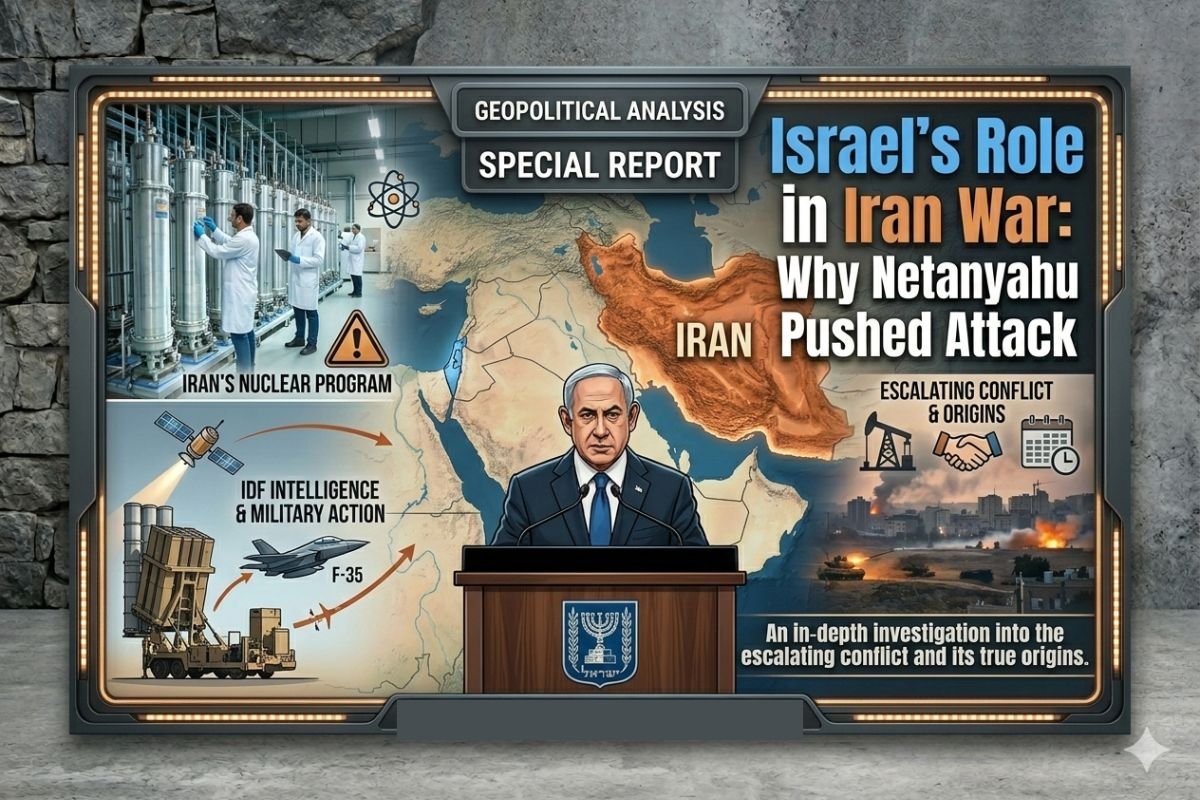
Israel’s Role in Iran War: Why Netanyahu Pushed for Attack

Why Netanyahu Pushed for Iran Attack | Israel's Role Explained

On February 28, 2026, the world woke up to a dramatic escalation in the Middle East. Israel and the United States launched coordinated airstrikes against multiple targets across Iran—an operation described by the Israel Defense Forces as the largest in the Israeli Air Force’s history . Explosions rocked Tehran, and within hours, Iran retaliated with missile strikes toward Israel and US bases across the Gulf .

The Man Who Made Iran His Life’s Mission

To understand why Israel attacked, you have to understand Benjamin Netanyahu. He hasn’t just been a prime minister dealing with Iran as one issue among many—he has made confronting Iran the defining mission of his political career .

For more than three decades, Netanyahu has portrayed Iran’s Islamic regime as an existential threat to Israel—not just a strategic rival, but a modern-day incarnation of the enemies that sought to destroy the Jewish people throughout history. He has repeatedly likened Iran’s leaders to Hitler’s Germany, arguing that their genocidal rhetoric (“wiping Israel off the map”) must be taken literally and seriously .

In Netanyahu’s worldview, a nuclear-armed Iran is not a problem to be managed or contained. It’s a red line that must never be crossed. He has argued this at the United Nations, in speeches to the US Congress, and in countless interviews over three decades.

So when Israel and the US launched Operation Lion’s Roar (the Israeli name) and Operation Epic Fury (the US name), Netanyahu was finally taking the shot he had been positioning himself for his entire career .

The October 7 Earthquake: Why Deterrence Died

But 2026 is different from previous years—and that difference has a name: October 7.

When Hamas launched its devastating attack on October 7, 2023, it didn’t just start a war in Gaza. It shattered a foundational assumption that had guided Israeli strategic thinking for years: that enemies could be managed, contained, and deterred .

For a decade, Israel had tolerated dangerous capabilities from its enemies, believing that so long as intentions appeared constrained, the threat could be managed. Hamas had rockets, but they were mostly intercepted. Hezbollah had missiles, but they stayed north of the border. Iran had proxies, but they operated at a distance.

October 7 demolished that premise .

“The lesson drawn across Israel’s political and security establishment was clear: you do not allow a sworn enemy to accumulate the capacity to destroy you and trust that deterrence will indefinitely hold,” wrote analysts at The Jerusalem Post .

Hamas was a proxy. Hezbollah is a proxy. At the center of that network sits Iran—the architect, financier, trainer, and supplier . If the massacre exposed the cost of underestimating a proxy’s intent, it sharpened attention on the patron’s capabilities.

There’s a deep irony here that analysts have noted: Yahya Sinwar, the Hamas leader, sought to derail Israel’s normalization in the region and restore the “axis of resistance” to center stage. He wanted to light a fire. He did—but the flames didn’t consume Israel as he had hoped. They consumed Gaza, then spread to Lebanon, and now they have drawn Israel and the United States into direct confrontation with the regime that empowered him .

A Window of Opportunity: Iran’s Vulnerability

Timing matters in war. Israel and the US didn’t attack now by accident. They saw a strategic window .

Iran in early 2026 is genuinely vulnerable:

  • Economic crisis: Severe sanctions and mismanagement have crippled the economy .
  • Domestic dissent: The regime has faced waves of protests, most recently in January 2026, and has demonstrated its willingness to shoot and kill thousands of fellow citizens to stay in power .
  • Military degradation: Iran’s defenses are still badly damaged from the 12-day war with Israel in June 2025 .
  • Proxy network weakened: Israel’s campaigns since October 7 have severely degraded Hamas, Hezbollah, and Iranian assets across the region .

BBC’s international editor Jeremy Bowen put it bluntly: “Israel and the United States have calculated that the Islamic regime in Iran is vulnerable… Their conclusion seems to have been that this was an opportunity that should not be squandered” .

In other words, this is a war of choice, not a response to an imminent threat. The word “pre-emptive” was used in official statements, but the evidence suggests this is about seizing a moment of Iranian weakness .

The Nuclear Factor: Red Lines and Broken Talks

Iran’s nuclear program has always been the core of the conflict. Iran insists it has no intention of building a bomb—a position repeated for years . But it has enriched uranium to levels that have no civilian use, and at minimum, it seems to want the option of building a weapon .

Talks between Washington and Tehran had been ongoing, mediated by Oman. A new round in Geneva had just ended on Thursday—two days before the strikes .

What happened in those talks? Analysts point to a fundamental disconnect. “Iran believes it made great concessions, but that clashed sharply with US and Israeli views,” one analyst told CGTN. “Continuing talks would be a waste of time” .

US President Donald Trump had set a 10-15 day deadline for meaningful diplomatic progress. When that deadline passed without a breakthrough, military pressure became the chosen path . Some analysts go further, arguing that “the negotiations were completely a smokescreen”—that the military buildup was already in place and the decision to strike was made regardless of diplomatic outcomes .

Either way, the nuclear program remains the stated justification. Netanyahu said plainly: the “murderous terror regime” in Tehran must not be armed with nuclear weapons capable of threatening “all of humanity” .

Regime Change: The New, Ambitious Goal

Here’s where this conflict differs from previous rounds. The goal now appears to be not just nuclear containment, but regime change .

In a video message, Netanyahu called on Iran’s diverse ethnic groups—Persians, Kurds, Azeris, Baloch, Ahwazi—to throw off “the yoke of tyranny” and establish a “free and peace-loving Iran” . Trump went further: “When we are finished, take over your government. It will be yours to take. This will be, probably, your only chance for generations” .

Nothing would burnish Netanyahu’s legacy more than toppling the Islamic Republic . It would be the ultimate validation of his decades-long crusade.

But analysts warn this is enormously ambitious—and enormously risky . Iran is a nation of 93 million people, with around 15 million considered devoted supporters of the Supreme Leader, backed by well-armed security forces . Decapitating leadership doesn’t automatically trigger a popular uprising. And if the regime fights for its life, it has nothing left to lose .

As one former Israeli intelligence official put it: “Let’s assume the people won’t go into the streets, and the supreme leader is still alive, and Iran will continue launching missiles. Then what? You can continue the war for how long?” 

Domestic Politics: Netanyahu’s Election Calculus

We can’t ignore the political dimension. Israel faces a general election later in 2026 . Netanyahu’s political position has been weakened by the costly two-year war with Hamas and the trauma of October 7 .

History shows that Israeli leaders often benefit politically when the nation is at war. The 2023-2025 Gaza war demonstrated that Netanyahu “believes his political position strengthens when Israel is at war” .

Analysts note that Netanyahu has “strong incentives to sustain a posture of external confrontation, which can consolidate political support and prolong his governing viability” . A major military win—especially one that neutralizes Iran’s nuclear threat or even topples the regime—would dramatically reshape the electoral landscape in his favor.

This doesn’t mean the war is only about domestic politics. The strategic threats are real. But political timing is rarely coincidental in the Middle East.

The US-Israel Alignment: Hand in Glove

Previous Israeli strikes faced US opposition. In 1956, Eisenhower forced a withdrawal. In 1967, Johnson warned Israel would stand alone . In June 2025, the US participated but played a supporting role, mainly “under Israel’s persuasion” .

This time is different. Washington and Jerusalem acted together, “hand in glove,” with extensive coordination and two US carrier strike groups deployed to the region . The US is playing the main role, and the scale and targets have expanded significantly .

Trump framed Iran not as Israel’s problem alone, but as a wider threat to global security . This alignment gives Israel strategic depth it has rarely enjoyed in past confrontations.

The Risks: A War That Could Spiral

For all the confidence, the dangers are enormous. Iran has already struck US bases in Qatar, Kuwait, UAE, Bahrain, and Jordan . The Strait of Hormuz—a chokepoint for global energy supplies—is now a potential flashpoint .

Analysts warn that a “single misinterpreted strike, an overzealous militia commander, or a cyber operation that crosses an unseen red line could ignite a chain reaction” . Unlike last June’s limited exchange, this conflict carries “significantly greater escalation” risks .

If the regime genuinely fears for its survival, Iranian allies in Lebanon, Yemen, and Iraq could join the fight in earnest . What began as an air campaign could expand into a broader regional war with unpredictable consequences.

The Bottom Line

So why did Netanyahu push for this attack?

  • Ideological conviction: He has spent his career arguing Iran is an existential threat.
  • October 7 trauma: The assumption that enemies can be deterred is dead.
  • A window of opportunity: Iran is economically weak, domestically divided, and militarily degraded.
  • Nuclear red lines: Diplomacy failed, and Israel won’t accept a nuclear-armed Iran.
  • Regime change ambition: For the first time, this is an explicit goal.
  • Domestic politics: A major win could reshape elections in his favor.

In Netanyahu’s calculation, the stars have aligned. Whether that calculation proves correct—or whether it unleashes consequences nobody can control—is the question that will define the Middle East for years to come.

As one analyst put it: “The current situation is a reaction to years of the Iranian regime’s proxy strategy… Effectively, a strategy meant to keep war at bay has invariably returned home” .

The war is here. And its end is nowhere in sight.

Frequently Asked Questions (FAQs)

1. Did Iran actually attack Israel first, or was this a “pre-emptive” strike?

Israel and the US described their action as “pre-emptive,” but evidence suggests this was a war of choice based on a perceived window of opportunity . Iran had not launched an imminent attack before the US-Israeli strikes, though it did retaliate afterward. Analysts point to the collapse of nuclear talks and Iran’s vulnerabilities—not an imminent threat—as the real triggers .

2. What does Israel hope to achieve militarily?

Israel aims to eliminate Iran’s nuclear threat, degrade its ballistic missile and drone capabilities, and potentially trigger regime change by encouraging internal uprisings . Unlike previous limited strikes, this operation explicitly targets leadership and seeks to create conditions for a new government in Tehran .

3. How is this different from the June 2025 Israel-Iran war?

The scale and goals are dramatically different. Last June’s 12-day war was more limited and Israel-led. This time, the US is playing the main role with two carrier strike groups, targets are expanded to include leadership and infrastructure, and regime change is an explicit—not just implicit—objective .

4. Could this lead to a broader regional war?

Yes, and risks are significantly higher than last year. Iran has already struck US bases across the Gulf . The Strait of Hormuz, global energy supplies, and multiple regional actors could be drawn in. Analysts warn that miscalculation by any party could spiral beyond anyone’s control .

5. What happens if Iran’s Supreme Leader is killed?

Khamenei’s death would trigger a succession battle within Iran’s complex political system. He would likely be replaced by another cleric supported by the IRGC, not a liberal democracy . While succession could create internal turmoil, it doesn’t automatically mean regime collapse. The IRGC remains the ultimate arbiter of power .
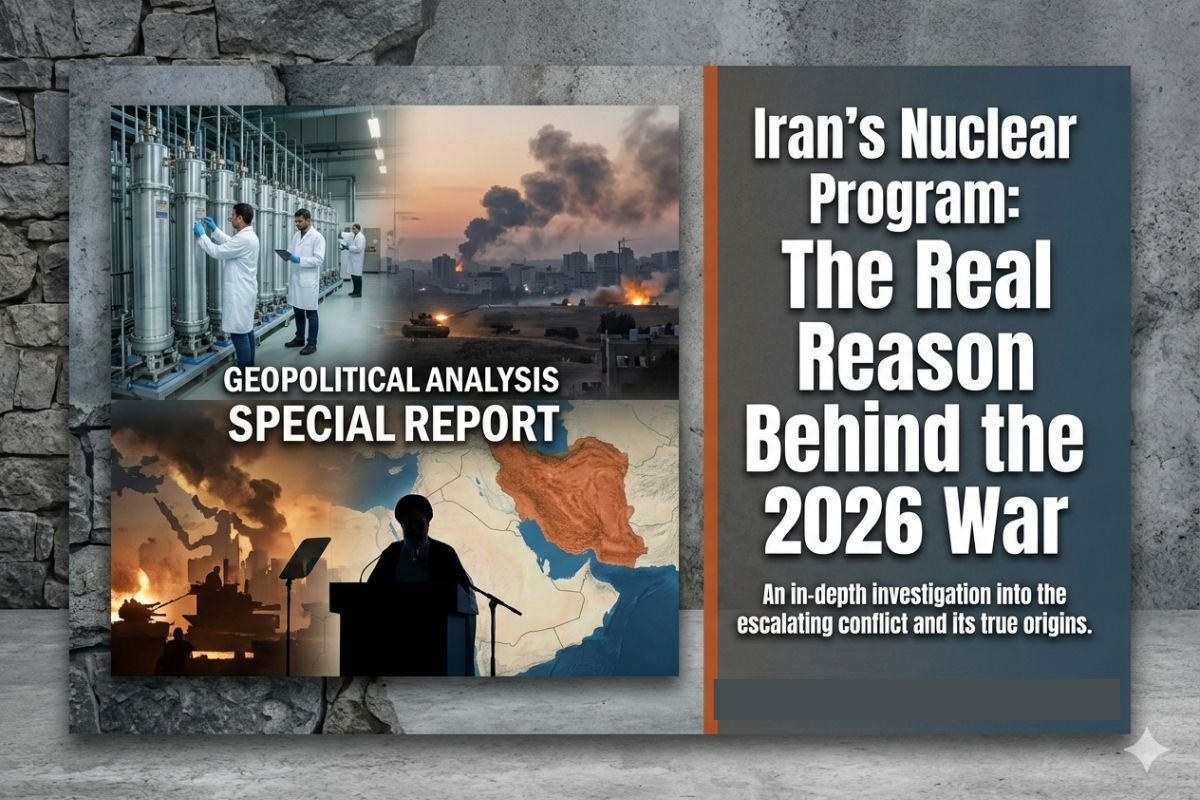
Iran’s Nuclear Program: The Real Reason Behind the 2026 War

Iran's Nuclear Program Explained: The Real Reason Behind 2026 War

In June 2025, the Middle East erupted into its most devastating conflict in decades. Israel launched strikes on Iran’s nuclear facilities, triggering a 12-day war that drew the United States into direct military action against Iranian targets . By early 2026, tensions remained sky-high, with a massive US naval buildup in the region and urgent diplomatic efforts to prevent further escalation .

A Quick History: How Did We Get Here?

Iran’s nuclear story didn’t start with conflict. In fact, it began with American support.

The 1950s-1970s: Friends with Benefits
The United States actually launched Iran’s nuclear program in 1957 under the Western-friendly Shah . Iran began developing nuclear power in the 1970s with US backing. But everything changed with the 1979 Islamic Revolution, which transformed Iran into an Islamic Republic and turned former allies into adversaries .

The 2000s: Suspicion Grows
In 2002, international inspectors discovered secret nuclear facilities in Iran—a violation of the Nuclear Non-Proliferation Treaty (NPT), which Iran had signed . The NPT allows countries to develop nuclear technology for peaceful purposes (medicine, agriculture, energy) but explicitly bans developing nuclear weapons . This discovery triggered years of international sanctions.

2015: The Nuclear Deal (JCPOA)
After years of negotiations, Iran and six world powers (US, China, France, Russia, Germany, UK) agreed to the Joint Comprehensive Plan of Action—the JCPOA . Under this deal:

  • Iran could only enrich uranium to 3.67% (enough for civilian power, not bombs)
  • Iran’s uranium stockpile was capped at 300kg
  • International inspectors gained access to all nuclear facilities
  • In return, economic sanctions were lifted 

2018: The Deal Collapses
President Donald Trump withdrew the US from the JCPOA, calling it a “bad deal” that wasn’t permanent and didn’t address Iran’s missile program . He reimposed crippling sanctions as part of a “maximum pressure” campaign.

Iran’s Response: Escalation
In retaliation, Iran began breaching the deal’s limits—installing advanced centrifuges, increasing enrichment levels, and growing its uranium stockpile . By 2023, the IAEA found uranium particles enriched to 83.7% purity—just below weapons-grade .

What Is Uranium Enrichment? (And Why Does It Matter?)

To understand the crisis, you need to understand enrichment. Let’s keep it simple.

Natural uranium is mostly uranium-238 (about 99.3%), which isn’t useful for nuclear reactions. Only about 0.7% is uranium-235—the special type that can release energy .

Enrichment is the process of increasing the concentration of uranium-235. It’s done by spinning uranium gas at high speeds in machines called centrifuges, which separate the lighter uranium-235 from the heavier uranium-238 .

The Key Levels:

  • 3.67% enrichment: Enough for nuclear power plants (the JCPOA limit)
  • 20% enrichment: Considered the threshold for weapons capability
  • 60% enrichment: Not bomb-grade, but dangerously close—and no country has uranium at this level without a weapons program, according to the IAEA 
  • 90% enrichment: Weapons-grade—what you need for an actual nuclear bomb 

Think of it like boiling water. 60% isn’t boiling yet, but you’re certainly getting the kettle hot. And the journey from 60% to 90% is much faster than from 0% to 60%.

How Close Is Iran to a Nuclear Bomb?

This is the million-dollar question. Here’s the 2026 reality.

Current Stockpile:
As of early 2026, Iran has approximately 275kg of uranium enriched to 60% purity . According to IAEA yardsticks, that’s theoretically enough—if enriched further—for about half a dozen nuclear weapons .

Breakout Time:
“Breakout time” is how long Iran would need to produce enough weapons-grade material for one bomb. US officials estimate Iran could turn its 60% stockpile into weapons-grade material in as little as one week . However, building an actual deliverable weapon would take longer—estimates range from six months to 18 months .

But Does Iran Want a Bomb?
Iran insists it does not. Supreme Leader Ali Khamenei has issued a religious decree (fatwa) against nuclear weapons, and Iran maintains its program is for peaceful energy purposes . A senior advisor recently stated that if not making nuclear weapons is the main issue, “an immediate agreement is within reach” .

However, Western countries remain deeply skeptical. The IAEA has declared Iran in breach of its non-proliferation obligations, and the combination of high enrichment levels, restricted inspector access, and past secret facilities fuels suspicion .

The 2025 War: What Actually Happened?

In June 2025, after years of shadow war and rising tensions, Israel launched a major military operation against Iran’s nuclear infrastructure .

The Strikes:

  • Israeli forces targeted Natanz—Iran’s largest uranium enrichment facility—setting it ablaze 
  • Six Iranian nuclear scientists were killed 
  • The United States joined the conflict, dropping massive bunker-buster bombs on two underground nuclear facilities and striking a third with submarine-launched missiles 

The Aftermath:

  • Iran launched waves of missiles at Israel in retaliation 
  • At least 610 civilians were killed in Iran, with thousands wounded 
  • Iran suspended some cooperation with the IAEA and restricted inspectors from accessing bombed sites 
  • A ceasefire was declared after 12 days of fighting 

The Damage Debate:
How much damage was actually done? Opinions differ dramatically:

  • President Trump claimed the strikes set Iran’s program back by “decades” 
  • Israel’s military said it had delayed the program “by several years” 
  • Leaked US intelligence suggested the damage was much less—just a few months’ setback, with centrifuges and enriched uranium stockpiles not fully eliminated 

The 2026 Crisis: Why War Threatens Again

Despite the ceasefire, 2026 has brought renewed tensions. Here’s what’s happening now.

The Military Build-Up:
President Trump has deployed a massive naval force to the region—what he calls an “armada”—including two aircraft carrier strike groups (USS Abraham Lincoln and USS Gerald Ford) . Iran has responded with its own military drills in the Gulf and around the strategic Strait of Hormuz .

The Diplomatic Dance:
Multiple rounds of indirect talks, mediated by Oman, have been held in Geneva . Both sides have presented “practical proposals” covering nuclear issues and sanctions relief .

The Key Disagreement:

  • The US position: Trump demands “zero enrichment”—the full dismantlement of Iran’s nuclear program, including enrichment, weaponization, and ballistic missiles 
  • Iran’s position: Foreign Minister Abbas Araghchi says the US has not actually asked for zero enrichment in negotiations, and Iran is willing to guarantee its program remains peaceful—but not to abandon enrichment entirely 

A Potential Breakthrough?
On February 27, 2026, Oman’s Foreign Minister announced that Iran has agreed “never again to possess nuclear materials that could be used to make a nuclear bomb” . Under this framework:

  • Existing enriched uranium would be diluted in purity and converted into fuel in an irreversible process
  • Iran would allow IAEA inspectors “full access” to its nuclear facilities
  • The agreement could take up to three months to implement 

If confirmed, this would represent a major diplomatic victory—but skepticism remains about whether it will hold.

The Regional Reaction: Who Stands Where?

The conflict has exposed deep global divisions.

US Allies (UK, Germany, France): They did not participate in the strikes and didn’t explicitly condemn them, but their statements placed blame on Iran, urging it to end its nuclear program .

Russia: Strongly condemned the US and Israel, calling it “premeditated armed aggression,” but offered only words, not concrete support .

China: Expressed “high concern” and warned of unpredictable consequences, but stopped short of strong action .

Saudi Arabia: Perhaps most significantly, Riyadh—which had been pursuing rapprochement with Tehran—threw its weight behind Gulf allies, condemning Iranian attacks on their territories and offering its capabilities for their defense . This represents a major strategic setback for Iran.

So, What’s the Real Reason Behind the 2026 War?

After all this, here’s the honest answer: Iran’s nuclear program is the trigger, but not the root cause.

The real reasons run deeper:

1. Red Lines Crossed
For Israel, a nuclear-armed Iran is an existential threat. Iranian leaders have repeatedly called for Israel’s destruction. From Jerusalem’s perspective, allowing Tehran to reach weapons capability is simply unacceptable .

2. The Deal Died
The JCPOA created a framework for containment. When the US withdrew in 2018, that framework collapsed—and no viable alternative emerged. Both sides blame each other, but the result is the same: escalation .

3. Trust Is Dead
Decades of shadow war, secret facilities, and broken promises mean neither side trusts the other. Iran doesn’t believe US guarantees. The US and Israel don’t believe Iran’s peaceful intentions. Without trust, diplomacy struggles .

4. Regional Rivalry
The Iran-Saudi Arabia cold war, the Israel-Iran proxy conflicts across the region, and the struggle for dominance in the Gulf all feed into the nuclear crisis. It’s never just about the bomb .

What Happens Next?

As of March 2026, the world watches three scenarios unfold:

Scenario A: Diplomatic Breakthrough
The Oman-mediated framework holds. Iran dilutes its uranium, opens its facilities, and sanctions are gradually lifted. Peace holds—for now .

Scenario B: Managed Tension
Talks drag on. Both sides continue posturing, but avoid all-out war. The US armada remains in the region. Iran enriches but stops short of weaponization. A tense, cold peace continues.

Scenario C: Renewed Conflict
Diplomacy fails. Trump’s 15-day ultimatum expires. The US and Israel strike again—this time harder. Iran retaliates. The region spirals into wider war .

The next few weeks will determine which path we take.

Conclusion

Iran’s nuclear program is one of the most complex, high-stakes issues in global politics. It’s a story of shifting alliances, broken deals, genuine security concerns, and profound mistrust.

Understanding the enrichment levels, the breakout timelines, and the historical context doesn’t make the situation simpler—but it does make it clearer. And in a world where misinformation spreads faster than facts, clarity matters.

Whether you’re following from the Gulf, tracking for work, or simply trying to make sense of the headlines, knowing what’s really happening with Iran’s nuclear program is the first step toward understanding what comes next.


Frequently Asked Questions (FAQs)

1. Does Iran currently have a nuclear bomb?

No. International assessments, including by the US intelligence community, confirm that Iran’s nuclear program is not currently weaponized . However, Iran has enough 60%-enriched uranium that, if further enriched to 90%, could theoretically produce multiple weapons .

2. How close is Iran to being able to build a bomb?

The “breakout time”—producing enough weapons-grade material for one bomb—is estimated at one to two weeks starting from Iran’s current 60% stockpile . Building an actual deliverable weapon would take longer: estimates range from six months to 18 months .

3. Why did the US withdraw from the nuclear deal in 2018?

President Trump called the JCPOA a “bad deal” because it wasn’t permanent, didn’t address Iran’s ballistic missile program, and didn’t restrict Iran’s regional activities. He sought to negotiate a new, expanded agreement through “maximum pressure” sanctions .

4. Can Iran enrich uranium for peaceful purposes without building a bomb?

Technically, yes. Many countries enrich uranium for nuclear power. But Iran’s enrichment to 60%—far beyond the 3.67% needed for power plants—is what raises alarm. The IAEA states that no country has uranium at this level without also having a weapons program .

5. What would it take to reach a new agreement?

The key sticking point is enrichment. The US demands “zero enrichment”—full dismantlement. Iran insists on maintaining some enrichment capability but has offered guarantees it will never seek weapons. The Oman-mediated framework announced in late February 2026 suggests Iran may have agreed to eliminate weapons-grade material in exchange for verified peaceful use .

Post a Job Opening

Fill in the details below. Your job posting will be reviewed by our team.

Basic Information

Specify years of experience required

Location & Salary

Qualifications & Skills

Specify educational requirements
Separate skills with commas

Company Details

Job Details

Contact Information