
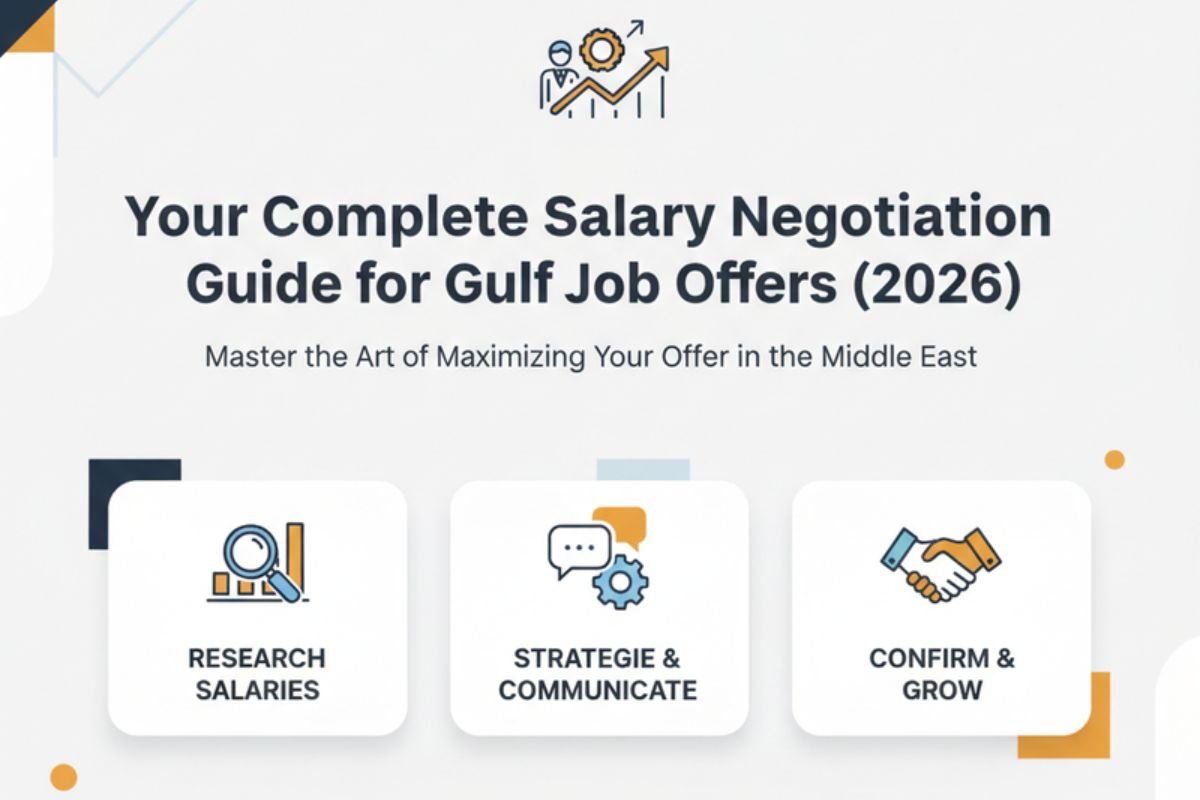
How you handle this question in a Gulf job interview can mean the difference between landing a package that sets you up for years, or leaving thousands on the table. The good news? Salary negotiation in the UAE, Saudi Arabia, and Qatar follows predictable rules. Learn them, and you’ll negotiate with confidence.
Step 1: Do Your Homework Before the Interview
Preparation is everything. Before any Gulf job interview, you need to know what you’re worth in today’s market.
Research market rates. The 2026 salary landscape shows modest increases across the region—around 4.1% in the UAE and 4.6% in Saudi Arabia . But averages hide big differences. Specialist roles in technology, finance, and project management are seeing 5-9% increases .
Know the sectors that are hiring. Financial services, industrial sectors, banking, real estate, and technology are leading salary growth in 2026 . If you’re in these fields, you have stronger negotiating power.
Understand total compensation. Gulf packages often include:
- Base salary
- Housing allowance (a major component)
- Transport allowance
- Annual flight tickets home
- Education allowance for children
- Health insurance
- Bonus potential (typically 2-3 months’ salary)
Step 2: Master the “Salary Expectations” Question
This is the moment most candidates dread. Here’s how to handle it professionally.
If they ask early in the process: deflect politely.
“I’d be happy to discuss salary once we’ve both confirmed there’s a good fit and I fully understand the scope of the role. Could you share the budgeted range for this position?”
This approach—asking about their budget first—puts you in a stronger position . If their range aligns with your expectations, you’re set. If it’s lower, you can decide whether to continue or politely withdraw.
If they insist on a number: provide a range.
“I’m looking for a package between AED 25,000 and AED 30,000 per month, with flexibility based on the total benefits and role scope.”
Notice the strategy: your ideal figure is at the lower end, showing flexibility while anchoring the conversation where you want it .
Step 3: Know What NOT to Say
Avoid these common mistakes that can cost you thousands.
Never say: “I’m flexible—whatever you think is fair.”
This signals you haven’t done research and gives away your power. Employers may offer well below market rate .
Never get personal: “I need this job because I have rent to pay.”
Shift the conversation from your needs to your value. Focus on what you’ll contribute .
Never respond emotionally: “That’s not enough.”
Instead, say: “Thank you for the offer. Based on my research and the responsibilities we discussed, I was hoping for something closer to X. Is there flexibility?”
Step 4: Consider the 2026 Market Realities
The Gulf job market in 2026 has some unique dynamics that affect negotiation.
Skills shortages work in your favor. With 90% of employers reporting skills gaps, qualified professionals are in demand . Roles in project management, data science, AI, and engineering are especially hard to fill .
AI skills matter. Around 66% of professionals now use AI regularly at work . Showing genuine AI capability—without exaggerating—can strengthen your position .
Nationalization targets are real. In the UAE, Emiratisation targets for skilled roles are now 10%, with 42% of companies planning to increase Emirati hires . In Saudi Arabia, 93% of employers already hire Saudi nationals, and 75% plan further increases . If you’re an expat, emphasize how you’ll support and develop local talent.
Job switching is common. Nearly 98% of professionals are open to new roles in 2026 . Employers know this, so they’re often willing to negotiate to secure top talent.
Step 5: Negotiate the Whole Package
Salary is important, but don’t overlook other elements that can add significant value.
Housing and transport allowances can be negotiated separately. In Saudi Arabia, family-related benefits (visas, medical cover, flights) are highly valued by 70% of professionals .
Flexible working matters more than ever. Nearly half of professionals rank time-off and flexibility as top benefits . If the base salary is firm, ask about remote work options or additional leave.
Bonuses and reviews. Ask about performance bonus structures (typically 2-3 months’ salary) and when your first salary review will happen .
Step 6: Handle the Offer Professionally
When the offer arrives, here’s your script:
“Thank you for the offer. I’m very excited about this role and the team. I’d like to take 24-48 hours to review the full package carefully.”
Never accept on the spot. Even if you’re thrilled, taking time shows you’re thoughtful and gives you space to prepare counter-arguments.
When you counter, be specific:
“Based on my 8 years of experience and current market rates for this role in Dubai, I was hoping for a base salary of AED 28,000. Is that achievable within your budget?”
Common Questions, Answered
Is negotiation expected in the Gulf?
Yes. Employers often start with a conservative offer, expecting candidates to negotiate professionally .
What if they say the budget is fixed?
Ask about other elements: signing bonus, earlier review date, additional leave, or professional development budget.
How transparent should I be about my current salary?
Be honest about your current package, including all components. Transparency builds trust .
When is the best time to negotiate?
After you’ve received a formal offer, but before you’ve accepted. That’s when you have maximum leverage.
Final Thought: You’re Worth It
Negotiation isn’t rude—it’s expected. In the Gulf’s competitive 2026 job market, employers want candidates who know their worth and communicate it professionally.
Do your research, stay confident and polite, and remember: the best time to negotiate your lifetime earnings is right now, before you accept.
Your next opportunity is waiting. Go get what you deserve.
Frequently Asked Questions (FAQs)
1. What’s the average salary increase in the Gulf for 2026?
2. How do I research fair salaries before a Gulf job interview?
Use resources like the Hays GCC Salary Guide (covering 400+ roles), Korn Ferry forecasts, and platforms like Bayt.com‘s salary calculator . Talk to recruiters and professionals in your network who know the local market.
3. What should I do if the initial offer is below my expectations?
Thank them politely, then respond with: “Based on my research and the responsibilities we discussed, I was hoping for something closer to X. Is there flexibility in the budget?” This invites conversation rather than confrontation
4. Are housing and transport allowances negotiable?
Yes. In fact, these are often separate line items in Gulf compensation packages. If base salary is firm, focus negotiations on allowances, bonuses, annual flights, or education benefits