Gulf Careers Hub

Decoding Your Offer Letter: Key Clauses to Check Before Accepting a Job in the Gulf

Decoding Gulf Job Offer Letters | Key Clauses Every Professional Must Check

The Gulf region — including the United Arab Emirates, Saudi Arabia, Qatar, Kuwait, Bahrain, and Oman — is one of the most attractive destinations for professionals worldwide. With tax-free salaries, modern infrastructure, and diverse workforces, thousands of job seekers relocate to the Gulf every year.

But before you pack your bags, there’s one critical step you must not overlook: reading and understanding your offer letter.

An offer letter is more than a formality. It’s a legally binding document that outlines your rights, responsibilities, and benefits as an employee. Many professionals, eager to secure a Gulf role, skim through the details and sign quickly. This can lead to misunderstandings, disputes, or even early resignation.

Why Offer Letters Matter in the Gulf

  • Legal binding: Once signed, your offer letter becomes part of your employment contract.
  • Visa processing: The details in your offer letter are used for work permit and residency applications.
  • Employer expectations: Clauses define your role, responsibilities, and performance standards.
  • Employee rights: Benefits, allowances, and termination conditions are all governed by the offer letter.

Clause 1: Job Title and Responsibilities

Your offer letter should clearly state your job title and a summary of responsibilities.

  • Ensure the title matches what was discussed during interviews.
  • Vague descriptions can lead to role confusion.
  • If responsibilities are too broad, clarify before signing.

Tip: A mismatch between your expectations and the employer’s description can cause frustration later.

Clause 2: Salary and Allowances

Salary packages in the Gulf are often structured differently than in other regions.

  • Base Salary: Usually tax-free, but confirm the currency (AED, SAR, QAR, or USD).
  • Housing Allowance: Many companies provide accommodation or a monthly allowance.
  • Transportation Allowance: Check if commuting costs are covered.
  • Education Allowance: Important for employees with children.
  • Annual Bonus: Some firms offer performance-based bonuses.

Tip: Calculate the total package value, not just the base salary.

Clause 3: Benefits and Perks

Benefits can significantly impact your quality of life in the Gulf.

  • Medical Insurance: Confirm if coverage extends to dependents.
  • Annual Flights: Many employers pay for return flights to your home country.
  • Leave Policy: Compare annual leave days and public holiday entitlements.
  • End-of-Service Gratuity: Mandatory in most Gulf countries, calculated based on years of service.

Tip: A lower salary with strong benefits may be better than a higher salary with minimal perks.

Clause 4: Contract Duration and Renewal

Most Gulf contracts are fixed-term, typically 2–3 years.

  • Check the duration and renewal conditions.
  • Understand whether renewal is automatic or requires renegotiation.
  • Clarify probation period terms (usually 3–6 months).

Tip: During probation, termination is easier for both parties.

Clause 5: Working Hours and Overtime

Work hours in the Gulf can differ from your home country.

  • Standard hours: 40–48 per week, depending on the country.
  • Ramadan hours: Reduced for Muslim employees.
  • Overtime: Clarify rates and eligibility.

Tip: Ensure overtime policies are clearly stated to avoid disputes.

Clause 6: Termination and Notice Period

Termination clauses define how either party can end the contract.

  • Notice Period: Usually 30–90 days.
  • Termination Conditions: Check if termination is possible during probation without notice.
  • Severance Pay: Understand entitlements if terminated after probation.

Tip: A longer notice period provides more security but may limit flexibility.

Clause 7: Non-Compete and Mobility Clauses

Some Gulf employers include restrictions on future employment.

  • Non-Compete: May prevent you from joining competitors for a set period.
  • Geographic Restrictions: Some clauses limit where you can work after leaving.
  • Internal Mobility: Clarify if transfers within the company are possible.

Tip: Seek clarification on restrictive clauses before signing.

Clause 8: Relocation and Visa Sponsorship

Your offer letter should outline relocation support.

  • Visa Sponsorship: Confirm the employer will handle work permit and residency.
  • Relocation Allowance: Some companies cover moving expenses.
  • Family Sponsorship: Check if dependents are included.

Tip: Ensure visa sponsorship is explicitly mentioned to avoid complications.

Clause 9: Performance Evaluation

Performance reviews affect promotions and bonuses.

  • Clarify how often evaluations occur.
  • Understand criteria for promotions and salary increases.
  • Check if performance targets are realistic.

Tip: Ask about career development opportunities during discussions.

Clause 10: Governing Law and Jurisdiction

Offer letters in the Gulf often specify which country’s labor laws apply.

  • UAE, Saudi Arabia, and Qatar each have distinct labor laws.
  • Disputes are resolved under local jurisdiction.
  • Ensure you understand the governing law before signing.

Tip: Familiarize yourself with basic labor rights in the country of employment.

Summary Table of Key Clauses

ClauseWhat to CheckWhy It Matters
Job TitleMatches interview discussionPrevents role confusion
Salary & AllowancesBase + housing + transportTotal package value
BenefitsInsurance, flights, leaveQuality of life
Contract DurationTerm length, probationStability and renewal
Working HoursWeekly hours, overtimeWork-life balance
TerminationNotice period, severanceSecurity and flexibility
Non-CompeteRestrictions on future jobsCareer mobility
RelocationVisa sponsorship, family supportSmooth transition
PerformanceEvaluation criteriaCareer growth
Governing LawApplicable labor lawsLegal protection

Common Mistakes to Avoid

  • Signing without reading the fine print.
  • Ignoring probation period terms.
  • Overlooking benefits in favor of salary.
  • Accepting restrictive non-compete clauses.
  • Failing to confirm visa sponsorship.

FAQs

Can I negotiate my Gulf offer letter?

Yes. Employers expect some negotiation, especially around allowances and benefits. Be respectful and realistic.

What happens if I resign during probation?

You may be required to give short notice or none at all, depending on the contract.

Is end-of-service gratuity mandatory in the Gulf?

Yes, but calculation methods vary by country. It’s based on years of service.

Should I worry about non-compete clauses?

Yes. They can restrict future opportunities. Clarify terms before signing.

How do I verify if benefits apply to dependents?

Ask HR directly and request written confirmation in the offer letter.

Final Thoughts

Your offer letter is the foundation of your employment in the Gulf. It defines your rights, responsibilities, and future career path. By carefully reviewing clauses on salary, benefits, contract terms, and legal jurisdiction, you can avoid unpleasant surprises and ensure a smooth transition.

Remember: a job in the Gulf is not just a career move — it’s a life-changing decision. Take the time to decode your offer letter, ask questions, and negotiate where necessary. The right preparation will set you up for success in one of the world’s most dynamic regions.
10 In-Demand Jobs in Dubai That Don’t Require Arabic Language Skills (October 2025 Edition)

10 Dubai Jobs That Don’t Require Arabic – Apply Now (October 2025)

Dubai is one of the most multicultural cities in the world, with over 85% of its population made up of expatriates. English is the dominant language in business, hospitality, retail, and tech — making it possible to thrive professionally without knowing Arabic.

Whether you’re a fresh graduate, a skilled technician, or a seasoned executive, Dubai offers a wide range of roles where English fluency is more than enough.

Eligibility Overview

Most of the jobs listed below require:

  • English fluency (spoken and written)
  • Relevant qualifications or certifications
  • 1–5 years of experience (some entry-level roles available)
  • Valid passport and visa status
  • Willingness to relocate or work flexible hours

💬 Note: Arabic is a plus in customer-facing roles but not mandatory.

1. Admin Assistant – Dubai

Company: Confidential
Salary: AED 4,000–6,000/month
Apply Link:

2. Customer Service Executive – Dubai

Company: Confidential
Salary: AED 5,000–7,000/month
Apply Link:

3. Document Controller – Dubai

Company: Confidential
Salary: AED 6,000–8,000/month
Apply Link:

4. Cashier / Sales Assistant – UAE

Company: Retail Group
Salary: AED 3,500–4,500/month
Apply Link:

5. Room Attendant – Dubai

Company: Retaj Hotels & Hospitality
Salary: AED 3,000–4,000/month
Apply Link:

6. Technician – Dubai

Company: Retaj Hotels & Hospitality
Salary: AED 4,000–5,500/month
Apply Link:

7. IT Support – Dubai

Company: Hospitality Group
Salary: AED 6,000–8,000/month
Apply Link:

8. Chef / Cook – Dubai

Company: Retaj Hotels & Hospitality
Salary: AED 4,000–6,000/month
Apply Link:

9. Education Coordinator – Dubai

Company: International School
Salary: AED 10,000–12,000/month
Apply Link:

10. Real Estate Agent – Dubai

Company: Confidential
Salary: Commission-based
Apply Link:

Salary Overview

Job TitleMonthly Salary (AED)Language Requirement
Customer Service Rep5,000–7,000English only
Real Estate AgentCommission-basedEnglish only
Digital Experience Lead18,000–22,000English only
Patient Care Nurse6,000–9,000English only
Account Manager12,000–15,000English only
Retail Sales Associate3,500–4,500English only
HR Executive8,000–10,000English only
HVAC Technician2,800–4,000English only
IT Support Specialist6,000–8,500English only
Education Coordinator10,000–12,000English only

Visa Sponsorship & Work Permits

Most companies in Dubai offer visa sponsorship for qualified candidates. Here’s what you need to know:

  • Employment Visa: Sponsored by your employer; valid for 2 years
  • Freelance Visa: Available for creatives, consultants, and tech professionals
  • Golden Visa: For high-income earners, investors, and skilled professionals (10-year validity)
  • Visit Visa to Work Visa: You can convert a visit visa to a work visa if hired while in Dubai

💬 Tip: Always verify visa terms with your employer before signing a contract.

Resume & Cover Letter Tips

To stand out in Dubai’s competitive market:

  • Use a clean, modern layout (A4 size, PDF format)
  • Include a professional summary with your core skills
  • List experience in reverse chronological order
  • Highlight English fluency and international experience
  • Keep it to 1–2 pages max
  • Add a tailored cover letter for each application

💬 Tip: Mention your availability to relocate and your visa status clearly.

Industries Hiring English-Speakers in Dubai

IndustryCommon RolesLanguage Requirement
HospitalityFront Desk, Concierge, WaitstaffEnglish only
RetailSales Associate, CashierEnglish only
TechDeveloper, IT SupportEnglish only
HealthcareNurse, Medical AdminEnglish only
EducationTeacher, CoordinatorEnglish only
Real EstateAgent, Property ConsultantEnglish only
FinanceAnalyst, Account ManagerEnglish only

FAQs

Can I work in Dubai without speaking Arabic?

Yes. Most private sector roles — especially in tech, retail, healthcare, and education — operate in English.

Are these jobs open to international applicants?

Yes. Many companies sponsor visas for qualified candidates.

Is English fluency enough for customer-facing roles?

Absolutely. English is the dominant language in malls, hotels, and service centers.

Do I need certifications for technical roles?

Yes. HVAC, nursing, and IT roles require diplomas or licenses.

Are salaries tax-free in Dubai?

Yes. All salaries listed are tax-free and often include benefits like housing, transport, and insurance.

Can I apply from outside the UAE?

Yes. Many companies conduct virtual interviews and sponsor visas for international hires.

🇰🇼 A Beginner’s Guide to Working in Kuwait: Visa Process, Benefits, and Common Pitfalls

Kuwait Work Visa Guide 2025 – Jobs, Benefits & Pitfalls

Thinking of working in Kuwait but not sure where to start? This guide breaks down everything you need to know — from securing a visa and landing a job to understanding your rights and avoiding common mistakes. Whether you’re aiming for a role in healthcare, construction, or hospitality, Kuwait offers tax-free salaries, stable contracts, and long-term growth. Let’s walk you through the essentials for a smooth transition.

Why Kuwait Is a Top Destination for Foreign Workers

Kuwait remains one of the most attractive Gulf countries for expatriates seeking stable employment, tax-free income, and long-term career growth. With a population of just over 4 million and a strong demand for foreign labor, Kuwait’s economy thrives on sectors like:

  • Oil & gas
  • Construction & infrastructure
  • Healthcare & nursing
  • Education & training
  • Finance & banking
  • Hospitality & retail

In 2025, Kuwait continues to modernize its labor laws, streamline visa processes, and offer competitive packages to skilled and semi-skilled workers from South Asia, Africa, and Southeast Asia.

Kuwait Work Visa: Step-by-Step Process (2025 Update)

According to PSFF Visa Guide, the Kuwait Work Visa process has been standardized in 2025 to reduce delays and eliminate sectoral exemptions.

🔹 Step 1: Secure a Job Offer

You must first receive a formal job offer from a Kuwait-based employer. The offer should include:

  • Job title and description
  • Monthly salary
  • Duration of contract
  • Benefits (housing, transport, medical)
  • Sponsorship confirmation

💬 Tip: Use verified platforms like Bayt, GulfTalent, and Naukrigulf to find legitimate employers.

🔹 Step 2: Employer Applies for Work Permit

Your employer will submit a work permit request to Kuwait’s Ministry of Interior. This includes:

  • Copy of your passport
  • Educational and experience certificates
  • Medical clearance
  • Police clearance
  • Company sponsorship documents

💬 2025 Update: All work permit transfers now carry a flat fee of KD 150, regardless of sector.

🔹 Step 3: Medical & Police Clearance

Before traveling, you must undergo:

  • Medical tests at a GAMCA-approved center (blood test, chest X-ray, etc.)
  • Police clearance certificate from your home country

💬 Tip: Ensure your documents are attested by your country’s Foreign Office and Kuwait Embassy.

🔹 Step 4: Visa Issuance & Travel

Once approved, you’ll receive:

  • Kuwait Work Visa (valid for 1–3 years)
  • Entry permit
  • Flight ticket (if provided by employer)

Upon arrival, your employer will assist with:

  • Residency stamping
  • Emirates ID (Civil ID)
  • Health insurance registration

Types of Jobs Available in Kuwait

SectorCommon RolesMonthly Salary (KWD)
Oil & GasTechnicians, Engineers400–1,200
ConstructionMasons, Electricians, Foremen180–450
HealthcareNurses, Lab Technicians, Doctors350–1,500
EducationTeachers, Coordinators300–900
HospitalityWaiters, Chefs, Housekeeping150–400
RetailCashiers, Sales Staff180–350
Domestic WorkHousemaids, Drivers100–250

💬 Note: Salaries are tax-free and often include housing, food, and transport.

Benefits of Working in Kuwait

✅ 1. Tax-Free Income

Kuwait does not impose income tax on salaries, allowing workers to save significantly.

✅ 2. Free Accommodation & Transport

Most employers provide shared housing and daily transport to work sites.

✅ 3. End-of-Service Benefits

After completing your contract, you’re entitled to a lump-sum gratuity based on years of service.

✅ 4. Family Sponsorship

After 1–2 years of employment, you may be eligible to sponsor your spouse and children.

✅ 5. Healthcare Access

Employees are covered under Kuwait’s public health system or private insurance.

✅ 6. Paid Leave & Holidays

Contracts include annual leave (30 days), public holidays, and sick leave.

Common Pitfalls to Avoid

❌ 1. Accepting Unverified Job Offers

Always confirm job offers through official channels. Avoid agents who promise “guaranteed visas” without paperwork.

❌ 2. Incomplete Documentation

Missing medical or police clearance can delay visa processing or lead to rejection.

❌ 3. Overstaying Visit Visas

Never enter Kuwait on a visit visa intending to work. It’s illegal and can result in fines or deportation.

❌ 4. Ignoring Contract Terms

Read your contract carefully. Ensure salary, working hours, and benefits are clearly stated.

❌ 5. Language Barriers

While English is widely spoken, basic Arabic helps in daily life and workplace communication.

❌ 6. Misunderstanding Sponsorship Rules

You cannot switch jobs freely without your sponsor’s approval or a formal release (NOC).

Cost of Living in Kuwait (2025)

Expense CategoryMonthly Cost (KWD)
Shared AccommodationIncluded or 60–120
Groceries & Dining40–80
Mobile & Internet10–20
Transport (if not provided)15–30
Entertainment20–50

💬 Tip: Most workers save 50–70% of their monthly salary due to employer-covered expenses.

Required Documents Checklist

Before applying, prepare:

  • Valid passport (6+ months)
  • Passport-size photos
  • Educational certificates
  • Experience letters
  • Police clearance
  • Medical report
  • Attested documents
  • Job offer letter
  • Visa application form

FAQs

Can I apply for a Kuwait job from Pakistan, India, or Bangladesh?

Yes. Many employers hire directly or through licensed recruitment agencies.

Is the Kuwait Work Visa open in 2025?

Yes. The visa is active and standardized under new rules. KD 150 is the flat transfer fee.

Do I need Arabic to work in Kuwait?

No. English is sufficient for most roles. Arabic is helpful but not mandatory.

Can I bring my family to Kuwait?

Yes, after meeting salary and residency requirements.

What happens if I lose my job?

You must transfer sponsorship or exit the country within 30 days.

Is there a minimum salary requirement?

Yes. For family sponsorship, you must earn at least KD 500/month.

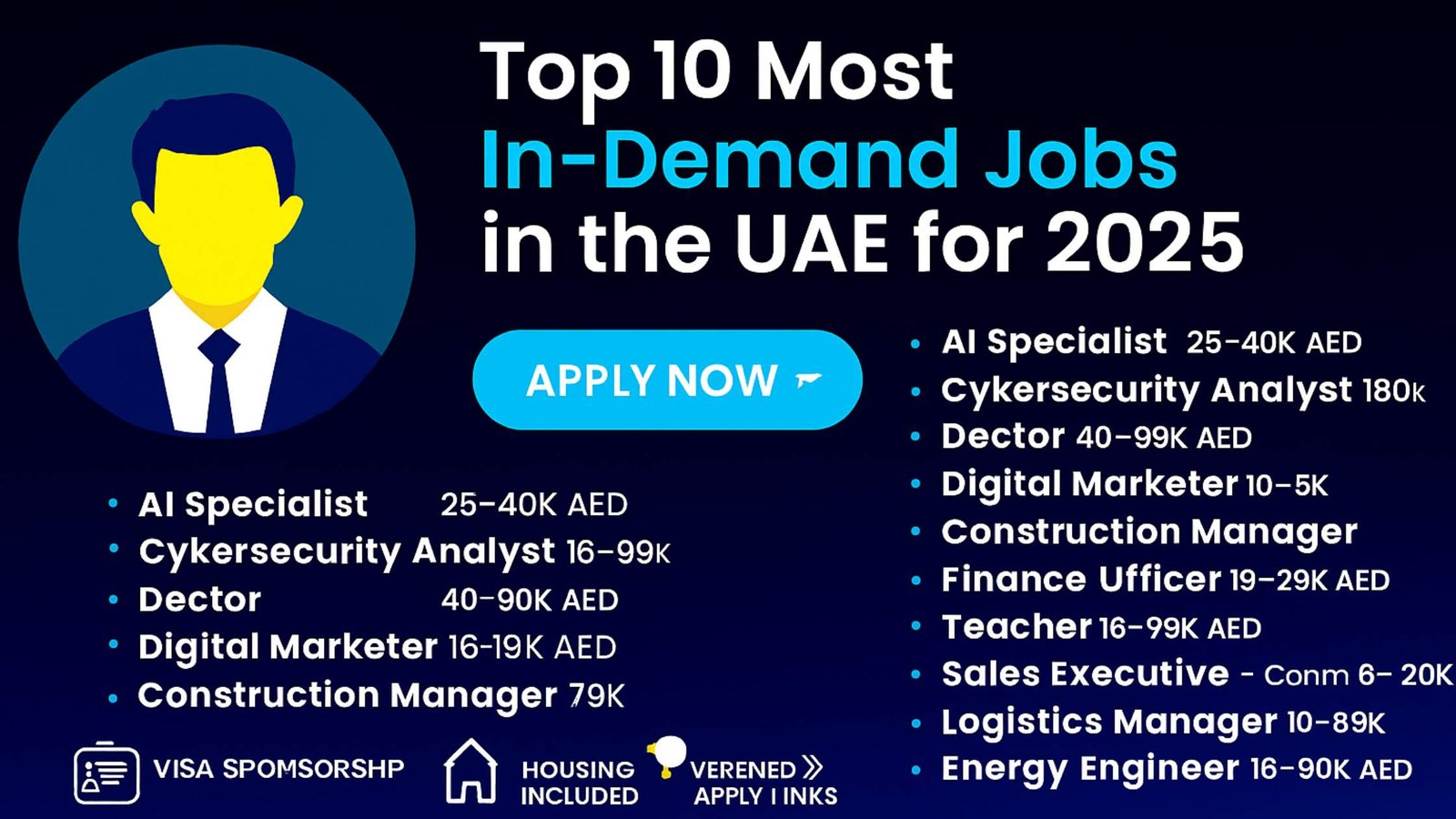
Top 10 Most In-Demand Jobs in the UAE for 2025 (And What They Pay)

Top 10 Most In-Demand Jobs in UAE for 2025 – Salaries & Apply Links

The UAE continues to lead the Gulf region in employment growth, driven by economic diversification, digital transformation, and global investment. With unemployment hovering around 3%, sectors like AI, fintech, healthcare, education, and construction are experiencing record demand.

Dubai and Abu Dhabi remain the top destinations for professionals, while Sharjah, Ajman, and Ras Al Khaimah are scaling up in logistics, manufacturing, and green energy. Whether you’re a UAE national or an expat, 2025 offers high-paying, high-impact career opportunities — if you know where to look.

Top 10 Most In-Demand Jobs in the UAE for 2025

1. AI & Machine Learning Specialists

  • Why in demand: UAE’s Vision 2031 prioritizes AI integration across government, healthcare, and finance.
  • Industries hiring: Tech startups, government AI labs, banks, logistics firms
  • Skills needed: Python, TensorFlow, NLP, data modeling, cloud platforms
  • Salary range: AED 25,000–40,000/month
  • Apply link:

💬 Tip: Candidates with AI certifications from Google, AWS, or Stanford stand out.

2. Cybersecurity Analysts

  • Why in demand: Surge in digital banking, e-commerce, and smart city infrastructure
  • Industries hiring: Telecom, fintech, government, aviation
  • Skills needed: Penetration testing, SIEM, firewalls, ISO 27001, ethical hacking
  • Salary range: AED 18,000–30,000/month
  • Apply link:

💬 Tip: CISSP, CEH, and CompTIA Security+ are highly valued.

3. Healthcare Professionals (Doctors, Nurses, Allied Health)

  • Why in demand: New hospitals in Dubai Hills, Abu Dhabi, and Sharjah; medical tourism growth
  • Industries hiring: Private hospitals, MOH, DHA, SEHA
  • Roles: General practitioners, ICU nurses, radiologists, physiotherapists
  • Salary range:
    • Doctors: AED 35,000–60,000/month
    • Nurses: AED 8,000–14,000/month
  • Apply link:

💬 Tip: HAAD/DHA/MOH license is mandatory for clinical roles.

4. Digital Marketing & SEO Specialists

  • Why in demand: E-commerce boom, influencer economy, and startup growth
  • Industries hiring: Retail, hospitality, education, fintech
  • Skills needed: SEO, SEM, Google Ads, Meta Ads, analytics, content strategy
  • Salary range: AED 10,000–18,000/month
  • Apply link:

💬 Tip: Experience with Arabic-language campaigns is a major asset.

5. Construction Project Managers

  • Why in demand: Expo legacy projects, real estate expansion, infrastructure upgrades
  • Industries hiring: MEP firms, real estate developers, government contractors
  • Skills needed: Primavera, AutoCAD, PMP, budgeting, site supervision
  • Salary range: AED 20,000–35,000/month
  • Apply link:

💬 Tip: PMP certification and GCC experience are often required.

6. Finance & Compliance Officers

  • Why in demand: Rise in fintech, crypto regulation, and ESG reporting
  • Industries hiring: Banks, insurance firms, investment houses, fintech startups
  • Skills needed: IFRS, AML, KYC, auditing, financial modeling
  • Salary range: AED 15,000–28,000/month
  • Apply link:

💬 Tip: ACCA, CPA, or CFA credentials boost your profile.

7. Education Professionals (Teachers & Academic Coordinators)

  • Why in demand: New schools opening in Dubai South, Abu Dhabi, and Sharjah
  • Industries hiring: Private schools, MOE, international academies
  • Roles: Primary teachers, IB coordinators, STEM educators
  • Salary range: AED 9,000–16,000/month
  • Apply link:

💬 Tip: PGCE, B.Ed, or QTS required; IELTS 6.5+ for non-native speakers.

8. Sales & Business Development Executives

  • Why in demand: UAE’s retail, tech, and B2B sectors are scaling aggressively
  • Industries hiring: FMCG, SaaS, logistics, hospitality
  • Skills needed: CRM tools, lead generation, negotiation, Arabic fluency
  • Salary range: AED 8,000–20,000/month + commission
  • Apply link:

💬 Tip: Proven track record in UAE market is key.

9. Logistics & Supply Chain Managers

  • Why in demand: UAE’s role as a global trade hub; expansion of Jebel Ali Port and Abu Dhabi’s KIZAD
  • Industries hiring: Shipping, e-commerce, manufacturing, aviation
  • Skills needed: SAP, Oracle, inventory control, freight management
  • Salary range: AED 12,000–22,000/month
  • Apply link:

💬 Tip: Experience with cross-border GCC logistics is a plus.

10. Renewable Energy Engineers

  • Why in demand: UAE’s Net Zero 2050 strategy and Masdar’s solar expansion
  • Industries hiring: Energy firms, government sustainability projects, consultancies
  • Skills needed: Solar PV, wind systems, grid integration, energy audits
  • Salary range: AED 18,000–30,000/month
  • Apply link:

💬 Tip: LEED, PMP, or energy modeling software experience is highly valued.

Salary Comparison Table

Job TitleMonthly Salary (AED)Visa SponsorshipHousing Allowance
AI Specialist25,000–40,000✅ Yes✅ Yes
Cybersecurity Analyst18,000–30,000✅ Yes✅ Yes
Doctor / Nurse8,000–60,000✅ Yes✅ Yes
Digital Marketer10,000–18,000✅ Yes❌ Sometimes
Construction Manager20,000–35,000✅ Yes✅ Yes
Finance Officer15,000–28,000✅ Yes✅ Yes
Teacher9,000–16,000✅ Yes✅ Yes
Sales Executive8,000–20,000 + comm.✅ Yes❌ Sometimes
Logistics Manager12,000–22,000✅ Yes✅ Yes
Renewable Energy Engineer18,000–30,000✅ Yes✅ Yes

Final Thoughts: How to Land These Roles

  • ✅ Tailor your CV for UAE recruiters
  • ✅ Highlight certifications and regional experience
  • ✅ Use verified portals like GulfTalent, Bayt, LinkedIn, Naukrigulf
  • ✅ Prepare for video interviews and visa documentation
  • ✅ Stay updated on Emiratisation policies and sector trends

💬 Tip: Always confirm offer letters, visa sponsorship, and housing details before accepting any job.

Frequently Asked Questions (FAQ)

What are the most in-demand jobs in the UAE for 2025?

The top roles include:
AI & Machine Learning Specialists
Cybersecurity Analysts
Doctors and Nurses
Digital Marketing Experts
Construction Project Managers
Finance & Compliance Officers
Teachers and Academic Coordinators
Sales Executives
Logistics Managers
Renewable Energy Engineers

Are these jobs open to international applicants?

Yes. Most employers offer visa sponsorship for qualified candidates, especially in healthcare, education, tech, and engineering sectors.

What is the average salary for these roles?

Salaries range from AED 8,000 to AED 60,000/month, depending on the role, experience, and employer. All salaries are tax-free.

Do these jobs include housing and other benefits?

Yes. Most mid-to-senior roles include:
Housing allowance or furnished accommodation
Medical insurance
Annual flight tickets
Relocation support
End-of-service gratuity

Do I need to speak Arabic?

No. English is the primary working language in most sectors. Arabic is a plus for sales, customer service, and government-facing roles.

The Ultimate Guide to Getting a Job in Dubai: A Step-by-Step Plan for 2025

The Ultimate Guide to Getting a Job in Dubai (2025)

Visa sponsorship, tax-free salaries, and direct hiring — here’s how to land your dream job in the UAE

Why Dubai Is Still the #1 Career Destination in 2025

Dubai remains a global magnet for professionals seeking high-paying jobs, modern living, and career growth. With tax-free salaries, world-class infrastructure, and over 250,000 new jobs projected in 2025, the city offers unmatched opportunities for skilled workers from Pakistan, India, and across the Middle East.

Top industries hiring in 2025 include:

  • Healthcare & Nursing
  • Engineering & Construction
  • IT & Cybersecurity
  • Aviation & Hospitality
  • Education & Logistics

Step-by-Step Plan to Get Hired in Dubai

Know Which Jobs Are in Demand

Before applying, research the sectors actively hiring. In 2025, the most in-demand roles include:

SectorRoles Hiring Now
HealthcareNurses, Lab Technicians, Radiologists
EngineeringCivil, Electrical, Mechanical Engineers
IT & TechSoftware Developers, Cybersecurity Experts
HospitalityHotel Managers, Chefs, Front Desk Staff
AviationGround Staff, Cabin Crew, Technicians
EducationTeachers, Trainers, School Admin

💡 Tip: Use platforms like Bayt, Naukri Gulf, and LinkedIn UAE Jobs to track live openings.

Create a Dubai-Ready CV

Your CV is your first impression. Employers in Dubai scan hundreds daily — yours must stand out.

Key elements of a strong CV:

  • Personal details (name, phone, email, nationality)
  • Career objective (2–3 lines max)
  • Work experience (start with most recent)
  • Education and certifications
  • Skills (languages, software, technical tools)
  • Professional photo (preferred in UAE market)

💡 Tip: Keep it clean, 1–2 pages max, and save as PDF.

Apply on Trusted Platforms

Avoid scams and fake listings. Use verified job portals:

PlatformBest For
LinkedIn JobsProfessional roles, networking
Bayt.comGulf-wide listings, employer profiles
Naukri GulfIndian, Pakistani, Nepali candidates
Indeed UAEBroad job categories
Company SitesEmirates, Hilton, Jumeirah, Marriott

💡 Tip: Apply directly on company websites for better visibility.

Apply Smart — Not Just Fast

Don’t mass-apply with the same CV. Tailor each application:

  • Match keywords from the job description
  • Add a short, clear cover letter
  • Highlight relevant experience and certifications
  • Mention availability and visa status

💡 Tip: Use ATS-friendly formatting — avoid tables, graphics, or unusual fonts.

Build Your Network

In Dubai, referrals matter. Many jobs are filled through internal recommendations.

Ways to network:

  • Join LinkedIn groups for UAE professionals
  • Attend online webinars or job fairs
  • Connect with alumni or ex-colleagues in Dubai
  • Follow recruiters and HR managers on LinkedIn

💡 Tip: A polite message and a well-maintained profile go a long way.

Prepare for Interviews

Once shortlisted, be ready for virtual or in-person interviews.

Common questions:

  • Why do you want to work in Dubai?
  • What’s your expected salary?
  • Are you open to relocation?
  • Can you join immediately?

💡 Tip: Research the company, dress professionally, and keep answers concise.

Understand Visa & Relocation

Most employers offer visa sponsorship if you’re hired. Here’s what to expect:

Visa TypeWho Provides ItDuration
Employment VisaEmployer2 years (renewable)
Visit VisaSelf-applied (job search)30–90 days
Freelance VisaSelf-sponsored1–2 years

Relocation benefits may include:

  • Flight tickets
  • Housing allowance or company accommodation
  • Medical insurance
  • Annual leave and gratuity

💡 Tip: Always confirm benefits in your offer letter.

Avoid Scams & Fake Offers

Sadly, job scams are common. Protect yourself:

  • Never pay for a job offer or visa
  • Avoid agents who promise “guaranteed jobs”
  • Check company websites and verify job listings
  • Use official portals like AlWazifaLLC for verified Gulf jobs

💡 Tip: If it sounds too good to be true, it probably is.

Final Checklist Before You Apply

✅ CV in Dubai format
✅ Professional LinkedIn profile
✅ Verified job portals bookmarked
✅ List of target companies
✅ Prepared for interviews
✅ Ready documents (passport, certificates, licenses)

FAQs

Can I apply from Pakistan or India?

Yes. Most Dubai jobs are open to international applicants.

Do I need a visa before applying?

No. Employers sponsor your visa after selection.

Is experience mandatory?

Preferred, but entry-level roles are also available.

Are salaries tax-free?

Yes. Dubai offers 100% tax-free income.

⚠️ Disclaimer

Gulf Careers Hub shares verified job listings and guides from public sources. We do not hire, sponsor, or guarantee employment. Always apply through official employer portals.

How to Get a Work Visa in Dubai: A Step-by-Step Guide for 2025

Dubai work visa and passport guide for 2025 with the city skyline

1. Who is Eligible for a Dubai Work Visa?

In most cases, your employer in Dubai will be your sponsor. They initiate and manage the majority of the application process. To be eligible, you typically need:

  • A valid job offer from a Dubai-based company.
  • Educational qualifications attested by the UAE embassy in your home country and the Ministry of Foreign Affairs in the UAE.
  • A valid passport with at least 6 months validity.
  • To pass a medical fitness test.

2. Step 1: Secure a Job Offer & Employment Contract

The process starts with securing a formal job offer. Your new employer will provide you with a standard employment contract that outlines your job title, responsibilities, salary, and benefits. This contract must be signed by both parties before any visa application can begin.

3. Step 2: Entry Permit Application

Your employer will apply for an Entry Permit on your behalf through the General Directorate of Residency and Foreigners Affairs (GDRFA). This is your initial permission to enter the UAE for employment purposes. Once approved, you will receive it electronically.

4. Step 3: Medical Fitness Test

After you arrive in the UAE using the Entry Permit, you must undergo a mandatory medical fitness test at an approved health center. This test includes a screening for infectious diseases like HIV, Tuberculosis, Hepatitis B and C, and Syphilis.

  • Passing the test: You proceed to the next step.
  • Failing the test: You will be deported.

5. Step 4: Emirates ID Application & Biometrics

The Emirates ID is your mandatory identity card for all UAE residents. Your employer will apply for it, but you must visit a certified typing center or an Federal Authority for Identity and Citizenship (ICA) service center to have your photo and fingerprints (biometrics) taken.

6. Step 5: Labour Contract & Work Permit Approval

Your employer will register you with the Ministry of Human Resources and Emiratisation (MOHRE). They will approve your official labour contract and issue your Work Permit, which legally allows you to work for that specific company.

7. Step 6: Residency Visa Stamping

The final step is having your residency visa stamped in your passport. This visa is typically valid for 2 years and is renewable. Your employer will submit your passport to the relevant GDRFA office for this stamping.

Congratulations! You are now a legal resident of the UAE.

8. Required Documents Checklist

  • Original Passport
  • Passport-sized photographs (with white background)
  • Entry Permit copy
  • Attested educational certificates
  • Medical fitness test results
  • Signed employment contract
  • Emirates ID application form

9. Costs & Processing Time

  • Processing Time: The entire process typically takes 2 to 5 weeks.
  • Costs: These are usually covered by the employer and can range from AED 3,000 to AED 7,000, depending on the company and visa type. Costs include:
    • Entry Permit fee
    • Medical test fee
    • Emirates ID fee
    • Visa stamping fee

10. 2025 Visa Rule Updates

  • Green Visa: A long-term residency visa for skilled professionals, freelancers, and investors, offering 5-year residency without the need for a sponsor.
  • Virtual Work Visa: A one-year visa for remote workers employed by companies outside the UAE to live in Dubai while working for their foreign employer.
  • Job Exploration Visa: A visa for young talents to explore job opportunities in the UAE.

11. Frequently Asked Questions (FAQ)

Can I apply for a work visa myself?

No, the process must be initiated and sponsored by your employer in Dubai.

Can my family join me?

Yes, once you have your residency visa and meet the minimum salary requirement (usually AED 3,000 – AED 4,000), you can sponsor your spouse and children.

What if I lose my job?

You have a grace period to either find a new job or leave the country. The standard grace period is 30 to 90 days.

Who pays for the visa costs?

By law, the employer is responsible for all visa and recruitment costs. You should not have to pay for your work visa.

Ready to start your job search? Explore thousands of opportunities on our Dubai Job Portal.


Author Bio:

About Gulf Careers Hub: We provide accurate, up-to-date information on visas, job markets, and career opportunities in Dubai, Abu Dhabi, and across the GCC. Our guides are built on extensive research to help you navigate your career journey in the Gulf.


Post a Job Opening

Fill in the details below. Your job posting will be reviewed by our team.

Basic Information

Specify years of experience required

Location & Salary

Qualifications & Skills

Specify educational requirements
Separate skills with commas

Company Details

Job Details

Contact Information