Gulf Careers Hub

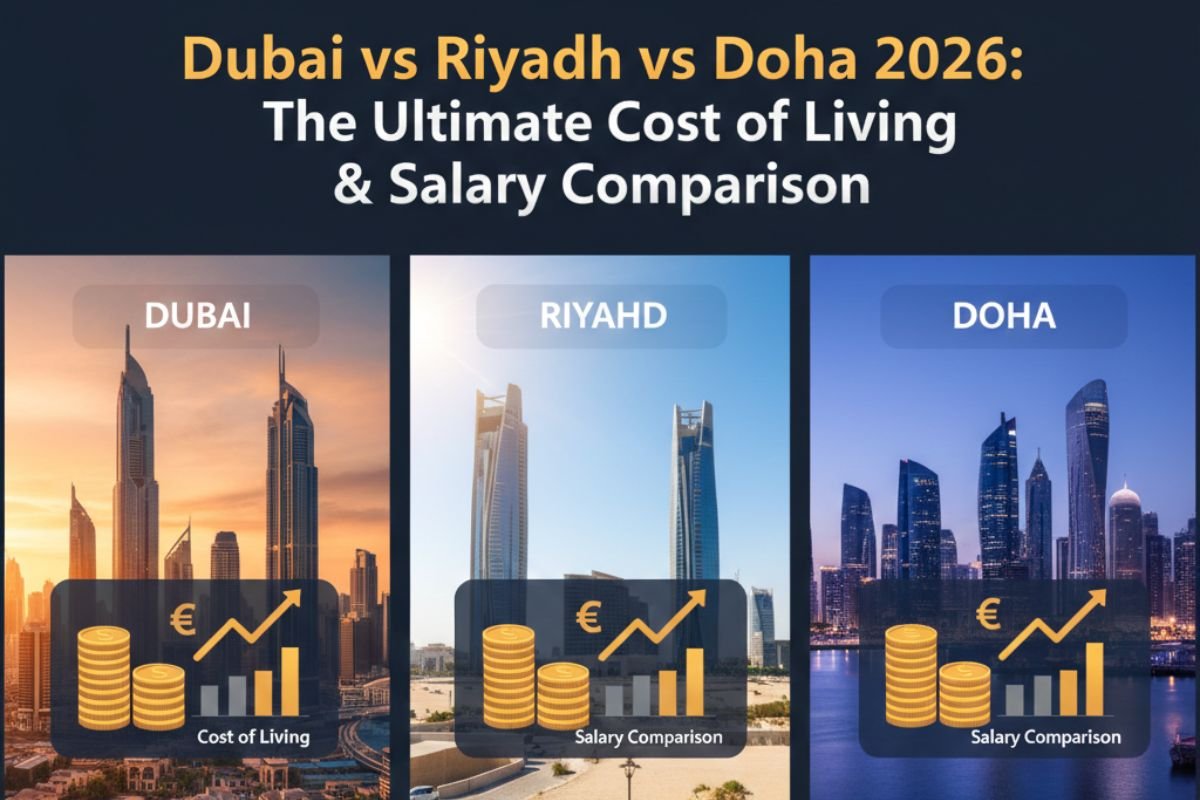
Dubai vs Riyadh vs Doha 2026: The Ultimate Cost of Living & Salary Comparison

Dubai vs Riyadh vs Doha 2026: Salary & Cost of Living Comparison

If you’re considering a move to the Gulf in 2026, you’re probably weighing three heavyweights: Dubai, Riyadh, and Doha. All offer tax-free salaries, modern infrastructure, and exciting lifestyles. But here’s the catch—your money buys very different things in each city.

Quick Verdict: The Gulf Trio Compared

Let’s start with the headline. Dubai is the most expensive overall, but offers the highest salaries in many sectors. Riyadh is catching up fast, with massive infrastructure spending driving demand for talent. Doha remains the most affordable, though salaries are generally lower .

CityMonthly Cost (Single)Monthly Cost (Family)2026 Salary Increase Forecast
Dubai$4,000–6,800$10,800–16,3004.1%
Riyadh$3,500–5,500$9,000–14,0004.6%
Doha$3,000–5,000$8,000–12,0004.3%

Sources: APRIL International, Gulf Business, Michael Page 

Housing: Where Your Biggest Expense Goes

Rent eats the largest slice of your paycheck in all three cities. Here’s how they stack up.

Dubai: Premium Living, Premium Prices

Dubai ranks as the most expensive city in the Middle East and 15th globally . A one-bedroom in Dubai Marina will set you back $24,500–60,000 annually. Even budget areas like International City start around $6,800 per year .

Riyadh: Rising Fast

Riyadh’s property market is heating up alongside Vision 2030 projects. A decent one-bedroom apartment in a central area like Al Olaya costs roughly $15,000–25,000 annually. You’ll find better value in suburbs like Al Narjis .

Doha: The Value Option

Doha is approximately 23% less expensive than Dubai . A one-bedroom in the city centre averages $19,500 per year (around 5,938 QAR/month). Head outside the centre, and that drops to $13,700 .

Winner for affordability: Doha

Salaries: What You’ll Actually Earn

Tax-free income is the big draw. But salaries vary significantly by city and sector.

Dubai: The Pay Leader

Dubai offers the highest salaries, particularly in banking, tech, and senior leadership. A CEO in Dubai can earn $27,000–43,000 monthly (Dhs100,000–160,000). Marketing directors average $15,000–27,000 monthly . Entry-level roles start around $3,000–5,000 monthly .

Riyadh: Closing the Gap

Saudi Arabia is projected to offer the highest average salary increase in 2026 at 4.6% . Top roles pay exceptionally well. Development managers can earn up to $80,000 monthly (300,000 SAR), reflecting the scale of giga-projects . Tech leads in AI and cybersecurity command $6,600–16,000 monthly .

Doha: Lower but Stable

Doha’s salaries are generally lower, but so are expenses. A sales director averages $95,000 annually ($7,900 monthly). Software engineers earn around $68,000 annually ($5,600 monthly) .

Winner for top-end salaries: Riyadh (for senior roles in specific sectors)

Everyday Expenses: Food, Transport, and Utilities

Dining Out

  • Dubai: Casual meal $15–20; fine dining $55–136+ 
  • Riyadh: Three-course dinner $26; lunch $8 
  • Doha: Inexpensive meal $8; mid-range three-course for two $55 

Groceries

  • Dubai: Generally most expensive 
  • Riyadh: Supermarket food 40% cheaper than US; milk $1.6/litre, bread $1.3 
  • Doha: Milk $2.1/litre, eggs $2.5/dozen 

Transport

  • Dubai: Petrol ~$0.78/litre; metro affordable but taxis add up
  • Riyadh: Petrol $0.6/litre; taxi $1.9/km 
  • Doha: Monthly metro pass $33; taxi base $2.2 

Winner for low everyday costs: Riyadh

So, Which City Should You Choose?

There’s no single “best” answer—it depends on your priorities.

Choose Dubai if: You want the highest potential salary, a vibrant expat lifestyle, and don’t mind paying premium prices for housing and entertainment. It’s the established hub for finance, tech, and marketing .

Choose Riyadh if: You’re in construction, infrastructure, or energy, and want to be where the action (and biggest paydays) are. The city is transforming rapidly, and opportunities are massive for those with in-demand skills .

Choose Doha if: You value affordability and a quieter pace. Your salary won’t stretch as far in absolute terms, but your monthly outgoings will be significantly lower, leaving room to save .

Wherever you choose, 2026 is shaping up to be a strong year for skilled professionals across the Gulf. Do your homework, negotiate your package, and enjoy the journey.
Frequently Asked Questions (FAQs)

1. Is Dubai really more expensive than Riyadh and Doha?

Yes. According to recent data, Dubai ranks as the most expensive city in the Middle East. Doha is approximately 23% less expensive than Dubai for comparable lifestyles .

2. Which city offers the highest salaries in 2026?

For senior leadership and specialised roles, Riyadh is offering exceptional packages, particularly in project management and development (up to $80,000 monthly). For broad professional roles, Dubai typically offers higher average salaries than Doha .

3. Are salaries really tax-free in all three cities?

Yes. The UAE, Saudi Arabia, and Qatar all offer tax-free personal income. This significantly increases your net take-home pay compared to most Western countries .

4. Can a family live comfortably in these cities?

Absolutely, but budgets vary. A family needs approximately $10,800–16,300 monthly in Dubai$9,000–14,000 in Riyadh, and $8,000–12,000 in Doha. Education costs are the biggest variable .

5. Which city has the best job market right now?

Riyadh has the momentum, with massive giga-projects driving demand. Dubai remains strong in finance, tech, and logistics. Doha offers stability, particularly in energy and education .

How to Get a Work Visa in Dubai: A Step-by-Step Guide for 2025

Dubai work visa and passport guide for 2025 with the city skyline

1. Who is Eligible for a Dubai Work Visa?

In most cases, your employer in Dubai will be your sponsor. They initiate and manage the majority of the application process. To be eligible, you typically need:

  • A valid job offer from a Dubai-based company.
  • Educational qualifications attested by the UAE embassy in your home country and the Ministry of Foreign Affairs in the UAE.
  • A valid passport with at least 6 months validity.
  • To pass a medical fitness test.

2. Step 1: Secure a Job Offer & Employment Contract

The process starts with securing a formal job offer. Your new employer will provide you with a standard employment contract that outlines your job title, responsibilities, salary, and benefits. This contract must be signed by both parties before any visa application can begin.

3. Step 2: Entry Permit Application

Your employer will apply for an Entry Permit on your behalf through the General Directorate of Residency and Foreigners Affairs (GDRFA). This is your initial permission to enter the UAE for employment purposes. Once approved, you will receive it electronically.

4. Step 3: Medical Fitness Test

After you arrive in the UAE using the Entry Permit, you must undergo a mandatory medical fitness test at an approved health center. This test includes a screening for infectious diseases like HIV, Tuberculosis, Hepatitis B and C, and Syphilis.

  • Passing the test: You proceed to the next step.
  • Failing the test: You will be deported.

5. Step 4: Emirates ID Application & Biometrics

The Emirates ID is your mandatory identity card for all UAE residents. Your employer will apply for it, but you must visit a certified typing center or an Federal Authority for Identity and Citizenship (ICA) service center to have your photo and fingerprints (biometrics) taken.

6. Step 5: Labour Contract & Work Permit Approval

Your employer will register you with the Ministry of Human Resources and Emiratisation (MOHRE). They will approve your official labour contract and issue your Work Permit, which legally allows you to work for that specific company.

7. Step 6: Residency Visa Stamping

The final step is having your residency visa stamped in your passport. This visa is typically valid for 2 years and is renewable. Your employer will submit your passport to the relevant GDRFA office for this stamping.

Congratulations! You are now a legal resident of the UAE.

8. Required Documents Checklist

  • Original Passport
  • Passport-sized photographs (with white background)
  • Entry Permit copy
  • Attested educational certificates
  • Medical fitness test results
  • Signed employment contract
  • Emirates ID application form

9. Costs & Processing Time

  • Processing Time: The entire process typically takes 2 to 5 weeks.
  • Costs: These are usually covered by the employer and can range from AED 3,000 to AED 7,000, depending on the company and visa type. Costs include:
    • Entry Permit fee
    • Medical test fee
    • Emirates ID fee
    • Visa stamping fee

10. 2025 Visa Rule Updates

  • Green Visa: A long-term residency visa for skilled professionals, freelancers, and investors, offering 5-year residency without the need for a sponsor.
  • Virtual Work Visa: A one-year visa for remote workers employed by companies outside the UAE to live in Dubai while working for their foreign employer.
  • Job Exploration Visa: A visa for young talents to explore job opportunities in the UAE.

11. Frequently Asked Questions (FAQ)

Can I apply for a work visa myself?

No, the process must be initiated and sponsored by your employer in Dubai.

Can my family join me?

Yes, once you have your residency visa and meet the minimum salary requirement (usually AED 3,000 – AED 4,000), you can sponsor your spouse and children.

What if I lose my job?

You have a grace period to either find a new job or leave the country. The standard grace period is 30 to 90 days.

Who pays for the visa costs?

By law, the employer is responsible for all visa and recruitment costs. You should not have to pay for your work visa.

Ready to start your job search? Explore thousands of opportunities on our Dubai Job Portal.


Author Bio:

About Gulf Careers Hub: We provide accurate, up-to-date information on visas, job markets, and career opportunities in Dubai, Abu Dhabi, and across the GCC. Our guides are built on extensive research to help you navigate your career journey in the Gulf.


Post a Job Opening

Fill in the details below. Your job posting will be reviewed by our team.

Basic Information

Specify years of experience required

Location & Salary

Qualifications & Skills

Specify educational requirements
Separate skills with commas

Company Details

Job Details

Contact Information