Gulf Careers Hub

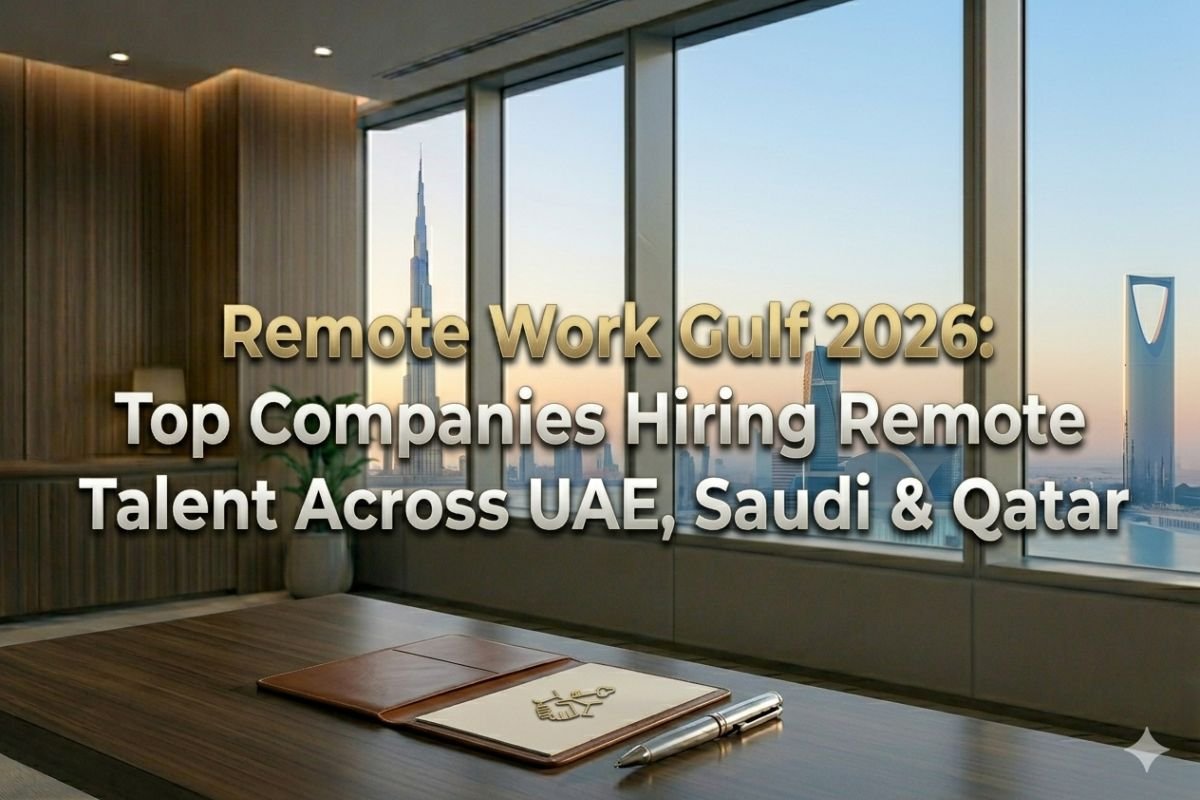
Remote Work Gulf 2026: Top Companies Hiring Remote Talent Across UAE, Saudi & Qatar

Remote Work Gulf 2026: UAE, Saudi Arabia & Qatar Remote Jobs

The Remote Revolution Has Officially Arrived in the Gulf

If you had told me five years ago that I’d be writing about fully remote positions at Saudi Aramco or Qatar Airways, I would have politely suggested you check your coffee strength. Yet here we are in 2026, watching the Gulf Cooperation Council (GCC) region undergo one of the most significant workplace transformations in its modern history.

The shift isn’t subtle. Walk through Dubai’s business districts on a Tuesday afternoon, and you’ll notice something peculiar—the parking lots aren’t full. Coffee shops in Riyadh’s diplomatic quarter are buzzing with professionals on video calls. And in Doha’s West Bay, luxury apartments now market themselves as “remote-work optimized” with dedicated office nooks and fiber-to-the-desk internet.

This isn’t a temporary adjustment. It’s a structural reimagining of how Gulf economies operate.

Why 2026 Marks the Definitive Turning Point

Several converging factors have made remote work not just acceptable but strategically essential across the UAE, Saudi Arabia, and Qatar:

Regulatory maturation has finally caught up with technological capability. The UAE’s Remote Work Visa (introduced in Dubai back in 2021) has evolved into a comprehensive framework covering employment rights, taxation clarity, and cross-border legal protections. Saudi Arabia’s Vision 2030 implementation now explicitly includes “flexible work arrangements” as a key performance indicator for economic diversification. Qatar, fresh off its World Cup infrastructure investments, has pivoted aggressively toward knowledge-economy positioning—remote talent acquisition is central to that strategy.

The talent mathematics have become impossible to ignore. Localization policies (Saudization, Emiratization, Qatarization) continue to prioritize citizen employment, but the skills gap in emerging sectors—artificial intelligence, green energy technology, fintech, digital health—requires accessing global expertise that simply isn’t available domestically in sufficient quantities. Remote hiring solves this without the friction of physical relocation.

Cost rationalization plays a role too. Commercial real estate in Dubai’s DIFC or Riyadh’s King Abdullah Financial District commands premium pricing. Companies have discovered that hybrid or fully remote teams reduce overhead by 30-40% while often improving productivity metrics.

Who’s Actually Hiring? The 2026 Remote Employer Landscape

Let me be direct about what matters—where the opportunities actually are.

Technology & Digital Infrastructure

Saudi Aramco’s Digital Transformation Unit has quietly built one of the region’s largest remote engineering teams. They’re recruiting cloud architects, cybersecurity specialists, and AI implementation consultants globally, with competitive packages that rival Silicon Valley when adjusted for tax advantages. Their “Digital Ambition” program specifically targets remote talent for 12-24 month project engagements.

UAE’s G42 (Group 42) continues expanding its remote workforce across AI research, healthcare technology, and smart city infrastructure. Their hiring approach is genuinely borderless—I’ve spoken with engineers working from Lisbon, Lagos, and Lahore, all contributing to Abu Dhabi’s technological ecosystem without ever setting foot in the Emirates.

Qatar’s Msheireb Properties and associated smart-city initiatives maintain substantial remote technology teams, particularly in data analytics and IoT systems architecture.

Financial Services & Fintech

The transformation here is remarkable. ADCB (Abu Dhabi Commercial Bank), SNB (Saudi National Bank), and QNB (Qatar National Bank) have all established formal remote-work divisions for non-client-facing roles. Risk management, compliance analysis, financial modeling, and backend development positions are increasingly location-agnostic.

The fintech disruptors are even more aggressive. Tabby (UAE-based buy-now-pay-later platform), Tamara (Saudi fintech unicorn), and CWallet (Qatari digital payments) operate with distributed teams as their default organizational structure. Their engineering and product teams span multiple time zones deliberately.

Energy Transition & Sustainability

Here’s where 2026 genuinely differs from previous years. The Gulf’s energy majors aren’t just paying lip service to decarbonization—they’re building the organizational capacity to execute it. ACWA Power (Saudi renewable energy developer), Masdar (UAE clean energy), and Neom’s energy subsidiaries actively recruit remote sustainability consultants, carbon accounting specialists, and green hydrogen project managers.

These roles often combine remote work with periodic on-site deployment, creating a “fly-in, fly-out” model familiar to oil industry veterans but applied to solar farms and wind installations.

Professional Services & Consulting

The Big Four accounting firms (Deloitte, PwC, EY, KPMG) maintain extensive remote capabilities across their Middle East practices, but the more interesting development is boutique consulting growth. Specialized firms focusing on Saudi market entry, UAE regulatory navigation, or Qatar public sector engagement increasingly operate with lean physical footprints and distributed expert networks.

The Practical Realities: What Remote Workers Should Know

Before you update your LinkedIn headline and start applying, understand the actual conditions governing Gulf remote employment in 2026:

Contract structures vary significantly. Some companies offer full local employment with remote-work provisions—meaning you get health insurance, end-of-service benefits, and legal protections under UAE, Saudi, or Qatari labor law. Others engage remote workers as independent contractors, which shifts tax and benefit responsibilities to you. Read carefully. Ask directly. Get legal review if the contract value warrants it.

Time zone alignment matters more than location. Most Gulf-based employers expect substantial overlap with Gulf Standard Time (UTC+4). If you’re in Toronto or Tokyo, be prepared for early mornings or late evenings. The “work from anywhere” promise has practical limits when your team operates on Riyadh time.

Cultural fluency remains valuable. Remote doesn’t mean disconnected from organizational culture. Understanding business communication norms, decision-making hierarchies, and relationship-building expectations in Gulf contexts will accelerate your success regardless of your physical coordinates.

Visa and tax implications have stabilized considerably. The UAE maintains its remote worker visa with straightforward renewal processes. Saudi Arabia introduced a “Premium Residency” option that accommodates remote professionals. Qatar’s visa framework remains more restrictive but is gradually liberalizing for knowledge workers.

Looking Forward: The Gulf Remote Work Trajectory

We’re past the experimental phase. The infrastructure—legal, technological, cultural—now supports sustained remote employment relationships between Gulf employers and global talent. What we’re seeing in 2026 is optimization and scaling rather than fundamental testing.

For professionals considering this market, the window is genuinely open. The skills shortages are real. The compensation is competitive. The professional experience offers exposure to some of the world’s most ambitious economic transformation projects.

The Gulf has always been a region of reinvention—from pearl diving to oil extraction, from trading posts to global financial centers. The current shift toward distributed, technology-enabled work represents simply the latest iteration of that adaptive capability.

Your desk might be in Dubai, Dallas, or Dundee. But your professional impact can absolutely be Gulf-shaped.

Ready to explore opportunities? Update your professional profiles to highlight remote-work experience, research specific companies’ distributed-work policies, and consider connecting with recruitment specialists focused on GCC markets. The transition from “considering” to “hired” is happening faster than you might expect.

Micro-Retirement: A New Career Strategy for Work-Life Balance

Micro-Retirement in 2025 – A Smarter Strategy for Work-Life Balance and Career Longevity

In 2025, the concept of retirement is no longer a distant finish line. For a growing number of professionals — especially Millennials and Gen Z — it’s a flexible, recurring strategy woven into their career journey. This emerging trend is called micro-retirement, and it’s transforming how people think about work, rest, and purpose.

Unlike sabbaticals or garden leave, micro-retirement is a self-elected, extended break from full-time work, typically lasting anywhere from six months to two years. It’s not about burnout or crisis — it’s about intentional pause. Whether it’s traveling, learning a new skill, spending time with family, or simply decompressing, micro-retirement offers a way to live more fully now, not just later.

What Is Micro-Retirement?

Micro-retirement refers to planned, extended breaks from full-time employment, taken periodically throughout a person’s working life. These breaks typically last anywhere from a few months to two years and are used for personal growth, travel, caregiving, education, or simply rest.

Unlike sabbaticals (which are often employer-sponsored) or gap years (typically taken before entering the workforce), micro-retirement is self-directed and can occur at any stage of a career. It’s not tied to age, income level, or industry — it’s a mindset shift toward intentional living.

Why Is Micro-Retirement Trending in 2025?

Several factors are driving the popularity of micro-retirement:

1. Burnout and Mental Health Awareness

The pandemic era exposed the fragility of traditional work models. In 2025, mental health is a top priority, and professionals are seeking sustainable ways to manage stress. Micro-retirement offers a proactive alternative to burnout, allowing people to step back before reaching a breaking point.

2. Remote and Hybrid Work Models

With flexible work arrangements now mainstream, professionals have more control over their schedules and career trajectories. This autonomy makes it easier to plan extended breaks without derailing long-term goals.

3. Changing Career Expectations

Millennials and Gen Z prioritize purpose, flexibility, and experiences over titles and tenure. They’re less interested in climbing a corporate ladder and more focused on building a meaningful life. Micro-retirement aligns perfectly with these values.

4. Financial Planning Innovations

The rise of the FIRE movement (Financial Independence, Retire Early), fractional investing, and digital budgeting tools has empowered people to save strategically and take breaks without jeopardizing financial stability.

5. Longevity and Lifelong Careers

As life expectancy increases, so does the length of our working years. Instead of working nonstop for 40 years, many professionals now prefer to intermittently pause and recalibrate, knowing they’ll likely work into their 70s or beyond.

Benefits of Micro-Retirement

Micro-retirement isn’t just a luxury — it’s a strategic investment in long-term well-being and career sustainability.

1. Mental and Emotional Renewal

Extended breaks allow individuals to decompress, reflect, and reconnect with themselves. This leads to improved mental health, reduced anxiety, and greater emotional resilience.

2. Enhanced Creativity and Innovation

Stepping away from routine work environments can spark new ideas and perspectives. Many professionals return from micro-retirement with fresh insights and renewed motivation.

3. Strengthened Relationships

Time off enables deeper connections with family, friends, and communities. Whether it’s caregiving, parenting, or simply being present, micro-retirement fosters stronger social bonds.

4. Skill Development

Many use micro-retirement to pursue education, certifications, or hobbies that enhance their professional toolkit. It’s a chance to learn without the pressure of deadlines or performance reviews.

5. Career Clarity

Breaks provide space to reassess goals, values, and priorities. This often leads to more intentional career choices and better alignment between work and life.

How Employers Can Support Micro-Retirement

Forward-thinking organizations are beginning to recognize the value of micro-retirement and are adapting their policies accordingly.

Flexible Leave Policies

Offering unpaid sabbaticals, career breaks, or extended leave options allows employees to take time off without severing ties.

Re-entry Programs

Structured return-to-work programs help employees reintegrate smoothly after a break, reducing friction and boosting retention.

Culture of Trust

Encouraging open conversations about career pauses fosters psychological safety and reduces stigma around taking time off.

Performance Metrics

Shifting from time-based metrics to outcome-based evaluations allows for more flexible career paths and supports intermittent breaks.

Global Talent Strategy

Remote-first companies can tap into a global workforce that embraces micro-retirement, creating a more diverse and resilient team.

Planning a Micro-Retirement: A Step-by-Step Guide

If you’re considering a micro-retirement, here’s how to do it strategically:

1. Define Your Purpose

Ask yourself: Why do I want this break? Is it for rest, travel, caregiving, education, or something else? Clarity will guide your decisions.

2. Set a Timeline

Decide how long you want to be away. Typical micro-retirements range from 6 months to 2 years. Be realistic about your goals and commitments.

3. Create a Financial Plan

Estimate your expenses and savings needs. Consider passive income, freelance work, or part-time gigs to support your lifestyle.

4. Communicate with Stakeholders

If employed, discuss your plans with your manager or HR. If freelancing, inform clients and set expectations. Transparency builds trust.

5. Plan Your Re-entry

Think about how you’ll return to work. Will you resume your old role, pivot to a new industry, or start something fresh? Prepare accordingly.

Industry Examples of Micro-Retirement Adoption

IndustryMicro-Retirement TrendsEmployer Response
TechEngineers taking 6–12 month breaks to travel or build side projectsSabbatical programs, freelance re-entry
HealthcareNurses and caregivers pausing for mental health or family careFlexible scheduling, mental health leave
EducationTeachers taking gap years to study or volunteer abroadJob-sharing, re-entry training
FinanceAnalysts taking breaks for certifications or entrepreneurshipLeave banks, alumni networks
Creative ArtsDesigners and writers pausing for inspiration or residenciesProject-based contracts, flexible gigs

Real-Life Examples

  • A UX designer in Dubai took a 9-month micro-retirement to travel Southeast Asia, returning with a new portfolio and a freelance career.
  • A nurse in Karachi paused her job for 14 months to care for her aging parents, later rejoining her hospital through a re-entry program.
  • A teacher in Riyadh took a year off to pursue a master’s degree in education technology, returning to lead digital transformation in her school.

These stories reflect a growing movement toward intentional career design.

FAQs

Is micro-retirement only for wealthy people?

No. With proper planning, micro-retirement is accessible to many. It’s about budgeting, prioritizing, and aligning your lifestyle with your values.

How is micro-retirement different from a sabbatical?

Sabbaticals are often employer-sponsored and tied to tenure. Micro-retirement is self-directed and can happen at any time.

Will taking a break hurt my career?

Not if it’s planned well. Many employers value the self-awareness and growth that come from intentional breaks.

How do I explain micro-retirement on my resume?

Be honest and strategic. Highlight what you learned, how you grew, and how it benefits your next role.

Can I freelance during micro-retirement?

Absolutely. Many people use this time to explore side projects, consulting, or creative work.

What if my employer doesn’t support it?

You can still plan a transition. Consider saving, resigning respectfully, and maintaining professional relationships for future opportunities.

Final Thoughts

Micro-retirement is more than a trend — it’s a paradigm shift. It challenges the notion that rest must wait until old age and empowers people to live with intention, balance, and purpose throughout their careers.

As the workforce evolves, so too must our definitions of success. Micro-retirement offers a flexible, human-centered approach to career planning — one that honors both ambition and well-being.

Whether you’re a job seeker, a manager, or a policymaker, the message is clear: work-life balance isn’t a perk — it’s a strategy.

Post a Job Opening

Fill in the details below. Your job posting will be reviewed by our team.

Basic Information

Specify years of experience required

Location & Salary

Qualifications & Skills

Specify educational requirements
Separate skills with commas

Company Details

Job Details

Contact Information