Gulf Careers Hub

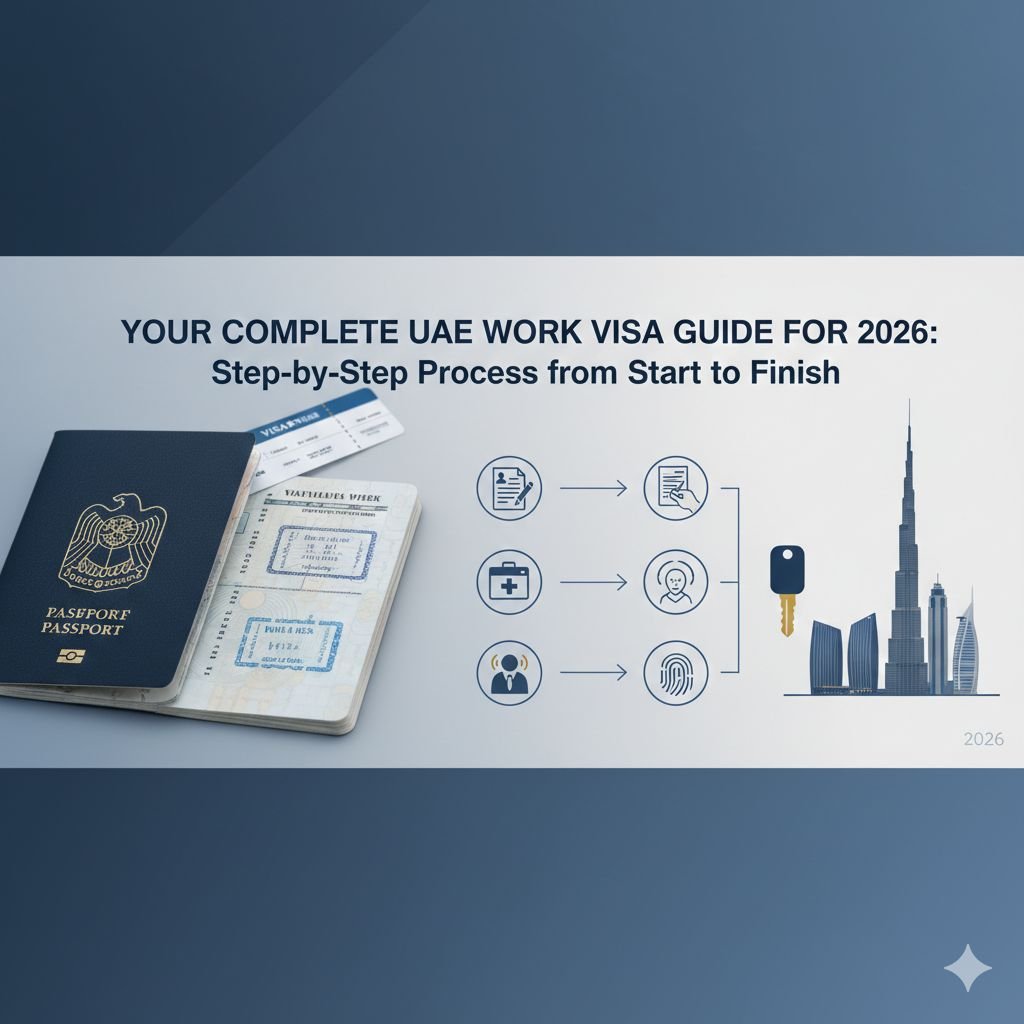
Your Complete UAE Work Visa Guide for 2026: Step-by-Step Process from Start to Finish

UAE Work Visa Guide 2024

For 2026, the UAE government has streamlined several procedures, making it more efficient but also emphasizing compliance and qualification standards. Whether you’re a software engineer from Bangalore, a project manager from Lahore, a finance expert from London, or a healthcare professional from Sydney, this guide will walk you through the entire process in clear, simple steps.

Understanding the Basics: UAE Work Visa vs. Residence Visa

First, let’s clarify the terminology, as this is a common point of confusion:

  • Entry Permit: Your initial permission to enter the UAE for employment. This is what your employer applies for first.
  • Work Visa/Residence Visa: Once you enter the UAE, this permit is stamped in your passport. It allows you to legally live and work in the country for a specific employer. It is typically valid for 2 years (1 year for some categories) and is linked to your employment contract.

Who Sponsors Your UAE Work Visa?

Unlike some countries where you apply independently, in the UAE, your employer is your sponsor. They must initiate and manage the majority of the application process. Your role is to provide accurate documents and complete medical checks.

Step 1: The Job Offer & Employment Contract

The process starts with a formal job offer from a UAE-based company licensed to hire expatriates. Ensure your contract details your position, salary, benefits, and probation period clearly. Do not resign from your current job until you have the Entry Permit in hand.

Step 2: Entry Permit Application (By Employer)

Your employer applies for your Entry Permit through the Ministry of Human Resources and Emiratisation (MOHRE) for the private sector or relevant federal authority for government jobs. This is done online via the MOHRE smart services system.

  • Key Requirements from You: Scanned copies of your passport (valid for at least 6 months), passport-sized photographs with white background, and attested educational certificates.

Step 3: Entry into the UAE & Medical Fitness Test

Once the Entry Permit is issued, you can travel to the UAE. You must enter the country within 60 days.
Shortly after arrival, you must undergo a mandatory medical fitness test at an approved health centre. This includes a blood test for HIV and tuberculosis and a chest X-ray for tuberculosis. If you test positive for any communicable disease, your visa will be rejected, and you must leave the country.

Step 4: Emirates ID Registration & Biometrics

The Emirates ID is your national identity card in the UAE and is mandatory. Your employer will apply for it on your behalf through the Federal Authority for Identity, Citizenship, Customs & Port Security (ICP). You will need to visit an authorized typing centre or ICP service centre to provide your biometrics (photograph and fingerprints).

Step 5: Residency Visa Stamping

With your medical clearance and Emirates ID application in process, your passport is submitted to the immigration authorities for the residency visa stamp. This is the final step where the visa is physically placed in your passport.

Step 6: Opening a Bank Account & Getting a Driver’s License

With your Emirates ID and residency visa, you can now open a local bank account and apply for a UAE driver’s license (often requiring attestation of your home country license or taking lessons/tests).

Essential Documents Checklist (2026 Requirements)

Prepare these documents with attention to detail. Attestation is critical.

  1. Passport: Valid for at least 6 months, with clear scanned copies.
  2. Passport Photos: Recent, white background, professional.
  3. Attested Educational Certificates: This is a multi-step process:
    • For India: Attestation from the State HRD/Education Department → UAE Embassy Attestation in India → Ministry of Foreign Affairs (MoFA) attestation in the UAE.
    • For Pakistan: Attestation from the Higher Education Commission (HEC) and the Ministry of Foreign Affairs (MoFA) in Pakistan → UAE Embassy Attestation in Pakistan → MoFA attestation in the UAE.
    • For UK/Australia: The process is often simpler, typically requiring certification by a notary public or solicitor, then attestation by the UAE Embassy in London/Canberra.
  4. Experience/Reference Letters: Attested letters from previous employers may be required for certain professional roles.
  5. Job Offer/Employment Contract: Signed by you and your employer.

Costs & Fees (Approximate for 2026)

Costs are usually borne by the employer, but this can be negotiated. Be aware of the typical fees:

  • Entry Permit: AED 300 – 600
  • Status Change & Medical Test: AED 500 – 800
  • Emirates ID: AED 300 – 500 (depending on validity)
  • Residency Visa Stamping: AED 500 – 700
  • Document Attestation: Varies widely by country (Can range from AED 1,000 to AED 3,000+ including all steps).

Total Estimated Cost: AED 3,000 – 5,000 (excluding document attestation from your home country).

Key Changes & Updates for 2026

  • Green Visa: A 5-year residency permit for skilled professionals, freelancers, and investors that offers greater flexibility, as it is not tied to a specific employer.
  • Golden Visa: A long-term 10-year residency for investors, entrepreneurs, scientists, outstanding students, and specialized professionals like doctors and engineers.
  • Digital Nomad Visa: Allows remote workers to live in the UAE while employed by a company overseas.
  • Enhanced Online Portals: The UAE government continues to digitize all processes through platforms like the ICP smart services and MOHRE’s website, making applications more transparent.

Comparing Gulf Processes: UAE vs. Saudi vs. Qatar

While this guide focuses on the UAE, professionals often explore opportunities across the region. Here’s a quick comparison:

  • Saudi Work Visa (Iqama): Process is also employer-led. Recent reforms under Vision 2030 have made it more streamlined. The medical test is strict. Family visa rules have been relaxed, making it easier to bring dependents.
  • Qatar Work Permit: Requires an employer (sponsor) in Qatar to initiate. A key step is obtaining a Qatar ID. The process involves medical tests and security checks. Recent World Cup infrastructure has led to more standardized procedures.

Important Tips for a Smooth Process

  1. Start Document Attestation Early: This is the step that takes the longest, especially for applicants from India and Pakistan. Begin as soon as you have a serious job offer.
  2. Verify Your Employer: Ensure the company offering you the job is legitimate and in good standing. You can check their trade license online through the respective Emirate’s economic department website (e.g., DED in Dubai).
  3. Understand Your Contract: Know your rights regarding probation periods, notice periods, and end-of-service benefits.
  4. Use Authorized Channels: Never use unauthorized “visa agents” for the main process. Your employer’s PRO (Public Relations Officer) or HR department should handle it through official government portals.

Conclusion: Your Pathway to a New Chapter

The UAE work visa process for 2026 is designed to be efficient for qualified professionals. While it involves several steps and requires meticulous document preparation, understanding the workflow removes the anxiety and helps you prepare effectively.

Success hinges on three pillars: a legitimate job offer from a reputable company, perfectly attested documents, and patience as the bureaucratic wheels turn. By following this guide, professionals from Pakistan, India, the UK, and Australia can approach their UAE relocation with confidence, ready to embark on a rewarding career in one of the world’s most dynamic regions.


Frequently Asked Questions (FAQs)

1. How long does the entire UAE work visa process take in 2026?

From the time your employer applies for the Entry Permit to receiving your Emirates ID and residency stamp, the entire process typically takes 4 to 8 weeks, assuming all your documents are correctly attested and ready. The medical test and Emirates ID biometrics can add a few days to the timeline. Delays most commonly occur during the educational certificate attestation process in your home country.

2. Can I bring my family (spouse and children) on my UAE work visa?

Yes, most expatriate professionals can sponsor their spouse and dependent children (usually under 18 years of age). Requirements include:
Proof of relationship (marriage/birth certificates attested).
Meeting a minimum salary threshold (typically AED 3,000 – 4,000 per month, but some Emirates may require more for housing allowances).
Providing proof of suitable accommodation.

3. What happens if I lose my job in the UAE?

Your residency visa is tied to your employment. If you lose your job, you have a grace period (currently 30 to 90 days from the date of cancellation, depending on your visa type and circumstances) to either find a new job and transfer your visa sponsorship, or leave the country. It is crucial to understand your specific grace period and act within it to avoid overstaying fines.

4. Is it better to get documents attested in my home country or in the UAE?

You must start the attestation process in your home country. The chain is: Notary/University → Home Government Department (e.g., HEC for Pakistan, HRD for India) → UAE Embassy/Consulate in your home country. Only the final “MoFA attestation” is done in the UAE. Trying to bypass your home country’s steps will result in rejection.

5. What is the main difference between the standard work visa and the Green/Golden Visa?

The standard work visa is tied to your specific employer and is valid for 2 years. If you change jobs, the visa must be cancelled and a new one issued. The Green Visa (5 years) and Golden Visa (10 years) are long-term residencies that offer greater flexibility. They are not tied to an employer, allowing you to change jobs freely and offering extended grace periods if you leave employment. They have higher eligibility criteria based on profession, salary, investment, or special skills.

Dubai Jobs Hiring Today – Apply Directly for Urgent Positions in 2026

Dubai Jobs Hiring 2026 – Apply for Urgent Vacancies

Dubai continues to be a global magnet for career opportunities, innovation, and unparalleled professional growth. As we move into 2026, the city’s dynamic job market is booming with urgent hiring across key sectors. Whether you’re a seasoned professional or seeking a fresh start, knowing where to find “Dubai jobs hiring today” can fast-track your career. This comprehensive guide provides direct application insights, high-demand sectors, and actionable steps to secure your next role in one of the world’s most vibrant economies.

Why Dubai’s Job Market is Thriving in 2026

Dubai’s vision for economic diversification, underscored by initiatives like the Dubai Economic Agenda D33 and preparation for Expo 2030, continues to drive job creation. The city is not just about oil and gas anymore; it’s a hub for technology, renewable energy, fintech, tourism, and logistics. With a business-friendly environment, tax-free salaries, and world-class infrastructure, Dubai offers compelling reasons for global talent to relocate.

Key Growth Sectors with Urgent Hiring

  1. Technology & Artificial Intelligence: With Dubai’s AI Strategy aiming to make it a global AI leader, roles in data science, cybersecurity, and software development are in high demand.
  2. Healthcare & Pharmaceuticals: Post-pandemic expansion continues, requiring doctors, nurses, medical technicians, and healthcare administrators.
  3. Renewable Energy & Sustainability: As the UAE targets net-zero, jobs in solar energy, green construction, and sustainability consulting are rising.
  4. Tourism & Hospitality: Dubai remains a top tourist destination, urgently hiring for hotel management, F&B services, events, and customer experience roles.
  5. Finance & Fintech: The Dubai International Financial Centre (DIFC) and growing fintech ecosystem need analysts, compliance officers, and blockchain experts.
  6. Logistics & Supply Chain: Dubai’s strategic location as a global trade link spurs demand for logistics managers and supply chain specialists.

Where to Find Dubai Jobs Hiring Today

1. Top Job Portals for Direct Applications

  • LinkedIn: Optimize your profile and use the “#OpenToWork” feature. Set job alerts for “Dubai” with keywords like “urgent hiring.”
  • Bayt.com & GulfTalent: Leading regional platforms where employers post direct recruitment drives.
  • Company Career Pages: For direct applications, always check the ‘Careers’ section of target company websites (e.g., Emirates Group, DP World, MAF, Careem).
  • Dubai Government Portals: Dubai Careers (government jobs) and Dubai Chamber for member company vacancies.

2. Networking: The Untapped Goldmine

  • Attend industry-specific events and expos in Dubai.
  • Engage with recruiters and professionals on LinkedIn.
  • Join Facebook and WhatsApp groups dedicated to “Dubai urgent jobs.”

3. Recruitment Agencies

Reputable agencies like Michael Page, Hays, and Robert Half often handle immediate placements. Ensure they are licensed by the UAE Ministry of Human Resources & Emiratisation (MOHRE).

Step-by-Step: How to Apply Directly for Urgent Positions

  1. Tailor Your CV for the UAE Market: Include a professional photo, mention your visa status, and highlight relevant regional experience. Keep it to 2 pages.
  2. Craft a Concise Cover Letter: Address it to the hiring manager. Clearly state the position you’re applying for and why you are a fit for the role and Dubai’s work culture.
  3. Prepare for Digital Interviews: Be ready for Zoom/Teams interviews. Test your tech, dress professionally, and ensure a quiet background.
  4. Understand Visa Sponsorship: Research whether the role offers employment visa sponsorship. Most full-time roles do, but it’s a crucial question to ask.
  5. Apply Promptly: For “Dubai jobs hiring today,” speed is essential. Set aside time each morning to apply for new postings.

Navigating Challenges: Tips for Job Seekers

  • Avoid Job Scams: Never pay money for a job offer. Verify company licenses and offers through official channels.
  • Salary Negotiation: Research average salaries for your role on platforms like Glassdoor. Discuss the full package: basic salary, housing allowance, transportation, airfare, and health insurance.
  • Cultural Adaptation: Understanding the multicultural and professional etiquette of the UAE workplace is key to long-term success.

The Future of Work in Dubai: 2026 Trends

  • Remote & Hybrid Roles: While many roles require on-site presence, hybrid models are becoming more common in certain sectors like tech and consulting.
  • Focus on Emiratisation: Be aware of programs prioritizing UAE national talent in specific sectors, while international hiring remains robust in private spheres.
  • Skills Over Degrees: There is a growing emphasis on certified skills, especially in tech (e.g., AWS, PMP, digital marketing certifications).

Conclusion: Your 2026 Dubai Career Awaits

The opportunity to build a rewarding career in Dubai has never been more accessible. By proactively searching for “Dubai urgent jobs,” leveraging the right platforms for direct applications, and presenting yourself as a skilled, adaptable professional, you can secure a position in this futuristic city. Start your job hunt today, and take the first step toward an exciting 2026 in Dubai.


Frequently Asked Questions (FAQs)

1. How can I verify if a ‘Dubai urgent job’ posting is legitimate?

Always cross-check the company’s name on the Dubai Economic Department (DED) website or MOHRE. Legitimate companies will never ask for payment for a job offer. Use LinkedIn to find current employees and verify the company’s activity.

2. What is the most effective way to apply for jobs in Dubai from outside the UAE?

An optimized LinkedIn profile combined with applications on GulfTalent and Bayt.com is highly effective. Mentioning your willingness to relocate and your available start date in your cover letter is crucial. Networking online with recruiters based in Dubai can also open doors.

3. Which industries are hiring most urgently in Dubai for 2026?

Currently, technology (especially AI and cybersecurity), healthcare, renewable energy/sustainability, tourism/hospitality, and finance/fintech are experiencing the most urgent hiring needs.

4. Do I need to attest my degrees to work in Dubai?

Yes, for most professional roles and to obtain your employment visa, your educational certificates and, in some cases, experience letters need to be attested by the UAE Embassy in your home country and the Ministry of Foreign Affairs in the UAE.

5. What is the average processing time for a Dubai work visa after a job offer?

Typically, the entire process—from signing the contract to receiving your Emirates ID and residency visa—can take between 2 to 6 weeks, depending on the company’s PRO efficiency and government processing times.

How to Get a Work Visa in Dubai: A Step-by-Step Guide for 2025

Dubai work visa and passport guide for 2025 with the city skyline

1. Who is Eligible for a Dubai Work Visa?

In most cases, your employer in Dubai will be your sponsor. They initiate and manage the majority of the application process. To be eligible, you typically need:

  • A valid job offer from a Dubai-based company.
  • Educational qualifications attested by the UAE embassy in your home country and the Ministry of Foreign Affairs in the UAE.
  • A valid passport with at least 6 months validity.
  • To pass a medical fitness test.

2. Step 1: Secure a Job Offer & Employment Contract

The process starts with securing a formal job offer. Your new employer will provide you with a standard employment contract that outlines your job title, responsibilities, salary, and benefits. This contract must be signed by both parties before any visa application can begin.

3. Step 2: Entry Permit Application

Your employer will apply for an Entry Permit on your behalf through the General Directorate of Residency and Foreigners Affairs (GDRFA). This is your initial permission to enter the UAE for employment purposes. Once approved, you will receive it electronically.

4. Step 3: Medical Fitness Test

After you arrive in the UAE using the Entry Permit, you must undergo a mandatory medical fitness test at an approved health center. This test includes a screening for infectious diseases like HIV, Tuberculosis, Hepatitis B and C, and Syphilis.

  • Passing the test: You proceed to the next step.
  • Failing the test: You will be deported.

5. Step 4: Emirates ID Application & Biometrics

The Emirates ID is your mandatory identity card for all UAE residents. Your employer will apply for it, but you must visit a certified typing center or an Federal Authority for Identity and Citizenship (ICA) service center to have your photo and fingerprints (biometrics) taken.

6. Step 5: Labour Contract & Work Permit Approval

Your employer will register you with the Ministry of Human Resources and Emiratisation (MOHRE). They will approve your official labour contract and issue your Work Permit, which legally allows you to work for that specific company.

7. Step 6: Residency Visa Stamping

The final step is having your residency visa stamped in your passport. This visa is typically valid for 2 years and is renewable. Your employer will submit your passport to the relevant GDRFA office for this stamping.

Congratulations! You are now a legal resident of the UAE.

8. Required Documents Checklist

  • Original Passport
  • Passport-sized photographs (with white background)
  • Entry Permit copy
  • Attested educational certificates
  • Medical fitness test results
  • Signed employment contract
  • Emirates ID application form

9. Costs & Processing Time

  • Processing Time: The entire process typically takes 2 to 5 weeks.
  • Costs: These are usually covered by the employer and can range from AED 3,000 to AED 7,000, depending on the company and visa type. Costs include:
    • Entry Permit fee
    • Medical test fee
    • Emirates ID fee
    • Visa stamping fee

10. 2025 Visa Rule Updates

  • Green Visa: A long-term residency visa for skilled professionals, freelancers, and investors, offering 5-year residency without the need for a sponsor.
  • Virtual Work Visa: A one-year visa for remote workers employed by companies outside the UAE to live in Dubai while working for their foreign employer.
  • Job Exploration Visa: A visa for young talents to explore job opportunities in the UAE.

11. Frequently Asked Questions (FAQ)

Can I apply for a work visa myself?

No, the process must be initiated and sponsored by your employer in Dubai.

Can my family join me?

Yes, once you have your residency visa and meet the minimum salary requirement (usually AED 3,000 – AED 4,000), you can sponsor your spouse and children.

What if I lose my job?

You have a grace period to either find a new job or leave the country. The standard grace period is 30 to 90 days.

Who pays for the visa costs?

By law, the employer is responsible for all visa and recruitment costs. You should not have to pay for your work visa.

Ready to start your job search? Explore thousands of opportunities on our Dubai Job Portal.


Author Bio:

About Gulf Careers Hub: We provide accurate, up-to-date information on visas, job markets, and career opportunities in Dubai, Abu Dhabi, and across the GCC. Our guides are built on extensive research to help you navigate your career journey in the Gulf.


Post a Job Opening

Fill in the details below. Your job posting will be reviewed by our team.

Basic Information

Specify years of experience required

Location & Salary

Qualifications & Skills

Specify educational requirements
Separate skills with commas

Company Details

Job Details

Contact Information