Gulf Careers Hub

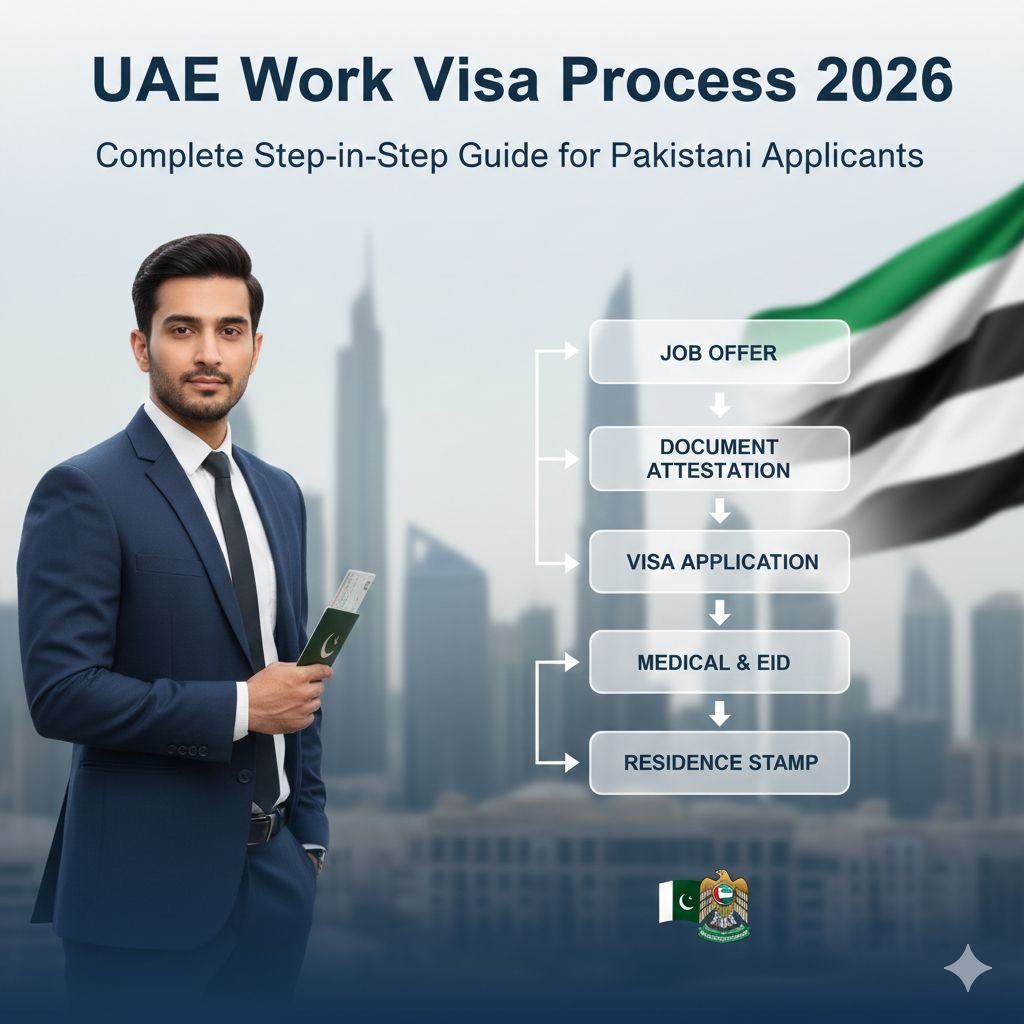
UAE Work Visa Process 2026: Complete Step-by-Step Guide for Pakistani Applicants

UAE Work Visa Process 2026 | Complete Step-by-Step Guide for Pakistanis

The good news? UAE work visas for Pakistani nationals are very much open in 2026 . The better news? With the right information and preparation, your approval chances are higher than ever—especially if you’re a skilled professional with attested documents and a genuine sponsor .

1. Is the UAE Work Visa Open for Pakistanis in 2026?

Let’s address the biggest question first. Yes, the UAE work visa for Pakistani nationals is open in 2026. Both the UAE and Pakistani governments have officially denied any rumours of a ban .

However—and this is important—there have been shifts in demand. The UAE is prioritising skilled workers over unskilled labour. Applications from candidates with university degrees, professional certifications, and attested educational documents have significantly higher approval rates .

The 2026 Reality:

  •  Skilled professionals (engineers, IT experts, accountants, doctors, nurses): High approval rates
  •  Inside-UAE employment visa changes: Getting approved
  •  Outside-UAE fresh applications: Approximately 50–50 approval rate, strongly dependent on documentation and profession
  •  Family visa sponsorship: 100% approval if documents are complete
  •  Visa change by bus: Not approved for Pakistani nationals 

Verdict: The door is open, but it swings wider for qualified, well-documented applicants.

2. What is a UAE Work Visa? Understanding the Basics

UAE work visa (officially an employment visa) is a legal permit that allows foreign nationals to live and work in the UAE under the sponsorship of a licensed employer .

Key Points to Understand:

  • Sponsorship: Your visa is tied to your employer. They are your sponsor.
  • Validity: Standard employment visas are valid for 2 years, renewable .
  • Dual Authorization: You need both a work permit (from Ministry of Human Resources – MoHRE) allowing you to work, and a residence visa (from immigration – GDRFA/ICP) allowing you to live in the UAE .
  • Green Visa Alternative: For freelancers or self-employed professionals, the 5-year Green Visa allows self-sponsorship (no employer needed) .

For the vast majority of Pakistani workers, the standard employer-sponsored work visa remains the primary pathway.

3. Eligibility Criteria for Pakistani Applicants

Before you start dreaming of Dubai’s skyline, check if you meet these baseline requirements.

For the Employee (You):

  • Age: Minimum 18 years. Workers over 65 require an additional AED 5,000 fee paid by the employer every two years .
  • Passport Validity: Must have at least 6 months remaining validity .
  • Job Offer: A confirmed, signed employment contract from a UAE-based registered company .
  • Qualifications: Your role should generally correspond to your education/training. Skilled categories (requiring degree/diploma) have lower visa fees and faster processing .
  • Clean Record: No criminal history. Police Clearance Certificate from Pakistan is now mandatory .

For the Employer (Sponsor):

  • Must have a valid trade license and active MoHRE registration
  • Must have sufficient visa quota based on office space
  • Must have no serious violations or outstanding fines 

Important: The employer is legally obligated to cover all visa and recruitment costs. If anyone asks you to pay fees before joining, do not proceed—this is illegal .

4. Required Documents: Your Complete 2026 Checklist

This is where most applications succeed or fail. Incomplete or unattested documents are the #1 reason for delays and rejections .

A. Personal Documents (You Provide)

DocumentRequirements2026 Update
PassportValid 6+ months, minimum 2 blank pagesColour scan required
Passport PhotosRecent, white background, UAE specificationAvoid old photos
CNIC / NICOPValid national ID cardMandatory
Educational CertificatesDegree/diploma; must be attested (see Section 5)Critical for skilled visa categories
Experience LettersFrom previous employers (if required for role)Helps establish expertise
Police Character CertificateIssued by Pakistani authoritiesNow mandatory for all Pakistani work visa applicants 

B. Employment Documents (Employer Provides)

  • Signed employment contract / job offer letter (MoHRE-approved format)
  • Company trade license copy
  • Establishment card / company profile

C. Medical & Insurance

  • Medical fitness certificate (conducted in UAE after arrival, or pre-approved centres in Pakistan for some cases) 
  • Health insurance (mandatory; employer provides in Dubai/Abu Dhabi, may be self-purchased in other emirates) 

D. For Family Sponsorship (Later Stage)

  • Attested marriage certificate
  • Attested birth certificates of children
  • Salary certificate meeting minimum threshold (AED 4,000+)

5. The Attestation Maze: Your Make-or-Break Step

If you take nothing else from this guide, remember this: Attestation is not optional. It is the foundation of your UAE work visa application.

Pakistani educational and civil documents must pass through this chain:

Step 1: Notary Public Attestation
Get your documents attested by a Notary Public in Pakistan .

Step 2: Higher Education Commission (HEC) Attestation
For degrees, HEC attestation is mandatory.

Step 3: Ministry of Foreign Affairs (MOFA), Pakistan
Documents must be attested by MOFA in Islamabad .

Step 4: UAE Embassy Attestation
Final attestation from the UAE Embassy in Islamabad or Consulate in Karachi .

Step 5: Translation (If Required)
Urdu documents must be translated to English by authorized translators before attestation .

⏱ Time Required: 2–4 weeks minimum. Start this process well before you have a job offer in hand.

Cost in PKR: Approximately PKR 20,000 – 50,000 depending on the number and type of documents .

6. Step-by-Step UAE Work Visa Process (2026)

Let’s walk through the entire journey, from job offer to Emirates ID.

Stage 1: Before You Travel (Employer-Led)

Step 1: Employer Quota Approval
Your employer applies to MoHRE for a visa quota (allocation to hire foreign workers).
Time: ~5 working days .

Step 2: Work Permit Application
Employer submits your job offer, your documents, and applies for a work permit.
Time: 1–5 working days .

Step 3: Entry Permit Issuance
Once approved, you receive an Entry Permit (sometimes called a “pink visa”). This allows you to legally enter the UAE.
Validity: 60 days from issue date .
If already inside UAE: You apply for “Change of Status” instead.

Step 4: Travel to UAE
Book your flight. Carry printed copies of your entry permit, job offer, and attested documents.

Stage 2: After Arrival in UAE

Step 5: Medical Fitness Test
Visit a government-approved medical centre. Tests include blood screening and chest X-ray.
Time: Results typically within 24–48 hours .
Cost: AED 300–500 (paid by employer or reimbursed) .

Step 6: Emirates ID Biometrics
Visit an EIDA (Federal Authority for Identity and Citizenship) centre to provide fingerprints and retina scan. This is mandatory for your Emirates ID.
Time: Appointment-based; ID card issued in 1–2 weeks .

Step 7: Labour Contract Submission
Employer uploads your signed labour contract to the MoHRE system (within 14 days of medical results) .

Step 8: Residence Visa Stamping
Your passport is stamped with the residence visa. You are now a legal UAE resident.
Time: ~5 working days after medical clearance .

Step 9: Receive Emirates ID
Your physical ID card arrives. You can now open bank accounts, register a SIM, and access all services.

Total Processing Time (from entry): 7–15 working days for mainland companies; 5–10 days for Free Zones .

7. UAE Work Visa Cost for Pakistanis: 2026 Breakdown in PKR

This is the question everyone asks. Here is the realistic cost picture.

Who Pays What?

Cost ComponentAmountWho Pays?
Government Visa FeesAED 3,000 – 6,000Employer (legally obligated)
Medical Test (UAE)AED 300 – 500Employer (or reimbursed)
Emirates ID FeeAED 370 / yearEmployer (or reimbursed)
Health InsuranceVariesEmployer in DXB/AUH; may be self-pay in other emirates
Document Attestation (Pakistan)PKR 20,000 – 50,000Employee (typically)
Travel Agency / Processing FeesPKR 20,000 – 50,000Employee (varies by agent)

Total Out-of-Pocket Cost for Pakistani Employee:
PKR 95,000 – 120,000 (includes attestation, agent fees, and miscellaneous expenses) .

Important: The employer must pay the core visa fees. Any agent asking you to pay the full visa cost is likely operating outside the law .

8. How to Check Your UAE Visa Status Online

You don’t need to wait for your HR department. Check your status yourself.

For Visas Issued in Dubai:

Portal: GDRFA Dubai Website
Details needed: Application number OR Passport information

For Visas Issued in Other Emirates:

Portal: ICP Smart Services (Federal Authority)
Tool: “File Validity” service
Details needed: Passport number, passport expiry date

The system will show your status as “Received,” “Approved,” or “Printed.” .

9. Common Reasons for UAE Work Visa Rejections (And How to Avoid Them)

Even with a valid job offer, rejections happen. Here’s why—and how to prevent it.

Rejection ReasonSolution
Unattested educational certificatesComplete the full attestation chain (HEC → MOFA → UAE Embassy) before application
Incomplete or incorrect documentsDouble-check everything. Use an authorized agent in Pakistan for verification
Police clearance missingObtain PCC from Pakistan; now mandatory for all Pakistani applicants 
Employer quota issuesVerify your employer has sufficient visa quota before you resign from your current job
Medical test failureEnsure you are free from communicable diseases (HIV, TB, Hepatitis B/C)
Previous UAE overstay or banClear any past violations before applying
Security clearance flagsEnsure your profile has no adverse information; this is beyond your control but more common for certain regions 

Pro Tip: Applicants with attested degrees have significantly higher approval rates than those without .

10. Latest 2026 Updates You Must Know

The UAE visa system is dynamic. Here are the key changes for 2026:

Police Clearance Certificate (PCC) is now mandatory for all Pakistani work visa applicants .

Work Bundle Digital Platform: The UAE has consolidated 8 government services into one integrated platform. Required steps reduced from 15 to 5, documents from 16 to 5, in-person visits from 7 to 2, and processing time slashed from 30 days to just 5 working days for the work permit stage .

Sharjah Visit Visas Recommended: For Pakistani nationals, Sharjah visit visas have much higher approval rates than Dubai visit visas .

Green Visa Expanded: Freelancers and self-employed professionals in IT, media, education, and design can now apply for 5-year self-sponsored residency with proof of income (AED 15,000/month) .

Visa Change by Bus: Not approved for Pakistani nationals in 2026 .

11. Approved Visa Agencies in Pakistan

Always use authorized channels. These are the recognized agencies for UAE visa processing from Pakistan:

CityApproved Agencies
KarachiTCS Visas, Gerry’s International, authorized travel agents
LahoreTCS Visas, Gerry’s International, approved visa consultants
IslamabadUAE Embassy-affiliated agencies, TCS, Gerry’s
FaisalabadAuthorized travel and visa service providers

Warning: Avoid unofficial “agents” operating without storefronts or verifiable credentials. Fraudulent applications can lead to long-term bans .

Conclusion: Your Path to the UAE in 2026

The UAE work visa process for Pakistani nationals in 2026 is clearer, more digital, and more efficient than ever before—but it also demands greater diligence. The era of “try your luck” applications is over.

Your success depends on three things:

  1. Authentic documentation: Fully attested degrees, valid passport, clean police record.
  2. Genuine sponsorship: A registered employer with quota and clean compliance record.
  3. Accurate process: Following each step in order, using authorized channels.

The UAE remains open and welcoming to Pakistani talent. Skilled professionals, qualified graduates, and genuine job seekers with complete documentation are still getting approved every single day .

If you’ve done your preparation, gathered your attestations, and secured a legitimate job offer—you have every reason to be confident.

Your UAE journey starts now. Take it step by step.


Frequently Asked Questions (FAQs)

1. Is the UAE work visa for Pakistanis open in 2026?

Yes, absolutely. Both UAE and Pakistani governments have confirmed there is no ban. Skilled professionals and applicants with attested degrees have strong approval rates. Applications from outside UAE currently have a 50–50 approval rate depending on profession and documentation 

2. How much does a UAE work visa cost from Pakistan in PKR?

The total out-of-pocket cost for a Pakistani employee typically ranges from PKR 95,000 to 120,000. This includes document attestation (PKR 20,000–50,000), agency processing fees, and miscellaneous expenses. The employer is legally responsible for the core government visa fees (AED 3,000–6,000) 

3. How long does the entire UAE work visa process take?

From Pakistan, the full process including attestation, employer processing, and post-arrival formalities takes approximately 4–6 weeks. Attestation itself takes 2–4 weeks. The new UAE “Work Bundle” system has reduced work permit processing to just 5 working days 

4. Is document attestation really mandatory?

Yes. Non-negotiable. Your educational certificates must be attested by HEC, Pakistan Ministry of Foreign Affairs, and the UAE Embassy. This is the single most common reason for visa rejections among Pakistani applicants. Start this process early 

5. Can I switch jobs in the UAE on a work visa?

Yes, you can change employers, but it requires approval and follows specific procedures. Standard employment visas typically include a 6–12 month “no-objection” period. The Green Visa offers more flexibility as it is self-sponsored. Always ensure your previous visa is properly cancelled before accepting a new offer 
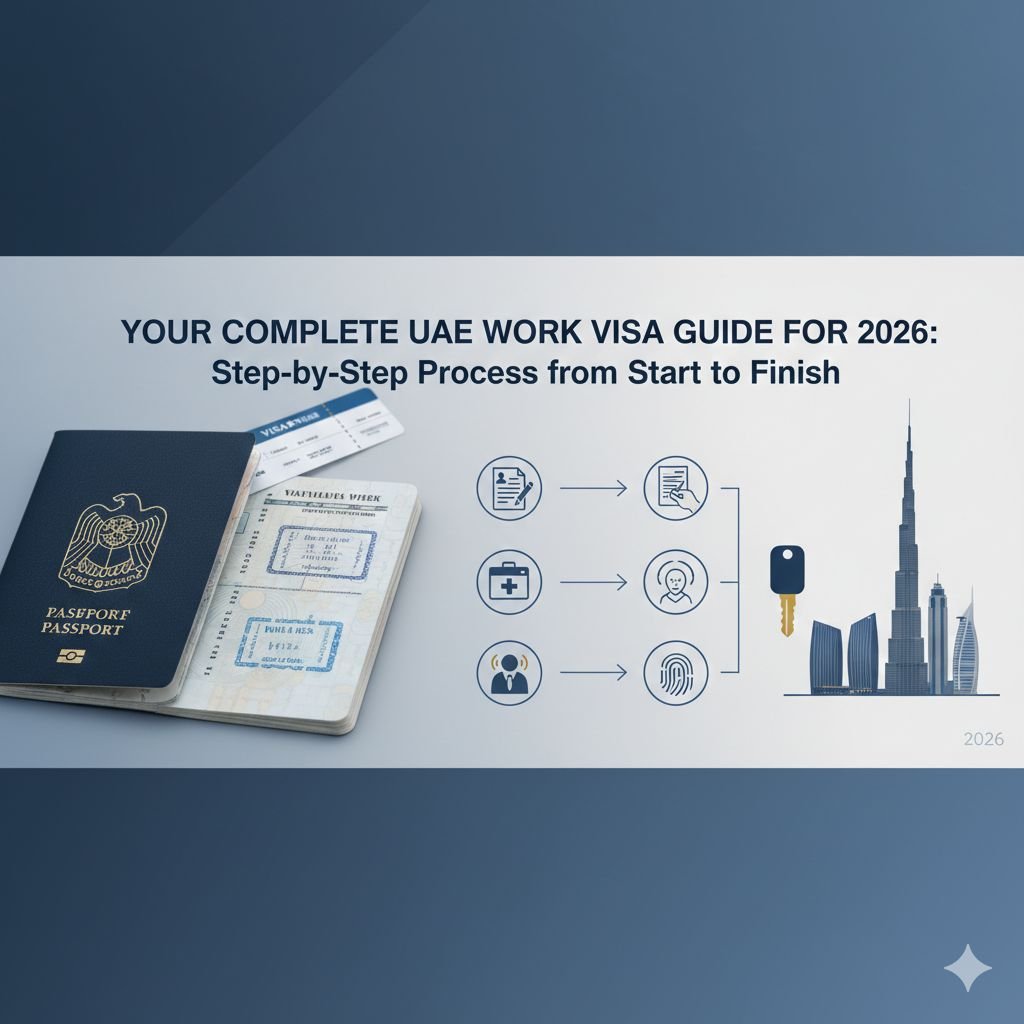
Your Complete UAE Work Visa Guide for 2026: Step-by-Step Process from Start to Finish

UAE Work Visa Guide 2024

For 2026, the UAE government has streamlined several procedures, making it more efficient but also emphasizing compliance and qualification standards. Whether you’re a software engineer from Bangalore, a project manager from Lahore, a finance expert from London, or a healthcare professional from Sydney, this guide will walk you through the entire process in clear, simple steps.

Understanding the Basics: UAE Work Visa vs. Residence Visa

First, let’s clarify the terminology, as this is a common point of confusion:

  • Entry Permit: Your initial permission to enter the UAE for employment. This is what your employer applies for first.
  • Work Visa/Residence Visa: Once you enter the UAE, this permit is stamped in your passport. It allows you to legally live and work in the country for a specific employer. It is typically valid for 2 years (1 year for some categories) and is linked to your employment contract.

Who Sponsors Your UAE Work Visa?

Unlike some countries where you apply independently, in the UAE, your employer is your sponsor. They must initiate and manage the majority of the application process. Your role is to provide accurate documents and complete medical checks.

Step 1: The Job Offer & Employment Contract

The process starts with a formal job offer from a UAE-based company licensed to hire expatriates. Ensure your contract details your position, salary, benefits, and probation period clearly. Do not resign from your current job until you have the Entry Permit in hand.

Step 2: Entry Permit Application (By Employer)

Your employer applies for your Entry Permit through the Ministry of Human Resources and Emiratisation (MOHRE) for the private sector or relevant federal authority for government jobs. This is done online via the MOHRE smart services system.

  • Key Requirements from You: Scanned copies of your passport (valid for at least 6 months), passport-sized photographs with white background, and attested educational certificates.

Step 3: Entry into the UAE & Medical Fitness Test

Once the Entry Permit is issued, you can travel to the UAE. You must enter the country within 60 days.
Shortly after arrival, you must undergo a mandatory medical fitness test at an approved health centre. This includes a blood test for HIV and tuberculosis and a chest X-ray for tuberculosis. If you test positive for any communicable disease, your visa will be rejected, and you must leave the country.

Step 4: Emirates ID Registration & Biometrics

The Emirates ID is your national identity card in the UAE and is mandatory. Your employer will apply for it on your behalf through the Federal Authority for Identity, Citizenship, Customs & Port Security (ICP). You will need to visit an authorized typing centre or ICP service centre to provide your biometrics (photograph and fingerprints).

Step 5: Residency Visa Stamping

With your medical clearance and Emirates ID application in process, your passport is submitted to the immigration authorities for the residency visa stamp. This is the final step where the visa is physically placed in your passport.

Step 6: Opening a Bank Account & Getting a Driver’s License

With your Emirates ID and residency visa, you can now open a local bank account and apply for a UAE driver’s license (often requiring attestation of your home country license or taking lessons/tests).

Essential Documents Checklist (2026 Requirements)

Prepare these documents with attention to detail. Attestation is critical.

  1. Passport: Valid for at least 6 months, with clear scanned copies.
  2. Passport Photos: Recent, white background, professional.
  3. Attested Educational Certificates: This is a multi-step process:
    • For India: Attestation from the State HRD/Education Department → UAE Embassy Attestation in India → Ministry of Foreign Affairs (MoFA) attestation in the UAE.
    • For Pakistan: Attestation from the Higher Education Commission (HEC) and the Ministry of Foreign Affairs (MoFA) in Pakistan → UAE Embassy Attestation in Pakistan → MoFA attestation in the UAE.
    • For UK/Australia: The process is often simpler, typically requiring certification by a notary public or solicitor, then attestation by the UAE Embassy in London/Canberra.
  4. Experience/Reference Letters: Attested letters from previous employers may be required for certain professional roles.
  5. Job Offer/Employment Contract: Signed by you and your employer.

Costs & Fees (Approximate for 2026)

Costs are usually borne by the employer, but this can be negotiated. Be aware of the typical fees:

  • Entry Permit: AED 300 – 600
  • Status Change & Medical Test: AED 500 – 800
  • Emirates ID: AED 300 – 500 (depending on validity)
  • Residency Visa Stamping: AED 500 – 700
  • Document Attestation: Varies widely by country (Can range from AED 1,000 to AED 3,000+ including all steps).

Total Estimated Cost: AED 3,000 – 5,000 (excluding document attestation from your home country).

Key Changes & Updates for 2026

  • Green Visa: A 5-year residency permit for skilled professionals, freelancers, and investors that offers greater flexibility, as it is not tied to a specific employer.
  • Golden Visa: A long-term 10-year residency for investors, entrepreneurs, scientists, outstanding students, and specialized professionals like doctors and engineers.
  • Digital Nomad Visa: Allows remote workers to live in the UAE while employed by a company overseas.
  • Enhanced Online Portals: The UAE government continues to digitize all processes through platforms like the ICP smart services and MOHRE’s website, making applications more transparent.

Comparing Gulf Processes: UAE vs. Saudi vs. Qatar

While this guide focuses on the UAE, professionals often explore opportunities across the region. Here’s a quick comparison:

  • Saudi Work Visa (Iqama): Process is also employer-led. Recent reforms under Vision 2030 have made it more streamlined. The medical test is strict. Family visa rules have been relaxed, making it easier to bring dependents.
  • Qatar Work Permit: Requires an employer (sponsor) in Qatar to initiate. A key step is obtaining a Qatar ID. The process involves medical tests and security checks. Recent World Cup infrastructure has led to more standardized procedures.

Important Tips for a Smooth Process

  1. Start Document Attestation Early: This is the step that takes the longest, especially for applicants from India and Pakistan. Begin as soon as you have a serious job offer.
  2. Verify Your Employer: Ensure the company offering you the job is legitimate and in good standing. You can check their trade license online through the respective Emirate’s economic department website (e.g., DED in Dubai).
  3. Understand Your Contract: Know your rights regarding probation periods, notice periods, and end-of-service benefits.
  4. Use Authorized Channels: Never use unauthorized “visa agents” for the main process. Your employer’s PRO (Public Relations Officer) or HR department should handle it through official government portals.

Conclusion: Your Pathway to a New Chapter

The UAE work visa process for 2026 is designed to be efficient for qualified professionals. While it involves several steps and requires meticulous document preparation, understanding the workflow removes the anxiety and helps you prepare effectively.

Success hinges on three pillars: a legitimate job offer from a reputable company, perfectly attested documents, and patience as the bureaucratic wheels turn. By following this guide, professionals from Pakistan, India, the UK, and Australia can approach their UAE relocation with confidence, ready to embark on a rewarding career in one of the world’s most dynamic regions.


Frequently Asked Questions (FAQs)

1. How long does the entire UAE work visa process take in 2026?

From the time your employer applies for the Entry Permit to receiving your Emirates ID and residency stamp, the entire process typically takes 4 to 8 weeks, assuming all your documents are correctly attested and ready. The medical test and Emirates ID biometrics can add a few days to the timeline. Delays most commonly occur during the educational certificate attestation process in your home country.

2. Can I bring my family (spouse and children) on my UAE work visa?

Yes, most expatriate professionals can sponsor their spouse and dependent children (usually under 18 years of age). Requirements include:
Proof of relationship (marriage/birth certificates attested).
Meeting a minimum salary threshold (typically AED 3,000 – 4,000 per month, but some Emirates may require more for housing allowances).
Providing proof of suitable accommodation.

3. What happens if I lose my job in the UAE?

Your residency visa is tied to your employment. If you lose your job, you have a grace period (currently 30 to 90 days from the date of cancellation, depending on your visa type and circumstances) to either find a new job and transfer your visa sponsorship, or leave the country. It is crucial to understand your specific grace period and act within it to avoid overstaying fines.

4. Is it better to get documents attested in my home country or in the UAE?

You must start the attestation process in your home country. The chain is: Notary/University → Home Government Department (e.g., HEC for Pakistan, HRD for India) → UAE Embassy/Consulate in your home country. Only the final “MoFA attestation” is done in the UAE. Trying to bypass your home country’s steps will result in rejection.

5. What is the main difference between the standard work visa and the Green/Golden Visa?

The standard work visa is tied to your specific employer and is valid for 2 years. If you change jobs, the visa must be cancelled and a new one issued. The Green Visa (5 years) and Golden Visa (10 years) are long-term residencies that offer greater flexibility. They are not tied to an employer, allowing you to change jobs freely and offering extended grace periods if you leave employment. They have higher eligibility criteria based on profession, salary, investment, or special skills.

Work Visa Jobs Hiring Now Worldwide: Your Global Career Pathway in 2026

Work Visa Jobs Hiring Now 2026 – International Jobs

The dream of building an international career is more accessible than ever. For skilled professionals across the globe, the key to unlocking this dream often lies in securing a work visa job—a position where an employer sponsors your legal right to work and live in a new country. In 2026, global talent mobility is accelerating, driven by demographic shifts, technological advancement, and strategic national policies aimed at attracting the best and brightest.

Whether you’re a nurse from Manila, a software developer from Nairobi, or an engineer from Cairo, opportunities abound for those who know where to look and how to navigate the process. This definitive guide explores the current landscape of international jobs with visa sponsorship, identifying high-demand countries and sectors, demystifying the visa process, and providing a proven roadmap to secure your position abroad.

The Global Demand for Skilled Talent: Why Countries Are Hiring

Nations worldwide are actively competing for skilled workers to fuel economic growth, address labor shortages, and drive innovation. This has led to the creation of specific visa pathways designed to attract talent:

  • Aging Populations: Countries like Germany, Japan, and Canada face significant demographic challenges, creating urgent demand in healthcare, engineering, and skilled trades.
  • Economic Expansion & Tech Leadership: Nations such as the UAE, Saudi Arabia, Singapore, and Australia are investing heavily in tech, green energy, and finance, requiring a global talent pool.
  • Post-Pandemic Recovery: The UK, USA, and New Zealand have streamlined visa processes in sectors like healthcare, logistics, and hospitality to bolster their workforces.
  • Giga-Projects & Infrastructure: The Gulf Cooperation Council (GCC) countries, led by Saudi Arabia’s Vision 2030, are undertaking historic projects, sourcing thousands of engineers, project managers, and technicians globally.

Top Countries Offering Work Visa Sponsorship in 2026

1. The Gulf Cooperation Council (GCC): UAE, Saudi Arabia, Qatar

  • Visa Type: Employer-Sponsored Residence/Work Permit (e.g., UAE’s Iqama, Saudi’s Qiwa).
  • Process: Typically straightforward and fully managed by the employer. Requires medical tests and attestation of documents.
  • Key Sectors: Construction, Engineering, Healthcare, IT, Hospitality, Finance.
  • Unique Advantage: Tax-free salaries, comprehensive benefits (housing, flights), and rapid career growth in dynamic economies.

2. Canada

  • Visa Pathways:
    • Express Entry (FSW, CEC, FST): Points-based system for skilled workers.
    • Provincial Nominee Program (PNP): Provincial-specific demands.
    • Global Talent Stream (GTS): Fast-track for tech occupations.
  • Key Sectors: IT (Software Devs, Data Scientists), Healthcare (Nurses, Physicians), Skilled Trades (Welders, Electricians), Engineering.
  • Ultimate Goal: A direct pathway to Permanent Residency (PR) and citizenship.

3. Germany

  • Visa Pathways: EU Blue Card (for university graduates with a job offer meeting a salary threshold), Skilled Worker Visa.
  • Key Sectors: Engineering (Automotive, Mechanical), IT, Healthcare (Doctors, Nurses), STEM Research.
  • Note: Strong demand for German language skills, though many tech companies operate in English.

4. Australia

  • Visa Pathways: Skilled Independent visa (subclass 189)Employer Nomination Scheme (subclass 186)Temporary Skill Shortage (TSS) visa (subclass 482).
  • Key Sectors: Healthcare, Education (Teachers), Construction, IT & Cyber Security, Agriculture.
  • Process: Often involves a skills assessment by a relevant assessing authority.

5. United Kingdom

  • Visa Pathways: Skilled Worker visa (requires a job offer from a Home Office-licensed sponsor).
  • Key Sectors: Healthcare (on the Health and Care Worker visa), Technology, Engineering, Science, and Academia.
  • Shortage Occupations List: Roles on this list have lower fee thresholds and are prioritized.

6. New Zealand

  • Visa Pathways: Accredited Employer Work Visa (AEWV). The employer must be accredited first.
  • Key Sectors: Healthcare, Construction, Technology, Agriculture, and Hospitality.

High-Demand Professions for Global Work Visa Sponsorship

These roles are in critical shortage across multiple continents:

  1. Healthcare Professionals: Registered Nurses, Specialist Doctors, Physiotherapists, Medical Laboratory Technologists. The global healthcare crisis has made this the most universally in-demand field.
  2. Technology & IT Specialists: Software Developers/Engineers, Cybersecurity Analysts, Data Scientists, DevOps Engineers, Cloud Architects. The digital transformation of every industry fuels this demand.
  3. Engineers: Civil, Mechanical, Electrical, and Project Engineers, especially with experience in construction, energy, or infrastructure.
  4. Skilled Tradespeople: Electricians, Welders, Plumbers, Heavy Equipment Operators. Essential for national infrastructure, these roles often offer excellent pay and visa pathways.
  5. Education Professionals: STEM Teachers, University Lecturers, Special Needs Educators.
  6. Finance & Accounting: Chartered Accountants, Financial Analysts, Auditors for global firms.

Step-by-Step Guide to Securing an International Job with Visa Sponsorship

Phase 1: Preparation & Research (The Foundation)

  1. Self-Assessment: Critically evaluate your qualifications, experience, and skills against global demand. Do you need additional certification (e.g., CGFNS for nurses, AWS for tech)?
  2. Target Country & Sector: Based on your profile, select 2-3 target countries. Research their specific visa categories, eligibility, and required documents.
  3. Credential Recognition: Begin the process of having your educational degrees and professional licenses assessed/attested for your target country. This can be time-consuming.

Phase 2: The Job Hunt & Application Strategy

  1. Optimize Your Global CV/Resume:
    • Use a clean, professional format.
    • Lead with a powerful summary highlighting your visa status (e.g., “Eligible for UK Skilled Worker Visa sponsorship”).
    • Quantify achievements using metrics.
    • Ensure it is culturally appropriate (e.g., include a professional photo for GCC applications).
  2. Leverage the Right Job Platforms:
    • Global/LinkedIn: Use filters like “Visa sponsorship” and “Relocation assistance.” Set your location to your target country.
    • Sector-Specific Portals: For healthcare (HealthTalent, NHS Jobs), tech (Stack Overflow Jobs, AngelList), academia (HigherEdJobs).
    • Country-Specific Portals: Indeed local versions, Reed (UK), SEEK (Australia), Bayt (GCC).
  3. Network Proactively:
    • Connect with recruiters specializing in international placement on LinkedIn.
    • Join online communities and forums for expats in your target country/industry.
    • Attend international virtual career fairs.

Phase 3: The Interview & Visa Process

  1. Ace the Virtual Interview: Be prepared to discuss your motivation for relocating, your understanding of the local work culture, and your long-term plans. Clarify visa sponsorship early in the process.
  2. Understand the Offer: A legitimate international offer should clearly detail: Job title, salary, benefits, and a clause confirming the employer will handle/work with you on the visa sponsorship process.
  3. Navigating Visa Logistics: Once you accept the offer, the employer’s HR or an immigration lawyer will typically guide you. Your role is to provide accurate documents promptly and complete required steps (medical exams, biometrics).

Red Flags & How to Avoid Job Scams

  • Never Pay for a Job or Visa: Legitimate employers and governments will charge application fees, but you should never pay an individual or company for a “guaranteed” job offer.
  • Verify the Employer: Research the company. Do they have a legitimate website, address, and reviews? Are they a licensed sponsor in the country (e.g., on the UK’s list of licensed sponsors)?
  • Too Good to Be True Offers: Be wary of unsolicited offers with unusually high salaries for minimal qualifications.

Conclusion: Your Global Career Awaits

Securing work visa jobs hiring now is a marathon, not a sprint. It requires meticulous preparation, targeted strategy, and resilient effort. However, the reward—a new life, career advancement, cultural immersion, and often a path to permanent residency—is transformative.

In 2026, the world is more connected and talent-hungry than ever. By aligning your skills with global needs, presenting yourself as a valuable asset, and navigating the process with diligence, you can successfully cross borders and build the international career you’ve envisioned. Start your journey today.


FAQs: International Jobs with Visa Sponsorship

1. Which country is easiest to get a work visa for in 2026?

“Easiest” depends on your profession. Currently, Canada (through Express Entry for in-demand skills) and the GCC countries (like UAE and Saudi Arabia, due to employer-driven, relatively straightforward processes) are considered among the most accessible for qualified professionals, especially in tech, engineering, and healthcare.

2. Can I apply for jobs abroad while still in my home country?

Absolutely, and this is the standard method. Employers expect international candidates. Use online job portals, optimize your LinkedIn profile for the target location, and be prepared for virtual interviews. Your job offer will precede your visa application.

3. Do I need a job offer before applying for a work visa?

In overwhelmingly most cases, yes. Work visas like the US H-1B, UK Skilled Worker, and Canada’s Temporary Foreign Worker Program require a formal job offer from a licensed sponsor. Some countries (like Canada’s Express Entry) have points-based systems where a job offer grants extra points but isn’t always mandatory.

4. How long does the entire process take, from job search to relocation?

The timeline varies widely:
Job Search: 3-9 months on average.
Visa Processing: 1-4 months after a job offer is accepted, depending on the country and your documentation.
Total: Be prepared for a 6 to 12-month process from the start of your search to your first day at work abroad.

5. Can my family join me on a work visa?

In most countries, yes. Primary work visas (like the UAE Residence Permit, Canada’s Work Permit, or the UK’s Skilled Worker visa) typically allow you to sponsor your spouse and dependent children for dependent visas, which grant them residence rights and, often, the ability to study or work.

UAE Jobs With Salary Above AED 5,000: Your 2026 Guide to Higher Earnings

High Salary UAE Jobs | Earn Above AED 5,000+ Monthly in 2026

The United Arab Emirates continues to stand as a global beacon for career advancement and financial growth. For professionals seeking not just a job but a lucrative career path, securing a position with a salary above AED 5,000 per month is a common and achievable benchmark. This figure often represents the threshold for roles that offer greater responsibility, specialized skills, and the potential for significant savings, especially when combined with the UAE’s tax-free income structure.

Understanding Salary Benchmarks in the UAE: What Does AED 5,000+ Represent?

In the UAE job market, salary is influenced by a critical matrix: industry, role, experience, qualifications, and nationality (due to market dynamics and demand for specific skill sets). While AED 5,000 is an excellent starting goal, it’s important to understand the broader spectrum:

  • AED 5,000 – AED 10,000: Typical range for skilled technicians, junior executives, entry-level engineers, experienced retail supervisors, and specialized customer service roles.
  • AED 10,000 – AED 20,000: Common for mid-level professionals, engineers with 3-5 years experience, marketing managers, qualified nurses, and IT specialists.
  • AED 20,000 – AED 40,000+: Standard for senior managers, lead engineers, specialist doctors, senior software architects, and financial controllers in multinational corporations.

salary above AED 5,000 is therefore a strong indicator of a role that requires demonstrable skill, professional experience, or specialized training. It moves beyond basic entry-level positions into the realm of skilled professional work.

Top Industries Offering High-Paying Jobs (AED 5,000+) in 2026

Target your job search in these expanding, high-value sectors known for competitive remuneration.

1. Information Technology, AI & Cybersecurity

The UAE’s ambition to be a global tech leader makes this the most explosive sector for high salaries.

  • Sample Roles & Salary Range:
    • Data Scientist: AED 18,000 – AED 40,000+
    • Cybersecurity Analyst: AED 15,000 – AED 35,000
    • Full-Stack Developer: AED 14,000 – AED 30,000
    • Cloud Solutions Architect: AED 25,000 – AED 50,000+
    • IT Project Manager: AED 20,000 – AED 45,000
  • Key Employers: G42, Dubai Electronic Security Center, Microsoft Gulf, Amazon Web Services (AWS), Careem, and numerous tech startups in DIFC & ADGM.

2. Healthcare & Medical Services

A perennial high-demand sector, especially for specialized clinical and administrative roles.

  • Sample Roles & Salary Range:
    • Registered Nurse (Specialized): AED 10,000 – AED 18,000
    • Pharmacist: AED 12,000 – AED 22,000
    • Medical Laboratory Technician: AED 8,000 – AED 15,000
    • Physiotherapist: AED 12,000 – AED 25,000
    • Healthcare Administrator: AED 15,000 – AED 30,000
  • Key Employers: Cleveland Clinic Abu Dhabi, Sheikh Shakhbout Medical City, Dubai Health Authority (DHA) facilities, Aster Hospitals, NMC Healthcare.

3. Engineering & Construction

Sustained by mega-projects like Dubai Urban Plan 2040 and Abu Dhabi’s economic diversification.

  • Sample Roles & Salary Range:
    • Civil/Mechanical/Electrical Engineer (3-5 yrs exp): AED 12,000 – AED 25,000
    • Project Engineer: AED 15,000 – AED 28,000
    • Site Manager: AED 20,000 – AED 40,000
    • CAD Technician (Senior): AED 8,000 – AED 15,000
  • Key Employers: DP World, ALEC Engineering, Bechtel, Parsons, Emirates Global Aluminum (EGA).

4. Finance, Banking & Fintech

The UAE’s status as a global financial hub ensures premium pay for finance professionals.

  • Sample Roles & Salary Range:
    • Financial Analyst: AED 16,000 – AED 30,000
    • Risk Management Specialist: AED 18,000 – AED 35,000
    • Accountant (Chartered): AED 14,000 – AED 28,000
    • Fintech Product Manager: AED 22,000 – AED 45,000+
  • Key Employers: Banks in DIFC & ADGM (Emirates NBD, FAB, Mashreq), fintech startups, the Big 4 accounting firms (PwC, Deloitte, EY, KPMG).

5. Aviation, Aerospace & Logistics

Leveraging the UAE’s geographic advantage and world-leading airlines.

  • Sample Roles & Salary Range:
    • Aircraft Maintenance Engineer: AED 15,000 – AED 30,000
    • Supply Chain Manager: AED 18,000 – AED 35,000
    • Aviation Safety Officer: AED 20,000 – AED 38,000
    • Senior Logistics Coordinator: AED 10,000 – AED 18,000
  • Key Employers: Emirates Group, Etihad Airways, Dubai Airports, DHL, Maersk.

6. Sales, Marketing & Business Development

Performance-driven roles where high commission can significantly boost base salaries well above AED 5,000.

  • Sample Roles: Key Account Manager, Enterprise Sales Executive, Digital Marketing Manager, Business Development Manager in sectors like technology, pharmaceuticals, and industrial goods.

The Complete Compensation Package: Beyond the Basic Salary

When evaluating a high salary UAE job, always consider the total package:

  1. Basic Salary: The core, tax-free amount (your AED 5,000+ benchmark).
  2. Housing Allowance: Often 30-50% of basic salary, or company-provided accommodation.
  3. Transportation Allowance: A monthly cash allowance for commuting.
  4. Annual Airfare: Return tickets to home country for employee and often family.
  5. Health Insurance: Comprehensive coverage, usually extending to spouse and children.
  6. Education Allowance: For children’s schooling, common in senior packages.
  7. End-of-Service Benefit (Gratuity): A legally mandated bonus paid upon completion of service.

A role with a basic salary of AED 8,000, plus housing (AED 3,000) and transportation (AED 1,000) allowances, effectively provides a total monthly financial benefit of AED 12,000.

How to Qualify and Apply for High-Paying UAE Jobs

Step 1: Skill Assessment & Upskilling

  • Identify In-Demand Skills: Use LinkedIn Job Insights and reports from Michael Page and Hays to see what skills are listed for high-salary roles.
  • Obtain Relevant Certifications: In tech (AWS, PMP, CISSP), healthcare (DHA/HAAD license), finance (CFA, CPA), or project management (PMP) to validate your expertise and justify a higher salary.

Step 2: Optimize Your Professional Profile

  • Tailor Your CV: Quantify achievements with metrics (e.g., “Increased regional sales by 22%” or “Reduced system downtime by 40%”). Highlight experience with major brands or complex projects.
  • Master LinkedIn: A complete profile with a professional headline, detailed experience, skills endorsements, and recommendations is non-negotiable. Recruiters actively headhunt here.

Step 3: Strategic Job Hunting

  • Leverage Premium Job Portals: LinkedIn, GulfTalent, and Bayt.com are primary. Use advanced filters for salary expectations and experience level.
  • Engage with Recruitment Agencies: Specialized agencies have exclusive contracts for mid-to-senior roles. Register with reputable firms like Michael Page, Robert Half, and Charterhouse.
  • Network Proactively: Attend industry conferences in Dubai/Abu Dhabi. Connect with professionals and hiring managers on LinkedIn with personalized messages.

Step 4: Ace the Interview & Salary Negotiation

  • Research Market Rates: Use the Glassdoor Salaries tool and the Bayt.com Salary Survey to know the exact salary range for your role, experience, and industry in the UAE.
  • Discuss the Total Package: Negotiate on the basis of the entire benefits package, not just the basic salary. Be prepared to articulate your value clearly.
  • Be Patient but Confident: The hiring process for higher-salaried roles can take longer due to multiple interview rounds.

Common Pitfalls to Avoid

  • Accepting the First Offer: Always negotiate respectfully based on your market research.
  • Ignoring Company Reputation: Research the company’s financial stability and employee reviews on Glassdoor.
  • Overlooking the Contract: Read your employment contract thoroughly before signing. Ensure all negotiated benefits are explicitly stated.

Conclusion: Your Path to a High-Earning Career in the UAE

Securing a UAE job with a salary above AED 5,000 is a realistic and strategic career goal for 2026. By aligning your skills with the high-growth sectors of technology, healthcare, engineering, and finance, and by approaching your job search with preparation and professionalism, you position yourself not just for a job, but for a thriving, high-value career.

The UAE rewards ambition, expertise, and results. Invest in your skills, craft a compelling professional narrative, and negotiate with confidence. Your journey toward significant financial growth and unparalleled professional experience in one of the world’s most dynamic economies starts now.


FAQs: UAE Jobs With High Salaries

1. Is a salary of AED 5,000 enough to live comfortably in Dubai or Abu Dhabi?

Yes, but it depends on your lifestyle. For a single person sharing accommodation, AED 5,000 can cover basic living expenses and allow for some savings. For a more comfortable lifestyle (private studio, frequent dining out, entertainment), a salary of AED 8,000-10,000+ is generally recommended.

2. Do all high-paying jobs in the UAE require a university degree?

While a degree is highly preferred and often required for professional roles (engineering, medicine, finance), specialized technical certifications and demonstrable experience can sometimes substitute, especially in high-demand tech fields like programming or cybersecurity.

3. How can I check if the salary offered to me is fair for the UAE market?

Use online salary survey tools from GulfTalent, Bayt.com, and LinkedIn Salary. These provide localized, role-specific data. You can also consult with reputable recruitment agencies for benchmark advice.

4. What is the single biggest factor that determines a high salary in the UAE?

Specialized, in-demand skills combined with proven experience. Employers pay a premium for expertise that directly contributes to revenue, innovation, or critical operations, especially in sectors aligned with national economic visions.

5. Are salaries higher in Dubai or Abu Dhabi?

Traditionally, Abu Dhabi has offered slightly higher base salaries for similar roles, particularly in government and oil & gas sectors. However, Dubai is highly competitive, especially in trade, tourism, tech, and finance, and often makes up the difference with performance-related bonuses and benefits. The gap has narrowed significantly.

UAE Jobs 2025: High‑Paying Careers, Salaries & Visa Sponsorship Guide

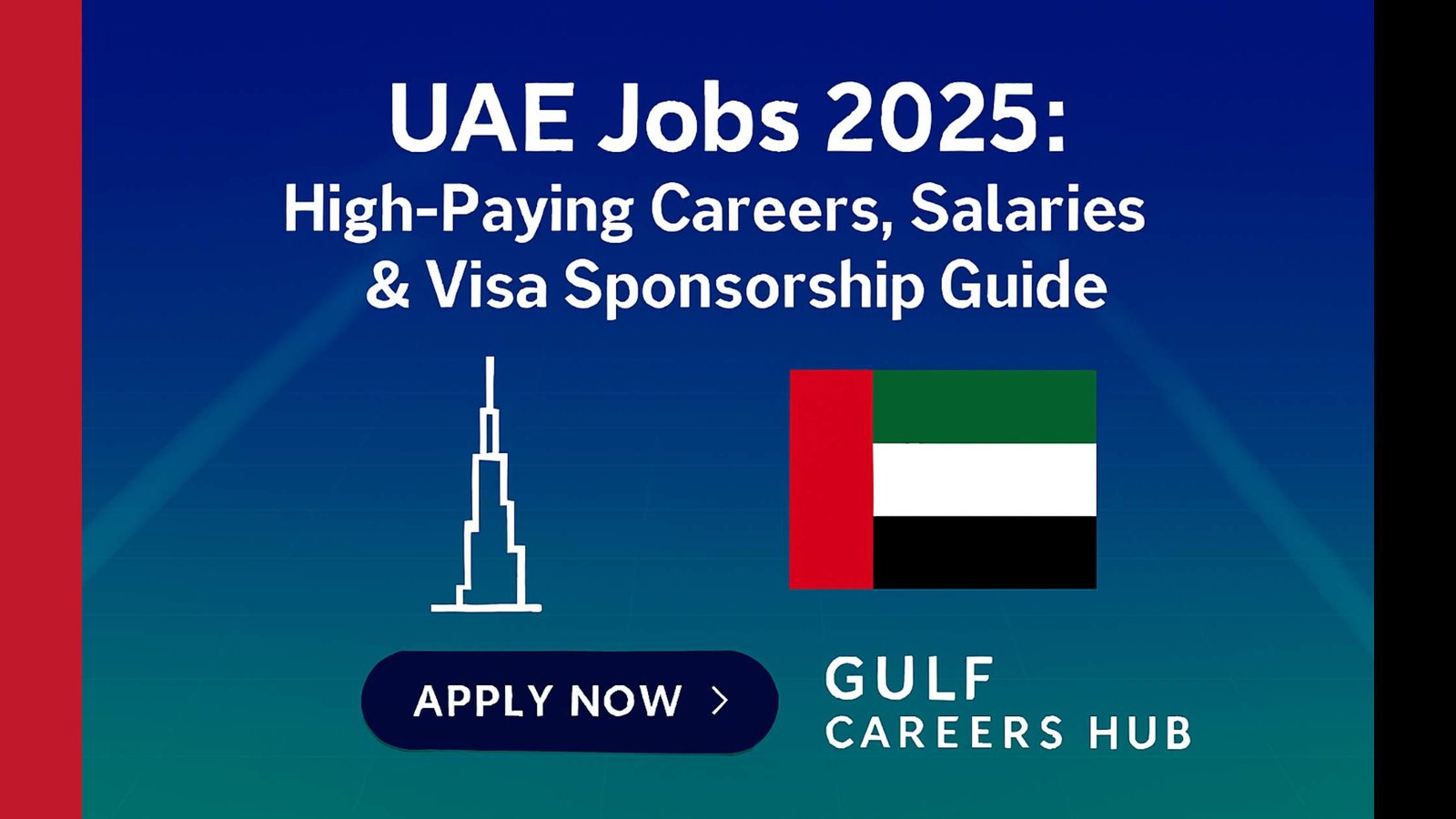
Banner showing UAE Jobs 2025 guide with Burj Khalifa, UAE flag, and Apply Now button

The UAE job market in 2025 is booming, with thousands of opportunities across Dubai, Abu Dhabi, and Sharjah. From high‑paying jobs in UAE to visa sponsorship roles, professionals worldwide are looking to secure their future in the Gulf. This guide covers the latest UAE jobs 2025, average salaries, and the UAE work visa process so you can apply with confidence.

Why Work in the UAE?

  • Tax‑free salaries in Dubai and Abu Dhabi
  • High‑demand jobs in UAE 2025 across IT, healthcare, and construction
  • UAE employment visa sponsorship for expats
  • Career growth in multinational companies

Top In‑Demand Jobs in UAE 2025

SectorJob RolesAverage Monthly Salary (AED)Visa Sponsorship
HealthcareNurses, Doctors, Lab Technicians8,000 – 25,000High
IT & TechnologySoftware Engineers, Data Analysts12,000 – 30,000High
ConstructionCivil Engineers, Project Managers9,000 – 20,000Medium
FinanceAccountants, Auditors, Bankers10,000 – 22,000High
EducationTeachers, Lecturers6,000 – 18,000High
HospitalityChefs, Hotel Managers, Wait Staff4,000 – 15,000Medium

Keywords inside table: UAE jobs 2025, high‑demand jobs in UAE, UAE salaries, UAE visa sponsorship

UAE Work Visa Process 2025

  1. Job Offer in UAE – Secure an offer from a registered employer.
  2. Work Permit Application – Employer applies for your UAE work permit.
  3. Medical Test & Emirates ID – Mandatory for all expats.
  4. Residence Visa Stamping – Final step to legally live and work in the UAE.

Keywords: UAE work visa 2025, UAE employment visa, UAE residence visa

RoleCompanyLocationSalary (AED)Apply Link
Business Development ManagerLinks InternationalDubaiCompetitiveApply on LinkedIn
Customer Service (UAE Nationals)TASC OutsourcingDubai4,000 – 6,000Apply on beBee
Software Project ManagerLink DevelopmentAbu Dhabi18,000 – 25,000Apply on beBee
Internship (Law & Business)DLA PiperDubaiStipend ProvidedApply on beBee
400+ Jobs in Dubai (Multiple Roles)Various EmployersDubaiVariesSee all on Indeed

Keywords inside chart: Dubai jobs 2025, Abu Dhabi jobs, UAE careers, apply UAE jobs

FAQs about UAE Jobs 2025

Are UAE jobs in 2025 open for foreigners?

Yes, most UAE jobs for expats include visa sponsorship.

What is the average salary in UAE 2025?

Salaries range from AED 4,000 to AED 30,000, depending on sector.

Which job portals are best for UAE jobs?

Trusted sites include LinkedIn, Bayt, GulfTalent, Naukrigulf, and Indeed.

Do UAE employers provide visa sponsorship?

Yes, most legitimate employers handle the UAE employment visa process.

Conclusion

The UAE job market in 2025 is full of opportunities for skilled professionals. Whether you’re looking for high‑paying jobs in Dubai, visa sponsorship roles in Abu Dhabi, or entry‑level positions in hospitality, the UAE offers a tax‑free salary and career growth.


✍️ About the Author

This article is published by Gulf Careers Hub, your trusted source for job updates, salary guides, visa sponsorship news, and expat career tips across the UAE, Saudi Arabia, Qatar, Oman, UK, and USA.

🔗 Visit us: GulfCareersHub.com


Post a Job Opening

Fill in the details below. Your job posting will be reviewed by our team.

Basic Information

Specify years of experience required

Location & Salary

Qualifications & Skills

Specify educational requirements
Separate skills with commas

Company Details

Job Details

Contact Information