Gulf Careers Hub

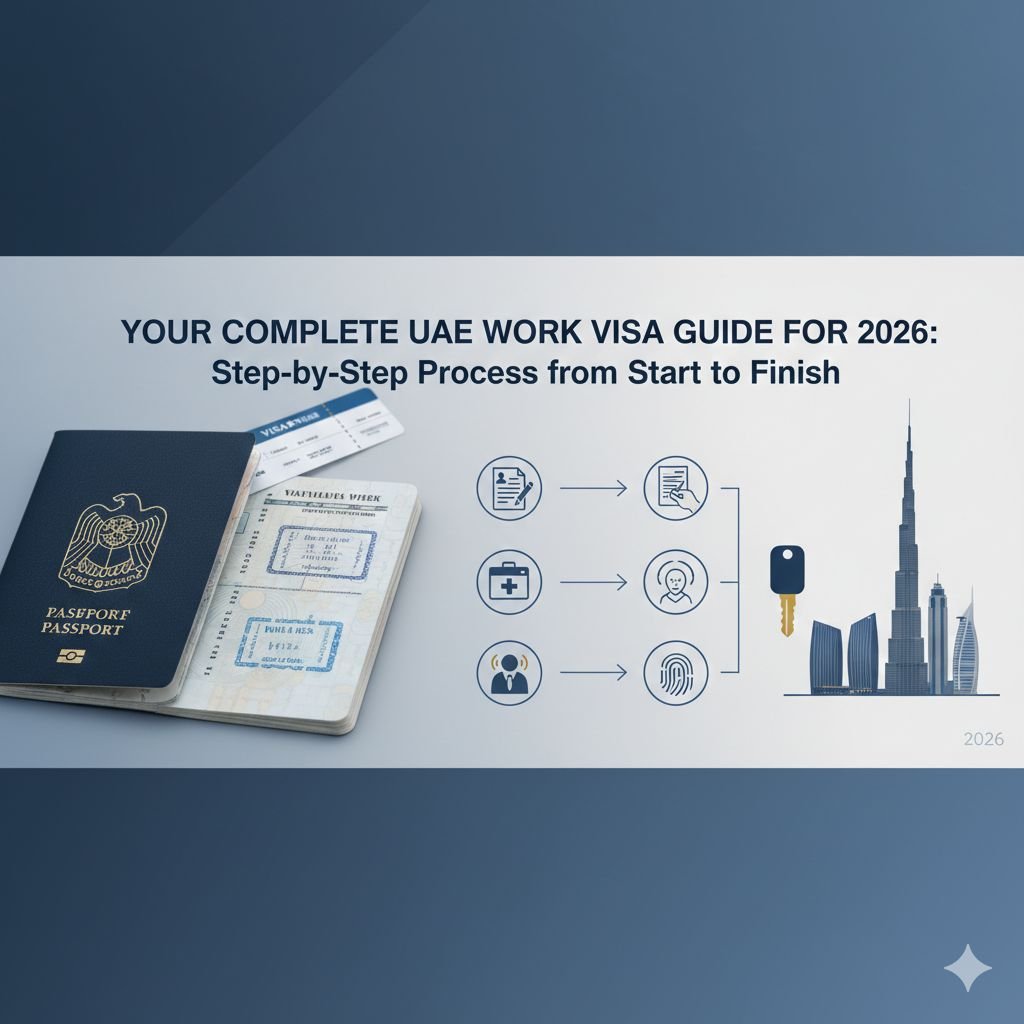
Your Complete UAE Work Visa Guide for 2026: Step-by-Step Process from Start to Finish

UAE Work Visa Guide 2024

For 2026, the UAE government has streamlined several procedures, making it more efficient but also emphasizing compliance and qualification standards. Whether you’re a software engineer from Bangalore, a project manager from Lahore, a finance expert from London, or a healthcare professional from Sydney, this guide will walk you through the entire process in clear, simple steps.

Understanding the Basics: UAE Work Visa vs. Residence Visa

First, let’s clarify the terminology, as this is a common point of confusion:

  • Entry Permit: Your initial permission to enter the UAE for employment. This is what your employer applies for first.
  • Work Visa/Residence Visa: Once you enter the UAE, this permit is stamped in your passport. It allows you to legally live and work in the country for a specific employer. It is typically valid for 2 years (1 year for some categories) and is linked to your employment contract.

Who Sponsors Your UAE Work Visa?

Unlike some countries where you apply independently, in the UAE, your employer is your sponsor. They must initiate and manage the majority of the application process. Your role is to provide accurate documents and complete medical checks.

Step 1: The Job Offer & Employment Contract

The process starts with a formal job offer from a UAE-based company licensed to hire expatriates. Ensure your contract details your position, salary, benefits, and probation period clearly. Do not resign from your current job until you have the Entry Permit in hand.

Step 2: Entry Permit Application (By Employer)

Your employer applies for your Entry Permit through the Ministry of Human Resources and Emiratisation (MOHRE) for the private sector or relevant federal authority for government jobs. This is done online via the MOHRE smart services system.

  • Key Requirements from You: Scanned copies of your passport (valid for at least 6 months), passport-sized photographs with white background, and attested educational certificates.

Step 3: Entry into the UAE & Medical Fitness Test

Once the Entry Permit is issued, you can travel to the UAE. You must enter the country within 60 days.
Shortly after arrival, you must undergo a mandatory medical fitness test at an approved health centre. This includes a blood test for HIV and tuberculosis and a chest X-ray for tuberculosis. If you test positive for any communicable disease, your visa will be rejected, and you must leave the country.

Step 4: Emirates ID Registration & Biometrics

The Emirates ID is your national identity card in the UAE and is mandatory. Your employer will apply for it on your behalf through the Federal Authority for Identity, Citizenship, Customs & Port Security (ICP). You will need to visit an authorized typing centre or ICP service centre to provide your biometrics (photograph and fingerprints).

Step 5: Residency Visa Stamping

With your medical clearance and Emirates ID application in process, your passport is submitted to the immigration authorities for the residency visa stamp. This is the final step where the visa is physically placed in your passport.

Step 6: Opening a Bank Account & Getting a Driver’s License

With your Emirates ID and residency visa, you can now open a local bank account and apply for a UAE driver’s license (often requiring attestation of your home country license or taking lessons/tests).

Essential Documents Checklist (2026 Requirements)

Prepare these documents with attention to detail. Attestation is critical.

  1. Passport: Valid for at least 6 months, with clear scanned copies.
  2. Passport Photos: Recent, white background, professional.
  3. Attested Educational Certificates: This is a multi-step process:
    • For India: Attestation from the State HRD/Education Department → UAE Embassy Attestation in India → Ministry of Foreign Affairs (MoFA) attestation in the UAE.
    • For Pakistan: Attestation from the Higher Education Commission (HEC) and the Ministry of Foreign Affairs (MoFA) in Pakistan → UAE Embassy Attestation in Pakistan → MoFA attestation in the UAE.
    • For UK/Australia: The process is often simpler, typically requiring certification by a notary public or solicitor, then attestation by the UAE Embassy in London/Canberra.
  4. Experience/Reference Letters: Attested letters from previous employers may be required for certain professional roles.
  5. Job Offer/Employment Contract: Signed by you and your employer.

Costs & Fees (Approximate for 2026)

Costs are usually borne by the employer, but this can be negotiated. Be aware of the typical fees:

  • Entry Permit: AED 300 – 600
  • Status Change & Medical Test: AED 500 – 800
  • Emirates ID: AED 300 – 500 (depending on validity)
  • Residency Visa Stamping: AED 500 – 700
  • Document Attestation: Varies widely by country (Can range from AED 1,000 to AED 3,000+ including all steps).

Total Estimated Cost: AED 3,000 – 5,000 (excluding document attestation from your home country).

Key Changes & Updates for 2026

  • Green Visa: A 5-year residency permit for skilled professionals, freelancers, and investors that offers greater flexibility, as it is not tied to a specific employer.
  • Golden Visa: A long-term 10-year residency for investors, entrepreneurs, scientists, outstanding students, and specialized professionals like doctors and engineers.
  • Digital Nomad Visa: Allows remote workers to live in the UAE while employed by a company overseas.
  • Enhanced Online Portals: The UAE government continues to digitize all processes through platforms like the ICP smart services and MOHRE’s website, making applications more transparent.

Comparing Gulf Processes: UAE vs. Saudi vs. Qatar

While this guide focuses on the UAE, professionals often explore opportunities across the region. Here’s a quick comparison:

  • Saudi Work Visa (Iqama): Process is also employer-led. Recent reforms under Vision 2030 have made it more streamlined. The medical test is strict. Family visa rules have been relaxed, making it easier to bring dependents.
  • Qatar Work Permit: Requires an employer (sponsor) in Qatar to initiate. A key step is obtaining a Qatar ID. The process involves medical tests and security checks. Recent World Cup infrastructure has led to more standardized procedures.

Important Tips for a Smooth Process

  1. Start Document Attestation Early: This is the step that takes the longest, especially for applicants from India and Pakistan. Begin as soon as you have a serious job offer.
  2. Verify Your Employer: Ensure the company offering you the job is legitimate and in good standing. You can check their trade license online through the respective Emirate’s economic department website (e.g., DED in Dubai).
  3. Understand Your Contract: Know your rights regarding probation periods, notice periods, and end-of-service benefits.
  4. Use Authorized Channels: Never use unauthorized “visa agents” for the main process. Your employer’s PRO (Public Relations Officer) or HR department should handle it through official government portals.

Conclusion: Your Pathway to a New Chapter

The UAE work visa process for 2026 is designed to be efficient for qualified professionals. While it involves several steps and requires meticulous document preparation, understanding the workflow removes the anxiety and helps you prepare effectively.

Success hinges on three pillars: a legitimate job offer from a reputable company, perfectly attested documents, and patience as the bureaucratic wheels turn. By following this guide, professionals from Pakistan, India, the UK, and Australia can approach their UAE relocation with confidence, ready to embark on a rewarding career in one of the world’s most dynamic regions.


Frequently Asked Questions (FAQs)

1. How long does the entire UAE work visa process take in 2026?

From the time your employer applies for the Entry Permit to receiving your Emirates ID and residency stamp, the entire process typically takes 4 to 8 weeks, assuming all your documents are correctly attested and ready. The medical test and Emirates ID biometrics can add a few days to the timeline. Delays most commonly occur during the educational certificate attestation process in your home country.

2. Can I bring my family (spouse and children) on my UAE work visa?

Yes, most expatriate professionals can sponsor their spouse and dependent children (usually under 18 years of age). Requirements include:
Proof of relationship (marriage/birth certificates attested).
Meeting a minimum salary threshold (typically AED 3,000 – 4,000 per month, but some Emirates may require more for housing allowances).
Providing proof of suitable accommodation.

3. What happens if I lose my job in the UAE?

Your residency visa is tied to your employment. If you lose your job, you have a grace period (currently 30 to 90 days from the date of cancellation, depending on your visa type and circumstances) to either find a new job and transfer your visa sponsorship, or leave the country. It is crucial to understand your specific grace period and act within it to avoid overstaying fines.

4. Is it better to get documents attested in my home country or in the UAE?

You must start the attestation process in your home country. The chain is: Notary/University → Home Government Department (e.g., HEC for Pakistan, HRD for India) → UAE Embassy/Consulate in your home country. Only the final “MoFA attestation” is done in the UAE. Trying to bypass your home country’s steps will result in rejection.

5. What is the main difference between the standard work visa and the Green/Golden Visa?

The standard work visa is tied to your specific employer and is valid for 2 years. If you change jobs, the visa must be cancelled and a new one issued. The Green Visa (5 years) and Golden Visa (10 years) are long-term residencies that offer greater flexibility. They are not tied to an employer, allowing you to change jobs freely and offering extended grace periods if you leave employment. They have higher eligibility criteria based on profession, salary, investment, or special skills.
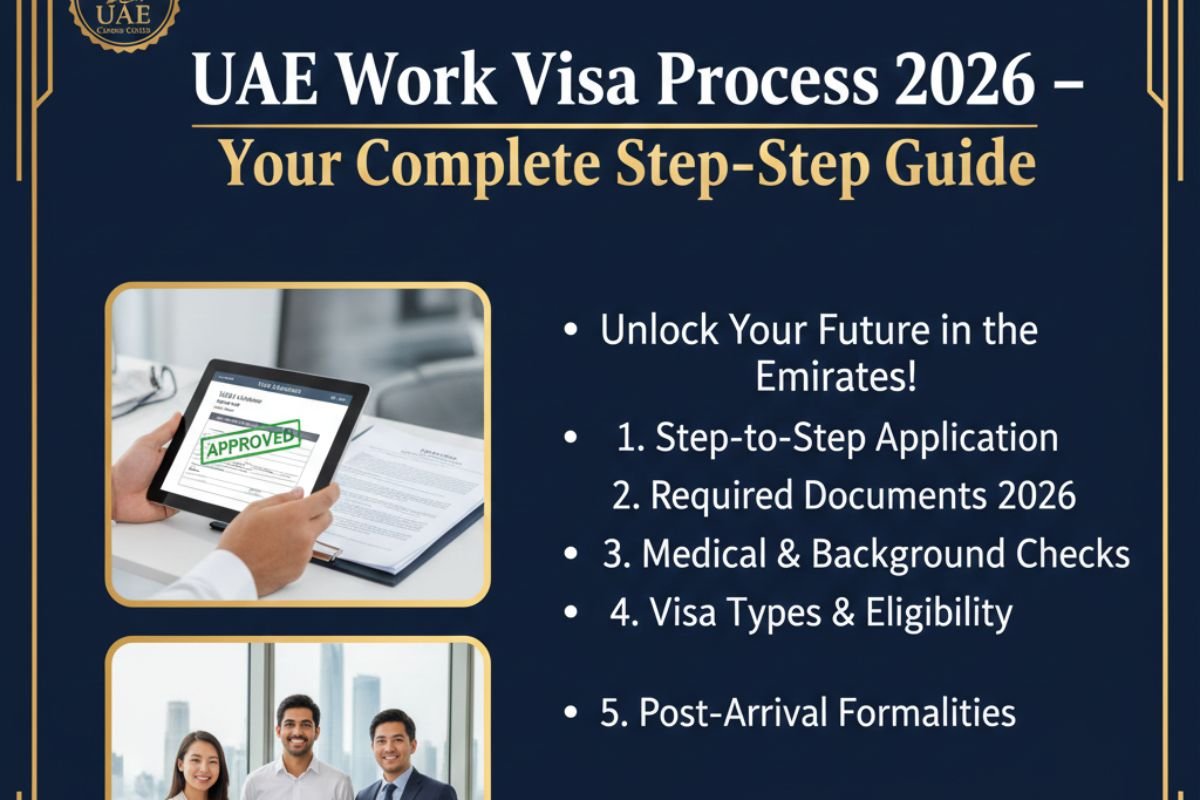
UAE Work Visa Process 2026 – Your Complete Step-by-Step Guide

UAE Work Visa Process 2026

Securing a work visa for the United Arab Emirates is the essential gateway for millions of expatriates building careers in this dynamic region. The UAE’s streamlined, digital-first approach has made the process more efficient than ever, but it remains a multi-step journey that requires precision and understanding from both employer and employee.

This comprehensive 2026 guide provides a clear, step-by-step breakdown of the entire UAE work visa process, from receiving a job offer to getting your Emirates ID. Whether you’re aiming for Dubai, Abu Dhabi, or any other emirate, this roadmap will prepare you for a smooth transition.

Understanding the UAE Visa Ecosystem

The UAE work visa is a residence permit tied to your employment. It’s a fully employer-sponsored process, meaning your company acts as your guarantor (or “sponsor”) and manages most of the application. The system is largely unified across the UAE, with slight variations in certain Free Zones (like DIFC or ADGM) which have their own autonomous authorities.

Key Authorities Involved:

  • Ministry of Human Resources and Emiratisation (MoHRE): Oversees labour contracts, work permits, and employer compliance for mainland companies.
  • Federal Authority for Identity, Citizenship, Customs & Port Security (ICP): Manages the issuance of Entry Permits, Residence Visas, and Emirates IDs.
  • Free Zone Authorities: Each free zone (e.g., DIFC, TECOM, twofour54) processes visas for companies registered within their jurisdiction.
  • General Directorate of Residency and Foreigners Affairs (GDRFA): The local emirate-level branch (e.g., GDRFA Dubai) that implements federal ICP policies.

The 2026 UAE Work Visa Process: A Step-by-Step Walkthrough

Phase 1: The Job Offer & Pre-Approval (Initiated by Employer)

Step 1: Secure a Formal Job Offer & Contract
You receive a formal, written job offer from a UAE-based company. Ensure the employment contract is detailed, stating your position, salary, benefits, and terms. This contract must be approved by the MoHRE (for mainland) or the relevant Free Zone.

Step 2: Employer Applies for Work Permit (Labour Card)
Your employer initiates the process by applying for your Work Permit (often still called a Labour Card) through the MoHRE’s digital system (e.g., the “My Companion” or “Ana” app) or their Free Zone portal. This proves there is a genuine job vacancy and the employer is authorized to hire you.

Step 3: Entry Permit Issuance
Once the Work Permit is approved, your employer applies for your Entry Permit (the electronic authorization that allows you to enter the UAE for employment). This is applied for through the ICP’s smart services system. Upon approval, you will receive an Entry Permit Number.

Phase 2: Your Actions – From Home Country to UAE Arrival

Step 4: Gather & Attest Documents (CRITICAL)
While the employer handles UAE-side approvals, you must prepare your personal documents. This step can cause major delays if not started early.

  • Educational Certificates: Your degree/diploma must be attested. This typically involves:
    1. Notarization and attestation by your home country’s Ministry/Department of Foreign Affairs.
    2. Final attestation by the UAE Embassy or Consulate in your home country.
  • Police Clearance Certificate: A clean criminal record check from your home country (and sometimes from countries you’ve lived in for the past 5 years), also attested.
  • Passport: Must be valid for at least 6 months from the date of entry.
  • Passport-Sized Photographs: On a white background.

Step 5: Medical Check in Home Country (For Some)
Depending on your nationality and the emirate, you may be required to undergo a pre-departure medical test (for HIV, Tuberculosis, Hepatitis) at an approved center. Your employer will advise if this is needed.

Step 6: Receive Entry Permit & Travel to UAE
Your employer sends you the electronic Entry Permit. You use this to book your flight and enter the UAE. The permit is typically valid for 60 days from issuance, during which you must complete the next steps inside the country.

Phase 3: In-Country Formalities (Post-Arrival)

These steps are mandatory and time-sensitive. Your employer’s PRO (Public Relations Officer) or HR will guide you, but you must be proactive.

Step 7: Medical Fitness Test in the UAE
Within 60 days of arrival, you must complete the official UAE medical fitness test at an approved health center (e.g., AMER or government health centers). This includes a blood test and chest X-ray. Passing this test is mandatory to proceed.

Step 8: Apply for Emirates ID & Biometrics
Your employer will submit your Emirates ID application to the ICP. You will then visit a designated ICP Customer Happiness Center or an authorized typing center to provide your biometrics (fingerprints and photograph).

Step 9: Residence Visa Stamping
After passing the medical and completing biometrics, your employer applies to have your Residence Visa stamped in your passport. This is your official permit to live and work in the UAE. The visa is typically valid for 2 or 3 years, aligned with your employment contract.

Step 10: Receive Your Emirates ID
Once the Residence Visa is stamped, your Emirates ID card is produced. This smart card is your official identity document in the UAE and must be carried at all times. It is linked to all government services.

Key Changes & Digital Trends for 2026

  • Full Digital Integration: The process is almost entirely paperless, managed through the ICP smart services platform and the MoHRE apps. Applications, payments, and status tracking are online.
  • Unified Platform: The ICP has consolidated services previously managed by separate immigration departments, creating a smoother federal process.
  • Digital Emirates ID: The physical card remains, but a digital version in the ICP/UAE Pass app is now widely accepted for verification.
  • Streamlined Medicals: Some emirates allow you to complete the medical test before arrival, further speeding up the in-country process.

The UAE Golden Visa: A Long-Term Alternative

For eligible professionals, investors, entrepreneurs, and outstanding students, the 10-year Golden Visa offers long-term residency without the need for a primary employer sponsor.

  • Key Eligibility Categories: Scientists, doctors, specialists, executives, engineers in priority fields, PhD holders, top university graduates, and investors.
  • Minimum Salary Threshold: Often set at AED 30,000 monthly for certain professionals.
  • Benefit: Provides unparalleled stability and flexibility, allowing you to sponsor family members and live in the UAE long-term.

Common Challenges & How to Avoid Them

  1. Document Attestation Delays: Start the attestation of your degree and police clearance immediately upon accepting the job offer. Use reliable attestation services if necessary.
  2. Medical Test Failure: Be aware of the health requirements. A positive result for a communicable disease like HIV or Tuberculosis will result in deportation.
  3. Employer Inefficiency: Choose employers with a good reputation for processing visas. Maintain clear communication with their HR/PRO team.
  4. Passport Validity: Ensure your passport has enough blank pages and validity (6+ months).

Conclusion: A Structured Path to Your UAE Career

The UAE work visa process for 2026 is a well-defined, digital, and efficient system designed to attract global talent. While it involves multiple steps across different government entities, understanding the sequence—from the crucial document attestation in your home country to the final biometrics for your Emirates ID—empowers you to navigate it confidently.

Success hinges on partnership with your employer, meticulous preparation of your documents, and using the official digital channels for updates. By following this guide, you can transform the visa process from a source of anxiety into a straightforward administrative prelude to an exciting new chapter in your career and life in the UAE.

5 Frequently Asked Questions (FAQs)

1. How long does the entire UAE work visa process take in 2026?

From job offer to having your Emirates ID in hand, the process typically takes 5 to 8 weeks. The most variable factor is the attestation of your educational documents in your home country, which can take 2-4 weeks alone. The in-country steps (medical, biometrics, stamping) usually take 2-3 weeks if coordinated efficiently.

2. Can I enter the UAE on a tourist visa to look for a job and change it to a work visa?

This is not recommended and is often not possible. You must apply for an Employment Entry Permit from outside the UAE. While you can job-hunt on a tourist visit, if you receive an offer, you will almost certainly have to exit the UAE (often to a nearby country like Oman) and re-enter on the newly issued Employment Entry Permit. Employers are very reluctant to process “change of status” applications.

3. Who pays for the visa and associated costs?

By law, the sponsoring employer is responsible for all visa and government processing fees, including the work permit, entry permit, status change, and Emirates ID. The employee typically pays for their own document attestation in their home country and the medical test fees inside the UAE. This should be clarified in your offer letter.

4. Can my family join me in the UAE?

Yes, once you have your Residence Visa stamped and your Emirates ID, and you meet the minimum salary requirement (which is set by your sponsor but is often around AED 4,000 – 5,000 per month), you can sponsor your spouse and children. You will need to provide proof of relationship (marriage/birth certificates attested) and secure suitable housing.

5. What happens if I lose my job in the UAE?

Your visa is tied to your employer. If your employment is terminated, you typically have a grace period of 30 to 90 days (recently extended for some categories) to either find a new job and transfer your sponsorship, or leave the country. During this period, you can legally stay in the UAE to search for new employment.

Post a Job Opening

Fill in the details below. Your job posting will be reviewed by our team.

Basic Information

Specify years of experience required

Location & Salary

Qualifications & Skills

Specify educational requirements
Separate skills with commas

Company Details

Job Details

Contact Information