Gulf Careers Hub

Free Visa Jobs in Gulf Countries (No Agent) 2026

Free Visa Jobs in Gulf Countries (No Agent)

The promise of a “free visa” job in the Gulf is a powerful draw for job seekers worldwide. It represents an opportunity where the employer covers all costs associated with your work permit, residency, and travel, allowing you to start your new role without significant upfront investment. However, navigating this landscape without falling prey to scams or unethical agents requires knowledge and a strategic approach.

This comprehensive 2026 guide explains what “free visa” truly means, which sectors commonly offer it, and provides a step-by-step blueprint for finding and securing these coveted roles directly from employers, without paying any agent fees.

What Does “Free Visa” Actually Mean in the Gulf Context?

genuine free visa job means your sponsoring employer assumes all legal and financial responsibilities for your legal right to work and reside in the country. This includes:

  • Government Processing Fees: All fees paid to the Ministry of Labour, Immigration, and other government bodies for your work permit and residence visa.
  • Medical Testing Costs: Fees for the mandatory medical fitness test required for your visa.
  • Emirates ID/Qatar ID/Iqama Costs: The fee for your national identity card.
  • Initial Entry Permit & Status Change: The cost of bringing you into the country legally.
  • Health Insurance: Mandatory basic health insurance (often with the option to upgrade).
  • Repatriation Ticket: A flight ticket to your home country upon final contract completion (as per labor law).

Crucially, it means you, the employee, pay $0 to the employer or any third party for these government processes. Your only costs should be for attesting your personal documents (degree, certificates) in your home country.

Sectors Most Likely to Offer Genuine Free Visa Sponsorship in 2026

Employers sponsor visas because they need specific skills they cannot find locally. Focus your search on these high-demand sectors:

1. Healthcare & Medical Services

Hospitals and clinics have a constant, critical need for qualified professionals.

  • Roles: Doctors, Specialist Consultants, Registered Nurses (especially ICU, OT, NICU), Physiotherapists, Lab Technicians.
  • Why Free Visa is Standard: These are licensed professions. Employers expect to cover all costs to attract global talent. Reputable hospitals (like Hamad Medical Corp in Qatar, King Faisal Specialist Hospital in KSA, Cleveland Clinic Abu Dhabi) have structured international recruitment.

2. Engineering & Project Management

The backbone of Gulf infrastructure and giga-projects.

  • Roles: Project Managers, Civil/Structural Engineers, MEP Engineers, Planning Engineers, QA/QC Engineers for major projects (e.g., NEOM, Red Sea Project).
  • Why Free Visa is Standard: Large engineering consultancies and contractors (Bechtel, Jacobs, Parsons) include full relocation and visa sponsorship in their packages for experienced hires to work on specific projects.

3. Education & Academia

International schools and universities recruit globally.

  • Roles: Licensed Teachers (especially STEM, IB/UK/US curriculum), University Professors, School Principals.
  • Why Free Visa is Standard: Reputable institutions (Qatar Foundation schools, GEMS Education in UAE, KAUST in KSA) offer complete expatriate packages, including visa, flights, housing, and schooling for children to attract qualified educators.

4. Technology & Digital Innovation

A priority sector for all Gulf nations.

  • Roles: Software Developers, Cybersecurity Specialists, Data Scientists, Cloud Architects, AI/Machine Learning Engineers.
  • Why Free Visa is Standard: Tech talent is in global shortage. Gulf tech hubs (Dubai Internet City, Qatar Science & Technology Park, KAUST) compete with Silicon Valley and offer full visa sponsorship to secure top talent.

5. Aviation & Hospitality (Senior Roles)

While entry-level roles may have different arrangements, senior professional roles are sponsored.

  • Roles: Airline Pilots, Aircraft Engineers, Senior Hotel Management (General Manager, Director of Sales), Executive Chefs in 5-star establishments.
  • Why Free Visa is Standard: For these certified and high-responsibility positions, leading companies like Emirates, Qatar Airways, and Marriott provide comprehensive expatriate packages.

How to Find Genuine Free Visa Jobs WITHOUT an Agent (2026 Strategy)

The key is to apply directly to the source company. This cuts out middlemen and reduces scam risk.

1. Use the Right Job Portals (Where Employers Post Directly)

  • LinkedIn: The #1 professional network. Use the “Jobs” tab, set your location to your target Gulf city, and use keywords like “visa sponsorship,” “relocation included,” and your job title. Turn on the “Open to Work” feature for recruiters.
  • Company Career Pages: This is the gold standard. Identify your top 30 target companies (hospitals, engineering firms, tech giants, schools) and bookmark their official “Careers” or “Join Us” page. Apply directly here.
  • Specialized Gulf Job Boards: GulfTalent and Bayt.com are reputable platforms where many companies post directly. Be wary of generic “Gulf Jobs” sites with flashy ads.

2. Verify the Employer’s Legitimacy (Non-Negotiable Step)

Before applying, ensure the company is real and licensed to sponsor.

  • Check the Commercial Registration (CR): In the UAE, use the Ministry of Economy’s “Verified” platform. In Saudi, use the “Qawaem” business directory. In Qatar, check the Ministry of Commerce portal.
  • Research Their Digital Footprint: Do they have a professional website? A legitimate office address? Active LinkedIn page with real employees?
  • Trust Your Gut: If an offer seems too good to be true, requires payment, or comes from a generic Gmail/Yahoo address, it’s a scam.

3. Craft a “Sponsorship-Ready” Application

Your CV and cover letter must immediately address the sponsorship question professionally.

  • In Your Cover Letter: State clearly, “I require full work visa sponsorship and am confident that my skills in [X] align with your needs for [Project/Role]. I have begun the process of attestation for my documents and am prepared for a swift relocation.”
  • In Your CV: Include a “Visa Status” line: e.g., “Requires Employment Visa Sponsorship for [Country].” This manages expectations upfront.

The Step-by-Step Process for a Legitimate Free Visa (2026)

  1. Receive a Formal Job Offer & Contract: A detailed offer letter and employment contract outlining salary, benefits, and terms. The contract is key.
  2. Begin Document Attestation: You are responsible for getting your degree certificates and police clearance attested by your home country’s Foreign Ministry and the relevant Gulf Embassy. Start this immediately.
  3. Employer Applies for Work Permit: They submit your details to the Ministry of Labour (e.g., Qiwa in KSA, MoHRE in UAE).
  4. Entry Visa Issuance: The employer receives an Entry Permit. You take this, your passport, and attested documents to the nearest Gulf embassy/VFS center for visa stamping.
  5. Travel & In-Country Formalities: You fly to the Gulf country. The employer arranges your medical test, biometrics, and issues your Residence ID (Iqama/Emirates ID).

Red Flags: How to Spot a Fake “Free Visa” Offer

  • Any Request for Payment: The #1 rule. Never pay for a “visa,” “processing,” “insurance,” or “document clearance” fee.
  • The “Tourist Visa Switch”: Being told to enter on a tourist visa with a promise to convert it later. This is illegal. A proper work visa must be issued from your home country.
  • Vague Job Details: No clear company name, contract, or role description.
  • Pressure to Act Quickly: Scammers use urgency to bypass your due diligence.

What About “Free Visa” or “Freelance Visa” Schemes?

Be extremely cautious. Some offers propose giving you a “free visa” (you are sponsored) but expect you to find your own work and pay the sponsor a monthly fee. This is often illegal (“visa trading“), leaves you vulnerable, and can result in fines, deportation, or a ban. True employment means you work for and are paid by your sponsor.

Conclusion: Empowerment Through Direct Hiring

Securing a genuine free visa job in the Gulf in 2026 is about partnering directly with a legitimate employer who values your skills enough to invest in your relocation. By focusing on high-demand sectors, applying directly through official channels, and conducting rigorous due diligence, you can successfully navigate the market without an agent.

This approach not only saves you money and avoids scams but also establishes a transparent, professional relationship with your future employer from day one. Your career in the Gulf should begin with empowerment, not exploitation. Use this guide as your roadmap to a legitimate, rewarding opportunity.

5 Frequently Asked Questions (FAQs)

1. Are there really jobs with completely free visa sponsorship?

Yes, absolutely. For professional, skilled roles in the sectors listed above (healthcare, engineering, tech, education), full visa sponsorship is the standard and expected practice from reputable employers. They budget for these costs as part of recruiting international talent. It is not a “favor”; it’s a standard business cost for them.

2. What is the difference between a “free visa” and a “visit visa” job offer?

“Free Visa” offer means the employer will sponsor your official Employment Residence Visa from your home country before you travel. A “Visit Visa” offer (a major red flag) asks you to enter the country on a tourist/visit visa, promising to change it later. This is illegal in all Gulf countries for employment purposes and is a hallmark of scams or illegal labor practices. Always insist on the proper employment visa issued from abroad.

3. Who pays for the flight ticket to the Gulf?

In a legitimate free visa employment package, the employer pays for your initial flight ticket from your home country to the Gulf as part of the relocation. This is standard practice. Some may provide a cash allowance or book the ticket directly. It should be specified in your contract.

4. Can I get a free visa job in the Gulf as a driver, laborer, or housekeeper?

Extreme caution is needed here. While sponsorship is common, this segment of the market is where exploitation and visa trading are most prevalent. You should never pay an agent a fee for such roles. Reputable hiring is done by large companies (e.g., for drivers in a government fleet) or families through regulated channels. Always verify the sponsor’s legitimacy and have a clear, signed contract in Arabic and English before traveling.

5. How can I verify if a company is licensed to sponsor visas?

You can and must verify this:
UAE: Ask for their Commercial Registration (CR) Number and verify it on the respective emirate’s Department of Economic Development (DED) website or the Ministry of Economy’s “Verified” platform.
Saudi Arabia: Check the company on the Ministry of Commerce’s “Qawaem” online business directory.
Qatar: Use the Ministry of Commerce and Industry company search portal.
A legitimate company will not hesitate to provide their CR number.
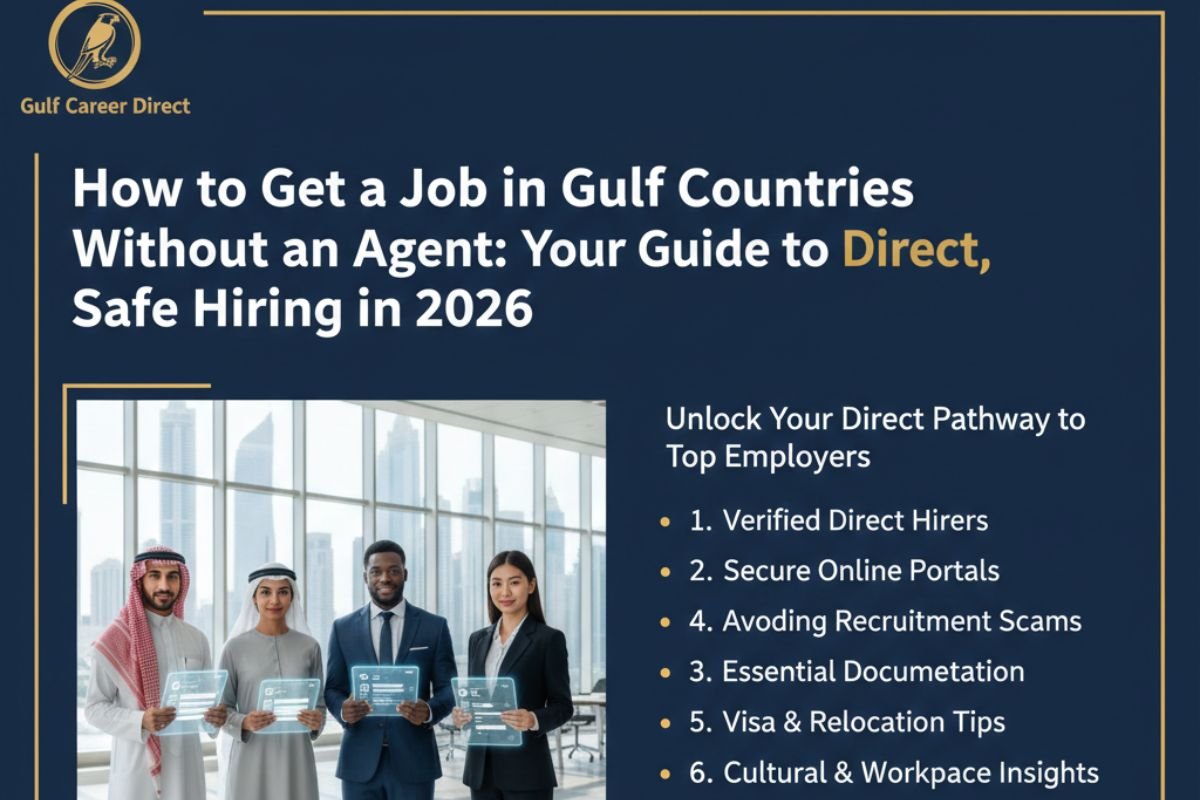
How to Get a Job in Gulf Countries Without an Agent: Your Guide to Direct, Safe Hiring in 2026

How to Get Gulf Job Without Agent

Landing a job in the Gulf Cooperation Council (GCC) countries—Saudi Arabia, UAE, Qatar, Kuwait, Oman, and Bahrain—is a major goal for professionals worldwide. However, the path is often perceived as complex, leading many to rely on recruitment agents. While reputable agents exist, the market is also rife with fraud. The good news is that securing a Gulf job directly, safely, and without paying exorbitant agent fees is entirely possible with the right strategy.

This comprehensive guide empowers you to navigate the Gulf job market independently, teaching you how to identify legitimate opportunities, apply effectively, and avoid scams, putting you in control of your career destiny.

Why Go Direct? The Benefits of Bypassing Agents

  • Cost Savings: You avoid paying hefty placement fees, which can range from one month’s salary to exorbitant illegal amounts.
  • Direct Communication: You build a relationship directly with your future employer, leading to clearer expectations.
  • Greater Control: You choose the companies you apply to based on your research, not an agent’s limited portfolio.
  • Avoiding Scams: You eliminate the risk of dealing with fraudulent agents who fabricate jobs, charge for visas that don’t exist, or place you with the wrong employer.
  • Better Job Matching: You can target roles that truly fit your skills and career goals, rather than being pushed into any available vacancy.

Step-by-Step Strategy: Landing a Gulf Job on Your Own

Phase 1: Preparation & Research (The Foundation)

1. Get Your Documents ‘Gulf-Ready’:
This is non-negotiable and your first task.

  • CV/Resume: Format it for the Gulf. It should be 2-3 pages max, professional, without a photo (unless specifically requested), and free of personal details like age or religion. Focus on quantifiable achievements.
  • Educational & Professional Attestation: Research the attestation process for your target country. Generally, degrees and professional certificates need attestation from your Home Country’s Foreign Ministry and the Embassy of the target Gulf countryStart this process early, even before you have an offer, as it can take weeks.
  • Police Clearance Certificate: Obtain a clean record from your home country; it will also need attestation later.

2. Deep Dive into Target Companies & Sectors:
Don’t just spray applications. Be strategic.

  • Identify In-Demand Sectors: Focus on areas with real skill shortages: Healthcare, Engineering (especially for mega-projects), Education, Technology, and Finance.
  • Create a Target List: Identify 20-30 specific companies you want to work for. These could be:
    • Government-Linked Entities: NEOM, Red Sea Global (KSA), Mubadala, ADNOC (UAE), QatarEnergy.
    • Large Local Conglomerates: Al-Futtaim, Alshaya, Olayan.
    • Reputable Multinationals: Every major international company has a Gulf presence.
  • Research Thoroughly: Understand their projects, values, and recent news. This will make your application stand out.

Phase 2: The Direct Job Search (Where to Look)

1. LinkedIn – Your Most Powerful Tool:

  • Optimize your profile with keywords for your role and target location (e.g., “Project Manager Riyadh”).
  • Use the ‘Jobs’ tab: Set your location to your target Gulf city and use filters.
  • Follow your target companies. They often post vacancies on their LinkedIn page first.
  • Connect directly with recruiters and hiring managers in your field. Send a personalized connection request referencing a specific role or their company’s work.

2. Official Company Career Portals:
This is the gold standard for direct applications.

  • Go to the official website of every company on your target list.
  • Navigate to the “Careers,” “Join Us,” or “Vacancies” section.
  • Create a profile and apply for relevant roles. This ensures your application goes directly to the company’s HR or hiring manager.

3. Reputable Gulf Job Portals (Not Agent Sites):
Use platforms where employers post directly.

  • Bayt.com: The leading regional job board.
  • GulfTalent.com: High-quality listings, often from direct employers.
  • LinkedIn Jobs: As mentioned.
  • Naukrigulf.com: Another established player.
  • Caution: Be wary of niche sites that look unprofessional or are dominated by agency postings.

4. Professional Networking & Referrals:

  • Attend international industry conferences (often virtual) where Gulf companies recruit.
  • Leverage alumni networks from your university who may be working in the Gulf.
  • A referral from a current employee is the most effective way to get an interview. Don’t be afraid to ask your network politely.

Phase 3: The Application & Interview Process

1. Tailor Every Application:

  • Your cover letter must explain why you want to work in that specific country and for that specific company. Mention a project or value you admire.
  • Clearly state: “I understand the visa sponsorship process and have begun preparing my documents (e.g., degree attestation).” This shows you are serious and informed.

2. Ace the Digital Interview:

  • Interviews will be via Zoom/Teams. Dress professionally as you would in-person.
  • Research common Gulf interview questions. Be prepared to discuss: your adaptability to a new culture, your long-term plans, and your understanding of the local business environment.
  • Have intelligent questions ready about the role, team, and company’s future in the region.

3. Understand the Legitimate Offer & Process:
A genuine offer will include:

  • A detailed employment contract outlining your position, duties, full compensation breakdown (basic salary, housing allowance, transportation, flights), gratuity, and working hours.
  • The company will never ask you to pay for your visa or work permit. All government fees are the sponsor’s responsibility.
  • They will guide you through the official process: signing the contract, applying for the work permit (e.g., Qatar’s MoI, Saudi’s Qiwa, UAE’s MoHRE), and your subsequent entry visa application at the nearest embassy.

Red Flags: How to Spot and Avoid Job Scams

Protecting yourself is paramount. If you encounter any of these, walk away immediately.

  • Any Request for Upfront Payment: Legitimate employers NEVER ask candidates to pay for visas, processing fees, “admin charges,” or “visa insurance.” This is the #1 scam.
  • Unprofessional Communication: Email addresses from free domains (Gmail, Yahoo) instead of a company domain, poor English, and grammatical errors.
  • Vague Job Details: The offer is vague, the company name is unclear, or they cannot provide a proper contract.
  • Pressure Tactics: Urging you to pay quickly to “secure” the visa or position.
  • The “Tourist Visa” Scam: Being told to enter the country on a tourist visa with a promise to convert it to a work visa inside. This is illegal in all GCC countries. A proper work visa must be issued from your home country before you travel.
  • Verification Failure: You cannot verify the company’s physical address, landline number, or commercial registration online through the official government portal of the respective country.

What to Do If You Suspect a Scam

  1. Stop All Communication.
  2. Do Not Send Money or Personal Documents (like passport copies) beyond an initial CV.
  3. Report It: Report the fake company/agent to the official authorities in the target Gulf country (e.g., UAE’s Ministry of Human Resources and Emiratisation, Saudi’s Ministry of Human Resources).
  4. Warn Others: Post about your experience on professional forums to alert fellow job seekers.

Conclusion: Empowerment Through Due Diligence

Getting a job in the Gulf without an agent requires more upfront effort in research and preparation, but it grants you safety, savings, and sovereignty over your career path. By treating your job search as a professional project—focusing on direct applications to verified companies, preparing your documents meticulously, and maintaining a healthy skepticism—you can successfully navigate the market and secure a legitimate, rewarding opportunity.

The Gulf is full of genuine employers desperately seeking skilled talent. Your ticket is not an agent’s fee; it’s your expertise, your professional approach, and your informed diligence. Take control and apply directly—your future in the Gulf awaits.

5 Frequently Asked Questions (FAQs)

1. Is it really possible to get a Gulf job without an agent?

Absolutely. Thousands of professionals do it every year. Major corporations, government entities, and reputable private companies all hire directly through their career portals and platforms like LinkedIn. They have professional HR departments to handle the visa process. Agents are often used for bulk hiring in specific sectors (e.g., hospitality, retail) or for hard-to-fill niche roles, but they are not a mandatory gateway.

2. What is the most important document to prepare in advance?

Start the attestation process for your highest educational degree immediately. This process—involving notarization, your home country’s foreign ministry, and the embassy of the target Gulf country—is universally required and can take the longest. Having it ready makes you a more attractive, “low-friction” candidate for employers.

3. How can I verify if a Gulf company is legitimate?

Search for the company’s official Commercial Registration (CR) number. A legitimate company will provide it.
Use the official government business directories: UAE’s Ministry of Economy ‘Verified’ platform, Saudi’s ‘Qawaem’ platform, Qatar’s Ministry of Commerce portal.
Check for a professional website, a physical address, and landline contact numbers. Be skeptical of PO Boxes only.

4. I received a job offer via WhatsApp/Telegram. Is this normal?

This is a major red flag. While initial informal contact may happen on these apps, all formal communication—especially the job offer, contract, and visa process—must come through official company email channels and documented processes. Treat unsolicited offers on messaging apps with extreme caution; they are a common scam vector.

5. Who pays for the flight ticket and initial accommodation?

In a standard, legitimate employment package, your sponsoring employer pays for your initial flight ticket to the Gulf country. They should also either provide initial temporary accommodation (e.g., a hotel or company apartment) or give you a cash allowance to secure your own housing as part of your “joining benefits.” This should be clearly stated in your offer letter.

Post a Job Opening

Fill in the details below. Your job posting will be reviewed by our team.

Basic Information

Specify years of experience required

Location & Salary

Qualifications & Skills

Specify educational requirements
Separate skills with commas

Company Details

Job Details

Contact Information