If you’re searching for a job in the Gulf right now, you’re not alone. May 2026 has brought some real changes. Some sectors are hiring like crazy, while others have gone quiet. I’ve been tracking the market across UAE, Saudi Arabia, Qatar, and Kuwait, and here’s the honest picture.
No fluff. Just what’s actually happening.
Quick Overview – Good News First
Let me start with the positive side. Yes, companies are hiring. But not everywhere.
The countries that are most active right now:
UAE – still the busiest, especially Dubai and Abu Dhabi
Saudi Arabia – huge push under Vision 2030 projects
Qatar – steady, mostly energy and construction
Kuwait – slower but some government roles
Bahrain – small but stable for fintech
If you’re flexible on location, your chances go way up.
Top 5 Industries Hiring Like Crazy in May 2026
From real job postings I’ve seen this month, these sectors are desperate for people:
1. Construction & Real Estate
Saudi’s NEOM and Red Sea projects are still going strong. They need project managers, engineers, site supervisors, and even admin staff. Example: A civil engineer friend got 3 calls in one week just from LinkedIn.
2. Healthcare & Nursing
Hospitals across the Gulf are short on nurses, lab techs, and home care staff. UAE just announced new visa fast-tracks for healthcare workers.
3. Technology & AI
Dubai’s AI strategy is real. Companies want cybersecurity experts, data analysts, and even entry-level coders. Remote options exist but mostly hybrid.
4. Tourism & Hospitality
With summer approaching, hotels in Dubai, Ras Al Khaimah, and Doha are prepping. Jobs in guest services, F&B, and housekeeping are popping up.
5. Logistics & Supply Chain
Ports in Jebel Ali and Jeddah are expanding. Drivers, warehouse managers, and procurement roles are available. Some offer accommodation.
Which Jobs Are Hard to Find Right Now?
Let me be real with you. Some roles have become very competitive or simply reduced.
General administrative assistants – many companies merged roles
Entry-level marketing – oversaturated with applicants
Retail sales – less hiring until September
Oil & gas (non-engineering) – only niche roles open
If you’re in these fields, don’t lose hope. You just need to adapt your CV or target smaller companies.
Salaries – What People Are Actually Getting (May 2026)
I’ve checked with real employees, not just online averages. Here’s what’s normal this month:
Job Role
UAE (AED)
Saudi (SAR)
Qatar (QAR)
Accountant (2-4 yrs)
8,000–12,000
7,000–10,000
8,000–11,000
Nurse
10,000–15,000
8,000–12,000
10,000–14,000
Site Engineer
12,000–18,000
10,000–16,000
11,000–17,000
Admin Assistant
4,000–7,000
3,500–6,000
4,000–6,500
Digital Marketer
7,000–13,000
6,000–11,000
7,000–12,000
All monthly salaries in local currency. Add accommodation or transport if the company is big.
Important: Don’t accept lowball offers just because they say “market is slow.” Negotiate politely.
Hiring Trends I’ve Noticed This Month
From scrolling through Bayt, Naukri Gulf, LinkedIn, and GulfTalent daily, here’s what’s different in May 2026:
Faster response times – some companies reply within 2–3 days
Video interviews are normal now – even for senior roles
AI screening CVs – if your CV doesn’t have keywords, a human never sees it
More contract roles (6–12 months) – permanent jobs fewer but exist
One thing that surprised me: small and medium companies are hiring faster than big corporates. Don’t ignore them.
Remote & Hybrid Jobs – Real or Fake
Yes, real remote jobs exist in the Gulf, but not many are fully remote.
What “remote” usually means in May 2026:
Fully remote – rare, mostly for tech or social media roles
Hybrid – 2–3 days in office, common in Dubai and Riyadh
Work from anywhere – almost none unless you’re a freelancer
If a job ad promises “fully remote” with huge salary, check carefully. Scammers are active this month.
Work Visas – Quick Update
Good news: UAE and Saudi have eased some rules.
UAE Green Visa – now easier for freelancers and skilled workers
Saudi work visa – processing time down to 2–3 weeks for some nationalities
Qatar – no major changes, but company sponsorship still required
If your visa is expiring soon, start renewal at least 45 days before. Delays are common in summer.
My Practical Advice for May 2026 Job Seekers
I’ve helped a few friends land jobs this month. Here’s what actually worked:
Update your LinkedIn headline – don’t just put “seeking opportunities.” Write what you do. Example: “Civil Engineer | NEOM project experience”
Apply within first 24 hours of a job post. After that, too many applicants.
Tailor your CV for each role – yes, it’s boring but it works. Change the skills section at least.
Follow up once after 5–7 days. A short message: “Just checking if you received my application.”
Avoid May 25–31 for applications. Many companies slow down before June holidays.
Final Honest Take
The Gulf job market in May 2026 is active but picky. Good candidates get calls fast. Average CVs get ignored. It’s not about being perfect. It’s about being clear, relevant, and fast.
If you’ve been applying for weeks with no reply, change something. Your CV, your approach, or the platforms you use.
And don’t give up. Hiring always slows down a bit in summer, then picks up again in September. Use May to prepare.
If you’re targeting a job in the Gulf region in 2026—whether in Dubai’s fast-paced private sector, Riyadh’s Vision 2030-driven projects, or Doha’s growing economy—here’s a truth you need to know: a generic CV won’t work. The Gulf job market has its own rules, expectations, and cultural nuances. Recruiters in the UAE, Saudi Arabia, and Qatar spend just seconds scanning each application, and most large companies use Applicant Tracking Systems (ATS) to filter candidates automatically .
Why the Gulf CV Format Is Different in 2026
The Gulf job market is unique. Employers here look for a blend of international expertise and local market understanding. Your CV must answer specific unspoken questions:
Are you serious about relocating and staying long-term?
Do you understand the professional culture (hierarchy, formality, relationship-building)?
Can you thrive in a multicultural workplace?
Is your experience relevant to this region?
In 2026, with competition fiercer than ever, a tailored Gulf CV format is your non-negotiable first step.
The Essential Sections of a Gulf CV (With Examples)
Follow this section order exactly. It’s designed to satisfy both ATS software and human recruiters scanning for key information.
1. Personal Details & Professional Photo
This section must be crystal clear. Include:
Full Name: As it appears on your passport.
Professional Title: Right below your name (e.g., “Chartered Accountant | Financial Controller”).
Contact Information: Phone with country code (+971 for UAE, +966 for KSA, +974 for Qatar), professional email, current city of residence.
LinkedIn Profile URL: Ensure it’s updated and matches your CV.
Nationality & Visa Status: This is standard in the Gulf. State your nationality clearly. If you’re already in the region, specify your current visa status (e.g., “UAE Employment Visa – Transferable,” “Visit Visa,” “Transferable Iqama”). If outside, write “Requiring Employment Visa Sponsorship” .
Professional Photo: A must for most private sector roles. Use a high-quality, passport-style headshot with a plain background, formal business attire, and a neutral expression .
2. Professional Summary (Your 30-Second Pitch)
This 3-4 line summary is the most-read part of your CV. Replace the outdated “Objective” with a powerful summary that answers: Who are you? What do you offer? What’s your goal?
Formula: [Your Title] with [X] years of experience in [Industry/Key Skill] specializing in [Specific Expertise]. Proven track record of [Key Achievement with Metric]. Seeking a [Target Role] position in [Specific Gulf Country].
Example: “Results-driven Marketing Director with 10+ years of experience in the FMCG sector, specializing in digital transformation and launching brands in the Saudi market. Increased market share by 22% for a leading beverage brand. Seeking a senior leadership role within a dynamic consumer goods company in Riyadh.”
3. Core Competencies / Key Skills (The ATS Keyword Zone)
This bullet-point list is prime real estate for keywords. Create two sub-sections:
Pro Tip: Tailor this list for every application using keywords mined directly from the job description. This significantly boosts your ATS score .
4. Professional Experience (The STAR Method for the Gulf)
List in reverse chronological order (most recent first). For each role, include:
Job Title, Company Name, City/Country, Dates (Month/Year)
One-line company description (if not well-known)
Achievement-oriented bullet points using the STAR Method (Situation, Task, Action, Result), focusing on Action and Result. Start with powerful action verbs (Led, Engineered, Optimized, Increased).
Weak: “Responsible for social media accounts.” Strong: “Grew the company’s Instagram following in the UAE by 40,000+ followers (150% increase) in 12 months through localized Arabic content and influencer partnerships, directly generating 350 qualified leads.”
Quantify Everything: Use numbers, percentages, and monetary values. Gulf employers in construction, sales, and finance are driven by metrics .
5. Education
List your highest degree first.
Include: Degree Name, Major, University Name, Location, Graduation Year.
Include GPA only if impressive (3.5/4.0 or higher).
For fresh graduates, this section can be placed above Professional Experience .
6. Certifications & Training (Highly Valued)
The Gulf market places strong emphasis on professional certifications. List any relevant ones (PMP, CFA, ACCA, CIPD, SHRM, Google/Meta certifications, etc.) .
7. Languages
Be honest about proficiency levels: Native, Fluent, Professional Working Proficiency, Intermediate, Basic.
Priority Order: Arabic (any dialect) is a massive advantage, even at basic conversational level. Then English. Then other languages .
Cultural Nuances for Each Gulf Country
🇦🇪 United Arab Emirates (UAE)
Highlight experience in fast-paced, multicultural environments.
Mention any specific emirate experience (Dubai, Abu Dhabi) if relevant.
Private sector values agility and international exposure .
🇸🇦 Saudi Arabia (KSA)
Emphasize experience with Saudi Vision 2030 projects or sectors (giga-projects, tourism, renewable energy).
Understanding of local business culture and hierarchy is key.
For senior roles, mention familiarity with Saudi government portals (Qiwa, MISA, ZATCA) .
🇶🇦 Qatar
Post-2022 World Cup, experience in sustainability, major event management, or infrastructure is valuable.
Formality and respect for hierarchy are appreciated .
The 2026 ATS Survival Guide: Making Your CV Machine-Readable
Most large companies and recruitment agencies in the Gulf use Applicant Tracking Systems (ATS) to screen CVs before a human sees them. If your CV isn’t ATS-friendly, it may be rejected automatically—even if you’re qualified .
ATS-Friendly Rules:
Use Standard Section Headings: “Work Experience,” “Education,” “Skills.” Avoid creative labels.
Avoid Graphics, Tables, or Columns: They scramble ATS parsing. Stick to a simple, single-column layout.
Incorporate Keywords Naturally: Use keywords from the job description in your summary, skills, and experience bullets.
Save as DOCX for ATS: DOCX (Word) is the safest format for ATS. Simple, text-based PDFs are acceptable but not ideal. Avoid scanned or image-based CVs completely .
Use Standard Fonts: Arial, Calibri, Times New Roman (size 10.5–11.5).
Keep It Concise: Freshers: 1 page. Mid-level: 1–2 pages. Senior: 2 pages maximum .
What NOT to Include in an ATS-Friendly CV:
Photos (ATS ignores them; they can reduce readability)
Age or date of birth
Marital status
Fancy designs or colored text
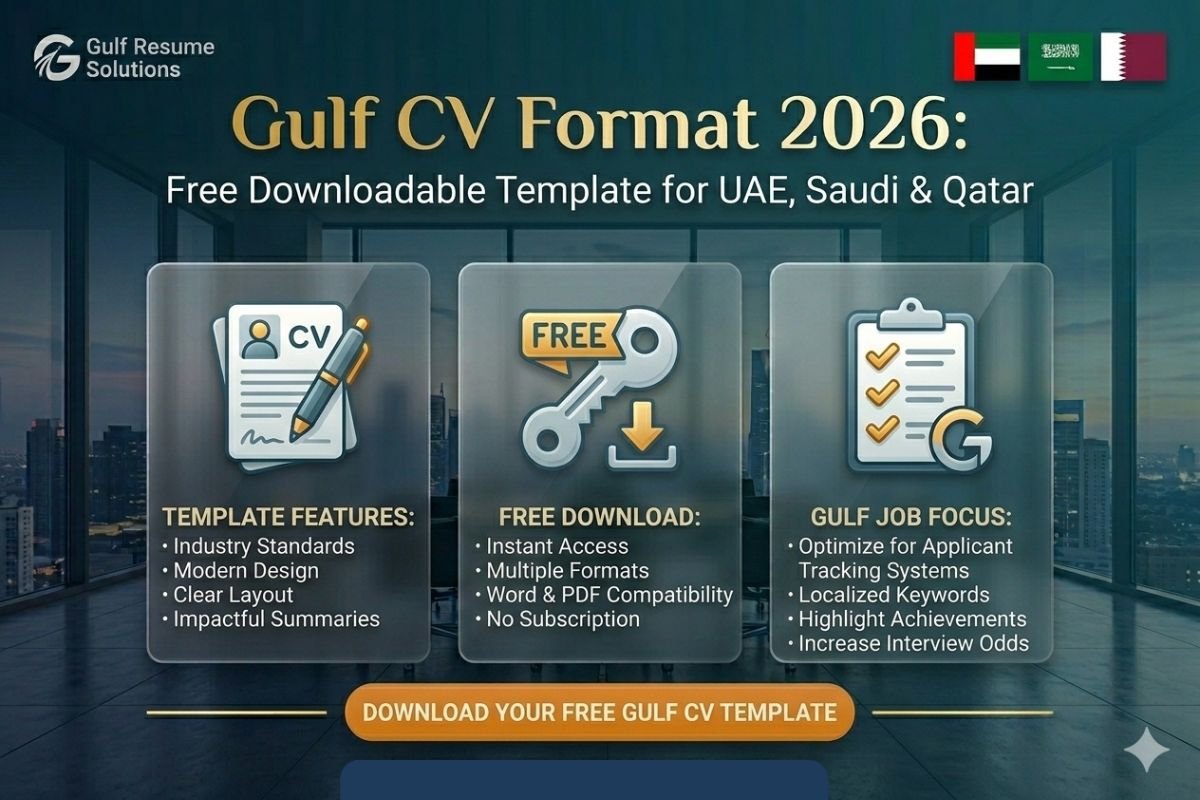
Free Gulf CV Format 2026 Template (Copy This Structure)
Common Mistakes That Reject Gulf CVs
Using a generic, one-size-fits-all CV – The most common and fatal error . Spelling or grammar errors – Indicates lack of attention to detail . Exceeding 2 pages (unless C-suite with 20+ years) . Unexplained employment gaps – Be prepared to address these briefly . Including irrelevant personal information (age, marital status, religion) unless requested . Poor photo quality or casual attire. Unprofessional email address (e.g., “superstar99@email.com”) .
Frequently Asked Questions (FAQs)
1. Is a photo really mandatory on a Gulf CV?
For the private sector in the UAE, Saudi Arabia, Qatar, and Kuwait, yes, it is strongly expected and considered standard practice. It helps with identification and is a cultural norm. For applications in international free zones or certain multinationals, it may be slightly less critical, but including one is still the safer approach. Omit it only if the job posting explicitly says not to include one.
2. How should I list my visa status?
Be clear and concise. If you are outside the Gulf, state: “Requiring Employment Visa Sponsorship.” If you are inside the Gulf, state your current status: e.g., “Transferable Iqama (KSA),” “Employment Visa (UAE) – Transferable,” “Visit Visa – Immediate Joiner.” This is crucial information for recruiters to assess the hiring process .
3. Should I write my CV in Arabic or English?
English is the primary language of business for most multinational and large regional companies. Always submit your main CV in English. However, if you are fluent in Arabic, it is a powerful advantage—note your proficiency under “Languages.” For some government or fully local Arabic-speaking companies, you may be asked for an Arabic version separately .
4. What’s the biggest difference between a Gulf CV and a Western CV?
Three key differences: 1) The Photo is standard. 2) Personal details like nationality and visa status are included. 3) Tone and structure tend to be more formal, with greater emphasis on clear hierarchies (job titles, company prestige) and measurable achievements within a regional context. The Gulf CV format is also more accepting of a 2-page length for experienced professionals .
5. How do I handle short contract roles or freelance work common in the Gulf?
Group them strategically. Create a section titled “Consulting & Project Work (2023-2025)” and list key projects or clients as bullet points, highlighting skills and achievements. This shows continuous engagement without highlighting job-hopping, which is common in the project-driven Gulf market but can still raise questions if not presented clearly .
Final Pro-Tips for 2026
PDF is King for Human Readers: Save your final CV as YourName_CV_TargetJobTitle.pdf for email submissions. But keep a DOCX version ready for ATS portals .
Leverage LinkedIn: Your LinkedIn profile must be a 100% match to your CV. Get recommendations and share industry insights to build your professional brand .
The Cover Letter Still Matters: For mid-to-senior roles, a tailored cover letter (brief, formal, PDF) connecting your achievements to the company’s needs can make a significant difference .
Follow Up Professionally: If you don’t hear back in 10-14 days, a polite single-line follow-up email can help .
Conclusion: Your CV Is Your Ticket to the Gulf
In 2026, the Gulf job market is efficient and competitive. Your CV isn’t just a document—it’s your first impression, your ticket to an interview, and your personal marketing brochure. By following this Gulf CV format 2026, you’re not just listing your history—you’re strategically presenting yourself as the solution a Gulf-based company is looking for.
Download our free template, tailor it with your unique story, and start applying with confidence. Your next opportunity is waiting.
If you’re planning your next career move, the UAE should be high on your radar. Despite global economic uncertainty, the UAE job market in 2026 is characterized by cautious optimism, strong hiring in key sectors, and a fundamental shift toward AI-powered roles . With nearly half of UAE employers planning to expand their workforce and GDP forecast to grow by over 5%, opportunities abound—but competition has never been fiercer .
The 2026 UAE Job Market: Overview
Hiring sentiment remains positive. A Cooper Fitch survey of over 1,000 Gulf organizations found that 48% of UAE companies plan to increase hiring in 2026, supported by robust GDP growth forecasts of 5.3% . However, 29% anticipate job reductions as companies maintain cost discipline, creating a mixed but largely stable outlook .
Competition is intense. More than 72% of UAE employees intend to look for a new role in 2026, according to a LinkedIn survey . Around 65% say it has become harder to find a job over the past year, with 63% citing increased competition as the main reason . The UAE’s population has grown from 11.02 million at the end of 2024 to 11.52 million in 2025, significantly expanding the talent pool .
Salaries are rising modestly. The broad trend is upwards but modest—just under 2% on average, according to Cooper Fitch . However, specialist roles and senior individual contributors saw healthy increases between 5-9% last year . Packages for AI, automation, and high-performing sales roles are rising faster than the market average .
Top Industries Hiring in Dubai & Abu Dhabi for 2026
1. Construction and Infrastructure
Why it’s booming: Major infrastructure and sustainability projects are driving massive demand. Dubai’s large-scale developments—including roads, metro expansion, and a new airport—require extensive workforce capacity as the population continues to grow . Key projects include the Etihad Rail national network, Hafeet Rail (UAE-Oman corridor), Dubai Metro Blue Line expansion, and Abu Dhabi Tram projects .
Roles in demand:
Project and construction managers
Civil engineers
Planning, cost control, and contracts engineers
HSE and sustainability professionals
Rail and infrastructure experts
What employers want: Professionals who can combine technical depth with leadership and digital fluency .
2. Technology and AI
Why it’s booming: The UAE leads globally in AI hiring growth, which rose to 48% in 2024–25 . Demand for data scientists rose 43%, AI product manager roles grew 37%, and AI engineer hiring increased 31% between 2024 and 2025 . Dubai International Financial Centre (DIFC) now hosts over 1,500 AI, fintech, and innovation firms, which have collectively raised over $4.2 billion .
Roles in demand:
Data scientists and AI specialists
AI product managers
AI engineers
Software developers
Digital transformation specialists
Cybersecurity experts
What employers want: Technical depth, execution experience, and the ability to deliver measurable outcomes . The market now demands specialized and value-added skill sets rather than generalist roles .
3. Financial Services
Why it’s booming: “I would be very optimistic about financial services for this year,” says Vlacheslav Shakhov, managing director at Cooper Fitch, pointing to banking, non-banking financial institutions, fintech, and crypto . The first full cycle of mandatory corporate tax submissions in the UAE drove short-term recruitment needs as businesses worked through compliance requirements .
Roles in demand:
Finance business partners
Controllership roles
FP&A professionals
Tax and compliance specialists
Treasury accounting experts
Banking operations (especially with escrow management skills for real estate)
What employers want: Technical capability remains non-negotiable, but strong stakeholder management and clear communication skills are increasingly valued as finance functions expand their strategic role .
4. Energy and Renewables
Why it’s booming: The industrial sector, including manufacturing and energy utilities, shows strong hiring signals . Clean energy, hydrogen, and sustainability zones are being developed across Abu Dhabi and Dubai, supported by the UAE’s commitment to net-zero goals .
Roles in demand:
Energy engineers
Sustainability specialists
Renewable energy project managers
Utilities experts
5. Aviation, Defence, and Aerospace
Why it’s booming: These sectors show the strongest hiring signals, with nearly half of respondents expecting double-digit workforce growth . Dubai’s status as a global aviation hub continues to drive demand.
Roles in demand:
Aviation engineers and technicians
Defence specialists
Aerospace professionals
6. Healthcare
Why it’s booming: The UAE’s growing population and focus on world-class healthcare infrastructure continue to drive demand across medical and administrative roles .
Roles in demand:
Medical professionals (doctors, nurses, specialists)
Healthcare administrators
Health technology specialists
Salary Trends 2026: What You Can Expect
By level:
Level
Outlook
Junior professionals
Salaries expected to increase, driven by strong academic backgrounds and competitive pricing
Mid-level professionals
Likely to remain steady, with potential uplift after summer 2026
Senior/executive level
Market saturated; salaries for directors not expected to rise unless roles carry significant transformation or regulatory accountability
By sector:
Specialist roles: 5-9% increases
AI and data roles: Premium salaries, with AI talent commanding top packages
Sales and commercial roles: Strong packages for high performers
Typical salary ranges:
Role Category
Monthly Range (AED)
Entry-Level Professional
5,000 – 15,000
Mid-Level Manager
15,000 – 35,000
Senior Manager/Director
35,000 – 70,000+
Specialized Tech Roles
20,000 – 50,000+
Source: Rivermate recruitment guide
Bonuses typically range from one to six months’ salary, with most clustered around two to three months .
Skills That Will Make You Stand Out in 2026
1. AI Literacy (Without Overpromising)
Nearly 25% of jobs and tasks globally are exposed to AI transformation, and they are more likely to benefit from augmentation rather than elimination . Employers want candidates who understand AI—but they value authenticity.
“Be authentic, so don’t overdress it,” advises Vlacheslav Shakhov. “If you did do a certain course, or you worked on a pilot project, or any sort of involvement, I think it’s important you add it to your CV” .
2. Data Analysis and Critical Thinking
“One key skill set is the data analysis,” says Shakhov. Candidates need to demonstrate judgment and critical thinking rather than claiming to be certified experts. “Working with that data and being able to process what’s actually critical and what’s true is very important” .
3. GCC Experience
Experience in the UAE and wider GCC markets is increasingly becoming a differentiator. “Understanding the nuances of the local market—from cultural dynamics to business regulations—is increasingly seen as a major advantage. Global experience still matters, but GCC experience now often tips the scales” .
4. Hybrid Skills
“The future belongs to those who blend human skills with technology,” says Nicki Wilson at Genie Recruitment. “A marketing professional who understands data analytics or an HR professional who can leverage AI for talent mapping” will stand out .
5. Core Technical Skills
For finance professionals: financial analysis, reporting, consolidation, budgeting, and ERP implementation experience .
How to Land a Job in the UAE in 2026
1. Optimize Your CV for Applicant Tracking Systems
For entry-level, administrative, and high-volume roles, automated systems increasingly act as the first gatekeeper. Structure, clarity, and relevance are essential. Poorly formatted or generic CVs may never reach a human reviewer .
For senior and specialist roles, storytelling, clarity of impact, and relevance matter more than keyword optimization alone .
2. Network Strategically
“Networking is still one of the most powerful tools,” says Wilson . Build relationships before you need them. Connect with professionals in your target industry, attend industry events, and engage meaningfully on LinkedIn.
3. Be Authentic
“Employers can spot generic, ChatGPT-style messages and CVs instantly,” warns Wilson. “Don’t ask for flexibility or remote work too early in the process” .
4. Understand the Market Before Applying
Overseas candidates need to understand how the local market works before applying. Speak to people already in the region, build networks, and learn about sector-specific dynamics rather than applying blindly .
5. Show, Don’t Just Tell
“Never lie about your salary or experience. Honesty and integrity will always outlast shortcuts” .
The Future: What’s Next for the UAE Job Market
AI will continue reshaping roles. While jobs that could be fully automated account for only about 3.3%, nearly 25% of jobs and tasks are exposed to transformation and are more likely to benefit from augmentation rather than elimination .
Mega-projects will drive long-term demand. The UAE is entering a new growth cycle, with next-gen transport networks, AI-powered cities, and sustainability zones creating long-term careers and leadership opportunities .
Talent shortages persist in specialized areas. Candidate shortages are concentrated in business analysis, data science, AI implementation, tax and treasury accounting, sales, and digital marketing .
Conclusion
The UAE job market in 2026 offers real opportunities—but only for those who come prepared. The days of easy moves are over. Success now requires genuine skills, cultural understanding, and strategic career management.
Focus on the booming sectors: construction and infrastructure, technology and AI, financial services, energy, aviation, and healthcare. Build skills that matter: AI literacy, data analysis, and hybrid capabilities. Network authentically. And never stop learning.
The opportunities are there. The question is: are you ready?
Frequently Asked Questions (FAQs)
1. Is the UAE job market slowing down in 2026?
No, but it’s becoming more selective. Hiring is continuing, with 48% of employers planning to expand. However, decision-making is slower as employers weigh global uncertainty against regional growth. The mood is one of cautious optimism .
2. Which industries are hiring the most in Dubai and Abu Dhabi for 2026?
Construction and infrastructure, technology and AI, financial services, energy and renewables, aviation and defence, and healthcare are leading hiring demand . Mega-projects across transport, smart cities, and sustainability are driving significant recruitment .
3. Are salaries rising in the UAE for 2026?
Yes, but modestly overall—just under 2% on average. However, specialist roles and senior individual contributors saw increases between 5-9% last year . AI, data science, and high-performing sales roles command premium packages .
4. How important are AI skills for job seekers in 2026?
Extremely important. Demand for data scientists rose 43%, AI product manager roles grew 37%, and AI engineer hiring increased 31% between 2024 and 2025 . Nearly 25% of jobs are exposed to AI transformation, but most will be augmented rather than eliminated .
5. How can overseas candidates improve their chances of getting hired in the UAE?
Understand the local market before applying. Speak to people already in the region, build networks, and learn about sector-specific dynamics . GCC experience is increasingly valued, and candidates who understand local expectations and regulations tend to stand out . Be authentic in your applications—generic, AI-generated messages are easily spotted .
Thinking about teaching in the Gulf? You’re not alone. Thousands of educators from around the world are drawn to the Middle East every year by the promise of tax-free salaries, warm climates, and the chance to experience a rich cultural landscape. But here’s the reality: the Gulf job market for teachers in 2026 is more competitive and structured than ever before.
Why the Gulf Remains a Top Teaching Destination in 2026
The Gulf Cooperation Council (GCC) countries—UAE, Saudi Arabia, Qatar, Kuwait, Oman, and Bahrain—continue to invest billions in education. With ambitious national visions (like Saudi Vision 2030 and UAE Centennial 2071), governments are prioritising world-class schooling. This means a constant demand for qualified Western-trained teachers .
The Hays GCC Salary Guide 2026 confirms that hiring momentum remains strong across the Gulf, with 66% of employers increasing headcount in 2025 and demand remaining high for qualified educational professionals . This trend shows no sign of slowing in 2026.
Key benefits attracting teachers to the Gulf include:
Tax-free salaries that allow for significant savings
Free accommodation or generous housing allowances
Annual flights home for you and your family
Comprehensive health insurance
End-of-service gratuity (typically 21 days’ salary per year of service)
General Requirements for Teaching Jobs in the Gulf
Before you start applying, make sure you meet these baseline requirements that most Gulf countries demand:
1. Qualifications
A Bachelor’s degree in Education or your specialist subject (minimum)
A teaching qualification (PGCE, PGDE, B.Ed., or state teaching license)
For leadership roles, a Master’s degree is often preferred
2. Experience
Most international schools require a minimum of 2 years’ full-time teaching experience post-qualification
Some entry-level positions exist, but competition is fierce
Experience with British, American, or IB curricula is highly valued
3. Police Clearance
A clean criminal record check from your home country and any country you’ve lived in recently is mandatory
Schools follow strict safeguarding protocols
4. Language Proficiency
For English-medium schools, native-level English is required
Some positions may require IELTS scores (minimum 6.0-7.0)
For non-English schools (e.g., German or French curriculum), fluency in the relevant language is essential
Country-by-Country Guide to Teaching in the Gulf
🇦🇪 United Arab Emirates (UAE)
The UAE—particularly Dubai and Abu Dhabi—remains the most popular destination for teachers.
Requirements:
Bachelor’s degree + teaching qualification
Minimum 2 years’ experience
ADEK approval for Abu Dhabi schools, KHDA approval for Dubai
Average Annual Salary (High School Teacher, Dubai):AED 193,756 ($52,750) according to Salary Expert data
Top Schools Hiring Now:
GEMS schools (multiple locations) are actively recruiting for August 2026
Amity International School, Abu Dhabi (seeking Science teachers)
GEMS Metropole School, Al Waha (seeking Music & Drama teachers)
Sample Job: Secondary English Teacher in Sharjah offers AED 11,500–17,000 per month, plus housing, flights, and tuition for dependents .
🇸🇦 Saudi Arabia
Saudi Arabia is undergoing a massive education transformation under Vision 2030.
Requirements:
Bachelor’s degree + teaching qualification
2-3 years’ experience minimum
Strict gender segregation in schools (male teachers for boys’ schools, female for girls’)
TEFL/CELTA may be accepted for some English teaching roles
Average Monthly Salaries (Tax-Free):
SAR 10,000 – 15,000 ($2,650 – $4,000)
Often includes free housing or allowance
Many international schools offer compound living
Note: With 93% of employers already employing Saudi nationals and 75% planning further increases in 2026, expat teachers are still in demand but competition with nationalised talent is growing .
🇶🇦 Qatar
Qatar continues to build on its education legacy following the 2022 World Cup.
Requirements:
Bachelor’s degree + teaching qualification
2+ years’ experience
SEC (Supreme Education Council) approval required
Average Monthly Salaries (Tax-Free):
QAR 10,000 – 18,000 ($2,750 – $4,950)
Excellent benefits packages common
🇰🇼 Kuwait
Kuwait offers high savings potential but a quieter lifestyle.
Requirements:
Bachelor’s degree minimum (Master’s preferred for university roles)
2+ years’ experience
For adjunct/university roles: Master’s degree and local residency required
Average Monthly Salaries (Tax-Free):
KWD 800 – 1,500 ($2,600 – $4,900)
Note: The American University of Kuwait is currently seeking adjunct faculty across multiple disciplines, though positions are limited to local residents only.
🇴🇲 Oman
Oman offers a more relaxed pace of life with beautiful natural scenery.
Requirements:
Bachelor’s degree + teaching qualification
2-3 years’ experience
IELTS 6.0+ for non-native speakers
Average Monthly Salaries (Tax-Free):
OMR 1,000 – 1,800 ($2,600 – $4,700)
🇧🇭 Bahrain
The smallest Gulf state, but with a growing education sector.
Requirements:
Bachelor’s degree + teaching qualification
2+ years’ experience
Average Monthly Salaries (Tax-Free):
BHD 800 – 1,400 ($2,100 – $3,700)
Subject Demand in 2026: What Schools Are Looking For
According to recent job postings and recruitment trends :
University-level adjunct faculty in specific disciplines
Salary Expectations: What You Can Really Earn in 2026
The Hays GCC Salary Guide 2026 indicates that 58% of professionals received a pay increase in 2025, up from 51% in 2024 . However, salary growth remains modest—typically 0-5% annually for most roles .
Typical Teacher Salary Packages Include:
Component
Details
Base Salary
Tax-free, paid monthly
Housing
Free accommodation OR allowance (AED 60,000-100,000/year in UAE)
Flights
Annual economy ticket to home country for teacher + family
Medical Insurance
Comprehensive cover for teacher + dependents
Schooling
Free tuition for up to 2-3 children at the school
Gratuity
End-of-service benefit (typically 21-30 days’ salary per year)
Relocation
Settling-in allowance and shipping allowance
Real Salary Examples from 2026 Job Postings:
Secondary English Teacher, Sharjah: AED 11,500–17,000 per month + housing + flights + tuition
Teacher of Science, Abu Dhabi: £2,000-3,000 per month (approx. AED 9,000-13,500)
The Recruitment Process: Step-by-Step
1. Application Season
Most Gulf schools recruit on a August-June academic calendar. Hiring begins January-March for August starts .
2. Documentation Required
Updated CV (2 pages maximum recommended)
Scanned degree certificates and teaching qualifications
Passport copy
Professional references (2-3, including current Head Teacher)
Police clearance certificate
3. Interview Process
Usually conducted via Teams/Zoom initially
May include a demo lesson (recorded or live)
Second round with senior leadership
Final offer and contract
4. Visa Processing
Employer sponsors your work visa
Medical fitness test required upon arrival
Degree attestation needed (from home country Foreign Office + UAE embassy)
Top International School Groups in the Gulf
School Group
Locations
Curriculum
GEMS Education
UAE, Qatar, KSA
British, IB, American
Taaleem
UAE
British, IB, American
Aldar Education
UAE
British, American
International Schools Partnership (ISP)
UAE, KSA
Multiple
ESOL Education
UAE, Qatar
American, British
Maple Leaf International Schools
Qatar
Canadian
5 Tips for Landing Your Dream Teaching Job in the Gulf
Start early: Recruitment peaks between January and March for August starts. Don’t wait until summer.
Get your documents attested: This process can take weeks or months. Start early.
Target schools directly: While recruitment agencies help, applying directly to school career pages (like GEMS or Amity ) can be more effective.
Highlight extracurricular skills: Schools value teachers who can coach sports, lead clubs, or direct plays .
Be patient with the market: With talent shortages across the region, 90% of organisations report skills gaps . If you’re qualified, opportunities exist—but you may need to wait for the right fit.
Common Pitfalls to Avoid
Pitfall: Applying without a recognised teaching qualification
Pitfall: Expecting to bring family on an entry-level salary (check dependent schooling benefits)
Pitfall: Ignoring cultural norms and dress codes
Pitfall: Assuming all Gulf countries offer the same lifestyle (they don’t!)
Conclusion: Your Gulf Teaching Adventure Awaits
The Gulf job market in 2026 offers incredible opportunities for qualified, passionate teachers. With tax-free salaries, excellent benefits, and the chance to live in one of the world’s most dynamic regions, it’s easy to see why so many educators make the move.
But success requires preparation. Get your qualifications in order, research your target country carefully, and start your applications early. Whether you dream of Dubai’s skyline, Riyadh’s rich heritage, or Doha’s world-class museums, a teaching job in the Gulf could be your next great adventure.
Ready to apply? Check current vacancies at GEMS Education , Amity International Schools , and the American University of Kuwait . Your Gulf classroom awaits.
Frequently Asked Questions (FAQs)
1. Do I need to speak Arabic to teach in the Gulf?
For most international schools teaching British, American, or IB curricula, no—English is the language of instruction. However, learning basic Arabic phrases helps with daily life and cultural integration. Some roles teaching Arabic as a subject do require native-level Arabic .
2. Can I bring my family with me to teach in the Gulf?
Yes, most international school packages include benefits for dependents—free tuition for up to 2-3 children, family medical insurance, and annual flights . However, check individual contracts carefully, as entry-level positions may offer single-status contracts only.
3. What’s the average savings potential for teachers in the Gulf?
This varies by lifestyle, but many teachers save 50-70% of their salary. With tax-free income, free housing, and schooling provided, your entire salary can be disposable income or savings.
4. Is there an age limit for teaching in the Gulf?
Most countries issue work visas up to age 60-65, depending on the role and country. Some schools prefer younger teachers for energy and adaptability, but experienced educators are highly valued for leadership roles .
5. How does the 2026 job market compare to previous years?
The market remains strong, with 66% of employers increasing headcount. However, competition is fiercer for top-tier schools. Nationalisation policies in Saudi Arabia and the UAE mean more local talent is entering the workforce, but expat teachers with specialised skills and Western qualifications remain in demand .
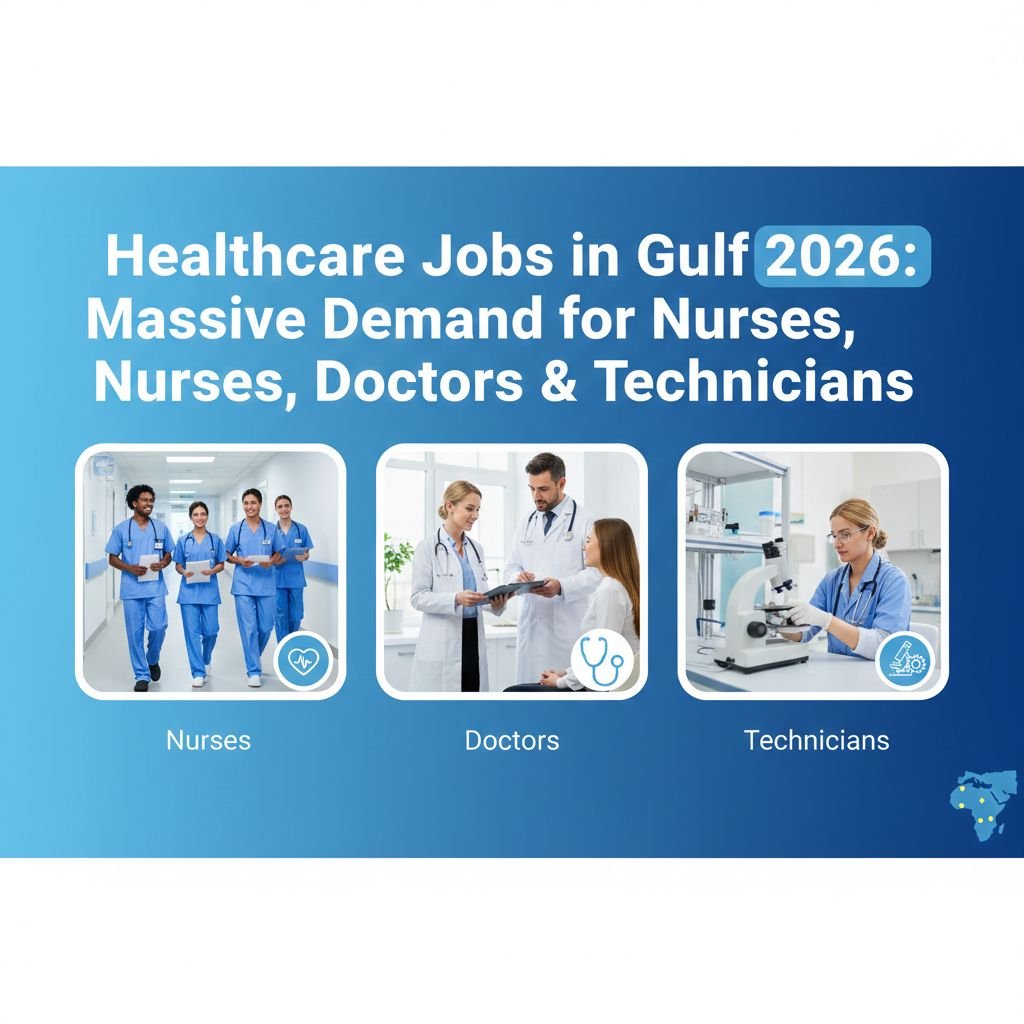
The Gulf region is witnessing an unprecedented boom in healthcare hiring. If you’re a nurse, doctor, or medical technician looking for international opportunities, 2026 is your year. With massive government investments, hospital expansions, and ambitious healthcare transformation projects across Saudi Arabia, the UAE, and Qatar, the demand for qualified medical professionals has never been higher.
The Big Picture: Why Healthcare Hiring Is Exploding in the Gulf
The numbers tell a compelling story. The Gulf Cooperation Council (GCC) healthcare ecosystem is projected to require over 50,000 additional nurses by 2027 alone . And that’s just one category. Demand for specialist doctors, technicians, and allied health professionals is growing at an annual rate of 10-15%, with some markets like Saudi Arabia seeing increases of 20-25% .
What’s driving this massive demand?
Population growth across the region
Hospital expansion projects tied to national development plans
Medical tourism initiatives requiring world-class staffing
Aging healthcare infrastructure being replaced and upgraded
Vision 2030 in Saudi Arabia and similar programs in the UAE prioritizing healthcare excellence
The Gulf is investing heavily in becoming a global healthcare destination. And that means they need you.
Nursing: The Greatest Demand
If you’re a nurse, your skills are needed now more than ever. India alone sends approximately 25,000 to 30,000 nurses to the GCC annually, representing 45-50% of the nurse workforce joining from other countries . And the demand continues to outpace supply.
Why Nurses Are in Such High Demand
Critical shortages across ICU, operating rooms, and emergency departments
Expansion of long-term care facilities requiring specialized nursing staff
Locum contracts creating flexible, fast-track opportunities
Competitive packages making Gulf roles attractive globally
What Nurses Can Expect
Salaries for nurses in the Gulf are highly competitive. Typical monthly packages range from approximately ₹1.3 to ₹1.5 lakh (around AED 5,700 to AED 6,600), with the added benefit of no income tax. Most positions also include:
Free accommodation or housing allowance
Transportation to and from work
Comprehensive medical coverage
Annual return airfare to home country
End-of-service benefits
For ICU, critical care, and operating room nurses, demand is particularly intense, and packages reflect that priority .
Doctors: Specialists Wanted
The Gulf is not just looking for general practitioners. The real demand—and the real money—is in specializations. Population growth, evolving regulations, and hospital expansion are driving strong demand for Western-trained doctors across the UAE, Saudi Arabia, and Qatar .
Specialties in Highest Demand for 2026
Based on current hospital needs and recruitment data, these specialties are at the top of every employer’s wish list :
Interventional Radiology
ENT (Otolaryngology)
Female Breast Surgery and Radiology
Neurology
Urology
Female Obstetrics & Gynaecology
Fetal Medicine
IVF & Reproductive Medicine
All Pediatric Subspecialties (Cardiovascular, Endocrinology, Hematology Oncology, Orthopedics)
Pediatric subspecialties are particularly hot right now. Hospitals are shifting toward senior and niche consultant roles as they expand subspecialty services. Positions like Pediatric Cardiovascular Consultant and Pediatric Cardiothoracic Transplant Consultant don’t open often—but when they do, hospitals move quickly .
Doctor Salary Ranges
In the UAE, doctors earn between AED 120,000 and AED 360,000 per year, depending on specialty, experience, and qualifications . Senior consultants and those in high-demand subspecialties command the top end of this range, plus generous benefits packages.
Medical Technicians and Allied Health Professionals
Doctors and nurses get most of the attention, but the Gulf also desperately needs skilled technicians and allied health professionals.
Roles in High Demand
Anesthesia Technicians: Strong demand for both permanent and locum contracts
Cardiovascular Technologists
Radiology and Imaging Technicians
Laboratory Technologists
Respiratory Therapists
Perfusionists
Surgical Technologists
The expansion of specialized cardiac centers, oncology units, and advanced surgical suites means technicians with specific expertise are being recruited aggressively.
Locum Opportunities: The Fast Track to the Gulf
One of the biggest trends in the 2026 Gulf healthcare market is the explosion of locum (temporary) contracts. These aren’t just stop-gap measures anymore—they’ve become a permanent feature of Gulf hiring .
Why Locum Contracts Are Growing
Faster hiring: Hospitals need coverage now, and locum roles typically bypass longer approval chains
Lower commitment: You can test life and work in the region without a long initial contract
Pathway to permanent: Many locum assignments convert to permanent roles after a successful term
Broad demand: Anesthesia, ICU, emergency medicine, and nursing dominate locum requests
If you want speed and flexibility while working in the Middle East, locum contracts remain the fastest entry point.
Leadership and Executive Roles
For experienced healthcare professionals, 2026 offers unprecedented leadership opportunities. IHR Canada reports a clear increase in executive-level and senior leadership recruitment .
Executive Roles Currently in Demand
Executive Director, Medical Tourism and Medical Services
Associate Executive Director, Nursing Services
Head of Clinical Data
Health Services Manager, Oncology
Executive Health Medicine Chairperson
Program Manager, Healthcare Improvement
Executive Director, Business Development
This signals growing investment in medical tourism, patient experience, nursing leadership, and data-driven service improvement. For many professionals, career options now extend well beyond bedside practice .
How to Prepare: Your Action Plan
Hospitals in the Gulf strongly favor candidates who are already licensed or fully prepared for rapid licensing. In many cases, licensing delays slow hiring more than interviews or credentialing .
Getting “Deployment Ready”
To be among the first candidates considered when new roles open, you need:
Professional licenses up to date and verified
Employment and education certificates organized and attested
References identified and contactable
Clean, clear credentialing records
Prometric exam preparation (required for most Gulf licensing)
The Licensing Process
Most Gulf countries require healthcare professionals to pass licensing exams:
Saudi Arabia: Saudi Commission for Health Specialties (SCFHS) exam
UAE: Dubai Health Authority (DHA) or Department of Health (DOH) exam
Qatar: Qatar Council for Healthcare Practitioners (QCHP) exam
Many recruitment platforms now offer end-to-end support, including training for these exams, documentation assistance, and visa processing .
What You Can Expect: Compensation and Benefits
The financial package for healthcare professionals in the Gulf remains one of the most attractive globally.
Typical Package Components
Component
What to Expect
Base Salary
Tax-free, competitive with Western markets
Housing
Free accommodation or generous allowance
Transport
Provided or allowance included
Medical Insurance
Comprehensive coverage for you and family
Education
School fee allowances for children (senior roles)
Annual Leave
30-45 days plus public holidays
Flight Allowance
Annual return tickets to home country
End of Service
Gratuity payment upon contract completion
The combination of tax-free income and comprehensive benefits means Gulf opportunities offer exceptional savings potential compared to Western markets.
The Future: Beyond 2026
The healthcare transformation in the Gulf is just beginning. Saudi Vision 2030, UAE Centennial 2071, and Qatar National Vision 2030 all prioritize healthcare excellence as a cornerstone of their post-oil economies .
This means sustained demand for international talent for years to come. For healthcare professionals willing to invest in the right credentials and adapt to Gulf work culture, the opportunities are truly limitless.
Ready to Make Your Move?
The Gulf healthcare market in 2026 is a seller’s market—and you’re the seller. Whether you’re an experienced consultant looking for a leadership role, a specialist nurse seeking adventure and savings, or a technician ready to advance your career, the opportunities are here.
Your next step: Get your documents in order, start your licensing preparation, and connect with reputable recruitment partners who specialize in Gulf placements. The hospitals are ready. The packages are waiting. The only question is: are you?
Frequently Asked Questions (FAQs)
1. What are the most in-demand healthcare jobs in the Gulf for 2026?
Nurses (especially ICU, OR, and critical care), specialist doctors in radiology, pediatrics, neurology, and reproductive medicine, and medical technicians across anesthesia, cardiology, and imaging are in highest demand. Leadership roles in medical tourism and nursing administration are also growing rapidly
2. How much can I earn as a healthcare professional in the Gulf?
Nurses typically earn tax-free packages equivalent to AED 5,700-6,600+ monthly plus benefits. Doctors earn AED 120,000-360,000 annually depending on specialty. All roles include accommodation, transport, medical coverage, and annual flights
3. What qualifications do I need to work in Gulf healthcare?
You need recognized professional degrees (MBBS, BSN, etc.), valid licenses from your home country, and usually 2-5 years experience. You’ll also need to pass country-specific licensing exams (DHA, DOH, SCFHS) and have your credentials attested
4. Are locum contracts a good option for first-timers in the Gulf?
Yes! Locum contracts offer faster hiring, lower commitment, and let you test the region before committing long-term. Many locum positions convert to permanent roles after successful assignments
5. Is the demand real, or just hype?
The demand is absolutely real. The GCC needs over 50,000 additional nurses by 2027. Major hospital expansions, medical tourism growth, and national healthcare transformation plans are driving sustained, documented demand across all specialties
Post a Job Opening
Fill in the details below. Your job posting will be reviewed by our team.