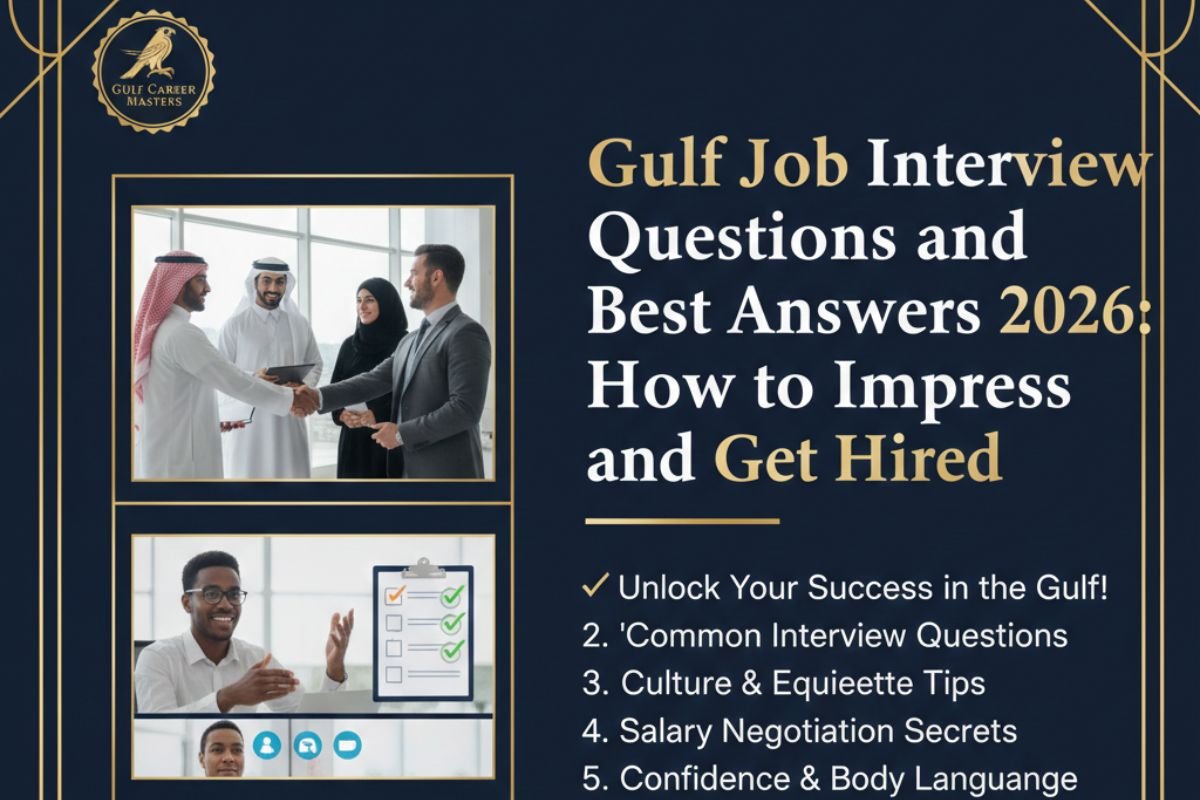
The Gulf job market is fiercely competitive, attracting top talent from across the globe. While your CV may open the door, the interview is where you secure the offer. Gulf-based interviews blend international business practices with distinct regional cultural expectations. Success requires more than just rehearsing answers; it demands an understanding of what employers in the UAE, Saudi Arabia, Qatar, and other GCC nations truly value.
This 2026 guide provides a deep dive into the most common and critical Gulf job interview questions. We’ll explain why they’re asked and deliver strategic, culturally-aware answers that will set you apart.
The Gulf Interview Mindset: What Are They Really Looking For?
Before we dive into questions, understand the core evaluation criteria:
- Cultural Fit & Adaptability: Can you thrive in a hierarchical, diverse, and often fast-paced environment?
- Stability & Long-Term Commitment: Are you looking for a career or just a short-term, tax-free stint? High turnover is costly.
- Professionalism & Respect: Do you understand and respect the local business etiquette and cultural norms?
- Delivering Tangible Results: Beyond qualifications, can you handle responsibility and deliver on major projects common in the region?
Top Gulf Interview Questions and Winning Answer Strategies
1. “Tell me about yourself.” (The Opening Pitch)
- Why they ask: This is not a casual ice-breaker. It’s your chance to deliver a concise, compelling professional narrative that connects your past directly to this specific role and company in the Gulf.
- The Gulf-Focused Strategy (Present-Past-Future Formula):
- Present: Start with your current role and one key achievement. “I am currently a Senior Project Engineer with X Constructions, where I lead the mechanical systems delivery for large-scale commercial developments across the Middle East.”
- Past: Highlight 2-3 key, quantifiable achievements most relevant to this Gulf role. *”Over the past eight years, I’ve specialized in managing multi-disciplinary teams, most notably delivering a $50M hotel project in Dubai 15% under budget and pioneering sustainable MEP solutions adopted on three subsequent projects.”*
- Future: Explicitly connect your goals to this company and the Gulf’s vision. “I am now keen to bring my expertise in sustainable engineering to a visionary developer like yours, particularly as I’m impressed by your commitment to NEOM/green building standards and believe I can contribute significantly to your upcoming projects in Riyadh.”
- Key Tip: Mention any prior GCC experience. If you don’t have it, express a researched understanding of the market.
2. “Why do you want to work in the UAE/Saudi Arabia/Qatar?” (Testing Motivation & Intent)
- Why they ask: They need to filter candidates attracted only by “tax-free salaries” from those genuinely interested in contributing to the region’s growth and adapting to its culture.
- The Winning Answer (Combine Professional & Cultural Insight):
- Professional Pull: Reference the company’s specific projects, the country’s national vision (e.g., Saudi Vision 2030, UAE’s We the UAE 2031), or the sector’s explosive growth. *”Saudi Arabia’s Vision 2030 and its focus on giga-projects is reshaping the global engineering landscape. I am specifically drawn to your company’s role in developing NEOM and want to be part of this transformative period.”*
- Cultural & Personal Interest: Show genuine respect and curiosity. “Professionally and personally, I am drawn to the unique blend of rapid innovation and rich heritage in the Gulf. I see it as a dynamic environment for long-term career and personal growth.”
- Avoid: Leading with “for the tax-free income” or “for a better lifestyle.” While understood, it should not be your primary stated reason.
3. “Why do you want to work for our company specifically?” (Testing Your Homework)
- Why they ask: This separates generic applicants from genuinely interested ones. In the Gulf, where personal networks and reputation matter deeply, knowing about the company is non-negotiable.
- The “I Have Done My Homework” Answer:
- Mention a specific recent project, award, or initiative. “I’ve followed your company’s strategic shift towards smart city technologies, and I was particularly impressed by the recent completion of the [Project Name] district, which aligns perfectly with my experience in IoT integration.”
- If it’s a well-known family-owned business, acknowledge its reputation and legacy respectfully. “Your company’s reputation for quality and its century-long legacy in the region are highly respected, and I want to contribute to that tradition of excellence.”
4. “Describe a time you faced a major challenge at work and how you handled it.” (Behavioral & Problem-Solving)
- Why they ask: Gulf projects are large, complex, and involve stakeholders from dozens of nationalities. They need proof you can handle pressure, solve problems, and navigate difficulties professionally.
- The Winning Formula (Use the STAR Method):
- Situation: Set the context briefly. “While managing a tight-deadline tower project in Doha, our main subcontractor failed to deliver critical materials on schedule.”
- Task: What was your specific responsibility? “I was tasked with resolving the supply issue without delaying the critical path or exceeding the budget.”
- Action: What steps did YOU take? This is the core. *”I immediately convened the team, audited three alternative local suppliers, negotiated a new contract within 48 hours that met our specs, and re-sequenced the construction schedule to absorb the initial two-day delay.”*
- Result: Quantify the positive outcome. *”We secured a more reliable partner, completed the phase only 3 days behind the original schedule—avoiding a potential 3-week delay—and kept costs within the contingency budget.”*
- Gulf-Specific Tip: Choose an example that highlights cross-cultural negotiation, adapting to client needs, or managing strict compliance/regulations.
5. “How do you handle working in a multicultural team?” (Cultural Competence)
- Why they ask: Your colleagues and clients will be from dozens of nationalities. Harmony is critical for productivity.
- The Winning Answer (Show, Don’t Just Tell):
- Provide a specific example. *”In my last role, my team of 12 represented 8 nationalities. I learned that while consensus took longer, it led to better solutions. I instituted a practice of written meeting summaries to ensure clarity and followed up with one-on-one check-ins to ensure everyone was comfortable voicing concerns.”*
- Emphasize active listening, patience, and respect for different communication styles.
- Frame it as a positive advantage: “I find diverse teams bring a wider range of perspectives, which is essential for innovation, especially on international projects here in the Gulf.”
6. “Where do you see yourself in 5 years?” (Testing Long-Term Commitment)
- Why they ask: Recruitment and visa sponsorship are major investments. They want to know you plan to grow with them.
- The Winning Answer (Align with the Company’s Growth):
- Frame your ambitions within the company’s trajectory. “In five years, I see myself having grown into a leadership role within the project management office, directly contributing to the expansion of your business in the Saudi market, and mentoring new talent joining the company.”
- Show a desire for continuous learning and deeper contribution. “I aim to be a subject matter expert in [your field] within the company, helping to shape strategy and standards.”
- Avoid: Mentioning plans to move to another company, start your own business, or relocate to another country.
7. “What are your salary expectations?” (The Negotiation Question)
- Why they ask: To see if your expectations align with their budget and the local market rate.
- The Strategic Answer:
- Research: Know the market rate for your role, experience, and the specific city (salaries differ between Dubai and Abu Dhabi, Riyadh and Jeddah). Use GulfTalent, Bayt.com salary surveys, and LinkedIn Salary.
- Defer if Possible: If early in the interview: “Based on my research and the responsibilities outlined, I’m confident we can reach a competitive number. Could you share the salary range you have budgeted for this role?”
- Give a Researched Range: If pressed: *”Considering the total compensation package for a role of this scope in [Dubai/Riyadh], I am looking for a range between [AED 25,000 to AED 30,000] per month, which I believe is aligned with the market.”* Always quote a monthly figure for the Gulf.
8. “How do you deal with a disagreement with your manager or a client?” (Professionalism & Hierarchy)
- Why they ask: Gulf corporate culture can be hierarchical. They need to know you can handle disagreements with utmost respect.
- The Respectful Resolution Framework:
- Emphasize private communication and seeking first to understand. “I believe in addressing concerns directly but respectfully. I would request a private meeting to understand their perspective fully, then present my data or viewpoint calmly, focusing on the project’s best interest.”
- Always conclude with deference to authority. *”Ultimately, I respect the chain of command and would support the final decision once made, ensuring the team is aligned.”
Final Tips for Gulf Interview Success in 2026
- Dress Conservatively: Formal business attire is expected. When in doubt, overdress.
- Punctuality is Sacred: Being on time is a sign of respect. For virtual interviews, test your tech early.
- Mind Your Body Language: Offer a firm handshake if appropriate (follow the interviewer’s lead, especially in conservative settings). Maintain respectful eye contact.
- Prepare Questions for Them: Asking insightful questions shows engagement. Ask about team culture, key challenges for the role, or how success is measured in the first 6 months.
- Send a Thank-You Email: Within 24 hours, send a polite email thanking the panel, reiterating your key strength, and your enthusiasm for the role and contribution to the company/region.
Conclusion
Mastering the Gulf job interview is about demonstrating a powerful combination: professional excellence, cultural intelligence, and genuine commitment. By preparing strategic, nuanced answers to these common questions, you show employers that you are not just a skilled candidate, but the right expat professional who will integrate smoothly, deliver results, and contribute to their long-term success in one of the world’s most dynamic regions.
Prepare, practice, and present yourself as the complete package. Your next career opportunity in the Gulf awaits.
5 Frequently Asked Questions (FAQs)
1. Are interviews in the Gulf more formal than in Western countries?
Generally, yes. The tone is typically more formal and respectful, especially in initial meetings. Hierarchy is acknowledged. Use titles (Mr., Ms., Dr., Eng.) unless invited to use first names. Dress is always formal business attire.
2. How many interview rounds can I expect for a Gulf job?
It’s common to have 2-4 rounds. This may include a phone screening with HR, a technical interview with a department head, an interview with senior management, and sometimes a final meeting with a sponsor or CEO, especially for senior roles. The process can take several weeks.
3. Should I bring hard copies of my documents to the interview?
Always. Bring multiple, neatly organized copies of your CV, attested educational certificates, professional licenses, and passport. This shows preparedness and is often expected, even if you submitted them online.
4. Is it appropriate to discuss salary and benefits in the first interview?
Let the interviewer lead. If they ask, be prepared. If not, it’s often best to wait until a later round (e.g., second interview or offer stage) to discuss details, unless you have a specific deal-breaker. Your initial focus should be on proving your value.
5. How important is it to have a “wasta” (connection) in Gulf interviews?
While professional merit is increasingly paramount, especially in large multinationals and government-linked entities, networking and referrals (“wasta”) can certainly help get your foot in the door. However, it will not substitute for being unprepared or unqualified in the interview itself. Focus on building a genuine professional network and a stellar interview performance.