Gulf Careers Hub

Maximizing LinkedIn for Your Gulf Job Search: An Advanced Profile Optimization Guide

LinkedIn Optimization for Gulf Jobs | Advanced Profile Guide UAE & Saudi

To stand out in the competitive Gulf job market, your LinkedIn profile must go beyond basic completeness — it needs to be strategic, keyword-rich, and recruiter-ready. This advanced guide shows you how to optimize every section for visibility, credibility, and conversion.

Introduction

In the UAE, Saudi Arabia, Qatar, and Bahrain, LinkedIn is more than a networking tool — it’s a primary hiring platform. Recruiters use it to source candidates, verify credentials, and assess cultural fit. Whether you’re targeting multinational firms in Dubai, Vision 2030 projects in Riyadh, or tech startups in Doha, your LinkedIn profile must be optimized for Gulf-specific hiring practices.

This guide goes beyond the basics. We’ll walk through advanced strategies to make your profile searchable, compelling, and conversion-ready, with real examples and FAQs tailored to Gulf job seekers.

Why LinkedIn Optimization Matters in the Gulf

  • Recruiters use keyword filters to find candidates — if your profile lacks the right terms, you won’t appear.
  • Gulf employers value certifications, bilingual skills, and regional experience — your profile must reflect these.
  • LinkedIn is often used in place of a CV for initial screening. A weak profile can cost you interviews.
  • Remote and hybrid roles are rising — your digital presence is part of your professional brand.

Advanced Optimization Checklist

1. Headline: Go Beyond Your Job Title

Instead of “Marketing Manager,” use: “Marketing Strategist | GCC Consumer Brands | SEO + Paid Media | Arabic-English Bilingual” This adds keywords, regional relevance, and skill highlights.

2. Profile Photo: Professional and Regionally Appropriate

  • Use a high-resolution headshot with neutral background.
  • Dress in business attire appropriate for Gulf norms.
  • Smile subtly — warmth matters.

3. Banner Image: Visual Branding

Use a custom banner that reflects your industry or region. Examples:

  • Dubai skyline for finance professionals
  • Tech icons for developers
  • Healthcare visuals for medical roles

4. About Section: Tell Your Career Story

Use a first-person narrative. Include:

  • Your current role and impact
  • Regional experience (e.g., “5 years in UAE retail”)
  • Certifications and languages
  • Career goals aligned with Gulf trends

Example:

“As a bilingual HR professional with 7 years in Saudi Arabia’s healthcare sector, I specialize in talent acquisition for high-growth environments…”

5. Experience: Quantify and Localize

  • Use bullet points with metrics: “Increased lead generation by 40% in UAE market.”
  • Mention Gulf-specific tools (e.g., Bayzat, SAP SuccessFactors, Oracle GCC modules).
  • Include project names if relevant to Vision 2030 or Expo 2020.

6. Skills Section: Strategic Keyword Placement

Add 30+ skills, prioritizing:

  • Industry-specific terms (e.g., “ESG Reporting,” “Digital Twin Modeling”)
  • Gulf-relevant tools (e.g., “Zoho CRM,” “Tawteen compliance”)
  • Soft skills (e.g., “Cross-cultural communication,” “Stakeholder engagement”)

7. Certifications: Credibility Boosters

Include:

  • PMP, Agile, Scrum
  • Google Ads, HubSpot, Meta Blueprint
  • LEED, GHG Protocol, ESG Fundamentals
  • Arabic language proficiency or translation credentials

8. Recommendations: Social Proof

Request 3–5 recommendations from:

  • Gulf-based managers or colleagues
  • Clients or vendors in the region
  • Mentors or professors with regional ties

9. Featured Section: Showcase Your Work

Upload:

  • CV or portfolio
  • Project dashboards
  • Published articles or blog posts
  • Video introductions or presentations

10. Engagement Strategy: Visibility Matters

  • Comment on Gulf industry posts
  • Share insights from local events (e.g., Gitex, Future Investment Initiative)
  • Use hashtags: #UAEJobs #SaudiCareers #GulfTalent #Vision2030

Optimization Table: Gulf-Specific Enhancements

SectionStandard ProfileOptimized for Gulf Job Search
Headline“Sales Manager”“Sales LeaderFMCG UAEArabic-EnglishCRM Expert”
AboutGeneric career summaryRegional experience + certifications + career goals
ExperienceJob duties listedQuantified impact + Gulf tools + project names
Skills10–15 general skills30+ targeted keywords + regional tools
CertificationsNone or outdatedPMP, Agile, ESG, Arabic language, Google Ads
EngagementPassive profileActive commenting, sharing, and hashtag use

Common Mistakes to Avoid

  • Using generic headlines
  • Leaving the About section blank
  • Listing job duties instead of achievements
  • Ignoring certifications and skills
  • Not engaging with Gulf-specific content
  • Failing to localize your profile for UAE/Saudi recruiters

FAQs

Should I use “Open to Work” on LinkedIn in the Gulf?

Yes — but customize your settings to show recruiters only, unless you’re comfortable being public.

Is Arabic language proficiency important?

Yes — especially in Saudi Arabia and Bahrain. Mention it even if you’re conversational.

Can I use LinkedIn instead of a CV?

For initial screening, yes. But always have a tailored CV ready for formal applications.

How often should I post or engage?

Aim for 2–3 interactions per week. Commenting on Gulf industry news is highly effective.

What if I’m switching industries?

Use your About section and Featured section to highlight transferable skills and new certifications.

Career Pivot Success Story: How to Transition into a High-Growth Industry in the UAE/Saudi

Career Pivot UAE/Saudi | Transition into High-Growth Industries Successfully

Introduction

In the fast-evolving economies of the United Arab Emirates (UAE) and Saudi Arabia, career pivots are no longer rare — they’re strategic. Whether you’re shifting from education to tech, oil to sustainability, or admin to digital marketing, the Gulf offers unprecedented opportunities for reinvention.

This blog explores how professionals are successfully transitioning into high-growth industries like fintech, renewable energy, healthcare, and digital infrastructure. We’ll spotlight a real success story, break down the pivot process, and answer common questions for anyone considering a bold career move in the region.

Meet the Pivot: From Government Admin to Digital Transformation Lead

Khalid, a 36-year-old Saudi professional, spent over a decade in a government ministry managing administrative operations. While the job was stable, he felt stagnant. In 2025, he received an offer from a Public Investment Fund (PIF) portfolio company to lead a digital transformation initiative — nearly doubling his salary and placing him at the heart of Vision 2030.

What Changed?

  • Khalid began upskilling in digital tools like Power BI, Salesforce, and agile project management.
  • He joined LinkedIn learning cohorts and attended Riyadh Tech Week to network.
  • He worked with a mentor to reframe his CV around transferable skills: stakeholder management, process optimization, and cross-departmental coordination.
  • He applied for internal secondments and volunteered for tech-related projects within his ministry.

Within 18 months, Khalid had built a portfolio that positioned him as a change agent, not just an administrator.

High-Growth Industries in UAE and Saudi Arabia

If you’re considering a pivot, here are five booming sectors to watch:

1. Fintech and Digital Payments

  • UAE’s DIFC and Saudi’s Fintech Saudi are hubs for innovation.
  • Roles: Product managers, UX designers, compliance analysts, blockchain developers.

2. Renewable Energy and Sustainability

  • NEOM, Masdar, and Red Sea Global are hiring for green infrastructure.
  • Roles: Energy analysts, ESG consultants, carbon market strategists.

3. Healthcare and Biotech

  • Smart hospitals and genomics labs are expanding in Riyadh and Abu Dhabi.
  • Roles: Health data analysts, biomedical engineers, telehealth coordinators.

4. Digital Infrastructure and Smart Cities

  • Projects like The Line and Expo City Dubai need tech-savvy planners.
  • Roles: IoT engineers, urban data scientists, digital twin specialists.

5. E-Commerce and Digital Marketing

  • With rising consumer demand, brands need digital storytellers.
  • Roles: SEO strategists, performance marketers, content creators.

How to Pivot Successfully

Step 1: Identify Transferable Skills

Don’t start from scratch. Map your current skills to the new industry. For example:

Current SkillTransferable To
Stakeholder managementProduct ownership
Budget trackingFinancial analysis
Report writingData storytelling
Team coordinationAgile project management

Step 2: Upskill Strategically

Choose certifications and courses that signal credibility:

  • PMP, Agile, Scrum for project roles
  • Google Analytics, Meta Ads for marketing
  • AWS, Azure, Python for tech roles
  • ESG, LEED, GHG Protocol for sustainability

Step 3: Build a Portfolio

Create case studies, dashboards, mock campaigns, or GitHub projects to showcase your skills.

Step 4: Network with Intent

Attend Gulf-specific events, join LinkedIn groups, and connect with recruiters in your target industry.

Step 5: Tailor Your CV and LinkedIn

Use industry keywords, highlight outcomes, and show growth potential.

Real Pivot Timeline: Khalid’s Journey

MonthAction Taken
1Enrolled in digital transformation course
2Joined internal innovation committee
4Created a dashboard for ministry KPIs
6Attended Riyadh Tech Week
9Updated CV and LinkedIn profile
12Applied to PIF portfolio company
14Interviewed and received offer
18Started new role as Digital Transformation Lead

Common Pivot Pitfalls

  • Trying to pivot without upskilling
  • Using generic CVs that don’t reflect the new industry
  • Ignoring Gulf-specific hiring practices
  • Not leveraging internal opportunities first
  • Expecting instant results — pivots take time

Mindset Shifts for Gulf Professionals

  • From job security to career agility
  • From title loyalty to skill relevance
  • From local focus to regional/global impact

FAQs

Can I pivot without quitting my current job?

Yes — start by volunteering for cross-functional projects or taking online courses during evenings/weekends.

Do I need a new degree to pivot?

Not always. Certifications, portfolios, and networking often matter more than formal degrees.

How long does a successful pivot take?

Typically 6–18 months, depending on your starting point and target industry.

What industries are easiest to pivot into?

Digital marketing, project management, and sustainability often welcome professionals from varied backgrounds.

Is age a barrier to pivoting in the Gulf?

No — many professionals pivot in their 30s and 40s. Experience can be reframed as strategic value.

The Art of the Follow-Up: How to Professionally Follow Up After a Gulf Job Interview

Gulf Job Interview Follow-Up Guide | Professional Tips & Email Templates

Following up after a Gulf job interview is a strategic move that can reinforce your professionalism, clarify your interest, and even influence hiring decisions. This guide covers timing, tone, templates, and cultural etiquette across UAE, Saudi Arabia, Qatar, and Bahrain.

Introduction

You’ve just completed a job interview in the Gulf — whether in Dubai, Riyadh, Doha, or Manama — and now the waiting begins. But what you do after the interview can be just as important as what you said during it. A well-crafted follow-up message shows that you’re engaged, respectful, and serious about the opportunity.

In the Gulf region, where professional etiquette blends global standards with local customs, following up requires timing, tact, and cultural awareness. This blog explores how to follow up professionally after a Gulf job interview, with real-world tips, email templates, and FAQs tailored to the region.

Why Follow-Up Matters in the Gulf

In competitive job markets like the UAE and Saudi Arabia, employers often interview dozens of candidates. A thoughtful follow-up can:

  • Reinforce your interest in the role
  • Clarify key points from the interview
  • Show appreciation for the interviewer’s time
  • Keep you top-of-mind during the decision process
  • Demonstrate cultural awareness and professionalism

In Gulf business culture, respectful persistence is valued, especially when paired with humility and clarity.

When to Follow Up (Timing Is Everything)

Within 24–48 Hours

Send a thank-you email within one or two days of the interview. This is standard practice and shows promptness without being pushy.

After 1 Week

If you haven’t heard back after the timeline discussed in the interview, send a gentle follow-up asking for updates.

After 2–3 Weeks

If there’s still no response, you can send a final check-in or pivot to a networking tone, expressing continued interest in future roles.

What to Say (Structure and Tone)

Your follow-up should be:

  • Brief (3–5 short paragraphs)
  • Grateful (thank them for their time)
  • Specific (mention something discussed)
  • Professional (no slang or emojis)
  • Culturally aware (use formal greetings and closings)

Sample Structure

  1. Greeting (Dear Mr./Ms. [Last Name])
  2. Thank You (for the interview and opportunity)
  3. Reaffirm Interest (mention why the role excites you)
  4. Clarify or Add Value (briefly expand on a point)
  5. Close Politely (express hope to hear back soon)

Sample Follow-Up Email (UAE Example)

Subject: Thank You – Interview for Marketing Manager Role

Dear Ms. Al Mansoori,

Thank you for the opportunity to interview for the Marketing Manager position at your Dubai office. I appreciated our discussion about your upcoming campaigns and was especially excited to learn about your expansion into the Saudi market.

I remain very enthusiastic about the role and believe my experience in regional branding and bilingual content strategy would be a strong asset to your team.

Please don’t hesitate to reach out if you need any additional information. I look forward to hearing from you.

Kind regards, Jotish [Your Full Name] [Phone Number] [LinkedIn Profile]

Cultural Etiquette in Gulf Follow-Ups

🇸🇦 Saudi Arabia

  • Use formal titles (e.g., Dr., Eng., Mr.)
  • Avoid overly casual language
  • Respect religious holidays and weekends (Friday–Saturday)

🇦🇪 United Arab Emirates

  • English is widely used, but Arabic greetings (e.g., “Salam”) are appreciated
  • Be concise and respectful of time
  • Avoid follow-ups during Eid or Ramadan unless urgent

🇶🇦 Qatar

  • Mention shared values or regional experience
  • Be patient — some hiring processes take longer
  • Follow up with HR if unsure who to contact

🇧🇭 Bahrain

  • Friendly tone is acceptable, but remain professional
  • Highlight cross-functional skills and adaptability
  • Use email over WhatsApp unless invited to do so

📊 Follow-Up Frequency Table

Stage After InterviewAction TypeGulf-Specific Tip
24–48 hoursThank-you emailUse formal tone and mention local context
7–10 daysStatus check-inReference interview timeline politely
2–3 weeksFinal follow-upExpress continued interest or pivot to networking

Common Mistakes to Avoid

  • Following up too soon (within hours)
  • Using casual or vague language
  • Sending multiple emails in one week
  • Ignoring cultural holidays or weekends
  • Failing to personalize your message

Pro Tips for Gulf Job Seekers

  • Ask about the hiring timeline during the interview
  • Save the interviewer’s contact info immediately
  • Use LinkedIn to stay connected professionally
  • Keep a follow-up tracker to avoid over-messaging
  • Tailor each message to the company’s tone and culture

FAQs

Should I follow up if the interviewer said they’d contact me?

Yes — if the timeline they mentioned has passed, a polite follow-up shows initiative.

Is WhatsApp appropriate for follow-ups in the Gulf?

Only if the interviewer initiated contact via WhatsApp. Otherwise, stick to email.

What if I don’t have the interviewer’s email?

Reach out to HR or the recruiter who scheduled the interview. LinkedIn can also help.

Can I follow up more than once?

Yes — once after 1 week, and again after 2–3 weeks if needed. Avoid excessive messaging.

Should I mention salary or benefits in the follow-up?

No — focus on gratitude and interest. Salary discussions come later.

Is it okay to ask for feedback if I’m rejected?

Yes — a respectful request for feedback can help you grow and shows maturity.

5 In-Demand Skills in the Gulf for 2025 (and How to Develop Them)

Top 5 Gulf Skills for 2025 | Career Growth & Development Guide

In 2025, the Gulf job market is prioritizing digital fluency, sustainability expertise, and cross-functional leadership. This blog explores five high-demand skills across Saudi Arabia, UAE, Qatar, and Bahrain — plus practical ways to build them.

Introduction

The Gulf region is undergoing a seismic shift in workforce priorities. As countries like Saudi Arabia, UAE, Qatar, and Bahrain accelerate their national visions — from Vision 2030 to Digital Economy Strategies — employers are no longer hiring based solely on degrees. Instead, they’re seeking skills that drive innovation, resilience, and transformation.

In 2025, the most valuable professionals will be those who combine technical expertise with strategic thinking, and who can adapt to fast-changing industries like fintech, green energy, healthcare, and digital infrastructure.

This blog explores five of the most in-demand skills in the Gulf for 2025, why they matter, and how you can develop them — whether you’re a fresh graduate, mid-career professional, or job seeker looking to relocate.

1. Digital and Tech Fluency

As Gulf economies diversify away from oil, digital transformation is at the heart of every sector — from banking and logistics to education and tourism.

Why It’s In-Demand

  • UAE and Saudi Arabia are investing billions in AI, cloud computing, and smart cities
  • Qatar and Bahrain are expanding e-government platforms and digital healthcare
  • Employers want candidates who can code, automate, analyze, and secure data

Key Roles

  • Software engineers
  • Data analysts and scientists
  • Cloud architects
  • Cybersecurity specialists
  • AI/ML engineers

How to Develop It

  • Take online courses in Python, SQL, cloud platforms (AWS, Azure)
  • Build a portfolio on GitHub or Kaggle
  • Get certified (CompTIA, Google Cloud, Microsoft Azure)
  • Attend Gulf-based tech bootcamps or virtual hackathons

2. Green Energy and Sustainability Expertise

With COP31 approaching and net-zero targets accelerating, green skills are becoming essential across construction, energy, and urban planning.

Why It’s In-Demand

  • Saudi Arabia and UAE are launching solar, wind, and hydrogen megaprojects
  • Qatar and Bahrain are integrating sustainable design into infrastructure
  • Companies need professionals who understand carbon accounting, ESG, and circular economy

Key Roles

  • Renewable energy engineers
  • Sustainability consultants
  • Environmental analysts
  • Carbon market strategists
  • Green building architects

How to Develop It

  • Study sustainability frameworks (LEED, ISO 14001, GHG Protocol)
  • Take courses in energy modeling, climate finance, or ESG reporting
  • Volunteer with green NGOs or climate startups
  • Follow Gulf climate initiatives and COP announcements

3. Healthcare and Life Sciences Skills

The Gulf’s healthcare sector is expanding rapidly, driven by population growth, medical tourism, and digital health innovation.

Why It’s In-Demand

  • Saudi Arabia is building smart hospitals and biotech hubs
  • UAE and Qatar are investing in telemedicine and genomics
  • Demand is rising for clinical, research, and digital health professionals

Key Roles

  • Doctors, nurses, and allied health workers
  • Biomedical researchers
  • Health data analysts
  • Telehealth coordinators
  • Public health experts

How to Develop It

  • Pursue certifications (DHA, HAAD, SCFHS) for Gulf licensing
  • Learn health informatics and EHR systems
  • Join medical research projects or clinical trials
  • Explore Gulf scholarships for healthcare degrees

4. Project and Construction Management

With mega-projects like NEOM, Lusail City, and Expo City Dubai, the Gulf needs professionals who can plan, execute, and deliver complex infrastructure.

Why It’s In-Demand

  • Billions are being spent on smart cities, transport, and tourism infrastructure
  • Employers want managers who understand cost control, safety, and digital tools
  • Cross-border collaboration requires multilingual and multicultural leadership

Key Roles

  • Construction project managers
  • Civil engineers
  • Quantity surveyors
  • BIM specialists
  • Urban planners

How to Develop It

  • Get certified (PMP, PMI-ACP, RICS, Primavera)
  • Learn BIM software (Revit, AutoCAD, Navisworks)
  • Gain site experience through internships or apprenticeships
  • Study Gulf-specific building codes and safety standards

5. Digital Marketing and Communication

As Gulf businesses go global, they need marketers who understand digital platforms, analytics, and cultural nuance.

Why It’s In-Demand

  • UAE and Saudi Arabia are hubs for e-commerce, fintech, and tourism
  • Brands want professionals who can drive engagement and conversion
  • Arabic-English bilingualism is a major asset

Key Roles

  • Digital marketing specialists
  • SEO/SEM analysts
  • Content strategists
  • Social media managers
  • UX writers and brand storytellers

How to Develop It

  • Learn tools like Google Analytics, Meta Ads Manager, HubSpot
  • Build a personal brand on LinkedIn or Medium
  • Take courses in SEO, copywriting, and performance marketing
  • Study Gulf consumer behavior and regional trends

Summary Table

Skill AreaWhy It’s In-DemandHow to Develop It
Digital & Tech FluencySmart cities, AI, cloud, cybersecurityOnline courses, certifications, GitHub
Green Energy & SustainabilityNet-zero goals, COP31, ESG investmentsClimate courses, green certifications
Healthcare & Life SciencesSmart hospitals, medical tourism, genomicsLicensing, informatics, research projects
Project & Construction ManagementMega-projects, smart cities, infrastructurePMP, BIM, site experience
Digital Marketing & CommunicationE-commerce, tourism, fintech brandingSEO tools, content creation, analytics

FAQs

Are these skills relevant across all Gulf countries?

Yes — while priorities vary, UAE, Saudi Arabia, Qatar, and Bahrain all value these five skill areas in 2025.

Can I get hired without a degree if I have these skills?

Increasingly yes — employers are prioritizing skills, portfolios, and certifications over formal degrees.

What’s the best way to start learning these skills?

Use platforms like Coursera, edX, Udemy, and LinkedIn Learning. Look for Gulf-specific bootcamps and scholarships.

Are these skills useful for remote or freelance work?

Absolutely — especially digital marketing, tech, and sustainability consulting.

How can I find real Gulf job openings in these fields?

Use trusted platforms like Bayt, GulfTalent, Naukrigulf, and follow LinkedIn pages of Gulf employers.

🇸🇦 How to Land a Job in Riyadh – 2025 Guide for Expats and Locals

How to Land a Job in Riyadh – 2025 Guide for Expats and Locals

Riyadh, the capital of Saudi Arabia, is undergoing a transformation. Fueled by Vision 2030, the city is becoming a global hub for finance, tech, healthcare, and tourism. Whether you’re a Saudi national or an expat, landing a job here requires more than just submitting a CV—it demands preparation, networking, and cultural fluency.

Step-by-Step Guide to Getting Hired in Riyadh

1. Understand the Job Market

Saudi Arabia’s labor market is shaped by two forces:

  • Vision 2030 diversification: Growth in tech, tourism, healthcare, and green energy
  • Saudization (Nitaqat): Preference for Saudi nationals in certain sectors

Top hiring sectors in Riyadh (2025):

  • Technology & AI: Software engineers, data analysts, cybersecurity experts
  • Healthcare: Nurses, lab technicians, hospital administrators
  • Finance: Accountants, auditors, compliance officers
  • Construction & Engineering: Project managers, civil engineers
  • Retail & E-commerce: Sales agents, digital marketers, logistics coordinators
  • Education: ESL teachers, curriculum developers, academic advisors

2. Prepare Your Documents

You’ll need:

  • Updated CV (in English and optionally Arabic)
  • Cover letter tailored to each job
  • Educational certificates (attested by Saudi embassy)
  • Experience letters from past employers
  • Passport copy and professional photo
  • Portfolio (for creative or tech roles)

3. Choose the Right Visa Path

  • Employment visa: Sponsored by your employer
  • Freelancer visa: Available for select professions
  • Investor visa: If starting a business
  • Dependent visa: If joining family already in KSA

Your employer typically handles the Iqama (residency permit) after hiring.

4. Use Trusted Job Portals

  • Bayt.com – Most popular in the Gulf
  • LinkedIn – Great for networking and direct applications
  • Nokryan – Saudi-focused listings
  • Saudiajobs.net – Verified local roles
  • GulfTalent – Mid-to-senior level jobs

5. Network Locally and Online

  • Attend career fairs and industry events in Riyadh
  • Join LinkedIn groups focused on Saudi careers
  • Connect with recruiters and HR managers directly
  • Use referrals—they’re highly valued in Saudi hiring culture

6. Ace the Interview

  • Dress formally (business attire)
  • Be punctual and respectful
  • Prepare for both technical and behavioral questions
  • Highlight your adaptability, teamwork, and cultural awareness
  • Expect interviews in English, but some may include Arabic segments

7. Understand Work Culture

  • Workweek: Sunday to Thursday
  • Working hours: Typically 8–9 hours/day
  • Hierarchical structure: Respect for seniority is key
  • Communication: Polite, formal, and often indirect
  • Religion and culture: Be mindful of prayer times and public conduct

8. Negotiate Your Offer

Typical packages include:

  • Basic salary
  • Housing allowance
  • Transport allowance
  • Medical insurance
  • Annual flight ticket
  • End-of-service benefits

Always ask for a written contract and clarify probation period, leave entitlements, and notice terms.

9. Stay Compliant

  • Respect labor laws and Saudization quotas
  • Renew your Iqama on time
  • Avoid working for multiple employers unless legally permitted
  • Keep copies of all contracts and correspondence

Riyadh Job Market Snapshot (2025)

SectorDemand LevelAverage Salary (SAR/month)
Tech & AIHigh12,000–25,000
HealthcareHigh8,000–18,000
FinanceMedium10,000–20,000
ConstructionMedium9,000–16,000
Retail & SalesModerate5,000–10,000
EducationModerate6,000–12,000

FAQs

Can I get a job in Riyadh without speaking Arabic?

Yes, especially in tech, healthcare, and multinational companies, but basic Arabic helps in daily life.

Do I need a degree to work in Riyadh?

Not always. Many roles accept diplomas or certifications, especially in sales, hospitality, and customer service.

How long does the hiring process take?

Typically 2–6 weeks, depending on visa processing and background checks.

Is it safe to work in Riyadh?

Yes. Riyadh is considered safe and business-friendly, with strict labor protections.

Can I switch jobs after arriving?

Yes, but you’ll need a No Objection Certificate (NOC) or wait until your contract ends.

Are remote jobs available in Riyadh?

Yes. Many companies now offer hybrid or remote roles, especially in tech and marketing.

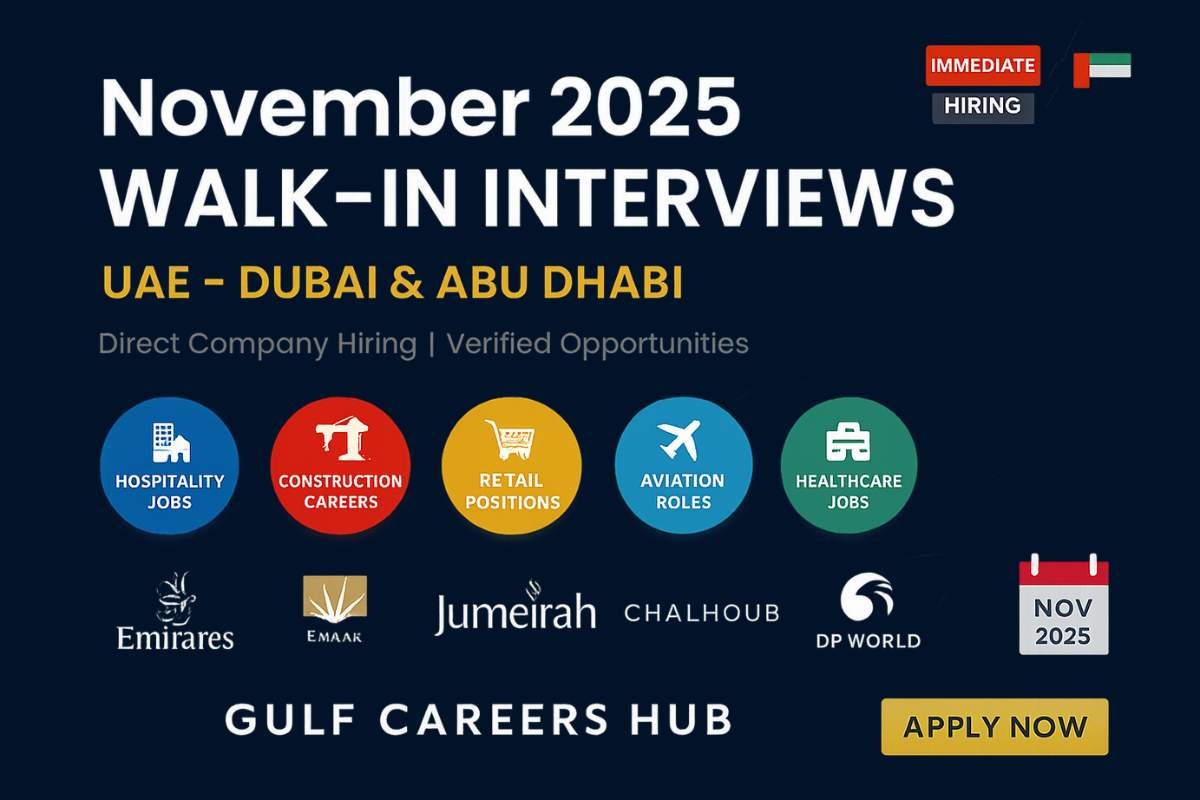
November 2025 Walk-In Interviews in UAE

UAE Walk-In Interviews November 2025 🇦🇪 | Dubai Jobs with Direct Hiring

Discover groundbreaking career opportunities as top UAE companies launch their November 2025 recruitment drives. From space tourism to AI-enhanced roles, this month features exclusive walk-in interviews for 2026 expansion projects. Don’t miss your chance to join Dubai’s evolving future-ready workforce.

Your dream job in the UAE’s innovative sectors awaits – walk in and step into tomorrow’s career landscape today!

Please verify all walk-in interview details directly on the official company websites before attending. Dates and venues may change – always confirm from official sources to avoid inconvenience.

Hospitality & Hotel Walk-Ins – November 2025

1. Jumeirah Group 2025 Winter Recruitment

📅 Date: November 3-7, 2025
Time: 8:30 AM - 4:30 PM
📍 Location: Jumeirah Beach Hotel, Umm Suqeim, Dubai

🏢 New Positions for 2025:
• Sustainable Tourism Coordinator
• Digital Guest Experience Manager
• AI Hospitality Specialist
• Wellness Retreat Coordinator
• Eco-Tourism Guide

🌟 2025 New Benefits:
• Green sustainability bonus
• Digital skills training allowance
• Flexible remote work options
• Career advancement programs
• Family wellness packages

📋 2025 Requirements:
• Diploma/Degree in Hospitality
• Digital literacy certification
• Sustainability training preferred
• Multilingual candidates prioritized

🔗 Official 2025 Portal: careers.jumeirah.com
📧 2025 Recruitment: careers2025@jumeirah.com
📞 2025 Hotline: +971-4-2025-8888

Rotana Hotels 2025 Digital Recruitment Drive

📅 Date: November 10-15, 2025
Time: 9:00 AM - 5:00 PM
📍 Location: All Rotana Properties Across UAE

💻 2025 Tech-Enabled Positions:
• Smart Room Technology Specialist
• Digital Concierge
• Virtual Event Coordinator
• Robotics Service Assistant
• Sustainable Operations Manager

🔄 2025 Hybrid Work Options:
• 4-day work week options
• Remote supervision roles
• Flexible shift patterns
• Digital training provided

💰 2025 Salary Ranges:
Entry Level: AED 3,500 - AED 5,000
Supervisory: AED 6,000 - AED 9,000
Management: AED 10,000 - AED 15,000

🔗 2025 Applications: rotana.com
📱 2025 Hotline: +971-50-2025-2025

Construction & Mega Project Walk-Ins – November 2025

3. Dubai 2040 Urban Development Projects

📅 Date: November 17-21, 2025
Time: 7:30 AM - 3:30 PM
📍 Location: Dubai Urban Planning Center, Business Bay

🏗️ 2040 Project Positions:
• Smart City Infrastructure Engineer
• Sustainable Construction Manager
• 3D Printing Construction Specialist
• Green Building Consultant
• Drone Operations Coordinator

🌱 2025 Sustainability Focus:
• Net-zero carbon projects
• Green construction materials
• Renewable energy integration
• Water conservation systems

🎓 2025 Qualifications:
• Bachelor's in relevant engineering
• LEED/ESTIDAMA certification
• Digital construction software skills
• UAE driving license

🔗 Portal: dubai.ae
📧 Urban Development HR: hr.urban2040@dubai.ae

Retail & E-commerce Walk-Ins – November 2025

4. Dubai Mall Expansion 2025 Recruitment

📅 Date: November 24-28, 2025
Time: 10:00 AM - 7:00 PM
📍 Location: The Dubai Mall Expansion Wing

🛒 2025 Retail Innovations:
• Virtual Shopping Assistant
• AR Experience Coordinator
• Sustainable Retail Manager
• Digital Inventory Specialist
• Omnichannel Customer Service

📱 2025 Tech Requirements:
• Proficient in retail AI systems
• VR/AR technology experience
• Digital payment systems knowledge
• E-commerce platform management

💡 2025 Training Programs:
• AI retail certification
• Sustainable retail practices
• Digital customer engagement
• Metaverse commerce training

🔗 Apply 2025: themall.ae/2025careers
📞 Retail HR 2025: +971-4-2025-2025

Aviation & Space Tourism – November 2025

5. Emirates Space Tourism Division

📅 Date: November 12-14, 2025
Time: 8:00 AM - 6:00 PM
📍 Location: Emirates Space Center, Dubai South

🚀 Space Tourism Roles:
• Zero-G Hospitality Specialist
• Spaceport Operations Manager
• Astro-Tourism Guide
• Spacecraft Service Coordinator
• Orbital Experience Designer

🌌 2025 Requirements:
• Aviation/hospitality background
• Space tourism certification
• Advanced safety training
• Multilingual capabilities
• Excellent physical health

🌟 2025 Benefits Package:
• Space training allowance
• Intergalactic travel insurance
• Advanced health monitoring
• Global mobility opportunities

🔗 Space Careers: emirates.com/
📧 Space HR: spacecareers@emirates.com

Healthcare & Wellness 2025 Walk-Ins

6. Dubai Health 2025 – Smart Hospitals

📅 Date: November 5-9, 2025
Time: 9:00 AM - 4:00 PM
📍 Location: Dubai Healthcare City, Phase 2

🏥 2025 Healthcare Roles:
• Telemedicine Coordinator
• AI Diagnostic Assistant
• Robotic Surgery Technician
• Wellness Technology Specialist
• Digital Patient Experience Manager

💊 2025 Qualifications:
• Healthcare degrees/certifications
• Digital health training
• Telemedicine experience
• Multilingual medical terminology

🔗 Health 2025 Portal: dubaihealth.ae/careers
📱 Telehealth HR: telehealthhr@dha.gov.ae

2025 Walk-In Interview Preparation Guide

Essential 2025 Documents:

✅ Digital CV with QR code
✅ UAE Digital ID/Emirates ID
✅ Digital educational certificates
✅ Blockchain-verified experience records
✅ Digital vaccination records
✅ AI skills certification

2025 Interview Format:

  • Phase 1: Digital screening via AI interview platform
  • Phase 2: Virtual reality skills assessment
  • Phase 3: In-person metaverse interview
  • Phase 4: Traditional face-to-face meeting

2025 Skills in Demand:

🤖 Technical Skills:
• AI and machine learning basics
• Blockchain technology understanding
• Virtual reality operations
• Sustainable technology practices
• Digital security protocols

🌍 Soft Skills:
• Cross-cultural communication
• Sustainability mindset
• Digital adaptability
• Innovative thinking
• Remote collaboration

Emerging Sectors for 2025:

  • Space Tourism & Commercial Space Operations
  • Sustainable Urban Development
  • Digital Health & Telemedicine
  • AI-Enhanced Hospitality
  • Green Technology & Renewable Energy

2025 Salary Expectations:

🏨 Hospitality 2.0: AED 4,000 - AED 18,000
🏗️ Smart Construction: AED 6,000 - AED 25,000
🛍️ Digital Retail: AED 4,500 - AED 20,000
🚀 Space Tourism: AED 8,000 - AED 35,000
🏥 Digital Health: AED 7,000 - AED 30,000

Recruitment Hotlines

Sector-Specific Contacts:

🏨 Hospitality: +971-4-2025-HOTEL (46835)
🏗️ Construction: +971-4-2025-BUILD (28453)
🛍️ Retail: +971-4-2025-SHOP (7467)
🚀 Aviation: +971-4-2025-FLY (359)
🏥 Healthcare: +971-4-2025-HEAL (4325)

2025 Walk-In Interview FAQs

What’s new in 2025 walk-in interviews?

2025 introduces AI-powered initial screenings, virtual reality assessments, and digital credential verification. Candidates should be prepared for hybrid interview formats.

Are there age restrictions for 2025 positions?

Most sectors have removed age restrictions, focusing instead on digital literacy, adaptability, and relevant skills. Some specialized roles may have specific requirements.

What digital skills are essential for 2025 jobs?

 Basic AI interaction, virtual collaboration tools, digital security awareness, and sustainability technology understanding are now fundamental requirements.

How has COVID-19 protocol changed by 2025?

Most pandemic restrictions have been replaced by advanced health monitoring systems and digital health verification processes.

Are remote work options available in 2025 positions?

Yes, hybrid and remote work options are standard across most sectors, with advanced digital collaboration infrastructure in place.

What’s the visa process for 2025 employment?

The UAE has streamlined digital visa processing with most approvals within 48 hours for qualified candidates meeting the 2025 skill requirements.


Last Updated: October 2025
Next Update: December 2025 Recruitment Schedule

*Note: All 2025 walk-in dates and positions are projected based on current industry trends and announced UAE 2025 development plans. Actual dates may be subject to change.*

Post a Job Opening

Fill in the details below. Your job posting will be reviewed by our team.

Basic Information

Specify years of experience required

Location & Salary

Qualifications & Skills

Specify educational requirements
Separate skills with commas

Company Details

Job Details

Contact Information