Gulf Careers Hub

Gulf Work Visa 2026: Complete Guide to UAE, Saudi, Qatar & Kuwait Employment Permits

Gulf Work Visa 2026: UAE, Saudi, Qatar & Kuwait Permit Guide

The Gulf Cooperation Council (GCC) region continues to be one of the most attractive destinations for expatriate workers in 2026. With tax-free salaries, world-class infrastructure, and ambitious national transformation plans, millions of professionals are eyeing opportunities in the UAE, Saudi Arabia, Qatar, and Kuwait. However, navigating the complex visa landscape requires up-to-date knowledge of evolving immigration policies.

Whether you’re a skilled engineer, healthcare professional, or seeking your first overseas assignment, this comprehensive guide breaks down everything you need to know about securing employment permits across the Gulf in 2026.

United Arab Emirates: The Golden Visa Era Continues

The UAE has solidified its position as the most expatriate-friendly Gulf nation, and 2026 brings further refinements to its visa ecosystem.

Employment Visa Process

The standard employment visa remains employer-sponsored, requiring your UAE-based company to initiate the application through the Ministry of Human Resources and Emiratisation (MOHRE) or relevant free zone authorities. The process typically takes 2-4 weeks and requires:

  • Valid passport (minimum 6 months validity)
  • Attested educational certificates
  • Medical fitness test (mandatory blood tests and chest X-ray)
  • Emirates ID registration

Key 2026 Updates

The Green Visa program has expanded significantly this year. Unlike traditional employment visas tied to a specific employer, the Green Visa offers 5-year residency for skilled workers earning AED 15,000+ monthly, freelancers, and self-employed individuals. This represents a seismic shift—giving professionals unprecedented mobility between employers without visa cancellation hassles.

The Golden Visa (10-year residency) criteria have also relaxed for specialized talents, including scientists, researchers, and exceptional students. Real estate investors now qualify with property purchases of AED 2 million, down from AED 5 million in previous years.

Pro tip: If you qualify for a Green Visa, apply directly rather than through an employer. You’ll retain control of your residency status.

Saudi Arabia: Vision 2030 Transforms Immigration

Saudi Arabia’s transformation under Vision 2030 has created massive demand for international talent, alongside increasingly sophisticated visa frameworks.

Work Visa Categories

The Standard Work Visit Visa allows 90-day stays for project-based work, while the Resident Permit (Iqama) remains the gold standard for long-term employment. Your Saudi employer (kafeel) must secure pre-approval from the Ministry of Human Resources and Social Development before you can apply.

Premium Residency: The Game Changer

2026 marks the expansion of the Premium Residency program (often called the “Saudi Green Card”). Two tracks exist:

  • Limited Duration (annual renewal): SAR 100,000/year
  • Unlimited Duration (permanent): SAR 800,000 one-time fee

Premium Residency holders can switch employers freely, own property, and sponsor family members without traditional kafeel restrictions. While expensive, it’s revolutionary for Saudi Arabia’s historically restrictive labor market.

Sector-Specific Opportunities

Massive giga-projects (NEOM, Red Sea Project, Qiddiya) have created expedited visa pathways for construction, hospitality, and technology professionals. The Specialized Talent Visa now offers 5-year residency for experts in artificial intelligence, renewable energy, and advanced manufacturing.

Important: Saudi Arabia has intensified Saudization (Nitaqat) requirements. Ensure your employer has sufficient quota to hire expatriates before accepting offers.

Qatar: Post-World Cup Evolution

Following the 2022 FIFA World Cup, Qatar has shifted focus toward sustainable economic diversification, with visa policies reflecting this transition.

Employment Visa Framework

Qatar’s Work Residence Permit requires employer sponsorship through the Ministry of Administrative Development, Labor and Social Affairs (MADLSA). The process includes:

  • Entry visa (valid for 30 days, extendable)
  • Medical examination at approved health centers
  • Fingerprinting and security clearance
  • Residence permit stamping (typically 2-3 months total processing)

2026 Policy Enhancements

Qatar introduced the Freelance Permit in late 2025, allowing independent professionals to work for multiple employers without traditional sponsorship. This particularly benefits consultants, designers, and IT specialists.

The Investor Residence Permit now offers 5-year renewable residency for entrepreneurs establishing businesses with capital of QAR 250,000 or more. Qatar’s growing focus on fintech and sports management has created niche visa categories for these sectors.

Family Sponsorship Rules

Qatar relaxed family reunification requirements in 2026. Professionals earning QAR 10,000+ monthly can now sponsor spouses and children more easily, with reduced documentation requirements compared to previous years.

Note: Qatar maintains strict exit permit requirements for certain professions. Clarify this with your employer before signing contracts.

Kuwait: Cautious Opening Amid Reform

Kuwait presents the most challenging visa environment in 2026, with ongoing efforts to balance expatriate workforce needs against demographic concerns.

Employment Visa Realities

The Work Permit (Article 18) remains the primary pathway, requiring Kuwaiti employer sponsorship through the Public Authority for Manpower (PAM). Processing times have improved to 4-6 weeks, though medical tests and security clearances add complexity.

2026 Restrictions to Note

Kuwait has intensified age restrictions—work visas are generally not issued to individuals over 60 years old for new applications. The country has also expanded prohibited job categories for expatriates, particularly in government and public sector roles.

However, specialist exemptions exist for healthcare professionals, engineers, and financial experts. The Domestic Worker Visa (Article 20) remains active but with enhanced protections and standardized contracts implemented in 2025.

Residency by Investment

Kuwait launched a limited Investor Residency program in early 2026, offering 5-year renewable residency for business owners investing KWD 300,000+ and creating jobs for Kuwaiti nationals. This represents Kuwait’s tentative step toward economic diversification visas.

Critical: Kuwait has strict rules regarding visa transfers. Changing employers typically requires 3+ years with your current sponsor or special ministry approval.

Cross-Cutting Considerations for 2026

Document Attestation

All Gulf states now require higher attestation standards for educational certificates. The standard chain involves:

  1. Notarization in home country
  2. Foreign Affairs attestation
  3. UAE Embassy/Consulate attestation
  4. Ministry of Foreign Affairs attestation in the destination country

The UAE and Saudi Arabia have introduced digital attestation portals that streamline this process, though physical documents remain required for initial applications.

Health Insurance Mandates

Comprehensive health insurance is now mandatory across all four countries before visa issuance. Employer-provided coverage is standard, but verify policy details—some “basic” packages offer inadequate coverage for serious conditions.

Criminal Background Checks

Qatar and Saudi Arabia now require police clearance certificates from home countries for most professional visas. UAE and Kuwait currently exempt most Western nationals but require them for South Asian and African applicants (a point of ongoing controversy).

Digital Nomad Visas

While not traditional work visas, the UAE (Dubai and Abu Dhabi) and Saudi Arabia now offer remote work visas allowing professionals employed by overseas companies to reside in the Gulf. These typically require proof of employment, minimum income thresholds ($3,500-$5,000/month), and valid health insurance.

Final Thoughts: Choosing Your Gulf Destination

For maximum flexibility: UAE’s Green Visa or Saudi Premium Residency offer unmatched freedom.

For highest salaries: Saudi Arabia’s giga-projects and Qatar’s LNG sector currently lead compensation packages.

For family life: UAE and Qatar offer the most international schools and family-friendly infrastructure.

For entrepreneurs: UAE’s free zones and Saudi Arabia’s expanding private sector provide the most straightforward business establishment pathways.

The Gulf’s visa landscape in 2026 reflects a broader trend: these nations increasingly compete for global talent while protecting national interests. Success requires thorough preparation, authentic documentation, and often, professional immigration assistance.

Have questions about your specific situation? The visa rules change frequently—always verify current requirements with official government portals or licensed immigration consultants before making decisions.

UK to UAE Work Visa: Complete Guide for British Professionals (2026)

UK to UAE Work Visa 2026 | Complete Guide for Brits

Dreaming of a tax-free salary, year-round sunshine, and career growth in one of the world’s most dynamic regions? You’re not alone. Over 240,000 British expats have already made the move to the UAE, drawn by opportunities in finance, tech, construction, and beyond . But before you pack your bags, there’s one crucial hurdle: navigating the UK to UAE work visa process.

Do UK Citizens Need a Visa to Work in the UAE?

Yes. While British passport holders receive a 30-day visa on arrival for tourism, this does not permit employment . To legally live and work in the UAE, you must obtain a residence visa sponsored either by a UAE employer or through one of the self-sponsored options.

Important: Arriving on a tourist visa and seeking work is common, but you must switch to a residence visa before starting employment. Working on a tourist visa is illegal and punishable under UAE law .

UK to UAE Work Visa Options for 2026

The UAE offers several pathways for British professionals. Your choice depends on whether you have a job offer, want to work freelance, or plan to invest.

1. Employment Visa (Company-Sponsored)

This is the most common route for professionals with a job offer from a UAE-based company.

  • Duration: 2 years, renewable
  • Sponsor: Your employer
  • Key requirements: Valid passport (6+ months validity), attested educational certificates, clean ACRO police certificate, medical fitness test 
  • Cost: AED 4,000–7,500 (approx. £800–1,500), typically paid by employer (employers must cover visa costs by law) 
  • Processing time: 2–3 weeks total 

Process:

  1. Employer applies for your work permit and entry permit
  2. You enter UAE on entry permit (valid 60 days)
  3. Complete medical test and biometrics
  4. Emirates ID issued
  5. Residence visa stamped (now digital, linked to Emirates ID) 

2. Green Visa (Self-Sponsored, 5 Years)

Introduced for skilled professionals and freelancers who want independence from an employer.

  • For skilled employees: Bachelor’s degree + minimum salary AED 30,000/month (approx. £6,500) 
  • For freelancers: Freelance permit from a free zone + proof of income
  • Benefits: Sponsor family, no employer dependency 

3. Golden Visa (10-Year Residency)

The gold standard for long-term stability, ideal for investors and top talent.

  • Property investors: Own property worth at least AED 2 million (£400,000+). Can be mortgaged with substantial down payment 
  • Professionals: Endorsed specialists in medicine, science, engineering, etc.
  • Benefits: 10-year renewable visa, sponsor dependents, travel freely for up to 12 months outside UAE 

4. Remote Work Visa (Virtual Working Program)

Perfect if you want to keep your UK job while living tax-free in the UAE.

  • Duration: 1 year, renewable
  • Requirements: Employment contract with overseas company (1+ year validity), minimum monthly salary USD 5,000 (£3,950) 
  • Benefits: No UAE employer needed, bring family

5. Investor/Partner Visa

For entrepreneurs setting up a business in a UAE free zone or mainland.

  • Duration: 2–3 years, renewable based on business activity
  • Requirements: Company registration, trade licence, local partner if applicable (for mainland) 

UK Document Legalisation: The Step Most People Get Wrong

Here’s the part that trips up even the most organised professionals. UAE authorities will not accept your UK degree, marriage certificate, or police check without proper legalisation .

Since the UAE is not a party to the Hague Apostille Convention, documents require an extra step: embassy attestation .

The Correct Legalisation Sequence (Do NOT Skip Steps)

StepWhat HappensWhy It Matters
1. NotarisationUK solicitor or public notary certifies your document copiesConfirms document authenticity to FCDO 
2. FCDO ApostilleForeign Office issues apostille certificateConfirms solicitor’s signature is genuine 
3. UAE Embassy AttestationUAE Embassy in London provides digital attestationNow done electronically, not physical stamps 
4. MOFA AttestationUAE Ministry of Foreign Affairs final approvalCompleted after arrival in UAE 

Key 2026 Update: The UAE Embassy in London now issues encrypted electronic PDFs with a unique verification number—no more physical stamps .

Which Documents Need Legalisation?

  • Degree certificates (highest qualification only usually sufficient, but check with employer) 
  • ACRO police certificate (must be less than 90 days old at submission) 
  • Marriage certificate (if sponsoring spouse)
  • Children’s birth certificates (if bringing family)
  • Work experience letters (sometimes required by HR) 

Warning: If your marriage certificate is laminated, the FCDO may reject it. Order a certified copy from the General Register Office instead .

Step-by-Step Timeline: Moving UK to UAE

8 Weeks Before Departure

  • Research visa options and confirm which applies to you
  • List all documents required for your specific visa
  • Apply for fresh ACRO police certificate 

7 Weeks Before

  • Gather original certificates (degree, marriage, birth)
  • Order replacement copies if originals are damaged/lost

6 Weeks Before

  • Start document legalisation (takes 7–10 working days for embassy stage) 
  • Use an FCDO-registered agent to manage the process remotely 

2 Weeks Before

  • Ensure all UK document legalisation is complete
  • Book flights (one-way if visa secured, return if still exploring)

Upon Arrival in UAE

  • Complete medical fitness test (blood work, chest X-ray)
  • Submit biometrics for Emirates ID
  • Register tenancy contract (Ejari) to open utilities
  • Open UAE bank account 

Costs Breakdown: What to Budget

ExpenseEstimated Cost (GBP)
Document legalisation (per document)£150–300
ACRO police certificate£45–75
Visa fees (if self-paying)£800–1,500
Medical test (Dubai)£70–100
Emirates ID£100–150
Health insurance (annual)£500–1,500
One-way flight£400–700
Shipping (3-bedroom house, sea freight)£2,000–6,000
Rental deposit (5–10% of annual rent)£1,500–4,000

Note: Employers typically cover visa costs for sponsored roles .

Common Mistakes That Delay Your Move

  • Wrong legalisation order: Notarisation → Apostille → Embassy. Skipping steps = rejection 
  • Expired police certificate: ACRO must be under 90 days old when submitted 
  • Unaccredited university: Check if your institution is recognised in UAE 
  • Laminated documents: FCDO may reject them—get official replacements 
  • Blurred passport scans: UAE immigration systems auto-reject poor-quality images 

FAQs: UK to UAE Work Visa

1. How long can I stay in UAE on a British passport without a visa?

British citizens receive a 30-day visa on arrival for tourism. This can be extended once for an additional 30 days. It does not permit work .

2. Can I work in Dubai with a UK remote work visa?

Yes, the UAE Remote Work Visa allows you to live in Dubai while working for a UK employer. You must prove a monthly salary of USD 5,000 (£3,950) and have a contract valid for at least one year .

3. How much does it cost to legalise UK documents for UAE?

Costs vary by provider and document type, but budget approximately £150–300 per document for the full legalisation chain (notary, FCDO, embassy) .

4. Does my UK degree need to be attested?

Yes. UAE authorities require attested educational certificates for most employment visas and for further study or professional licensing .

5. Can I sponsor my spouse and children?

Yes. Once you hold a valid UAE residence visa, you can sponsor dependents if you meet the minimum salary requirement (AED 4,000/month or AED 3,000 plus accommodation). Their marriage and birth certificates must also be fully legalised .

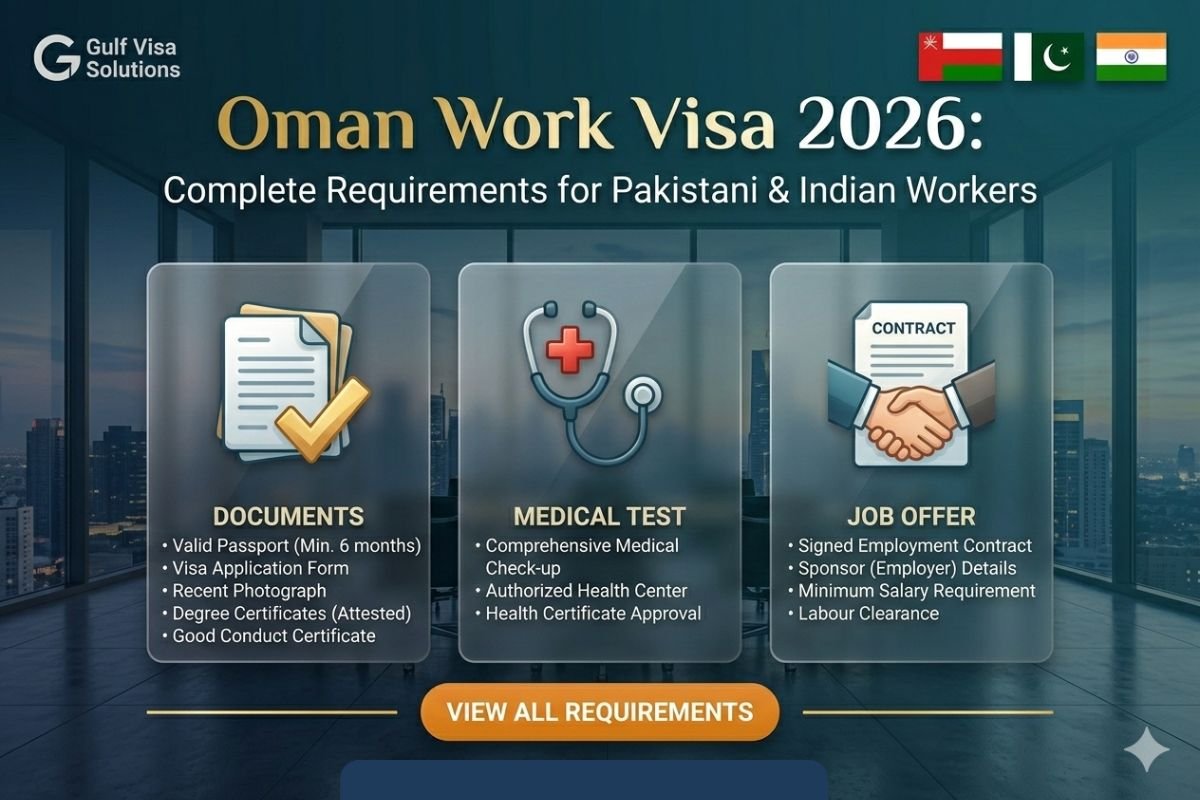
Oman Work Visa 2026: Complete Requirements for Pakistani & Indian Workers

Oman Work Visa 2026: Requirements for Pakistani & Indian Workers

Are you a skilled worker from Pakistan or India looking for better career opportunities in the Gulf? Oman has emerged as one of the most attractive destinations for expatriate workers in 2026. With tax-free salaries, a safe and stable environment, and growing demand across multiple industries, the Sultanate offers a compelling package for those seeking to build a future abroad .

Why Oman in 2026?

Oman’s economy is diversifying rapidly under its Vision 2040 plan, creating thousands of job opportunities for expatriate workers . Key sectors actively hiring foreign talent include:

  • Construction and infrastructure (massive projects across the country)
  • Healthcare (doctors, nurses, technicians)
  • Information Technology (developers, cybersecurity experts)
  • Oil and gas (engineers, technicians, specialists)
  • Logistics and transportation
  • Hospitality and tourism

For workers from Pakistan and India, Oman offers the added advantage of cultural familiarity, a significant expatriate community, and relatively straightforward visa processes compared to some other Gulf countries .

What Is an Oman Work Visa?

An Oman work visa is a legal permit issued by the Royal Oman Police (ROP) in coordination with the Ministry of Labour. It allows foreign nationals to work for a specific employer in Oman .

Key things to understand:

  • The visa is employer-specific—you cannot change jobs without canceling your current visa and applying for a new one 
  • It is typically valid for two years, aligned with your employment contract 
  • Your employer acts as your sponsor and initiates the entire application process 
  • The visa allows multiple entries during its validity period 

Eligibility Criteria for Oman Work Visa 2026

Before applying, you must meet specific requirements set by Omani authorities :

RequirementDetails
AgeBetween 21 and 60 years
Job OfferConfirmed employment from a licensed Omani company
OccupationMust be approved by the Ministry of Labour
Criminal RecordClean record with police clearance certificate
Medical FitnessPass examination at approved centers
Employer ClearanceEmployer must obtain labour clearance first

Additional requirements for certain professions:

  • Medical professionals: Approval from the Ministry of Health
  • Teachers: Approval from the Ministry of Education
  • Engineers: Letter from the Ministry of Manpower 

Documents Required for Oman Work Visa

Proper documentation is critical. Missing or incorrect paperwork is the leading cause of visa delays and rejections .

For All Applicants:

  • Valid passport with at least six months’ validity beyond your intended stay 
  • Recent passport-sized photographs (white background, typically 6×4 cm) 
  • Signed employment contract between you and your Omani employer 
  • Medical fitness certificate from an approved medical center 
  • Police clearance certificate from your home country (Pakistan or India) 
  • Attested educational certificates and professional qualifications 

For Pakistani Workers Specifically:

  • Protector of Emigrants (POE) clearance – Mandatory before traveling 

For Indian Workers Specifically:

  • Attestation from Ministry of Foreign Affairs and the Oman Embassy in India 

Documents Your Employer Provides:

  • Labour license issued by the Ministry of Labour 
  • Commercial registration certificate of the company
  • Specimen signature card (for authorized signatories) 

Important: All non-Arabic and non-English documents must be translated and attested by authorized officials .

Types of Work Visas in Oman

Depending on your employment situation, you may apply for one of these visa types :

Visa TypeDescriptionValidity
Standard Work VisaFor long-term employment; requires labour permit2 years
Temporary Work VisaFor short-term projects or contracts4–9 months
Employment Contracting VisaFor jobs requiring initial government testingVaries
Specialized Profession VisaFor highly specialized roles (medicine, engineering, IT)2 years

Step-by-Step Application Process

The application process follows a clear sequence. Your employer handles most steps, but you must provide accurate documents promptly .

Step 1: Secure a Job Offer

Receive and sign a formal employment contract from a registered Omani company. Ensure the job title matches your qualifications—Omani authorities verify this .

Step 2: Employer Obtains Labour Clearance

Your employer applies to the Ministry of Labour for approval to hire a foreign worker. The employer must demonstrate that no suitable Omani national is available for the role .

Step 3: Document Preparation

Gather all required documents and ensure proper attestation:

  • Educational certificates attested by the Oman Embassy in your home country
  • Police clearance certificate obtained from local authorities
  • Medical tests completed at approved centers 

Step 4: Visa Application Submission

Your employer submits the visa application to the Royal Oman Police (ROP) via the eVisa portal or at a local ROP office. The application must include all your documents .

Step 5: Visa Approval and Stamping

Once approved, the visa is stamped in your passport or issued electronically. Your employer receives it and forwards it to you .

Step 6: Travel to Oman

With your visa approved, you can travel to Oman. Carry copies of your:

  • Employment contract
  • Medical certificate
  • All supporting documents 

Step 7: Resident Card Registration

Within 30 days of arrival, you must apply for a Resident Card (Civil ID) at the Civil Status Department of the Royal Oman Police . This card is essential for:

  • Legal residence
  • Opening a bank account
  • Sponsoring family members later 

Step 8: Start Work

Once you have your Resident Card, you can legally begin employment under your sponsor company, in full compliance with Oman Labour Law .

Visa Fees and Processing Time

Fees:

Visa TypeFee (OMR)Approx. in PKRApprox. in INR
Standard Work Visa20–50 OMRPKR 15,000–38,000₹4,350–10,850
Temporary Work VisaVariesVariesVaries

Fees are subject to exchange rate fluctuations .

Processing Time:

  • Typical processing: 2 to 4 weeks after complete submission
  • Can take up to: 6 weeks depending on document verification and workload 

Factors affecting processing time:

  • Completeness and accuracy of documents
  • Your nationality
  • Current workload at Ministry of Labour and ROP 

Important Regulations for Work Visa Holders

Understanding Oman’s labour laws protects you from legal issues :

Work Restrictions:

  • You can only work for the employer who sponsored your visa
  • Changing jobs requires your current employer’s consent and a new visa 

Overstaying:

  • Overstaying your visa or working illegally can result in:
    • Heavy fines
    • Deportation
    • Future entry bans 

Family Sponsorship:

  • Once you have your Resident Card and meet minimum salary requirements, you can sponsor your spouse and children for Family Joining Visas 

Visa Renewal:

  • Your visa can be renewed before expiry through your employer
  • Renewal requires continued employment and compliance with all conditions 

Common Reasons for Visa Rejection

Avoid these pitfalls :

ReasonHow to Avoid
Incomplete documentationDouble-check requirements before submission
Medical test failureComplete tests early and address any health issues
Criminal recordObtain and verify your police clearance
Job title mismatchEnsure visa matches your labour permit occupation
Past immigration violationsClear any previous issues in GCC countries
Employer issuesVerify your employer’s registration and financial standing

Tips for a Smooth Application

For Pakistani Workers:

  • Obtain POE clearance before traveling—this is mandatory 
  • Verify your employer through official channels to avoid scams
  • Keep certified copies of all documents

For Indian Workers:

  • Get medical tests at approved centers only
  • Ensure all certificates are properly attested by the Oman Embassy in India 
  • Keep digital and physical copies of everything

For All Applicants:

  • Never start work without a valid visa – It’s illegal and can lead to deportation 
  • Verify your employer – Check their commercial registration with Oman’s Ministry of Commerce 
  • Keep copies – Maintain copies of your passport, visa, contract, and resident card
  • Know your rights – Familiarize yourself with Oman Labour Law regarding working hours, overtime, and leave 

Frequently Asked Questions (FAQs)

1. How long does it take to get an Oman work visa from Pakistan or India?

The complete process typically takes 2 to 6 weeks from the time your employer submits the application. Factors affecting timeline include document verification, medical test scheduling, and current workload at Omani ministries .

2. Can I change employers while on an Oman work visa?

Yes, but you need your current employer’s consent through a No-Objection Certificate (NOC) and a new visa application from your new employer. You cannot legally work for a new sponsor until this process is complete .

3. Is the Oman work visa fee refundable if my application is rejected?

No, visa fees are generally non-refundable, even if your application is rejected. This makes it essential to ensure all documentation is correct before submission .

4. Can I bring my family to Oman on a work visa?

Yes, once you have obtained your Resident Card (Civil ID) and meet minimum salary requirements, you can apply for Family Joining Visas for your spouse and children .

5. What medical tests are required for the Oman work visa?

Applicants must undergo testing for infectious diseases including tuberculosis, HIV, and hepatitis. Tests must be conducted at government-approved medical centers in your home country or upon arrival in Oman, depending on your nationality .

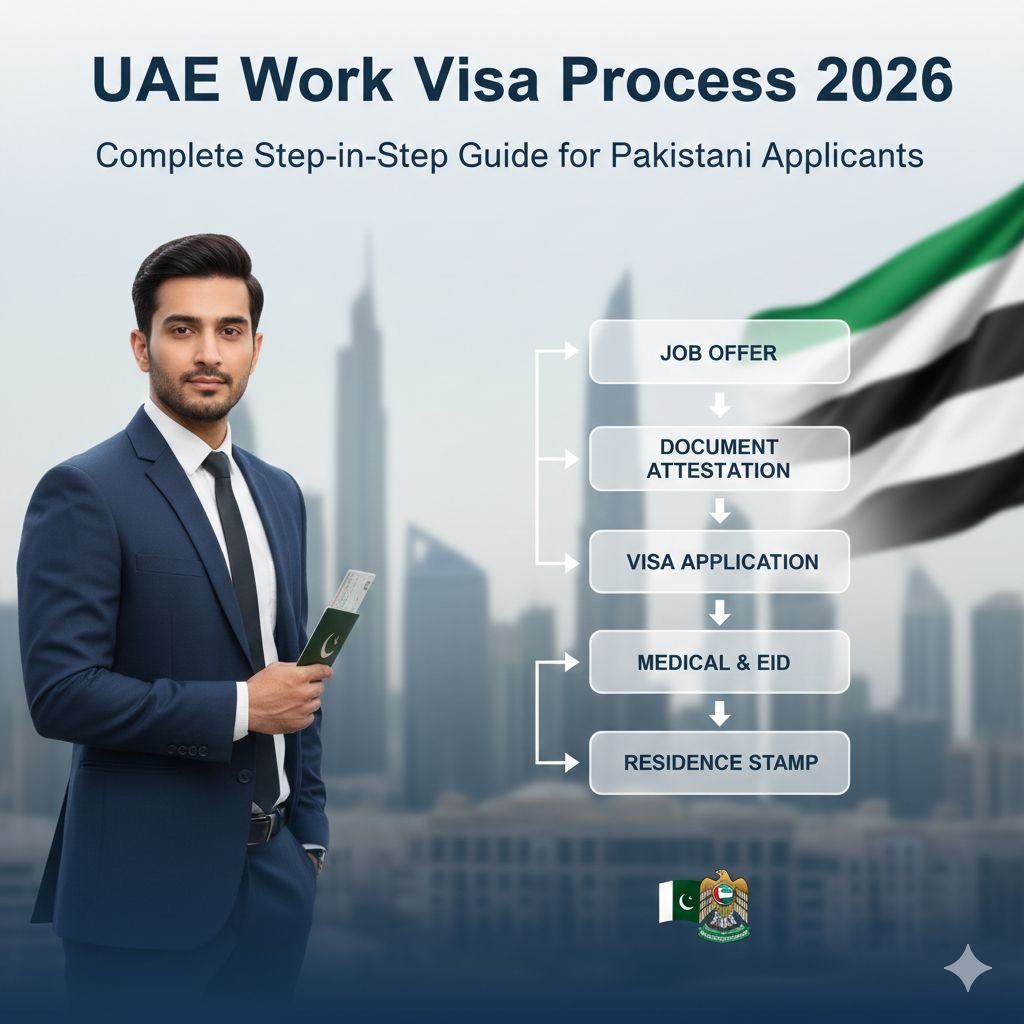
UAE Work Visa 2026: Complete Process for Pakistani & Indian Applicants

UAE Work Visa 2026: Complete Guide for Pakistan & India

Dreaming of working in Dubai or anywhere in the UAE? You’re not alone. Every year, hundreds of thousands of professionals from Pakistan and India make the move to the Gulf, drawn by tax-free salaries, world-class infrastructure, and exciting career opportunities.

Quick Overview: UAE Work Visa 2026 at a Glance

Before diving into details, here’s what you need to know:

AspectDetails
Visa Validity2 years (standard), renewable
Total Processing Time25-35 working days (including attestation)
Total Cost (PKR)PKR 85,000–125,000 + attestation
Total Cost (INR)₹25,000–40,000 + attestation
Medical RequiredYes (HIV, Hepatitis, TB tests)
Age RequirementMinimum 18 years
Salary RequirementTypically AED 4,000–5,000 minimum

Latest 2026 Updates: What’s Changed?

The UAE has dramatically simplified its visa processes for 2026. Here are the biggest changes affecting Pakistani and Indian applicants:

Digital Transformation

The Ministry of Human Resources and Emiratisation (MoHRE) has launched advanced AI-powered services that slash processing times dramatically :

  • Work permit processing time reduced by 95%
  • Data verification now takes under one minute (down from 10 minutes)
  • Several services require zero customer visits
  • Academic qualification verification completed in less than one minute through system integration

Work Bundle Platform

The new “Work Bundle” platform unifies multiple government services into a single digital journey . What used to require 15 steps and 16 documents across 30 working days now takes just 5 steps, 5 documents, and approximately 5 working days for eligible applications.

Smart Verification

AI systems now instantly verify:

  • IDs and passports
  • Employment contracts
  • Academic qualifications

This means faster approvals and fewer document rejections.

Step-by-Step UAE Work Visa Process 2026

Phase 1: Before You Leave Home

Step 1: Secure a Job Offer

Everything starts here. You cannot apply for a work visa independently—your UAE employer must sponsor you .

What your employer does:

  • Checks their visa quota availability
  • Applies for work permit approval through MoHRE
  • Submits your signed employment contract

What you should do:

  • Verify the company is legitimate (ask for trade license)
  • Get everything in writing: salary, benefits, who pays which fees
  • Understand your contract terms before signing

Step 2: Document Attestation (The Longest Step)

For both Pakistani and Indian applicants, document attestation is the most time-consuming part. Start early!

For Pakistani Applicants: 

Documents needing attestation:

  • Educational certificates (degrees, diplomas)
  • Experience certificates
  • Police clearance certificate
  • Marriage certificate (if applicable)

The attestation chain:

  1. HEC Pakistan (for educational documents)
  2. Ministry of Foreign Affairs (MOFA) Pakistan
  3. UAE Embassy in Pakistan (Islamabad) or Consulate (Karachi)

Time & Cost: 15-20 days | PKR 25,000–35,000

For Indian Applicants:

Documents needing attestation:

  • Educational certificates
  • Marriage certificate (if applicable)
  • Police clearance certificate (for some roles)

The attestation chain:

  1. State HRD/University (for educational documents)
  2. MEA (Ministry of External Affairs) New Delhi
  3. UAE Embassy in India (New Delhi)

Time & Cost: 15-20 days | ₹8,000–15,000

Phase 2: Entry Permit & Arrival

Step 3: Work Permit & Entry Permit Approval

Once your documents are ready, your employer applies for:

  • Work permit through MoHRE (2-7 working days) 
  • Entry permit (employment visa) through immigration (3-5 working days)

When approved, you receive an entry permit valid for 60 days to enter the UAE .

Step 4: Travel to UAE

Book your flight and carry:

  • Valid passport (6+ months validity)
  • Printed entry permit
  • Attested educational certificates (originals)
  • Employment contract copy
  • Passport-sized photographs (white background)

Phase 3: In-Country Processing (Dubai/UAE)

Step 5: Medical Fitness Test 

Within days of arrival, you must complete mandatory medical screening at government-approved centers.

Tests include:

  • Blood test (HIV, Hepatitis B & C)
  • Chest X-ray (Tuberculosis)
  • General physical examination

Cost: PKR 7,000–10,000 | ₹2,000–3,000
Results: 2-3 working days (electronically sent to authorities)

Important: Failed medical results = visa cancellation. Be honest about your health history.

Step 6: Emirates ID Application 

Visit an approved typing center or ICA service center to:

  • Complete Emirates ID application form
  • Provide biometric data (fingerprints and photograph)
  • Pay the ID card fee

Cost (2 years): PKR 8,500–11,000 | ₹2,500–3,500
Processing: 3-5 working days for ID number; card delivered in 10-15 working days

Step 7: Residence Visa Stamping 

After medical clearance and Emirates ID application, your employer submits your passport for residence visa stamping.

What happens:

  • Immigration stamps your passport with the residence visa
  • Your labor card (work permit) is issued
  • You can now legally work in the UAE

Cost: PKR 18,000–25,000 | ₹5,000–7,000
Time: 5-7 working days

Step 8: Labour Contract Registration

Your employment contract is registered with MoHRE, and you receive a labour card (now digital in most cases). This confirms your legal employment status.

UAE Work Visa Costs: Complete Breakdown (2026)

For Pakistani Applicants (in PKR) 

Fee ComponentAmount (PKR)Paid By
Entry Permit15,000–20,000Usually employer
Work Permit (MOHRE)8,000–12,000Employer
Medical Fitness Test7,000–10,000Usually employee
Emirates ID (2 Years)8,500–11,000Varies
Residence Visa Stamping18,000–25,000Employer
Document Attestation25,000–35,000Employee
Typing & Documentation5,000–8,000Employee
Total Estimated Cost85,000–125,000Excluding attestation
+ Attestation25,000–35,000

For Indian Applicants (in INR)

Fee ComponentAmount (INR)Paid By
Entry Permit4,500–6,000Usually employer
Work Permit (MOHRE)2,500–3,500Employer
Medical Fitness Test2,000–3,000Usually employee
Emirates ID (2 Years)2,500–3,500Varies
Residence Visa Stamping5,000–7,000Employer
Document Attestation8,000–15,000Employee
Typing & Documentation1,500–2,500Employee
Total Estimated Cost25,000–40,000Excluding attestation
+ Attestation8,000–15,000

Important Note on Who Pays 

According to UAE labour law, employers should bear all visa-related costs including work permit, entry permit, and residence visa fees. However, in practice:

  • Some employers cover everything
  • Others expect employees to pay for medical tests, Emirates ID, and attestation
  • Always clarify this in your job offer/contract before accepting

Never pay for a “guaranteed job visa” upfront to agents promising employment—these are often scams.

UAE Work Visa Requirements 2026: Complete Checklist

Employee Documents 

Essential:

  • Valid passport (minimum 6 months validity, 2 blank pages)
  • 6-8 passport-sized photographs (white background)
  • Signed employment contract (MOHRE-approved)

Educational:

  • Educational certificates (degrees, diplomas)
  • Experience certificates from previous employers
  • All must be properly attested (see attestation section above)

Personal:

  • Police clearance certificate (for some roles/nationalities)
  • CNIC (Pakistan) / Aadhaar + PAN (India)
  • Marriage certificate (if sponsoring family later)
  • Birth certificates for children (if applicable)

Employer Requirements 

Your sponsor must have:

  • Valid trade license
  • Active establishment card
  • Clean compliance record (affects visa fee category)
  • Available visa quota

Processing Time: Complete Timeline

For Pakistani Applicants 

StageTime
Document Attestation (Pakistan)15-20 days
Work Permit Approval2-7 working days
Entry Permit Issuance3-5 working days
Travel to UAE1 day
Medical Test & Results3-4 working days
Emirates ID Application1 day (processing 10-15 days for card)
Residence Visa Stamping5-7 working days
Total (excluding attestation)25-35 working days
Total (including attestation)6-8 weeks

For Indian Applicants

StageTime
Document Attestation (India)15-20 days
Work Permit Approval2-7 working days
Entry Permit Issuance3-5 working days
Travel to UAE1 day
Medical Test & Results3-4 working days
Emirates ID Application1 day (processing 10-15 days for card)
Residence Visa Stamping5-7 working days
Total (excluding attestation)25-35 working days
Total (including attestation)6-8 weeks

Express Processing Options 

Need it faster? Express processing is available:

  • Express processing fee: +AED 500-1,000 (PKR 15,000–30,000)
  • Reduced timeline: 15-20 working days total
  • Available for most visa stages

UAE Work Visa Rejection: Common Reasons & How to Avoid

Even with a job offer, rejections happen. Here are the most common reasons :

Medical Reasons

  • Testing positive for communicable diseases (HIV, Hepatitis B/C, active TB)
  • Solution: Be honest; get tested in your home country first if concerned

Document Issues

  • Non-attested certificates
  • Forged or fake documents (leads to permanent bans)
  • Incomplete applications
  • Solution: Use authorized attestation services; never submit fake documents

Employer Problems

  • Company has reached visa quota limit
  • Employer has compliance violations (affects fee category)
  • Solution: Verify company status before accepting offer

Security Concerns

  • Previous overstay or violations in UAE/Gulf
  • Criminal record
  • Solution: Be honest about your history; obtain police clearance if required

The “Free Visa” Trap

Beware of offers where you pay everything for a “free visa” (visa sponsorship without actual employment). These often involve:

  • Fake or low-quality employers
  • No guaranteed salary or work
  • Risk of visa cancellation and bans

Red flag: If you’re paying all costs but have no real job, think twice.

Country-Specific Guidance: Pakistan

Attestation Centers in Pakistan 

HEC Pakistan (Higher Education Commission)

  • Sector H-9, Islamabad
  • For degree attestation

Ministry of Foreign Affairs (MOFA)

  • Constitution Avenue, Islamabad

UAE Embassy Islamabad

  • Plot 6, Street 15, F-6/2, Islamabad

UAE Consulate Karachi

  • Plot ST-6, Block 8, Clifton, Karachi

Authorized Attestation Services

  • Al Meezan Attestation (Blue Area, Islamabad)
  • Gerry’s Documents (multiple locations nationwide)

Medical Test Costs in Dubai (from Pakistan)

  • Standard package: PKR 7,000–8,000
  • VIP express service: PKR 10,000–12,000 (results in 4-6 hours)

Country-Specific Guidance: India

Attestation Process 

Step 1: State Attestation

  • Contact your university’s examination controller or State HRD department

Step 2: MEA Attestation

  • Ministry of External Affairs, New Delhi
  • Branch offices in major cities

Step 3: UAE Embassy Attestation

  • UAE Embassy, New Delhi
  • UAE Consulate, Mumbai

Authorized Attestation Services

  • Multiple agencies in New Delhi, Mumbai, Kochi, Chennai
  • Check for MEA-authorized status

Life After Visa: What Happens Next?

Starting Work

Once your visa is stamped:

  • You can work legally for your sponsor only
  • Ensure your salary is deposited through WPS (Wage Protection System)
  • Keep digital copies of all documents

Family Sponsorship 

After 3-6 months, you can sponsor family if you meet salary requirements:

Minimum salary requirements:

  • Dubai: AED 4,000 or AED 3,000 + accommodation
  • Other emirates: AED 3,000–4,000

Family visa costs: PKR 50,000–80,000 per person

Visa Renewal 

  • Start renewal process 30-60 days before expiry
  • Employer initiates through MoHRE
  • Medical test may be required again
  • Renewal fees similar to new visa costs

Job Change & Visa Cancellation 

Changing employers:

  • Need NOC from current sponsor OR complete contract term
  • Without NOC: 1-2 year employment ban may apply
  • New employer applies for visa transfer

Cancellation process:

  • Employer files cancellation with immigration
  • Settle all dues (salary, leave, gratuity)
  • Exit UAE within grace period or face overstay fines

Alternative UAE Residency Options 2026

If standard employment doesn’t fit, consider these alternatives :

Green Visa (5 Years) 

  • Self-sponsored residency for skilled professionals
  • No employer needed for residence
  • For freelancers, self-employed, or high-income professionals
  • Must meet salary/qualification criteria

Golden Visa (5-10 Years) 

  • For investors, entrepreneurs, scientists, exceptional talents
  • Long-term stability without employer sponsorship
  • Family sponsorship included automatically

Freelance Visa 

  • For creatives, media professionals, tech workers
  • Work for multiple clients
  • Self-sponsored through free zones

Frequently Asked Questions (FAQs)

1. Can I apply for a UAE work visa while on a tourist visa in Dubai?

Yes. If you find a job while in Dubai on a tourist visa, your employer can apply for a “Change of Status” rather than an entry permit . You complete medical tests, Emirates ID, and visa stamping without leaving the UAE. Your tourist visa must be valid during processing. Change of status fee is approximately PKR 22,000–30,000 (AED 550).

2. How much does a UAE work visa cost for Pakistani and Indian applicants in 2026?

For Pakistani applicants: PKR 85,000–125,000 plus PKR 25,000–35,000 for attestation. For Indian applicants: ₹25,000–40,000 plus ₹8,000–15,000 for attestation . Note that UAE law requires employers to cover most core visa costs—clarify this in your contract.

3. How long is the UAE work visa valid, and can it be renewed?

Standard employment visas are valid for 2 years and are renewable indefinitely as long as your employment continues . Start renewal 30-60 days before expiry. Some free zones offer 3-year visas depending on contract terms.

4. Is medical test mandatory for UAE work visa?

Yes, absolutely. Every work visa applicant must pass a medical fitness test at a government-approved center in the UAE . Tests include HIV, Hepatitis B & C, and Tuberculosis screening. Failed medical results in visa cancellation—you cannot appeal.

5. Can I change jobs in the UAE on a work visa?

Yes, but with conditions . If you’ve completed your contract term, you can transfer to a new employer without NOC. If you leave before contract ends, you generally need a No Objection Certificate (NOC) from your current employer. Without NOC, you may face a 1-2 year employment ban depending on contract type and duration worked. Green Visa and Golden Visa holders have more flexibility.

Saudi Arabia Work Visa 2026: New Rules, Requirements & Processing Time

Saudi Work Visa 2026: New Rules, Requirements & Processing Time

Saudi Arabia’s Vision 2030 continues to reshape the Kingdom’s labor market, making it one of the most dynamic destinations for skilled professionals worldwide. If you’re considering working in Saudi Arabia in 2026, you’ll find a modernized system that values skills, education, and real experience over outdated sponsorship models. But with these improvements come stricter requirements and digital-first processes you need to understand.

What’s New in 2026: Key Changes to Saudi Work Visas

Skill-Based Classification System

The most significant change to Saudi immigration rules is the implementation of a transparent, three-tier skill-based system that categorizes foreign workers based on qualifications and salary levels .

TierMonthly SalaryTypical RolesRequirements
High-SkilledSAR 15,000+Doctors, engineers, IT expertsAdvanced degrees, 5+ years experience, MHRSD test
SkilledSAR 7,000–14,999Technicians, supervisorsRelevant certifications, verified experience
BasicSAR 3,000–6,999Entry-level, manual laborBasic qualifications, employer sponsorship

This classification affects everything from family sponsorship eligibility to residency renewal terms. High-skilled professionals enjoy greater benefits, including faster processing and the ability to sponsor family members immediately .

Digital Transformation: Qiwa Platform Mandate

Saudi Arabia has fully digitized its work visa process through the Qiwa platform, an integrated online system for managing employment and residency . Every work contract must now be approved through Qiwa to be legally valid.

What this means for workers:

  • All job terms must be clearly registered with the government
  • Contracts are protected from unauthorized employer changes
  • Workers receive a digital record of their employment status
  • Permit renewals happen seamlessly through the platform 

The process begins when a Saudi employer makes a request on Qiwa. Once you accept the contract online, the system automatically connects it to your residency permit (Iqama), creating a transparent, traceable record .

Labor Reform Initiative: More Freedom for Workers

One of the most welcome changes for 2026 is the expanded Labor Reform Initiative, which has removed the strictest elements of the traditional Kafala (sponsorship) system .

Key improvements include:

  • Job mobility: After completing your first contract, you can often transfer to a new employer without permission from your current sponsor, provided you follow Qiwa regulations
  • Exit permits: Workers can now apply for exit and re-entry permits through the Absher platform, giving greater control over travel and vacations
  • Final exit visas: Automatically approved when a contract ends, building trust between workers and the Saudi government 

These reforms aim to make Saudi Arabia more attractive to global talent while ensuring fair treatment for foreign workers.

Types of Saudi Work Visas in 2026

Understanding which visa category fits your situation is critical. Here are the main types available:

1. Standard Work Visa (Iqama-Based)

The traditional employment visa tied to a specific employer sponsor. This is for long-term employment and leads to an Iqama (residence permit) upon arrival .

  • Duration: 1-2 years, renewable
  • Processing time: 3-8 weeks 
  • Best for: Permanent roles with Saudi companies

2. Temporary Work Visa

A newer option introduced in early 2026, this visa allows immediate work without the need for a full work permit and residency .

Key features:

  • Duration: 3 months, renewable once for a similar period
  • Issuance: Immediate through Qiwa, no documents required
  • Eligibility: The enterprise must be active with valid commercial registration, no expired work permits, and sufficient credit in the unified number 

This visa is ideal for short-term projects, technical services, and specialized consulting work .

3. Skilled Worker Visa

Designed for qualified professionals with confirmed job offers from licensed Saudi employers .

  • Eligible roles: Engineering, IT, healthcare, energy, construction, project management
  • Initial visa validity: 3 months for entry
  • Post-arrival: Iqama issued for 1-2 years based on contract 

4. Premium Residency (Self-Sponsorship)

For successful professionals, business owners, and executives, Saudi Arabia now offers premium residency options that allow living without a sponsor .

  • Benefits: No sponsor required, can own property and business
  • Best for: High-net-worth individuals, long-term investors

Important Update: Temporary Work Visa Suspension for Certain Nationalities

As of February 2026, Saudi authorities have announced an immediate suspension of temporary work visas for nationals from specific countries .

Affected nationalities include:
Algeria, Egypt, Ethiopia, India, Indonesia, Iran, Iraq, Jordan, Libya, Morocco, Nigeria, Pakistan, Somalia, Sudan, Tunisia, Turkey, Yemen

Critical notes:

  • This suspension applies only to Temporary Work Visas, not standard work visas (Iqama-based) or other residence visas 
  • It does not affect workers who already hold valid visas
  • Employers planning short-term assignments for these nationalities will face delays and refusals 

If you’re from an affected country, explore standard work visa options or consult with immigration experts for alternative pathways.

Complete Application Process: Step-by-Step

Phase 1: Securing Employment

The process always begins with a confirmed job offer from a Saudi-registered company .

Steps:

  1. Receive a formal employment contract outlining role, salary, and terms
  2. Employer registers the position through Qiwa and obtains work permit authorization
  3. Work permit must be approved BEFORE consular submission 

Phase 2: Document Preparation

Gather and authenticate all required documents:

Document TypeRequirements
PassportValid at least 6 months beyond travel date
Employment contractSigned, authenticated, registered on Qiwa
Educational certificatesAttested, translated if needed
Professional qualificationsVerified by relevant authorities
Medical fitness certificateFrom approved Saudi health center
Police clearance certificateFrom home country
Passport photographsSaudi visa specifications
Work permit authorizationProvided by employer

Documents not in Arabic or English must be translated and attested by appropriate government authorities .

Phase 3: Application Submission

For skilled worker visas:

  1. Application submitted through Saudi Ministry of Foreign Affairs or employer’s authorized system
  2. Embassy appointment may be required for biometrics and document verification
  3. Fees paid (typically by employer) 

For temporary work visas:

  1. Business owner or commissioner submits request through Qiwa
  2. Visa issued immediately, no documents required
  3. Electronic visa valid within one year 

Phase 4: Medical and Background Checks

All applicants must undergo:

  • Medical fitness examination at approved centers
  • Criminal background verification 

Phase 5: Visa Approval and Travel

Once approved:

  1. Visa stamped in passport
  2. Travel to Saudi Arabia within visa validity period
  3. Upon arrival, complete Iqama registration with employer (for standard work visas) 

Phase 6: Iqama Registration

For standard work visas, post-arrival steps:

  1. Fingerprinting and further medical checks
  2. Issuance of Iqama (residence permit) card
  3. Registration with labor authorities 

Processing Times and Costs

Processing Times

Visa TypeProcessing Time
Temporary Work VisaImmediate (through Qiwa) 
Standard Work Visa2-6 weeks 
Skilled Worker Visa3-8 weeks 

Factors affecting processing time include documentation completeness, employer compliance, nationality, and embassy workload.

Cost Estimates

Visa TypeEstimated Cost (USD)
Temporary Work Visa$720-$1,200 
Standard Work VisaVaries by nationality and sector
Business Visit Visa$160-$650 

Most government fees are typically covered by the employer.

Eligibility Requirements by Category

General Requirements for All Work Visas

  • Valid job offer from Saudi-registered employer
  • Relevant qualifications for the position
  • Passport valid 6+ months
  • Medical fitness
  • Clean criminal record
  • Legal working age 

High-Skilled Professional Requirements

  • Monthly salary minimum SAR 15,000
  • Advanced degree
  • 5+ years relevant experience
  • Passing score on MHRSD professional test 

Skilled Worker Requirements

  • Monthly salary SAR 7,000–14,999
  • Relevant certifications
  • Verified work experience 

New Saudization (Nitaqat) Impact

Saudi Arabia’s Nitaqat program imposes quotas for employing Saudi nationals. This affects work visa approvals:

  • Employers must maintain compliance to avoid visa delays
  • Some positions may be restricted based on Saudization levels
  • Companies with good compliance receive faster processing 

Wage Protection System (WPS)

The strengthened Wage Protection System ensures:

  • Salaries paid on time through Saudi banks
  • Government tracking of all payments
  • Automatic flagging of non-compliant employers
  • Financial security for foreign workers 

Common Reasons for Visa Rejection

Avoid these pitfalls:

  1. Incomplete or incorrect documentation – Most common reason 
  2. Insufficient qualifications – Skills don’t match job title
  3. Failed medical fitness test
  4. Criminal record or past immigration violations
  5. Fraudulent information – Results in bans
  6. Employer non-compliance – Company has expired permits or Saudization violations
  7. Inconsistent information – Details don’t match across documents 

Family Sponsorship

High-skilled and qualified permit holders can sponsor family members (spouse and children) subject to:

  • Minimum salary requirements
  • Suitable accommodation
  • Compliance with all regulations 

Visa Renewal and Extension

Standard Work Visa

  • Iqama renewable annually provided employment continues
  • Renewal requires updated employment and health records 

Temporary Work Visa

  • 3-month duration, renewable once for similar period
  • Cannot exceed 180 days within 12 months 

Changing Employers

  • After completing initial contract, workers can often transfer
  • Requires MHRSD approval and potentially new work permit
  • “No Objection Certificate” requirement largely removed for those fulfilling contractual obligations 

Practical Tips for Success

  1. Start early – Processing can take weeks; apply well in advance 
  2. Verify employer credentials – Ensure company is registered and compliant
  3. Get everything attested – Unattested documents cause delays
  4. Keep copies – Maintain records of all submissions and receipts
  5. Be truthful – Inconsistent or false information guarantees rejection 
  6. Stay informed – Saudi regulations evolve; check official sources
  7. Work with experts – Immigration practitioners can navigate complex cases

Conclusion

The Saudi work visa 2026 landscape offers unprecedented opportunities for skilled professionals willing to navigate its digital-first, compliance-driven system. With streamlined platforms like Qiwa, labor reforms granting greater worker freedom, and a clear focus on attracting global talent, Saudi Arabia remains one of the world’s most exciting employment destinations.

Success requires attention to detail—ensuring qualifications match job requirements, documents are properly authenticated, and employers are fully compliant. For those who prepare thoroughly, the Kingdom offers tax-free income, world-class infrastructure, and the chance to participate in history’s most ambitious national transformation.

Whether you’re an engineer contributing to giga-projects, a healthcare professional serving a growing population, or a tech expert driving digital innovation, your Saudi journey begins with understanding these new rules. Follow this guide, work with reputable employers, and take the next step toward your Gulf career.


Frequently Asked Questions (FAQs)

1. How long does it take to get a Saudi work visa in 2026?

Processing times vary by visa type. Temporary work visas can be issued immediately through Qiwa . Standard work visas typically take 2-6 weeks . Skilled worker visas require 3-8 weeks depending on documentation and embassy processing . Start your application well before your intended start date.

2. Can I change employers in Saudi Arabia without my sponsor’s permission?

Yes, under the expanded Labor Reform Initiative, many workers can transfer to a new employer after completing their initial contract. The process is managed through the Qiwa platform, and the requirement for a “No Objection Certificate” has been largely removed for those who have fulfilled contractual obligations .

3. What’s the minimum salary requirement for a Saudi work visa?

The minimum salary depends on your skill classification. Basic tier positions start at SAR 3,000 monthly, skilled roles require SAR 7,000–14,999, and high-skilled professionals must earn at least SAR 15,000 monthly . Higher salaries also determine eligibility for family sponsorship.

4. Which nationalities are affected by the temporary work visa suspension?

As of February 2026, temporary work visas are suspended for nationals of 17 countries including Algeria, Egypt, India, Indonesia, Iran, Iraq, Jordan, Libya, Morocco, Nigeria, Pakistan, Somalia, Sudan, Tunisia, Turkey, and Yemen . This suspension does NOT affect standard work visas or existing valid visas.

5. Is health insurance mandatory for foreign workers in Saudi Arabia?

Yes, health insurance is mandatory for all foreign workers and is typically provided by the employer. You must have valid health coverage throughout your employment, and it’s required for Iqama issuance and renewal .

Qatar Work Permit 2026: Your Complete Guide to Working in Qatar as an Expat

Qatar Work Permit 2026 | Complete Guide for Expatriates

Are you considering a career move to Qatar in 2026? With its tax-free salaries, world-class infrastructure, and ambitious Vision 2030 projects, Qatar continues to attract top talent from around the globe. But before you pack your bags, understanding the Qatar work permit process is essential.

Why Work in Qatar in 2026?

Qatar’s economy is booming, driven by massive investments in infrastructure, technology, and sustainable development as part of the Qatar National Vision 2030. The country offers:

  • Tax-free income – Keep 100% of what you earn
  • High salaries – Competitive packages, especially in energy, construction, finance, and tech
  • Modern lifestyle – World-class shopping, dining, and entertainment
  • Safe environment – One of the safest countries globally
  • Strategic location – Gateway to the Middle East and beyond

With major projects still underway post-FIFA World Cup, demand for skilled expatriates remains strong across multiple sectors .

Types of Qatar Work Permits in 2026

Standard Work Permit (For General Professionals)

The standard work permit remains the most common route for expatriate employees. This permit is sponsored by a Qatari employer and allows you to work legally in the country.

Key Features:

  • Initially issued for up to 2 years, renewable 
  • Tied to a specific employer (sponsorship system)
  • Requires a valid employment contract
  • Allows sponsorship of family members (subject to salary criteria)

New 10-Year Residency for Executives and Entrepreneurs

In February 2026, Qatar announced a groundbreaking 10-year residency programme targeting senior executives and high-growth entrepreneurs. This initiative, launched during Web Summit Qatar 2026, marks a significant shift toward longer-term retention of top talent .

Executive Category

This stream is designed for C-suite professionals already holding Qatar residency or those with job offers from eligible employers.

Eligibility Requirements:

  • Nomination by a registered Qatari employer
  • Minimum monthly salary:
    • QAR 50,000 for Chairman, CEO, CFO, CTO, COO positions
    • QAR 80,000 for other executive director titles
  • Minimum 5 years of senior executive management experience (inside or outside Qatar)
  • Valid employment contract with an eligible employer 

Eligible Employers Include:

  • Public shareholding companies listed on the Qatar Stock Exchange
  • Banks and financial institutions licensed by Qatar Central Bank
  • Insurance companies regulated by Qatar Central Bank or QFMA
  • Consulting firms serving government or semi-government entities 

Entrepreneur Category

This pathway is for founders and innovators launching or expanding businesses aligned with Qatar’s economic priorities.

Eligibility Requirements:

  • Formal endorsement from a recognised Qatari business incubator
  • Approved incubators: Qatar Development Bank, QFTH, QBIC, Scale 7, Qatar Science and Technology Park (QSTP) 
  • Bank statement showing minimum balance of QAR 36,500 maintained over three months 
  • Participation in an approved incubator programme

Benefits of the 10-Year Residency:

  • Long-term stability with renewable permits
  • Ability to sponsor dependents and domestic workers
  • Asset ownership rights
  • Merchant discounts
  • Streamlined immigration processes 

Real Estate-Based Residency

If you’re not in the executive or entrepreneur categories, Qatar also offers residency through property investment:

  • Invest QAR 730,000 ($200,000) in approved freehold zones → renewable residency without sponsor
  • Invest QAR 3.65 million ($1 million) → may qualify for permanent residency (subject to annual quotas) 

Permanent residency includes access to public healthcare and education.

Step-by-Step Qatar Work Permit Application Process

Phase 1: Pre-Arrival Procedures

1. Employer Initiates Application

Your Qatari employer must first obtain approval from the Ministry of Labour and obtain a work visa number through the Ministry of Interior (MOI) portal at www.moi.gov.qa .

2. Document Legalisation (For UK and Western Nationals)

For UK citizens and professionals from non-Hague countries, document legalisation follows a strict sequence:

Step 1 – UK Solicitor Certification: Each document must be certified individually by a UK-accredited solicitor. Bundled certifications are not accepted .

Step 2 – UK Apostille (FCDO): After solicitor certification, each document must receive its own apostille from the Foreign, Commonwealth & Development Office. Bundled apostilles are rejected .

Step 3 – Qatar Embassy Attestation: Only after solicitor certification and individual apostille can documents be submitted to the Qatar Embassy in London for final attestation .

Critical Rule: Each document must go through all three steps individually. No bundling, no exceptions .

3. Qatar Visa Centre (QVC) Procedures

For workers from select countries, Qatar has established Visa Centres where you can complete pre-arrival formalities:

Current QVC Locations: India (Delhi, Mumbai, Kolkata, Lucknow, Hyderabad, Chennai, Kochi), Pakistan (Islamabad, Karachi), Bangladesh (Dhaka, Sylhet), Nepal (Kathmandu), Philippines (Manila), Sri Lanka (Colombo) .

Services Available at QVCs:

  • Biometric data registration (fingerprinting)
  • Medical examination
  • Employment contract signing
  • Vision testing for driver license applicants 

New Services (2026): Medical services for temporary work visas, medical tests for multiple-entry work visit visas, and vision test services for driving license applicants are now available at QVCs .

4. Entry Visa Issuance

Once all procedures are complete, you receive an entry visa to travel to Qatar.

Phase 2: Arrival and Residency Processing

5. Medical Examination

Upon arrival in Qatar, you must undergo a medical examination including:

  • Blood tests
  • Chest X-ray (for tuberculosis)
  • General health check 

6. Fingerprinting and Biometrics

You’ll provide biometric data at the MOI processing centre.

7. Qatar ID (Residence Permit) Issuance

After medical clearance and biometrics, your Qatar Residence Permit (RP) is issued. This typically takes 4-8 weeks from arrival .

Important: Leaving Qatar during this processing period may require restarting the entire procedure .

Required Documents for Qatar Work Permit

Personal Documents

  • Valid passport (minimum 6 months validity)
  • Passport-sized photographs
  • Birth certificate
  • Marriage certificate (if sponsoring family)
  • Divorce documents (if applicable)
  • Police clearance certificate 

Educational Documents

Educational documents face the strictest scrutiny. For each qualification, you must provide three separate documents, all individually legalised:

  1. Degree/Diploma Certificate
  2. Academic Transcript – Must list all modules, grades, credits, and be on official letterhead 
  3. Official Cover Letter from Institution – Must confirm:
    • Location of study and examinations
    • Start and end dates
    • Mode of study (full-time/part-time)
    • Format of study (on-site/face-to-face) 

Important Restrictions:

  • Distance learning, online, or e-learning qualifications are NOT accepted (except possibly postgraduate degrees subject to approval) 
  • For bachelor’s degrees, you must provide proof of lawful study (e.g., student visa covering the study period) 

Employment Documents

  • Valid employment contract (signed and attested)
  • Employer sponsorship letter
  • Salary certificate (for executive category applicants)

Qatar Labour Law and Job Change Rules

Understanding your rights under Qatari labour law is essential for any expat worker.

Priority in Employment

Qatari law requires employers to give priority to Qatari nationals first, then other Arab nationals, before hiring non-Arab expatriates .

Work Permit Duration

Standard work permits are issued initially for up to 2 years and renewed for the same duration as the residence permit .

Changing Jobs

The rules for changing jobs in Qatar have evolved:

  • Expatriates can take up a new job after completing their contract with the current employer
  • For open-ended contracts, workers may change jobs after 5 years of service
  • The Ministry of Labour must approve all job changes
  • Workers dismissed for violating labour law cannot return to Qatar for work for 4 years from departure date 

Qatar Work Permit Costs and Timeline

Estimated Costs

ItemEstimated Cost (QAR)
Work permit application feesVaries by sector
Medical examination200–500
Qatar ID issuance100–300
Document legalisation (per document)500–1,500
Total estimate2,000–5,000+

Note: Employers typically cover most work permit costs.

Processing Timeline

StageEstimated Time
Employer visa number approval1-2 weeks
Document legalisation2-4 weeks
QVC procedures1-2 weeks
Entry visa issuance1 week
Medical and biometrics in Qatar1-2 weeks
Qatar ID issuance2-3 weeks
Total4-8 weeks 

Tips for a Successful Qatar Work Permit Application

  1. Start Early: Begin document collection and legalisation at least 2-3 months before your planned move.
  2. Use Professional Services: For complex legalisation (especially UK documents), consider specialist firms like Ginkgo Advisory who ensure the correct sequence and wording .
  3. Check Your Qualifications: Ensure your degree is from an accredited, on-site institution. Distance learning degrees are likely to be rejected .
  4. Maintain Bank Balance: For entrepreneurs, ensure your bank statements show the required QAR 36,500 balance over three consecutive months .
  5. Keep Copies: Make certified copies of all legalised documents before submission.
  6. Verify Employer Status: For executive applicants, confirm your employer qualifies under the approved categories (listed companies, licensed banks, etc.) .
  7. Don’t Leave During Processing: Avoid international travel while your residency permit is being processed in Qatar .

Frequently Asked Questions (FAQs)

1. How long does it take to get a Qatar work permit in 2026?

The entire process, from employer application to receiving your Qatar ID, typically takes 4 to 8 weeks. This includes document legalisation (2-4 weeks), QVC procedures (1-2 weeks), and in-country processing (2-3 weeks). Timelines may vary based on your home country and the completeness of your documentation .

2. Can I change jobs in Qatar without my employer’s permission?

Qatar has reformed its labour laws. Expatriates can now change jobs after completing their contract period. For open-ended contracts, you may change jobs after 5 years of service. However, you must obtain approval from the Ministry of Labour, and the process must not undermine the rights of your original employer who recruited you .

3. Is distance learning accepted for Qatar work visa purposes?

Generally, no. Qatar does not recognise online, distance, or e-learning qualifications. The only possible exception is for postgraduate degrees (MSc, PhD), which may be considered on a case-by-case basis. Even then, approval is not guaranteed. All qualifications must be from accredited, on-site institutions .

4. What are the new 10-year residency options announced in 2026?

In February 2026, Qatar announced a 10-year residency programme for:
Senior executives earning QAR 50,000–80,000+ monthly, with 5+ years experience, sponsored by eligible employers
Entrepreneurs endorsed by approved incubators (like QSTP) with QAR 36,500 in bank funds
Benefits include long-term stability, family sponsorship, asset ownership, and merchant discounts .

5. Can I bring my family to Qatar on a work permit?

Yes, most expatriate workers can sponsor their families (spouse and children) once they meet certain salary criteria (typically around QAR 10,000 monthly, though this can vary). The new 10-year executive visa explicitly includes the ability to sponsor dependents and domestic workers as a key benefit .

Freelance Visa Options 2026: Dubai vs Abu Dhabi vs Qatar

Freelance Visa Dubai vs Abu Dhabi vs Qatar 2026: Full Guide

Dubai, Abu Dhabi, and Qatar each offer pathways for freelancers, but they work very differently. The costs, requirements, and even the legal status of “freelancing” vary significantly across these locations. In 2026, with new rules and tighter scrutiny, making the wrong choice could cost you time, money, and headaches.

Overview: The Freelance Landscape in 2026

Before diving into specifics, here’s the high-level picture:

LocationOfficial Freelance Visa?Typical Cost (Annual)Visa ValidityFamily Sponsorship
Dubai Yes (via Free Zones)AED 12,000–20,0002–3 years Yes
Abu Dhabi Yes (via DED)~AED 15,000–25,000Licence: 2 yrs / Visa: 3 yrs Yes (with Abu Dhabi tenancy)
Qatar No official visaQAR 5,000–25,000+ (via alternatives)Varies Limited / Complex

Dubai Freelance Visa: The Popular Choice

Dubai has long been the frontrunner for freelancers, and 2026 is no different. The city offers structured pathways through its numerous free zones, each catering to specific industries.

How It Works

Dubai doesn’t have a single “freelance visa.” Instead, you apply for a freelance permit through a free zone authority (like Dubai Media City, Dubai Internet City, or GoFreelance), which then allows you to sponsor your residency visa .

Key Requirements in 2026

  • Minimum age 18
  • Valid passport (6+ months)
  • Educational qualifications (degree or diploma, attested)
  • Portfolio or CV demonstrating expertise
  • Clean criminal record
  • Medical fitness test 

Cost Breakdown (2026)

  • Freelance permit: AED 7,500–15,000 per year
  • Establishment card: ~AED 2,000 annually
  • Residence visa (2-3 years): AED 4,000–5,000
  • Medical & Emirates ID: ~AED 700
  • Health insurance: AED 1,500–2,000 annually
  • Total first-year cost: AED 12,500–20,000+ 

Benefits

  • 100% ownership, no local sponsor needed
  • Tax-free personal income
  • Can sponsor family (with higher visa costs)
  • Access to coworking spaces and free zone communities
  • Work with clients across UAE and globally 

Best For

Media professionals, tech specialists, consultants, designers, and creatives.

Abu Dhabi Freelancer Licence: The Capital’s Offering

Abu Dhabi has stepped up its game with the Abu Dhabi Freelancer Licence, issued by the Department of Economic Development (DED). It’s a mainland option, meaning you’re not confined to a specific free zone.

How It Works

You apply directly to the Abu Dhabi DED for a freelancer licence. Once approved, you can obtain an investor visa under the licence, granting you residency .

Key Requirements

  • Higher education certificate or degree (attested)
  • Activity must be on the approved list (48 activities, mostly consultancy-related)
  • Clean criminal record
  • Valid passport
  • Abu Dhabi health insurance (HAAD approved) 

Cost Breakdown (2026)

  • Freelancer licence (2 years): ~AED 10,000–15,000
  • Investor visa (3 years): ~AED 5,000–7,000
  • Medical & Emirates ID: ~AED 700
  • Health insurance: AED 1,500–2,500 annually
  • Total first-year cost: AED 15,000–25,000+ 

Benefits

  • Mainland licence = work across entire UAE
  • No office space required
  • 100% ownership
  • Can sponsor family (requires Abu Dhabi tenancy contract)
  • Can open corporate bank account 

Limitations

  • Cannot hire employees under this licence
  • Strictly consultancy activities
  • Must have or rent property in Abu Dhabi to sponsor family 

Best For

Consultants, coaches, advisors, and professionals who want UAE-wide access without free zone restrictions.

Qatar Freelance Visa: The Complex Reality

Here’s the honest truth: Qatar does not have an official freelance visa. The term is used informally to describe various workaround arrangements, which carry significant legal risks .

What “Freelance Visa” Means in Qatar

In Qatar, foreign workers must be sponsored by a company or authorized entity. “Freelance” arrangements typically fall into one of these categories:

  1. Labour-supply sponsorship: Working through an agency that permits project-based work (requires monthly fees)
  2. Mustaqel Visa: A limited program for highly skilled professionals (strict criteria, not widely available)
  3. Company formation: Setting up an LLC or Free Zone company (costly)
  4. Remote work: Living outside Qatar while serving Qatari clients 

Key Risks

  • Illegal work without proper sponsorship can lead to fines, deportation, and entry bans
  • “Free visas” purchased from individuals are illegal
  • No legal protection for unpaid work
  • Difficulty transferring sponsorship
  • Limited family sponsorship options 

Cost Estimates (via legal alternatives)

  • Sponsor-based visa: QAR 5,000–10,000 initial + QAR 300–600 monthly
  • Labour-supply company: QAR 4,000–8,000 annually
  • Mustaqel Visa: Government fees vary (high eligibility bar)
  • Company formation: QAR 12,000–25,000+ per year 

Best For

Only those who can secure a legitimate sponsorship or qualify for the Mustaqel Visa. Not recommended for most freelancers seeking straightforward residency.

Side-by-Side Comparison: Which Is Right for You?

FactorDubaiAbu DhabiQatar
Official freelance visa? YesYes No
Typical total cost (Year 1)AED 12,500–20,000AED 15,000–25,000QAR 5,000–25,000+
Processing time2–4 weeks3–5 weeks2–6 weeks
Visa validity2–3 years3 years (visa)Varies
Work across UAE?Free zone only (some restrictions) Yes (mainland)Qatar only
Family sponsorship Yes Yes (Abu Dhabi tenancy required) Limited / Complex
Office space required?Varies by free zone NoUsually yes
Legal clarityHighHighLow / Risky

Key Updates for 2026 You Must Know

UAE-Wide Changes

  • Health insurance is now compulsory for all visa holders 
  • Remote Working Visa rules tightened: now requires 6 months of bank statements (up from 3 months) to prove income stability 
  • Applications are being scrutinized more carefully to ensure credentials are genuine 

Dubai-Specific

  • Some free zones moved to 2-year maximum visa structures following 2025 administrative changes 
  • The Green Residence Visa (5-year self-sponsored) is available for established freelancers meeting higher income thresholds (AED 360,000+ annually) 

Abu Dhabi-Specific

  • Freelancer licence must be renewed every 2 years with DED
  • Investor visa renewed every 3 years with Immigration 
  • Health insurance must be HAAD approved 

Qatar-Specific

  • No official freelance visa exists—proceed with extreme caution
  • Working without proper authorization carries severe penalties 

Which Option Should You Choose?

Choose Dubai IF:

  • You’re in media, tech, design, or creative fields
  • You want access to established free zone communities
  • You prefer a straightforward, well-trodden path
  • You don’t need to work across the entire UAE mainland immediately

Choose Abu Dhabi IF:

  • You’re a consultant, coach, or advisor
  • You want UAE-wide work access (mainland licence)
  • You prefer not to rent office space
  • You plan to live in the capital and potentially sponsor family there

Choose Qatar IF:

  • You have a legitimate sponsorship or quality for Mustaqel Visa
  • You’ve consulted with a qualified immigration lawyer
  • You understand and accept the legal complexities
  • (For most freelancers, UAE is the safer bet)

Final Thoughts: Do Your Homework

The UAE, particularly Dubai and Abu Dhabi, offers clear, legal, and relatively affordable pathways for freelancers in 2026. Qatar, while attractive for some, remains a complex landscape without an official freelance visa category.

Before applying:

  • Check the latest fees with your chosen free zone or authority (costs change)
  • Prepare your documents properly—attestation matters
  • Budget for hidden costs like health insurance and renewals
  • Consult experts if your situation is complex

Your freelance journey in the Gulf can be incredibly rewarding. Choose the right location, follow the rules, and you’ll be set up for success.


Frequently Asked Questions (FAQs)

1. Can I switch from a Dubai free zone freelance visa to Abu Dhabi later?

Yes, you can. However, you would need to cancel your existing Dubai visa and freelance permit, then apply fresh in Abu Dhabi. There’s no direct transfer, and you must meet Abu Dhabi’s requirements, including attested qualifications and health insurance.

2. Is the UAE freelance visa the same as the Remote Work Visa?

No. A freelance visa allows you to live in the UAE and work for local or international clients as a self-employed person. The Remote Work Visa is for people employed by a company outside the UAE who want to live in the UAE while working remotely. Both offer residency, but they serve different purposes 

3. What happens if I work in Qatar without the correct visa?

Working illegally in Qatar can lead to severe penalties, including fines, detention, deportation, and a multi-year entry ban. Employers also face penalties. Always ensure you have proper authorization before starting any work 

4. Do I need a degree to get a freelance visa in Dubai or Abu Dhabi?

In most cases, yes. Both Dubai free zones and Abu Dhabi DED typically require a higher education certificate or degree, attested appropriately. Some creative fields may accept a strong portfolio in lieu of formal qualifications, but this varies by free zone 

Family Visa Guide: How to Bring Your Family to UAE & Saudi Arabia (2026)

UAE Family Visa 2026 | Complete Guide for Pakistani Families

For Pakistani expatriates working in the Gulf, being separated from family is one of the hardest parts of the journey. The good news? Both the UAE and Saudi Arabia offer clear pathways for residents to sponsor their loved ones. This guide covers everything you need—salary requirements, documents, costs, and step-by-step processes—to bring your family to the Gulf in 2026.

UAE Family Visa: Complete Requirements for Pakistanis

If you’re a Pakistani expatriate residing in the UAE, you can sponsor your spouse, children, and in some cases parents for a family residence visa. Here’s what you need to know.

Who Can Sponsor Family in UAE?

Any expatriate resident with a valid residency visa can sponsor family members, provided they meet the income criteria. Importantly, job title is no longer a condition for family sponsorship in Dubai .

Salary Requirements for UAE Family Sponsorship

The minimum income requirements vary depending on who you’re sponsoring :

Family MemberMinimum Monthly SalaryNotes
Spouse & ChildrenAED 4,000Or AED 3,000 + employer-provided accommodation
Parents (Standard)AED 20,000Must sponsor both parents together unless death/divorce
Parents (Humanitarian)AED 10,000Plus suitable attested tenancy contract
Parents-in-LawAED 10,000Through humanitarian permit route

For visit visas for relatives and friends, the sponsor’s salary requirements are :

  • First-degree relatives (parents, spouse, children): AED 4,000/month
  • Second/third-degree relatives: AED 8,000/month
  • Friends: AED 15,000/month

Required Documents for UAE Family Visa

Pakistani applicants need to prepare :

Sponsor Documents:

  • Valid Emirates ID and residency visa copy
  • Salary certificate or employment contract
  • Attested tenancy contract (Ejari)
  • Bank statements (last 3-6 months)
  • Passport copy with valid residency

Family Member Documents:

  • Valid passports (minimum 6 months validity)
  • Attested marriage certificate (from Pakistan NADRA and UAE embassy)
  • Attested birth certificates for children
  • Recent passport-size photographs (white background)
  • Health insurance for each family member

Important Note: All Pakistani documents must be attested by NADRA, Ministry of Foreign Affairs Pakistan, and the UAE Embassy in Pakistan before submission .

Step-by-Step UAE Family Visa Process

  1. Entry Permit Application: Sponsor applies for entry permit through GDRFA Dubai or ICA (depending on emirate)
  2. Medical & Biometrics: Family members (5+ years) undergo medical tests at GAMCA-approved centers in Pakistan and complete biometric verification 
  3. Visa Stamping: Once approved, the visa is stamped in the passport at UAE Embassy in Islamabad, Lahore, or Karachi
  4. Entry to UAE: Family travels to UAE within 60 days of visa issuance
  5. Residency Issuance: Upon arrival, complete medical, Emirates ID registration, and visa stamping

UAE Family Visa Costs

Approximate fees for 2025-2026 :

  • Visa processing fee: $69 (approx. Rs. 19,300) per person
  • Entry permit: Variable by emirate
  • Medical test: AED 300-500 per person
  • Emirates ID: AED 100-300 per person
  • Health insurance: Varies by provider

Bank Statement Requirement: Pakistani applicants must show a minimum balance of $5,000 (approx. Rs. 1.4 million) in a six-month stamped bank statement .

Saudi Arabia Family Visa: Complete Guide for Pakistanis

Saudi Arabia offers a permanent family visa (dependent visa) that allows expatriate residents to bring their spouse and children to live with them long-term .

Eligibility for Saudi Family Sponsorship

To sponsor your family in Saudi Arabia, you must meet these criteria :

  • Valid Iqama: Minimum 3 months validity remaining
  • Minimum Salary: SAR 3,500 per month (as per GOSI certificate)
  • Acceptable Profession: Most professional roles qualify (engineers, doctors, IT professionals, managers, skilled trades)
  • Valid Employment: Current work contract in Saudi Arabia

Who Can Be Sponsored?

Family MemberEligibilityNotes
SpouseOne wifePolygamous marriages recognized but only one spouse per visa
SonsUnder 18 yearsAge restriction applies
DaughtersAny ageMust be unmarried
ParentsGenerally not eligibleNeed visit visa instead

Required Documents for Saudi Family Visa

Documents must be properly attested and translated into Arabic :

Sponsor Documents:

  • Valid Iqama copy
  • Passport copy
  • GOSI certificate (shows registered salary)
  • Salary certificate (stamped by Chamber of Commerce)
  • Istiqdam form (official application form with company seal)

Family Member Documents:

  • Valid passports (6+ months validity)
  • Attested marriage certificate (by Saudi Embassy in Pakistan and MOFA)
  • Attested birth certificates for children
  • Recent passport-size photos (51mm x 51mm, white background)
  • Medical fitness reports from GAMCA-approved centers in Pakistan

Saudi Family Visa Costs

Initial Visa Fee :

  • SAR 2,000 per family (covers spouse and all eligible children)
  • SAR 30 Chamber of Commerce attestation fee
  • Government employees may be exempt from visa fee

Ongoing Monthly Dependent Fees :

  • SAR 400 per dependent per month (after first 90 days free)
  • Example: Family with spouse + 2 children = SAR 1,200/month = SAR 14,400/year
  • This is separate from health insurance costs

How to Apply: Online vs Offline

Online Method (via Absher) :

  1. Log in to Absher platform (absher.sa)
  2. Navigate to “Expatriates Services” → “New Family Visa Application”
  3. Select “Apply for Family Visa”
  4. Enter family member details
  5. Submit and print application
  6. Get company attestation through Chamber of Commerce (SAR 30)
  7. Pay SAR 2,000 via SADAD payment system
  8. Wait 2-3 working days for approval
  9. Send visa number to Pakistan for stamping

Offline Method (via Istiqdam) :

  • Book appointment at Istiqdam office
  • Pay SAR 2,000 fee in advance via SADAD
  • Submit all attested documents in person
  • Receive yellow slip within 30 minutes (contains visa details)
  • Send yellow slip to Pakistan for embassy stamping

Processing Timeline

3 to 6 weeks depending on document readiness and consular appointment availability .

Key Differences: UAE vs Saudi Family Visas

AspectUAESaudi Arabia
Minimum SalaryAED 4,000 (spouse/children)SAR 3,500
Parents SponsorshipPossible (higher thresholds)Generally not allowed
Visa Fee$69 + emirate feesSAR 2,000 per family
Ongoing FeesHealth insurance onlySAR 400/month per dependent
Validity1-3 years, renewable1 Hijri year, renewable
Profession RestrictionNoYes (must be eligible profession)

Common Mistakes to Avoid

  1. Unattested Documents: All Pakistani civil documents must be properly attested by NADRA, MOFA Pakistan, and relevant Gulf embassy .
  2. Insufficient Bank Balance: UAE applicants need $5,000 minimum balance in six-month statement .
  3. Expired Passports: Ensure all family passports have minimum 6 months validity.
  4. Missing Medical Tests: Family members over certain ages must complete GAMCA medical tests before visa stamping .
  5. Ignoring Grace Periods: Saudi gives 90 free days after arrival; after that, monthly fees apply .

Conclusion: Plan Ahead for a Smooth Process

Bringing your family to the Gulf requires careful planning, proper documentation, and meeting financial thresholds. Whether you’re applying for a UAE family visa or a Saudi permanent family visa, start preparing 3-4 months in advance.

Key Takeaways:

  • UAE: AED 4,000 minimum salary for spouse/children; AED 20,000 for parents
  • Saudi: SAR 3,500 minimum salary; SAR 2,000 one-time visa fee + SAR 400/month per dependent
  • All documents must be properly attested in Pakistan
  • Medical tests and biometrics are mandatory
  • Process takes 3-6 weeks on average

Ready to reunite with your family? Start gathering your documents today and verify the latest requirements through official channels like GDRFA DubaiAbsher, or the UAE/Saudi embassies in Pakistan.


Frequently Asked Questions (FAQs)

1. Can I sponsor my parents in Saudi Arabia?

Generally, parents are not eligible for a dependent residence visa in Saudi Arabia. They would need to visit on a family visit visa instead 

2. What is the minimum salary for UAE family visa in 2026?

For sponsoring spouse and children, you need AED 4,000 per month, or AED 3,000 plus employer-provided accommodation 

3. How much bank balance is required for UAE visa from Pakistan?

Pakistani applicants must show a minimum balance of $5,000 (approx. Rs. 1.4 million) in a six-month stamped bank statement 

4. How long does the Saudi family visa process take?

The complete process typically takes 3 to 6 weeks, depending on document attestation, medical tests, and embassy appointment availability .

5. Do children need to visit the UAE embassy in Pakistan?

For UAE visa: Children under 5 years don’t need to visit; ages 6-15 have photos taken at center; 15+ follow adult procedure 

Saudi Work Visa 2026: New Regulations & Iqama Process for Indian Workers

Saudi Work Visa 2026: New Rules & Iqama Process for Indians

If you’re an Indian professional planning to work in Saudi Arabia in 2026, you’ve likely heard conflicting news—stricter quotas, digital contracts, and even visa suspensions. The truth is, Saudi Arabia is undergoing its biggest labor transformation since Vision 2030 began. For Indian workers, this means both challenges and opportunities.

URGENT: Temporary Suspension of Work Visas for Indian Nationals

Effective immediately (February 2026), Saudi Arabia has temporarily suspended the acceptance, processing, and issuance of Temporary Work Visas for nationals of India and 16 other countries .

What this means for you:

  • This suspension currently applies to Temporary Work Visas only (short-term contracts)
  • Standard Employment Visas (long-term/sponsored) are not mentioned in this suspension
  • The suspension is described as “temporary,” but no end date has been announced
  • Employers are seeking alternative visa pathways for affected Indian workers 

Action Step: Before paying any agency or accepting an offer, confirm which visa category your employer is applying for. If it is a Temporary Work Visa, expect delays and discuss alternative sponsorship options.

🇸🇦 The Big Picture: Saudization in 2026

The single biggest factor affecting Saudi work visa approvals in 2026 is Saudization—the policy requiring companies to hire Saudi citizens first .

New 2026 Quotas That Impact Indian Workers

Sector/RoleSaudi Staff RequirementImpact on Foreign Workers
Engineering30% minimumCompanies must reduce foreign engineers or face visa bans
ProcurementUp to 70%Severe reduction in new visas
Marketing/SalesUp to 60%Management roles now reserved for Saudis
Healthcare55–80% (varies)Dentists: 55%, Pharmacy: 65%, Radiology: 65%, Physiotherapy: 80%
Retail100%Most shop-floor positions closed to expats
AdministrationHR, reps, security guards100% Saudi

The Hard Truth: If your job falls into these categories, your employer must prove no qualified Saudi is available before they can sponsor your Saudi work visa. This has already led to non-renewal of contracts for thousands of Indian and Nepali engineers .

Saudi Work Visa 2026: Step-by-Step Process for Indians

Despite stricter quotas, Indian workers are still being hired—particularly in specialized technical roles, healthcare, and positions requiring experience not yet available locally .

Phase 1: Recruitment & Contract (In India)

1. Deal ONLY with registered Recruiting Agents (RAs)

  • Verify agent status on eMigrate.gov.in
  • Maximum service charge: ₹20,000 (or 45 days’ wages, whichever is lower)
  • Make payments only by DD/Cheque, get receipts 

2. Demand Letter & Power of Attorney
Your Saudi employer must provide:

  • Valid demand letter from Saudi Ministry of Human Resources
  • Power of Attorney authorizing recruitment

3. Employment Contract – THE MOST IMPORTANT DOCUMENT
As of 2026, digital contracts approved through Qiwa platform are mandatory. Paper contracts are no longer legally valid .

Your Contract MUST Include:

  • Salary (basic + allowances) in SAR
  • Accommodation, transport, food allowance
  • Medical coverage & Iqama cost responsibility
  • Working hours, overtime rates
  • Annual leave & airfare
  • End-of-service benefits
  • Arabic AND English versions must match

CRITICAL: Indian workers must obtain a copy of the employment contract before departing India. Saudi labor law states the Arabic text prevails in disputes—verify both versions carefully .

Phase 2: Document Preparation & Attestation

Step 1: Medical Test

  • Visit a GAMCA-approved (Wafad) medical center in India
  • Tests: HIV, Hepatitis B & C, TB, other contagious diseases
  • Validity: Only 2 months from date of issue 

Step 2: Educational Certificate Attestation (The Longest Step)
Saudi Cultural Attaché, New Delhi, requires:

  1. Degree attested by:
    • State Higher Education Department
    • Ministry of Human Resource Development (HRD), Govt of India
    • Ministry of External Affairs (MEA), Govt of India
  2. Offer Letter/Contract: Attested by Saudi Chamber of Commerce + Saudi Ministry of Foreign Affairs (not older than 6 months)
  3. Affidavit on ₹10 Stamp Paper: Declaring degree genuineness, notarized
  4. University Verification Letter: Confirming degree is genuine and mode of study was regular

 Distance learning/online degrees are NOT attested 

Step 3: Police Clearance Certificate (PCC)
Good news for Indians: Saudi Arabia has waived mandatory PCC for certain employment categories to streamline processing. However, many employers still require it for professional roles—confirm with your agent .

Phase 3: Visa Stamping & Emigration Clearance

ECR vs ECNR Passports:

  • ECNR (Emigration Clearance Not Required): Professionals, degree holders, income tax payers—can travel without emigration clearance
  • ECR (Emigration Clearance Required): Must obtain clearance through eMigrate portal 

Visa Stamping Checklist:

  • Original passport (6+ months validity, 2 blank pages)
  • Visa authorization (Visa Block) from Saudi MOFA
  • Electronic employment contract (Qiwa approved)
  • GAMCA medical report (within 2 months)
  • Attested educational certificates
  • Passport photos (4x6cm, white background) 

Iqama Process 2026: What Changes for Indian Workers

Once you arrive in Saudi Arabia, your Iqama (residence permit) is your legal identity. Without it, you cannot work, open a bank account, drive, or access healthcare .

2026 Iqama Rules You Must Know

1. Digital-First, No Paper
All Iqama applications are now processed through Absher (individuals) or Muqeem/Qiwa (employers). Your digital Iqama updates instantly in the system .

2. Validity & Renewal Fees (2026)

CategoryAnnual Fee (SAR)Notes
Company workers650Paid by employer
Domestic workers600Paid by sponsor
Dependents (18+)500Paid by employee

Flexible Renewal: You can now renew Iqama for 3, 6, 9, or 12 months. Pro-rated fees apply .

3. Work Permit Fee (Expat Levy) – PAID BY EMPLOYER

DurationFee (SAR)
Monthly800
3 months2,400
6 months4,800
12 months9,600

IMPORTANT: Saudi labor law strictly prohibits employers from deducting this fee from your salary. If your company attempts this, it is illegal .

4. Dependent Fees (If Sponsoring Family)

DurationPer Dependent (SAR)
Monthly400
12 months4,800

90-Day Grace Period: New dependents get first 90 days free .

5. Absher Business Service Fees (2026)

ServiceFee (SAR)
New Iqama issuance51.75
Iqama renewal51.75
Exit/re-entry visa extension103.50
Final exit visa70.00

6. Iqama Transfer Fees (Sponsorship Change)

Transfer InstanceFee (SAR)
First transfer2,000
Second transfer4,000
Third+ transfer6,000

Who Pays? Your new employer is legally responsible for transfer fees .

GOOD NEWS: Major Labor Reforms Protecting Indian Workers in 2026

1. Digital Contracts End “Bait-and-Switch”

Every contract is now registered in Qiwa before you arrive. Employers cannot secretly change your salary, job title, or benefits after you land. If your Qiwa contract differs from what was promised, you have legal grounds to refuse .

2. You CAN Change Jobs Without Permission

Workers can now transfer sponsorship without current employer consent in cases of:

  • Contract expiry
  • Unpaid wages (delayed salaries are monitored via Wage Protection System)
  • Serious contract violations

The process is handled digitally through Qiwa—no more being “stuck” with a bad employer .

3. Probation Period: Up to 180 Days

Both parties can terminate without notice during probation. Use this time to evaluate if the job matches what was promised .

4. Salary Protection

Employers must state exact payment dates in your contract. The Wage Protection System (WPS) tracks compliance. Repeated delays result in hiring bans for the company .

What Can Get Your Saudi Work Visa Rejected?

  1. Unattested educational documents – Saudi Cultural Attaché will reject distance/online degrees
  2. Expired GAMCA medical – Valid only 2 months
  3. Employer below Saudization quota – Company cannot sponsor new visas
  4. Profession mismatch – Your degree must match the job title on visa
  5. Previous final exit without re-entry ban expiry

Total Estimated Cost: What an Indian Worker Pays vs. Employer Pays

ExpensePaid ByAmount (Approx.)
GAMCA medical testWorker₹2,500 – ₹4,500
Degree attestationWorker₹5,000 – ₹10,000
Passport/Visa photosWorker₹500
Agent service feeWorkerMax ₹20,000
Air ticketEmployerMarket rate
Visa feeEmployerN/A
Iqama issuance feeEmployerSAR 650 + 51.75
Work permit fee (expat levy)EmployerSAR 9,600/year
Health insuranceEmployerSAR 500 – 2,000/year

RED FLAG: If an agent asks you to pay for visa, air ticket, or work permit fees—this is illegal. Saudi labor law places these costs on the employer .

Grievances: What to Do If Something Goes Wrong

1. Register on MADAD Portal
MADAD (MEA in Aid of Diaspora in Distress) is the Indian government’s official grievance system for overseas workers. Register complaints for:

  • Contract violation
  • Salary delays/non-payment
  • Harassment
  • Repatriation issues
  • Death compensation

Website: madad.gov.in 

2. Contact Indian Embassy, Riyadh / Consulate, Jeddah
Keep your passport copy, visa, employment contract, and sponsor details ready.

3. Saudi Ministry of Human Resources & Social Development
Complaints can be filed via Qiwa-linked platforms. Employers must respond within stipulated time .

Final Word: Is Saudi Arabia Still a Good Destination for Indian Workers in 2026?

Yes—but the profile has changed.

The era of “any job, any degree” in Saudi Arabia is over. Saudi work visa approval now depends on:

  • Your skill level – High-skilled and specialized technical roles are still in demand
  • Your employer’s compliance – Companies with good Nitaqat ratings get visas
  • Authentic, attested documents – No shortcuts

For Indian engineers, healthcare professionals, IT specialists, and skilled technicians who follow the proper process, Saudi Arabia still offers tax-free income, growing industries, and a strategic location.

For unskilled or semi-skilled workers: Opportunities are shrinking due to Saudization. Verify demand carefully before paying agents.

Disclaimer: This guide is based on information from the Embassy of India, Riyadh; Saudi government platforms (Absher, Qiwa, Muqeem); and official announcements as of February 2026. Regulations change rapidly—always verify current requirements with official sources before proceeding .


Frequently Asked Questions (FAQs)

1. Is Saudi Arabia still issuing work visas for Indians in 2026?

. Standard Employment Visas (long-term, sponsored) are not part of this suspension, but approvals depend heavily on your employer meeting Saudization quotas. Skilled professionals in engineering, IT, and healthcare still receive visas, but processing may be slower 

2. What is the total cost for an Indian worker to get a Saudi job?

Legally, you should only pay: GAMCA medical test (₹2,500–4,500), degree attestation fees (₹5,000–10,000), photos, and a maximum agent service fee of ₹20,000. Your employer must pay for visa, air ticket, Iqama, and work permit fees. Any agent asking for more is overcharging 

3. How long does the Saudi work visa process take from India?

Typically 2–4 months, depending on document attestation. Degree attestation by Saudi Cultural Attaché in New Delhi is the longest step (often 3–6 weeks). GAMCA medical is valid only 2 months, so timing is critical 

4. Can I change my sponsor in Saudi Arabia without employer permission in 2026?

Yes, under specific conditions. You can transfer sponsorship through Qiwa without current employer consent if: your contract has expired, your employer has not paid wages, or there is a serious contract violation. This is a major 2026 reform benefiting workers 

5. Is my Indian degree accepted for a professional job in Saudi Arabia?

Only if it is fully attested and the mode of study was regular (full-time classroom). Distance learning, online, or part-time degrees are not accepted by the Saudi Cultural Attaché for attestation. Your degree subject must also match the job title on your visa 

UAE Work Visa Process 2026: Complete Step-by-Step Guide for Pakistani Applicants

UAE Work Visa Process 2026 | Complete Step-by-Step Guide for Pakistanis

The good news? UAE work visas for Pakistani nationals are very much open in 2026 . The better news? With the right information and preparation, your approval chances are higher than ever—especially if you’re a skilled professional with attested documents and a genuine sponsor .

1. Is the UAE Work Visa Open for Pakistanis in 2026?

Let’s address the biggest question first. Yes, the UAE work visa for Pakistani nationals is open in 2026. Both the UAE and Pakistani governments have officially denied any rumours of a ban .

However—and this is important—there have been shifts in demand. The UAE is prioritising skilled workers over unskilled labour. Applications from candidates with university degrees, professional certifications, and attested educational documents have significantly higher approval rates .

The 2026 Reality:

  •  Skilled professionals (engineers, IT experts, accountants, doctors, nurses): High approval rates
  •  Inside-UAE employment visa changes: Getting approved
  •  Outside-UAE fresh applications: Approximately 50–50 approval rate, strongly dependent on documentation and profession
  •  Family visa sponsorship: 100% approval if documents are complete
  •  Visa change by bus: Not approved for Pakistani nationals 

Verdict: The door is open, but it swings wider for qualified, well-documented applicants.

2. What is a UAE Work Visa? Understanding the Basics

UAE work visa (officially an employment visa) is a legal permit that allows foreign nationals to live and work in the UAE under the sponsorship of a licensed employer .

Key Points to Understand:

  • Sponsorship: Your visa is tied to your employer. They are your sponsor.
  • Validity: Standard employment visas are valid for 2 years, renewable .
  • Dual Authorization: You need both a work permit (from Ministry of Human Resources – MoHRE) allowing you to work, and a residence visa (from immigration – GDRFA/ICP) allowing you to live in the UAE .
  • Green Visa Alternative: For freelancers or self-employed professionals, the 5-year Green Visa allows self-sponsorship (no employer needed) .

For the vast majority of Pakistani workers, the standard employer-sponsored work visa remains the primary pathway.

3. Eligibility Criteria for Pakistani Applicants

Before you start dreaming of Dubai’s skyline, check if you meet these baseline requirements.

For the Employee (You):

  • Age: Minimum 18 years. Workers over 65 require an additional AED 5,000 fee paid by the employer every two years .
  • Passport Validity: Must have at least 6 months remaining validity .
  • Job Offer: A confirmed, signed employment contract from a UAE-based registered company .
  • Qualifications: Your role should generally correspond to your education/training. Skilled categories (requiring degree/diploma) have lower visa fees and faster processing .
  • Clean Record: No criminal history. Police Clearance Certificate from Pakistan is now mandatory .

For the Employer (Sponsor):

  • Must have a valid trade license and active MoHRE registration
  • Must have sufficient visa quota based on office space
  • Must have no serious violations or outstanding fines 

Important: The employer is legally obligated to cover all visa and recruitment costs. If anyone asks you to pay fees before joining, do not proceed—this is illegal .

4. Required Documents: Your Complete 2026 Checklist

This is where most applications succeed or fail. Incomplete or unattested documents are the #1 reason for delays and rejections .

A. Personal Documents (You Provide)

DocumentRequirements2026 Update
PassportValid 6+ months, minimum 2 blank pagesColour scan required
Passport PhotosRecent, white background, UAE specificationAvoid old photos
CNIC / NICOPValid national ID cardMandatory
Educational CertificatesDegree/diploma; must be attested (see Section 5)Critical for skilled visa categories
Experience LettersFrom previous employers (if required for role)Helps establish expertise
Police Character CertificateIssued by Pakistani authoritiesNow mandatory for all Pakistani work visa applicants 

B. Employment Documents (Employer Provides)

  • Signed employment contract / job offer letter (MoHRE-approved format)
  • Company trade license copy
  • Establishment card / company profile

C. Medical & Insurance

  • Medical fitness certificate (conducted in UAE after arrival, or pre-approved centres in Pakistan for some cases) 
  • Health insurance (mandatory; employer provides in Dubai/Abu Dhabi, may be self-purchased in other emirates) 

D. For Family Sponsorship (Later Stage)

  • Attested marriage certificate
  • Attested birth certificates of children
  • Salary certificate meeting minimum threshold (AED 4,000+)

5. The Attestation Maze: Your Make-or-Break Step

If you take nothing else from this guide, remember this: Attestation is not optional. It is the foundation of your UAE work visa application.

Pakistani educational and civil documents must pass through this chain:

Step 1: Notary Public Attestation
Get your documents attested by a Notary Public in Pakistan .

Step 2: Higher Education Commission (HEC) Attestation
For degrees, HEC attestation is mandatory.

Step 3: Ministry of Foreign Affairs (MOFA), Pakistan
Documents must be attested by MOFA in Islamabad .

Step 4: UAE Embassy Attestation
Final attestation from the UAE Embassy in Islamabad or Consulate in Karachi .

Step 5: Translation (If Required)
Urdu documents must be translated to English by authorized translators before attestation .

⏱ Time Required: 2–4 weeks minimum. Start this process well before you have a job offer in hand.

Cost in PKR: Approximately PKR 20,000 – 50,000 depending on the number and type of documents .

6. Step-by-Step UAE Work Visa Process (2026)

Let’s walk through the entire journey, from job offer to Emirates ID.

Stage 1: Before You Travel (Employer-Led)

Step 1: Employer Quota Approval
Your employer applies to MoHRE for a visa quota (allocation to hire foreign workers).
Time: ~5 working days .

Step 2: Work Permit Application
Employer submits your job offer, your documents, and applies for a work permit.
Time: 1–5 working days .

Step 3: Entry Permit Issuance
Once approved, you receive an Entry Permit (sometimes called a “pink visa”). This allows you to legally enter the UAE.
Validity: 60 days from issue date .
If already inside UAE: You apply for “Change of Status” instead.

Step 4: Travel to UAE
Book your flight. Carry printed copies of your entry permit, job offer, and attested documents.

Stage 2: After Arrival in UAE

Step 5: Medical Fitness Test
Visit a government-approved medical centre. Tests include blood screening and chest X-ray.
Time: Results typically within 24–48 hours .
Cost: AED 300–500 (paid by employer or reimbursed) .

Step 6: Emirates ID Biometrics
Visit an EIDA (Federal Authority for Identity and Citizenship) centre to provide fingerprints and retina scan. This is mandatory for your Emirates ID.
Time: Appointment-based; ID card issued in 1–2 weeks .

Step 7: Labour Contract Submission
Employer uploads your signed labour contract to the MoHRE system (within 14 days of medical results) .

Step 8: Residence Visa Stamping
Your passport is stamped with the residence visa. You are now a legal UAE resident.
Time: ~5 working days after medical clearance .

Step 9: Receive Emirates ID
Your physical ID card arrives. You can now open bank accounts, register a SIM, and access all services.

Total Processing Time (from entry): 7–15 working days for mainland companies; 5–10 days for Free Zones .

7. UAE Work Visa Cost for Pakistanis: 2026 Breakdown in PKR

This is the question everyone asks. Here is the realistic cost picture.

Who Pays What?

Cost ComponentAmountWho Pays?
Government Visa FeesAED 3,000 – 6,000Employer (legally obligated)
Medical Test (UAE)AED 300 – 500Employer (or reimbursed)
Emirates ID FeeAED 370 / yearEmployer (or reimbursed)
Health InsuranceVariesEmployer in DXB/AUH; may be self-pay in other emirates
Document Attestation (Pakistan)PKR 20,000 – 50,000Employee (typically)
Travel Agency / Processing FeesPKR 20,000 – 50,000Employee (varies by agent)

Total Out-of-Pocket Cost for Pakistani Employee:
PKR 95,000 – 120,000 (includes attestation, agent fees, and miscellaneous expenses) .

Important: The employer must pay the core visa fees. Any agent asking you to pay the full visa cost is likely operating outside the law .

8. How to Check Your UAE Visa Status Online

You don’t need to wait for your HR department. Check your status yourself.

For Visas Issued in Dubai:

Portal: GDRFA Dubai Website
Details needed: Application number OR Passport information

For Visas Issued in Other Emirates:

Portal: ICP Smart Services (Federal Authority)
Tool: “File Validity” service
Details needed: Passport number, passport expiry date

The system will show your status as “Received,” “Approved,” or “Printed.” .

9. Common Reasons for UAE Work Visa Rejections (And How to Avoid Them)

Even with a valid job offer, rejections happen. Here’s why—and how to prevent it.

Rejection ReasonSolution
Unattested educational certificatesComplete the full attestation chain (HEC → MOFA → UAE Embassy) before application
Incomplete or incorrect documentsDouble-check everything. Use an authorized agent in Pakistan for verification
Police clearance missingObtain PCC from Pakistan; now mandatory for all Pakistani applicants 
Employer quota issuesVerify your employer has sufficient visa quota before you resign from your current job
Medical test failureEnsure you are free from communicable diseases (HIV, TB, Hepatitis B/C)
Previous UAE overstay or banClear any past violations before applying
Security clearance flagsEnsure your profile has no adverse information; this is beyond your control but more common for certain regions 

Pro Tip: Applicants with attested degrees have significantly higher approval rates than those without .

10. Latest 2026 Updates You Must Know

The UAE visa system is dynamic. Here are the key changes for 2026:

Police Clearance Certificate (PCC) is now mandatory for all Pakistani work visa applicants .

Work Bundle Digital Platform: The UAE has consolidated 8 government services into one integrated platform. Required steps reduced from 15 to 5, documents from 16 to 5, in-person visits from 7 to 2, and processing time slashed from 30 days to just 5 working days for the work permit stage .

Sharjah Visit Visas Recommended: For Pakistani nationals, Sharjah visit visas have much higher approval rates than Dubai visit visas .

Green Visa Expanded: Freelancers and self-employed professionals in IT, media, education, and design can now apply for 5-year self-sponsored residency with proof of income (AED 15,000/month) .

Visa Change by Bus: Not approved for Pakistani nationals in 2026 .

11. Approved Visa Agencies in Pakistan

Always use authorized channels. These are the recognized agencies for UAE visa processing from Pakistan:

CityApproved Agencies
KarachiTCS Visas, Gerry’s International, authorized travel agents
LahoreTCS Visas, Gerry’s International, approved visa consultants
IslamabadUAE Embassy-affiliated agencies, TCS, Gerry’s
FaisalabadAuthorized travel and visa service providers

Warning: Avoid unofficial “agents” operating without storefronts or verifiable credentials. Fraudulent applications can lead to long-term bans .

Conclusion: Your Path to the UAE in 2026

The UAE work visa process for Pakistani nationals in 2026 is clearer, more digital, and more efficient than ever before—but it also demands greater diligence. The era of “try your luck” applications is over.

Your success depends on three things:

  1. Authentic documentation: Fully attested degrees, valid passport, clean police record.
  2. Genuine sponsorship: A registered employer with quota and clean compliance record.
  3. Accurate process: Following each step in order, using authorized channels.

The UAE remains open and welcoming to Pakistani talent. Skilled professionals, qualified graduates, and genuine job seekers with complete documentation are still getting approved every single day .

If you’ve done your preparation, gathered your attestations, and secured a legitimate job offer—you have every reason to be confident.

Your UAE journey starts now. Take it step by step.


Frequently Asked Questions (FAQs)

1. Is the UAE work visa for Pakistanis open in 2026?

Yes, absolutely. Both UAE and Pakistani governments have confirmed there is no ban. Skilled professionals and applicants with attested degrees have strong approval rates. Applications from outside UAE currently have a 50–50 approval rate depending on profession and documentation 

2. How much does a UAE work visa cost from Pakistan in PKR?

The total out-of-pocket cost for a Pakistani employee typically ranges from PKR 95,000 to 120,000. This includes document attestation (PKR 20,000–50,000), agency processing fees, and miscellaneous expenses. The employer is legally responsible for the core government visa fees (AED 3,000–6,000) 

3. How long does the entire UAE work visa process take?

From Pakistan, the full process including attestation, employer processing, and post-arrival formalities takes approximately 4–6 weeks. Attestation itself takes 2–4 weeks. The new UAE “Work Bundle” system has reduced work permit processing to just 5 working days 

4. Is document attestation really mandatory?

Yes. Non-negotiable. Your educational certificates must be attested by HEC, Pakistan Ministry of Foreign Affairs, and the UAE Embassy. This is the single most common reason for visa rejections among Pakistani applicants. Start this process early 

5. Can I switch jobs in the UAE on a work visa?

Yes, you can change employers, but it requires approval and follows specific procedures. Standard employment visas typically include a 6–12 month “no-objection” period. The Green Visa offers more flexibility as it is self-sponsored. Always ensure your previous visa is properly cancelled before accepting a new offer 

Post a Job Opening

Fill in the details below. Your job posting will be reviewed by our team.

Basic Information

Specify years of experience required

Location & Salary

Qualifications & Skills

Specify educational requirements
Separate skills with commas

Company Details

Job Details

Contact Information