Gulf Careers Hub

Work Visa Jobs Hiring Now Worldwide: Your Global Career Pathway in 2026

Work Visa Jobs Hiring Now 2026 – International Jobs

The dream of building an international career is more accessible than ever. For skilled professionals across the globe, the key to unlocking this dream often lies in securing a work visa job—a position where an employer sponsors your legal right to work and live in a new country. In 2026, global talent mobility is accelerating, driven by demographic shifts, technological advancement, and strategic national policies aimed at attracting the best and brightest.

Whether you’re a nurse from Manila, a software developer from Nairobi, or an engineer from Cairo, opportunities abound for those who know where to look and how to navigate the process. This definitive guide explores the current landscape of international jobs with visa sponsorship, identifying high-demand countries and sectors, demystifying the visa process, and providing a proven roadmap to secure your position abroad.

The Global Demand for Skilled Talent: Why Countries Are Hiring

Nations worldwide are actively competing for skilled workers to fuel economic growth, address labor shortages, and drive innovation. This has led to the creation of specific visa pathways designed to attract talent:

  • Aging Populations: Countries like Germany, Japan, and Canada face significant demographic challenges, creating urgent demand in healthcare, engineering, and skilled trades.
  • Economic Expansion & Tech Leadership: Nations such as the UAE, Saudi Arabia, Singapore, and Australia are investing heavily in tech, green energy, and finance, requiring a global talent pool.
  • Post-Pandemic Recovery: The UK, USA, and New Zealand have streamlined visa processes in sectors like healthcare, logistics, and hospitality to bolster their workforces.
  • Giga-Projects & Infrastructure: The Gulf Cooperation Council (GCC) countries, led by Saudi Arabia’s Vision 2030, are undertaking historic projects, sourcing thousands of engineers, project managers, and technicians globally.

Top Countries Offering Work Visa Sponsorship in 2026

1. The Gulf Cooperation Council (GCC): UAE, Saudi Arabia, Qatar

  • Visa Type: Employer-Sponsored Residence/Work Permit (e.g., UAE’s Iqama, Saudi’s Qiwa).
  • Process: Typically straightforward and fully managed by the employer. Requires medical tests and attestation of documents.
  • Key Sectors: Construction, Engineering, Healthcare, IT, Hospitality, Finance.
  • Unique Advantage: Tax-free salaries, comprehensive benefits (housing, flights), and rapid career growth in dynamic economies.

2. Canada

  • Visa Pathways:
    • Express Entry (FSW, CEC, FST): Points-based system for skilled workers.
    • Provincial Nominee Program (PNP): Provincial-specific demands.
    • Global Talent Stream (GTS): Fast-track for tech occupations.
  • Key Sectors: IT (Software Devs, Data Scientists), Healthcare (Nurses, Physicians), Skilled Trades (Welders, Electricians), Engineering.
  • Ultimate Goal: A direct pathway to Permanent Residency (PR) and citizenship.

3. Germany

  • Visa Pathways: EU Blue Card (for university graduates with a job offer meeting a salary threshold), Skilled Worker Visa.
  • Key Sectors: Engineering (Automotive, Mechanical), IT, Healthcare (Doctors, Nurses), STEM Research.
  • Note: Strong demand for German language skills, though many tech companies operate in English.

4. Australia

  • Visa Pathways: Skilled Independent visa (subclass 189)Employer Nomination Scheme (subclass 186)Temporary Skill Shortage (TSS) visa (subclass 482).
  • Key Sectors: Healthcare, Education (Teachers), Construction, IT & Cyber Security, Agriculture.
  • Process: Often involves a skills assessment by a relevant assessing authority.

5. United Kingdom

  • Visa Pathways: Skilled Worker visa (requires a job offer from a Home Office-licensed sponsor).
  • Key Sectors: Healthcare (on the Health and Care Worker visa), Technology, Engineering, Science, and Academia.
  • Shortage Occupations List: Roles on this list have lower fee thresholds and are prioritized.

6. New Zealand

  • Visa Pathways: Accredited Employer Work Visa (AEWV). The employer must be accredited first.
  • Key Sectors: Healthcare, Construction, Technology, Agriculture, and Hospitality.

High-Demand Professions for Global Work Visa Sponsorship

These roles are in critical shortage across multiple continents:

  1. Healthcare Professionals: Registered Nurses, Specialist Doctors, Physiotherapists, Medical Laboratory Technologists. The global healthcare crisis has made this the most universally in-demand field.
  2. Technology & IT Specialists: Software Developers/Engineers, Cybersecurity Analysts, Data Scientists, DevOps Engineers, Cloud Architects. The digital transformation of every industry fuels this demand.
  3. Engineers: Civil, Mechanical, Electrical, and Project Engineers, especially with experience in construction, energy, or infrastructure.
  4. Skilled Tradespeople: Electricians, Welders, Plumbers, Heavy Equipment Operators. Essential for national infrastructure, these roles often offer excellent pay and visa pathways.
  5. Education Professionals: STEM Teachers, University Lecturers, Special Needs Educators.
  6. Finance & Accounting: Chartered Accountants, Financial Analysts, Auditors for global firms.

Step-by-Step Guide to Securing an International Job with Visa Sponsorship

Phase 1: Preparation & Research (The Foundation)

  1. Self-Assessment: Critically evaluate your qualifications, experience, and skills against global demand. Do you need additional certification (e.g., CGFNS for nurses, AWS for tech)?
  2. Target Country & Sector: Based on your profile, select 2-3 target countries. Research their specific visa categories, eligibility, and required documents.
  3. Credential Recognition: Begin the process of having your educational degrees and professional licenses assessed/attested for your target country. This can be time-consuming.

Phase 2: The Job Hunt & Application Strategy

  1. Optimize Your Global CV/Resume:
    • Use a clean, professional format.
    • Lead with a powerful summary highlighting your visa status (e.g., “Eligible for UK Skilled Worker Visa sponsorship”).
    • Quantify achievements using metrics.
    • Ensure it is culturally appropriate (e.g., include a professional photo for GCC applications).
  2. Leverage the Right Job Platforms:
    • Global/LinkedIn: Use filters like “Visa sponsorship” and “Relocation assistance.” Set your location to your target country.
    • Sector-Specific Portals: For healthcare (HealthTalent, NHS Jobs), tech (Stack Overflow Jobs, AngelList), academia (HigherEdJobs).
    • Country-Specific Portals: Indeed local versions, Reed (UK), SEEK (Australia), Bayt (GCC).
  3. Network Proactively:
    • Connect with recruiters specializing in international placement on LinkedIn.
    • Join online communities and forums for expats in your target country/industry.
    • Attend international virtual career fairs.

Phase 3: The Interview & Visa Process

  1. Ace the Virtual Interview: Be prepared to discuss your motivation for relocating, your understanding of the local work culture, and your long-term plans. Clarify visa sponsorship early in the process.
  2. Understand the Offer: A legitimate international offer should clearly detail: Job title, salary, benefits, and a clause confirming the employer will handle/work with you on the visa sponsorship process.
  3. Navigating Visa Logistics: Once you accept the offer, the employer’s HR or an immigration lawyer will typically guide you. Your role is to provide accurate documents promptly and complete required steps (medical exams, biometrics).

Red Flags & How to Avoid Job Scams

  • Never Pay for a Job or Visa: Legitimate employers and governments will charge application fees, but you should never pay an individual or company for a “guaranteed” job offer.
  • Verify the Employer: Research the company. Do they have a legitimate website, address, and reviews? Are they a licensed sponsor in the country (e.g., on the UK’s list of licensed sponsors)?
  • Too Good to Be True Offers: Be wary of unsolicited offers with unusually high salaries for minimal qualifications.

Conclusion: Your Global Career Awaits

Securing work visa jobs hiring now is a marathon, not a sprint. It requires meticulous preparation, targeted strategy, and resilient effort. However, the reward—a new life, career advancement, cultural immersion, and often a path to permanent residency—is transformative.

In 2026, the world is more connected and talent-hungry than ever. By aligning your skills with global needs, presenting yourself as a valuable asset, and navigating the process with diligence, you can successfully cross borders and build the international career you’ve envisioned. Start your journey today.


FAQs: International Jobs with Visa Sponsorship

1. Which country is easiest to get a work visa for in 2026?

“Easiest” depends on your profession. Currently, Canada (through Express Entry for in-demand skills) and the GCC countries (like UAE and Saudi Arabia, due to employer-driven, relatively straightforward processes) are considered among the most accessible for qualified professionals, especially in tech, engineering, and healthcare.

2. Can I apply for jobs abroad while still in my home country?

Absolutely, and this is the standard method. Employers expect international candidates. Use online job portals, optimize your LinkedIn profile for the target location, and be prepared for virtual interviews. Your job offer will precede your visa application.

3. Do I need a job offer before applying for a work visa?

In overwhelmingly most cases, yes. Work visas like the US H-1B, UK Skilled Worker, and Canada’s Temporary Foreign Worker Program require a formal job offer from a licensed sponsor. Some countries (like Canada’s Express Entry) have points-based systems where a job offer grants extra points but isn’t always mandatory.

4. How long does the entire process take, from job search to relocation?

The timeline varies widely:
Job Search: 3-9 months on average.
Visa Processing: 1-4 months after a job offer is accepted, depending on the country and your documentation.
Total: Be prepared for a 6 to 12-month process from the start of your search to your first day at work abroad.

5. Can my family join me on a work visa?

In most countries, yes. Primary work visas (like the UAE Residence Permit, Canada’s Work Permit, or the UK’s Skilled Worker visa) typically allow you to sponsor your spouse and dependent children for dependent visas, which grant them residence rights and, often, the ability to study or work.
How Long Does Gulf Visa Processing Take? A 2026 Country-by-Country Timeline

Gulf Visa Processing Time (Country-Wise)

Securing a work visa is the critical final step before starting your new career in the Gulf. A common and anxiety-inducing question for every prospective expatriate is: “How long will this take?” The answer is not a single number, as processing times vary significantly by country, employer efficiency, and your own preparedness.

Understanding the Visa Process: It’s a Multi-Stage Journey

Visa processing isn’t a single step; it’s a pipeline with several dependent stages. The total time is the sum of:

  1. Document Preparation & Attestation (Your Responsibility): Getting your degrees, police clearance, etc., attested in your home country.
  2. Employer-Side Processing (Their Responsibility): The company obtaining labor market approval, work permits, and visa authorization.
  3. Government Processing (Immigration Authority): The actual review and stamping by embassies and ministries.
  4. Post-Arrival Formalities: Medical tests and ID issuance after you land.

The #1 Rule: Your timeline starts the day your employer initiates the process, but your preparation can prevent 80% of delays.

Country-by-Country Gulf Visa Processing Timelines (2026 Estimates)

All estimates are for standard processing. Premium/express services may be available at extra cost.

1. United Arab Emirates (UAE) – Dubai & Abu Dhabi

The UAE has one of the most streamlined and digitalized processes.

  • Total Timeline (Job Offer to Emirates ID in Hand): 5 – 8 Weeks
  • Breakdown:
    • Employer-Side (Work Permit & Entry Permit): 5 – 10 business days via MoHRE/ICP portals.
    • Your Action (Document Attestation): 2 – 4 Weeks (BIGGEST VARIABLE). This must be done before or in parallel with employer steps. UAE Embassy attestation in your home country is required.
    • Entry Visa Stamping (at Embassy/VFS): 3 – 7 working days after submission.
    • Post-Arrival (Medical, Emirates ID): 10 – 15 working days after landing.
  • Key 2026 Factor: The Federal Authority for Identity, Citizenship, Customs & Port Security (ICP) now oversees a unified digital system, increasing efficiency. The Golden Visa pathway for eligible professionals can have a different, sometimes longer, timeline.

2. Saudi Arabia

Saudi’s process is robust and can be lengthier, especially due to stringent document requirements.

  • Total Timeline (Job Offer to Iqama in Hand): 8 – 14 Weeks
  • Breakdown:
    • Employer-Side (Qiwa Work Permit & MoFA Authorization): 2 – 4 weeks.
    • Your Action (Document Attestation): 4 – 8 Weeks (CRITICAL). Saudi has one of the most rigorous attestation chains, requiring your home country’s Foreign Ministry AND the Saudi Embassy/Cultural Mission. Start this instantly.
    • Visa Stamping (at Saudi Embassy): 5 – 10 working days.
    • Post-Arrival (Medical, Fingerprinting, Iqama): 2 – 3 weeks after passing the medical.
  • Key 2026 Factor: The Qiwa platform is central. For Vision 2030 giga-projects, some employers have expedited channels. Family visa processing begins only after your Iqama is issued.

3. Qatar

Qatar’s process is efficient but demands precise documentation.

  • Total Timeline (Job Offer to QID in Hand): 6 – 10 Weeks
  • Breakdown:
    • Employer-Side (METRAZ Work Permit & MOI Entry Permit): 1 – 3 weeks.
    • Your Action (Document Attestation): 3 – 6 Weeks. Requires Qatar Embassy attestation in your home country.
    • Visa Stamping (at Embassy/QVC): 5 – 10 working days via Qatar Visa Centres (QVCs).
    • Post-Arrival (Medical, QID): 10 – 15 working days.
  • Key 2026 Factor: Use of Qatar Visa Centres (QVCs) in many countries standardizes biometrics and submission, adding predictability.

4. Kuwait

Known for a slower, more manual process with sponsor-dependent variability.

  • Total Timeline (Job Offer to Civil ID in Hand): 10 – 16 Weeks
  • Breakdown:
    • Employer-Side (Work Permit & Security Clearance): 4 – 8 weeks. Security clearance (fingerprinting) is a unique, time-consuming step.
    • Your Action (Document Attestation): 3 – 6 weeks. Kuwait Embassy attestation required.
    • Visa Stamping: 1 – 2 weeks after clearance.
    • Post-Arrival (Medical, Civil ID): 2 – 4 weeks.
  • Key 2026 Factor: Heavily dependent on the sponsor’s (Kafeel) efficiency and connections. Security checks are a major bottleneck.

5. Oman

A moderate pace with an emphasis on medical fitness.

  • Total Timeline (Job Offer to Resident Card in Hand): 8 – 12 Weeks
  • Breakdown:
    • Employer-Side (MOL Approval): 2 – 4 weeks.
    • Your Action (Document Attestation): 3 – 5 weeks. Omani Embassy attestation.
    • Visa Stamping: 1 – 2 weeks.
    • Post-Arrival (Medical, Resident Card): 2 – 3 weeks.
  • Key 2026 Factor: Medical tests in Oman are thorough; any health issue will stop the process.

The 4 Major Factors That Impact Your Processing Time

1. Your Document Readiness (The Controllable Factor)

  • Delay Cause: Waiting for degree attestation, police clearance, or correcting errors in documents.
  • Expedite Strategy: Begin attestation the day you accept the offer. Use reliable attestation services. Ensure all personal details match your passport exactly.

2. Your Employer’s Efficiency & License

  • Delay Cause: An unprepared HR/PRO, an expired company commercial license, or failure to meet localization quotas (Nitaqat in KSA).
  • Expedite Strategy: Choose employers with a known record of hiring expats. Politely ask for estimated internal timelines.

3. Your Nationality & Professional Sector

  • Delay Cause: Additional security clearances for certain nationalities. Medical professionals often face longer credential verification (DataFlow, Prometric).
  • Expedite Strategy: Be aware of your country’s specific requirements. For healthcare, start the DataFlow or Prometric process immediately.

4. Time of Year & Government Workload

  • Delay Cause: Ramadan, Eid holidays, national holidays, and summer months (July-August) slow down all government departments. Year-end (December) is also slow.
  • Expedite Strategy: If possible, aim for visa processing during peak government activity periods (January-May, September-November).

The Digital Transformation of 2026: Faster, But Not Instant

Across the GCC, processes are becoming paperless:

  • UAE: ICP smart services, MoHRE’s “Ana” app.
  • Saudi Arabia: Absher, Qiwa, Muqeem platforms.
  • Qatar: METRAZ, MOI portals.
    This reduces human error and allows some steps to be tracked online, but the underlying legal and security checks remain, preserving minimum timeframes.

Your Action Plan to Minimize Waiting Time

  1. Pre-Offer: Ensure your passport is valid. Research attestation requirements for your target country.
  2. Upon Offer: Sign and return the contract immediately. The same day, courier your degrees for attestation.
  3. Week 1: Apply for your Police Clearance Certificate. Gather all other personal documents.
  4. Ongoing: Maintain a single, organized digital folder with scanned copies of every document. Communicate proactively but patiently with your employer’s HR.
  5. Do Not: Book non-refundable flights or give notice at your current job until your visa is stamped in your passport.

Conclusion: Patience, Preparedness, and Partnership

In 2026, Gulf visa processing is a test of systematic preparation more than a test of luck. While the UAE often offers the swiftest route, and Kuwait the most unpredictable, the common denominator for success is your proactive management of the documents within your control.

By understanding the staged timeline for your specific destination, starting the attestation marathon on day one, and partnering with an efficient employer, you can navigate this waiting period with confidence. The visa process is your final professional hurdle before an exciting new chapter—clear it with organization, and your transition to a Gulf career will be as smooth as possible.


Frequently Asked Questions (FAQs)

1. Can I pay extra to speed up (fast-track) my Gulf work visa?

Generally, no. Gulf government immigration processes do not typically offer official “fast-track” options for a fee like some other countries. The speed is determined by standard processing channels. However, some service providers or your employer’s PRO might be able to ensure your file is complete and submitted perfectly to avoid delays, but they cannot bypass mandated security or labor checks. Premium services at visa application centers may offer faster submission appointments, but not faster government approval.

2. Does the processing time include the time for my family’s visas?

No. Family/dependent visa processing starts AFTER you have received your own residence permit (Iqama/Emirates ID/QID). You must first complete your medical, get your ID, and often meet a minimum salary requirement. Sponsor your family’s visas is a separate, subsequent process that typically takes an additional 4-8 weeks after you apply for them. Factor this into your overall relocation plan.

3. My visa is taking much longer than the estimated time. What should I do?

First, stay calm and communicate professionally.
Check with your employer’s HR/PRO for a status update. They have the direct contact with authorities.
Verify if the delay is on your end (e.g., attestation not complete, document error).
Ask if there is a specific pending clearance (security, labor quota).
Avoid flooding them with daily emails. Weekly, polite follow-ups are best. If delays extend beyond a month past the estimate, request a clearer explanation.

4. How long is the work visa valid once issued?

Initial work visas and residence permits in the Gulf are typically valid for 1 to 3 years, aligned with your employment contract. They are renewable as long as you remain with the sponsoring employer. The Entry Visa stamped in your passport to travel is usually valid for 30 to 60 days from issuance, meaning you must enter the country within that window.

5. What happens if my visa is rejected after waiting for months?

Rejections after employer approval are uncommon but possible, usually due to:
Failed Medical Test (for a communicable disease).
Security Clearance Issues.
Discovery of forged or incorrect documents.
If rejected, your employer will be informed of the reason. Depending on the cause, you may be able to rectify the issue (e.g., treat a medical condition, provide correct documents) and reapply, but this resets the clock. A rejection for serious issues like document fraud can lead to long-term bans.

Free Visa Jobs in Gulf Countries (No Agent) 2026

Free Visa Jobs in Gulf Countries (No Agent)

The promise of a “free visa” job in the Gulf is a powerful draw for job seekers worldwide. It represents an opportunity where the employer covers all costs associated with your work permit, residency, and travel, allowing you to start your new role without significant upfront investment. However, navigating this landscape without falling prey to scams or unethical agents requires knowledge and a strategic approach.

This comprehensive 2026 guide explains what “free visa” truly means, which sectors commonly offer it, and provides a step-by-step blueprint for finding and securing these coveted roles directly from employers, without paying any agent fees.

What Does “Free Visa” Actually Mean in the Gulf Context?

genuine free visa job means your sponsoring employer assumes all legal and financial responsibilities for your legal right to work and reside in the country. This includes:

  • Government Processing Fees: All fees paid to the Ministry of Labour, Immigration, and other government bodies for your work permit and residence visa.
  • Medical Testing Costs: Fees for the mandatory medical fitness test required for your visa.
  • Emirates ID/Qatar ID/Iqama Costs: The fee for your national identity card.
  • Initial Entry Permit & Status Change: The cost of bringing you into the country legally.
  • Health Insurance: Mandatory basic health insurance (often with the option to upgrade).
  • Repatriation Ticket: A flight ticket to your home country upon final contract completion (as per labor law).

Crucially, it means you, the employee, pay $0 to the employer or any third party for these government processes. Your only costs should be for attesting your personal documents (degree, certificates) in your home country.

Sectors Most Likely to Offer Genuine Free Visa Sponsorship in 2026

Employers sponsor visas because they need specific skills they cannot find locally. Focus your search on these high-demand sectors:

1. Healthcare & Medical Services

Hospitals and clinics have a constant, critical need for qualified professionals.

  • Roles: Doctors, Specialist Consultants, Registered Nurses (especially ICU, OT, NICU), Physiotherapists, Lab Technicians.
  • Why Free Visa is Standard: These are licensed professions. Employers expect to cover all costs to attract global talent. Reputable hospitals (like Hamad Medical Corp in Qatar, King Faisal Specialist Hospital in KSA, Cleveland Clinic Abu Dhabi) have structured international recruitment.

2. Engineering & Project Management

The backbone of Gulf infrastructure and giga-projects.

  • Roles: Project Managers, Civil/Structural Engineers, MEP Engineers, Planning Engineers, QA/QC Engineers for major projects (e.g., NEOM, Red Sea Project).
  • Why Free Visa is Standard: Large engineering consultancies and contractors (Bechtel, Jacobs, Parsons) include full relocation and visa sponsorship in their packages for experienced hires to work on specific projects.

3. Education & Academia

International schools and universities recruit globally.

  • Roles: Licensed Teachers (especially STEM, IB/UK/US curriculum), University Professors, School Principals.
  • Why Free Visa is Standard: Reputable institutions (Qatar Foundation schools, GEMS Education in UAE, KAUST in KSA) offer complete expatriate packages, including visa, flights, housing, and schooling for children to attract qualified educators.

4. Technology & Digital Innovation

A priority sector for all Gulf nations.

  • Roles: Software Developers, Cybersecurity Specialists, Data Scientists, Cloud Architects, AI/Machine Learning Engineers.
  • Why Free Visa is Standard: Tech talent is in global shortage. Gulf tech hubs (Dubai Internet City, Qatar Science & Technology Park, KAUST) compete with Silicon Valley and offer full visa sponsorship to secure top talent.

5. Aviation & Hospitality (Senior Roles)

While entry-level roles may have different arrangements, senior professional roles are sponsored.

  • Roles: Airline Pilots, Aircraft Engineers, Senior Hotel Management (General Manager, Director of Sales), Executive Chefs in 5-star establishments.
  • Why Free Visa is Standard: For these certified and high-responsibility positions, leading companies like Emirates, Qatar Airways, and Marriott provide comprehensive expatriate packages.

How to Find Genuine Free Visa Jobs WITHOUT an Agent (2026 Strategy)

The key is to apply directly to the source company. This cuts out middlemen and reduces scam risk.

1. Use the Right Job Portals (Where Employers Post Directly)

  • LinkedIn: The #1 professional network. Use the “Jobs” tab, set your location to your target Gulf city, and use keywords like “visa sponsorship,” “relocation included,” and your job title. Turn on the “Open to Work” feature for recruiters.
  • Company Career Pages: This is the gold standard. Identify your top 30 target companies (hospitals, engineering firms, tech giants, schools) and bookmark their official “Careers” or “Join Us” page. Apply directly here.
  • Specialized Gulf Job Boards: GulfTalent and Bayt.com are reputable platforms where many companies post directly. Be wary of generic “Gulf Jobs” sites with flashy ads.

2. Verify the Employer’s Legitimacy (Non-Negotiable Step)

Before applying, ensure the company is real and licensed to sponsor.

  • Check the Commercial Registration (CR): In the UAE, use the Ministry of Economy’s “Verified” platform. In Saudi, use the “Qawaem” business directory. In Qatar, check the Ministry of Commerce portal.
  • Research Their Digital Footprint: Do they have a professional website? A legitimate office address? Active LinkedIn page with real employees?
  • Trust Your Gut: If an offer seems too good to be true, requires payment, or comes from a generic Gmail/Yahoo address, it’s a scam.

3. Craft a “Sponsorship-Ready” Application

Your CV and cover letter must immediately address the sponsorship question professionally.

  • In Your Cover Letter: State clearly, “I require full work visa sponsorship and am confident that my skills in [X] align with your needs for [Project/Role]. I have begun the process of attestation for my documents and am prepared for a swift relocation.”
  • In Your CV: Include a “Visa Status” line: e.g., “Requires Employment Visa Sponsorship for [Country].” This manages expectations upfront.

The Step-by-Step Process for a Legitimate Free Visa (2026)

  1. Receive a Formal Job Offer & Contract: A detailed offer letter and employment contract outlining salary, benefits, and terms. The contract is key.
  2. Begin Document Attestation: You are responsible for getting your degree certificates and police clearance attested by your home country’s Foreign Ministry and the relevant Gulf Embassy. Start this immediately.
  3. Employer Applies for Work Permit: They submit your details to the Ministry of Labour (e.g., Qiwa in KSA, MoHRE in UAE).
  4. Entry Visa Issuance: The employer receives an Entry Permit. You take this, your passport, and attested documents to the nearest Gulf embassy/VFS center for visa stamping.
  5. Travel & In-Country Formalities: You fly to the Gulf country. The employer arranges your medical test, biometrics, and issues your Residence ID (Iqama/Emirates ID).

Red Flags: How to Spot a Fake “Free Visa” Offer

  • Any Request for Payment: The #1 rule. Never pay for a “visa,” “processing,” “insurance,” or “document clearance” fee.
  • The “Tourist Visa Switch”: Being told to enter on a tourist visa with a promise to convert it later. This is illegal. A proper work visa must be issued from your home country.
  • Vague Job Details: No clear company name, contract, or role description.
  • Pressure to Act Quickly: Scammers use urgency to bypass your due diligence.

What About “Free Visa” or “Freelance Visa” Schemes?

Be extremely cautious. Some offers propose giving you a “free visa” (you are sponsored) but expect you to find your own work and pay the sponsor a monthly fee. This is often illegal (“visa trading“), leaves you vulnerable, and can result in fines, deportation, or a ban. True employment means you work for and are paid by your sponsor.

Conclusion: Empowerment Through Direct Hiring

Securing a genuine free visa job in the Gulf in 2026 is about partnering directly with a legitimate employer who values your skills enough to invest in your relocation. By focusing on high-demand sectors, applying directly through official channels, and conducting rigorous due diligence, you can successfully navigate the market without an agent.

This approach not only saves you money and avoids scams but also establishes a transparent, professional relationship with your future employer from day one. Your career in the Gulf should begin with empowerment, not exploitation. Use this guide as your roadmap to a legitimate, rewarding opportunity.

5 Frequently Asked Questions (FAQs)

1. Are there really jobs with completely free visa sponsorship?

Yes, absolutely. For professional, skilled roles in the sectors listed above (healthcare, engineering, tech, education), full visa sponsorship is the standard and expected practice from reputable employers. They budget for these costs as part of recruiting international talent. It is not a “favor”; it’s a standard business cost for them.

2. What is the difference between a “free visa” and a “visit visa” job offer?

“Free Visa” offer means the employer will sponsor your official Employment Residence Visa from your home country before you travel. A “Visit Visa” offer (a major red flag) asks you to enter the country on a tourist/visit visa, promising to change it later. This is illegal in all Gulf countries for employment purposes and is a hallmark of scams or illegal labor practices. Always insist on the proper employment visa issued from abroad.

3. Who pays for the flight ticket to the Gulf?

In a legitimate free visa employment package, the employer pays for your initial flight ticket from your home country to the Gulf as part of the relocation. This is standard practice. Some may provide a cash allowance or book the ticket directly. It should be specified in your contract.

4. Can I get a free visa job in the Gulf as a driver, laborer, or housekeeper?

Extreme caution is needed here. While sponsorship is common, this segment of the market is where exploitation and visa trading are most prevalent. You should never pay an agent a fee for such roles. Reputable hiring is done by large companies (e.g., for drivers in a government fleet) or families through regulated channels. Always verify the sponsor’s legitimacy and have a clear, signed contract in Arabic and English before traveling.

5. How can I verify if a company is licensed to sponsor visas?

You can and must verify this:
UAE: Ask for their Commercial Registration (CR) Number and verify it on the respective emirate’s Department of Economic Development (DED) website or the Ministry of Economy’s “Verified” platform.
Saudi Arabia: Check the company on the Ministry of Commerce’s “Qawaem” online business directory.
Qatar: Use the Ministry of Commerce and Industry company search portal.
A legitimate company will not hesitate to provide their CR number.

Australia Job Vacancies With Work Visa (Updated 2026) – Your Complete Pathway

UK Jobs With Visa Sponsorship

Australia remains one of the world’s most desirable destinations for skilled professionals, offering a unique blend of a robust economy, high quality of life, and stunning natural beauty. For international workers, the opportunity to build a career and potentially gain permanent residency is a powerful draw. In 2026, Australia’s skilled migration program continues to actively target foreign talent to fill critical shortages across its economy.

This comprehensive guide provides an up-to-date overview of Australia’s job market for visa-sponsored roles in 2026. We’ll cover the latest in-demand sectors, explain the key work visa pathways, and equip you with a strategic plan to secure your Australian opportunity.

Australia’s 2026 Job Market: Why the Demand for Skilled Workers Continues

Australia’s economy is built on more than mining and agriculture. Strategic national priorities are driving sustained demand in key sectors:

  • Infrastructure Boom: Multi-billion dollar investments in transport, energy, and urban development.
  • Digital Transformation: A national push in cybersecurity, AI, and tech innovation.
  • Healthcare Expansion: An ageing population and world-class health system require constant staffing.
  • Net Zero Transition: Massive investments in renewable energy, green hydrogen, and sustainable engineering.

Top Sectors with High Visa-Sponsorship Job Vacancies (2026)

These industries have the most active recruitment for overseas talent, backed by official skill shortage data.

1. Healthcare & Social Assistance

A perennial top sector with critical shortages.

  • In-Demand Roles: Registered Nurses (Aged Care, ICU, Mental Health, Perioperative), General Practitioners (GPs)Specialist Physicians (Psychiatrists, Radiologists), MidwivesAged or Disabled Carers.
  • Key Visa Pathway: Temporary Skill Shortage (TSS) visa (subclass 482) and permanent Employer Nomination Scheme (ENS) visa (subclass 186). Many health roles are on the Medium and Long-term Strategic Skills List (MLTSSL).
  • Key Employers: State Health Departments (e.g., NSW Health, Victoria Health), private hospital networks (Ramsay, Healthscope), aged care providers.

2. Information & Communication Technology (ICT)

The digital skills gap is a national priority.

  • In-Demand Roles: Software & Applications ProgrammersCybersecurity SpecialistsICT Business & Systems AnalystsData ScientistsDevOps EngineersTelecommunications Engineers.
  • Key Visa Pathway: TSS visa (482) and ENS visa (186). Tech roles are heavily featured on skilled occupation lists. The Global Talent visa (subclass 858) is also a pathway for high achievers in fintech, edtech, etc.
  • Key Employers: Major banks (CBA, NAB), telecoms (Telstra, Optus), tech giants (Atlassian, Canva), and government digital teams.

3. Engineering & Construction

Fueling the nation’s infrastructure pipeline.

  • In-Demand Roles: Civil EngineersMining EngineersElectrical EngineersStructural EngineersSurveyorsConstruction Project Managers.
  • Key Visa Pathway: Primarily TSS (482) and ENS (186) visas. Critical roles in regional areas may have faster pathways via Regional Sponsored Migration Scheme (RSMS) visa (subclass 187).
  • Key Employers: Engineering consultancies (Aurecon, GHD), mining giants (BHP, Rio Tinto), and major construction firms.

4. Education & Training

Building the future workforce.

  • In-Demand Roles: Secondary School Teachers (Maths, Science, Technology), Early Childhood TeachersUniversity Lecturers & TutorsSpecial Needs Teachers.
  • Key Visa Pathway: TSS (482) and ENS (186) visas. Teaching requires registration with the state’s teaching body (e.g., NESA in NSW, VIT in Victoria).
  • Key Employers: Public and private schools, TAFE institutes, and universities.

5. Trades & Technical Services

Hands-on skills are in chronic short supply.

  • In-Demand Roles: ElectriciansPlumbersCarpentersMotor MechanicsChefs.
  • Key Visa Pathway: TSS (482) visa is common. A positive skills assessment from TRA (Trades Recognition Australia) is mandatory. Pathway to permanent residency is strong for many trades.
  • Key Employers: Construction companies, hospitality groups, manufacturing, and service industries.

Understanding the Key Australian Work Visas (2026 Update)

Your job offer must align with a specific visa pathway. Here are the main employer-sponsored routes:

1. Temporary Skill Shortage (TSS) visa (subclass 482)

The primary temporary work visa.

  • Purpose: Allows an approved Australian business to sponsor a skilled worker for up to 2 or 4 years to fill a position they can’t source locally.
  • Requirements: Occupation on the relevant skilled list, 2 years relevant work experience, employer sponsorship, skills assessment (for some roles), and English proficiency.
  • Pathway: Can be a stepping stone to the permanent Employer Nomination Scheme (ENS) visa (subclass 186) after 3 years with the employer.

2. Employer Nomination Scheme (ENS) visa (subclass 186)

The main permanent residency visa via employer sponsorship.

  • Purpose: For skilled workers nominated by an employer to live and work in Australia permanently.
  • Streams: Temporary Residence Transition stream (for TSS visa holders), Direct Entry stream (for those not holding a TSS), Labour Agreement stream.
  • Requirements: Under 45 years of age (exemptions apply), competent English, occupation on the MLTSSL, positive skills assessment (Direct Entry), and at least 3 years relevant experience.

3. Regional Sponsored Migration Scheme (RSMS) visa (subclass 187)

Permanent residency for regional areas.

  • Purpose: For skilled workers to work in regional Australia, addressing local skill shortages.
  • Requirements: Job offer in a designated regional area, employer sponsorship, skills assessment, and relevant experience.

How to Find Australian Job Vacancies with Visa Sponsorship

A targeted, professional approach is non-negotiable.

1. Master the Job Search Platforms

  • SEEK: Australia’s #1 job site. Use keywords “visa sponsorship,” “overseas applicants welcome,” or “relocation package.”
  • LinkedIn: Optimize your profile for Australian recruiters. Use the location filter for “Australia” and the job search filter for “Visa Sponsorship.”
  • Indeed.com.au: Another major aggregator. Use specific keyword searches.
  • Specialist Industry Sites: e.g., Careercone for construction/engineering, Hatch for graduates.

2. Target Licensed & Accredited Sponsors

  • Research companies known for sponsoring overseas talent (large corporations, public sector health/education, major projects).
  • Check if a business is an Approved Sponsor – they will often advertise this.
  • Apply directly via company career pages. Look for “International Candidates” sections.

3. Partner with Recruitment Agencies

Australian recruiters are often gatekeepers for sponsored roles.

  • Register with large national agencies (Hays, Michael Page, Robert Half) and specialist agencies in your field (Healthcare Australia, Finite IT, Techstream).
  • Be upfront about your need for sponsorship in your initial contact.

4. Excel in the Application Process

  • Australian-style Resume (CV): 3-4 pages maximum, include a professional summary, key achievements, and referees. Omit photos and personal details.
  • Tailored Cover Letter: Must directly address your right to work: “I am an experienced [Your Role] currently located overseas and seeking an employer willing to sponsor a TSS/ENS visa. I have researched the skills assessment and visa requirements for this role and am confident I meet all criteria.”
  • Prepare for Video Interviews: Be ready to discuss your motivation for moving to Australia and your long-term commitment.

The 2026 Sponsorship Process: From Job Offer to Visa

  1. Secure a Formal Job Offer: The employer must agree to sponsor you.
  2. Skills Assessment: You must obtain a positive skills assessment from the relevant assessing authority for your occupation (e.g., ACS for IT, Engineers Australia for engineering, ANMAC for nursing). Start this early—it can take months.
  3. Employer Applies for Sponsorship/Nomination: The employer lodges an application with the Department of Home Affairs to sponsor you for the specific role.
  4. You Apply for the Visa: Once the nomination is approved, you lodge your visa application with proof of skills assessment, English language ability, health insurance, and character checks.
  5. Visa Grant & Relocation: Upon grant, you can make arrangements to move to Australia.

Critical Factors for Success in 2026

  • Skills Assessment is Key: This is your professional validation in Australia. Don’t delay.
  • English Language Proficiency: A high score (IELTS, PTE, TOEFL) is crucial for both visa eligibility and job market competitiveness.
  • Regional Opportunities: Be open to roles in regional Australia (e.g., South Australia, Tasmania, regional QLD/WA). Visa pathways are often faster and requirements slightly more flexible.
  • Patience & Professionalism: The process is lengthy (6-18 months total). Maintain clear, professional communication with potential employers.

Conclusion

Australia’s doors are open to skilled professionals who can fill critical gaps in its 2026 economy. By strategically targeting high-demand sectors, thoroughly preparing your skills assessment and application, and proactively seeking out approved sponsors, you can successfully navigate the pathway to an Australian work visa and a rewarding new career Down Under. The journey requires diligence, but for thousands each year, it culminates in a life-changing opportunity.

5 Frequently Asked Questions (FAQs)

1. Can I apply for jobs in Australia while on a tourist visa?

You can look for jobs, but you cannot work on a tourist visa. Furthermore, it is highly unlikely an employer will interview you in person on a tourist visit. Almost all sponsored hiring is conducted via video interview from your home country. Entering Australia on a tourist visa with the primary intention to seek work and change visa status is against the conditions and can lead to refusal and bans.

2. What is the minimum salary for a sponsored work visa in Australia?

For the TSS visa (482), you must be paid at least the Temporary Skilled Migration Income Threshold (TSMIT), which is $73,150 AUD per year (as of July 2024) or the market salary rate for your occupation, whichever is higher. This threshold is indexed annually.

3. How long does the entire visa sponsorship process take?

The timeline varies greatly. From job search to visa grant, you should expect a minimum of 6 to 12 months. Factors include: time to find a sponsor (1-6 months), skills assessment (1-3 months), and visa processing (1-4 months). Patience is essential.

4. Does an Australian work visa lead to permanent residency (PR)?

Yes, for many pathways. The most common route is working for your sponsor on a TSS visa (482) for 3 years, then being nominated by them for the permanent Employer Nomination Scheme (ENS) visa (subclass 186). Certain occupations on the Medium and Long-term Strategic Skills List (MLTSSL) have clearer pathways. Always check the long-term prospects for your specific occupation.

5. Are there age limits for Australian work visas?

For the permanent Employer Nomination Scheme (ENS) visa (subclass 186), you must generally be under 45 years of age at the time of application. For the temporary TSS visa (482), there is no official age limit. However, if you plan to transition to PR, you must meet the age requirement at that later stage.

UK Jobs With Visa Sponsorship for Non-EU Workers: Your Complete 2026 Guide

UK Jobs With Visa Sponsorship

Securing a job in the United Kingdom with visa sponsorship is a coveted goal for skilled professionals worldwide. Post-Brexit, the UK has implemented a points-based immigration system that prioritizes skills and talent over nationality. While this creates clear pathways for qualified non-EU workers, navigating the process requires strategic planning and precise execution.

This comprehensive guide demystifies the UK visa sponsorship landscape for 2024. We’ll cover the essential visa routes, the highest-demand sectors for sponsored roles, and a step-by-step action plan to secure your UK career opportunity.

Understanding the UK Points-Based Immigration System

The primary work visa route for non-EU professionals is the Skilled Worker visa. To qualify, you must meet the following criteria:

  1. A Job Offer from a Licensed Sponsor: You must have a confirmed job offer from a UK employer that holds a valid Sponsor Licence from the Home Office. This is the non-negotiable first step.
  2. The Job Must Be at an Appropriate Skill Level: The role must be at RQF Level 3 or above (equivalent to A-level). Most professional roles meet this requirement.
  3. Meet the Minimum Salary Threshold: You must be paid at least £26,200 per year or the “going rate” for the specific occupation (whichever is higher). The “going rate” varies by profession and is published by the UK government.
  4. Speak English to the Required Standard: You must prove your English language ability through an approved test or qualification.
  5. Have Enough Personal Savings: You must have at least £1,270 in your bank account for 28 consecutive days before applying, unless your sponsor will cover your initial costs.

The Key Advantage: The Shortage Occupation List (SOL)

Jobs on the Shortage Occupation List (SOL) have significant advantages:

  • Lower salary threshold (80% of the role’s usual going rate).
  • Lower visa application fees.
  • They signal to employers and migrants that there is a verified national shortage, making sponsorship more likely.

High-Demand Sectors for UK Visa Sponsorship (2024)

Focus your job search on these sectors where UK employers are most actively seeking international talent and are experienced sponsors.

1. Healthcare & Social Care

The NHS and private healthcare providers have a chronic, high-volume need for medical professionals.

  • Roles: Doctors (Consultants, GPs), Registered Nurses (all specialisms), Senior Care WorkersPsychologistsBiomedical Scientists.
  • Visa Route: Most use the Skilled Worker visa. The Health and Care Worker visa is a specific, fast-tracked, and cost-friendly route for eligible healthcare professionals with an NHS or social care job offer.

2. Technology & Digital

The UK tech sector is booming and faces a massive skills gap.

  • Roles: Software Developers & EngineersCybersecurity AnalystsIT Project ManagersData Scientists & AnalystsDevOps EngineersUX/UI Designers.
  • Why High Demand: Many tech roles are on the Shortage Occupation List, making sponsorship more straightforward.

3. Engineering & Construction

Major infrastructure projects drive demand for specialized engineers.

  • Roles: Civil EngineersMechanical EngineersElectrical EngineersDesign & Development EngineersQuantity Surveyors.
  • Key Employers: Large engineering consultancies, construction firms, and manufacturers.

4. Science & Academia

The UK is a global research hub.

  • Roles: Research Scientists (life sciences, chemistry), University Lecturers & AcademicsLab Technicians.
  • Visa Note: The Global Talent visa is an excellent, sponsor-free route for recognized or promising leaders in academia and research.

5. Finance & Professional Services

London’s status as a global financial centre necessitates global talent.

  • Roles: Financial AnalystsAccountants (ACA, ACCA), AuditorsRisk & Compliance Specialists.
  • Key Employers: Major banks, insurance companies, and the “Big Four” accounting firms (all have large sponsorship programmes).

How to Find UK Jobs Offering Visa Sponsorship: A Proactive Strategy

Finding a sponsor requires a targeted approach. Generic applications will fail.

1. Use the Right Job Search Platforms & Filters

  • LinkedIn: Use the search filter “Show jobs that include visa sponsorship”. Use keywords like “sponsorship,” “Skilled Worker visa,” or “relocation package”.
  • Specialist Job Boards:
    • uk.sponsorship.jobs: A site dedicated to UK roles offering sponsorship.
    • Milkround: Good for graduate-level sponsored roles.
    • CV-Library, Reed, Indeed: Use the keyword “visa sponsorship” in your search.
  • Company Career Pages: Target companies known for sponsorship. Research and apply directly on their websites.

2. Target Licensed Sponsors Directly

This is the most effective strategy.

  • Use the Official UK Government List: Search the Register of Licensed Sponsors (Workers). You can filter by company name, town, or type of sponsor. Focus your applications on companies on this list.
  • Research Companies in Your Sector: Identify leading UK firms in your industry and check if they are on the sponsor list. Medium and large companies are more likely to have a licence than very small businesses.

3. Optimise Your Application for Sponsorship

  • CV/Resume: Adopt a UK format (2 pages max). Include a Professional Summary at the top stating: “A [Your Profession] with [X] years of experience seeking a role in the UK with an employer who holds a Sponsor Licence.” Be upfront but positive.
  • Cover Letter: Address the sponsorship question directly. Frame it as a mutual benefit: “I require Skilled Worker visa sponsorship and am confident that my skills in [Area] will make an immediate contribution to [Company Name]’s goals in the UK market.” Reassure them you understand the process.

4. Network Strategically

  • Use LinkedIn to connect with recruiters and HR professionals at your target UK companies.
  • Attend virtual career fairs focused on UK opportunities.
  • Engage with industry-specific online forums and groups where UK hiring managers may be present.

The Application & Visa Process: Step-by-Step

  1. Secure the Job Offer: The employer must issue a formal Certificate of Sponsorship (CoS), a unique reference number for your visa application.
  2. Prepare Your Documents:
    • Valid passport.
    • Proof of English language (test certificate or degree taught in English).
    • Bank statements showing maintenance funds (£1,270 for 28 days).
    • Tuberculosis (TB) test results (if from a listed country).
    • Criminal record certificate (if required for your role).
  3. Apply Online: Complete the application on the GOV.UK website, pay the fee (£827 if staying over 3 years, plus the Immigration Health Surcharge – IHS – of £1,035 per year).
  4. Biometrics Appointment: Provide your fingerprints and photograph at a visa application centre.
  5. Decision & Travel: Standard processing is about 3 weeks. Once approved, you can travel to the UK. Your Biometric Residence Permit (BRP) will be collected upon arrival.

Important Considerations for Non-EU Workers

  • The Cost: Sponsorship is expensive for employers (Sponsor Licence, Immigration Skills Charge, legal fees). You must demonstrate you are worth this investment.
  • Salary Realism: Ensure the offered salary meets both the general threshold (£26,200) and the “going rate” for your specific job code. Use government tools to check.
  • Dependants: Your spouse/partner and children can apply as dependants. You must show additional funds for them.
  • Permanent Residency (Indefinite Leave to Remain): You can typically apply for settlement after 5 years on a Skilled Worker visa.

Conclusion: A Clear Path for the Skilled

While challenging, the path to UK employment with visa sponsorship is clearly defined and accessible for qualified, determined professionals. Success lies in a focused, two-pronged strategy: relentlessly targeting companies with a proven history of sponsorship, and perfectly tailoring your application to demonstrate you are the solution to their skills gap.

The UK market is competitive but values global talent. By understanding the rules of the points-based system, positioning your skills effectively, and executing a meticulous job search, you can turn your ambition of a UK career into a reality.

5 Frequently Asked Questions (FAQs)

1. Can I apply for jobs in the UK without a work visa?

Yes, you can and should apply for jobs, but you must be transparent. Your CV and cover letter should clearly state that you require Skilled Worker visa sponsorship. Do not apply for roles that explicitly state “no sponsorship.” Focus on employers who are licensed sponsors.

2. Which UK companies sponsor the most work visas?

Large multinationals, the NHS, universities, and major banks are consistently top sponsors. Consult the official Register of Licensed Sponsors. Sectors like tech, healthcare, and finance have the highest volume of sponsored roles. Look for companies with dedicated “international hiring” or “relocation” pages on their career sites.

3. How long does the UK work visa process take?

From job offer to visa in hand, allow 2 to 4 months. This includes time for the employer to assign the Certificate of Sponsorship (CoS) and for you to gather documents and go through processing (standard service is 3 weeks). Priority services (5 working days) are available for an extra fee.

4. What is the minimum salary for a Skilled Worker visa in 2026?

The general threshold is £26,200 per year. However, you must also be paid at least the “going rate” for your specific occupation code, which can be higher. For jobs on the Shortage Occupation List, the minimum is £20,960 (80% of £26,200) or 80% of the going rate, whichever is higher.

5. Can I switch jobs in the UK on a Skilled Worker visa?

Yes, but you must follow the process. Your new employer must also be a licensed sponsor and issue you a new Certificate of Sponsorship (CoS). You must apply to update your visa before starting the new role. You do not need to leave the country to do this.

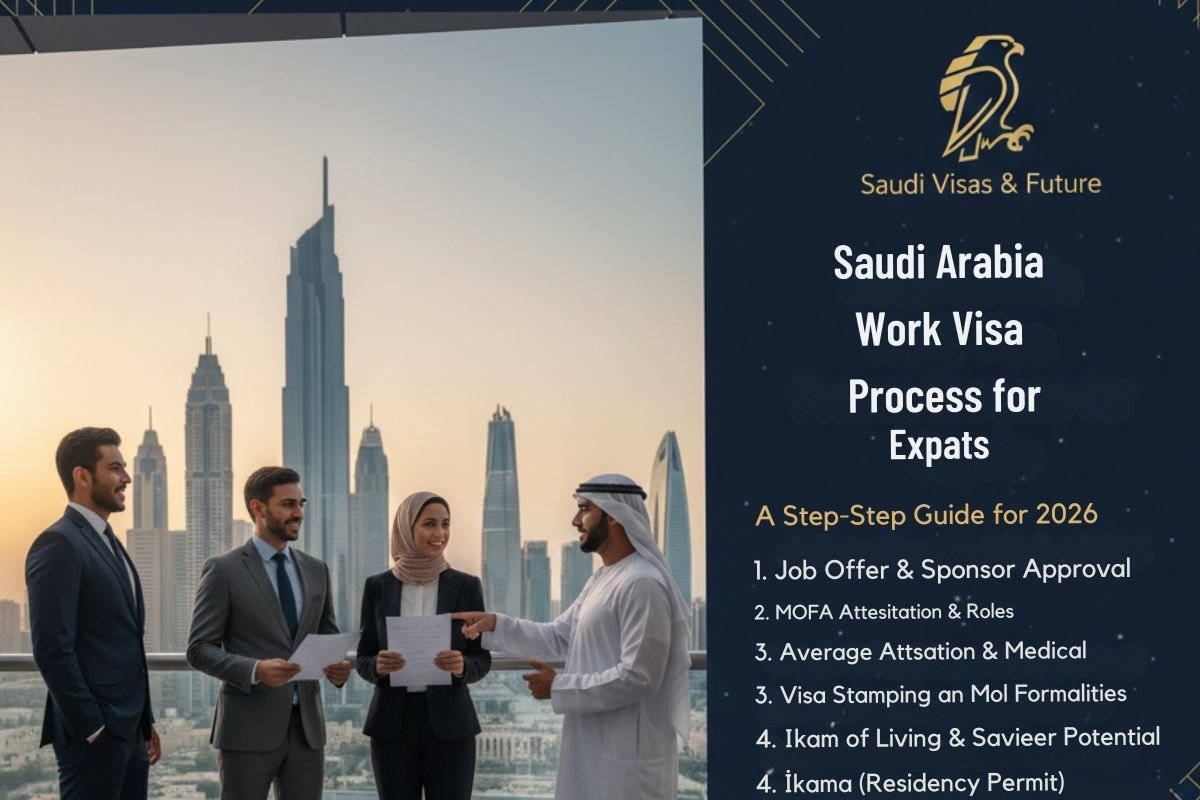
Saudi Arabia Work Visa Process for Expats: A Complete 2026 Guide

Saudi Arabia Work Visa Process for Expats

Securing a work visa for Saudi Arabia is the essential first step for expatriates aiming to build a career in the Kingdom. As Saudi Arabia accelerates its Vision 2030 transformation, opportunities for skilled professionals are expanding rapidly across sectors like construction, technology, healthcare, and tourism. However, navigating the visa process can seem complex.

This comprehensive guide breaks down the Saudi Arabia work visa process for expats in 2026, providing clear, step-by-step instructions, outlining the latest requirements, and offering expert tips to ensure a smooth application journey.

Understanding the Saudi Work Visa Landscape

The Saudi work visa, officially known as the Work Visit Visa (or Employment Visa), is your legal gateway to employment. It is tied to a specific employer and position. The process is highly systematic and relies heavily on the sponsoring employer, known as the “Kafeel.”

Key Players in the Process:

  1. The Expat Employee: You, the applicant.
  2. The Saudi Employer (Kafeel): Your sponsor, who must be a licensed entity in Saudi Arabia.
  3. The Ministry of Human Resources and Social Development (MHRSD): Issues work permits and labor approvals.
  4. The Ministry of Foreign Affairs (MoFA): Oversees visa issuance.
  5. The Saudi Embassy/Consulate: Where you submit your final application.

Step-by-Step: The Saudi Work Visa Process for Expats (2026)

The journey begins with your employer in Saudi Arabia and ends with a visa stamp in your passport. Here is the detailed flow:

Phase 1: Employer-Side Preparation (Initiated by Your Kafeel)

Step 1: Job Offer & Contract
You receive a formal, signed job offer from a Saudi company. Ensure the contract details are clear: position, salary, benefits, working hours, and contract duration.

Step 2: Labor Approval (Work Permit)

  • Your employer applies online through the MHRSD’s Qiwa platform.
  • They must demonstrate a genuine need for your role (proving no qualified Saudi candidate is available for the position, per Saudization rules).
  • Upon approval, the MHRSD issues a Work Permit (also called a Block Visa or Mission Number). This is pre-approval from the labor authorities.

Step 3: Visa Authorization

  • Your employer submits the Work Permit to the Ministry of Foreign Affairs (MoFA) for visa authorization.
  • Once approved, MoFA issues a Visa Authorization Number. This number is critical for the next phase.

Phase 2: Expat Application & Documentation

At this stage, your employer sends you the Visa Authorization Number and a copy of the company’s commercial registration (CR). You can now begin your part of the process.

Step 4: Gather Required Documents
You will need to prepare a precise set of documents, typically including:

  • Passport: Original passport, valid for at least six months beyond your application date, with at least two blank visa pages.
  • Visa Application Form: Completed online via the MoFA’s Enjaz platform or the KSA Visa Portal. Your employer usually provides the login details linked to the authorization number.
  • Photographs: Recent professional, passport-sized photos on a white background.
  • Employment Contract: Signed by you and your employer, attested by the Saudi Chamber of Commerce and the Ministry of Foreign Affairs.
  • Educational & Professional Certificates:
    • All academic degrees and professional qualifications (e.g., engineering licenses, nursing certificates).
    • These documents require legalization: attested by your country’s Foreign Ministry, the Saudi Embassy/Consulate in your home country, and finally by the Ministry of Foreign Affairs in Saudi Arabia upon arrival.
  • Police Clearance Certificate: A criminal record check from your home country (and sometimes from any country you’ve lived in for the past 5 years), attested similarly to your degrees.
  • Medical Reports: A comprehensive medical check-up from an approved medical center, confirming you are free from contagious diseases (like HIV/AIDS, Tuberculosis, Hepatitis B & C). This is often done after a visa is issued but before travel in some home countries.

Phase 3: Submission, Stamping, and Entry

Step 5: Submit to the Saudi Embassy/Consulate
Submit all your attested documents, passport, and application forms to the designated Saudi diplomatic mission (Embassy or Consulate) in your country of residence. You will pay the visa fee at this stage.

Step 6: Visa Stamping
The embassy processes your application, conducts any necessary verifications, and stamps the work visa in your passport. Processing times vary but average 1-4 weeks.

Step 7: Travel to Saudi Arabia
Once your visa is stamped, you are cleared to travel. Your visa is typically valid for entry for 90 days from the date of issue.

Phase 4: Post-Arrival Formalities in Saudi Arabia

Your visa process is not complete upon landing. You have crucial steps to finalize within your first weeks.

Step 8: Medical Check in Saudi Arabia
Within 10 days of arrival, you must undergo another medical test at an accredited health center in Saudi Arabia (this often includes fingerprinting and biometrics).

Step 9: Fingerprinting & Biometrics
You will visit the Passport Office (Jawazat) or a designated center to provide fingerprints and biometric data for your residence permit.

Step 10: Issuance of Iqama (Residence Permit)
After passing the local medical and biometrics, your employer applies for your Iqama. This is your national ID card in Saudi Arabia, proving your legal residency and right to work. It includes your Unified Number and must be carried at all times.

Step 11: Getting Your Work Permit Card
The final step is the physical Work Permit Card, issued by MHRSD, which you should keep with your Iqama.

Key Changes and Trends for 2026

  • Digitalization & Qiwa Platform: The entire process is increasingly paperless and managed through the Qiwa and Absher platforms. Expats must activate their Absher accounts (with employer sponsorship) to manage services.
  • Premium Residency (Privileged Iqama): For high-net-worth individuals and investors, Saudi Arabia now offers a Premium Residency scheme, which provides greater flexibility and independence from a specific employer/sponsor.
  • Family Visa Regulations: Rules for sponsoring dependents (spouse and children) are becoming more streamlined, often linked to your profession and salary threshold (usually a minimum monthly salary of SAR 3,500-5,000).

Common Challenges & How to Avoid Them

  1. Document Attestation Delays: Start the attestation process for your degrees and police clearance immediately upon receiving your job offer. It is the most time-consuming step.
  2. Medical Test Failures: Ensure you are in good health and aware of the medical requirements. A positive test for a prohibited disease will result in immediate deportation.
  3. Miscommunication with Employer: Maintain clear, regular communication with your HR or PRO (Public Relations Officer) in Saudi Arabia. They are your guide.
  4. Using the Wrong Visa Type: Ensure your employer applies for the correct Work Visit/Employment Visa, not a Tourist or Business Visa.

Conclusion

The Saudi work visa process for expats is a structured, employer-driven procedure that demands accuracy and patience. While it involves multiple steps across different ministries, understanding the flow—from the Qiwa platform labor approval to the final Iqama issuance—empowers you as an applicant.

Success lies in partnering with a reputable employer, meticulously preparing and attesting your documents, and staying informed about the latest digital procedures. As Saudi Arabia continues to open its doors to global talent under Vision 2030, a smooth visa process is your first step toward a rewarding career in one of the world’s most dynamic economies.

5 Frequently Asked Questions (FAQs)

1. Can I apply for a Saudi work visa without a job offer?

No. It is impossible. A Saudi work visa is 100% employer-sponsored. You must have a signed employment contract with a licensed Saudi company (your Kafeel or sponsor) to begin the process. They initiate and manage the majority of the application.

2. How long does the entire Saudi work visa process take?

From job offer to receiving your Iqama, the process typically takes 2 to 4 months. The timeline varies based on document attestation speed in your home country, embassy processing times, and your employer’s efficiency. The post-arrival steps to get the Iqama take about 3-4 weeks.

3. What is the difference between the Visa, Iqama, and Work Permit?

Work Visa: The sticker in your passport allowing you to enter Saudi Arabia for employment.
Iqama: Your residency identity card issued after you arrive, proving your legal status to live and work.
Work Permit: The official authorization from the MHRSD that allows you to perform a specific job for your sponsor.

4. Can I change jobs in Saudi Arabia on a work visa?

Yes, but the process (called transfer of sponsorship) has specific rules. You generally need your current employer’s consent (a No Objection Certificate or NOC), or you must complete a certain period of service (often one year) to transfer without consent under newer labor reforms. The new employer must initiate a new visa process.

5. Can my family join me in Saudi Arabia?

Yes, expats meeting a minimum salary requirement (usually SAR 3,500-5,000 per month, depending on the employer’s policy) can sponsor their spouse and children. You apply for family visit visas initially, which are then converted to dependent residency (Iqama) after they arrive and complete medicals.

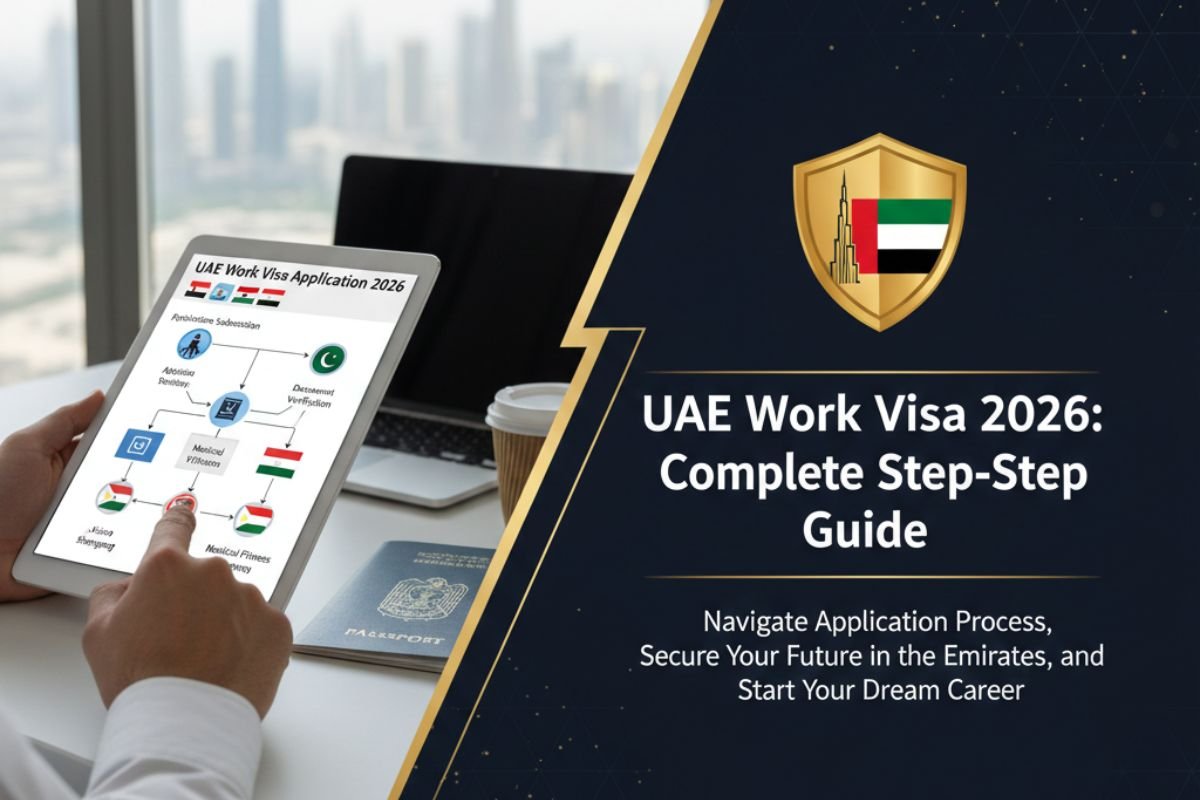
UAE Work Visa 2026: Complete Step-by-Step Guide

UAE Work Visa Guide 2026: Steps & Requirements

Introduction:

The United Arab Emirates has consistently ranked among the world’s most attractive destinations for expatriate professionals. With its tax-free salaries, world-class infrastructure, safety, and diverse cultural landscape, the UAE offers unparalleled opportunities for career growth and personal development. As we approach 2026, the country’s focus on economic diversification—particularly in technology, renewable energy, healthcare, and finance—means more opportunities than ever for skilled workers.

Understanding the Gulf visa process is your first step toward building a successful career in this dynamic region. This guide will walk you through each phase of obtaining a UAE work visa in 2026.
Navigating the UAE work visa process can be a complex journey, but with the right information, it becomes a clear and achievable path. As 2026 approaches, the United Arab Emirates continues to refine its immigration system, making it more streamlined for skilled professionals worldwide. This comprehensive guide provides everything you need to know about securing your UAE work visa, ensuring you’re prepared for the Gulf visa process in 2026.

Part 1: Understanding UAE Visa Types (2026 Updates)

Before diving into the application process, it’s crucial to understand which visa category applies to your situation:

1. Standard Employment Visa

The most common route for professionals with a confirmed job offer from a UAE-based employer. This visa is typically valid for two years and renewable.

2. Green Visa (Long-Term Residence)

Introduced as part of the UAE’s 2021 reforms and enhanced for 2026, this five-year visa offers greater flexibility for skilled professionals, freelancers, and investors—without requiring employer sponsorship.

3. Freelance/Remote Work Visa

Perfect for digital nomads and independent contractors, this one-year renewable visa allows you to live in the UAE while working for clients outside the country.

4. Golden Visa

A long-term (5-10 year) residency visa for exceptional talents, researchers, professionals with highly sought-after skills, and outstanding students.

5. Mission Visa

Short-term work permit for specific projects or assignments lasting less than six months.

Part 2: Step-by-Step UAE Work Visa Process for 2026

Step 1: Secure a Job Offer

Your visa journey begins with a confirmed employment contract from a UAE employer. Ensure your offer includes:

  • Detailed job description and responsibilities
  • Salary and benefits (including health insurance)
  • Contract duration
  • Terms of employment termination

2026 Update: The UAE has implemented stricter regulations to ensure employment contracts are transparent and fair. All contracts must now be registered through the Ministry of Human Resources and Emiratisation (MOHRE) digital system.

Step 2: Entry Permit Application

Your employer applies for your Entry Permit through:

  • The MOHRE for mainland companies
  • The relevant free zone authority for free zone companies
  • The Federal Authority for Identity, Citizenship, Customs & Port Security (ICP) for government sectors

Processing Time: 5-7 working days
Validity: 60 days from issuance

Step 3: Travel to the UAE

Once you receive your Entry Permit, you can travel to the UAE. You must enter the country within 60 days of permit issuance.

Step 4: Medical Fitness Test

Within 30 days of arrival, you must complete:

  • Blood test for HIV/AIDS, Hepatitis B, Hepatitis C, Tuberculosis, Syphilis, and Malaria
  • Chest X-ray for tuberculosis screening

2026 Update: Additional vaccination requirements may apply depending on your country of origin and current global health guidelines.

Step 5: Emirates ID Application

The Emirates ID serves as your official identification in the UAE. Application involves:

  • Visiting an authorized typing center with required documents
  • Biometric data collection (photograph, fingerprints, signature)
  • Paying applicable fees (approximately AED 170-370 depending on validity period)

Processing Time: 7-10 working days

Step 6: Residence Visa Stamping

Your employer submits your passport to the immigration department for residence visa stamping, which includes:

  • Entry Permit
  • Medical fitness test results
  • Passport copies
  • Photographs
  • Emirates ID application receipt
  • Proof of health insurance

Processing Time: 5-10 working days

Step 7: Labor Card Registration

Your employer registers you with MOHRE or the relevant free zone authority, formalizing your employment status.

Step 8: Open a Bank Account

With your residence visa and Emirates ID, you can open a local bank account—essential for receiving your salary and managing finances.

Part 3: Required Documents for UAE Work Visa 2026

For Employees:

  • Passport with minimum 6 months validity
  • Passport-size photographs with white background
  • Entry Permit copy
  • Attested educational certificates (degree/diploma)
  • Employment contract signed by both parties
  • Medical fitness test certificate
  • Previous visa copies (if applicable)

For Employers:

  • Company trade license copy
  • Establishment card
  • Ministry of Labor quota approval
  • Insurance policy for employee

2026 Document Update: The UAE is moving toward complete digitalization of document submission and verification. Expect increased use of blockchain technology for certificate attestation and verification.

Part 4: Cost Breakdown for UAE Work Visa 2026

While costs may vary slightly between emirates and free zones, approximate fees include:

  • Entry Permit: AED 300-500
  • Medical Test: AED 350-500
  • Emirates ID: AED 170-370
  • Residence Visa Stamping: AED 500-700
  • Labor Card: AED 150-300
  • Health Insurance: Varies by plan (employer typically covers)

Total Estimated Cost: AED 1,500-2,500 (usually borne by employer)

Part 5: Important Changes for 2026

  1. Enhanced Digital Processing: The UAE aims for 100% digital visa processing through the ICP and MOHRE smart applications.
  2. Sustainability Criteria: Certain sectors may require proof of sustainability training or certifications as part of the UAE’s Net Zero 2050 strategic initiative.
  3. AI-Powered Application Review: Artificial intelligence systems will assist in preliminary document verification and application assessment.
  4. Blockchain Verification: Educational and professional certificates will be verified through blockchain networks, reducing attestation times.
  5. Flexible Visa Transfers: Simplified procedures for changing employers without leaving the country.

Part 6: Common Challenges and Solutions

Challenge 1: Document Attestation Delays

Solution: Begin the attestation process early. Many countries now offer expedited services through their UAE embassies.

Challenge 2: Medical Test Failures

Solution: Undergo preliminary health screenings in your home country before applying. Conditions like tuberculosis will result in visa denial and potential deportation.

Challenge 3: Employer Delays

Solution: Maintain clear communication with your employer and request regular updates. Familiarize yourself with MOHRE regulations to understand processing timelines.

Challenge 4: Changing Jobs

Solution: Understand the conditions of your visa. Standard employment visas typically require six months with your initial employer before transferring. Green Visa holders have more flexibility.

Part 7: Tips for a Smooth Gulf Visa Process

  1. Start Early: Begin document preparation 3-4 months before your intended start date.
  2. Use Official Channels: Always verify information through official government websites (ICP, MOHRE) rather than third-party sources.
  3. Maintain Copies: Keep digital and physical copies of all documents throughout the process.
  4. Understand Your Rights: Familiarize yourself with UAE labor laws to ensure fair treatment.
  5. Plan Your Arrival: Consider arriving during weekdays to begin procedures immediately rather than waiting through weekend closures.

Conclusion: Your Pathway to UAE Success

The UAE work visa process for 2026 reflects the country’s commitment to attracting global talent while maintaining efficient, transparent systems. While the Gulf visa process involves multiple steps, careful preparation and understanding of requirements will ensure a smooth transition to your new career in the Emirates.

As regulations continue to evolve, staying informed through official channels is crucial. The UAE’s forward-thinking approach to residency and employment makes it an increasingly attractive destination for professionals seeking growth, stability, and opportunity in one of the world’s most dynamic regions.

Begin your journey today by researching employers in your field, preparing your documents, and familiarizing yourself with the rich cultural tapestry that awaits in the United Arab Emirates.

Frequently Asked Questions (FAQs)

1. How long does the entire UAE work visa process take in 2026?

The complete process typically takes 2-3 weeks for most applicants once all documents are submitted. However, when including document preparation (especially attestation) and potential variables, allow 6-8 weeks from job offer to visa issuance. The 2026 digital enhancements are expected to reduce processing times further.

2. Can I bring my family on a UAE work visa?

Yes, most employment visas allow you to sponsor family members (spouse and children under 18). Requirements include a minimum salary threshold (typically AED 3,000-4,000 depending on emirate), suitable accommodation, and additional documentation like marriage and birth certificates. The 2026 updates have streamlined family sponsorship for Green Visa holders, with more flexible requirements.

3. What happens if I lose my job while on a UAE work visa?

Standard employment visa holders have a 30-90 day grace period (depending on visa category) to either find new employment, change their visa status, or leave the country. Green Visa holders have a longer 180-day grace period. It’s crucial to adhere to these timelines to avoid penalties or bans.

4. Are there any professions restricted for expatriates in the UAE?

While most sectors are open to expatriates, certain government and security-related positions are reserved for UAE nationals. Some professions require specific licensing or qualifications recognized by UAE authorities. Always verify with your potential employer and check MOHRE guidelines for your specific field.

5. How does the UAE work visa process differ between Dubai/Abu Dhabi and other emirates?

The fundamental process is consistent across the UAE through the Federal Authority (ICP). However, free zones (like DIFC in Dubai or ADGM in Abu Dhabi) have their own streamlined procedures. Mainland companies follow MOHRE regulations uniformly, while free zone companies process through their respective authority. Requirements and processing times are largely standardized nationwide as of 2026.


Post a Job Opening

Fill in the details below. Your job posting will be reviewed by our team.

Basic Information

Specify years of experience required

Location & Salary

Qualifications & Skills

Specify educational requirements
Separate skills with commas

Company Details

Job Details

Contact Information