Gulf Careers Hub

ATS-Proof CV for Gulf Employers 2026: Beat UAE & Saudi AI Screening Systems

ATS-Proof CV for Gulf 2026: Beat UAE & Saudi AI Screening

Landing your dream job in Dubai, Riyadh, or Abu Dhabi isn’t just about qualifications anymore—it’s about getting past the robots first. If your CV isn’t optimized for Applicant Tracking Systems (ATS), you’re invisible to Gulf employers in 2026.

Here’s the reality: UAE and Saudi companies now deploy sophisticated AI screening tools that reject 75% of applications before a human ever sees them. But don’t panic. I’ve spent months analyzing how these systems work, and I’m sharing everything you need to know to get your resume into human hands.

Why Gulf Employers Went All-In on AI Screening

The hiring landscape transformed dramatically after 2023. With Vision 2030 driving massive recruitment across Saudi Arabia and the UAE’s continued economic diversification, companies faced an avalanche of applications. A single role at a major Dubai bank or Riyadh tech firm now attracts 500+ candidates.

The numbers tell the story:

  • Emirates NBD processes 40,000+ CVs monthly through AI filters
  • Saudi Aramco’s screening system handles 200,000 applications quarterly
  • 89% of GCC companies now use automated first-round filtering

These aren’t basic keyword matchers anymore. The 2026 generation of Gulf ATS systems use machine learning to assess cultural fit, predict retention rates, and even evaluate communication style through natural language processing.

Understanding the 2026 Gulf ATS Landscape

The Big Three Systems Dominating the Region

1. SAP SuccessFactors (UAE Preference) Used by 60% of Dubai and Abu Dhabi employers. This system heavily weights “skills taxonomy” matching—meaning it cross-references your stated skills against official government competency frameworks like the UAE’s NQF (National Qualifications Framework).

2. Oracle Taleo (Saudi Market Leader) Preferred by Saudi Vision 2030 employers. Taleo 2026 now includes “Saudization compliance scoring”—automatically flagging applications that help meet nationalization quotas. It also scans for Arabic language proficiency indicators even in English CVs.

3. Custom AI Solutions (High-Growth Sectors) Fintech and tech startups use bespoke systems trained on successful Gulf hires. These are the trickiest—they learn from rejection patterns and evolve monthly.

What Changed in 2026?

Last year’s updates introduced game-changing features:

  • Cultural alignment scoring: AI now detects values alignment with Gulf workplace culture
  • Video CV parsing: Some Saudi employers request 60-second video introductions analyzed by emotion-recognition AI
  • Blockchain verification: Dubai government roles now auto-verify credentials against educational blockchains
  • Retention prediction: Systems score your likelihood of staying 2+ years based on career trajectory patterns

The Anatomy of an ATS-Proof Gulf CV

1. The Header: Keep It Machine-Readable

What works:

plain

Copy

AHMED AL-RASHID
Senior Project Manager | PMP Certified | 7 Years GCC Experience
Dubai, UAE | +971 50 123 4567 | ahmed.rashid@email.com
LinkedIn: linkedin.com/in/ahmedrashid | Portfolio: arashid-portfolio.com

What kills your application:

  • Headers with graphics or tables
  • Photos (unless specifically requested—still rare in ATS-optimized applications)
  • Multiple phone numbers or addresses
  • Fancy fonts or colored text

Gulf-specific tip: Include your visa status if you have existing UAE or Saudi residency. The AI flags “ready to work” candidates higher. Write: “UAE Resident Visa | Valid until 2027” or “Transferable Iqama | Saudi Arabia.”

2. Professional Summary: Keyword Density Matters

Your opening paragraph must hit density targets without sounding robotic. Aim for 3-5 role-specific keywords in 3-4 lines.

Weak example:“Dynamic professional seeking challenging opportunities to leverage my skills in a growth-oriented environment.”

ATS-optimized for a Dubai Finance role:“Finance Director with 8 years leading treasury operations for UAE-based multinationals. Expertise in IFRS 17 compliance, Islamic banking structures, and VAT optimization across GCC markets. Delivered $12M cost reductions through process automation and cross-border cash flow management.”

Notice the specificity? “IFRS 17,” “Islamic banking,” “GCC markets”—these are taxonomy terms the system is hunting for.

3. Skills Section: Mirror the Job Description

Here’s a secret: Gulf ATS systems use “skills inference” algorithms. If you list “stakeholder management,” the AI assumes you also have “communication” and “leadership”—but only if those secondary terms appear elsewhere in your CV.

The 2026 Gulf skills hierarchy:

Tier 1 (Must-have exact matches):

  • Technical certifications (PMP, CMA, CPA, Six Sigma)
  • Software proficiencies (SAP, Oracle, Salesforce specific versions)
  • Regulatory knowledge (UAE Central Bank regulations, SAMA guidelines, SCA compliance)
  • Language skills (Arabic proficiency levels, business English scores)

Tier 2 (Contextual synonyms):

  • “Budget management” ↔ “Financial planning” ↔ “P&L ownership”
  • “Team leadership” ↔ “People management” ↔ “Cross-functional coordination”

Pro move: Create a “Skills” section with 8-12 bullet points pulled directly from the job posting, then weave the same terms naturally into your experience bullets.

4. Work Experience: The STAR Method with Data

Gulf employers love quantified achievements. The ATS rewards them too—numbers break up text patterns and signal “results-oriented” candidate status.

Structure every bullet:[Action verb] + [Specific task] + [Quantified result] + [Gulf context]

Example for Saudi Construction role:“Directed $45M residential development project in Riyadh, delivering 3 months early through Saudi Building Code compliance optimization and local contractor relationship management, achieving 15% under budget.”

Keyword integration: “Saudi Building Code,” “Riyadh,” “local contractor”—all trigger geographic and regulatory relevance scores.

5. Education & Certifications: Verification-Ready

Dubai and Riyadh employers now auto-verify credentials. List degrees exactly as they appear on official documents:

Correct:Bachelor of Science in Computer EngineeringAmerican University of Sharjah, UAE | 2018MOHESR Accredited

Fatal errors:

  • Abbreviated degree names (“BS Comp Eng”)
  • Unaccredited institutions (check UAE’s CAA or Saudi’s NCAAA lists)
  • Missing graduation years (ATS flags career gaps)

2026 update: Add “Credential ID” numbers for professional certifications. PMP, CMA, and Saudi Commission for Health Specialties certificates now include blockchain verification codes—include them.

Formatting Rules That Determine Survival

File Format: PDF vs. DOCX

The debate is settled for 2026:

  • Apply with PDF unless the system specifically requests .docx
  • Use “PDF/A” format for government applications (Dubai Government, Saudi ministries)
  • Ensure your PDF is “text-searchable”—scanned image PDFs get rejected instantly

Font & Layout Specifications

Safe choices:

  • Arial, Calibri, or Times New Roman (size 10-12)
  • Single-column layout (tables and columns confuse parsing algorithms)
  • 0.75-1 inch margins
  • Clear section headers in ALL CAPS or Bold

Death traps:

  • Text boxes, headers/footers, or page breaks in the middle of sections
  • Graphics for skill bars or star ratings
  • Columns that split your employment history
  • Creative designs with background colors

Length: The 2-Page Sweet Spot

Gulf ATS systems penalize 1-page CVs as “insufficient detail” and 3+ page documents as “unfocused.” Two pages is the algorithmic preference for mid-to-senior roles. Entry-level candidates: stick to one comprehensive page.

The Gulf-Specific Optimization Checklist

Before hitting “apply,” verify these 2026 requirements:

✓ Arabic language indication Even if the role is English-based, include “Arabic: Professional Working Proficiency” or “Native” if applicable. The AI scores bilingual candidates higher for client-facing roles.

✓ GCC experience flags Explicitly mention “UAE experience,” “Saudi market knowledge,” or “GCC regional exposure.” The system prioritizes candidates familiar with local business culture.

✓ Visa/Status clarity Uncertainty about work authorization triggers automatic filtering. Be explicit: “Spouse visa,” “Employment visa transferable,” or “Citizen.”

✓ Sector alignment keywords Research the employer’s industry taxonomy. Dubai International Financial Centre roles need “DIFC,” “financial services,” and “regulatory compliance.” Saudi industrial roles need “SABIC,” “NEOM,” or “Vision 2030” references where relevant.

✓ Soft skills with evidence “Adaptability” and “cultural awareness” are high-value Gulf ATS terms—but only if supported by examples. “Managed diverse teams of 12 nationalities” proves cultural awareness; simply listing it does not.

Testing Your CV Before Submission

Don’t trust your instincts—verify algorithmic compatibility:

  1. Copy-paste test: Copy your CV into plain text. If it looks garbled, the ATS will struggle too.
  2. Keyword density check: Use free tools like Jobscan or SkillSyncer to match your CV against the job description. Aim for 80%+ match rate for Gulf applications.
  3. The 6-second scan: Have a friend glance at your CV for 6 seconds. What did they catch? That’s what the AI’s “first impression” algorithm registers.
  4. Saudi-specific: Saudization calculator If applying to Saudi roles, research the company’s current Saudization percentage (Nitaqat program). If they’re in the “red” or “low-green” zones, emphasize any Saudi training, education, or language skills—the AI weights these heavily.

The Human Element: Getting Past the AI to the Interview

Here’s what most guides miss: Gulf ATS systems now generate “interview priority scores” that rank candidates 1-100. Scores above 85 get same-day recruiter calls. Scores 70-85 enter the “review queue.” Below 70? Digital purgatory.

Boost your score with these 2026 tactics:

  • Apply Tuesday-Thursday, 8-10 AM Gulf Time: Algorithms refresh candidate pools mid-week. Weekend applications get buried.
  • Use the company’s career portal, not LinkedIn Easy Apply: Direct applications score 5-10 points higher for engagement metrics.
  • Follow up with a connection: If you score 75+ and have a LinkedIn connection at the company, ask them to “refer” you in the internal system. This bumps you to “high priority” regardless of initial score.

Final Thoughts: The Balance of Optimization and Authenticity

Yes, gaming the system matters. But Gulf employers are catching on to “keyword stuffing.” The 2026 algorithms include “authenticity scoring” that penalizes unnatural repetition.

The golden rule: Write for humans first, then verify machine compatibility. If a recruiter would roll their eyes at your keyword density, the AI’s “natural language” filter will too.

Your CV should scream “I understand Gulf business culture” while whispering “I’m technically perfect for this role.” Master that balance, and you’ll hear back from Dubai and Riyadh employers within days, not months.
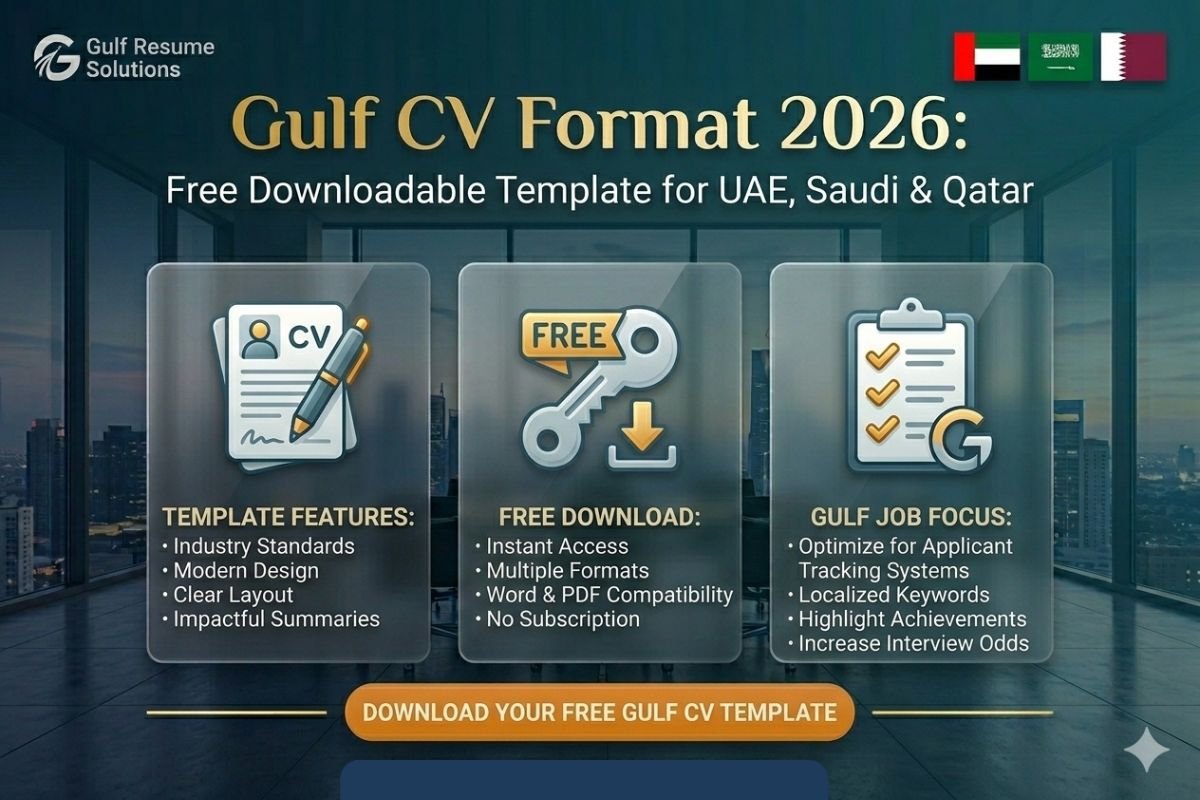
Gulf CV Format 2026: Free Downloadable Template for UAE, Saudi & Qatar

Gulf CV Format 2026: Free Template for UAE, Saudi & Qatar Jobs

If you’re targeting a job in the Gulf region in 2026—whether in Dubai’s fast-paced private sector, Riyadh’s Vision 2030-driven projects, or Doha’s growing economy—here’s a truth you need to know: a generic CV won’t work. The Gulf job market has its own rules, expectations, and cultural nuances. Recruiters in the UAE, Saudi Arabia, and Qatar spend just seconds scanning each application, and most large companies use Applicant Tracking Systems (ATS) to filter candidates automatically .

Why the Gulf CV Format Is Different in 2026

The Gulf job market is unique. Employers here look for a blend of international expertise and local market understanding. Your CV must answer specific unspoken questions:

  • Are you serious about relocating and staying long-term?
  • Do you understand the professional culture (hierarchy, formality, relationship-building)?
  • Can you thrive in a multicultural workplace?
  • Is your experience relevant to this region? 

In 2026, with competition fiercer than ever, a tailored Gulf CV format is your non-negotiable first step.

The Essential Sections of a Gulf CV (With Examples)

Follow this section order exactly. It’s designed to satisfy both ATS software and human recruiters scanning for key information.

1. Personal Details & Professional Photo

This section must be crystal clear. Include:

  • Full Name: As it appears on your passport.
  • Professional Title: Right below your name (e.g., “Chartered Accountant | Financial Controller”).
  • Contact Information: Phone with country code (+971 for UAE, +966 for KSA, +974 for Qatar), professional email, current city of residence.
  • LinkedIn Profile URL: Ensure it’s updated and matches your CV.
  • Nationality & Visa Status: This is standard in the Gulf. State your nationality clearly. If you’re already in the region, specify your current visa status (e.g., “UAE Employment Visa – Transferable,” “Visit Visa,” “Transferable Iqama”). If outside, write “Requiring Employment Visa Sponsorship” .
  • Professional Photo: A must for most private sector roles. Use a high-quality, passport-style headshot with a plain background, formal business attire, and a neutral expression .

2. Professional Summary (Your 30-Second Pitch)

This 3-4 line summary is the most-read part of your CV. Replace the outdated “Objective” with a powerful summary that answers: Who are you? What do you offer? What’s your goal?

Formula: [Your Title] with [X] years of experience in [Industry/Key Skill] specializing in [Specific Expertise]. Proven track record of [Key Achievement with Metric]. Seeking a [Target Role] position in [Specific Gulf Country].

Example: “Results-driven Marketing Director with 10+ years of experience in the FMCG sector, specializing in digital transformation and launching brands in the Saudi market. Increased market share by 22% for a leading beverage brand. Seeking a senior leadership role within a dynamic consumer goods company in Riyadh.” 

3. Core Competencies / Key Skills (The ATS Keyword Zone)

This bullet-point list is prime real estate for keywords. Create two sub-sections:

  • Technical/Hard Skills: Software, tools, methodologies, certifications.
  • Professional/Soft Skills: Leadership, client relations, cross-cultural communication.

Pro Tip: Tailor this list for every application using keywords mined directly from the job description. This significantly boosts your ATS score .

4. Professional Experience (The STAR Method for the Gulf)

List in reverse chronological order (most recent first). For each role, include:

  • Job Title, Company Name, City/Country, Dates (Month/Year)
  • One-line company description (if not well-known)
  • Achievement-oriented bullet points using the STAR Method (Situation, Task, Action, Result), focusing on Action and Result. Start with powerful action verbs (Led, Engineered, Optimized, Increased).

Weak: “Responsible for social media accounts.”
Strong: “Grew the company’s Instagram following in the UAE by 40,000+ followers (150% increase) in 12 months through localized Arabic content and influencer partnerships, directly generating 350 qualified leads.” 

Quantify Everything: Use numbers, percentages, and monetary values. Gulf employers in construction, sales, and finance are driven by metrics .

5. Education

  • List your highest degree first.
  • Include: Degree Name, Major, University Name, Location, Graduation Year.
  • Include GPA only if impressive (3.5/4.0 or higher).
  • For fresh graduates, this section can be placed above Professional Experience .

6. Certifications & Training (Highly Valued)

The Gulf market places strong emphasis on professional certifications. List any relevant ones (PMP, CFA, ACCA, CIPD, SHRM, Google/Meta certifications, etc.) .

7. Languages

Be honest about proficiency levels: Native, Fluent, Professional Working Proficiency, Intermediate, Basic.

  • Priority Order: Arabic (any dialect) is a massive advantage, even at basic conversational level. Then English. Then other languages .

Cultural Nuances for Each Gulf Country

🇦🇪 United Arab Emirates (UAE)

  • Highlight experience in fast-paced, multicultural environments.
  • Mention any specific emirate experience (Dubai, Abu Dhabi) if relevant.
  • Private sector values agility and international exposure .

🇸🇦 Saudi Arabia (KSA)

  • Emphasize experience with Saudi Vision 2030 projects or sectors (giga-projects, tourism, renewable energy).
  • Understanding of local business culture and hierarchy is key.
  • For senior roles, mention familiarity with Saudi government portals (Qiwa, MISA, ZATCA) .

🇶🇦 Qatar

  • Post-2022 World Cup, experience in sustainability, major event management, or infrastructure is valuable.
  • Formality and respect for hierarchy are appreciated .

The 2026 ATS Survival Guide: Making Your CV Machine-Readable

Most large companies and recruitment agencies in the Gulf use Applicant Tracking Systems (ATS) to screen CVs before a human sees them. If your CV isn’t ATS-friendly, it may be rejected automatically—even if you’re qualified .

ATS-Friendly Rules:

  • Use Standard Section Headings: “Work Experience,” “Education,” “Skills.” Avoid creative labels.
  • Avoid Graphics, Tables, or Columns: They scramble ATS parsing. Stick to a simple, single-column layout.
  • Incorporate Keywords Naturally: Use keywords from the job description in your summary, skills, and experience bullets.
  • Save as DOCX for ATS: DOCX (Word) is the safest format for ATS. Simple, text-based PDFs are acceptable but not ideal. Avoid scanned or image-based CVs completely .
  • Use Standard Fonts: Arial, Calibri, Times New Roman (size 10.5–11.5).
  • Keep It Concise: Freshers: 1 page. Mid-level: 1–2 pages. Senior: 2 pages maximum .

What NOT to Include in an ATS-Friendly CV:

  • Photos (ATS ignores them; they can reduce readability)
  • Age or date of birth
  • Marital status
  • Fancy designs or colored text 

Free Gulf CV Format 2026 Template (Copy This Structure)

Common Mistakes That Reject Gulf CVs

 Using a generic, one-size-fits-all CV – The most common and fatal error .
 Spelling or grammar errors – Indicates lack of attention to detail .
 Exceeding 2 pages (unless C-suite with 20+ years) .
 Unexplained employment gaps – Be prepared to address these briefly .
 Including irrelevant personal information (age, marital status, religion) unless requested .
 Poor photo quality or casual attire .
 Unprofessional email address (e.g., “superstar99@email.com”) .

Frequently Asked Questions (FAQs)

1. Is a photo really mandatory on a Gulf CV?

For the private sector in the UAE, Saudi Arabia, Qatar, and Kuwait, yes, it is strongly expected and considered standard practice. It helps with identification and is a cultural norm. For applications in international free zones or certain multinationals, it may be slightly less critical, but including one is still the safer approach. Omit it only if the job posting explicitly says not to include one.

2. How should I list my visa status?

Be clear and concise. If you are outside the Gulf, state: “Requiring Employment Visa Sponsorship.” If you are inside the Gulf, state your current status: e.g., “Transferable Iqama (KSA),” “Employment Visa (UAE) – Transferable,” “Visit Visa – Immediate Joiner.” This is crucial information for recruiters to assess the hiring process .

3. Should I write my CV in Arabic or English?

English is the primary language of business for most multinational and large regional companies. Always submit your main CV in English. However, if you are fluent in Arabic, it is a powerful advantage—note your proficiency under “Languages.” For some government or fully local Arabic-speaking companies, you may be asked for an Arabic version separately .

4. What’s the biggest difference between a Gulf CV and a Western CV?

Three key differences: 1) The Photo is standard. 2) Personal details like nationality and visa status are included. 3) Tone and structure tend to be more formal, with greater emphasis on clear hierarchies (job titles, company prestige) and measurable achievements within a regional context. The Gulf CV format is also more accepting of a 2-page length for experienced professionals .

5. How do I handle short contract roles or freelance work common in the Gulf?

Group them strategically. Create a section titled “Consulting & Project Work (2023-2025)” and list key projects or clients as bullet points, highlighting skills and achievements. This shows continuous engagement without highlighting job-hopping, which is common in the project-driven Gulf market but can still raise questions if not presented clearly .

Final Pro-Tips for 2026

  • PDF is King for Human Readers: Save your final CV as YourName_CV_TargetJobTitle.pdf for email submissions. But keep a DOCX version ready for ATS portals .
  • Leverage LinkedIn: Your LinkedIn profile must be a 100% match to your CV. Get recommendations and share industry insights to build your professional brand .
  • The Cover Letter Still Matters: For mid-to-senior roles, a tailored cover letter (brief, formal, PDF) connecting your achievements to the company’s needs can make a significant difference .
  • Follow Up Professionally: If you don’t hear back in 10-14 days, a polite single-line follow-up email can help .

Conclusion: Your CV Is Your Ticket to the Gulf

In 2026, the Gulf job market is efficient and competitive. Your CV isn’t just a document—it’s your first impression, your ticket to an interview, and your personal marketing brochure. By following this Gulf CV format 2026, you’re not just listing your history—you’re strategically presenting yourself as the solution a Gulf-based company is looking for.

Download our free template, tailor it with your unique story, and start applying with confidence. Your next opportunity is waiting.

10 CV Mistakes That Get Your Application Rejected in the Gulf (And How to Fix Them)

CV Mistakes in Gulf Applications | Saudi Arabia & UAE CV Tips

The Gulf job market (UAE, Saudi Arabia, Qatar, Kuwait, Oman, Bahrain) is one of the most competitive in the world. Recruiters here spend an average of 10-15 seconds scanning a CV before deciding . In that time, specific mistakes can send your application straight to the rejection pile.

1. Sending the Same Generic CV to Every Job

The Mistake: Using one “master CV” for every application. Recruiters can spot this immediately—your CV doesn’t mention the specific skills or keywords from their job description.

Why It Gets Rejected: Gulf employers want to see that you’ve understood their specific requirements. A generic CV signals laziness or desperation .

The Fix: Create a tailored version for each application. Pull keywords directly from the job posting and weave them naturally into your professional summary and skills section.

2. Including Too Much Personal Information

The Mistake: Listing passport numbers, religion, marital status, age, or family details.

Why It Gets Rejected: This is considered unprofessional and irrelevant. It also creates potential bias issues .

The Fix: Stick to: Full name, phone number (with country code), professional email, city/country, and nationality. Visa status is acceptable and actually helpful.

3. Missing or Weak Career Summary

The Mistake: No summary at all, or vague lines like “Looking for a challenging opportunity to grow my skills.”

Why It Gets Rejected: Recruiters decide in seconds whether to keep reading. A weak opener gives them no reason to continue .

The Fix: Write 3-4 lines that state: your job title, years of experience, key industries, and what you bring. Example: “Bilingual marketing manager with 8+ years across retail and F&B in UAE and KSA. Specialized in digital campaigns and team leadership.”

4. Poor Formatting and Walls of Text

The Mistake: Long paragraphs, tiny fonts, inconsistent spacing, or overly creative designs with graphics and tables.

Why It Gets Rejected: Gulf recruiters scan, not read. Walls of text are exhausting. Fancy designs often break Applicant Tracking Systems (ATS) that many companies now use .

The Fix: Use clean, single-column layout. Professional fonts (Calibri, Arial, Roboto). Bullet points for achievements. Clear section headings. Save as PDF.

5. Listing Duties Instead of Achievements

The Mistake: “Responsible for managing a team” or “Handled customer queries.”

Why It Gets Rejected: This tells recruiters what you were supposed to do, not what you actually accomplished .

The Fix: Use numbers and results. “Managed a team of 12, increasing productivity by 25% in 6 months.” “Resolved 50+ customer queries daily with 95% satisfaction rate.”

6. Ignoring ATS Keywords

The Mistake: Using generic language that doesn’t match the job description.

Why It Gets Rejected: Many Gulf companies (especially in UAE and KSA) use Applicant Tracking Systems. If your CV lacks the keywords from the job ad, it’s filtered out before a human ever sees it .

The Fix: Study the job description. Identify 10-15 key terms (specific skills, software, certifications) and ensure they appear naturally in your CV.

7. Not Stating Visa Status or Availability

The Mistake: Leaving recruiters guessing about whether you’re locally available or need sponsorship.

Why It Gets Rejected: Gulf hiring is fast-paced. If a recruiter can’t immediately tell if you’re eligible to work, they move to the next candidate .

The Fix: Add a clear line: “Currently in Dubai on transferable visa” or “Based in UK, requires visa sponsorship” or “Available immediately.”

8. Spelling and Grammar Errors

The Mistake: Typos, inconsistent tenses, or mixing British and American English.

Why It Gets Rejected: It screams carelessness. For roles involving communication, it’s an automatic disqualifier .

The Fix: Use spell-check tools. Read your CV aloud. Ask a friend to proofread. Pay attention to “UAE” (not “uae”) and consistent spelling.

9. Outdated Phrases Like “References Available Upon Request”

The Mistake: Wasting valuable space on this line.

Why It Gets Rejected: It’s assumed references are available. Including this makes you look outdated and fills space that could showcase value .

The Fix: Remove it. Use that line for an additional achievement or certification.

10. Wrong Length (Too Long or Too Short)

The Mistake: 5+ page CVs for mid-level roles, or one page for senior executives with 15+ years.

Why It Gets Rejected: Recruiters don’t have time for novels. Too short suggests lack of substance .

The Fix: 1-2 pages is the sweet spot. Entry-level: 1 page. Experienced professionals: 2 pages. Senior executives: maximum 3 pages.

Bonus: The Correct Gulf CV Format Checklist

SectionWhat to Include
Contact InfoFull name, UAE/KSA phone, email, city, nationality, visa status
Professional Summary3-4 lines: who you are, key strengths, what you offer
Work ExperienceReverse chronological. Company, role, dates. Bullet points with achievements + numbers
SkillsTechnical + soft skills relevant to the role
EducationDegree, institution, year
LanguagesArabic/English proficiency levels
CertificationsRelevant to your field

The Bottom Line

Your CV is your first impression in the Gulf job market. In 2026, with competition fiercer than ever, these mistakes aren’t minor—they’re the difference between an interview and the rejection pile.

Take an hour today. Review your CV against this list. Be ruthless. Remove the fluff. Add the numbers. Make it recruiter-friendly.

Your next interview is one well-written CV away.

Frequently Asked Questions

1. Do I need to include a photo on my CV for Gulf jobs?

It depends. For customer-facing roles (hospitality, sales, aviation), a professional headshot can help. For most corporate and technical roles, photos are optional. If you include one, ensure it’s professional—business attire, neutral background .

ATS-Friendly CV Format for Gulf Jobs: The 2026 Blueprint for Indian Job Seekers

Gulf CV Format 2026 | ATS-Friendly Templates for Indian Job Seekers

If you’re an Indian professional targeting the Gulf job market in 2026, you’ve probably experienced this frustration: you have the right qualifications, years of experience, and genuine enthusiasm to work abroad—yet the interview calls never come. Your CV gets lost in a black hole, and you’re left wondering what went wrong.

Part 1: Why Indian CVs Fail in the Gulf Market

Before we fix your CV, let’s understand why most Indian applications never make it past the first gate.

The ATS Reality in 2026 Gulf Hiring

In 2026, ATS usage across the Gulf is no longer optional—it’s universal. Sectors like aviation, banking, healthcare, construction, technology, and government-affiliated entities in the UAE and Saudi Arabia all screen candidates through systems like Taleo, SAP SuccessFactors, and Zoho Recruit .

How ATS works:

  1. You submit your CV through a company portal or job platform
  2. The system parses your document, extracting text, dates, and section headings
  3. It scans for specific keywords from the job description
  4. Your CV receives a “match score” against the ideal candidate profile
  5. Only top-scoring CVs (typically 80/100 or above) reach human recruiters 

Here’s the brutal reality: if your CV uses columns, tables, text boxes, graphics, icons, or non-standard headings, the ATS parser will either ignore critical information or jumble it into unreadable nonsense . Your ten years of stellar experience become invisible because the system couldn’t “read” your carefully designed two-column layout.

The India-Gulf Expectation Gap

Beyond technology, there’s a cultural gap. CVs optimized for the Indian domestic market often omit details that Gulf recruiters consider mandatory .

What Works in IndiaWhat Gulf Recruiters Expect
No photo neededProfessional headshot is standard
Personal details minimalNationality, visa status, location required upfront
One-page ideal2 pages expected for experienced professionals
Creative formats acceptableClean, single-column, ATS-optimized required
Objective statement commonProfessional summary with achievements essential
Visa status rarely mentionedMust state “Immediate Joiner” or visa type clearly

The bottom line: Using your standard Indian-format CV for Gulf applications is like wearing a winter coat to a desert interview—it signals you haven’t done your homework .

Part 2: The Essential Components of a Gulf-Optimized, ATS-Friendly CV

A successful Gulf CV in 2026 has two non-negotiable qualities: ATS compatibility and Gulf cultural alignment. Here is the exact structure and content required.

1. Header with Mandatory Personal Details

Unlike Western or Indian CVs, Gulf applications require specific personal information upfront. Recruiters use these details to immediately assess your eligibility and logistics .

Your header must include:

  • Full Name: As it appears on your passport
  • Professional Headshot: High-quality, formal business attire, neutral background
  • Nationality: Indian—this is standard and expected
  • Current Location: City and country (e.g., Mumbai, India)
  • Visa Status: Crucial. Options include:
    • “Visit Visa (Valid until [date]) – Immediate Joiner”
    • “Employment Visa (Transferable)”
    • “Seeking Sponsorship – Available for UAE/Saudi relocation”
  • Contact Information: Phone with country code (+91), professional email, LinkedIn URL
  • Professional Title: Below your name, match it to your target role

Why this matters: Recruiters actively search for candidates on “Visit Visa” because they can join immediately. Hiding this information guarantees rejection .

2. Professional Summary (Not an Objective)

Your summary is the most read section of your CV. Recruiters spend 6-8 seconds scanning it—you must deliver maximum impact immediately .

The Formula:

[Job Title] with [X] years of experience in [Industry/Sector]. Proven expertise in [Key Skill 1], [Key Skill 2], and [Key Skill 3]. Successfully delivered [Notable Achievement with Metric]. Seeking [Target Role] to contribute to [Company/Region] growth.

Indian Professional Example (Finance):

“Chartered Accountant with 8+ years of experience in financial reporting, audit compliance, and ERP implementation across manufacturing and retail sectors. Managed financial close processes for AED 150M+ annual revenue portfolios. Successfully led SAP S/4HANA finance module implementation, reducing reporting turnaround by 30%. Seeking Senior Accountant role in UAE to leverage GCC-focused IFRS expertise and drive financial excellence.”

Why this works: It states your title, years, industry, specific technical skills, quantified achievement, and clear target—all within 4 lines .

3. Core Competencies / Key Skills (The ATS Keyword Bank)

This section is prime ATS real estate. It must be a clean, scannable bullet list of relevant hard skills and tools—no lengthy paragraphs .

Structure:

  • Technical Skills: [Software, tools, methodologies, certifications]
  • Industry-Specific Terms: [Terms from your niche]
  • Professional Skills: [Limited to 3-4 relevant soft skills]

Example for an Indian IT Professional targeting Dubai:

Core Competencies

  • Full Stack Development: Java, Python, React.js, Node.js
  • Cloud Platforms: AWS (Certified), Azure, Google Cloud
  • Database Management: SQL, MongoDB, Oracle
  • DevOps: Docker, Kubernetes, Jenkins, CI/CD Pipelines
  • Agile Methodologies, Scrum, JIRA
  • Bilingual: English (Fluent), Hindi (Native), Arabic (Basic)

Keyword Rule: Mine the job description. Every keyword that appears in the “requirements” section should appear somewhere in your CV—naturally .

4. Professional Experience (Achievement-Focused, Not Duty-Focused)

This is where Indian professionals often underperform. Listing responsibilities tells recruiters what you were supposed to do. Listing achievements proves you delivered results.

The STAR Method for Bullet Points:

[Action Verb] + [Specific Task/Project] + [Quantifiable Result]

Weak (Duty-Focused):

“Responsible for managing client accounts and handling sales inquiries.”

Strong (Achievement-Focused):

“Managed portfolio of 25+ key client accounts, achieving 98% retention rate and increasing cross-sell revenue by 35% ($2.1M) within 12 months.”

Gulf-Specific Tip: If you have experience working with Middle Eastern clients, Gulf projects, or international teams, highlight it prominently . Example:

“Coordinated with UAE-based stakeholders and contractors on $8M infrastructure project, ensuring 100% compliance with Dubai Municipality regulations.”

5. Education

List your degrees in reverse chronological order. For Indian qualifications, include the full degree name and university. If you have a strong GPA (above 70% or equivalent), include it .

Example:

Bachelor of Engineering (Computer Science) | Visvesvaraya Technological University, Karnataka | 2016 – 2020 | CGPA: 8.7/10

For Indian Chartered Accountants:

Chartered Accountant (CA) | The Institute of Chartered Accountants of India (ICAI) | 2018
Rank: AIR 28 (if applicable)

6. Certifications (Your Gulf Competitive Advantage)

Gulf employers place exceptional value on internationally recognized certifications. This is where Indian professionals can differentiate themselves .

High-Value Certifications for Gulf Jobs:

  • Finance: CFA, CPA, ACCA, CMA
  • Project Management: PMP, PRINCE2
  • IT: AWS Certified Solutions Architect, CISSP, CISM, Google Cloud Certified
  • HR: CIPD, SHRM-CP/SCP
  • Health & Safety: NEBOSH, IOSH

Indian Context: Your ICAI, ICSI, or NICMAR qualifications are respected—list them clearly with the issuing body.

7. Languages

Arabic proficiency, even at “Basic” or “Conversational” level, is a significant advantage in the Gulf market. It signals cultural commitment and initiative .

Format:

  • English: Native / Fluent
  • Hindi: Native
  • Arabic: Conversational (or Professional Working Proficiency)
  • [Other Indian languages]: As applicable

Part 3: The 2026 ATS-Friendly Gulf CV Template (Ready to Use)

Copy this exact structure. Do not add columns, tables, text boxes, or graphics. Use Calibri or Arial (11pt), single-column layout, standard headings.

PROFESSIONAL SUMMARY

Results-driven Software Engineer with 6+ years of experience in full-stack development and cloud migration for BFSI and e-commerce sectors. Expertise in Java, React.js, and AWS cloud architecture. Successfully led migration of legacy systems to AWS, reducing infrastructure costs by 40% and improving application response time by 60%. Seeking Senior Developer role in Dubai to deliver scalable, high-performance solutions in a dynamic GCC technology environment.

CORE COMPETENCIES

  • Frontend: React.js, Angular, HTML5, CSS3, JavaScript (ES6+)
  • Backend: Java (Spring Boot), Node.js, Python (Django)
  • Database: MySQL, MongoDB, PostgreSQL, Oracle
  • Cloud & DevOps: AWS (Certified Solutions Architect), Docker, Kubernetes, Jenkins, Git
  • Project Management: Agile/Scrum, JIRA, Confluence
  • Languages: English (Fluent), Hindi (Native), Arabic (Basic – A2)

PROFESSIONAL EXPERIENCE

Senior Software Engineer | TechSolutions Pvt Ltd, Pune, India | 2021 – Present

  • Led a team of 6 engineers in redesigning the company’s flagship e-commerce platform; achieved 40% increase in mobile conversion rates and reduced cart abandonment by 25% within 6 months of launch.
  • Architected and implemented migration of on-premise infrastructure to AWS cloud, resulting in 40% reduction in annual hosting costs and 99.99% uptime.
  • Developed RESTful APIs serving 50,000+ daily active users, ensuring sub-200ms response time through database query optimization and caching strategies.
  • Mentored 4 junior developers through code reviews and pair programming sessions, leading to 2 internal promotions within the team.

Software Engineer | Digital Innovations Ltd, Mumbai, India | 2018 – 2021

  • Built responsive web applications for 3 international banking clients using React.js and Spring Boot, delivering all projects ahead of schedule.
  • Collaborated with UAE-based product team to localize a retail banking application for Dubai Islamic Bank requirements.
  • Reduced critical bug turnaround time by 50% by implementing automated testing protocols (JUnit, Selenium).

EDUCATION

Bachelor of Engineering (Computer Science) | Savitribai Phule Pune University, Pune | 2014 – 2018 | Percentage: 78%

CERTIFICATIONS

  • AWS Certified Solutions Architect – Associate | Amazon Web Services | 2024
  • Oracle Certified Professional, Java SE 11 Developer | Oracle | 2022
  • Certified ScrumMaster (CSM) | Scrum Alliance | 2023

LANGUAGES

  • English: Fluent (IELTS: 7.5)
  • Hindi: Native
  • Arabic: Elementary Proficiency (working towards A2 certification)

Why this template works:
Single-column, ATS-readable layout
All mandatory Gulf personal details upfront
Achievement-focused, quantified bullet points
Keyword-rich skills section
Clear visa status – immediate joiner signal
Arabic language initiative noted
PDF-ready (save as: Rahul_Sharma_SoftwareEngineer_UAE.pdf)

Part 4: Keyword Strategy – How to Beat the ATS Every Time

ATS success is fundamentally a keyword optimization game. Here is your systematic approach.

Step 1: Deconstruct the Job Description

For every application, highlight:

  • Exact job title (use their phrasing, not your preferred title)
  • Required technical skills (software, tools, platforms)
  • Required soft skills (leadership, negotiation, stakeholder management)
  • Industry-specific terminology (IFRS, BIM, GMP, etc.)
  • Certifications they explicitly request

Step 2: Map Keywords to Your CV Sections

Keyword FoundWhere to Place It
“Project Manager – Infrastructure”Resume Header, Professional Summary
“PMP Certified”Header (after name), Certifications
“Risk Management”Core Competencies, Experience Bullets
“Stakeholder Communication”Professional Summary, Experience
“AED 50M+ projects”Experience Bullets (quantify your scale)

Step 3: Use Action Verbs from the Gulf Market

Gulf recruiters and ATS systems respond to strong, specific action verbs .

Weak VerbStrong ATS-Friendly Verb
HandledManaged, Directed, Oversaw
HelpedSupported, Collaborated, Facilitated
MadeDeveloped, Created, Engineered
Was responsible forLed, Headed, Spearheaded
Worked onImplemented, Executed, Delivered

Step 4: The 80/100 Rule

Your CV should score at least 80/100 on ATS simulation tools. Free tools like Jobscan, ResumeWorded, or even ChatGPT (with the right prompt) can analyze your CV against a job description and identify keyword gaps .

Pro Tip: Save your “Master CV” with every possible achievement and skill. For each application, create a tailored version by promoting the most relevant bullet points and keywords to the top of each section .

Part 5: Gulf-Specific Cultural Nuances Every Indian Applicant Must Know

Beyond ATS optimization, these cultural factors can make or break your application.

1. The Photo Question

In India, photos on CVs are discouraged. In the Gulf, a professional headshot is standard and expected, particularly for client-facing roles in sales, hospitality, HR, and executive positions .

Requirements:

  • Formal business attire (suit, tie, blazer, or professional saree/formal wear for women)
  • Neutral, light-coloured background
  • High resolution, recent photo
  • Friendly, confident, approachable expression

2. Nationality Disclosure

Unlike Western markets where nationality is omitted to prevent bias, Gulf recruiters require nationality information for visa processing and Emiratisation/Saudization quota compliance .

Do not hide that you are Indian. Transparency signals professionalism.

3. Employment Gaps

Indian professionals often have resume gaps due to competitive exam preparation, family obligations, or between jobs. Gulf recruiters view unexplained gaps negatively .

Strategy:

  • Use years only (2022–2024) instead of months to reduce gap visibility
  • Address significant gaps briefly in your cover letter
  • Frame gaps as upskilling periods (e.g., “Completed CFA Level 1 during career break”)

4. Longevity and Stability

Frequent job-hopping (multiple roles under 2 years each) is viewed more critically in the Gulf than in India. Employers invest significantly in visas, relocation, and training—they expect commitment .

If you have short stints: Group similar short-term contracts under one umbrella heading (e.g., “Independent Consultant” or “Project Engineer – Multiple GCC Projects”) and list key assignments as bullet points.

Part 6: Common Mistakes Indian Professionals Make (And How to Fix Them)

MistakeWhy It FailsThe Fix
Using a two-column formatATS reads left-to-right; columns jumble textUse single-column only
No visa status mentionedRecruiter assumes you need 3 months’ noticeState “Immediate Joiner” or exact availability
Generic objective statement“Seeking a challenging position” says nothingReplace with achievement-focused summary
Responsibilities, not achievementsDoesn’t prove you delivered valueEvery bullet = Action + Result
No photoMissed cultural expectationAdd professional headshot
Hiding nationalityRaises suspicionBe upfront: “Indian”
Applying with one CV for all jobsATS detects generic applicationsTailor keywords per role
Weak file naming“CV.pdf” gets lost“Name_Role_City.pdf”

Part 7: Your 5-Step Action Plan for Gulf Job Success in 2026

Step 1: Build Your Master CV
Create a comprehensive document containing every role, achievement, skill, certification, and project you’ve ever completed. This is your source of truth .

Step 2: Create Your Gulf-Targeted Template
Using the template above, build a clean, ATS-friendly version with all mandatory Gulf personal details. Add your professional headshot.

Step 3: Research and Shortlist
Identify 10-15 target companies in your industry in the UAE or Saudi Arabia. Study their career pages. Note the keywords they consistently use.

Step 4: Tailor and Apply
For each application, spend 20 minutes tailoring your CV:

  • Adjust your Professional Title to match their job title
  • Add 5-7 keywords from the job description to your Core Competencies
  • Reorder your experience bullet points to feature the most relevant achievements first
  • Update your Professional Summary to reference the specific role and company

Step 5: Track and Follow Up
Maintain a simple spreadsheet of applications. After 10-14 days with no response, find the HR manager or hiring manager on LinkedIn and send a polite, single-paragraph follow-up message referencing your application.

Conclusion: Your CV Is Your Gulf Ambassador

For Indian professionals, the Gulf job market in 2026 offers unparalleled opportunity—tax-free income, world-class infrastructure, and proximity to home. But opportunity only knocks if your CV is designed to open the door.

The difference between rejection and interview is not your experience. It’s your presentation. An ATS-optimized, culturally-attuned, achievement-focused CV signals to both the algorithm and the recruiter: This candidate understands us. This candidate is serious. This candidate is ready.

Invest the hours to get this right. Your first interview call—and your new life in the Gulf—depends on it.


Frequently Asked Questions (FAQs)

1. I’m an Indian CA/Engineer/Doctor with 10+ years of experience. Should my CV be one page or two?

For professionals with over 10 years of relevant experience, a two-page CV is standard and expected in the Gulf. Never stretch to two pages with filler content; ensure every line adds value. Fresh graduates should aim for one page 

2. Is it mandatory to include my age, marital status, or religion on a Gulf CV?

Age and nationality are standard and should be included. Marital status is optional but commonly added. Religion should never be included unless specifically requested in the application portal. It is irrelevant to your professional qualifications 

3. I’m currently in India on a tourist visa to Dubai. How do I mention this on my CV?

State clearly in your header: “Visa Status: Visit Visa (Valid until [date]) – Available for Immediate Joining.” This is a positive signal—recruiters actively seek candidates who can start immediately 

4. Do I need an Arabic version of my CV?

For 90% of private sector jobs in the UAE and Saudi Arabia, English is the required language. However, for government entities, semi-government roles, or organizations with strong localization mandates, a bilingual (English/Arabic) CV is a significant competitive advantage 

5. How do I prove my English proficiency for Gulf employers?

If you have worked in multinational companies or completed education in English-medium institutions, state this clearly. For additional credibility, include standardized test scores: IELTS (minimum 6.5 overall) or TOEFL. Many Gulf employers request this for visa processing 

The Gulf CV Format 2026: Get Hired Faster with Our Free Template & Guide

Gulf CV Format 2024 (Free Template)

Searching for a job in the Gulf in 2026? You could have the perfect skills and experience, but if your CV doesn’t match the Gulf CV format, it might never get seen by a human. Recruiters in Dubai, Riyadh, Doha, and across the GCC receive hundreds of applications. The first cut isn’t about your qualifications—it’s about whether your CV passes the 7-second scan and, increasingly, the ATS (Applicant Tracking System) software scan.

Why the Gulf CV is Different (And Why It Matters in 2026)

The Gulf job market is unique. Employers here often look for a blend of international experience and local market understanding. Your CV isn’t just a list of jobs; it’s a personal marketing document that must answer specific, unspoken questions:

  • Are you serious about relocating and staying? High turnover is costly.
  • Do you understand the professional culture? Hierarchy and formality matter.
  • Can you navigate a multicultural workplace? The Gulf is a global hub.
  • Does your experience translate to this region? A “Sales Manager” in London operates differently than in Jeddah.

In 2026, with more competition than ever, a tailored Gulf CV format is your non-negotiable first step.

The 2026 Gulf CV Structure: Section-by-Section Breakdown

Follow this order exactly. It’s designed for both ATS software and the human recruiter’s eye.

1. Personal Details & Photo

  • Full Name: Prominently at the top.
  • Professional Title: Right under your name (e.g., “Chartered Accountant with 8+ Years in KSA Audit”).
  • Contact Info: Phone (with international code), professional email, and your current city of residence. If you’re already in the Gulf, this is a major advantage—highlight it.
  • LinkedIn Profile URL: Ensure your profile is updated and mirrors your CV.
  • Nationality & Visa Status: This is standard in the Gulf. Clearly state your nationality and, if applicable, your current visa status (e.g., “Visit Visa,” “Employment Visa,” “Transferable Iqama”).
  • Professional Photo: A must-have for most private sector roles in the UAE, KSA, and Qatar. Use a high-quality, professional headshot with a plain background. Dress in formal business attire.

2. Professional Summary (Your 30-Second Pitch)

This is your most important paragraph. In 3-4 lines, answer: Who are you, what do you offer, and what is your goal?

  • Formula: [Your Title] with [X] years of experience in [Industry/Key Skill] specializing in [Specific Expertise]. Proven track record of [Key Achievement with Metric]. Seeking a [Target Role] position within [Industry/Sector] in [Specific Gulf Country, e.g., UAE].
  • Example: “Results-driven Marketing Director with 10+ years of experience in the FMCG sector, specializing in digital transformation and launching brands in the Saudi market. Increased market share by 22% for a leading beverage brand. Seeking a senior leadership role within a dynamic consumer goods company in Riyadh.”

3. Core Competencies / Key Skills (The ATS Keyword Zone)

Use a bullet-point list of 6-10 skills. This is where ATS software looks for matches. Mix hard skills (e.g., Python, Financial Modeling, P&L Management) with industry-specific soft skills (e.g., Cross-Cultural Team Leadership, KPI-Driven Management).

  • Tip: Mirror the keywords used in the job description you’re targeting.

4. Professional Experience (The STAR Method for the Gulf)

List in reverse chronological order (most recent job first).
For each role, include:

  • Job Title, Company Name, City/Country, Dates.
  • Company Description (1 line): Briefly explain what the company does, especially if it’s not a household name.
  • Achievements (3-5 bullet points): This is critical. Don’t just list duties; highlight achievements with metrics and context.
    • Use the Gulf-Enhanced STAR Method: Situation (in the Gulf market), Task, Action, Result (with numbers).
    • Weak: “Managed social media accounts.”
    • Strong: “Grew the company’s Instagram following in the UAE by 40,000+ followers (150% increase) in 12 months through localized Arabic content and influencer partnerships, directly generating 350 qualified leads.”

5. Education

  • Degree, Major, University Name, Location, Graduation Year.
  • Include only your highest relevant degrees.

6. Certifications & Training (Highly Valued)

The Gulf values professional certifications. List any relevant ones (e.g., PMP, ACCA, CIPD, Digital Marketing Certifications from recognized platforms).

7. Languages

Be honest about proficiency levels: Native, Fluent, Professional Working Proficiency, Intermediate, Basic.

  • Priority Order: Arabic (any dialect) is a massive advantage, even if basic. Then English. Then other languages.

Cultural Nuances for Specific Gulf Countries in 2026

  • Saudi Arabia (KSA): Emphasize experience with Saudi Vision 2030 projects or sectors (giga-projects, tourism, renewable energy). Understanding of local business culture is key.
  • United Arab Emirates (UAE): Highlight experience in fast-paced, multicultural environments. Mention any specific emirate (Dubai, Abu Dhabi) experience if relevant.
  • Qatar: Post-2022 World Cup, experience in sustainability, major event management, or infrastructure is valuable. Formality is appreciated.
  • General GCC: Use respectful, formal language throughout. Avoid slang.

The 2026 ATS Resume Gulf Survival Guide

Most large companies and recruitment agencies use ATS. To pass:

  1. Use Standard Section Headings: “Work Experience,” “Education,” “Skills.”
  2. Avoid Graphics, Tables, or Columns: They scramble ATS parsing. Our free template is built to be ATS-safe.
  3. Incorporate Keywords: Naturally include keywords from the job description in your summary, skills, and experience bullets.
  4. Save as a PDF and a Word Doc: Submit as a PDF for cleanliness, but have a simple Word version ready if an ATS system requires it.
  5. Use Standard Fonts: Arial, Calibri, Times New Roman.

Your Free Gulf CV Format 2026 Template

[We are providing a downloadable link here: “Gulf_CV_Template_2026.docx”]

What’s inside the template:

  • ATS-optimized, single-column layout.
  • Correct section order with prompts.
  • Examples of strong achievement bullet points.
  • Guidance on where to insert your personal details.
  • Formatted for both readability and software parsing.

Common Fatal Mistakes to Avoid

  • Using a Generic “International” CV: Not tailoring it for the Gulf.
  • Exceeding 2 Pages: Unless you are a C-suite executive with 20+ years, keep it concise.
  • Unexplained Gaps: Be prepared to explain any career gaps briefly and positively.
  • Spelling or Grammar Errors: Proofread meticulously. Ask a native English (or Arabic) speaker to review.
  • Including Irrelevant Personal Information: Age, marital status, etc., are not required and should not be included unless specifically requested.

The Final Step: The Cover Letter

In the Gulf, a tailored cover letter is still important. It should be a brief, formal letter (PDF) that:

  • Addresses the hiring manager by name if possible.
  • States the specific role you’re applying for.
  • In one paragraph, connects your most relevant achievement from your CV to a challenge you know the company faces.
  • Expresses your enthusiasm for the role and the specific Gulf region.

Conclusion: Your CV is Your Ticket

In 2026, the Gulf job market is efficient and competitive. Your CV is your ticket to an interview. By following this Gulf CV format, you’re not just listing your history—you’re strategically presenting yourself as the solution a Gulf-based company is looking for.

Download the template, tailor it with your unique story, and start applying with confidence. Your next opportunity is waiting.


Frequently Asked Questions (FAQs)

1. Is a photo really mandatory on a Gulf CV?

For the private sector in the UAE, Saudi Arabia, Qatar, and Kuwait, yes, it is strongly expected and often considered standard practice. It helps with identification and is a cultural norm. For applications in more international free zones or certain multinationals, it may be slightly less critical, but including one is still the safer, recommended approach. Omit it only if the job posting explicitly says not to include one.

2. How should I list my visa status?

Be clear and concise. If you are outside the Gulf, you typically state: “Requiring Employment Visa Sponsorship.” If you are inside the Gulf, state your current status: e.g., “Transferable Iqama (KSA)” or “Employment Visa (UAE) under current sponsor.” This is crucial information for recruiters to assess the hiring process.

3. What’s the biggest difference between a Gulf CV and a Western CV?

Three key differences: 1) The Photo is standard. 2) Personal Details like nationality and visa status are included. 3) Tone and Structure tend to be more formal, with a greater emphasis on clear hierarchies (job titles, company prestige) and measurable achievements within a regional context. The Gulf CV format is also more accepting of a 2-page length for experienced professionals.

4. Should I write my CV in Arabic or English?

English is the primary language of business for most multinational and large regional companies. Always submit your main CV in English. However, if you are fluent in Arabic, it is a powerful advantage. You can note your Arabic proficiency under “Languages.” For some government or fully local Arabic-speaking companies, you may be asked for an Arabic version separately.

5. How do I handle very short contract roles or freelance work common in the Gulf?

Group them strategically. For example, create a section titled “Consulting & Project Work (2023-2025)” and list key projects or clients as bullet points, highlighting skills and achievements. This shows continuous engagement without highlighting job-hopping, which is common in the project-driven Gulf market but can still raise questions if not presented clearly.

ATS Friendly Resume Format for UK & USA Jobs 2026: The Complete Guide

ATS Friendly Resume Format

In today’s digital hiring landscape, your first interview isn’t with a human—it’s with a machine. Over 90% of Fortune 500 companies and the majority of mid-to-large-sized employers in the UK and USA use Applicant Tracking Systems (ATS) to filter, rank, and manage job applications. A resume crafted for human eyes alone will likely be rejected before it ever reaches a recruiter.

This comprehensive 2026 guide demystifies ATS software and provides a battle-tested, ATS-friendly resume format specifically tailored for the UK and US job markets. Learn how to structure, write, and optimize your resume to pass the digital gatekeeper and land in the “yes” pile.

What is an ATS and Why Does It Reject Resumes?

An Applicant Tracking System (ATS) is software used by recruiters and HR departments to automate the initial screening of resumes. It’s a database that parses, sorts, and ranks applications based on how well they match the job description.

Common Reasons for ATS Rejection:

  • Unreadable Formatting: Complex layouts, graphics, tables, text boxes, and unusual fonts.
  • Missing Keywords: The resume doesn’t contain the specific skills, titles, and qualifications listed in the job description.
  • Incorrect File Type: Using a .doc, .pages, or image file instead of the recommended format.
  • Poor Structure: Lack of clear, standard section headings (e.g., “Work Experience,” “Education”).

Core Principles of an ATS-Friendly Resume for 2026

Your resume must be both machine-readable and human-engaging. Follow these universal principles:

  1. Simple, Clean Formatting: Use a single-column layout with standard headings.
  2. Keyword Optimization: Strategically incorporate keywords from the job description.
  3. Standard File Type: Always save and submit as a .PDF (unless the job posting specifically requests a .docx).
  4. Standard Section Headings: Use common terms like “Work Experience,” “Education,” “Skills.”
  5. No Graphics or Tables: Avoid images, logos, charts, and tables, as most ATS cannot read them accurately.

The ATS-Optimized Resume Structure (UK & USA Format)

This structure is designed for maximum compatibility with all major ATS platforms (like Taleo, Workday, Greenhouse) while appealing to recruiters.

1. Header & Contact Information

  • Full Name: Use your professional name as it appears on legal documents.
  • Phone Number: Include country code (+44 for UK, +1 for USA).
  • Professional Email Address: firstname.lastname@domain.com.
  • Location: City, State/Region, Country (e.g., “London, UK” or “Austin, TX, USA”).
  • LinkedIn Profile URL: Ensure your profile is updated and matches your resume.
  • Portfolio/Website (if relevant): For tech, creative, or academic roles.

What to Exclude: Photographs, date of birth, marital status, nationality (unless relevant to visa status). These are not standard in the UK/USA and can introduce bias.

2. Professional Summary / Profile (The “Headline”)

This is a 3-4 line paragraph at the very top. It’s your elevator pitch.

  • Structure: [Your Job Title] with [X] years of experience in [Industry]. Proven expertise in [Key Skill 1] and [Key Skill 2]. [One major quantifiable achievement]. Seeking to leverage skills in [Target Area] at [Company Name/Type].
  • Example (Tech – USA): *”Senior Software Engineer with 8+ years of experience building scalable web applications in fintech. Expert in Python, Django, and AWS. Increased system efficiency by 40% at XYZ Corp. Seeking to lead backend development for a Series B startup in New York.”*
  • Example (Marketing – UK): *”Chartered Marketer (CIM) with 10 years of experience driving B2B growth in the SaaS sector. Specialist in marketing automation, lead generation, and multi-channel strategy. Grew qualified leads by 200% over 18 months. Looking for a Head of Marketing role in London.”*

3. Core Competencies / Skills Section

A dedicated, scannable section for keywords. Use a simple bulleted list or a few lines of comma-separated skills.

  • Categorize for clarity:
    • Technical Skills: Python, Salesforce, Google Analytics 4, SEO, AutoCAD, QuickBooks.
    • Professional Skills: Budget Management, Agile Methodologies, Stakeholder Engagement.
  • Directly mirror the “Requirements” section of the job description here. This is your primary keyword zone.

4. Professional Experience

The most important section. List in reverse chronological order.

  • Format for each role:
    • Job Title, Company Name, Location, Dates (Month YYYY – Month YYYY).
  • Use 3-5 bullet points per role.
  • Start each bullet with a strong, varied action verb (e.g., Led, Engineered, Optimized, Developed, Managed).
  • The ATS & Human Secret: Quantify Everything. Use the CAR Method (Challenge-Action-Result) or XYZ Formula“Accomplished [X] as measured by [Y], by doing [Z].”
    • Weak: “Responsible for social media accounts.”
    • Strong (ATS & Human Friendly): *”Increased social media engagement by 75% (measured by comments/shares) by implementing a user-generated content strategy across Instagram and LinkedIn.”*
  • Incorporate job description keywords naturally into your bullet points.

5. Education & Certifications

  • Highest degree first. Include: Degree Name, University Name, Location, Graduation Year.
  • For the UK: Including grades (e.g., “2:1”) is common and recommended for recent graduates.
  • For the USA: GPA (e.g., “GPA: 3.8/4.0”) is common for recent grads; can be omitted after ~5 years of experience.
  • List relevant professional certifications (PMP, CPA, CISSP, CIM). These are high-value keywords.

6. Optional (But Impactful) Sections

  • Projects: Crucial for tech, engineering, and recent grads. Describe a relevant project, your role, tools used, and outcome.
  • Publications / Presentations: Key for academic, medical, and research roles.

UK vs. USA: Key Resume Nuances for 2026

While the ATS principles are identical, cultural preferences differ.

FeatureUK Resume (CV)USA Resume
Document NameTypically called a “CV” (Curriculum Vitae).Called a “Resume.”
Length2 pages is standard for experienced professionals.1 page is the gold standard for most roles. Senior execs may use 2 pages.
Personal DetailsNo photo, date of birth, or marital status.No photo, date of birth, or marital status.
ToneSlightly more formal. “Whilst” and “amongst” are acceptable.Direct and concise. Prefers “while” and “among.”
File Format.PDF is standard..PDF is strongly preferred to preserve formatting.

The Free 2026 ATS-Friendly Resume Template (Text Version)

Copy and adapt this structure.

Your Full Name
[City, State, Country] | [Phone with Country Code] | [Email] | [LinkedIn URL]

PROFESSIONAL SUMMARY
[Your compelling 3-4 line pitch incorporating target job title, key skills, and a top achievement.]

CORE COMPETENCIES
[Skill Category 1]: [Keyword 1], [Keyword 2], [Keyword 3]
[Skill Category 2]: [Keyword 4], [Keyword 5], [Keyword 6]

PROFESSIONAL EXPERIENCE

Job Title | Company Name | City, State | [Month YYYY] – [Present / Month YYYY]

  • [Action Verb] [quantifiable accomplishment] that resulted in [positive outcome], using [keyword skill].
  • [Action Verb] [task/project], achieving a [X]% increase/decrease in [metric] for the [department/company].
  • [Action Verb] [key responsibility], improving [process] by leveraging [software/tool from job description].

Previous Job Title | Previous Company | City, State | [Month YYYY] – [Month YYYY]

  • [Follow the same quantified, keyword-rich format.]

EDUCATION

[Degree Name], [Major]
[University Name], [City, State] | [Graduation Year]
(UK: Include classification, e.g., First Class Honours (1st). USA: Include GPA if >3.5 and recent grad)

CERTIFICATIONS

  • [Certification Name], [Issuing Organization] | [Year]
  • [Other relevant certification]

[Optional: PROJECTS]

  • [Project Name]: [Brief description of the project, your role, technologies used, and quantifiable result].

Technical Checklist: Pre-Submission ATS Audit

Before you hit “submit,” ensure your resume passes this test:

  • File Type: Saved as a .PDF (or .docx if explicitly requested).
  • Font: Uses a standard, web-safe font (e.g., Arial, Calibri, Georgia, Helvetica, Times New Roman).
  • No Headers/Footers: ATS often ignores text in these areas. Place contact info in the main body.
  • No Tables, Text Boxes, or Columns: Used only simple bullet points and line breaks.
  • Spelling: Perfect spelling, especially for technical terms and company names.
  • Keyword Density: Key terms from the job description appear naturally throughout.
  • Section Headings: Use standard labels (“Work Experience,” not “Career Narrative”).
  • Name the File: FirstName_LastName_Resume_TargetJob.pdf (e.g., Maria_Garcia_Resume_MarketingManager.pdf).

Conclusion: Your Passport to the Interview

In 2026, an ATS-friendly resume is not an optional extra; it is the foundational requirement for a successful job search in the UK and USA. By mastering this hybrid approach—building a document that is both meticulously optimized for machine parsing and compelling for human readers—you bypass the digital gatekeeper and ensure your true value is seen by decision-makers.

Stop gambling with your first impression. Use this format, tailor it relentlessly for each application, and transform your resume from a passive document into an active career-launching tool.

5 Frequently Asked Questions (FAQs)

1. Should I submit my resume as a .PDF or a .docx file?

In 2026, .PDF is almost always the best choice. It preserves your formatting across all devices and operating systems, which is critical for ATS parsing. Only use .docx if the job posting explicitly requests it. Never submit a .pages file or an image.

2. Can I use a template from Canva or a graphic design for my resume?

You must avoid visually complex templates from Canva, Photoshop, or similar design tools. While they look beautiful to humans, the embedded graphics, non-standard layouts, and text layers often cause ATS systems to parse the text incorrectly or not at all, leading to instant rejection. Stick to the simple, text-based format outlined in this guide.

3. How do I find the right keywords for ATS optimization?

The job description is your keyword bible. Copy the entire description into a free tool like WordClouds.com or Jobscan.co. Identify the most frequently mentioned hard skills (software, tools, methodologies), job titlescertifications, and industry jargon. These are your primary keywords to incorporate naturally into your “Core Competencies” and experience bullet points.

4. Is it okay to have a two-page resume for the USA?

The one-page rule is strongly preferred in the USA for anyone with under 10-15 years of directly relevant experience. It forces conciseness and impact. Only senior executives or academics with extensive publication records should consider two pages. For the UK, a two-page CV is standard for most professionals.

5. How can I test if my resume is ATS-friendly?

Use Free Tools: Upload your resume to Jobscan.co (free limited scans) or ResumeWorded.com. They will compare it to a job description and give you a match score and parsing report.
The Copy-Paste Test: Copy the entire text of your resume from the PDF and paste it into a plain text editor like Notepad. If the text appears in the correct order and is readable, an ATS can likely parse it. If it’s jumbled or missing, your formatting is problematic.

Best CV Format for Gulf Jobs (Free Sample & Template) – 2026 Guide

Best CV Format for Gulf Jobs

Securing a job in the Gulf Cooperation Council (GCC) requires more than just skills and experience—it requires presenting them in a way that resonates with regional recruiters and hiring managers. A CV that works perfectly in Europe or North America can fail instantly in the competitive Gulf market due to cultural nuances, employer expectations, and local recruitment processes.

This comprehensive guide provides the definitive CV format for Gulf jobs in 2024. We’ll break down each section with clear explanations, provide a ready-to-use template, and explain the “why” behind every recommendation to maximize your chances of landing an interview.

Why a Gulf-Specific CV Format is Non-Negotiable

The Gulf recruitment landscape is unique:

  • High Volume & Speed: Recruiters screen hundreds of applications. Your CV must be instantly scannable within 7-10 seconds.
  • Sponsorship Context: Employers need to see you as a worthwhile investment for visa sponsorship. Your CV must project professionalism and clear value.
  • Cultural & Professional Norms: Certain personal details common elsewhere are considered unprofessional or irrelevant here.
  • ATS Compatibility: Large companies and recruitment agencies use Applicant Tracking Systems (ATS). Your format must be machine-readable.

The Ideal Gulf CV Structure: Section-by-Section Breakdown

Follow this exact order for maximum impact.

1. Contact Information (Top & Center)

  • What to Include:
    • Full Name: Use your professional name as it appears on your passport.
    • Professional Title: Your target role (e.g., “Senior Project Manager – Infrastructure”).
    • Mobile Number: With country code (e.g., +971 50 XXX XXXX).
    • Professional Email Address: Firstname.Lastname@gmail.com is fine; avoid unprofessional nicknames.
    • LinkedIn Profile URL: Ensure your profile is updated and matches your CV.
    • Current Location: City & Country (e.g., “Currently in: Cairo, Egypt” or “Location: Seeking opportunities in Riyadh, KSA”).
  • What to EXCLUDE:
    • Photograph (Unless explicitly requested for a specific role like cabin crew or acting).
    • Date of Birth, Marital Status, Nationality, or Religion.
    • Full Home Address.
  • Why: Keeps it professional, avoids bias, and focuses on your skills from the very first line.

2. Professional Summary (Your 30-Second Elevator Pitch)

This is the most important 3-4 lines of your CV. Place it directly under your contact info.

  • Structure:
    1. Your Title & Core Expertise: “A results-driven [Your Profession] with [X] years of experience in [Your Industry/Specialization].”
    2. Key Achievement Highlight: “Proven track record of [Mention 1-2 top quantifiable achievements, e.g., reducing costs by 15%, leading teams of 20+].”
    3. Core Skills & Value: “Skilled in [2-3 key technical skills relevant to the Gulf market].”
    4. Career Objective (Optional but powerful): “Seeking to contribute expertise to a dynamic organization in the UAE/KSA/Qatar.”
  • Example: *”A Chartered Accountant (ACCA) with 8 years of experience in financial auditing and compliance within the construction sector. Proven track record of implementing new reporting systems that improved efficiency by 25%. Skilled in IFRS, ERP systems, and cross-functional team leadership. Seeking a Finance Manager role with a leading conglomerate in Dubai.”*

3. Core Competencies / Key Skills Section

A bulleted list that provides an instant keyword scan for recruiters and ATS.

  • Format: Use 2-3 columns of bullet points.
  • Categorize (Optional but effective):
    • Technical Skills: Software (SAP, Primavera P6), Tools, Certifications (PMP, NEBOSH).
    • Industry-Specific Skills: Mergers & Acquisitions, HVAC Design, Curriculum Development.
    • Professional Skills: Budget Management, Strategic Planning, Client Relations.
  • Why: This section ensures critical keywords from the job description are prominently featured.

4. Professional Experience (The Heart of Your CV)

List in reverse chronological order (most recent job first).

  • For Each Position, Include:
    • Job Title, Company Name, City/Country, and Dates of Employment (Month, Year).
  • Use 4-6 bullet points per role. Start each with a strong action verb (Managed, Engineered, Increased, Reduced, Spearheaded).
  • The Golden Rule: Quantify Everything. Gulf employers are driven by results and ROI.
    • BAD: “Responsible for project delivery.”
    • GOOD: “Managed the end-to-end delivery of a $12M residential tower in Dubai, completing it 3 weeks ahead of schedule and 10% under budget.”
  • Highlight GCC/MENA Experience: If you have it, make it stand out. “Led a multicultural team of 15 across 5 nationalities for a Saudi Aramco subcontract…”

5. Education & Professional Qualifications

Gulf employers place high value on formal credentials.

  • List your highest degree first.
  • Include: Degree Name, University, Location, Graduation Year.
  • Separately list all Professional Certifications (e.g., PMP, CFA, CIPD, Six Sigma). These are extremely valuable.

6. Additional Sections (If Relevant)

  • Languages: State proficiency level (e.g., Arabic: Native, English: Fluent, French: Intermediate). Arabic is a significant asset.
  • Professional Memberships: e.g., “Member, Project Management Institute (PMI).”
  • Key Projects: A separate section for major project highlights can be powerful for engineers and consultants.

The Free Gulf CV Template (Text-Based Format)

Copy and paste this structure into a Word or Google Doc, then fill in your details.

[Your Name]
[Your Professional Title] | [Your Industry]
Mobile: [+Country Code XXXXXXXXX] | Email: [Your Email] | LinkedIn: [Your LinkedIn URL]
Current Location: [Your City, Country]

PROFESSIONAL SUMMARY
[A concise 3-4 line paragraph following the structure above. This is your key selling pitch.]

CORE COMPETENCIES

  • Technical Skills: [Skill 1], [Skill 2], [Skill 3], [Skill 4]
  • Management Skills: [Skill 1], [Skill 2], [Skill 3]
  • Industry Knowledge: [Area 1], [Area 2], [Software/Tool]

PROFESSIONAL EXPERIENCE

Job Title | Company Name | City, Country | [Month, Year] – [Month, Year / Present]

  • Achieved [quantifiable result] by [action taken], resulting in [positive outcome].
  • Spearheaded [project/task] that led to a [X]% increase in [relevant metric].
  • Managed a team of [number] to deliver [specific task], improving [process] by [X]%.
  • Reduced [cost/time/errors] by [X]% through the implementation of [new system/process].

Previous Job Title | Previous Company | City, Country | [Month, Year] – [Month, Year]

  • [Follow the same achievement-oriented, quantified bullet point format.]

EDUCATION & QUALIFICATIONS

Degree Name (e.g., Bachelor of Engineering)
[University Name], [City, Country] | [Year of Graduation]

Professional Certifications

  • [Certification Name, e.g., Project Management Professional (PMP)] | [Issuing Body, e.g., PMI] | [Year]
  • [Other relevant certification]

LANGUAGES

  • [Language 1]: [Proficiency Level]
  • [Language 2]: [Proficiency Level]

Formatting & Technical Essentials

  1. File Name: Save as FirstName_LastName_CV_Gulf.pdf (e.g., Ahmed_Khan_CV_ProjectManager.pdf).
  2. File Type: Always send a PDF to preserve formatting.
  3. Length: Strictly 2 pages for experienced professionals. 1 page if under 5 years of experience.
  4. Font: Use a clean, professional font like Calibri, Arial, or Times New Roman at 11-12pt.
  5. Design: No graphics, colors, or fancy templates unless you are a graphic designer. Clean, black and white is most professional.

Common Gulf CV Mistakes to Avoid

  • Including a Photo: The default should be NO unless specifically asked.
  • Using “CV” or “Resume” as a Title: Your name is the title.
  • First Person Pronouns: Avoid “I,” “me,” “my.” Write in implied first person (e.g., “Managed a team…”).
  • Vague, Generic Language: Replace “hard-working team player” with quantified achievements.
  • Unexplained Employment Gaps: Briefly address significant gaps (e.g., “Career break for professional certification”).
  • Spelling Errors: Triple-check for correct spelling of Gulf company names, cities (e.g., Dubai, Riyadh, Doha).

Final Checklist Before Sending

  • No photograph or personal details.
  • Professional Summary is strong and tailored.
  • Core Competencies section includes keywords.
  • Every experience bullet point starts with a verb and has a number/result.
  • Saved as a PDF with a professional file name.
  • Perfect spelling and grammar.

Conclusion: Your Ticket to the Interview

Your CV is your first interview in the Gulf. By adopting this standardized, professional, and results-driven format, you signal to employers that you understand the regional market, you are a serious professional, and you represent a valuable return on their sponsorship investment. This format is tried, tested, and gets results. Customize this template with your powerful achievements, and you are ready to confidently apply for your next role in the dynamic Gulf region.

5 Frequently Asked Questions (FAQs)

1. Should I write my CV in British or American English for the Gulf?

Use British English spelling (e.g., “centre,” “organise,” “colour”) as it is the standard across the GCC due to historical ties. Be consistent throughout the document.

2. Is it acceptable to have a 3-page CV for a senior role with 20+ years of experience?

While you have extensive experience, the 2-page rule still strongly applies in the Gulf. Recruiters value conciseness. Your challenge is to be strategic: detail only the most relevant last 10-15 years of experience and summarize earlier roles or group them under an “Earlier Career” highlight. Prioritize quality and relevance over quantity.

3. How should I handle my notice period on my Gulf CV?

Include it in your Professional Summary or at the end of your CV after the Education section. A simple line such as “Notice Period: 1 month” is sufficient. This is critical information for recruiters planning their hiring timeline.

4. I don’t have any Gulf work experience. How can I make my CV competitive?

Emphasize international experience, work with diverse/multicultural teams, and relevant global projects. In your Summary, express a clear motivation for moving to the Gulf. Tailor your skills to match the specific needs of the Gulf market (e.g., if applying for a project management role in KSA, highlight experience with large-scale projects).

5. What if a job posting specifically asks for a photo?

If explicitly stated, you may include one. Ensure it is a high-quality, professional headshot with a plain background, business formal attire, and a neutral expression—the same standard you would use for a corporate LinkedIn profile photo.

CV Templates That Work for UAE & Saudi Employers (2026 Guide)

CV Templates That Work for UAE & Saudi Employers

Securing your dream job in the dynamic Gulf Cooperation Council (GCC) starts with a single, crucial document: your CV. For hiring managers in the United Arab Emirates and the Kingdom of Saudi Arabia, your CV is more than a career summary—it’s a first impression, a test of your attention to local detail, and a demonstration of your professional adaptability. Using generic international CV templates can immediately disadvantage you. This 2026 guide provides the definitive blueprint for creating a winning UAE CV and Saudi CV, complete with ready-to-use templates, cultural nuances, and strategies to make your application rank at the top of the pile.

Why GCC CVs Are Different: Understanding the Local Hiring Mindset

The Gulf job market is unique, blending global business practices with strong local culture. Your CV must bridge this gap. Recruiters in the UAE and Saudi Arabia often look for:

  • Clarity & Directness: Information must be easy to find quickly. Recruiters may spend only 6-8 seconds on an initial scan.
  • Professional Formality: A polished, conservative, and professional tone is preferred over overly creative or casual formats.
  • Relevance is King: Highlighting experience relevant to the Middle East or similar markets (e.g., project scale, clientele) is a significant advantage.
  • Structured Hierarchy: Clearly defined career progression and achievements within respected organizations are highly valued.
  • Compliance & Completeness: Including details sometimes omitted elsewhere—like nationality, visa status, age, and a professional photo—is often expected.

The Foundational Rules for Your 2026 Gulf CV

Before diving into templates, master these non-negotiable rules:

  1. Length: 2 pages maximum. Be concise and impactful.
  2. Format: Save and send as a PDF (unless specified otherwise) to preserve formatting. Use a clean, professional font like Calibri, Arial, or Helvetica (10-12 pt).
  3. Photo: Include a professional headshot in formal business attire with a plain, light background. This is a standard expectation.
  4. Personal Details: Prominently include:
    • Full Name
    • Nationality
    • Current Location & Visa Status (e.g., “UAE Residence Visa,” “Available for Sponsorship”)
    • Contact Information (Phone with country code, Email, LinkedIn Profile URL)
  5. Keyword Optimization: Integrate keywords from the job description naturally. For roles in the Gulf, terms like “budget management,” “stakeholder management,” “compliance,” “multicultural team,” and specific software/standards relevant to your industry are crucial.
  6. Achievement-Oriented Language: Use bullet points and action verbs (Led, Managed, Increased, Reduced, Implemented). Quantify results with numbers, percentages, and timeframes.

Template 1: The Modern Professional (Ideal for UAE – Private Sector)

This template is clean, strategic, and perfect for sectors like Finance, Tech, Consulting, Hospitality, and Marketing in Dubai, Abu Dhabi, etc.

[Your Name]
[Professional Headshot]
[Your Phone Number] | [Your Email] | [LinkedIn Profile URL] | [Nationality] | [Current Location/Visa Status]

Professional Summary
*A concise 3-4 line pitch. Example: “Results-driven Project Manager with 8+ years of experience delivering large-scale infrastructure projects in the Middle East. Proven expertise in managing multicultural teams and budgets exceeding $5M. Seeking to leverage my expertise in cost control and stakeholder engagement to contribute to the success of [Target Company Name].”*

Core Competencies
A keyword-rich bulleted list. Example:

  • Project Lifecycle Management (PMI/PRINCE2)
  • Budgeting & Cost Control
  • Client & Stakeholder Relations (GCC Experience)
  • Team Leadership & Development
  • Risk Management & Mitigation
  • ERP Software (SAP Oracle)
  • Fluent in English & Arabic

Professional Experience
Project Manager | ABC Construction, Dubai, UAE | Jan 2021 – Present

  • Led a team of 15+ engineers and contractors on the $12M “Marina Towers” project, delivering it 3 weeks ahead of schedule, resulting in a 5% cost saving.
  • Managed all client communications with a major government entity, ensuring 100% compliance with UAE regulations and securing a contract extension.
  • Implemented a new safety protocol that reduced onsite incidents by 40% year-over-year.

Senior Engineer | DEF Engineering, Riyadh, KSA | Jun 2017 – Dec 2020

  • Played a key role in the design phase of [Project Name], a mixed-use development, coordinating with 3 international consultancies.

Education
Master of Business Administration (MBA) | [University Name, Country] | Year
Bachelor of Science in Civil Engineering | [University Name, Country] | Year

Certifications & Training

  • Project Management Professional (PMP)® – Project Management Institute
  • UAE Health & Safety Officer Certification

Languages

  • English (Fluent)
  • Arabic (Native)
  • [Other Language] (Proficient)

Template 2: The Executive & Saudi Market Format

This structure is highly effective for senior roles and is particularly well-suited for the formal business environment of Saudi Arabia. It places strong emphasis on leadership and strategic impact.

[Your Name]
[Professional Headshot]
[Phone] | [Email] | [LinkedIn] | [Nationality] | [Location/Visa]

Career Profile
*A more comprehensive 5-6 line summary focusing on leadership and vision. Example: “Strategic Finance Director with over 15 years of experience steering financial performance for multinational corporations across the GCC. Expertise in financial restructuring, IPO preparation, and navigating the regulatory landscape of Saudi Arabia’s Vision 2030 initiatives. A proven leader in building high-performing teams to drive profitability and sustainable growth.”*

Key Achievements
*A dedicated section to highlight 3-4 major, quantified career wins.*

  • Spearheaded the financial due diligence and integration for a $50M acquisition in Jeddah, achieving synergy savings of 15% within 18 months.
  • Directed the IPO readiness program for a family-owned conglomerate, successfully listing on the Tadawul (Saudi Stock Exchange).
  • Built and led a finance team of 25+ professionals, improving reporting efficiency by 30% through digital transformation.

Professional Experience
Finance Director | Major Industrial Group, Riyadh, KSA | 2020 – Present

  • Provide full strategic financial leadership for a portfolio of 3 subsidiaries with a combined annual revenue of $300M.
  • Report directly to the Group CEO and board, advising on all financial matters, investments, and risk management.
  • Cultivate key relationships with Saudi banks, investors, and government authorities (e.g., MISA, ZATCA).

Group Financial Controller | Manufacturing Group, Dubai, UAE | *2015 – 2020*

  • [Additional details…]

Education & Qualifications

  • Chartered Financial Analyst (CFA) – CFA Institute
  • Master of Finance – [University Name]
  • Bachelor of Commerce (Accounting) – [University Name]

Skills & Expertise
[Same structured bullet-point approach as Template 1]

Languages
[Include proficiency levels]

Cultural & Sector-Specific Tailoring for 2026

  • For Saudi Arabia: Emphasize any experience with Vision 2030 projects (giga-projects like NEOM, Red Sea Global, Qiddiya), familiarity with Saudi labor laws (Qiwa), and respect for local business hierarchy. Mentioning “seeking a long-term role to contribute to the Kingdom’s growth” can be favorable.
  • For Government & Semi-Government Roles (UAE & KSA): Be meticulous about dates, attestations, and certificates. A more detailed CV is acceptable. Highlight experience with government procedures, compliance, and serving public-sector clients.
  • For Fresh Graduates (including those who pursued studies in Saudi Arabia): Lead with a strong Education section. Highlight your degree, any Saudi scholarships you were awarded (this demonstrates merit), relevant coursework, projects, and internships. Include a section on “Academic Projects” or “University Leadership.”

The Digital Edge: LinkedIn & ATS Compliance

  1. LinkedIn Sync: Your LinkedIn profile must be a 100% match to your CV in terms of dates, titles, and key points. Add rich media and recommendations.
  2. Beat the Bots (ATS): Use standard section headings (e.g., “Work Experience,” “Education”), avoid graphics/text boxes, and incorporate relevant keywords naturally to pass Applicant Tracking Systems used by large firms.

5 Essential FAQs for Your Gulf CV

1. Should I write my CV in British or American English?

British English is generally preferred in the UAE and Saudi Arabia (e.g., “Curriculum Vitae,” “Centre,” “Organisation”). However, consistency is key. Choose one style and stick to it throughout the document.

2. Is it mandatory to include my age, marital status, and nationality?

While not always legally required, it is a strongly expected practice in the Gulf. Including your nationality and current visa status helps recruiters immediately assess sponsorship requirements. Age and marital status are commonly included in the personal details section.

3. How do I handle gaps in my employment history?

Be prepared to explain any significant gap. You can address it briefly in your cover letter or, on the CV, use years instead of months for employment dates (e.g., 2020 – 2022). If the gap was for upskilling, mention a relevant course or certification.

4. What’s the biggest mistake applicants make on a Gulf CV?

Submitting a one-size-fits-all, non-tailored CV. The most successful candidates adapt their CV for each application, mirroring the job description’s language and highlighting the most relevant experience for that specific role and company.

5. I studied in Saudi Arabia on a scholarship. How should I highlight this?

In your Education section, list your degree and university. In bold or brackets, you can add: “Awarded the [Name of Saudi Scholarship] for Academic Excellence.” This immediately signals merit, your familiarity with the region, and is a strong positive differentiator for employers.

5 CV Mistakes That Will Get You Rejected in Gulf Jobs

5 CV Mistakes That Will Get You Rejected in Gulf Jobs

Landing a job in the Gulf Cooperation Council (GCC) countries—Saudi Arabia, UAE, Qatar, Kuwait, Oman, and Bahrain—is a goal for millions of professionals worldwide. The region offers tax-free salaries, high-profile projects, and rapid career growth. However, the gateway to these opportunities, your CV, is also where countless applications fail before they even begin.

The Gulf job market is unique, with specific cultural expectations and hiring practices. A CV that might succeed in Europe or North America can instantly disqualify you here. After reviewing thousands of applications common to the region, recruiters and HR managers consistently flag the same critical errors.

Here are the 5 CV mistakes that will guarantee your rejection for Gulf jobs, and exactly how to fix them.

Mistake #1: Using a Generic, One-Size-Fits-All CV

The Mistake:

You have one “master” CV that you send for every job application, from a Dubai-based marketing role to a Riyadh engineering position. It’s not tailored, doesn’t speak to the specific job description, and fails to highlight why you are the perfect fit for this role in this company.

Why It Gets You Rejected in the Gulf:

  1. High Volume & Low Patience: Gulf job markets, especially in hubs like Dubai and Doha, receive an immense volume of international applications. Recruiters spend an average of 6-8 seconds on an initial scan. A generic CV is immediately obvious and easy to discard.
  2. Keyword-Scanning Technology: Large companies and recruitment agencies use Applicant Tracking Systems (ATS). These systems scan for keywords from the job description. A generic CV lacking these specific terms will be filtered out before human eyes ever see it.
  3. Lack of Demonstrated Interest: Sending a generic CV signals that you are mass-applying without genuine interest in the company or role. Gulf employers value candidates who have researched their organization and understand its regional context.

The Fix: Tailor Strategically

  • Dissect the Job Description: Identify the top 5-6 hard skills and keywords (e.g., “ERP implementation,” “P&L management,” “ASHRAE standards”). Ensure these terms are naturally woven into your “Skills” section and bullet points.
  • Customize Your Professional Summary: The top 3-4 lines of your CV should be rewritten for each application. Mention the target job title, your relevant years of experience, and one key achievement that mirrors the role’s requirements.
  • Research the Company: Mention a key project, the company’s values, or its regional expansion plans in your cover letter (and subtly in your summary) to show you’ve done your homework.

Mistake #2: Including a Photograph, Personal Details, or Inappropriate Information

The Mistake:

Your CV includes a photo, your date of birth, marital status, nationality, passport number, or even your religion.

Why It Gets You Rejected in the Gulf:

This is a critical area of cultural and legal nuance.

  1. Professional Standards: In most professional sectors in the Gulf (with exceptions for frontline roles like cabin crew or hospitality), including a photo is seen as unprofessional and outdated. It opens the door to unconscious bias, which forward-thinking HR departments actively seek to avoid.
  2. Anti-Discrimination Policies: Companies, especially large multinationals and government entities, have strict policies against CVs with photos to ensure fair hiring practices. Submitting one flags you as unaware of modern corporate norms.
  3. Privacy & Security Risk: Sharing passport details or an ID number on an initial CV is a major security risk. This information is only required later in the process for visa paperwork.
  4. It Wastes Precious Space: The top of your CV is prime real estate. Using it for personal details steals space from your professional summary and key skills.

The Fix: Keep it Professional and Private

  • No Photo: Unless explicitly requested in the job ad (rare for corporate roles), never include a photograph.
  • Limited Personal Details: Include only: Name, Professional Phone Number (with country code), Professional Email Address, and LinkedIn Profile URL. Optionally, you can list your current city/country of residence.
  • Omit: Date of birth, marital status, nationality/ethnicity, religion, passport details, father’s name, or family information.

Mistake #3: Writing Long, Dense Paragraphs Instead of Achievements

The Mistake:

Your work experience section reads like a copied-and-pasted job description: “Responsible for managing a team… Duties included budget oversight… Handled client communications.” It’s written in dense paragraphs that are difficult to scan.

Why It Gets You Rejected in the Gulf:

  1. Achievement-Oriented Culture: Gulf employers, particularly in project-driven industries like construction, energy, and finance, are obsessed with delivery and results. They hire problem-solvers and achievers, not just people who fulfilled duties.
  2. Scanability: Recruiters need to find evidence of your success quickly. A wall of text hides your accomplishments.
  3. Lack of Quantifiable Impact: Vague statements don’t differentiate you. In a competitive market, you must prove your value with numbers.

The Fix: Use the SAR/STAR Method and Bullet Points

  • Structure with Bullets: Under each job title, use 4-6 bullet points maximum.
  • Start with a Power Verb: “Led,” “Engineered,” “Increased,” “Reduced,” “Streamlined.”
  • Quantify Everything: Use metrics, percentages, and dollar amounts.
    • BAD: “Managed social media accounts.”
    • GOOD: “Grew LinkedIn company page following by 45% (from 10K to 14.5K) in 6 months through a targeted content strategy.”
  • Contextualize for the Gulf: If you have regional experience, highlight it. “Managed a diverse team of 15 across 3 GCC nationalities…” or “Delivered a project 10% under budget for a major Saudi Aramco subcontract.”

Mistake #4: Poor Formatting, Spelling Errors, and Unprofessional File Names

The Mistake:

Your CV has inconsistent fonts, awkward spacing, spelling/grammar mistakes, or is saved as “CV.pdf” or “Resume_2024_New_Final_v2.docx”.

Why It Gets You Rejected in the Gulf:

  1. Attention to Detail: In a region known for luxury, grand projects, and high-stakes business, meticulous presentation is non-negotiable. A sloppy CV implies you will be sloppy in your work.
  2. First Impression is Everything: Your CV is a direct reflection of your personal brand. Poor formatting makes it look unprofessional and hastily prepared.
  3. File Management: A recruiter downloading 100 CVs for a role will see “CV.pdf” 50 times. Yours gets lost. It also suggests a lack of basic organizational skills.

The Fix: Polish to Perfection

  • Formatting: Use a clean, modern template. Ensure consistent font (Calibri, Arial, Garamond), heading sizes, and margin alignment. Use whitespace effectively.
  • Proofread, Then Proofread Again: Use spellcheck, then read it aloud. Have a friend or mentor review it. Triple-check for the correct spelling of Gulf company names, cities (Dubai, not Dubay), and job titles.
  • Use a Professional File Name: Format: FirstName_LastName_CV_TargetJobTitle.pdf
    • Example: Ahmed_Khan_CV_Senior_Project_Manager.pdf
  • Save as PDF: Always send a PDF unless the job ad specifically requests a Word document. This preserves your formatting across all devices.

Mistake #5: Ignoring the Keywords & Skills That Gulf Recruiters Seek

The Mistake:

Your CV lacks the specific terminology and transferable skills that are gold in the Gulf market. You don’t highlight your experience with major regional companies, mega-projects, or cross-cultural environments.

Why It Gets You Rejected in the Gulf:

Recruiters are scanning for specific signals that you understand and can thrive in the Gulf work environment.

  • Missing Key Phrases: Lack of terms like “GCC experience,” “client-facing,” “multi-national team,” “megaproject,” “compliance,” or “stakeholder management.”
  • Omitting Prestigious Employers: Not highlighting past work with recognized regional entities (e.g., Aramco, ADNOC, NEOM, SABIC, Emaar, Qatar Airways, etc.).
  • Neglecting Soft Skills: The Gulf work environment is highly relational. Not demonstrating skills like “adaptability,” “cultural sensitivity,” “diplomacy,” or “negotiation in a multi-cultural setting” is a missed opportunity.

The Fix: Speak the Gulf’s Professional Language

  • Incorporate a “Key Skills” Section: Near the top, include a bulleted list of hard and soft skills. Tailor this list for each application.
  • Name-Drop Strategically: If you’ve worked for or with major regional brands, ensure the company name is clearly visible and you detail your role in their projects.
  • Showcase Cultural Intelligence: In your bullet points, mention experience working with diverse teams, clients, or regulators in the Middle East.
  • Highlight Relevant Compliance & Standards: Mention knowledge of specific standards (e.g., ISO, PMP, CFA) or local regulations that are valuable in your field.

Conclusion

Your CV is not just a list of past jobs; it is your personal marketing document for the Gulf job market. By avoiding these five critical mistakes—staying generic, including personal details, listing duties instead of achievements, tolerating sloppy presentation, and ignoring key regional keywords—you move from being part of the rejection pile to the shortlist.

The Gulf market rewards candidates who are professional, precise, and results-driven. Take the time to refine your CV with these insights.

5 Frequently Asked Questions (FAQs)

1. Should I put my nationality on my CV for a Gulf job?

No. It is not necessary or recommended on an initial CV. While visa sponsorship is tied to nationality later in the process, including it upfront can lead to unintended bias. Your skills and experience should be the sole focus for the first screening.

2. What is the ideal CV length for Gulf jobs?

For professionals with under 10 years of experience, aim for a strict 2-page maximum. For senior executives with 15+ years, 3 pages may be acceptable. Concise, impactful writing is valued far more than exhaustive detail. Recruiters prefer a CV they can digest quickly.

3. Is it okay to use a creative/designer CV template for corporate roles in the Gulf?

Generally, no. For fields like engineering, finance, law, project management, and most corporate roles, a clean, classic, and professional template is best. Creative templates can be difficult for ATS systems to read and may be viewed as unprofessional. Save creativity for portfolios in design-specific fields.

4. How important is it to mention Arabic language skills?

It is a significant advantage, even if basic. If you have any proficiency, include it in your skills section (e.g., “Arabic: Professional Working Proficiency”). For client-facing or government liaison roles, it can be a decisive factor. If you don’t speak Arabic, emphasize your experience in multicultural environments.

5. Can I mention my current salary or salary expectations on my CV?

Absolutely not. Never state your current or expected salary on your CV. Salary negotiations happen at the offer stage, after you have demonstrated your value. Putting it on your CV can either rule you out prematurely or weaken your negotiating position later.


How to Write a CV that Impresses Gulf Employers: Your 2026 Guide to Landing Interviews

How to Write a CV that Impresses Gulf Employers

Master the art of writing a CV for the Gulf job market. Our step-by-step guide includes a CV template, cultural insights, keywords, and tips to make your application stand out to UAE, Saudi, and Qatar employers in 2026.

In the competitive Gulf job market—spanning the UAE, Saudi Arabia, Qatar, Kuwait, and Oman—your CV is your first and most critical ambassador. It’s not just a list of your experiences; it’s a strategic marketing document designed to pass through Applicant Tracking Systems (ATS) and capture the attention of hiring managers who value both professional prowess and cultural fit.

A Gulf-specific CV requires a unique blend of international standards and local nuance. This comprehensive guide will walk you through every section, offering a proven template and expert insights to ensure your application lands at the top of the pile in 2026.

Understanding the Gulf Hiring Mindset

Before you write a single word, understand what employers in the region prioritize:

  1. Relevance & Precision: Hiring managers are busy. They want to see immediately that your skills match the job requirements.
  2. Professional Formality: A polished, conservative, and error-free presentation is non-negotiable. Creativity is welcomed in design fields, but clarity always wins.
  3. Stability & Commitment: Frequent job-hopping is often viewed negatively. Demonstrating progression and tenure in roles is a plus.
  4. Cultural Awareness: Showing an understanding of the Gulf’s professional environment (hierarchical, relationship-oriented, multinational) is a subtle advantage.

The Ultimate Gulf-Optimized CV Structure

Here is a breakdown of every section, from most to least important for Gulf recruiters.

1. Personal Details & Contact Information (The Header)

This section must be instantly clear and professional.

  • Full Name: Use your name as it appears on your passport.
  • Professional Title: Place a targeted title right below your name (e.g., “Chartered Accountant | FP&A Specialist” or “Project Manager | PMP Certified”).
  • Contact Details:
    • Phone Number (with international code).
    • Professional Email Address (use a variant of your name, e.g., john.smith@email.com, not supercoder99@email.com).
    • Location: Current city of residence is crucial. If you are outside the Gulf but seeking relocation, state “Eligible for UAE Employment Visa” or “Seeking Opportunities in Riyadh” to immediately address the recruiter’s primary question.
    • LinkedIn Profile URL: Ensure your profile is updated and mirrors your CV. A photo is recommended on LinkedIn.
  • Note on Photos: In the Gulf, including a professional headshot on your CV is still common and often expected, especially for client-facing roles. Use a high-quality, formal photo against a neutral background. If in doubt, research your specific industry norm.

2. Professional Summary (Your 30-Second Elevator Pitch)

This is the most important 3-4 lines of your CV. Replace the outdated “Objective” with a powerful summary.

  • Formula: [Your Title] with [Number] years of experience in [Key Industry/Skill]. Proven expertise in [Key Achievement 1] and [Key Achievement 2]. Seeking to leverage skills in [Target Role] at [Target Company Type].
  • Example: “Digital Marketing Manager with 5+ years of experience driving e-commerce growth in the GCC region. Proven expertise in increasing organic traffic by 150% and reducing CPA by 30% through integrated SEO and paid media strategies. Seeking to leverage performance marketing skills to contribute to a leading retail brand in Dubai.”

3. Core Competencies & Key Skills (The ATS Filter)

This bullet-point list is prime real estate for keywords.

  • Create Two Sub-sections:
    • Technical/Hard Skills: List software (SAP, Oracle, Figma), tools, methodologies (Agile, Lean Six Sigma), languages (Python, Arabic), and certifications.
    • Professional/Soft Skills: Leadership, Client Relationship Management, Cross-functional Team Collaboration, Negotiation, Strategic Planning.
  • Pro Tip: Tailor this list for every application using keywords mined directly from the job description.

4. Professional Experience (The Evidence)

This is where you prove your summary.

  • Format: Reverse chronological (most recent job first).
  • For Each Role, Include:
    • Job Title, Company Name, City/Country, Employment Dates (Month & Year).
    • A one-line description of the company or your department’s role.
    • Achievement-Oriented Bullet Points: Use the STAR Method (Situation, Task, Action, Result) but focus on the Action and Result. Start bullets with powerful action verbs (Led, Engineered, Optimized, Increased, Reduced, Managed).
      • Weak: “Responsible for social media accounts.”
      • Strong: “Developed and executed a social media content strategy that grew Instagram following by 40% (to 50K) and increased lead generation by 25% in 6 months.”
  • Quantify Everything: Use numbers, percentages, and monetary values. Gulf employers, especially in sectors like construction, sales, and finance, are driven by metrics.

5. Education

  • List your highest degree first.
  • Include: Degree Name, Major, University Name, Location, Graduation Year.
  • Include GPA only if it is impressive (3.5/4.0 or equivalent or higher).
  • For fresh graduates, this section can be placed above Professional Experience.

6. Certifications, Training & Awards (The Differentiator)

The Gulf market highly values professional certifications.

  • List any relevant certifications (PMP, CFA, CIPD, ACCA, SHRM, Digital Marketing Certificates from Google/Meta).
  • Include licenses and noteworthy awards.

7. Languages

  • State proficiency level: Native, Fluent, Professional Working Proficiency, Intermediate, Basic.
  • Arabic is a Significant Asset: Even “Basic” or “Conversational” Arabic can be a major advantage, as it shows cultural initiative. Be honest about your level.

The Gulf CV Template (Copy This Structure)

[Your Name]
[Professional Title, e.g., Chartered Accountant | Financial Controller]

[Phone Number with Country Code] | [Your Email] | [Your City, Country] | [LinkedIn Profile URL]


PROFESSIONAL SUMMARY
[Dynamic 3-4 line summary highlighting your years of experience, core expertise, key achievements, and career target.]

CORE COMPETENCIES

  • Technical Skills: [Skill 1], [Skill 2], [Skill 3], [Skill 4], [Skill 5]
  • Professional Skills: [Skill 1], [Skill 2], [Skill 3], [Skill 4]

PROFESSIONAL EXPERIENCE

Job Title | Company Name, City, Country | MM/YYYY – Present
One-line description of the company/division.

  • Achieved [specific, quantifiable result] by [action taken], resulting in [impact].
  • Led [project/initiative] that improved [metric] by [percentage/amount].
  • Managed [team size/budget] to deliver [outcome] ahead of schedule/by [date].

Previous Job Title | Previous Company, City, Country | MM/YYYY – MM/YYYY

  • Action + Result bullet point.
  • Action + Result bullet point.

EDUCATION

Degree Name, Major | University Name, City, Country | Graduation Year (GPA: X.X/4.0 if notable)

CERTIFICATIONS & AWARDS

  • [Certification Name], [Issuing Body] (Year)
  • [Award Name], [Awarding Organization] (Year)

LANGUAGES

  • English: Fluent
  • Arabic: Professional Working Proficiency

Critical FAQs About Writing a CV for the Gulf

Should I tailor my CV for every single job application in the Gulf?

Absolutely, yes. This is the single most effective thing you can do. Gulf employers receive thousands of applications. A generic CV is instantly apparent. Use the job description as a blueprint: mirror its keywords, highlight the experiences most relevant to that role, and adjust your professional summary to align with the company’s stated goals. This significantly increases your chances of passing the ATS and catching the recruiter’s eye.

Is a one-page or two-page CV better for the Gulf market?

The rule is clarity and relevance, not page count. For fresh graduates or those with under 10 years of experience, a concise, impactful one-page CV is ideal. For seasoned professionals with extensive, relevant experience, a two-page CV is perfectly acceptable and expected. Never stretch to two pages with filler content; every line must add value.

How important are cover letters when applying for jobs in the UAE or Saudi Arabia?

While your CV is the star, a well-crafted cover letter is a powerful supporting actor. It is especially important for mid-to-senior level roles, when applying through a referral, or when you need to explain context (e.g., a career gap, relocation reason). A good cover letter connects your CV’s dots to the company’s specific needs and demonstrates your written communication skills and genuine interest.

What are the most common CV mistakes that reject applications in the Gulf?

The top fatal errors include:
Spelling & Grammar Errors: Indicates a lack of attention to detail.
Generic, Non-Tailored Content: Shows a “spray and pray” application strategy.
Unexplained Employment Gaps: Be prepared to address these briefly in a cover letter or interview.
Inappropriate Email Address or Unprofessional Photo.
Lengthy, Dense Paragraphs: Recruiters scan; make it easy for them with bullet points and white space.
Including Irrelevant Personal Information: Age, marital status, religion, or nationality should not be included unless specifically requested in the application portal.

How should I handle job-hopping or short-term roles on my Gulf CV?

Be strategic. If you have multiple short contracts in a similar field (e.g., project-based consulting), you can group them under one heading like “Independent Consultant” or “Project Manager” and list key projects/clients. For unrelated short stints, it is sometimes acceptable to omit a very brief role (2-3 months) if it doesn’t add value, ensuring you can explain the timeline if asked. Focus on framing your experience as a diverse skill-building journey rather than instability.

Final Pro-Tips for 2026

  • PDF is King: Always save and send your CV as a PDF file named YourName_CV_TargetJobTitle.pdf (e.g., FatimaAlMansoori_CV_MarketingManager.pdf). This preserves formatting.
  • Leverage LinkedIn: Your LinkedIn profile must be a 100% match and expansion of your CV. Endorse others, get recommendations, and share industry insights to build your professional brand.
  • Follow Up Professionally: If you apply through a portal and don’t hear back in 10-14 days, a polite, single-line follow-up email to a relevant HR contact or hiring manager (if you can find them) can make a difference.

By following this guide, you’re not just writing a CV; you’re constructing a key to unlock doors in one of the world’s most dynamic job markets. Invest the time, tailor with care, and present yourself with the professionalism that Gulf employers respect and reward.

Ready to apply? Refine your CV, target your dream role, and take the next step in your Gulf career journey today.


Post a Job Opening

Fill in the details below. Your job posting will be reviewed by our team.

Basic Information

Specify years of experience required

Location & Salary

Qualifications & Skills

Specify educational requirements
Separate skills with commas

Company Details

Job Details

Contact Information