Gulf Careers Hub

AI Jobs Boom in the Gulf 2026: How UAE’s Stargate and Saudi Arabia’s Humain Are Creating 50,000+ Tech Roles

Real Estate Agent Job in Dubai - Secondary Market, 60-70% Commission

The Middle East has long been associated with oil wealth and ambitious skylines, but 2026 is marking a dramatic pivot. The Gulf region is experiencing an unprecedented AI jobs boom, with the United Arab Emirates and Saudi Arabia leading a transformative wave that’s creating over 50,000 new technology positions by year-end. At the heart of this revolution stand two landmark initiatives: the UAE’s Project Stargate and Saudi Arabia’s Humain—multibillion-dollar bets on artificial intelligence that are reshaping the region’s economic DNA.

The Gulf’s Strategic Pivot from Oil to Algorithms

For decades, Gulf economies have grappled with the “resource curse” dilemma—how to diversify beyond hydrocarbons before the wells run dry. While previous diversification attempts showed mixed results, the AI revolution has provided an unexpected accelerant. The timing couldn’t be better: global AI investment is projected to exceed $500 billion in 2026, and Gulf nations are positioning themselves as indispensable hubs in this new digital ecosystem.

What makes this transition different from past efforts? Scale and urgency. Unlike the gradual development of financial centers or tourism infrastructure, AI infrastructure requires immediate, massive capital deployment. The Gulf’s sovereign wealth funds—collectively managing over $3 trillion in assets—provide the financial firepower to compete with Silicon Valley and Beijing from day one.

UAE’s Project Stargate: Building the Brain of Tomorrow

Launched in late 2025, Project Stargate represents the UAE’s most audacious technological gamble to date. This $100 billion initiative—developed in partnership with global tech consortiums—aims to establish Abu Dhabi as the world’s premier AI infrastructure hub. But what exactly does this mean for job seekers?

The project encompasses three critical pillars:

1. Compute Infrastructure Stargate is constructing one of the world’s largest AI supercomputers, with processing capacity measured in exaflops. This isn’t just hardware installation—it requires thousands of data center engineers, thermal management specialists, quantum computing researchers, and network architects. The facility alone has already generated 8,000 direct construction and engineering roles, with operational positions expected to triple that number by Q3 2026.

2. AI Research & Development The UAE has aggressively recruited top-tier AI researchers through “golden visa” programs and tax-free compensation packages exceeding $500,000 annually for senior scientists. Stargate Labs, the project’s R&D division, currently employs 1,200 PhD-level researchers working on everything from large language models optimized for Arabic dialects to climate prediction algorithms tailored for desert ecosystems.

3. Applied AI Solutions Perhaps most significantly for regional employment, Stargate is deploying AI across UAE’s existing industries. Healthcare diagnostics, logistics optimization, renewable energy management, and financial services are all being transformed. This “practical AI” layer is creating thousands of implementation specialists, AI ethics officers, prompt engineers, and human-AI interaction designers—roles that didn’t exist in regional job markets three years ago.

Saudi Arabia’s Humain: The Kingdom’s Answer to AI Supremacy

Not to be outdone, Saudi Arabia unveiled Humain (a portmanteau of “Human” and “AI”) in early 2026—a $50 billion national AI company designed to leapfrog traditional development stages. While smaller in absolute terms than Stargate, Humain’s focused mandate and integration with Vision 2030 make it equally transformative for employment markets.

Humain’s strategy differs in its vertical integration approach:

Neom’s AI Backbone The futuristic city of Neom serves as Humain’s primary testing ground. Every system—from traffic management to water desalination—incorporates proprietary AI. This has created immediate demand for smart city engineers, autonomous systems operators, and predictive maintenance technicians. Current estimates suggest Neom’s AI operations alone account for 15,000 positions, with 40% reserved for Saudi nationals under aggressive localization policies.

Energy Sector Transformation Saudi Aramco’s collaboration with Humain to optimize oil extraction through machine learning has paradoxically created some of the region’s highest-paying AI roles. Geoscience AI specialists and predictive drilling algorithm developers command salaries exceeding $300,000, representing a fascinating merger of traditional industry expertise with cutting-edge technology.

Language Models for the Arab World Humain’s most culturally significant contribution is the development of ALLaM (Arabic Large Language Model)—a foundational model trained specifically on Arabic linguistic and cultural contexts. Building this required hiring computational linguists, Arabic dialect specialists, and cultural dataset curators—roles that prioritize regional expertise over generic tech skills.

The 50,000 Jobs Breakdown: Where the Opportunities Lie

Industry analysts tracking both initiatives provide this employment projection for 2026:Table

SectorEstimated New RolesKey Positions
Infrastructure & Hardware18,000Data center engineers, chip designers, cooling specialists
Software Development15,000ML engineers, AI architects, MLOps specialists
Applied AI Solutions12,000Industry AI consultants, implementation managers
Governance & Ethics3,500AI policy analysts, ethics officers, compliance managers
Support & Training2,500AI trainers, technical writers, curriculum developers

Critical insight: Approximately 60% of these positions prioritize functional expertise with AI fluency over pure computer science backgrounds. Healthcare professionals who understand clinical AI applications, lawyers specializing in algorithmic accountability, and educators developing AI curricula are all in exceptional demand.

Regional Implications: Beyond the Numbers

The AI jobs boom is catalyzing secondary effects throughout Gulf economies:

Educational Restructuring Universities from Kuwait to Oman are launching AI-specific degree programs and executive courses. The Mohamed bin Zayed University of Artificial Intelligence in Abu Dhabi has expanded enrollment by 400% since 2024, while Saudi Arabia’s KAUST has pivoted significantly toward AI research. Critically, vocational training programs are emerging for mid-career professionals seeking AI transition pathways—addressing fears of technological displacement.

Compensation Inflation The talent competition between Stargate, Humain, and international tech giants establishing Gulf headquarters has created a salary arms race. Entry-level AI engineering roles now start at $80,000—triple regional averages from 2022. This pressure is filtering into adjacent sectors, with traditional IT professionals commanding 40-60% premiums if they demonstrate AI literacy.

Demographic Opportunities Both initiatives explicitly prioritize national workforce development. Saudi Arabia’s “Saudization” requirements mandate 70% local employment in Humain’s operational roles, while the UAE’s visa reforms specifically target AI talent retention. For expatriate professionals, however, the boom offers unprecedented pathways to long-term residency through specialized “tech talent” visa categories.

Challenges on the Horizon

Despite optimistic projections, significant hurdles remain:

Talent Pipeline Constraints Regional education systems, despite rapid reform, cannot yet produce AI specialists at required volumes. This creates dependence on international recruitment, potentially limiting knowledge transfer objectives.

Infrastructure Bottlenecks Power consumption for AI data centers strains Gulf electrical grids already stressed by climate adaptation needs. Renewable energy expansion must accelerate to support sustainable AI growth.

Geopolitical Considerations AI development increasingly intersects with export controls and technology sovereignty concerns. Gulf initiatives must navigate complex relationships between Western AI ecosystems and emerging Chinese alternatives.

Looking Forward: 2027 and Beyond

The 2026 AI jobs boom represents merely the foundation phase. Industry projections suggest the Gulf AI workforce could exceed 200,000 professionals by 2028 as Stargate and Humain mature and spawn ecosystem companies. More importantly, these initiatives are establishing regional AI capabilities that reduce dependence on imported technology—a strategic autonomy goal shared across Gulf capitals.

For professionals considering career pivots, the message is clear: AI fluency is becoming as essential as digital literacy was a decade ago. Whether through formal education, bootcamp certifications, or self-directed learning, developing practical AI skills represents perhaps the most reliable employment insurance in rapidly evolving regional markets.

The Gulf’s transformation from energy exporter to AI hub won’t happen overnight, but 2026 will be remembered as the inflection point—when the region stopped talking about diversification and started coding it into existence.

Teaching Jobs in Gulf 2026: Your Complete Guide to Requirements, Salaries & Top Schools

Teaching Jobs in Gulf 2026 | Requirements, Salaries & Schools

Thinking about teaching in the Gulf? You’re not alone. Thousands of educators from around the world are drawn to the Middle East every year by the promise of tax-free salaries, warm climates, and the chance to experience a rich cultural landscape. But here’s the reality: the Gulf job market for teachers in 2026 is more competitive and structured than ever before.

Why the Gulf Remains a Top Teaching Destination in 2026

The Gulf Cooperation Council (GCC) countries—UAE, Saudi Arabia, Qatar, Kuwait, Oman, and Bahrain—continue to invest billions in education. With ambitious national visions (like Saudi Vision 2030 and UAE Centennial 2071), governments are prioritising world-class schooling. This means a constant demand for qualified Western-trained teachers .

The Hays GCC Salary Guide 2026 confirms that hiring momentum remains strong across the Gulf, with 66% of employers increasing headcount in 2025 and demand remaining high for qualified educational professionals . This trend shows no sign of slowing in 2026.

Key benefits attracting teachers to the Gulf include:

  • Tax-free salaries that allow for significant savings
  • Free accommodation or generous housing allowances
  • Annual flights home for you and your family
  • Comprehensive health insurance
  • End-of-service gratuity (typically 21 days’ salary per year of service)

General Requirements for Teaching Jobs in the Gulf

Before you start applying, make sure you meet these baseline requirements that most Gulf countries demand:

1. Qualifications

  • Bachelor’s degree in Education or your specialist subject (minimum)
  • teaching qualification (PGCE, PGDE, B.Ed., or state teaching license)
  • For leadership roles, a Master’s degree is often preferred 

2. Experience

  • Most international schools require a minimum of 2 years’ full-time teaching experience post-qualification 
  • Some entry-level positions exist, but competition is fierce
  • Experience with British, American, or IB curricula is highly valued 

3. Police Clearance

  • clean criminal record check from your home country and any country you’ve lived in recently is mandatory
  • Schools follow strict safeguarding protocols 

4. Language Proficiency

  • For English-medium schools, native-level English is required
  • Some positions may require IELTS scores (minimum 6.0-7.0) 
  • For non-English schools (e.g., German or French curriculum), fluency in the relevant language is essential 

Country-by-Country Guide to Teaching in the Gulf

🇦🇪 United Arab Emirates (UAE)

The UAE—particularly Dubai and Abu Dhabi—remains the most popular destination for teachers.

Requirements:

  • Bachelor’s degree + teaching qualification
  • Minimum 2 years’ experience
  • ADEK approval for Abu Dhabi schools, KHDA approval for Dubai

Average Monthly Salaries (Tax-Free) :

  • Entry-level teachers: AED 10,000 – 12,000 ($2,700 – $3,250)
  • Experienced teachers: AED 12,000 – 17,000 ($3,250 – $4,600)
  • Leadership roles: AED 20,000 – 30,000+ ($5,400 – $8,200)

Average Annual Salary (High School Teacher, Dubai): AED 193,756 ($52,750) according to Salary Expert data 

Top Schools Hiring Now:

  • GEMS schools (multiple locations) are actively recruiting for August 2026 
  • Amity International School, Abu Dhabi (seeking Science teachers) 
  • GEMS Metropole School, Al Waha (seeking Music & Drama teachers) 

Sample Job: Secondary English Teacher in Sharjah offers AED 11,500–17,000 per month, plus housing, flights, and tuition for dependents .

🇸🇦 Saudi Arabia

Saudi Arabia is undergoing a massive education transformation under Vision 2030.

Requirements:

  • Bachelor’s degree + teaching qualification
  • 2-3 years’ experience minimum
  • Strict gender segregation in schools (male teachers for boys’ schools, female for girls’)
  • TEFL/CELTA may be accepted for some English teaching roles

Average Monthly Salaries (Tax-Free):

  • SAR 10,000 – 15,000 ($2,650 – $4,000)
  • Often includes free housing or allowance
  • Many international schools offer compound living

Note: With 93% of employers already employing Saudi nationals and 75% planning further increases in 2026, expat teachers are still in demand but competition with nationalised talent is growing .

🇶🇦 Qatar

Qatar continues to build on its education legacy following the 2022 World Cup.

Requirements:

  • Bachelor’s degree + teaching qualification
  • 2+ years’ experience
  • SEC (Supreme Education Council) approval required

Average Monthly Salaries (Tax-Free):

  • QAR 10,000 – 18,000 ($2,750 – $4,950)
  • Excellent benefits packages common

🇰🇼 Kuwait

Kuwait offers high savings potential but a quieter lifestyle.

Requirements:

  • Bachelor’s degree minimum (Master’s preferred for university roles)
  • 2+ years’ experience
  • For adjunct/university roles: Master’s degree and local residency required 

Average Monthly Salaries (Tax-Free):

  • KWD 800 – 1,500 ($2,600 – $4,900)

Note: The American University of Kuwait is currently seeking adjunct faculty across multiple disciplines, though positions are limited to local residents only .

🇴🇲 Oman

Oman offers a more relaxed pace of life with beautiful natural scenery.

Requirements:

  • Bachelor’s degree + teaching qualification
  • 2-3 years’ experience
  • IELTS 6.0+ for non-native speakers

Average Monthly Salaries (Tax-Free):

  • OMR 1,000 – 1,800 ($2,600 – $4,700)

🇧🇭 Bahrain

The smallest Gulf state, but with a growing education sector.

Requirements:

  • Bachelor’s degree + teaching qualification
  • 2+ years’ experience

Average Monthly Salaries (Tax-Free):

  • BHD 800 – 1,400 ($2,100 – $3,700)

Subject Demand in 2026: What Schools Are Looking For

According to recent job postings and recruitment trends :

Highest Demand:

  • STEM subjects: Science, Mathematics, Computer Science
  • English (especially for ESL learners)
  • Early Years/Foundation Stage teachers
  • Special Education Needs (SEN) specialists

Growing Demand:

  • Arabic (as first language and for non-native speakers) 
  • Music & Drama 
  • ICT & Computing

Niche Roles:

  • Curriculum coordinators (British, American, IB curricula)
  • School counsellors
  • University-level adjunct faculty in specific disciplines 

Salary Expectations: What You Can Really Earn in 2026

The Hays GCC Salary Guide 2026 indicates that 58% of professionals received a pay increase in 2025, up from 51% in 2024 . However, salary growth remains modest—typically 0-5% annually for most roles .

Typical Teacher Salary Packages Include:

ComponentDetails
Base SalaryTax-free, paid monthly
HousingFree accommodation OR allowance (AED 60,000-100,000/year in UAE)
FlightsAnnual economy ticket to home country for teacher + family
Medical InsuranceComprehensive cover for teacher + dependents
SchoolingFree tuition for up to 2-3 children at the school
GratuityEnd-of-service benefit (typically 21-30 days’ salary per year)
RelocationSettling-in allowance and shipping allowance 

Real Salary Examples from 2026 Job Postings:

  • Secondary English Teacher, Sharjah: AED 11,500–17,000 per month + housing + flights + tuition 
  • Arabic Teacher, Dubai: Competitive tax-free package + CPD opportunities 
  • Teacher of Science, Abu Dhabi: £2,000-3,000 per month (approx. AED 9,000-13,500) 

The Recruitment Process: Step-by-Step

1. Application Season

Most Gulf schools recruit on a August-June academic calendar. Hiring begins January-March for August starts .

2. Documentation Required

  • Updated CV (2 pages maximum recommended) 
  • Scanned degree certificates and teaching qualifications
  • Passport copy
  • Professional references (2-3, including current Head Teacher)
  • Police clearance certificate

3. Interview Process

  • Usually conducted via Teams/Zoom initially 
  • May include a demo lesson (recorded or live)
  • Second round with senior leadership
  • Final offer and contract

4. Visa Processing

  • Employer sponsors your work visa
  • Medical fitness test required upon arrival
  • Degree attestation needed (from home country Foreign Office + UAE embassy)

Top International School Groups in the Gulf

School GroupLocationsCurriculum
GEMS EducationUAE, Qatar, KSABritish, IB, American
TaaleemUAEBritish, IB, American
Aldar EducationUAEBritish, American
International Schools Partnership (ISP)UAE, KSAMultiple
ESOL EducationUAE, QatarAmerican, British
Maple Leaf International SchoolsQatarCanadian

5 Tips for Landing Your Dream Teaching Job in the Gulf

  1. Start early: Recruitment peaks between January and March for August starts. Don’t wait until summer.
  2. Get your documents attested: This process can take weeks or months. Start early.
  3. Target schools directly: While recruitment agencies help, applying directly to school career pages (like GEMS  or Amity ) can be more effective.
  4. Highlight extracurricular skills: Schools value teachers who can coach sports, lead clubs, or direct plays .
  5. Be patient with the market: With talent shortages across the region, 90% of organisations report skills gaps . If you’re qualified, opportunities exist—but you may need to wait for the right fit.

Common Pitfalls to Avoid

  • Pitfall: Applying without a recognised teaching qualification
  • Pitfall: Expecting to bring family on an entry-level salary (check dependent schooling benefits)
  • Pitfall: Ignoring cultural norms and dress codes
  • Pitfall: Assuming all Gulf countries offer the same lifestyle (they don’t!)

Conclusion: Your Gulf Teaching Adventure Awaits

The Gulf job market in 2026 offers incredible opportunities for qualified, passionate teachers. With tax-free salaries, excellent benefits, and the chance to live in one of the world’s most dynamic regions, it’s easy to see why so many educators make the move.

But success requires preparation. Get your qualifications in order, research your target country carefully, and start your applications early. Whether you dream of Dubai’s skyline, Riyadh’s rich heritage, or Doha’s world-class museums, a teaching job in the Gulf could be your next great adventure.

Ready to apply? Check current vacancies at GEMS Education , Amity International Schools , and the American University of Kuwait . Your Gulf classroom awaits.


Frequently Asked Questions (FAQs)

1. Do I need to speak Arabic to teach in the Gulf?

For most international schools teaching British, American, or IB curricula, no—English is the language of instruction. However, learning basic Arabic phrases helps with daily life and cultural integration. Some roles teaching Arabic as a subject do require native-level Arabic .

2. Can I bring my family with me to teach in the Gulf?

Yes, most international school packages include benefits for dependents—free tuition for up to 2-3 children, family medical insurance, and annual flights . However, check individual contracts carefully, as entry-level positions may offer single-status contracts only.

3. What’s the average savings potential for teachers in the Gulf?

This varies by lifestyle, but many teachers save 50-70% of their salary. With tax-free income, free housing, and schooling provided, your entire salary can be disposable income or savings.

4. Is there an age limit for teaching in the Gulf?

Most countries issue work visas up to age 60-65, depending on the role and country. Some schools prefer younger teachers for energy and adaptability, but experienced educators are highly valued for leadership roles .

5. How does the 2026 job market compare to previous years?

The market remains strong, with 66% of employers increasing headcount . However, competition is fiercer for top-tier schools. Nationalisation policies in Saudi Arabia and the UAE mean more local talent is entering the workforce, but expat teachers with specialised skills and Western qualifications remain in demand .

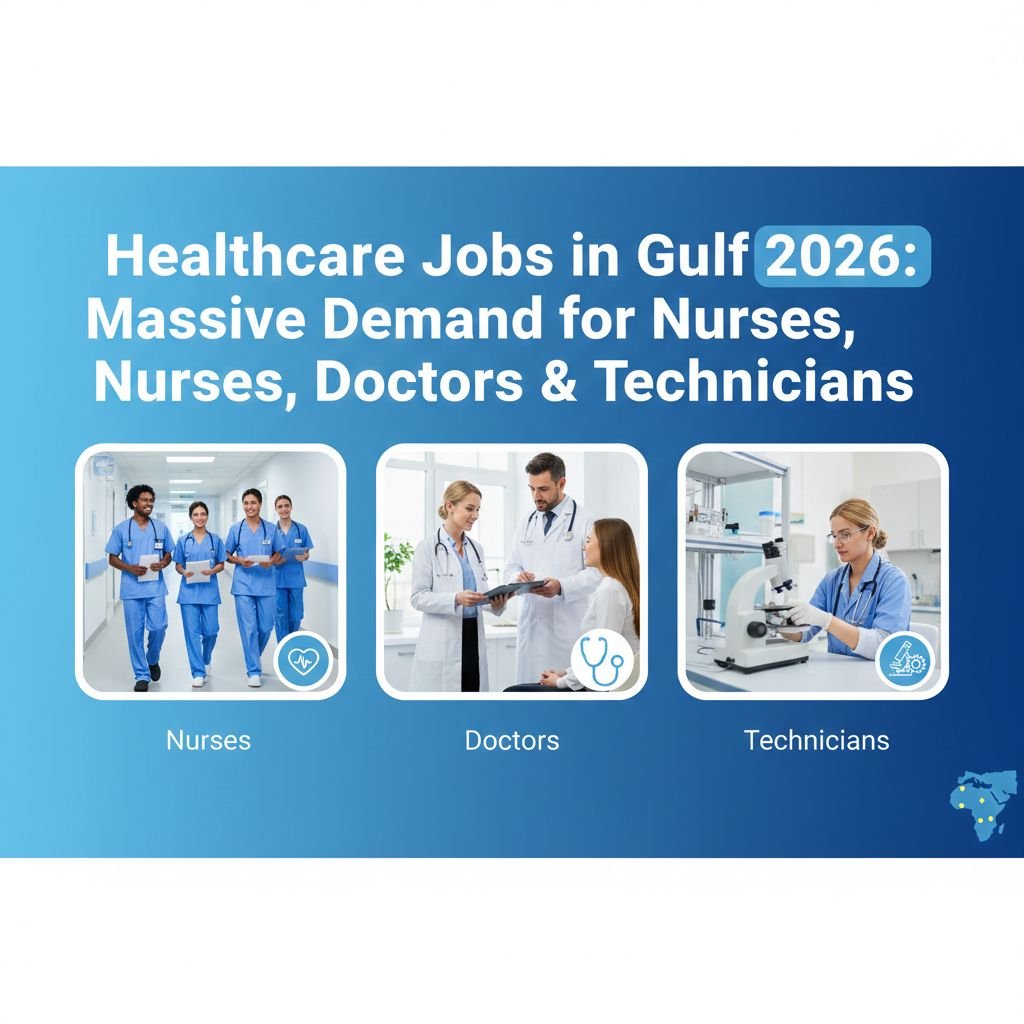
Healthcare Jobs in Gulf 2026: Massive Demand for Nurses, Doctors & Technicians

Gulf Healthcare Jobs 2026 | Nurses, Doctors & Technicians in Demand

The Gulf region is witnessing an unprecedented boom in healthcare hiring. If you’re a nurse, doctor, or medical technician looking for international opportunities, 2026 is your year. With massive government investments, hospital expansions, and ambitious healthcare transformation projects across Saudi Arabia, the UAE, and Qatar, the demand for qualified medical professionals has never been higher.

The Big Picture: Why Healthcare Hiring Is Exploding in the Gulf

The numbers tell a compelling story. The Gulf Cooperation Council (GCC) healthcare ecosystem is projected to require over 50,000 additional nurses by 2027 alone . And that’s just one category. Demand for specialist doctors, technicians, and allied health professionals is growing at an annual rate of 10-15%, with some markets like Saudi Arabia seeing increases of 20-25% .

What’s driving this massive demand?

  • Population growth across the region
  • Hospital expansion projects tied to national development plans
  • Medical tourism initiatives requiring world-class staffing
  • Aging healthcare infrastructure being replaced and upgraded
  • Vision 2030 in Saudi Arabia and similar programs in the UAE prioritizing healthcare excellence 

The Gulf is investing heavily in becoming a global healthcare destination. And that means they need you.

Nursing: The Greatest Demand

If you’re a nurse, your skills are needed now more than ever. India alone sends approximately 25,000 to 30,000 nurses to the GCC annually, representing 45-50% of the nurse workforce joining from other countries . And the demand continues to outpace supply.

Why Nurses Are in Such High Demand

  • Critical shortages across ICU, operating rooms, and emergency departments
  • Expansion of long-term care facilities requiring specialized nursing staff
  • Locum contracts creating flexible, fast-track opportunities
  • Competitive packages making Gulf roles attractive globally

What Nurses Can Expect

Salaries for nurses in the Gulf are highly competitive. Typical monthly packages range from approximately ₹1.3 to ₹1.5 lakh (around AED 5,700 to AED 6,600), with the added benefit of no income tax . Most positions also include:

  • Free accommodation or housing allowance
  • Transportation to and from work
  • Comprehensive medical coverage
  • Annual return airfare to home country
  • End-of-service benefits

For ICU, critical care, and operating room nurses, demand is particularly intense, and packages reflect that priority .

Doctors: Specialists Wanted

The Gulf is not just looking for general practitioners. The real demand—and the real money—is in specializations. Population growth, evolving regulations, and hospital expansion are driving strong demand for Western-trained doctors across the UAE, Saudi Arabia, and Qatar .

Specialties in Highest Demand for 2026

Based on current hospital needs and recruitment data, these specialties are at the top of every employer’s wish list :

  • Interventional Radiology
  • ENT (Otolaryngology)
  • Female Breast Surgery and Radiology
  • Neurology
  • Urology
  • Female Obstetrics & Gynaecology
  • Fetal Medicine
  • IVF & Reproductive Medicine
  • All Pediatric Subspecialties (Cardiovascular, Endocrinology, Hematology Oncology, Orthopedics)

Pediatric subspecialties are particularly hot right now. Hospitals are shifting toward senior and niche consultant roles as they expand subspecialty services. Positions like Pediatric Cardiovascular Consultant and Pediatric Cardiothoracic Transplant Consultant don’t open often—but when they do, hospitals move quickly .

Doctor Salary Ranges

In the UAE, doctors earn between AED 120,000 and AED 360,000 per year, depending on specialty, experience, and qualifications . Senior consultants and those in high-demand subspecialties command the top end of this range, plus generous benefits packages.

Medical Technicians and Allied Health Professionals

Doctors and nurses get most of the attention, but the Gulf also desperately needs skilled technicians and allied health professionals.

Roles in High Demand

  • Anesthesia Technicians: Strong demand for both permanent and locum contracts 
  • Cardiovascular Technologists
  • Radiology and Imaging Technicians
  • Laboratory Technologists
  • Respiratory Therapists
  • Perfusionists
  • Surgical Technologists

The expansion of specialized cardiac centers, oncology units, and advanced surgical suites means technicians with specific expertise are being recruited aggressively.

Locum Opportunities: The Fast Track to the Gulf

One of the biggest trends in the 2026 Gulf healthcare market is the explosion of locum (temporary) contracts. These aren’t just stop-gap measures anymore—they’ve become a permanent feature of Gulf hiring .

Why Locum Contracts Are Growing

  • Faster hiring: Hospitals need coverage now, and locum roles typically bypass longer approval chains
  • Lower commitment: You can test life and work in the region without a long initial contract
  • Pathway to permanent: Many locum assignments convert to permanent roles after a successful term
  • Broad demand: Anesthesia, ICU, emergency medicine, and nursing dominate locum requests 

If you want speed and flexibility while working in the Middle East, locum contracts remain the fastest entry point.

Leadership and Executive Roles

For experienced healthcare professionals, 2026 offers unprecedented leadership opportunities. IHR Canada reports a clear increase in executive-level and senior leadership recruitment .

Executive Roles Currently in Demand

  • Executive Director, Medical Tourism and Medical Services
  • Associate Executive Director, Nursing Services
  • Head of Clinical Data
  • Health Services Manager, Oncology
  • Executive Health Medicine Chairperson
  • Program Manager, Healthcare Improvement
  • Executive Director, Business Development

This signals growing investment in medical tourism, patient experience, nursing leadership, and data-driven service improvement. For many professionals, career options now extend well beyond bedside practice .

How to Prepare: Your Action Plan

Hospitals in the Gulf strongly favor candidates who are already licensed or fully prepared for rapid licensing. In many cases, licensing delays slow hiring more than interviews or credentialing .

Getting “Deployment Ready”

To be among the first candidates considered when new roles open, you need:

  1. Professional licenses up to date and verified
  2. Employment and education certificates organized and attested
  3. References identified and contactable
  4. Clean, clear credentialing records
  5. Prometric exam preparation (required for most Gulf licensing)

The Licensing Process

Most Gulf countries require healthcare professionals to pass licensing exams:

  • Saudi Arabia: Saudi Commission for Health Specialties (SCFHS) exam
  • UAE: Dubai Health Authority (DHA) or Department of Health (DOH) exam
  • Qatar: Qatar Council for Healthcare Practitioners (QCHP) exam

Many recruitment platforms now offer end-to-end support, including training for these exams, documentation assistance, and visa processing .

What You Can Expect: Compensation and Benefits

The financial package for healthcare professionals in the Gulf remains one of the most attractive globally.

Typical Package Components

ComponentWhat to Expect
Base SalaryTax-free, competitive with Western markets
HousingFree accommodation or generous allowance
TransportProvided or allowance included
Medical InsuranceComprehensive coverage for you and family
EducationSchool fee allowances for children (senior roles)
Annual Leave30-45 days plus public holidays
Flight AllowanceAnnual return tickets to home country
End of ServiceGratuity payment upon contract completion

The combination of tax-free income and comprehensive benefits means Gulf opportunities offer exceptional savings potential compared to Western markets.

The Future: Beyond 2026

The healthcare transformation in the Gulf is just beginning. Saudi Vision 2030, UAE Centennial 2071, and Qatar National Vision 2030 all prioritize healthcare excellence as a cornerstone of their post-oil economies .

This means sustained demand for international talent for years to come. For healthcare professionals willing to invest in the right credentials and adapt to Gulf work culture, the opportunities are truly limitless.

Ready to Make Your Move?

The Gulf healthcare market in 2026 is a seller’s market—and you’re the seller. Whether you’re an experienced consultant looking for a leadership role, a specialist nurse seeking adventure and savings, or a technician ready to advance your career, the opportunities are here.

Your next step: Get your documents in order, start your licensing preparation, and connect with reputable recruitment partners who specialize in Gulf placements. The hospitals are ready. The packages are waiting. The only question is: are you?


Frequently Asked Questions (FAQs)

1. What are the most in-demand healthcare jobs in the Gulf for 2026?

Nurses (especially ICU, OR, and critical care), specialist doctors in radiology, pediatrics, neurology, and reproductive medicine, and medical technicians across anesthesia, cardiology, and imaging are in highest demand. Leadership roles in medical tourism and nursing administration are also growing rapidly 

2. How much can I earn as a healthcare professional in the Gulf?

Nurses typically earn tax-free packages equivalent to AED 5,700-6,600+ monthly plus benefits. Doctors earn AED 120,000-360,000 annually depending on specialty. All roles include accommodation, transport, medical coverage, and annual flights 

3. What qualifications do I need to work in Gulf healthcare?

You need recognized professional degrees (MBBS, BSN, etc.), valid licenses from your home country, and usually 2-5 years experience. You’ll also need to pass country-specific licensing exams (DHA, DOH, SCFHS) and have your credentials attested 

4. Are locum contracts a good option for first-timers in the Gulf?

Yes! Locum contracts offer faster hiring, lower commitment, and let you test the region before committing long-term. Many locum positions convert to permanent roles after successful assignments 

5. Is the demand real, or just hype?

The demand is absolutely real. The GCC needs over 50,000 additional nurses by 2027. Major hospital expansions, medical tourism growth, and national healthcare transformation plans are driving sustained, documented demand across all specialties 

New Opportunities Beyond the World Cup

Qatar Job Market 2026 | New Post-World Cup Opportunities

Remember all those headlines about Qatar’s post-World Cup slowdown? They got it wrong. As we move through 2026, Qatar’s job market isn’t shrinking—it’s transforming. The country has quietly built one of the most forward-thinking employment ecosystems in the Middle East, and for job seekers, the opportunities are more exciting than ever.

The New Reality: From Construction to Knowledge Economy

Yes, the construction frenzy that built stadiums and metro lines has cooled. That was always the plan . But what’s replaced it is far more sustainable for long-term careers. Qatar is now focused on building something different: a knowledge-based economy powered by talent, not towers.

The numbers tell the story. The IMF confirms that Qatar’s post-World Cup strategy centers on private sector growth, with reforms designed to attract skilled professionals and entrepreneurs . This isn’t about filling temporary roles anymore. It’s about building careers.

Two Game-Changing Visa Programs You Need to Know About

If you’re a senior professional or entrepreneur, February 2026 brought news that changes everything. Qatar launched two new 10-year residency visas that effectively remove the old barriers to building a life here .

The Executive Residency

This one’s for senior professionals already working in Qatar or considering the move. Chairmen, CEOs, and directors who meet salary criteria can now secure long-term residency through employer nomination . Here’s the kicker: you keep your residency status even if you change jobs. That’s huge for career flexibility.

The Entrepreneur Residency

Founders, take note. This pathway lets you establish or scale your business in Qatar with a five-year renewable residency . You’ll need endorsement from incubators like Qatar Development Bank or Qatar FinTech Hub, but once approved, you get access to mentorship, funding networks, and serious business support .

How Qatar is Fixing the Job Search Process

Remember the frustration of applying for jobs through platforms that never seemed to understand your real skills? Qatar’s upgraded Kawader platform tackles this head-on .

The new system uses AI for skills-based matching rather than just scanning job titles. If you’ve ever been overlooked because your unique combination of skills didn’t fit a rigid box, this matters. The platform also lets government entities nominate candidates without seeing names in early stages—a genuine move toward merit-based hiring .

Students aren’t forgotten either. The platform now connects university students with part-time government work aligned with national workforce needs . That’s practical experience before graduation.

What Employers Actually Want in 2026

If you’re updating your CV, here’s what Qatar’s manufacturers and employers are prioritizing right now :

  • Safety mindset and integrity top the list (nearly 99% of employers rate these as very important)
  • Problem-solving abilities (90.9% say this is critical)
  • Teamwork and communication (around 90% want people who can collaborate and share ideas clearly)
  • Risk and time management (over 90% need professionals who can handle these)

Notice what’s less important? Basic technical skills alone won’t cut it anymore. Employers want higher-order thinking and interpersonal competencies . The message is clear: adaptability matters more than ever.

The Workforce Reality Check

Let’s be realistic about what working in Qatar means today. A recent GCC salary survey reveals some tension beneath the surface :

  • Over 30% of professionals received no pay rise last year
  • Salary growth is expected at just 0-5% for most roles
  • Nearly 98% of professionals are open to new opportunities in 2026

But here’s the interesting part: employers are still hiring. Over 75% plan to increase headcount this year . The challenge isn’t lack of jobs—it’s matching talent with roles in a market where compensation isn’t keeping pace with workload intensity.

For professionals, this means looking beyond base salary. Nearly half of workers now rank flexibility and time-off as their most valued benefits . Smart employers are responding with hybrid arrangements and better development pathways.

Where the Jobs Are

Construction isn’t dead—it’s just more focused. The work now centers on gas expansion, industrial free zones, and transport infrastructure rather than stadiums . But the real growth areas are elsewhere:

  • Technology and innovation roles are expanding rapidly, supported by initiatives like the new residency programs 
  • Manufacturing needs professionals with problem-solving skills and safety expertise 
  • Green jobs are emerging as Qatar aligns labor policies with environmental goals 
  • Private sector leadership positions are opening as the economy diversifies beyond public sector dominance 

A Final Word

The Qatar job market in 2026 rewards those who pay attention. The old assumptions—that you need connections, that your visa ties you to one employer, that only construction matters—no longer hold true.

If you’re a senior executive looking for stability with flexibility, check the Executive Residency. If you’re an entrepreneur with a scalable idea, the Entrepreneur Residency deserves serious consideration. And if you’re a professional at any level, update your skills toward problem-solving, teamwork, and adaptability—because that’s what Qatar’s employers are actually hiring for.

The World Cup was never the finish line. It was the launchpad. And the real race for talent in Qatar is just beginning.


Frequently Asked Questions (FAQs)

1. Is the Qatar job market still strong after the 2022 World Cup?

Yes, but it has changed focus. While temporary construction roles declined as planned, Qatar is now building a knowledge-based economy with strong demand in technology, manufacturing, green industries, and private sector leadership. The IMF confirms the country is successfully transitioning to private sector-driven growth 

2. What are the new 10-year residency visas for Qatar?

Launched in February 2026, these visas target entrepreneurs and senior executives. The Entrepreneur Residency requires endorsement from approved incubators. The Executive Residency is for chairmen, CEOs, and directors meeting salary criteria, nominated by employers. Both offer long-term stability, family sponsorship, and asset ownership 

3. How does the Kawader platform help job seekers?

Kawader is Qatar’s upgraded national employment platform using AI for skills-based matching rather than just job titles. It connects jobseekers with opportunities in government entities, allows students to find part-time work, and promotes merit-based recruitment by hiding candidate names during initial screening .

4. What skills are employers looking for in Qatar right now?

Employers prioritize safety mindset, integrity, problem-solving, teamwork, and communication skills over basic technical abilities. Risk management, time management, and digital fluency are also highly valued. The focus is on higher-order cognitive skills and interpersonal competencies 

5. Can I change jobs easily in Qatar now?

Yes. Qatar was the first GCC country to abolish the kafala sponsorship system, improving worker mobility . The new Executive Residency even allows professionals to retain residency status if they change or lose employment, offering unprecedented career flexibility .

Dubai Job Market 2026: Top Hiring Industries & Future Trends

Dubai Job Market 2026 | Top Hiring Sectors & Salary Trends in UAE

The good news? The opportunities are real. Nearly half of UAE companies plan to expand their workforce this year, with major infrastructure projects, digital transformation, and clean energy investment driving demand . The challenge is that competition has never been higher. The UAE’s population has grown by nearly two million since 2020, and global talent continues to pour in .

The Big Picture: Cautious Optimism, Strong Fundamentals

Let us start with the numbers. The Central Bank of the UAE expects GDP to grow by 5.3% in 2026, driven by non-oil sectors that are expanding at nearly 5% annually . This is not speculative growth; it is built on projects that are already underway.

A survey of over 1,000 Gulf organisations by Cooper Fitch found that 48% of UAE employers expect to increase hiring in 2026 . That is the headline. But the full story is more nuanced.

  • 29% of employers anticipate workforce reductions, reflecting cost discipline and structural adjustments .
  • 23% expect no change to headcount .

What this tells us is that companies are not freezing recruitment. They are reallocating budgets toward high-impact roles and trimming functions that are being automated or consolidated .

Vlacheslav Shakhov, Managing Director at Cooper Fitch, describes the mood as “cautious optimism.” He notes: “The companies don’t mind spending, but they would like to spend wisely” .

Top Hiring Industries in Dubai & UAE for 2026

So where are the jobs? Multiple sources point to a consistent set of winning sectors.

1. Construction, Real Estate & Infrastructure

Large-scale infrastructure spending is the engine of Dubai’s job market. With population projected to keep rising, demand for roads, metro expansion, and a new airport is creating thousands of roles .

  • Hiring outlook: 55–65% positive in construction and real estate .
  • Roles in demand: Project managers, civil engineers, site supervisors, quantity surveyors .
  • Government opportunities: RTA and Dubai municipal entities actively recruiting engineers and depot supervisors .

Nikhil Nanda from Innovations Group confirms: “The Construction, Technology, and Energy sectors are expected to lead hiring demand in 2026” .

2. Technology, AI & Digital Services

This is the fastest-growing segment of the UAE job market. AI jobs in Dubai doubled from 5,000 to 10,000 between 2021 and 2024, and demand continues to accelerate .

  • Hiring outlook: 65–70% positive for tech and digital roles .
  • Global leader: UAE leads the world in AI hiring growth, with a 48% year-on-year increase .
  • Specific roles: Data scientists (+43% demand), AI product managers (+37%), AI engineers (+31%), cybersecurity specialists .

Importantly, the demand is shifting away from purely technical, coding-heavy roles. Employers now want “applied AI” professionals who can use AI for decision-making, automation, compliance, customer experience, and risk management .

3. Financial Services, Fintech & Crypto

Banking, non-banking financial institutions, and fintech are all hiring aggressively. The Dubai International Financial Centre (DIFC) now hosts over 1,500 AI, fintech, and innovation firms .

  • Hiring outlook: 70–75% positive .
  • Roles in demand: Tax and treasury accountants, financial analysts, compliance officers, risk managers .

4. Aviation, Defence & Aerospace

With Dubai’s airports operating near capacity and national carriers expanding fleets, this sector is expecting double-digit workforce growth .

  • Nearly half of surveyed organisations in this space anticipate significant headcount increases .
  • Roles span engineering, operations, logistics, and customer experience.

5. Energy & Renewables

The UAE’s commitment to net-zero and clean energy investment continues to generate jobs .

  • Industrial sector, including manufacturing and energy utilities, is a top performer .
  • Roles in project management, engineering, and sustainability are in high demand.

6. Healthcare & Social Care

Federal vacancies are rising, and Dubai government entities are actively recruiting expat professionals in healthcare .

  • Emergency Medical Technicians (EMTs), nurses, and allied health professionals are needed.
  • Social care roles, such as housing supervisors at foundations supporting vulnerable communities, are also available .

The AI Factor: Not Replacing Jobs, Reshaping Them

There is understandable anxiety about AI and job security. The data, however, suggests a more nuanced picture.

According to Cooper Fitch, only 7% of companies reported any job loss due to AI . What is actually happening is a merger of roles and skills, not wholesale elimination .

What does this mean for job seekers?

  • Entry-level and generalist roles are declining. Call-centre agents, basic administrative functions, and some analyst positions are being automated .
  • Hybrid talent is winning. The most sought-after candidates combine domain expertise with digital fluency. A marketer who understands analytics. An HR professional who uses AI for talent mapping .
  • Data literacy is foundational. Recruiters emphasize that the ability to work with data, exercise judgment, and separate signal from noise is more valuable than claiming to be an “AI expert” .

James Randall from HireRight puts it plainly: “Employers are increasingly looking for professionals who can use AI to support decision-making, automation, compliance monitoring, customer experience, and risk management” .

Salaries and Benefits: Modest Growth, Targeted Premiums

Do not expect double-digit salary increases across the board. The broad forecast is for salary growth of just under 2% in 2026 .

However, averages hide significant variation:

  • Specialist roles and senior individual contributors saw increases of 5–9% last year .
  • AI and data talent command premiums due to intense competition for a limited pool .
  • Bonuses typically range from one to six months’ salary, with most clustered around two to three months .

Benefits packages are also evolving. More companies are offering family benefits and schooling allowances, even in industries that previously did not .

Government Jobs: Growing Opportunities for Expats

While UAE nationals receive priority for public-sector roles, several Dubai government entities are now welcoming skilled expatriates .

Dubai Careers portal lists vacancies across departments with salaries reaching Dh40,000 per month for senior roles .

Current openings include:

  • Specialist – Digital Services Development (IT, 5+ years)
  • Senior Site Engineer (Civil, Dh30,001–40,000)
  • AV Editor (Media, Dh10,001–20,000)
  • Systems & Applications Development Specialist – Hyperion/EPM (IT, Dh20,001–30,000)
  • Expert – Innovation & Pioneering (14+ years experience)

Federal vacancies are projected to reach 7,842 in 2026, supported by a Dh1.315 billion budget allocation .

How to Stand Out in 2026: Advice from Recruiters

1. Tailor Your CV for Both Humans and Algorithms

Applicant Tracking Systems (ATS) are increasingly used for high-volume roles. Your CV must be clearly formatted, keyword-optimised, and directly relevant to the job description .

But for senior and specialist roles, human reviewers still assess storytelling, clarity of impact, and relevance. Balance technical optimisation with human readability .

2. Be Authentic About AI Skills

“Do not overdress it,” advises Shakhov. If you have completed a course, worked on a pilot project, or used AI tools in your current role, include it. But exaggeration is easily exposed .

3. Network Strategically

“Networking is still one of the most powerful tools,” says Nicki Wilson from Genie Recruitment. Employers can spot generic, ChatGPT-generated messages instantly. Personalise your outreach .

4. Understand the Local Market

Overseas candidates often fail because they apply blindly. Speak to people already in the region. Understand sector-specific dynamics, local regulations, and hiring timelines .

Wilson adds: “To truly stand out, especially for Gen Z, adopting a traditional mindset of hard work, consistency and humility will actually make you more memorable” .

5. Do Not Lead with Flexibility Requests

Asking for remote work or flexible hours too early in the process can hurt your chances. While hybrid models are common, performance visibility still matters .

Challenges: Talent Shortages and Intense Competition

The UAE job market is not without friction.

  • 67% of employers believe the UAE has enough talent to meet hiring needs. But among senior executives, only 50% are confident, and 40% believe the market cannot meet their requirements .
  • Specialist and leadership roles are increasingly difficult to fill, particularly where sector-specific expertise or transformation capabilities are required .
  • The population has grown from 9.44 million in 2020 to 11.48 million in 2025, intensifying competition for top roles .

Conclusion: A Market That Rewards Precision

The 2026 UAE job market is not a mass hiring boom. It is a targeted, skill-driven market where employers know exactly what they want and are willing to pay for it.

For job seekers, this means:

  • Specialise or diversify strategically. Generalist roles are shrinking; hybrid roles that combine technical and human skills are growing.
  • Invest in genuine AI capability. Not certification alone, but demonstrated ability to apply AI to real business problems.
  • Be patient and deliberate. Hiring timelines are longer because decisions matter more. Use that time to build relationships and understand the market.

For businesses, the mandate is clear: compete on precision, not volume. The talent is there, but finding it requires smarter sourcing, clearer role design, and a willingness to invest in retention.

The opportunities are real. They are just concentrated where the value is highest.


Frequently Asked Questions (FAQs)

1. Which industries are hiring the most in Dubai for 2026?

Construction, technology (especially AI and data science), financial services, aviation, and renewable energy are leading hiring demand. Government sectors are also expanding roles for skilled expats in healthcare, IT, and infrastructure 

2. Are salaries rising in the UAE job market?

Modestly. Average forecasts are under 2%, but specialist roles in AI, data, and senior individual contributor positions are seeing increases of 5–9%. Competition for proven talent is driving premiums .

3. Is AI really replacing jobs in the UAE?

Not at scale. Only 7% of companies report job losses due to AI. Instead, roles are merging and skills are being augmented. The demand is for professionals who can work alongside AI, not those who fear it .

4. How can overseas candidates improve their chances of getting hired?

Research the local market before applying. Build networks through LinkedIn and professional contacts. Tailor CVs to both ATS systems and human reviewers. Understand UAE regulations and sector dynamics 

5. Are Dubai government jobs open to expats?5. Are Dubai government jobs open to expats?

Yes. Several Dubai government entities now actively recruit skilled expatriates in technology, engineering, media, and healthcare. Roles are listed on dubaicareers.ae with salaries up to Dh40,000 per month 

Gulf on the Move: The Complete UAE, Saudi & Qatar Job Market Report 2026

UAE Job Market Report 2026

If you’re hiring in the Gulf—or hoping to be hired—2026 is shaping up as a year of stark contrasts. The UAE is navigating cautious optimism against global headwinds. Saudi Arabia is accelerating its workforce transformation with ambitious new quotas. And Qatar is quietly building one of the most sophisticated, AI-driven employment platforms in the world.

Part One: UAE – Cautious Growth, Intense Competition, and the AI Premium

The Mood: Optimism, But Slower Decisions

Let’s start with the honest truth: the UAE is still hiring, but the brakes are slightly on.

Vlacheslav Shakhov, managing director at Cooper Fitch, describes the current climate as “cautious optimism” . Companies aren’t freezing budgets. They’re just spending more deliberately. Decision-making cycles have lengthened as employers weigh global economic uncertainty against regional growth momentum.

The headline numbers support this. Nadia Global tracking shows about 48% of UAE companies expect to increase hiring in 2026, with overall labour market growth estimated at around 2.5% carrying momentum from late 2025 .

Salaries: Up, But Not Evenly

Here’s where averages deceive. The broad forecast is modest: just under 2% overall . But dig deeper, and a different picture emerges.

Specialist roles and senior individual contributors aren’t seeing 2%. They received increases between 5% and 9% last year . The market is polarizing. Generalists face flat offers. Niche experts command premiums.

Average increases across the board settled around 5% in 2025, with bonuses ranging from one to six months’ salary, most commonly two to three months .

The Workforce Shuffle: 72% Are Looking

This is the stat that should worry employers: more than seven in ten UAE employees (72%) plan to look for a new job in 2026 .

Here’s the paradox. Most of these workers—74%—say they’re currently happy in their roles . Happiness, apparently, is no longer enough to guarantee loyalty.

Staff turnover is expected to climb above the traditional 7-10% range, intensifying pressure on employers to retain skilled people . Yet finding replacements is getting harder. 65% of UAE employees say it’s become more difficult to find a new job over the past year, with 63% citing increased competition .

The math is simple: the UAE added nearly two million people over five years, reaching 11.52 million in 2025 . More talent chasing roles, combined with slower decision-making, creates a tougher environment on both sides.

AI: Not Replacing Jobs, Rewiring Them

The AI panic? It’s largely misplaced.

Only 7% of companies report any job loss due to AI adoption . What’s actually happening, says Cooper Fitch’s Shakhov, is “a merger of roles, and not a loss of roles or merger of skills” .

This is critical to understand. Employers aren’t looking for AI specialists in every hire. They’re looking for foundational data skills, critical thinking, and judgment . The ability to work with AI tools, interpret outputs, and separate signal from noise.

Adoption is already widespread. Hays GCC Salary Guide 2026 reports 66% of professionals already use AI regularly at work, citing benefits in creativity, productivity, and communication .

The UAE leads globally in AI hiring growth, reaching 48% year-on-year between 2024 and 2025 . Demand for data scientists rose 43%, AI product managers 37%, and AI engineers 31% over the same period .

What employers will penalize? Exaggeration. Candidates who oversell their AI expertise are “exposed quickly” . The advice from recruiters is consistent: be authentic. If you completed a course, worked on a pilot, or used AI meaningfully in a project, include it. Frame it honestly.

Sectors Hiring in 2026 UAE

Financial services leads the pack. Banking, non-banking financial institutions, fintech, and crypto are all flagged as strong performers .

Industrial sectors—manufacturing, energy, utilities—are equally optimistic .

Technology, healthcare, and logistics continue their steady demand . Dubai International Financial Centre (DIFC) now hosts over 1,500 AI, fintech, and innovation firms, collectively raising over $4.2 billion .

Part Two: Saudi Arabia – The Great Transformation, Now Codified

Employment Growth: 4.5% and Climbing

Saudi Arabia’s job market is operating at a different tempo. Employment growth is estimated at roughly 4.5% in 2025, significantly outpacing the UAE . Long-term demand projections point to hundreds of thousands of additional workers needed by 2030 under Vision 2030.

The Hays GCC Salary Guide confirms this momentum: 93% of employers already employ Saudi nationals, and 75% plan further increases in 2026 .

The New Saudization: 60% by April

If there’s one number every employer and jobseeker in Saudi Arabia must memorize in 2026, it’s this: 60% by April 19.

The Ministry of Human Resources and Social Development has dramatically raised Saudization targets for sales and marketing professions .

Private sector firms employing three or more workers in 10 marketing professions—including marketing manager, public relations manager, marketing specialist, and graphic designer—must now ensure 60% of these positions are held by Saudi nationals. This is up from 30% .

For nine sales professions—sales manager, sales specialist, sales representative, commodity broker—the threshold also rises to 60%, a steep increase from the previous 15% requirement for certain roles .

Crucially, Saudi employees count toward the quota only if their monthly salary registered with GOSI is at least SAR 5,500 .

Non-compliance carries real teeth: suspension of ministry services, including employee transfer facilities and work permit renewals .

A Decade of Progress: The Numbers Behind the Narrative

On January 27, 2026, the Global Labor Market Conference (GLMC), World Bank, and Ministry of Human Resources released “A Decade of Progress,” a comprehensive report on Saudi labor market transformation since Vision 2030 .

The headline achievements are extraordinary:

  • Labor force participation reached 67.1% by 2025.
  • Overall unemployment declined to 2.8% by mid-2025.
  • Female employment surged from 11% (2015) to 32% (2025).
  • Employment among mothers rose from 8% to 45%.
  • Youth employment (18-24) increased from 10% to 33%.
  • Share of youth not in education, employment, or training (NEET) fell from 40% to 25%.
  • Private sector now employs 52.8% of Saudi citizens.
  • Education-to-job matching improved from 41% to 62%.

Perhaps most striking: the share of individuals unwilling to work declined from 49% to 12% .

Jobseekers exclusively targeting public sector work fell from 60% to 10% for men, and 48% to 22% for women . A generation that once saw government employment as the only respectable path now actively pursues private sector careers.

This is not incremental change. This is structural, cultural, and irreversible.

What Employers Face

Talent shortages remain acute. Hays reports 90% of organizations experienced skills gaps in 2025 . Employers cite low salaries and benefits (38%), high competition (31%), and lack of career progression (28%) as leading causes .

The message is clear: nationalization is no longer just a quota exercise. Retention, career development, and genuine skills investment are now competitive necessities.

Part Three: Qatar – Building the Smarter Labor Market

Less Noise, More Strategy

If the UAE is about speed and Saudi about scale, Qatar is about precision.

January 2026 saw two significant developments. First, HE Minister of Labour Dr Ali bin Samikh Al Marri chaired the Workforce Planning Committee meeting, reviewing strategic initiatives to strengthen Qatari talent capabilities, expand national workforce participation in the private sector, and attract highly skilled expatriate professionals .

The language is important. Qatar explicitly frames its approach around both developing nationals and deliberately attracting global expertise—not as alternatives, but as complements.

Kawader: AI-Powered, Skills-First, Bias-Reduced

The upgraded Kawader platform, launched in January 2026, represents a philosophical shift in how government employment works .

Key features:

  • Skills-based matching prioritizing competencies over rigid job titles.
  • Anonymous shortlisting—government entities can nominate candidates without accessing names during early stages.
  • Student integration allowing university students part-time government work aligned with 2026 workforce needs.
  • School-level exposure helping students align academic choices with national priorities.
  • Clear progression pathways and mobility within government to retain Qatari talent.
  • Retiree inclusion, recognizing experienced talent as a national asset.

This is not a job board. It’s a lifelong workforce development ecosystem .

The Peninsula’s editorial captured the significance: “Employment is no longer treated as a single transaction, but as a lifelong journey that begins at school and evolves across every professional stage” .

For a region where public sector employment remains highly sought after, Kawader’s merit-based, anonymized recruitment mechanism is genuinely innovative. It builds trust. It signals that opportunity follows capability, not familiarity.

Part Four: The Gulf Talent Shortage – A Regional Crisis

Zoom out, and one pattern dominates every market: demand exceeds supply.

Hays GCC Salary Guide 2026 reports 90% of organizations experienced skills gaps in 2025 .

Which skills? Across all three countries, recruiters consistently identify shortages in:

  • Data science and AI implementation
  • Business analysis
  • Leadership and project management
  • Software development and engineering
  • Tax, treasury, and accounting
  • Sales and digital marketing 

Nadia Global reports a 65% increase in new clients year-on-year and a 25% rise from existing clients, reflecting sustained vacancy growth .

Egypt remains the region’s primary talent reservoir, leading hiring volume across software, engineering, data science, and QA roles. Pakistan ranks second across several engineering categories .

Part Five: Practical Advice for 2026 Job Seekers and Employers

For Job Seekers

1. Tailor CVs strategically. Applicant tracking systems are real gatekeepers for high-volume roles. Structure matters. Relevance matters. Keywords matter. For senior roles, storytelling and measurable impact outweigh keyword density .

2. Demonstrate AI capability authentically. Don’t claim expertise you don’t have. Do highlight genuine courses, pilot projects, or practical applications. The question isn’t “Are you an AI expert?” It’s “Can you work effectively with AI tools?” .

3. Understand local context before applying from abroad. Overseas candidates who network, speak to people already in-region, and demonstrate knowledge of sector-specific dynamics stand out. Blind applications rarely succeed .

4. Keep skills current. LinkedIn’s survey found digital readiness and proactive career management increasingly differentiate successful candidates in competitive markets .

5. Signal interest clearly. Update online profiles. Leverage professional networks. Make it easy for recruiters to find you .

For Employers

1. Salary alone won’t win. Low salaries and benefits top the list of why organizations lose talent (38%) . Competitive hiring now hinges on strong benefits, career development opportunities, and positive work environments.

2. Saudi compliance is tightening. The April 19, 2026 deadline for 60% Saudization in sales and marketing is real. Review workforce composition now .

3. UAE retention requires active management. With 72% of employees considering moves, passive satisfaction isn’t loyalty. Visibility, impact, and value recognition matter—whether in-office or remote .

4. Invest in skills. The organizations best positioned to compete in 2026 are those addressing skills gaps through training, progression pathways, and genuine development investment .

5. Understand Qatar’s Kawader shift. If you’re recruiting in Qatar’s public sector or targeting Qatari national talent, familiarity with Kawader’s skills-based, anonymous model is now essential .

Conclusion: Three Markets, One Region, Unlimited Opportunity

The Gulf in 2026 is not pausing. It’s rebalancing.

UAE employers are hiring with more precision, paying premiums for genuine specialists, and navigating a workforce that has never been more mobile. Saudi Arabia is codifying its transformation into binding quotas while celebrating a decade of historic labor market gains. Qatar is quietly building one of the world’s most sophisticated public employment platforms—skills-first, AI-powered, and designed for the long arc of a career.

For professionals with in-demand capabilities—data, AI, leadership, engineering, finance, digital—this region remains the most attractive destination on earth.

For employers willing to invest in retention, skills development, and authentic talent strategies, the opportunity has never been greater.

The Gulf is on the move. The question is whether you’re ready to move with it.


Frequently Asked Questions (FAQs)

1. Are salaries actually rising in the UAE in 2026, or is it just inflation?

Salaries are rising modestly overall—forecast at just under 2%—but this average hides significant variation. Specialist roles and senior individual contributors saw increases of 5-9% in 2025. The market is polarizing: generalists face flat offers while niche experts command genuine premiums. Cost-of-living pressures are real, but in-demand skills are driving real wage growth .

2. What is the new 60% Saudization rule, and who does it affect?

Effective April 19, 2026, private sector firms with three or more employees in 10 marketing professions and nine sales professions must ensure 60% of these roles are held by Saudi nationals. This is a significant increase from previous thresholds (30% for marketing, 15% for certain sales roles). Covered roles include marketing manager, PR manager, graphic designer, sales manager, and sales representative. Non-compliance risks suspension of ministry services .

3. How is Qatar’s Kawader platform different from other job portals?

Kawader represents a philosophical shift. It uses AI for skills-based matching rather than rigid job titles. It enables anonymous shortlisting in government recruitment—nominations without accessing candidate names in early stages. It integrates students, working professionals, and even retirees into a single lifelong career ecosystem. This is workforce planning as national strategy, not just a vacancy board 

4. Is AI really replacing jobs in the Gulf?

No. Only 7% of companies report any job loss due to AI. What’s happening is role transformation—tasks are being redistributed, not eliminated. Employers increasingly seek foundational data literacy and critical thinking rather than specialist AI certifications. Two-thirds of professionals already use AI regularly at work. The risk isn’t replacement; it’s failing to adapt 

5. Which Gulf country has the strongest job market right now?

It depends on your profile. Saudi Arabia shows the highest employment growth (4.5%) and aggressive nationalization targets creating both compliance pressure and opportunities. The UAE remains the region’s talent hub with the deepest concentration of international firms, though competition is intense. Qatar offers strategic, deliberate opportunities, particularly for those aligned with its skills-based, digitally-driven workforce reforms. All three are strong—but for very different reasons 

Gulf Job Market Trends 2026: Your Must-Read Guide to Opportunities & Strategies

Gulf Job Market Trends 2026

The Gulf Cooperation Council (GCC) job market is undergoing a historic transformation. Driven by ambitious national visions like Saudi Arabia’s Vision 2030 and the UAE’s “We the UAE 2031,” the region is rapidly diversifying its economy beyond oil, creating a dynamic and evolving landscape for job seekers. For professionals worldwide, understanding these 2026 trends is not just useful—it’s essential for making strategic career decisions and securing high-value opportunities.

This comprehensive analysis breaks down the most critical Gulf job market trends for 2026, highlighting the sectors set to boom, the skills in highest demand, and the strategic shifts every candidate must understand.

The Macro-Driver: Economic Diversification in Overdrive

The overarching theme is accelerated economic diversification. Hydrocarbon wealth is now the fuel for building parallel, sustainable economies. This strategic pivot is creating two parallel labor markets: one for national talent (through Saudization, Emiratization, etc.) and another for expatriates with highly specialized, niche skills needed to build these new sectors.

Top 6 Gulf Job Market Trends for 2026

1. The “Niche Expat” & Knowledge Transfer Imperative

  • The Trend: Blanket expatriate hiring is over. The new era is about targeted, skill-specific recruitment. Gulf countries are willing to pay a premium for expatriates who possess critical expertise not yet available locally—especially in emerging technologies and complex project leadership—with the explicit or implicit expectation of knowledge transfer to the national workforce.
  • Impact on Job Seekers: Generic applications will fail. Success requires demonstrating unique, verifiable expertise in a high-demand niche. Your value proposition must be: “I have the specific skill you cannot find locally to build X, and I can help develop your team.”

2. Technology & Digital Sovereignty as a National Priority

Every GCC nation has a “Smart” or digital transformation agenda. This isn’t just IT support; it’s about building national technological capability.

  • Hot Sectors: Artificial Intelligence (AI) & Machine Learning, Cybersecurity, FinTech, Blockchain, and Smart City Infrastructure.
  • In-Demand Roles: AI Ethics Specialists, Cybersecurity Architects, Cloud Migration Experts, Data Scientists, IoT Solution Engineers.
  • Key Projects/Hubs: Saudi Arabia’s NEOM and The Line, UAE’s Dubai Metaverse Strategy and Abu Dhabi’s Hub71, Qatar’s TASMU Smart Qatar.

3. The Green Economy & Sustainable Development Goes Mainstream

With COP28 setting a precedent and net-zero targets (UAE 2050, KSA 2060), sustainability is no longer a buzzword but a core economic pillar.

  • Hot Sectors: Renewable Energy (Solar, Hydrogen, Wind), Green Construction & ESG Consulting, Sustainable Urban Planning, Water Conservation Technology, Electric Vehicle (EV) Infrastructure.
  • In-Demand Roles: Renewable Energy Project Managers, ESG Reporting Analysts, Green Hydrogen Engineers, Sustainability Consultants, Carbon Markets Specialists.

4. Giga-Projects Shift from Planning to Execution & Operations

The massive infrastructure projects announced in the early 2020s are now moving into intense construction and initial operational phases.

  • Hot Sectors: Construction, Advanced Logistics, Operational Technology (OT), Tourism & Hospitality Operations, Mega-Event Planning.
  • In-Demand Roles: Construction Project Directors, BIM Managers, Operational Readiness Managers, Tourism Cluster Managers, Logistics & Supply Chain Directors.
  • Location Focus: Demand will be hyper-concentrated in Saudi Arabia (Riyadh, NEOM, Red Sea, Qiddiya) and specific developments in the UAE and Qatar.

5. The Evolving Nature of Work: Remote, Hybrid, and Talent Ecosystems

  • Remote Work for Global Talent: Gulf companies, especially in tech and services, are increasingly open to hiring specialized global talent on a remote basis, paying competitive salaries without relocation. This widens the talent pool for employers and creates opportunities for those not wishing to relocate.
  • Hybrid Models: Within the Gulf, hybrid work is becoming standardized for roles that allow it, particularly in multinational corporations and knowledge-based industries.
  • Rise of the “Gig” Expert: Short-term, high-value consulting contracts for experts to solve specific problems (e.g., a 6-month contract to set up a cybersecurity framework) are becoming more common.

6. Increased Focus on Quality of Life & Long-Term Residency

To attract and retain top global talent, Gulf states are enhancing livability and offering pathways to long-term ties.

  • Trend: Expansion of long-term residency visas and “Golden” visas (e.g., UAE Golden Visa, Saudi Premium Residency). This offers stability for expats and signals a shift from transient workforces to established talent communities.
  • Impact: This makes the Gulf a more attractive long-term career destination, not just a short-term earning post. It also increases competition for roles, as professionals think about settling down.

Sector-Specific Outlook for 2026

  • Healthcare: Sustained high demand. Focus on specialized care, medical tourism, and digital health. Need for senior consultants, specialized nurses, and healthcare tech integrators.
  • Finance: Evolution towards FinTech and ESG finance. Traditional banking roles face pressure from localization, but high demand exists for fintech developers, Shariah-compliant fintech experts, and sustainable finance specialists.
  • Education & Training: Booming. Demand for educators in STEM, vocational trainers for new industries (e.g., green tech, tourism), and corporate trainers to upskill the national workforce.
  • Logistics & Supply Chain: Strategic growth. As the Gulf positions itself as a global logistics hub connecting East and West, demand for supply chain digitization experts, port managers, and air cargo specialists will rise.

Strategic Advice for Job Seekers in the 2026 Gulf Market

  1. Upskill for Priority Sectors: Invest now in certifications for AI, cybersecurity (CISSP, CISM), ESG reporting (GRI, SASB), or advanced project management (PMP, PMI-SP). This directly translates to higher earning potential.
  2. Build a “Gulf-Relevant” Digital Profile: Your LinkedIn profile must scream your niche expertise. Publish articles or posts on trends like smart cities or renewable energy in the Middle East. Follow and engage with key Gulf companies and thought leaders.
  3. Master the Art of the Niche Application: Tailor your CV and cover letter to tell a specific story: “Here is my proven expertise in [High-Demand Niche], and here is how it directly applies to your project/goal at [Gulf Company].”
  4. Be Open to Regional Hubs: While Dubai remains a powerhouse, Riyadh is the undisputed epicenter of job growth for 2026. Be prepared to explore opportunities in emerging hubs like NEOM, Abu Dhabi, and Doha.
  5. Understand the Total Package: Negotiate beyond the base salary. In a competitive market, housing, education allowances, annual flights, and performance bonuses are key differentiators. Understand the value of long-term residency options.

Conclusion: A Market of Quality Over Quantity

The Gulf job market in 2026 is characterized by selectivity, specialization, and strategic growth. The era of easy, generalist expat roles is fading, replaced by a dynamic market that richly rewards professionals with future-proof skills aligned with the region’s transformative goals.

For the prepared candidate, this represents an unparalleled opportunity. By aligning your skills with the trends of technology, sustainability, and giga-project execution, you position yourself not as just another job seeker, but as a critical partner in building the future of one of the world’s most ambitious regions. The 2026 Gulf market isn’t just hiring workers; it’s recruiting architects of the future.

Frequently Asked Questions (FAQs)

1. Is the Gulf job market still good for expats in 2026?

Yes, but it has fundamentally changed. It is exceptionally strong for highly skilled, specialized expats in technology, engineering, healthcare, and advanced project management. It is increasingly challenging for those in generic administrative, HR, or support roles, as these are major focuses of nationalization (localization) programs.

2. Which Gulf country will have the most job opportunities in 2026?

Saudi Arabia is projected to have the highest volume and growth rate of new job opportunities, driven directly by the execution phase of its giga-projects under Vision 2030. The UAE will remain a stable, diversified hub with strong opportunities in tech, finance, and business services. Qatar and Oman will have targeted growth in energy, logistics, and tourism.

3. Are salaries in the Gulf still competitive internationally in 2026?

For in-demand roles, yes—and often leading. To attract the niche global talent they need, Gulf employers are offering very competitive, tax-free salary packages that can exceed Western net salaries for comparable roles, especially when combined with benefits like housing and education allowances. Salaries for common roles may see more modest growth.

4. How important are professional certifications for Gulf jobs in 2026?

Extremely important. In a market prioritizing proven specialization, certifications (PMP, CFA, CISSP, AWS/Azure certifications, Six Sigma) act as a trusted, third-party validation of your skills. They are often explicitly listed in job requirements and can be the deciding factor between two candidates, justifying a higher salary offer.

5. What is the biggest mistake job seekers make in the 2026 Gulf market?

The biggest mistake is using a generic, non-targeted approach from past years. Sending out hundreds of identical CVs, failing to research the specific strategic goals of target companies, and not highlighting niche, future-focused skills will lead to a low response rate. Success requires a sniper-like approach, not a shotgun approach.

New UAE Labor Law Changes Explained Simply: A 2026 Guide for Employers & Employees

UAE Labor Law Changes

The United Arab Emirates has implemented significant updates to its Federal Labour Law (Federal Decree-Law No. 33 of 2021), with further refinements and executive regulations issued in 2022-2023. These changes represent a major modernization of the employment landscape, introducing greater flexibility, stronger protections, and aligning the UAE with international best practices.

Why the Changes? A Move Towards a Modern, Flexible Economy

The new laws aim to:

  • Boost the UAE’s competitiveness by attracting and retaining global talent.
  • Increase labor market flexibility for both businesses and workers.
  • Enhance employee protections and clarify rights and obligations.
  • Support diverse work models, including remote and part-time work.

Key Changes Explained Simply

1. Introduction of New Flexible Work Models (The Biggest Shift)

The old law was designed primarily for full-time, indefinite contracts. The new law formally recognizes three main types of work:

  • Full-Time: The traditional model, where an employee works for one employer exclusively.
  • Part-Time: An employee can work for one or more employers for a specific number of hours/days.
  • Flexible Work: An employee’s hours/days of work can vary based on the employer’s workload and operational needs (paid for actual hours worked).
  • Temporary Work: For a specific project or fixed period.
  • Remote Work: Work performed fully or partly outside the workplace.

What it means: Employees now have legal pathways for job-sharing, side-hustles (with approval), and flexible schedules. Employers can better manage variable workloads.

2. The End of Unlimited Contracts & Fixed-Term Contracts for All

  • The Change: All employment contracts must now be for a fixed term, not exceeding 3 years. They can be renewed or extended by mutual agreement.
  • What it means:
    • For Employees: Provides more clarity on your commitment period. When a fixed-term contract ends, you are entitled to an end-of-service gratuity. Previously, leaving an unlimited contract required a lengthy notice period.
    • For Employers: Simplifies workforce planning and contract management. No more “unlimited” contracts that are difficult to terminate.

3. New Probation Period Rules (More Protections)

  • The Change: The maximum probation period is 6 months.
    • An employee on probation can leave to join another UAE company, but they must give 14 days’ notice.
    • The new employer may be required to compensate the old employer for recruitment costs, if agreed in the contract.
    • An employer can terminate during probation with 14 days’ notice.
  • What it means: More clarity and fairness during the trial period for both sides. It discourages “probation-hopping” while protecting employees from sudden dismissal.

4. Equal Wages & Stronger Anti-Discrimination Protections

  • The Change: The law explicitly prohibits discrimination on the basis of race, color, sex, religion, national or social origin, or disability.
    • It also mandates equal pay for men and women who perform work of equal value.
  • What it means: A stronger legal framework promoting an inclusive workplace. Women are guaranteed equal pay for equal work.

5. New Leave Entitlements (More Generous)

  • Parental Leave: 5 working days of paid parental leave for both fathers and mothers following the birth of a child (applicable to private sector employees).
  • Study Leave: 10 working days of paid leave per year for employees enrolled in accredited UAE institutions, provided they have completed at least 2 years of service.
  • Compassionate & Bereavement Leave: Enhanced provisions for the death of a spouse (5 days) or a close family member (3 days).
  • Maternity Leave: Remains generous at 45 days at full pay, followed by 15 days at half pay, with the option to extend by an additional 30 days unpaid.

6. New Rules for Termination & End of Service

  • Limited Reasons for Termination: Employers can only terminate for specific, justified reasons outlined in the law (e.g., gross misconduct, chronic underperformance after warnings, redundancy).
  • Notice Periods: Ranges from 30 to 90 days, as stipulated in the contract. During notice, an employee is entitled to one full day off per week to seek new employment.
  • End-of-Service Gratuity (EOSB): Calculation is streamlined. It is based on basic salary:
    • 1-5 years of service: 21 days’ basic salary per year.
    • 5+ years of service: 30 days’ basic salary per year for each additional year.
    • Must be paid within 14 days of the contract’s end.

7. New “Non-Compete” Clause Limits

  • The Change: Non-compete clauses are now only enforceable if they are reasonable in time, place, and scope to protect the employer’s legitimate business interests. They cannot prevent an employee from earning a livelihood indefinitely.
  • What it means: More freedom for employees to move within their industry after leaving a job, preventing overly restrictive clauses.

8. Protection Against Harassment & Bullying

  • The Change: The law explicitly prohibits verbal, physical, or sexual harassment, bullying, and any abusive use of authority.
  • What it means: A safer, more respectful work environment with clear legal recourse for victims.

What Hasn’t Changed (Important Fundamentals)

  • Friday-Saturday Weekend: The official weekend for most of the private sector.
  • Employer-Sponsored Visas: The Kafala (sponsorship) system has been reformed but remains; your visa is still tied to your employment.
  • Mandatory Health Insurance: Provided by the employer.
  • Gratuity on Resignation: You are still entitled to prorated gratuity if you resign after completing 1 year of service, with the amount reduced if you leave before 5 years.

Action Steps for Employees & Employers

For Employees:

  1. Review Your New Contract: Ensure it correctly states your work model (full-time, part-time), fixed term, and all benefits.
  2. Understand Your Rights: Know your leave entitlements, notice periods, and anti-discrimination protections.
  3. Document Issues: In case of disputes, keep records of communication, warnings, or incidents.

For Employers:

  1. Update All Contracts: Ensure all templates comply with the new fixed-term, model, and clause requirements.
  2. Revise HR Policies: Update employee handbooks on leave, probation, termination, and anti-harassment.
  3. Train Managers: Ensure management understands the new rules, especially around termination and discrimination.
  4. Consult Legal Counsel: For complex situations, always seek advice from a UAE labor law specialist.

Conclusion: A More Balanced Future of Work

The new UAE labor law changes signify a pivotal shift towards a more mature, flexible, and equitable job market. They balance the need for business agility with stronger safeguards for employee well-being and rights.

By moving away from indefinite commitments and embracing diverse work models, the UAE is positioning itself as a forward-thinking destination for global talent and investment. Understanding these simplified explanations is the first step for both employees and employers to adapt, thrive, and build successful professional relationships in the UAE’s evolving economic landscape.

Frequently Asked Questions (FAQs)

1. Do the new laws apply to Free Zones (like DIFC, ADGM)?

Not directly. The main Federal Labour Law (Law No. 33) applies to the mainland UAE and most government entities. However, DIFC and ADGM have their own independent employment laws (based on common law), which have also been updated in a similar spirit (e.g., introducing parental leave). Always check the specific regulations of the Free Zone you are employed in.

2. Can my employer still hold my passport?

No. This has been illegal for years under UAE law. An employer cannot withhold an employee’s passport or any other official documents. If this happens, you should report it to the Ministry of Human Resources and Emiratisation (MoHRE).

3. What happens if my fixed-term contract is not renewed?

If your employer chooses not to renew your contract upon its expiry, it is considered a termination. You are entitled to:
Any unpaid salary.
Payment for accrued but untaken annual leave.
Your End-of-Service Gratuity.
repatriation ticket to your home country (if applicable).
You must also receive your notice period or payment in lieu.

4. How do I report a violation of the new labor law?

You can file a complaint with the Ministry of Human Resources and Emiratisation (MoHRE) through their smart app, website, or by calling their hotline (600 665 555). It is recommended to try to resolve issues internally first and keep all written evidence (emails, contracts, payslips).

5. I have an old unlimited contract. Is it still valid?

Yes, existing unlimited contracts remain valid. However, when it comes time for renewal or a significant change in terms, your employer will likely issue you a new fixed-term contract under the provisions of the new law. You cannot be forced to switch mid-contract without mutual agreement on new terms.

Cost of Living Comparison 2026: UAE vs Qatar vs Saudi Arabia for Professionals

Cost of Living Comparison: UAE vs Qatar vs Saudi

Choosing where to build your career in the Gulf is a major decision that extends far beyond your salary offer. The true value of your compensation package is determined by the cost of living in your new home. As we look toward 2026, understanding the evolving financial landscapes of the United Arab Emirates, Qatar, and Saudi Arabia is essential for making an informed, sustainable move.

This comprehensive 2026 guide provides a detailed, category-by-category comparison of living costs across these three powerhouse economies, analyzing current trends and future projections to help you calculate your potential disposable income and lifestyle.

Executive Summary: The 2026 Landscape at a Glance

  • UAE (Dubai/Abu Dhabi): The most cosmopolitan and diverse, but also the most expensive. It offers the widest range of lifestyle options, from ultra-luxury to moderate, but demands careful budgeting, especially for housing and schooling. Ideal for those prioritizing networking, lifestyle, and a “ready-made” expat experience.
  • Qatar (Doha): Historically the most costly, but post-2022 World Cup adjustments and increased housing supply are creating a more balanced market. It offers high salaries, exceptional infrastructure, and a compact, family-centric environment. Costs remain significant but are becoming more competitive.
  • Saudi Arabia (Riyadh/Jeddah): Generally offers the lowest cost of living of the three, particularly for housing. This is coupled with a rapidly transforming social and entertainment landscape. It presents the highest potential for savings and disposable income, especially for those comfortable with a pace of profound change.

Category-by-Category Cost Breakdown for 2026

1. Housing & Accommodation

This will be your single largest monthly expense.

  • UAE (Dubai Focus):
    • Trend: High demand continues to put upward pressure on rents, especially in prime communities (Marina, Downtown, Palm Jumeirah). New developments in areas like Dubai Hills, Town Square, and Al Furjan offer more affordable options.
    • 2026 Outlook: Expect continued premium prices in central locations. Annual increases are regulated by the RERA rental index, but newcomers will face high entry costs.
    • Sample Monthly Rent (Premium 2BR Apartment): AED 120,000 – 180,000+ ($32,700 – $49,000)
    • Sample Monthly Rent (Family-Friendly 2BR in Commuter Area): AED 70,000 – 100,000 ($19,000 – $27,200)
  • Qatar (Doha):
    • Trend: A significant increase in housing supply post-World Cup has softened the rental market, making it more tenant-friendly. Negotiation power has increased.
    • 2026 Outlook: A stable or slightly softening market is expected, with good value in areas like Al Waab, Muaither, and newer parts of Lusail.
    • Sample Monthly Rent (2BR in West Bay/Lusail): QAR 10,000 – 14,000 ($2,750 – $3,850)
    • Sample Monthly Rent (2BR in Family Area like Al Waab): QAR 7,000 – 9,000 ($1,925 – $2,475)
  • Saudi Arabia (Riyadh Focus):
    • Trend: While demand is skyrocketing due to Vision 2030 projects, the supply of new compounds and apartments is also rising rapidly. Costs are increasing but from a much lower base.
    • 2026 Outlook: Steady increases expected, but it will likely remain the most affordable major Gulf capital for quality housing.
    • Sample Monthly Rent (2BR in a Diplomatic Quarter Compound): SAR 80,000 – 120,000 ($21,300 – $32,000)
    • Sample Monthly Rent (2BR in a Northern Riyadh Suburb): SAR 40,000 – 70,000 ($10,700 – $18,700)

Verdict: Saudi Arabia offers the best value, Qatar is becoming more competitive, and the UAE commands a premium for location and lifestyle.

2. Education (International Schools)

A critical cost for families.

  • UAE: Home to some of the world’s most expensive international schools (e.g., Dubai American School, British School Al Khubairat). Fees are a major budget item.
    • Annual Cost per Child: AED 50,000 – 120,000+ ($13,600 – $32,700+)
  • Qatar: Also features high-cost, high-quality schools (e.g., ACS Doha, Qatar Academy). Fees are significant but can be slightly lower than top-tier UAE schools on average.
    • Annual Cost per Child: QAR 40,000 – 100,000 ($11,000 – $27,500)
  • Saudi Arabia: Quality international schools are expanding quickly. Costs are rising but remain notably lower than neighbors. New schools are opening to meet demand.
    • Annual Cost per Child: SAR 30,000 – 80,000 ($8,000 – $21,300)

Verdict: Saudi Arabia is the most affordable. The UAE and Qatar require substantial education allowances in employment packages.

3. Transportation

  • Car Ownership (Essential in all three): Car prices and fuel are relatively similar and affordable across the GCC. Fuel is subsidized in KSA and Qatar, making it cheapest there.
  • Insurance & Maintenance: Comparable costs.
  • Public Transport: UAE (Dubai) has the most extensive and usable metro/tram system. Qatar (Doha) has a new, excellent metro system. Saudi Arabia is investing heavily but public transport is still developing in Riyadh, making a car a necessity.
  • Ride-Hailing (Careem/Uber): Costs are similar, with frequent use becoming a significant expense.

4. Utilities & Telecoms

  • Utilities (Electricity, Water, Cooling): Qatar often has the lowest utility costs due to heavy subsidies. UAE and Saudi costs are moderate and vary by villa/apartment size and consumption.
  • Internet & Mobile: High-speed fiber packages are competitively priced across all three. Saudi Arabia’s STC, UAE’s Etisalat/du, and Qatar’s Ooredoo offer similar plans. Expect to pay ~$80-$120 per month for a good family bundle.

5. Groceries & Dining

  • Groceries: Imported goods have similar prices. Local produce and staples can be cheapest in Saudi ArabiaQatar and UAE see marginally higher costs in premium supermarkets.
  • Dining & Entertainment:
    • UAE: Offers the widest spectrum, from affordable street food to ultra-high-end dining. The entertainment tax on restaurants and attractions adds to costs.
    • Qatar: Dining out is expensive, especially in hotels and high-end venues. More affordable options are growing but limited compared to Dubai.
    • Saudi Arabia: A rapidly expanding scene with new restaurants opening weekly. Prices are generally lower than the UAE for equivalent quality, though premium venues are catching up.

6. Lifestyle & Leisure

  • UAE: “You pay for the ecosystem.” Beaches, clubs, theme parks, global events—all are world-class but come with high entry fees, membership costs (for beach clubs), and activity prices.
  • Qatar: Investing heavily in museums (often free/low cost), parks, and family attractions. High-end leisure (e.g., marina clubs, fine dining) is pricey.
  • Saudi Arabia: Undergoing a massive transformation. New entertainment venues (cinemas, concerts, sports events) and tourist destinations (AlUla, Red Sea) are creating new spending opportunities. Costs are currently more moderate but rising with demand.

The Salary vs. Savings Equation: 2026 Projection

The key question is: Where will my standard of living be highest, and my potential savings greatest?

  • For Singles & Young Professionals: The UAE’s networking and lifestyle opportunities may outweigh higher costs. Saudi Arabia offers unparalleled savings potential and a front-row seat to transformation.
  • For Families: The equation shifts. Saudi Arabia’s lower school and housing costs can dramatically increase disposable income. Qatar’s safe, compact environment and improved housing value are attractive. The UAE requires a very strong education allowance to be viable for multiple children.
  • For Senior Executives: Packages in all three locations are often comprehensive (housing, schooling, flights). The choice then hinges on preferred lifestyle, company stability, and long-term career trajectory within the region.

Key 2026 Trends to Watch

  1. Saudi Arabia’s “Scale-Up”: As Riyadh aims to be a top 10 global city by 2030, costs will inevitably rise. Moving in 2026 may allow you to benefit from current value before it further converges with its neighbors.
  2. Qatar’s Market Normalization: The post-World Cup adjustment is a unique window for better rental value in a high-infrastructure environment.
  3. UAE’s Premium Consolidation: Dubai will continue to position itself as a luxury lifestyle hub. Budget-conscious expats will need to look at emerging suburbs and neighboring emirates like Sharjah or Ajman (with trade-offs in commute).

Final Recommendation: It’s About Priorities

  • Choose the UAE for a dynamic, established, diverse expat life where you are willing to pay a premium for convenience and world-class amenities.
  • Choose Qatar for a high-standard, family-focused, and stable environment with excellent infrastructure, where you can find good value in a tightening rental market.
  • Choose Saudi Arabia for maximum savings, high-impact career opportunities linked to Vision 2030, and the excitement of being part of a society undergoing historic change.

Ultimately, the “best” destination is the one where your total compensation package comfortably covers your desired lifestyle while allowing you to meet your financial goals—whether that’s wealth accumulation, unique experiences, or family stability.

5 Essential FAQs on Gulf Cost of Living

1. Is it true you can save more money in Saudi Arabia?

Generally, yes. While salaries can be competitive across the GCC, the significantly lower costs for core expenses like housing and international schooling in Saudi Arabia often result in a higher proportion of disposable income and savings potential, even if the base salary is slightly lower than a UAE offer.

2. How much should I budget for “entertainment” per month?

This varies wildly. A modest budget for a couple (dining out 1-2 times a week, occasional activities) could be $500-$800 in Saudi Arabia, $800-$1,200 in Qatar, and $1,000-$1,500+ in the UAE (Dubai). Lifestyle inflation is a real risk in the UAE.

3. Are there significant “hidden costs”?

Yes. Key ones include:
Vehicle Deposits: Large, refundable deposits for utilities and telecom connections.
Agency Fees: One-time broker fee for renting (typically 5% of annual rent in UAE).
School Registration/Materials: Upfront fees beyond tuition.
Healthcare Co-Pays: Even with insurance, you may pay 10-20% of medical costs or have deductibles.

4. Which city is best for a family on a moderate budget?

For 2026, Riyadh, Saudi Arabia likely offers the best balance of quality international schooling, safe housing, and manageable costs. In the UAE, families often look at Abu Dhabi (more subsidized) or communities on the outskirts of Dubai.

5. Should my salary request be the same for all three countries?

No. Your salary negotiation must be location-specific. You should research the total compensation (salary + benefits) needed to achieve your desired standard of living and savings in each country. A salary suitable for Dubai may be excessive for Riyadh, while a Riyadh salary would likely be insufficient for Dubai.

Salary Trends in UAE & Saudi Arabia for 2026: A Strategic Guide for Job Seekers and Professionals

The Gulf Cooperation Council (GCC) job market is in a period of transformative growth, driven by ambitious national visions. For professionals considering a move or planning their next career step, understanding the salary landscape is crucial. This comprehensive analysis breaks down the projected salary trends in the UAE and Saudi Arabia for 2026, offering insights into the highest-paying sectors, the impact of localization policies, and strategic advice for salary negotiation.

Executive Summary: The 2026 Salary Outlook

The overarching theme for 2026 is differentiation. While the era of blanket, high expatriate packages is evolving, exceptional opportunities and competitive salaries remain for skilled professionals in strategic sectors. Overall, salary increases are projected to be moderate but targeted, with growth heavily favoring specific industries and high-demand skill sets.

  • UAE: Expect steady, inflation-adjusted increases averaging 3-5% across sectors, with significant spikes (8-15%) in high-demand tech, engineering, and healthcare roles. Dubai and Abu Dhabi will continue to lead in offering competitive, tax-free packages.
  • Saudi Arabia: More aggressive salary growth is anticipated, averaging 5-7%+, fueled by massive government investment and a competitive war for specialized talent to fulfill Vision 2030 projects. Riyadh and the Eastern Province are key hubs.

Key Drivers Shaping 2026 Salaries

  1. Vision-Led Economic Diversification: Both UAE’s “We the UAE 2031” and Saudi Arabia’s “Vision 2030” are moving beyond oil. Salaries are rising in the non-oil sectors driving this shift: technology, renewable energy, tourism, logistics, and advanced manufacturing.
  2. Localization Policies (Saudization/Emiratization): These policies are fundamentally reshaping compensation structures. While creating opportunities for national talent, they are making the expatriate hiring process more selective. Companies are willing to pay a premium for expats who possess critical, niche skills not yet available locally and who can play a role in knowledge transfer.
  3. The Global Competition for Tech Talent: The Gulf is in direct competition with Europe, North America, and Asia for top tech talent. To attract experts in AI, cybersecurity, data science, and fintech, companies are offering globally aligned, attractive salary packages and benefits.
  4. Cost of Living Adjustments: Particularly in the UAE, employers are increasingly factoring in housing and living costs (which have risen) into their compensation planning, especially for mid-level roles.

Sector-by-Sector Salary Trends for 2026

1. Technology & Digital Transformation

This is the undisputed leader in salary growth for both countries.

  • In-Demand Roles: Artificial Intelligence/Machine Learning Engineers, Cybersecurity Specialists, Data Scientists, Cloud Architects, Blockchain Developers, Full-Stack Engineers.
  • UAE 2026 Outlook: Salaries are highly competitive with global markets. Senior AI specialists can command AED 45,000 – 70,000+ per month. Strong demand in Dubai’s tech hubs and Abu Dhabi’s focus on smart government.
  • Saudi 2026 Outlook: Even more aggressive due to the establishment of tech hubs like NEOM’s OXAGON and the King Abdullah Financial District (KAFD). Premiums of 20-30% above base packages are common for urgent hires. Senior tech roles can reach SAR 40,000 – 65,000+ per month.
  • Key Driver: Every company is becoming a tech company. NEOM, Dubai’s Metaverse Strategy, and national AI initiatives are creating unprecedented demand.

2. Engineering & Project Management (Mega-Projects)

The backbone of Gulf infrastructure growth.

  • In-Demand Roles: Project Directors, Construction Managers, Renewable Energy Engineers (Solar/Wind/Hydrogen), Civil/Mechanical Engineers with giga-project experience, BIM Managers.
  • UAE 2026 Outlook: Steady demand linked to projects like Dubai Urban Plan 2040 and UAE Net Zero 2050. Senior Project Directors can earn AED 50,000 – 80,000+. Niche engineering in sustainability commands a premium.
  • Saudi 2026 Outlook: The hottest market globally. Salaries for experienced project professionals on giga-projects (NEOM, Red Sea Project, Qiddiya, Diriyah Gate) are at a premium. Roles often come with hardship allowances and enhanced benefits. Packages for senior roles can exceed SAR 55,000 – 90,000+ per month.
  • Key Driver: Saudi Arabia’s estimated $3+ trillion in projects under development.

3. Healthcare & Life Sciences

A perennial high-demand sector with renewed focus post-pandemic.

  • In-Demand Roles: Consultants (Specialists), Biomedical Engineers, Genomics Specialists, Hospital Administrators, Experienced Nurses.
  • UAE 2026 Outlook: Strong, stable demand with a push for medical tourism. Specialist doctors can earn AED 60,000 – 100,000+ depending on specialty and facility.
  • Saudi 2026 Outlook: Massive expansion of healthcare infrastructure under Vision 2030. Significant investment in new hospitals and medical cities. Salaries are rising rapidly to attract global talent, often matching or exceeding UAE benchmarks.
  • Key Driver: Demographic growth, rising quality standards, and strategic investment in healthcare as an economic sector.

4. Finance & Investment

Evolving from traditional banking to fintech and investment management.

  • In-Demand Roles: Fintech Developers, Investment Professionals (especially in VC/PE for tech), Mergers & Acquisitions (M&A) Advisors, Risk and Compliance Experts in digital assets.
  • UAE 2026 Outlook: Dubai (DIFC) and Abu Dhabi (ADGM) are competing for finance talent. Fintech and sustainable finance roles are seeing the highest growth. Senior investment roles range from AED 40,000 – 70,000+, often with significant bonus potential.
  • Saudi 2026 Outlook: Riyadh’s financial center is growing rapidly. Roles linked to Public Investment Fund (PIF) initiatives and Saudi capital market expansion are highly lucrative.
  • Key Driver: The Gulf’s emergence as a global fintech and alternative investment hub.

5. Logistics & Supply Chain

The Gulf’s geographic position as a global logistics hub is being supercharged.

  • In-Demand Roles: Supply Chain Digitalization Experts, E-commerce Logistics Managers, Air and Sea Cargo Specialists.
  • UAE 2026 Outlook: Dubai (DXB, DWC, Jebel Ali) and Abu Dhabi remain central. Salaries are stable with growth for roles integrating AI and automation into logistics (AED 25,000 – 45,000 for managers).
  • Saudi 2026 Outlook: Massive investments in ports and logistics infrastructure as part of Vision 2030’s goal to become a global logistics gateway. Competitive packages are emerging to build this expertise locally.

The Evolving Compensation Structure: Beyond Base Salary

The total reward package in the Gulf is changing. While the tax-free base salary remains the cornerstone, professionals must evaluate the entire package:

  1. Housing Allowance: Often a separate, significant part of the package (typically 30-50% of base salary). Clarify if it’s a lump sum or company-provided accommodation.
  2. Education Allowance: For families, this is critical. Many companies cover 1-3 children’s tuition up to a specified annual limit.
  3. Annual Airfare: Typically provided for employee and sometimes family.
  4. Bonus & Incentives: Performance-linked bonuses are becoming more common, especially in finance, sales, and project-based roles.
  5. New Benefits: Wellness allowances, remote/flexible work options (growing post-pandemic), and professional development budgets are increasingly used to attract top talent.

Regional Variations: UAE vs. Saudi Arabia

  • UAE (Dubai/Abu Dhabi): Offers a highly developed, stable, and cosmopolitan living environment. Salaries are competitive, but the cost of living (particularly housing) is a key factor in negotiations. The market is mature and selective.
  • Saudi Arabia (Riyadh/Eastern Province): Offers higher potential salary growth and savings potential due to lower living costs in many areas. The trade-off can be a more conservative environment and rapid pace of change. The “hardship” premium for remote project sites is significant.

Strategic Advice for Professionals in 2026

  • Upskill for Priority Sectors: Invest in certifications and skills relevant to digital transformation, sustainability, and mega-project management.
  • Quantify Your Impact: When negotiating, frame your expected salary around the value you deliver, not just your past salary. Use project metrics and achievements.
  • Research Thoroughly: Use platforms like GulfTalent, Bayt.com, LinkedIn Salary Insights, and Michael Page salary surveys to get accurate, role-specific data for your experience level and target city.
  • Negotiate the Total Package: Look beyond the base monthly figure. A slightly lower base with a generous housing allowance, education support, and a strong bonus potential may be better overall.
  • Understand the “Why”: For Saudi roles, demonstrate how your skills align with Vision 2030 goals. For UAE roles, highlight your ability to contribute to innovation and sector growth.

Conclusion

The 2026 salary landscape in the UAE and Saudi Arabia is one of opportunity tempered by selectivity. Broad-based increases are giving way to strategic, skill-driven premiums. Professionals with expertise in technology, engineering for giga-projects, healthcare, and next-generation finance are positioned to command excellent, tax-free compensation.

Success will belong to those who align their skills with the strategic priorities of the region, conduct meticulous research, and negotiate their total package wisely. The Gulf remains a land of extraordinary professional opportunity, and 2026 will reward those who approach its market with insight and preparation.

5 Frequently Asked Questions (FAQs)

1. Are salaries in the Gulf still tax-free in 2026?

Yes, for the vast majority of expatriate employees in the UAE and Saudi Arabia, personal income tax remains zero. This is a foundational advantage of working in the region. However, always review your contract, as some indirect taxes (like VAT) exist, and corporate tax structures are evolving.

2. Which pays more in 2026: UAE or Saudi Arabia?

It depends on the role and sector. Saudi Arabia is currently offering higher salary growth and premiums for in-demand, specialized talent, especially for roles directly linked to Vision 2030 projects. The UAE offers highly competitive, stable salaries with a potentially higher cost of living. For senior, niche roles, total compensation can be similar, with Saudi sometimes offering higher base cash.

3. How much should I expect as a housing allowance?

This varies by company, role, and location. A common rule of thumb is 30-50% of your base salary. In high-cost areas like central Dubai or Abu Dhabi, employers often provide a defined amount (e.g., AED 120,000 annually) or company housing. Always clarify this during offer negotiations.

4. Is it still possible to save money while working in the Gulf?

Absolutely, but it requires budgeting. The key advantage is the tax-free income. Your saving potential depends on your lifestyle choices, family size, and whether you receive allowances (housing, education) that cover major expenses. Professionals often save a significant portion of their income by managing discretionary spending.

5. How do localization policies affect my salary as an expat?

Localization (Emiratization/Saudization) makes the expat hiring process more selective. It does not cap expat salaries; in fact, it can have the opposite effect. Companies are often willing to pay a premium for expats who bring critical, verified expertise not available in the local market and who can help develop national talent. Your unique skills and experience are your leverage.

Post a Job Opening

Fill in the details below. Your job posting will be reviewed by our team.

Basic Information

Specify years of experience required

Location & Salary

Qualifications & Skills

Specify educational requirements
Separate skills with commas

Company Details

Job Details

Contact Information