
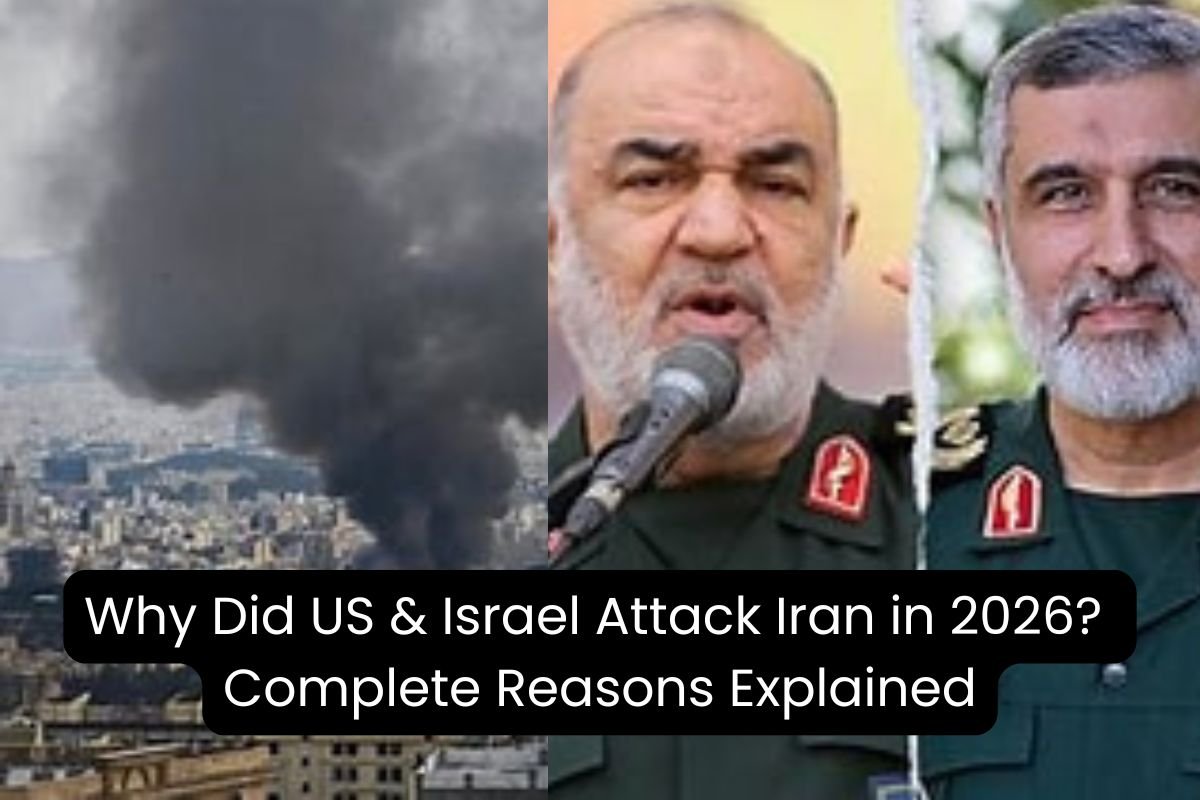
On February 28, 2026, the world woke to a different Middle East. Explosions lit up the night sky over Tehran. Air raid sirens wailed across Iranian cities. Communications went dark. Within hours, news emerged that Supreme Leader Ayatollah Ali Khamenei had been killed in the strikes, and the United States and Israel had launched their most ambitious military operation against Iran in decades .
Reason 1: The Nuclear Impasse—When Diplomacy Hit a Wall
At the heart of the conflict lies Iran’s nuclear program—a source of tension for over two decades. By early 2026, US and Israeli intelligence assessed that Tehran was dangerously close to having enough material for a nuclear bomb .
The Geneva Talks That Went Nowhere
Just days before the strikes, Omani mediators announced what looked like a breakthrough in Geneva. Iran had reportedly agreed to “zero uranium stockpiling” and full IAEA verification . But neither Washington nor Jerusalem trusted the deal.
The United States had taken a hardline position: demanding that Iran surrender all enriched uranium, dismantle key nuclear facilities, and accept unrestricted inspections . For Iran, which views its nuclear program as a matter of national sovereignty and pride, this was a non-starter.
“The negotiations were completely a smokescreen,” said Tang Zhichao, a Middle East analyst at the Chinese Academy of Social Sciences . The massive US military buildup in the region—including a second aircraft carrier—was already in place. “This was a carefully planned result. It shows that the United States and Israel have completely lost hope in negotiations.”
Why the US Shifted from Dialogue to Force
The United States had historically preferred engagement with Iran, applying sustained diplomatic pressure to extract concessions . But by February 2026, that approach had run its course. US negotiators—including Middle East envoy Steve Witkoff and Jared Kushner—returned from Geneva deeply disappointed. Iran’s position largely adhered to its established framework: refusing to abandon nuclear development, making no substantive concessions on transferring highly enriched uranium, and continuing to reject discussions of its missile technology and regional policies .
President Donald Trump set a 10-15 day deadline for meaningful diplomatic progress. When that deadline passed with no breakthrough, the military option was activated .
Reason 2: The US-Israel Dynamic—Convergence After Years of Divergence
For years, the United States and Israel had disagreed on how to handle Iran. Washington preferred communication and engagement. Israel, viewing Iran as an existential threat, advocated for decisive military pressure .
Israel’s Long Campaign
Israel had spent the previous two years systematically dismantling Iran’s proxy network—crushing Hamas in Gaza, severely degrading Hezbollah in Lebanon, and watching the Assad regime fall in Syria . With Iran’s “Axis of Resistance” shattered, Prime Minister Benjamin Netanyahu saw a strategic window to strike at the source directly.
Netanyahu had long argued that diplomacy alone couldn’t stop Iran. The strikes, code-named “Roaring Lion” by Israel, were framed as pre-emptive self-defence against an existential threat .
Trump’s Shift Toward Israel’s Position
When Trump returned to office in 2025, he restored his “maximum pressure” campaign against Tehran while paradoxically opening direct negotiations—the first such talks since he pulled the US out of the JCPOA in 2018 . But by February 2026, Trump had moved decisively toward Israel’s harder line.
The joint operation, with US forces playing the main role (in contrast to June 2025, when Israel led the strikes), marked a significant shift. Analysts note that while the two allies’ objectives are more aligned now than ever, they still differ in emphasis: Israel wants to completely eliminate Iran’s strategic threat across nuclear, missile, and proxy dimensions, while Trump primarily wants to eliminate the nuclear threat—though he doesn’t rule out regime change if conditions are favorable .
Reason 3: Domestic Politics—Elections, Legitimacy, and Distraction
Wars aren’t always about foreign policy. Sometimes, they’re about votes.
Trump’s Calculation
The 2026 midterm elections were approaching, and Iran-related issues occupy a critical place in US foreign policy and national security discourse . By taking a strong stance on Iran—either by weakening its strategic capabilities through military means or by pressuring it into greater concessions—the administration could bolster its diplomatic and governance credibility.
Trump framed the operation in sweeping, historic terms. In a video message, he listed grievances stretching back to the 1979 Islamic Revolution, which turned Iran from one of America’s closest allies into one of its most persistent enemies . His stated goals were extraordinary: destroy Iran’s nuclear program, obliterate its missile industry, sink its navy, and trigger regime change from within .
He addressed the Iranian public directly: “The hour of your freedom is at hand. When we are finished, take over your government. It will be yours to take.”
This was not just a military strike. It was a political bet from a president who campaigned on ending foreign wars but chose to launch arguably the most consequential US military operation since Iraq in 2003 .
Netanyahu’s Unfinished Business
For Netanyahu, the political timing was equally significant. With Israeli elections approaching in October 2026, demonstrating resolve in safeguarding national security helps consolidate support from the right-wing political base . It also diverts attention from domestic pressures such as corruption allegations .
Sun Taiyi, a political scientist at Christopher Newport University, noted that “domestic political considerations cannot be ignored, with Netanyahu having strong incentives to sustain a posture of external confrontation, which can consolidate political support and prolong his governing viability” .
Reason 4: Iran’s Weakened Position—A Window of Opportunity
For Washington and Tel Aviv, the strategic calculus included a hard-headed assessment: Iran had never been weaker.
The Collapse of the “Axis of Resistance”
Over the previous two years, Israel had systematically dismantled Iran’s proxy network. Hamas was crushed in Gaza. Hezbollah was severely degraded in Lebanon. The Assad regime in Syria had fallen . For years, Iran had funded and armed these groups as its first line of defence and offensive reach. By early 2026, most of those tools were gone.
Economic Collapse and Domestic Unrest
Inside Iran, the situation was dire. The economy was in freefall, the rial had collapsed, basic goods were scarce, and nationwide protests in January had been met with a brutal crackdown that left thousands dead . US-based group HRANA reported over 7,000 verified deaths, with thousands more under review .
Trump seized on this in his messaging, citing Iran’s killing of “tens of thousands of its own citizens on the street as they protested” as a justification for intervention . Donald Heflin, a veteran diplomat and professor at Tufts University’s Fletcher School, noted that this provides “a bit of a fig leaf”—an excuse to sell the intervention to the Iranian people and the world .
The “Rally ‘Round the Flag” Risk
However, Heflin also warned of a familiar dynamic: when bombs start falling, populations often rally around their government, even one they were protesting days earlier . Whether the strikes would weaken the regime or strengthen it remained an open question.
Reason 5: Regime Change—The Unspoken but Clear Goal
While US officials publicly framed the strikes as defensive, aimed at neutralizing “imminent threats,” analysts argue that leadership change is now the primary objective .
Trump’s direct call for Iranians to “take over your government” and reports that Supreme Leader Khamenei’s residence was specifically targeted make this clear . The operation marks a break from last year’s strikes, which primarily focused on Iran’s nuclear facilities. This time, the scale and targets have clearly expanded to include political leadership .
Can It Work?
Experts are sceptical. Heflin points to US history in the region: during the 1990-1991 Gulf War, the US encouraged Iraqis to rise up against Saddam Hussein, then stopped short of attacking Baghdad. “That has not been forgotten in Iraq or surrounding countries,” he says. “I would be surprised if we saw a popular uprising in Iran that really had a chance of bringing the regime down” .
The regime, despite its weaknesses, remains tightly controlled and heavily armed. Even if top leaders are eliminated, the most likely successor is the Revolutionary Guard—hardcore true believers who may be no easier for the US to work with .
The Fallout: A Region on the Brink
Iran retaliated quickly, launching missiles at dozens of US military bases across the Middle East and targeting Israeli facilities . Explosions were reported in Qatar, the UAE, Bahrain, and Kuwait . Dubai International Airport shut down .
The conflict carries much higher risks than last year’s 12-day war, with two US carrier strike groups in the region signalling heightened readiness . Gulf states, some hit by Iranian retaliation on their own soil, now face difficult choices about where they stand .
Conclusion: The End of Diplomacy, The Beginning of Uncertainty
The strikes of February 28, 2026, represent the culmination of years of accumulated mistrust, failed diplomacy, and strategic impatience. The nuclear impasse proved unbreakable. The US-Israel policy gap finally converged. Domestic politics pushed leaders toward bold action. And a perceived window of opportunity—with Iran weakened and isolated—proved too tempting to resist.
What comes next is uncertain. Retaliation is already underway. The conflict could stabilise or expand. But one thing is clear: the world of February 27th no longer exists. And for the millions of people across the Middle East who woke to sirens and explosions, the consequences of this decision will unfold for years to come.
Frequently Asked Questions (FAQs)
1. Why did the US and Israel attack Iran specifically in late February 2026?
The immediate trigger was the collapse of nuclear talks in Geneva. US negotiators set a 10-15 day deadline for meaningful progress, and when Iran refused to make what Washington considered sufficient concessions on uranium enrichment and nuclear inspections, the military option was activated . The US had also completed a massive military buildup in the region, including a second aircraft carrier, making the strike operationally feasible .
2. Was the attack really about nuclear weapons, or was regime change the real goal?
Both. While preventing Iran from acquiring nuclear weapons was the stated primary objective, the scale and targets of the attack—including the confirmed killing of Supreme Leader Ayatollah Ali Khamenei—make clear that regime change is now a central goal . President Trump explicitly called on the Iranian people to “take over your government” .
3. How did Iran’s domestic situation contribute to the timing of the attack?
Iran entered 2026 in its weakest position in decades. The economy was in freefall, the rial had collapsed, and nationwide protests in January had been met with a brutal crackdown. Its proxy network (the “Axis of Resistance”) had been largely dismantled. US and Israeli strategists likely assessed this as a window of opportunity when Iran was too weak to mount an effective response .
4. What role did Israeli domestic politics play in the decision?
Significant. With Israeli elections approaching in October 2026, Prime Minister Netanyahu had strong incentives to demonstrate resolve against Iran’s perceived existential threat. Military action helps consolidate his right-wing political base and diverts attention from domestic pressures like corruption allegations .
5. How have Gulf countries responded to the crisis?
Gulf states are in a deeply uncomfortable position. While some like Saudi Arabia expressed solidarity with “targeted nations,” they also face Iranian retaliation on their own soil—with missiles striking near US bases in Bahrain, Qatar, and Kuwait. They must balance deterrence with de-escalation, maintaining security ties with the US while avoiding direct confrontation with Iran .