
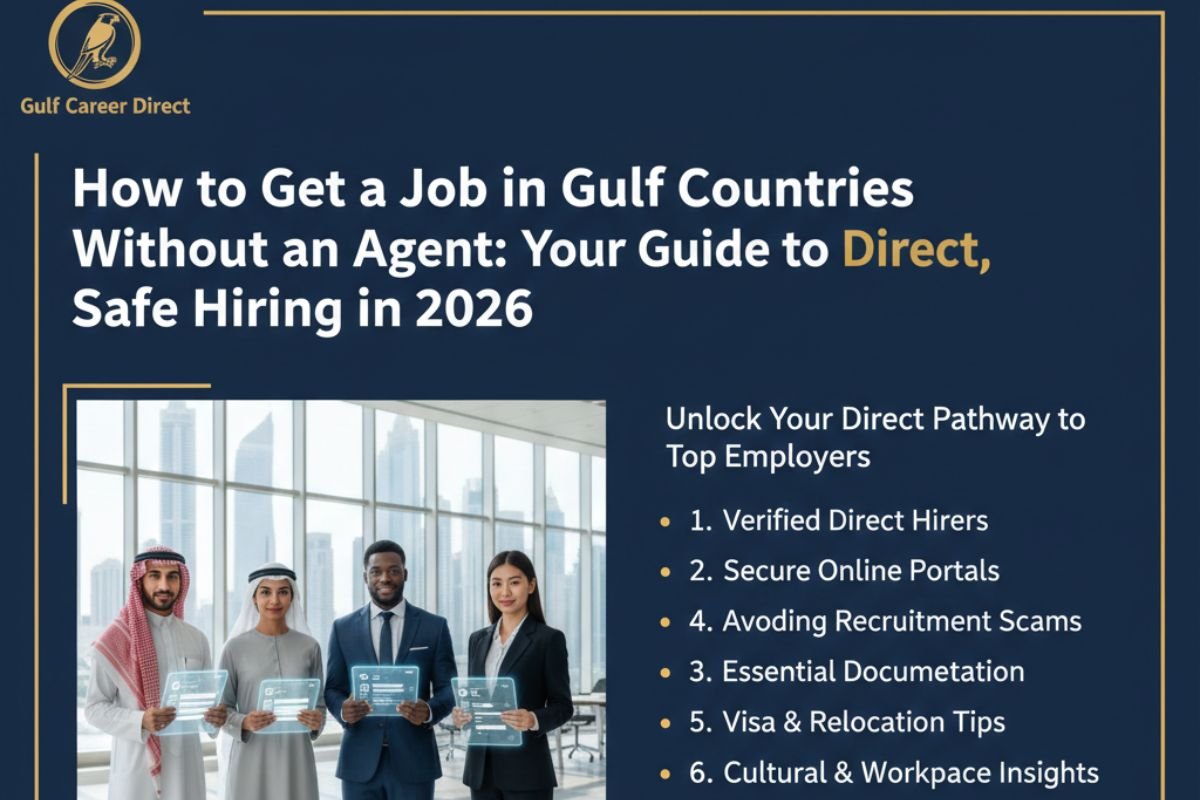
Landing a job in the Gulf Cooperation Council (GCC) countries—Saudi Arabia, UAE, Qatar, Kuwait, Oman, and Bahrain—is a major goal for professionals worldwide. However, the path is often perceived as complex, leading many to rely on recruitment agents. While reputable agents exist, the market is also rife with fraud. The good news is that securing a Gulf job directly, safely, and without paying exorbitant agent fees is entirely possible with the right strategy.
This comprehensive guide empowers you to navigate the Gulf job market independently, teaching you how to identify legitimate opportunities, apply effectively, and avoid scams, putting you in control of your career destiny.
Why Go Direct? The Benefits of Bypassing Agents
- Cost Savings: You avoid paying hefty placement fees, which can range from one month’s salary to exorbitant illegal amounts.
- Direct Communication: You build a relationship directly with your future employer, leading to clearer expectations.
- Greater Control: You choose the companies you apply to based on your research, not an agent’s limited portfolio.
- Avoiding Scams: You eliminate the risk of dealing with fraudulent agents who fabricate jobs, charge for visas that don’t exist, or place you with the wrong employer.
- Better Job Matching: You can target roles that truly fit your skills and career goals, rather than being pushed into any available vacancy.
Step-by-Step Strategy: Landing a Gulf Job on Your Own
Phase 1: Preparation & Research (The Foundation)
1. Get Your Documents ‘Gulf-Ready’:
This is non-negotiable and your first task.
- CV/Resume: Format it for the Gulf. It should be 2-3 pages max, professional, without a photo (unless specifically requested), and free of personal details like age or religion. Focus on quantifiable achievements.
- Educational & Professional Attestation: Research the attestation process for your target country. Generally, degrees and professional certificates need attestation from your Home Country’s Foreign Ministry and the Embassy of the target Gulf country. Start this process early, even before you have an offer, as it can take weeks.
- Police Clearance Certificate: Obtain a clean record from your home country; it will also need attestation later.
2. Deep Dive into Target Companies & Sectors:
Don’t just spray applications. Be strategic.
- Identify In-Demand Sectors: Focus on areas with real skill shortages: Healthcare, Engineering (especially for mega-projects), Education, Technology, and Finance.
- Create a Target List: Identify 20-30 specific companies you want to work for. These could be:
- Government-Linked Entities: NEOM, Red Sea Global (KSA), Mubadala, ADNOC (UAE), QatarEnergy.
- Large Local Conglomerates: Al-Futtaim, Alshaya, Olayan.
- Reputable Multinationals: Every major international company has a Gulf presence.
- Research Thoroughly: Understand their projects, values, and recent news. This will make your application stand out.
Phase 2: The Direct Job Search (Where to Look)
1. LinkedIn – Your Most Powerful Tool:
- Optimize your profile with keywords for your role and target location (e.g., “Project Manager Riyadh”).
- Use the ‘Jobs’ tab: Set your location to your target Gulf city and use filters.
- Follow your target companies. They often post vacancies on their LinkedIn page first.
- Connect directly with recruiters and hiring managers in your field. Send a personalized connection request referencing a specific role or their company’s work.
2. Official Company Career Portals:
This is the gold standard for direct applications.
- Go to the official website of every company on your target list.
- Navigate to the “Careers,” “Join Us,” or “Vacancies” section.
- Create a profile and apply for relevant roles. This ensures your application goes directly to the company’s HR or hiring manager.
3. Reputable Gulf Job Portals (Not Agent Sites):
Use platforms where employers post directly.
- Bayt.com: The leading regional job board.
- GulfTalent.com: High-quality listings, often from direct employers.
- LinkedIn Jobs: As mentioned.
- Naukrigulf.com: Another established player.
- Caution: Be wary of niche sites that look unprofessional or are dominated by agency postings.
4. Professional Networking & Referrals:
- Attend international industry conferences (often virtual) where Gulf companies recruit.
- Leverage alumni networks from your university who may be working in the Gulf.
- A referral from a current employee is the most effective way to get an interview. Don’t be afraid to ask your network politely.
Phase 3: The Application & Interview Process
1. Tailor Every Application:
- Your cover letter must explain why you want to work in that specific country and for that specific company. Mention a project or value you admire.
- Clearly state: “I understand the visa sponsorship process and have begun preparing my documents (e.g., degree attestation).” This shows you are serious and informed.
2. Ace the Digital Interview:
- Interviews will be via Zoom/Teams. Dress professionally as you would in-person.
- Research common Gulf interview questions. Be prepared to discuss: your adaptability to a new culture, your long-term plans, and your understanding of the local business environment.
- Have intelligent questions ready about the role, team, and company’s future in the region.
3. Understand the Legitimate Offer & Process:
A genuine offer will include:
- A detailed employment contract outlining your position, duties, full compensation breakdown (basic salary, housing allowance, transportation, flights), gratuity, and working hours.
- The company will never ask you to pay for your visa or work permit. All government fees are the sponsor’s responsibility.
- They will guide you through the official process: signing the contract, applying for the work permit (e.g., Qatar’s MoI, Saudi’s Qiwa, UAE’s MoHRE), and your subsequent entry visa application at the nearest embassy.
Red Flags: How to Spot and Avoid Job Scams
Protecting yourself is paramount. If you encounter any of these, walk away immediately.
- Any Request for Upfront Payment: Legitimate employers NEVER ask candidates to pay for visas, processing fees, “admin charges,” or “visa insurance.” This is the #1 scam.
- Unprofessional Communication: Email addresses from free domains (Gmail, Yahoo) instead of a company domain, poor English, and grammatical errors.
- Vague Job Details: The offer is vague, the company name is unclear, or they cannot provide a proper contract.
- Pressure Tactics: Urging you to pay quickly to “secure” the visa or position.
- The “Tourist Visa” Scam: Being told to enter the country on a tourist visa with a promise to convert it to a work visa inside. This is illegal in all GCC countries. A proper work visa must be issued from your home country before you travel.
- Verification Failure: You cannot verify the company’s physical address, landline number, or commercial registration online through the official government portal of the respective country.
What to Do If You Suspect a Scam
- Stop All Communication.
- Do Not Send Money or Personal Documents (like passport copies) beyond an initial CV.
- Report It: Report the fake company/agent to the official authorities in the target Gulf country (e.g., UAE’s Ministry of Human Resources and Emiratisation, Saudi’s Ministry of Human Resources).
- Warn Others: Post about your experience on professional forums to alert fellow job seekers.
Conclusion: Empowerment Through Due Diligence
Getting a job in the Gulf without an agent requires more upfront effort in research and preparation, but it grants you safety, savings, and sovereignty over your career path. By treating your job search as a professional project—focusing on direct applications to verified companies, preparing your documents meticulously, and maintaining a healthy skepticism—you can successfully navigate the market and secure a legitimate, rewarding opportunity.
The Gulf is full of genuine employers desperately seeking skilled talent. Your ticket is not an agent’s fee; it’s your expertise, your professional approach, and your informed diligence. Take control and apply directly—your future in the Gulf awaits.
5 Frequently Asked Questions (FAQs)
1. Is it really possible to get a Gulf job without an agent?
Absolutely. Thousands of professionals do it every year. Major corporations, government entities, and reputable private companies all hire directly through their career portals and platforms like LinkedIn. They have professional HR departments to handle the visa process. Agents are often used for bulk hiring in specific sectors (e.g., hospitality, retail) or for hard-to-fill niche roles, but they are not a mandatory gateway.
2. What is the most important document to prepare in advance?
Start the attestation process for your highest educational degree immediately. This process—involving notarization, your home country’s foreign ministry, and the embassy of the target Gulf country—is universally required and can take the longest. Having it ready makes you a more attractive, “low-friction” candidate for employers.
3. How can I verify if a Gulf company is legitimate?
Search for the company’s official Commercial Registration (CR) number. A legitimate company will provide it.
Use the official government business directories: UAE’s Ministry of Economy ‘Verified’ platform, Saudi’s ‘Qawaem’ platform, Qatar’s Ministry of Commerce portal.
Check for a professional website, a physical address, and landline contact numbers. Be skeptical of PO Boxes only.
4. I received a job offer via WhatsApp/Telegram. Is this normal?
This is a major red flag. While initial informal contact may happen on these apps, all formal communication—especially the job offer, contract, and visa process—must come through official company email channels and documented processes. Treat unsolicited offers on messaging apps with extreme caution; they are a common scam vector.
5. Who pays for the flight ticket and initial accommodation?
In a standard, legitimate employment package, your sponsoring employer pays for your initial flight ticket to the Gulf country. They should also either provide initial temporary accommodation (e.g., a hotel or company apartment) or give you a cash allowance to secure your own housing as part of your “joining benefits.” This should be clearly stated in your offer letter.