Gulf Careers Hub

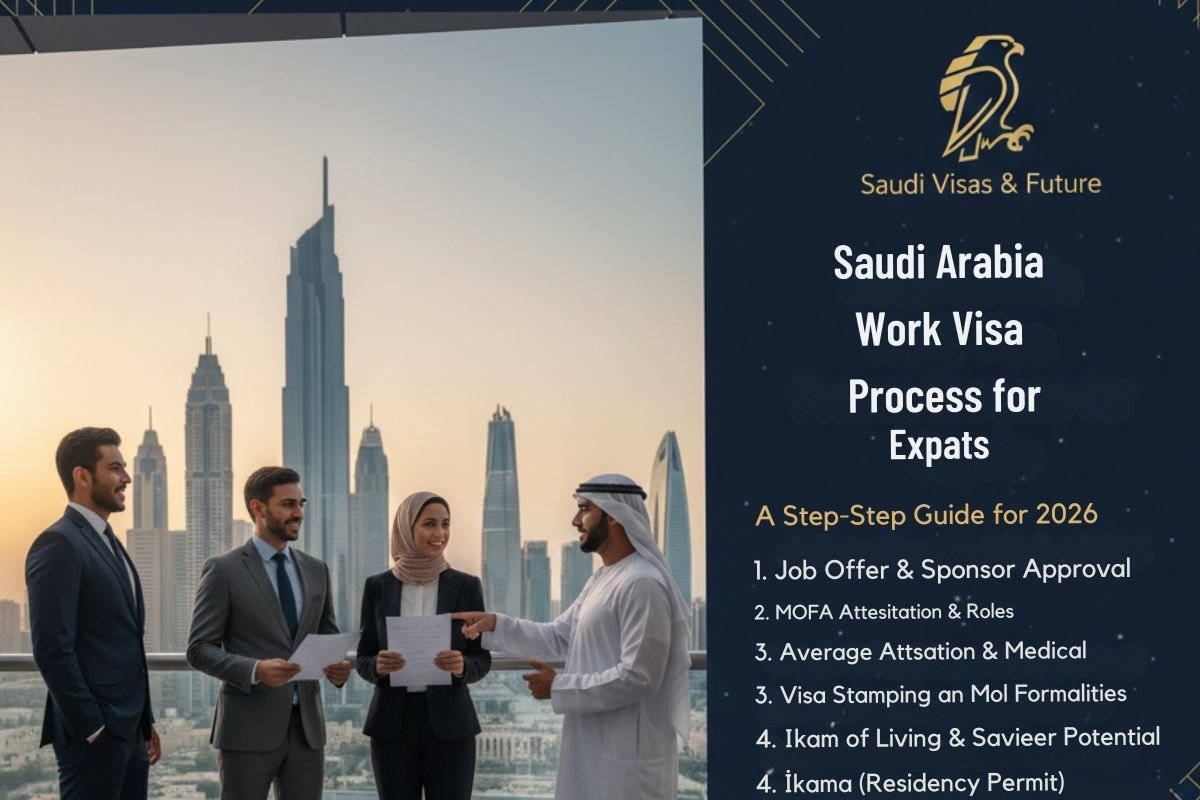
Saudi Arabia Work Visa Process for Expats: A Complete 2026 Guide

Saudi Arabia Work Visa Process for Expats

Securing a work visa for Saudi Arabia is the essential first step for expatriates aiming to build a career in the Kingdom. As Saudi Arabia accelerates its Vision 2030 transformation, opportunities for skilled professionals are expanding rapidly across sectors like construction, technology, healthcare, and tourism. However, navigating the visa process can seem complex.

This comprehensive guide breaks down the Saudi Arabia work visa process for expats in 2026, providing clear, step-by-step instructions, outlining the latest requirements, and offering expert tips to ensure a smooth application journey.

Understanding the Saudi Work Visa Landscape

The Saudi work visa, officially known as the Work Visit Visa (or Employment Visa), is your legal gateway to employment. It is tied to a specific employer and position. The process is highly systematic and relies heavily on the sponsoring employer, known as the “Kafeel.”

Key Players in the Process:

  1. The Expat Employee: You, the applicant.
  2. The Saudi Employer (Kafeel): Your sponsor, who must be a licensed entity in Saudi Arabia.
  3. The Ministry of Human Resources and Social Development (MHRSD): Issues work permits and labor approvals.
  4. The Ministry of Foreign Affairs (MoFA): Oversees visa issuance.
  5. The Saudi Embassy/Consulate: Where you submit your final application.

Step-by-Step: The Saudi Work Visa Process for Expats (2026)

The journey begins with your employer in Saudi Arabia and ends with a visa stamp in your passport. Here is the detailed flow:

Phase 1: Employer-Side Preparation (Initiated by Your Kafeel)

Step 1: Job Offer & Contract
You receive a formal, signed job offer from a Saudi company. Ensure the contract details are clear: position, salary, benefits, working hours, and contract duration.

Step 2: Labor Approval (Work Permit)

  • Your employer applies online through the MHRSD’s Qiwa platform.
  • They must demonstrate a genuine need for your role (proving no qualified Saudi candidate is available for the position, per Saudization rules).
  • Upon approval, the MHRSD issues a Work Permit (also called a Block Visa or Mission Number). This is pre-approval from the labor authorities.

Step 3: Visa Authorization

  • Your employer submits the Work Permit to the Ministry of Foreign Affairs (MoFA) for visa authorization.
  • Once approved, MoFA issues a Visa Authorization Number. This number is critical for the next phase.

Phase 2: Expat Application & Documentation

At this stage, your employer sends you the Visa Authorization Number and a copy of the company’s commercial registration (CR). You can now begin your part of the process.

Step 4: Gather Required Documents
You will need to prepare a precise set of documents, typically including:

  • Passport: Original passport, valid for at least six months beyond your application date, with at least two blank visa pages.
  • Visa Application Form: Completed online via the MoFA’s Enjaz platform or the KSA Visa Portal. Your employer usually provides the login details linked to the authorization number.
  • Photographs: Recent professional, passport-sized photos on a white background.
  • Employment Contract: Signed by you and your employer, attested by the Saudi Chamber of Commerce and the Ministry of Foreign Affairs.
  • Educational & Professional Certificates:
    • All academic degrees and professional qualifications (e.g., engineering licenses, nursing certificates).
    • These documents require legalization: attested by your country’s Foreign Ministry, the Saudi Embassy/Consulate in your home country, and finally by the Ministry of Foreign Affairs in Saudi Arabia upon arrival.
  • Police Clearance Certificate: A criminal record check from your home country (and sometimes from any country you’ve lived in for the past 5 years), attested similarly to your degrees.
  • Medical Reports: A comprehensive medical check-up from an approved medical center, confirming you are free from contagious diseases (like HIV/AIDS, Tuberculosis, Hepatitis B & C). This is often done after a visa is issued but before travel in some home countries.

Phase 3: Submission, Stamping, and Entry

Step 5: Submit to the Saudi Embassy/Consulate
Submit all your attested documents, passport, and application forms to the designated Saudi diplomatic mission (Embassy or Consulate) in your country of residence. You will pay the visa fee at this stage.

Step 6: Visa Stamping
The embassy processes your application, conducts any necessary verifications, and stamps the work visa in your passport. Processing times vary but average 1-4 weeks.

Step 7: Travel to Saudi Arabia
Once your visa is stamped, you are cleared to travel. Your visa is typically valid for entry for 90 days from the date of issue.

Phase 4: Post-Arrival Formalities in Saudi Arabia

Your visa process is not complete upon landing. You have crucial steps to finalize within your first weeks.

Step 8: Medical Check in Saudi Arabia
Within 10 days of arrival, you must undergo another medical test at an accredited health center in Saudi Arabia (this often includes fingerprinting and biometrics).

Step 9: Fingerprinting & Biometrics
You will visit the Passport Office (Jawazat) or a designated center to provide fingerprints and biometric data for your residence permit.

Step 10: Issuance of Iqama (Residence Permit)
After passing the local medical and biometrics, your employer applies for your Iqama. This is your national ID card in Saudi Arabia, proving your legal residency and right to work. It includes your Unified Number and must be carried at all times.

Step 11: Getting Your Work Permit Card
The final step is the physical Work Permit Card, issued by MHRSD, which you should keep with your Iqama.

Key Changes and Trends for 2026

  • Digitalization & Qiwa Platform: The entire process is increasingly paperless and managed through the Qiwa and Absher platforms. Expats must activate their Absher accounts (with employer sponsorship) to manage services.
  • Premium Residency (Privileged Iqama): For high-net-worth individuals and investors, Saudi Arabia now offers a Premium Residency scheme, which provides greater flexibility and independence from a specific employer/sponsor.
  • Family Visa Regulations: Rules for sponsoring dependents (spouse and children) are becoming more streamlined, often linked to your profession and salary threshold (usually a minimum monthly salary of SAR 3,500-5,000).

Common Challenges & How to Avoid Them

  1. Document Attestation Delays: Start the attestation process for your degrees and police clearance immediately upon receiving your job offer. It is the most time-consuming step.
  2. Medical Test Failures: Ensure you are in good health and aware of the medical requirements. A positive test for a prohibited disease will result in immediate deportation.
  3. Miscommunication with Employer: Maintain clear, regular communication with your HR or PRO (Public Relations Officer) in Saudi Arabia. They are your guide.
  4. Using the Wrong Visa Type: Ensure your employer applies for the correct Work Visit/Employment Visa, not a Tourist or Business Visa.

Conclusion

The Saudi work visa process for expats is a structured, employer-driven procedure that demands accuracy and patience. While it involves multiple steps across different ministries, understanding the flow—from the Qiwa platform labor approval to the final Iqama issuance—empowers you as an applicant.

Success lies in partnering with a reputable employer, meticulously preparing and attesting your documents, and staying informed about the latest digital procedures. As Saudi Arabia continues to open its doors to global talent under Vision 2030, a smooth visa process is your first step toward a rewarding career in one of the world’s most dynamic economies.

5 Frequently Asked Questions (FAQs)

1. Can I apply for a Saudi work visa without a job offer?

No. It is impossible. A Saudi work visa is 100% employer-sponsored. You must have a signed employment contract with a licensed Saudi company (your Kafeel or sponsor) to begin the process. They initiate and manage the majority of the application.

2. How long does the entire Saudi work visa process take?

From job offer to receiving your Iqama, the process typically takes 2 to 4 months. The timeline varies based on document attestation speed in your home country, embassy processing times, and your employer’s efficiency. The post-arrival steps to get the Iqama take about 3-4 weeks.

3. What is the difference between the Visa, Iqama, and Work Permit?

Work Visa: The sticker in your passport allowing you to enter Saudi Arabia for employment.
Iqama: Your residency identity card issued after you arrive, proving your legal status to live and work.
Work Permit: The official authorization from the MHRSD that allows you to perform a specific job for your sponsor.

4. Can I change jobs in Saudi Arabia on a work visa?

Yes, but the process (called transfer of sponsorship) has specific rules. You generally need your current employer’s consent (a No Objection Certificate or NOC), or you must complete a certain period of service (often one year) to transfer without consent under newer labor reforms. The new employer must initiate a new visa process.

5. Can my family join me in Saudi Arabia?

Yes, expats meeting a minimum salary requirement (usually SAR 3,500-5,000 per month, depending on the employer’s policy) can sponsor their spouse and children. You apply for family visit visas initially, which are then converted to dependent residency (Iqama) after they arrive and complete medicals.
How to Apply for Saudi Jobs Remotely in 2026: A Complete Guide to Online Success

How to Apply for Saudi Jobs Remotely in 2026

Master the process of applying for Saudi jobs online in 2026. Learn the best platforms, how to tailor your application, ace virtual interviews, and navigate visa sponsorship from abroad. Your ultimate guide to launching a remote job search for the booming Saudi market.


The Kingdom of Saudi Arabia is not just opening its doors to the world; it’s actively seeking global talent to power its unprecedented transformation. With mega-projects like NEOM, the Red Sea Project, and Qiddiya reshaping the nation’s skyline and economy under Vision 2030, opportunities are exploding across sectors. In 2026, the ability to apply for and secure these jobs remotely is not just an advantage—it’s the standard. This comprehensive guide provides you with a proven step-by-step strategy to navigate the Saudi job market from anywhere in the world.

Why Saudi Arabia is Actively Recruiting International Talent in 2026

Vision 2030 is more than a blueprint; it’s an economic engine. The Kingdom’s strategic shift away from oil dependence has ignited demand for skilled professionals in:

  • Giga-Projects & Construction: Engineering, project management, architecture.
  • Technology & Digital Transformation: AI, cybersecurity, data science, software development.
  • Tourism, Hospitality & Entertainment: From luxury resort management to event planning.
  • Financial Services & FinTech: Banking innovation and financial consulting.
  • Healthcare & Life Sciences: Building a world-class medical sector.
  • Renewable Energy & Sustainability: Leading the green transition in the region.

For international applicants, this means a market ripe with opportunity, competitive tax-free salaries, and the chance to be part of a historic national transformation.

Part 1: The Foundation – Preparing for Your Remote Application

1. Understand the Saudi Work Culture & Nuances

Before you apply, understand the context. Saudi workplaces are professional, hierarchical to a degree, and value respect, relationship-building (wasta, though evolving), and formal communication. Research the company culture meticulously. Is it a traditional Saudi conglomerate, a giga-project start-up, or a multinational branch? Tailor your approach accordingly.

2. Get Your Documents “Saudi-Ready”

Having these documents prepared in a digital, polished format is non-negotiable:

  • Internationally-Standardized CV: Unlike a creative resume, Saudi recruiters prefer detailed, chronological CVs. It should be 2-3 pages, include a professional photo, your date of birth, nationality, and marital status (common expectations). Clearly list all qualifications with dates.
  • Digitally Certified Credentials: Have scanned, clear copies of your:
    • Educational Certificates (degree, transcripts)
    • Professional Certifications
    • Passport (valid for at least 6 months)
    • Previous experience/attestation letters (highly valued)
  • Compelling Cover Letter: Must be customized for each application. Articulate not just what you offer, but also why you want to work in Saudi Arabia and contribute to Vision 2030. Show you’ve done your homework.

3. Craft a Saudi-Optimized LinkedIn Profile

Your LinkedIn is your digital handshake. For Saudi recruiters, it’s a primary tool.

  • Headline & About Section: Use keywords like “Seeking opportunities in KSA,” “Vision 2030,” “NEOM,” or your industry plus “Saudi Arabia.”
  • Profile Photo: Professional, conservative, and high-quality.
  • Experience: Elaborate on achievements with metrics. Connect your skills to sectors booming in KSA.
  • Endorsements & Recommendations: Actively seek them to build credibility.
  • Set Your Profile to “Open to Work” and select Saudi Arabia as your target location.

Part 2: The Action Plan – Where and How to Apply Online

Step 1: Target the Right Job Portals

Not all job boards are created equal for the Saudi market.

  • Primary Platforms:
    • LinkedIn Jobs: The #1 platform for professional and multinational roles. Use advanced filters for location “Saudi Arabia” and “Remote” (if applicable).
    • Bayt.com & GulfTalent: The regional giants. Most Saudi HR departments actively use these. Ensure your profile is 100% complete.
  • Niche & Direct Channels:
    • Company Career Pages: This is crucial. Identify the top 20 companies in your field (e.g., Aramco, SABIC, NEOM, Red Sea Global, STC, Almarai) and bookmark their career portals. Set up job alerts.
    • Giga-Project Career Portals: Websites for NEOMRed Sea GlobalQiddiyaROSOHN, etc., have dedicated career sections. Apply directly here for the most cutting-edge roles.
    • Government Platforms: The Ministry of Human Resources and Social Development (MHRSD) website provides resources and links to the “Qiwa” platform for labor-related services.

Step 2: Master the Application Process

  1. Tailor Every Single Application: Use keywords from the job description in your CV and cover letter. Saudi job descriptions often list very specific requirements.
  2. Follow Instructions Precisely: If they ask for information in a certain format or on their portal, comply exactly. This tests your attention to detail.
  3. Leverage Your Network: Use LinkedIn to identify recruiters or hiring managers in your target Saudi companies. A polite, informative connection request or InMail referencing a specific role can get you noticed.
  4. Consider Recruitment Agencies: Reputable international and local agencies (like Michael Page, Hays, or Pedersen & Partners) have major contracts to fill roles in KSA. Register with those specializing in your industry.

Step 3: Ace the Virtual Interview Process

The remote hiring process typically involves 3-5 rounds.

  • Initial Screening (Phone/Video): Often with HR or a recruiter. Be prepared to discuss your CV, motivation for moving to KSA, salary expectations, and availability.
  • Technical/Line Manager Interview: This is the core. You will be assessed deeply on your skills. Use the STAR (Situation, Task, Action, Result) method to structure your answers. Have concrete examples ready.
  • Final Interview with Senior Management: Focuses on cultural fit, long-term vision, and alignment with company goals. Demonstrate your understanding of the Saudi market and your role within it.
  • Practical Tests or Presentations: Be prepared for online assessments, case studies, or being asked to prepare a presentation.

Virtual Interview Tips for Saudi Roles:

  • Test Your Tech: Ensure a stable internet connection, professional background, and good lighting.
  • Dress Professionally: Business attire is expected, even remotely.
  • Be Punctual: Saudi time is GMT+3. Confirm the time zone.
  • Show Respect: Use titles (Mr., Ms., Dr.), listen carefully, and avoid interrupting.
  • Have Questions Ready: Ask about team structure, project impact, and support for expatriate relocation.

Part 3: The Final Hurdle – Understanding Visa & Relocation

Securing the job offer is a monumental step, but the process isn’t over.

  • The Visa Sponsorship Process: Your Saudi employer will act as your sponsor. They will initiate the IQAMA (resident permit) process. This involves:
    1. Work Visa Authorization: The company obtains approval from the MHRSD.
    2. Medical Check & Biometrics: You will complete these at a Saudi embassy/visa center in your home country.
    3. Final Entry Visa & IQAMA: Upon arrival in KSA, your employer facilitates the final medical check and issuance of your IQAMA.
  • Key Document: You will sign a standard Saudi employment contract in Arabic and English. Have it reviewed carefully, noting the contract duration, probation period, salary (in SAR), working hours, annual leave, and end-of-service benefits.
  • Relocation Support: Most reputable companies offer a comprehensive relocation package, including flights, temporary housing, and shipment allowance. Negotiate this if it’s not initially offered.

FAQs for Applying to Saudi Jobs Remotely in 2026

 Is it really possible to get a Saudi job offer without being in the country?

Absolutely, yes. The vast majority of professional international hires for Saudi Arabia are completed entirely remotely. The entire process—from application and multiple interview rounds to the initial contract signing—is designed to be conducted online. Physical presence is only required for the final visa stamping and upon your first arrival in the Kingdom.

What are the most in-demand sectors for remote applicants in 2026?

The highest demand is in sectors critical to Vision 2030: Construction & Engineering (for giga-projects), Technology (AI, cybersecurity, software development), Tourism & Hospitality DevelopmentRenewable Energy & Utilities, and Advanced Manufacturing. Healthcare and FinTech are also consistently strong.

How do I handle salary negotiations from abroad?

Research is key. Use platforms like GulfTalent’s Salary SurveyBayt.com‘s salary reports, and LinkedIn insights to understand the market rate for your role, experience, and the specific city (Riyadh, Jeddah, NEOM). Negotiate your total package, which includes base salary (tax-free), housing allowance, transportation allowance, flight tickets, and education allowances for children. Be clear and professional in your discussions.

What are common mistakes to avoid in a Saudi job application?

Using a generic, non-detailed CV.
Not customizing your cover letter for Saudi and the specific company.
Being unaware of Vision 2030 and how your role contributes.
Inappropriate communication (too informal or overly direct).
Not having your documents (degree, experience letters) attested and ready for the later visa stage.

How long does the entire remote hiring-to-relocation process take?

The timeline can vary significantly. From first application to first day in the office, expect a process of 4 to 8 months. The interview stage may take 1-2 months. Once an offer is accepted, the visa and relocation process can take an additional 2-4 months, depending on government processing times and your personal document readiness. Patience and clear communication with your employer’s HR team are essential.

Your Roadmap to Success Starts Now

Applying for Saudi jobs remotely in 2026 is a structured process that rewards preparation, cultural awareness, and professional persistence. By strategically positioning yourself on the right platforms, crafting a compelling, Saudi-focused application, and navigating the virtual interview and visa process with knowledge, you place yourself at a tremendous advantage.

The Kingdom’s transformation is creating a once-in-a-generation career opportunity. Take the first step today. Update your LinkedIn, refine your CV, and begin your search on the platforms that matter. Your future role in Saudi Arabia awaits.

Post a Job Opening

Fill in the details below. Your job posting will be reviewed by our team.

Basic Information

Specify years of experience required

Location & Salary

Qualifications & Skills

Specify educational requirements
Separate skills with commas

Company Details

Job Details

Contact Information