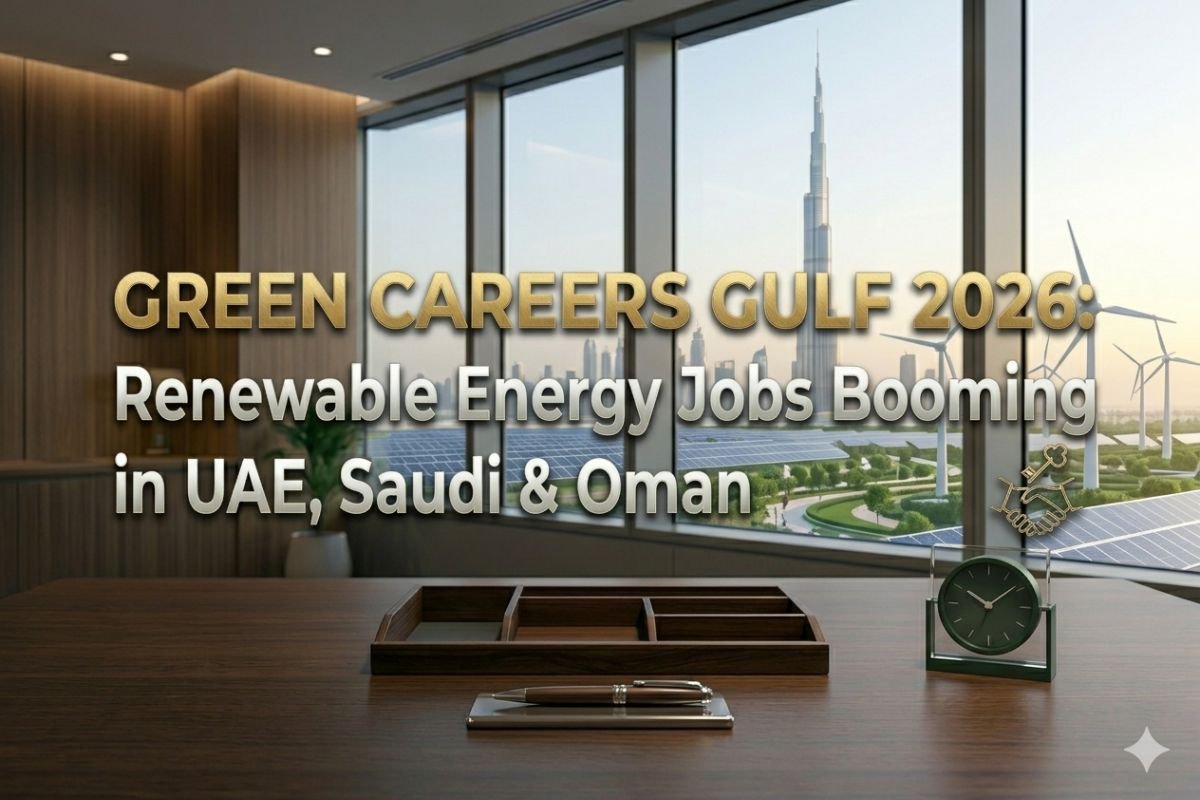
The Arabian Peninsula is undergoing a transformation that would have seemed impossible just a decade ago. While oil has long been the region’s economic lifeblood, 2026 marks a pivotal moment where green careers are no longer niche positions—they’re becoming the engine of employment growth across the Gulf Cooperation Council (GCC).
If you’re considering a career pivot or wondering where the next wave of opportunity lies, the renewable energy sector in the UAE, Saudi Arabia, and Oman deserves your attention. Here’s why this shift matters and where the jobs are actually opening up.
The Policy Push Driving This Boom
The UAE has positioned itself as the region’s clean energy leader through concrete policy frameworks. The National Energy Strategy 2050, updated in late 2024, now targets 50% clean energy in the national mix—up from the previous 44% goal. More significantly, the Emirates has mandated that all new government buildings achieve net-zero status by 2027, creating immediate demand for energy auditors, sustainable architects, and smart grid specialists.
Dubai’s Green Building Regulations have evolved beyond voluntary certifications. Since January 2026, commercial developments over 50,000 square meters must integrate renewable generation capacity equivalent to 15% of their projected energy consumption. This isn’t aspirational—it’s enforced through building permit approvals, meaning project delays occur without compliance.
Saudi Arabia’s approach operates at an entirely different scale. The Saudi Green Initiative and Vision 2030 aren’t merely environmental commitments; they’re economic diversification strategies with employment targets attached. The Kingdom has publicly committed to generating 50% of its electricity from renewable sources by 2030, requiring an estimated 175 gigawatts of installed capacity—up from negligible levels in 2020.
What makes this relevant for job seekers? The Human Resources Development Fund (Hadaf) has introduced specific subsidies for renewable energy employers, covering up to 50% of training costs for Saudi nationals entering solar, wind, and hydrogen sectors. The National Renewable Energy Program (NREP) now requires 30% local content in project development, forcing international developers to build local teams rather than fly in expatriate workforces.
Oman, often overlooked in regional energy discussions, has emerged as perhaps the most pragmatic player. The National Energy Strategy 2040 recognizes that the Sultanate’s oil reserves face depletion within two decades, creating genuine urgency. The Hydrogen Oman (HYDRO) initiative, launched in 2023, has accelerated beyond projections—Oman now targets 1 million tons annually of green hydrogen production by 2030.
The Oman Vision 2040 implementation follow-up unit has mandated that all new industrial zone developments in Duqm and Sohar include renewable energy training centers. This isn’t abstract planning; these facilities opened in late 2025 and are actively recruiting instructors and curriculum developers.
Where the Jobs Actually Are
Solar Energy: Beyond Installation
The solar sector remains the largest employer, but the nature of work has shifted. Utility-scale project development now dominates hiring in the UAE, with Mohammed bin Rashid Al Maktoum Solar Park’s Phase V completion requiring hundreds of project managers, grid integration specialists, and performance engineers.
In Saudi Arabia, the Sudair and Al Shuaibah solar projects—among the world’s largest single-site facilities—have moved from construction into operations and maintenance. This transition creates demand for predictive maintenance technicians using drone inspection and thermal imaging, SCADA system operators, and performance optimization analysts who can maximize output during dust storm conditions that plague the region.
Oman’s solar sector differs significantly. With less available land than its neighbors, the Sultanate focuses on agrivoltaics—combining agriculture with solar generation. This hybrid approach requires specialists who understand both crop science and photovoltaic systems, a genuinely rare skill combination commanding premium salaries.
Green Hydrogen: The Emerging Heavyweight
If solar represents today’s employment, green hydrogen represents tomorrow’s. The UAE’s Al Reyadah facility in Abu Dhabi has expanded operations, but the real growth lies in export infrastructure. The Abu Dhabi National Oil Company (ADNOC) and TAQA joint venture is constructing facilities specifically for European and Asian export markets, requiring liquefaction specialists, pipeline integrity engineers, and international certification managers who understand EU regulatory frameworks.
Saudi Arabia’s NEOM project contains Helios Green Fuels, arguably the world’s most ambitious green hydrogen facility. The project entered full production phases in early 2026, creating an estimated 3,000 direct positions in electrolyzer operations, desalination integration, and ammonia conversion for maritime transport.
The hiring profile here favors chemical engineers with process safety experience, electrolyzer maintenance technicians, and logistics coordinators familiar with hazardous material handling. NEOM’s unique governance structure—operating outside traditional Saudi regulatory frameworks—allows faster work visa processing for specialized technical roles.
Oman’s hydrogen strategy targets European export markets specifically, leveraging existing port infrastructure. The Port of Duqm is being retrofitted for hydrogen export, creating immediate demand for maritime safety inspectors, storage facility engineers, and customs specialists familiar with emerging international hydrogen trade standards.
Energy Storage and Grid Modernization
The intermittent nature of renewable generation has created an unexpected employment sector: battery storage and grid stabilization. The UAE’s Etihad Water and Electricity company has deployed grid-scale battery systems across the Northern Emirates, requiring battery management system technicians and grid stability analysts.
Saudi Arabia faces particular challenges given its geographical scale. The Saudi Electricity Company is implementing high-voltage direct current (HVDC) transmission lines connecting renewable generation in remote areas to consumption centers. This infrastructure build-out employs transmission line engineers, substation automation specialists, and grid protection relay technicians.
Circular Economy and Sustainable Construction
Perhaps the most accessible entry point for career changers lies in green building and sustainable materials. The UAE’s Estidama Pearl Rating System, mandatory for new developments in Abu Dhabi, requires sustainability consultants during design phases. These roles emphasize life-cycle assessment, embodied carbon calculation, and material sourcing verification—skills obtainable through certification programs rather than decade-long career tracks.
Saudi Arabia’s Saudi Green Building Forum has professionalized this sector, creating standardized job classifications for LEED AP and WELL AP certified professionals. The Riyadh Sustainability Week events now include dedicated career fairs where employers actively recruit for positions that didn’t exist five years ago.
Skills That Actually Get You Hired
After reviewing hundreds of job postings across these markets, certain patterns emerge. Technical certifications carry more weight than general degrees—specifically NABCEP (North American Board of Certified Energy Practitioners) for solar, Certified Energy Manager (CEM) for efficiency roles, and Project Management Professional (PMP) with energy sector specialization.
Language capabilities matter more than expected. While English dominates technical operations, Arabic proficiency differentiates candidates for roles involving regulatory compliance or government liaison. For Oman’s hydrogen export focus, French and German language skills provide genuine advantages given European partnership structures.
Digital literacy has become non-negotiable. Building Information Modeling (BIM) with energy analysis plugins, Python for data analysis in performance optimization, and drone operation licenses for inspection work appear repeatedly in job requirements.
The Reality Check
This growth isn’t without friction. Housing availability in remote project locations—particularly Saudi Arabia’s northern regions and Oman’s interior—remains problematic. Salary compression occurs as training programs graduate increasing numbers of local candidates, particularly affecting entry-level positions.
Regulatory uncertainty persists. While policy frameworks exist, implementation details—specifically grid connection standards and power purchase agreement structures—continue evolving. Professionals who can navigate ambiguity while maintaining technical competence find themselves rapidly promoted.
Looking Forward
The renewable energy employment boom in the Gulf isn’t a temporary construction spike. These economies are genuinely restructuring, and the skills being developed now—grid integration, hydrogen safety management, performance optimization in harsh climates—will prove transferable globally as other regions confront similar transitions.
For professionals considering relocation or career transition, 2026 offers unusual timing: the projects are funded and underway, the training infrastructure exists, and the regulatory frameworks have matured beyond experimental phases. The positions being advertised today represent operational roles rather than speculative planning positions.
The Arabian Gulf’s energy transition has moved from announcement to implementation. For those with relevant skills—or the capacity to develop them—the employment landscape has genuinely shifted.