Gulf Careers Hub

10 CV Mistakes That Get Your Application Rejected in the Gulf (And How to Fix Them)

CV Mistakes in Gulf Applications | Saudi Arabia & UAE CV Tips

The Gulf job market (UAE, Saudi Arabia, Qatar, Kuwait, Oman, Bahrain) is one of the most competitive in the world. Recruiters here spend an average of 10-15 seconds scanning a CV before deciding . In that time, specific mistakes can send your application straight to the rejection pile.

1. Sending the Same Generic CV to Every Job

The Mistake: Using one “master CV” for every application. Recruiters can spot this immediately—your CV doesn’t mention the specific skills or keywords from their job description.

Why It Gets Rejected: Gulf employers want to see that you’ve understood their specific requirements. A generic CV signals laziness or desperation .

The Fix: Create a tailored version for each application. Pull keywords directly from the job posting and weave them naturally into your professional summary and skills section.

2. Including Too Much Personal Information

The Mistake: Listing passport numbers, religion, marital status, age, or family details.

Why It Gets Rejected: This is considered unprofessional and irrelevant. It also creates potential bias issues .

The Fix: Stick to: Full name, phone number (with country code), professional email, city/country, and nationality. Visa status is acceptable and actually helpful.

3. Missing or Weak Career Summary

The Mistake: No summary at all, or vague lines like “Looking for a challenging opportunity to grow my skills.”

Why It Gets Rejected: Recruiters decide in seconds whether to keep reading. A weak opener gives them no reason to continue .

The Fix: Write 3-4 lines that state: your job title, years of experience, key industries, and what you bring. Example: “Bilingual marketing manager with 8+ years across retail and F&B in UAE and KSA. Specialized in digital campaigns and team leadership.”

4. Poor Formatting and Walls of Text

The Mistake: Long paragraphs, tiny fonts, inconsistent spacing, or overly creative designs with graphics and tables.

Why It Gets Rejected: Gulf recruiters scan, not read. Walls of text are exhausting. Fancy designs often break Applicant Tracking Systems (ATS) that many companies now use .

The Fix: Use clean, single-column layout. Professional fonts (Calibri, Arial, Roboto). Bullet points for achievements. Clear section headings. Save as PDF.

5. Listing Duties Instead of Achievements

The Mistake: “Responsible for managing a team” or “Handled customer queries.”

Why It Gets Rejected: This tells recruiters what you were supposed to do, not what you actually accomplished .

The Fix: Use numbers and results. “Managed a team of 12, increasing productivity by 25% in 6 months.” “Resolved 50+ customer queries daily with 95% satisfaction rate.”

6. Ignoring ATS Keywords

The Mistake: Using generic language that doesn’t match the job description.

Why It Gets Rejected: Many Gulf companies (especially in UAE and KSA) use Applicant Tracking Systems. If your CV lacks the keywords from the job ad, it’s filtered out before a human ever sees it .

The Fix: Study the job description. Identify 10-15 key terms (specific skills, software, certifications) and ensure they appear naturally in your CV.

7. Not Stating Visa Status or Availability

The Mistake: Leaving recruiters guessing about whether you’re locally available or need sponsorship.

Why It Gets Rejected: Gulf hiring is fast-paced. If a recruiter can’t immediately tell if you’re eligible to work, they move to the next candidate .

The Fix: Add a clear line: “Currently in Dubai on transferable visa” or “Based in UK, requires visa sponsorship” or “Available immediately.”

8. Spelling and Grammar Errors

The Mistake: Typos, inconsistent tenses, or mixing British and American English.

Why It Gets Rejected: It screams carelessness. For roles involving communication, it’s an automatic disqualifier .

The Fix: Use spell-check tools. Read your CV aloud. Ask a friend to proofread. Pay attention to “UAE” (not “uae”) and consistent spelling.

9. Outdated Phrases Like “References Available Upon Request”

The Mistake: Wasting valuable space on this line.

Why It Gets Rejected: It’s assumed references are available. Including this makes you look outdated and fills space that could showcase value .

The Fix: Remove it. Use that line for an additional achievement or certification.

10. Wrong Length (Too Long or Too Short)

The Mistake: 5+ page CVs for mid-level roles, or one page for senior executives with 15+ years.

Why It Gets Rejected: Recruiters don’t have time for novels. Too short suggests lack of substance .

The Fix: 1-2 pages is the sweet spot. Entry-level: 1 page. Experienced professionals: 2 pages. Senior executives: maximum 3 pages.

Bonus: The Correct Gulf CV Format Checklist

SectionWhat to Include
Contact InfoFull name, UAE/KSA phone, email, city, nationality, visa status
Professional Summary3-4 lines: who you are, key strengths, what you offer
Work ExperienceReverse chronological. Company, role, dates. Bullet points with achievements + numbers
SkillsTechnical + soft skills relevant to the role
EducationDegree, institution, year
LanguagesArabic/English proficiency levels
CertificationsRelevant to your field

The Bottom Line

Your CV is your first impression in the Gulf job market. In 2026, with competition fiercer than ever, these mistakes aren’t minor—they’re the difference between an interview and the rejection pile.

Take an hour today. Review your CV against this list. Be ruthless. Remove the fluff. Add the numbers. Make it recruiter-friendly.

Your next interview is one well-written CV away.
Frequently Asked Questions

1. Do I need to include a photo on my CV for Gulf jobs?

It depends. For customer-facing roles (hospitality, sales, aviation), a professional headshot can help. For most corporate and technical roles, photos are optional. If you include one, ensure it’s professional—business attire, neutral background .

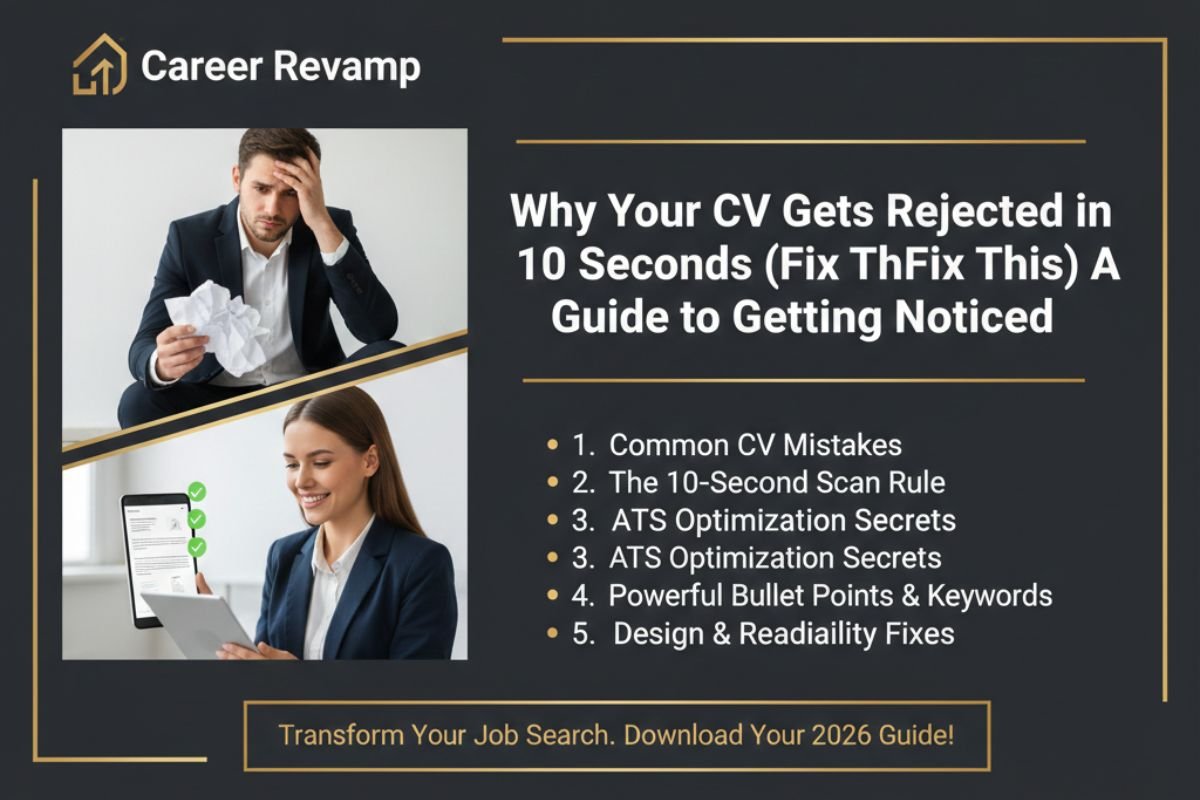
Why Your CV Gets Rejected in 10 Seconds (Fix This): A 2026 Guide to Getting Noticed

Why Your CV Gets Rejected

In today’s hyper-competitive job market, your CV isn’t just a document—it’s your first and often only chance to make an impression. Recruiters and hiring managers are overwhelmed with applications, spending an average of just 7 to 10 seconds on an initial scan before deciding “yes,” “no,” or “maybe.”

If your CV is consistently getting rejected without an interview, the problem is likely not your experience, but how you present it. Understanding the brutal reality of that 10-second scan is the key to fixing your resume and finally getting the callbacks you deserve.

This guide breaks down the fatal flaws that trigger instant rejection and provides actionable fixes to transform your CV into a powerful tool that survives the cut.

The 10-Second Reality: What Recruiters Actually See

In those critical seconds, a recruiter is not reading; they are pattern-matching. They are subconsciously asking a series of rapid-fire questions:

  • Does this look professional? (Formatting, typos)
  • What is this person’s current role and title?
  • Do they have the key skills I need? (Keywords)
  • Have they achieved anything? (Numbers, results)
  • Is there a logical career progression?

If the answers aren’t obvious, it’s a swift click to “Reject.” Here are the top reasons you’re failing that test.

Fatal Flaw #1: Poor Formatting & Visual Clutter

The Mistake: Dense paragraphs, inconsistent fonts, tiny margins, confusing layouts, unreadable headers, or an overly “creative” design that’s hard to parse.
Why It Gets Rejected: A cluttered CV is physically taxing to read. It signals a lack of attention to detail and makes it impossible for the recruiter to find key information quickly. If they have to work to understand your career, they won’t.
The Fix:

  • Use a clean, professional template. Stick to classic fonts like Calibri, Arial, or Garamond.
  • Embrace white space. Use margins of at least 1 inch and clear section breaks.
  • Create a clear visual hierarchy. Use consistent, bold headings (e.g., “Experience,” “Education”) and bullet points.
  • Keep it to 2 pages maximum for most professionals.
  • Save and send as a PDF to preserve formatting.

Fatal Flaw #2: No Clear “Professional Summary” or “Profile”

The Mistake: Launching straight into your work history with no context.
Why It Gets Rejected: The recruiter doesn’t know who you are or what you’re targeting. They have to piece it together, wasting precious seconds. A weak or absent summary fails to “hook” them.
The Fix:

  • Write a powerful 3-4 line summary at the very top.
  • Structure it as: [Your Title] with [X] years of experience in [Industry/Specialization]. Proven ability to [Key Achievement 1] and [Key Achievement 2]. Seeking to leverage skills in [Target Area] at [Target Company Type].
  • Example: *”Senior Digital Marketing Manager with 8+ years of experience driving growth in B2B SaaS. Proven ability to increase qualified leads by 150% and reduce CAC by 30%. Seeking to leverage data-driven strategy to scale the marketing function at a high-growth tech company.”*

Fatal Flaw #3: Listing Duties, Not Achievements

The Mistake: Bullet points that read like a copied job description: “Responsible for social media management… Duties included budget tracking… Handled client communication.”
Why It Gets Rejected: It tells the recruiter what you were supposed to do, not how well you did it. It’s generic and fails to differentiate you from every other candidate who held a similar title.
The Fix: Use the CAR or STAR Method.

  • Challenge: What was the problem or goal?
  • Action: What did YOU specifically do?
  • Result: What was the quantifiable outcome?
  • Transform “Responsible for social media” into: “Grew Instagram following by 40% (from 10K to 14K) in 6 months through a targeted UGC campaign and influencer partnerships, contributing to a 15% increase in website traffic from social channels.”

Fatal Flaw #4: Ignoring Keywords & Applicant Tracking Systems (ATS)

The Mistake: Using internal jargon or generic language that doesn’t match the job description.
Why It Gets Rejected: Up to 75% of CVs are rejected by ATS software before a human even sees them. These systems scan for specific keywords from the job description. No keywords = instant digital rejection.
The Fix:

  • Meticulously analyze the job description. Identify the hard skills, software, and certifications listed (e.g., “SEO,” “Python,” “PMP,” “Google Analytics 4”).
  • Naturally integrate these keywords into your Professional Summary, Skills section, and achievement bullet points.
  • Use standard job titles. If you were a “Growth Hacker,” but the ad says “Digital Marketing Manager,” consider using “Digital Marketing Manager (Growth)” as your title.

Fatal Flaw #5: Typos, Grammatical Errors, and Inconsistencies

The Mistake: A single typo, inconsistent date formatting (e.g., “Jan 2023 – Present” vs. “03/2022 – 02/2024”), or misplaced punctuation.
Why It Gets Rejected: This is the easiest reason to dismiss a candidate. It screams carelessness. If you can’t proofread the most important document of your career, how can they trust your work?
The Fix:

  • Read your CV aloud. Your ear will catch errors your eyes skip over.
  • Use tools like Grammarly or Hemingway Editor.
  • Ask a trusted friend or mentor to review it.
  • Check for consistency: Are all dates formatted the same way? Are bullet points parallel in structure?

Fatal Flaw #6: Irrelevant Information

The Mistake: Including hobbies, personal details (age, marital status, photo in most countries), or every single job you’ve had since high school.
Why It Gets Rejected: It wastes space and distracts from your core professional narrative. In some regions, personal details can introduce unconscious bias.
The Fix:

  • Be ruthless. Only include experience from the last 10-15 years unless earlier roles are highly relevant.
  • Omit hobbies unless they directly showcase a skill for the job (e.g., “Competitive coding” for a developer).
  • Never include: Photo (unless explicitly requested), date of birth, nationality, religion, or home address beyond city/country.

Fatal Flaw #7: A Weak or Missing Skills Section

The Mistake: A disorganized list of soft skills (“hard-working, team player, good communicator”) buried at the bottom.
Why It Gets Rejected: It doesn’t help with keyword scanning and adds no substantive value. Every candidate claims to be a “team player.”
The Fix:

  • Create a dedicated “Core Competencies” or “Technical Skills” section near the top.
  • Categorize skills: “Digital Marketing,” “Project Management,” “Programming Languages.”
  • List hard skills first: Software, tools, methodologies, languages.
  • Incorporate soft skills within your achievements: Show you’re a “leader” by stating you “led a team of 5,” not by just listing the word.

Your 10-Second CV Overhaul Checklist

Before you send another application, run your CV through this list:

  • Formatting: Is it clean, consistent, and easy to scan in 10 seconds?
  • Summary: Do the first 4 lines clearly state who I am and what value I offer?
  • Achievements: Does every bullet point start with a power verb and include a metric (%, $, #)?
  • Keywords: Have I integrated the key terms from the job description?
  • Proofreading: Is it 100% free of typos and grammatical errors?
  • Relevance: Have I removed all irrelevant personal info and outdated experience?
  • Skills: Do I have a clear, keyword-rich skills section?
  • Length: Is it a concise 1-2 pages?

Conclusion: From Rejected to Recruited

Your CV is not an autobiography; it’s a marketing document. Its sole purpose is to get you an interview. By shifting your mindset from “listing my history” to “proving my value,” and by ruthlessly eliminating the flaws that cause instant rejection, you can transform your CV from a passive list into an active career accelerator.

Stop being a victim of the 10-second scan. Master it. Implement these fixes, and watch your response rate change from silence to success.

5 Frequently Asked Questions (FAQs)

1. Is it okay to use a creative CV template for a corporate job?

Generally, no. For fields like finance, law, engineering, and most corporate roles, a clean, traditional format is safest. Creative templates can be difficult for ATS systems to parse and may be viewed as unprofessional. Save creative designs for industries like graphic design, marketing (sometimes), or the arts, where presentation is a direct reflection of skill.

2. Should I include a cover letter if it’s optional?

Yes, almost always. An optional cover letter is a massive opportunity to stand out. It allows you to connect your CV directly to the company’s needs, tell a story, and show genuine interest. It signals extra effort and can be the deciding factor between two similar CVs.

3. How far back should my work history go?

The standard rule is the last 10-15 years. Recruiters are most interested in your recent, relevant experience. You can summarize earlier career highlights in a single line (e.g., “Earlier career includes progressive roles in project management at X and Y companies.”) if space allows. Never go back to high school or unrelated part-time jobs.

4. What’s better: a one-page or two-page CV?

For professionals with under 10 years of experience, aim for one page. For those with over 10 years of significant, relevant experience, two pages is acceptable and often expected. The key is that every line on page two must be as compelling as page one. Never use two pages just to add fluff.

5. Can I use the same CV for every job application?

This is the #1 mistake. You must tailor your CV for every single application. This doesn’t mean a full rewrite, but you must adjust your Professional Summary and Keywords to mirror the specific job description. The 15 minutes it takes to tailor your CV can mean the difference between rejection and an interview.

What Is a Good CV Format for UAE Jobs in 2025? (Free Template)

Professional CV format for UAE jobs in 2025 on a desk in a modern Dubai office

Your CV is your first impression on recruiters in the competitive UAE job market. A well-formatted, targeted CV isn’t just a summary of your experience—it’s your marketing tool. The right format for 2025 is clean, professional, and tailored to both Applicant Tracking Systems (ATS) and human recruiters in the Gulf region.

This guide provides the optimal CV format for UAE jobs, complete with what to include, what to avoid, and a free template to download.

Quick Overview: UAE CV Essentials 2025

CategoryRecommendation
Length2 Pages Maximum
PhotoProfessional (Recommended)
File FormatPDF (Unless specified otherwise)
DesignClean, Professional, ATS-Friendly
Personal DetailsNationality, Visa Status, Location
Key SectionsContact Info, Profile Summary, Experience, Education, Skills
CustomizationTailor for each application

1. Personal Details & Contact Information

(Top of the first page)

  • Full Name (Large, bold font)
  • Professional Title (e.g., “Senior Project Manager”)
  • Phone Number (with international code: +971…)
  • Email Address (Professional, e.g., name.lastname@email.com)
  • Location (e.g., “Dubai, UAE” or “Relocating to Abu Dhabi”)
  • LinkedIn Profile URL (Customize your profile link)
  • Nationality (Important for visa purposes)
  • Visa Status (e.g., “Employment Visa,” “Visit Visa,” “Requiring Sponsorship”)

❌ Avoid: Date of birth, marital status, religion, father’s name. These are irrelevant and should not be included.

2. Professional Profile / Career Summary

*(A powerful 3-4 line pitch)*

This is your elevator pitch. Summarize your years of experience, industry expertise, key skills, and career goals. Use keywords from the job description you are targeting.

Example:

“Results-driven Digital Marketing Manager with 8+ years of experience in the GCC region, specializing in growth strategy, SEO, and social media management. Proven track record of increasing online revenue by over 30% for B2C brands. Seeking to leverage expertise to drive growth at a leading tech company in Dubai.”

3. Work Experience

(List in reverse chronological order)

  • Job Title (Bold)
  • Company Name, Location (City, Country)
  • Dates of Employment (Month, Year – Month, Year)
  • Key Responsibilities & Achievements (Use bullet points)
    • Start each point with a powerful action verb (e.g., Managed, Developed, Increased, Reduced, Led).
    • Quantify your achievements wherever possible (e.g., “Increased sales by 25%,” “Managed a team of 10,” “Reduced costs by AED 500,000″).

4. Education

(Keep it concise, especially for experienced professionals)

  • Degree Name (Bold) (e.g., Bachelor of Science in Computer Engineering)
  • University Name, City, Country
  • Year of Graduation
  • Relevant coursework/thesis only if you’re a recent graduate.

5. Skills

(A scannable section for keywords)

Categorize your skills to make them easy to find.

Example:

  • Technical Skills: Python, SQL, React, AWS, Google Analytics
  • Soft Skills: Leadership, Team Management, Client Relations
  • Languages: English (Native), Arabic (Conversational), Hindi (Fluent)

6. (Optional) Additional Sections

  • Certifications (Highly valuable in the UAE)
  • Projects (Great for tech and creative roles)
  • Awards & Recognition

UAE CV Template 2025 (Free Download)

➡️ Download Our Free ATS-Friendly UAE CV Template (Word Document)
(Note for you: You can create a simple, clean template in Google Docs/Word and offer it as a lead magnet for your audience to download in exchange for their email address.)


UAE CV vs. Global CV: Key Differences

FeatureUAE CV FormatStandard Global CV
PhotoRecommendedOften avoided
Personal DetailsNationality, Visa StatusUsually excluded
Length1-2 Pages1 Page (US Resume)
DesignProfessional, slightly more conservativeCan be more creative
Marital Status/AgeExcludeExclude

Do’s and Don’ts for Your UAE CV

✅ DO:

  • Tailor your CV for each job application using keywords from the job description.
  • Save your CV as a PDF to preserve formatting, unless asked for a Word document.
  • Use a clean, professional font like Calibri, Arial, or Helvetica (Size 11-12pt).
  • Be honest and accurate about your dates and achievements.
  • Include a cover letter tailored to the company.

❌ DON’T:

  • Use fancy graphics or tables. They often confuse ATS software.
  • Write in the first person (e.g., “I managed a team”). Use bullet points instead (“Managed a team…”).
  • Go over 2 pages. Recruiters spend seconds scanning a CV.
  • Leave gaps in your employment history. Explain any periods longer than 6 months.
  • Include irrelevant personal information.

Frequently Asked Questions (FAQ)

 Is a photo mandatory on a UAE CV?

While not always mandatory, it is highly recommended and expected for most customer-facing and corporate roles in the UAE. Use a professional, passport-style headshot.

Should I include my visa status?

Yes, this is crucial. It helps recruiters understand if you need visa sponsorship. Be clear: “Visit Visa,” “Employment Visa,” “Seeking Sponsorship.”

How far back should my work experience go?

Generally, list the last 10-15 years of relevant experience. There’s no need to detail every job you’ve had since university.

What is the best file name for my CV?

Use a professional format: YourName_CV_TargetJobTitle.pdf (e.g., Fatima_Ahmed_CV_Marketing_Manager.pdf).

How important is it to tailor my CV for each job?

Extremely important. Tweaking your professional profile and skills to match the job description significantly increases your chances of getting an interview.

Need help with your job search? Explore thousands of opportunities on our UAE Job Portal.


Author Bio:

About Gulf Careers Hub: We provide expert career guidance for professionals seeking opportunities in the UAE, Saudi Arabia, Qatar, and Oman. From CV writing tips to interview preparation, we help you navigate the Gulf job market.


Post a Job Opening

Fill in the details below. Your job posting will be reviewed by our team.

Basic Information

Specify years of experience required

Location & Salary

Qualifications & Skills

Specify educational requirements
Separate skills with commas

Company Details

Job Details

Contact Information