
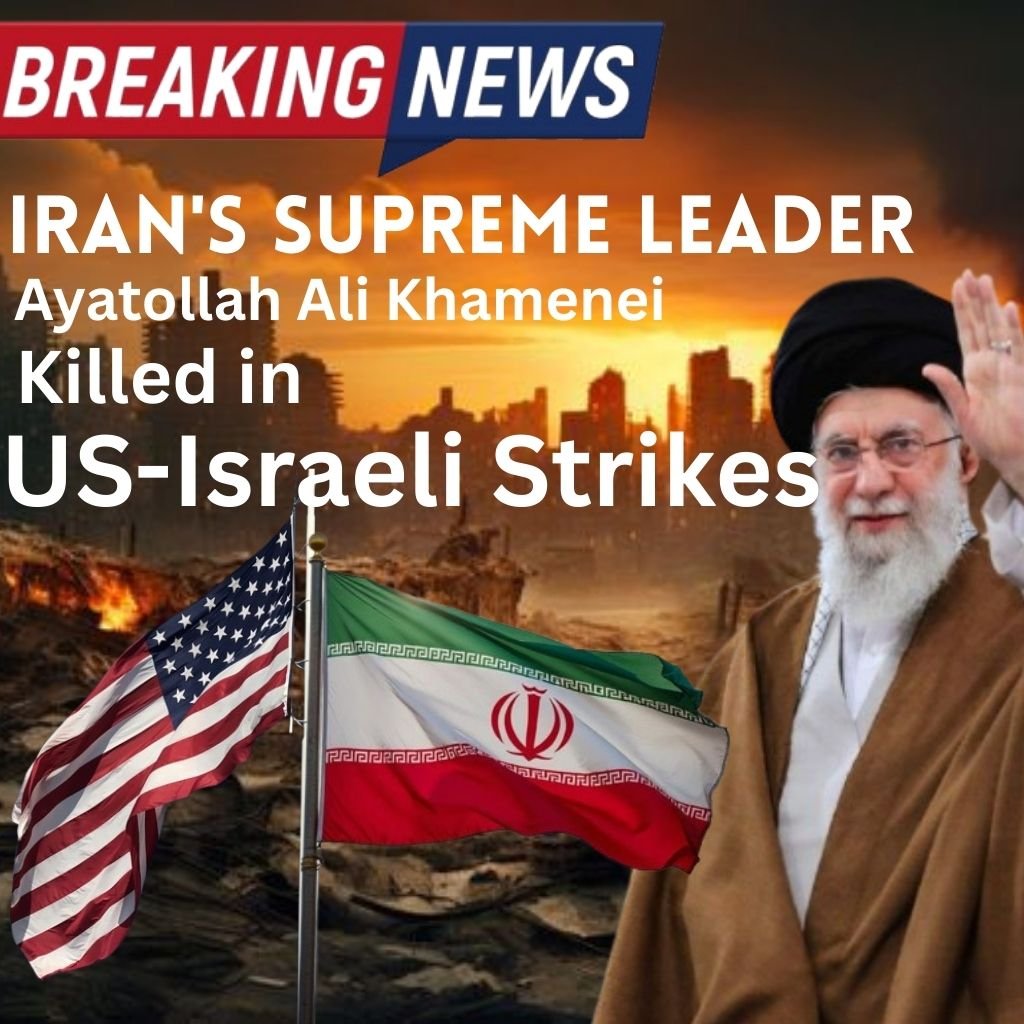
In a dramatic escalation of Middle East tensions, Iran has confirmed the death of its Supreme Leader, Ayatollah Ali Khamenei, following joint US-Israeli airstrikes on Tehran. The 86-year-old leader, who ruled Iran with an iron fist for nearly four decades, was killed at his office during the coordinated attacks on Saturday, February 28, 2026 .
What Happened: The Attacks
The joint military operation, named “Operation Epic Fury” by the US and “Operation Lion’s Roar” by Israel, began on Saturday morning . Israeli officials reported that 200 fighter jets took part in the “extensive attack,” hitting more than 500 targets across 24 provinces .
Key targets included:
- Khamenei’s residential compound in Tehran, which satellite imagery confirms sustained significant damage
- Multiple sites where senior Iranian officials had gathered
- Iranian missile launchers and air defense systems
- Facilities associated with Iran’s nuclear program
An intelligence source and military source told CBS News that around 40 Iranian officials were killed in the strikes, including Khamenei .
Casualties and Human Toll
The human cost has been severe:
- At least 200+ people killed across Iran, according to the Red Crescent
- 108 people reported killed when a girls’ school in Minab, southern Iran, was struck
- Khamenei’s daughter, son-in-law, and grandchild were also killed in the attacks, according to Iran’s Fars News Agency
- Additional casualties reported at a school east of Tehran
Iran’s Response and Retaliatory Strikes
Iran has launched waves of retaliatory strikes across the Middle East :
The Islamic Revolutionary Guard Corps (IRGC) announced it targeted:
- The US Fifth Fleet in Bahrain
- Other American bases in the Gulf region
- Multiple locations in Israel
The IRGC also closed the Strait of Hormuz, a vital waterway through which much of the world’s oil and gas passes .
Regional Impact:
UAE: Two people killed in Abu Dhabi, including a Pakistani civilian. The defence ministry reported intercepting 137 missiles and 209 drones. Witnesses in Dubai reported explosions and saw missiles streak across the sky, with four people injured .
Qatar: The defence ministry intercepted several missile attacks targeting the Gulf state .
Saudi Arabia: Loud explosions heard in Riyadh .
Bahrain: Explosions reported across the capital Manama .
Iraq: Two people killed in air strikes on an Iraqi military base housing Kataeb Hezbollah, a powerful pro-Iran group .
Israel: A woman was killed and at least 21 injured in the Tel Aviv area from Iranian missile and drone attacks .
Iran Declares 40 Days of National Mourning
In response to Khamenei’s death, the Iranian cabinet has declared 40 days of national mourning . The official statement described Khamenei’s killing as following a “brutal attack by the criminal U.S. government and the sinister Israeli regime” and praised the late leader for having led the country “sagaciously” for more than 37 years .
Thousands have taken to the streets in Tehran, Isfahan, and Mashhad to mourn, with state media showing crowds chanting “God is great” and gathering at holy sites .
Mixed Reactions Inside Iran
The attacks have produced starkly divided reactions within Iran:
Celebrations: Social media videos verified by BBC Persian show some Iranians in Karaj and Tehran celebrating the reported death, with residents dancing in streets and cheering from balconies as smoke rose from Khamenei’s compound .
Mourning and Anger: Meanwhile, regime loyalists have gathered in large numbers to protest the strikes and mourn what state media terms the “martyrdom” of their leader .
Succession: Who Will Lead Iran Now?
With Khamenei’s death, Iran faces a leadership vacuum at the most critical moment in the Islamic Republic’s history .
How Succession Works
An 88-member panel called the Assembly of Experts—entirely composed of Shiite clerics—is responsible for appointing the new supreme leader .
Temporary leadership: Until the assembly can convene, a temporary leadership council will assume duties, consisting of:
Potential Successors
Several names have emerged as possible contenders :
| Candidate | Age | Profile |
|---|---|---|
| Mojtaba Khamenei | 56 | The late leader’s second son; wields significant influence with IRGC but father-to-son succession is controversial |
| Alireza Arafi | 67 | Deputy chairman of Assembly of Experts; established cleric with government track record |
| Hashem Hosseini Bushehri | Late 60s | First deputy chairman of Assembly of Experts; close to Khamenei |
| Mohammad Mehdi Mirbagheri | Early 60s | Hardline cleric; represents most conservative wing |
| Hassan Khomeini | Early 50s | Grandson of revolution founder Ayatollah Khomeini; less hardline but lacks security establishment ties |
According to constitutional expert analysis, the new leader must be male, a cleric with political competence, moral authority, and loyalty to the Islamic Republic .
International Reactions
United States
President Trump has indicated that bombing operations will continue “as long as necessary to achieve our objective of PEACE THROUGHOUT THE MIDDLE EAST AND, INDEED, THE WORLD” . He called on Iranian forces to surrender in exchange for immunity, stating: “Now they can have Immunity, later they only get Death!” .
Pentagon chief Pete Hegseth said the campaign sent a clear message: “We will hunt you down and we will kill you” .
Israel
Prime Minister Benjamin Netanyahu indicated there were “growing signs” of Khamenei’s death and warned that thousands more targets would be struck in coming days .
United Nations
Secretary-General António Guterres said he was “not in a position to confirm” reports of Khamenei’s death during an emergency Security Council meeting, but warned that military action “carries the risk of igniting a chain of events that no one can control” .
China
China’s UN envoy Fu Cong expressed deep concern, calling for immediate cessation of military action and stating: “At all times, the red line for protecting civilians in armed conflict must not be crossed” .
Russia
Russia slammed the US-Israeli strikes as a “dangerous adventure” that could spark regional “catastrophe” .
Gulf States
Gulf Cooperation Council states condemned Iran’s retaliatory attacks in a joint statement read at the UN Security Council, calling them “cowardly” .
What Happens Next: Scenarios and Implications
Experts warn of several possible trajectories :
1. Continued Conflict
The IRGC has vowed “a hard, decisive, and regret-inducing” punishment on the “murderers” . Trump has pledged bombing will continue “uninterrupted throughout the week” .
2. Regime Change Attempt
Trump framed the moment as “the single greatest chance for the Iranian people to take back their country” . However, analysts caution that while Iranian society broadly wants change, the opposition remains unarmed and disorganized compared to the security forces .
3. Power Vacuum and Potential Instability
The regime could close ranks behind a new hardline leader, or the country could fracture along ethnic lines (Azeris, Kurds, Arabs, Baluch) .
4. Regional War
The closure of the Strait of Hormuz threatens global oil supplies. Iran may target Gulf oil installations to spike prices .
Practical Impact on the Gulf Region
For professionals and residents across the Gulf, immediate effects include:
- Airspace closures: Iran, Iraq, Kuwait, Syria, UAE, and Israel have closed airspace to civilian traffic
- Flight cancellations: Multiple airlines have cancelled flights; Russia cancelled all flights to Iran and Israel
- Security alerts: Gulf states remain on high alert
- Internet blackout: Iran is under near-total internet blackout, with NetBlocks reporting connectivity severely restricted
Conclusion: A Watershed Moment
The death of Ayatollah Ali Khamenei marks an unprecedented turning point in Middle Eastern history. As the region holds its breath, the coming days will determine whether this moment leads to meaningful change for the Iranian people or deeper conflict.
What remains clear is that the Islamic Republic faces its most severe challenge since its founding in 1979—and the world watches as events continue to unfold.