Gulf Careers Hub

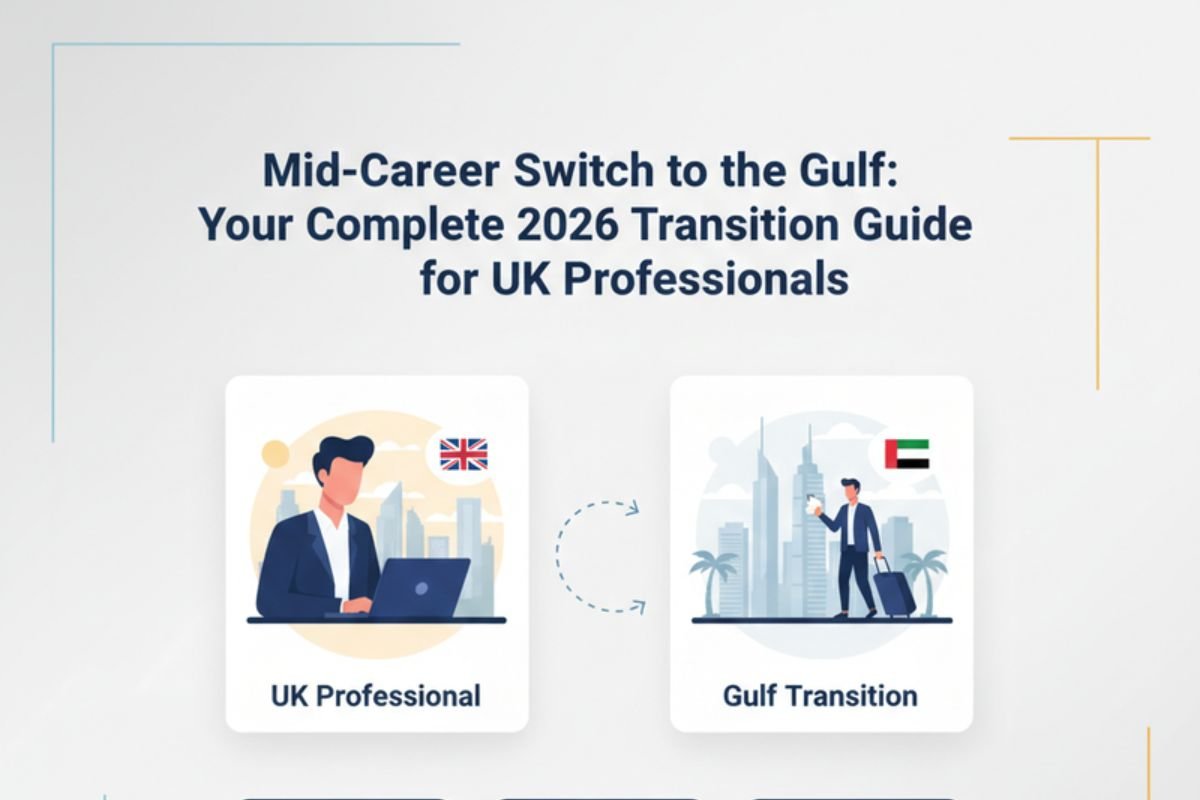
Mid-Career Switch to the Gulf: Your Complete 2026 Transition Guide for UK Professionals

Mid-Career Switch to Gulf 2026

Are you a mid-career professional in the UK feeling stuck in a rut? Perhaps you’re tired of the dreary weather, the high cost of living, or the limited growth opportunities. You’re not alone. Thousands of British professionals are now looking towards the Gulf region—specifically the UAE, Saudi Arabia, Qatar, and Kuwait—for a fresh start and life-changing career opportunities.

Why the Gulf? Understanding the 2026 Opportunity

The Gulf region has transformed dramatically over the past decade. It’s no longer just about oil and gas. Today, you’ll find world-class opportunities in education, finance, healthcare, technology, and renewable energy.

The Gulf Advantage

Tax-Free Income
This is the headline grabber, and it’s real. Countries like the UAE, Kuwait, and Qatar offer genuinely tax-free salaries. What you earn is what you keep. For a UK professional paying 40-45% tax at home, this effectively doubles your disposable income overnight .

High-Quality Lifestyle
Cities like Dubai and Abu Dhabi offer world-class infrastructure, excellent healthcare, and year-round sunshine. The expat communities are thriving, making it easier to settle in .

Career Acceleration
In the Gulf, experienced international professionals are often fast-tracked into leadership roles. You’ll gain responsibility faster than you would in the UK’s more saturated market.

Strategic Location
The Gulf is a hub for global travel. Weekend trips to the Maldives, India, Africa, or Europe are easily accessible.

Top Sectors Hiring UK Professionals in 2026

Based on current job vacancies, these are the hottest sectors for British talent in the Gulf right now.

1. Education and Teaching

The Gulf has a massive demand for UK-qualified teachers. British curriculum schools are expanding rapidly across the region.

Real Example: Gulf British Academy in Kuwait is actively recruiting KS2 teachers for 2026, offering tax-free monthly salaries of £2,700 – £3,400, plus furnished accommodation, annual flights, and end-of-service benefits .

Requirements: UK QTS (Qualified Teacher Status), a BEd or PGCE, and recent UK curriculum experience.

Where to Look: GEMS schools in Dubai are also hiring across subjects, with packages including free schooling for children and private medical insurance .

2. Engineering and Energy

The energy transition and infrastructure boom are driving huge demand.

Real Example: A UK-based energy company is recruiting an Asset Manager for a Waste-to-Energy plant in the UAE, offering a tax-free salary of £85,000 – £95,000, plus family visas, medical insurance, and education allowances for children .

Offshore Opportunities: The oil and gas sector remains strong, with roles like Drilling Supervisors earning £85,000 – £110,000 (converted from USD) and HSE Officers in high demand .

3. Finance and Consulting

Dubai and Abu Dhabi are becoming global financial powerhouses. Banks and consulting firms actively seek UK-trained professionals with mid-career experience.

Typical Roles: Financial analysts, investment associates, risk managers, and management consultants.

4. Hospitality and Operations

With Vision 2030 driving tourism in Saudi Arabia and established hospitality scenes in Dubai and Bahrain, operations managers are in high demand.

Real Example: A hospitality group in Bahrain is recruiting a UK-based Operations Manager with multi-site experience, offering up to £5,500 per month tax-free plus relocation support .

5. Data Science and Technology

The UK’s data science skills are highly valued. Companies in the Gulf are investing heavily in AI and digital transformation .

Salary Benchmark: Senior data scientists in the Gulf can command tax-free packages equivalent to £70,000 – £90,000 .

Step-by-Step Transition Guide

Making the move requires careful planning. Follow this roadmap for a smooth transition.

Step 1: Self-Assessment and Research

Before you do anything, ask yourself:

  • Why do I want to move? (Be honest)
  • Which country aligns with my lifestyle preferences? (UAE is most liberal, Saudi is rapidly modernising but more conservative, Kuwait and Qatar sit in between)
  • Which sector has the strongest demand for my skills?

Action: Spend two weeks researching job portals like TES (for teaching), Gulf News Jobs, Bayt.com, and LinkedIn’s Gulf-specific pages.

Step 2: Update Your CV and Online Presence

Gulf employers love detail. Your CV should:

  • Be in reverse-chronological format
  • Include specific achievements with numbers (e.g., “Managed £2M budget” or “Improved efficiency by 20%”)
  • Highlight any Middle East experience or cross-cultural work

LinkedIn is critical. Ensure your profile is complete, your headline includes your target role and location (e.g., “Senior Engineer | Seeking UAE Opportunities 2026”), and you’re set to “Open to Work” for recruiters.

Step 3: Secure Your Role

Most professionals secure a job before moving. The recruitment process typically involves:

  1. Application submission
  2. Initial video interview with HR
  3. Technical interview with hiring manager
  4. Final interview with senior leadership (sometimes in-person if you’re already in region)

Top Tip: Many Gulf schools and companies conduct recruitment roadshows in the UK. For example, GEMS Metropole School held interviews in Glasgow, Manchester, and London in late 2025 for 2026 roles . Watch for these opportunities.

Step 4: Understand Your Employment Package

Gulf employment packages vary. Here’s what to look for:

Salary: Usually quoted as monthly tax-free. Ask if it’s all-inclusive or if there are allowances.

Housing: Many education roles include furnished accommodation. Corporate roles often provide a housing allowance .

Benefits checklist:

  • Annual flights home (for you and family)
  • Health insurance (check coverage)
  • School fees for children (critical for families)
  • End-of-service gratuity (a lump sum paid when you leave, required by law)
  • Visa costs (who pays?)

Step 5: Legal and Visa Processing

Your employer will typically sponsor your work visa. The process includes:

  1. Medical fitness test
  2. Police clearance certificate from UK
  3. Attestation of your degree and professional certificates
  4. Residence visa stamping in your passport

Timeline: Allow 4-8 weeks for complete processing.

Step 6: Relocation Logistics

Packing: Most expats bring clothes, personal items, and perhaps furniture if they have strong attachments. Many opt to buy furniture locally or use furnished accommodation.

Banking: Open a local bank account after arrival. Transferring money home? Use services like Wise or Revolut for better rates.

Accommodation: If your employer doesn’t provide housing, budget approximately:

  • Dubai: £25,000 – £40,000 per year for a decent 2-bed apartment
  • Abu Dhabi: Slightly lower, £20,000 – £35,000
  • Riyadh: Rapidly rising, but still more affordable than Dubai

Cultural Adaptation: What UK Professionals Need to Know

Respect Local Customs
The Gulf is welcoming to expats, but respect is paramount. Dress modestly in public, avoid public displays of affection, and be mindful during Ramadan (no eating, drinking, or smoking in public during daylight hours).

Weekend Differences
The weekend in most Gulf countries is Friday-Saturday (or sometimes Saturday-Sunday in more liberal workplaces). Friday is the holy day, so it’s a day of rest.

Driving and Transport
You’ll likely need a car. You can drive on a UK license for a limited period (check local rules), but eventually you’ll need a local license. In some cases, you can transfer your UK license without a test.

Expat Community
You’ll find thriving British expat communities, particularly in Dubai, Abu Dhabi, and Doha. Join Facebook groups like “British Expats in Dubai” for advice and networking.

Financial Planning for Your Move

Cost of Living Comparison

ExpenseUK (London)DubaiDifference
Income TaxUp to 45%0%Massive saving
Rent (2-bed)£2,500+ p/m£2,000 – £3,000 p/mSimilar
Utilities£200 p/m£150 – £250 p/mSimilar
School FeesFree (state)£8k – £25k/yearMajor cost
HealthcareNHS (free)Insurance requiredBudget for it

Key Takeaway: The tax saving is enormous, but factor in school fees if you have children—this is the biggest hidden cost.

Real Success Stories

Sarah, Teacher (Nottingham to Kuwait):
“I was a KS2 teacher in Nottingham for eight years, stuck in the same routine. I saw an advert for Gulf British Academy on TES, applied on a whim, and within three months I was in Kuwait. The tax-free salary means I save in a month what took me a year in the UK. I’m also head of year now—responsibility I’d never have gotten at home.” 

David, Asset Manager (Manchester to UAE):
“After 15 years in UK energy, I felt I’d hit the ceiling. The UAE role came with a £90k tax-free package, family visas, and school fees paid. My quality of life has transformed. We spend weekends on beaches instead of battling motorway traffic.” 

Common Pitfalls to Avoid

Pitfall 1: Not researching your employer.
Some companies promise the world. Check reviews on Glassdoor, speak to current employees on LinkedIn.

Pitfall 2: Underestimating the heat.
Summer temperatures hit 45-50°C. It’s intense. Make sure your accommodation has reliable AC.

Pitfall 3: Ignoring the fine print on contracts.
Understand your probation period, notice period, and gratuity calculations before signing.

Pitfall 4: Arriving without a job.
It’s risky. Competition is fierce, and your savings will drain quickly. Secure the role first.

Frequently Asked Questions (FAQs)

1. Do I need to speak Arabic to work in the Gulf?

No. English is the primary business language across the Gulf, especially in multinational companies and international schools. Arabic skills are an advantage but rarely a requirement for expat professionals 

2. Is the tax-free salary really worth it after accounting for living costs?

For most professionals, yes. The absence of income tax means your take-home pay is significantly higher. However, factor in accommodation costs and school fees if applicable. On balance, most UK expats save substantially more than they could at home 

3. Can my family come with me?

Yes. Most reputable employers offer family packages that include visas, medical insurance, and often education allowances for children. This is standard for mid to senior-level roles .

4. What happens to my UK pension?

You can usually continue contributing to a UK pension while abroad, or you may have access to international pension schemes. Speak to a financial advisor specialising in expat finances before you move.

5. How long does the recruitment process take?

From application to offer, expect 4-8 weeks. Visa processing then takes another 4-8 weeks. Total timeline from application to arrival is typically 3-4 months 
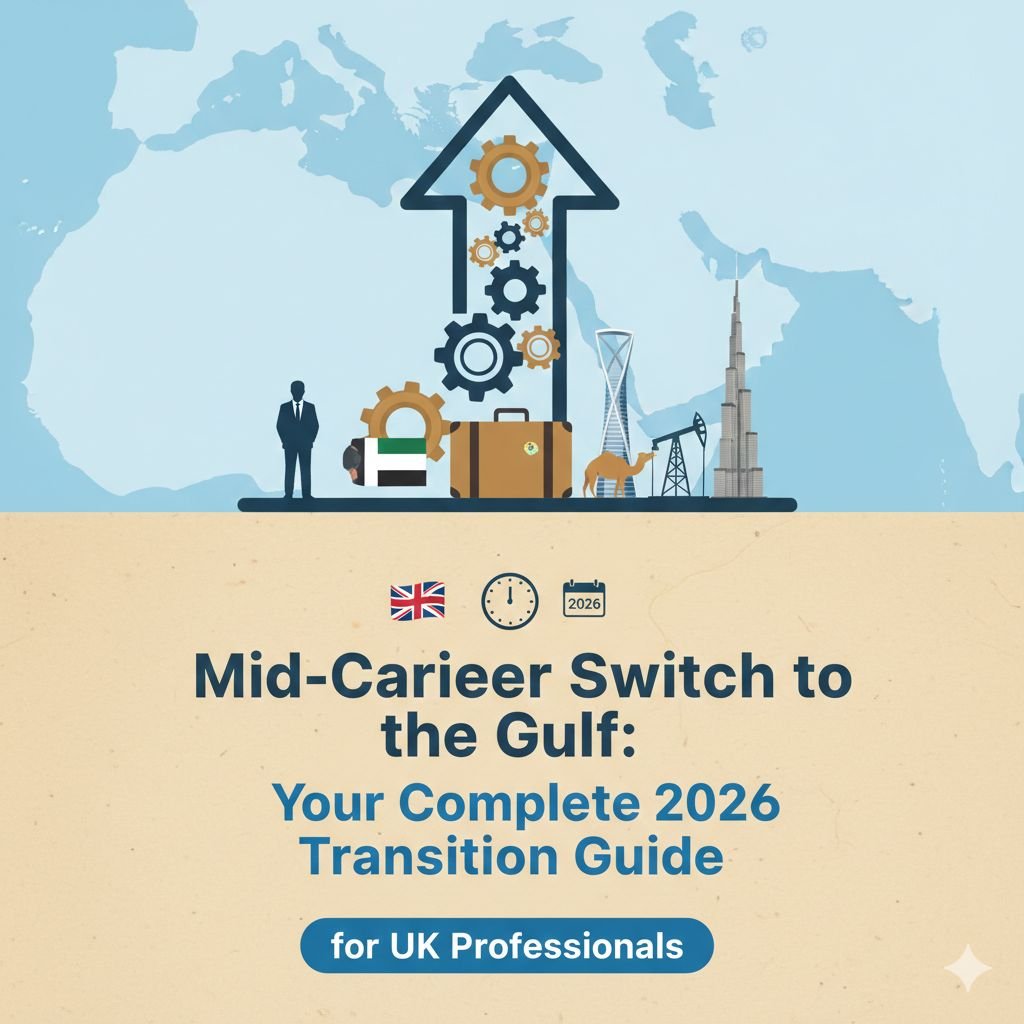
Mid-Career Switch to the Gulf: Your Complete 2026 Transition Guide for UK Professionals

Gulf Career Advice 2026 | UK to UAE/Saudi Transition Guide

Are you a UK professional feeling stuck? Rising taxes, stagnant wages, and limited career progression have many British workers asking the same question: “Is it time to leave the UK and work abroad?”

Why UK Professionals Are Looking to the Gulf

The numbers tell a compelling story. In the UK, professionals face high income tax and national insurance, rising living costs, and limited salary growth. The Gulf offers a fundamentally different equation:

  • Tax-free income – What you earn is what you take home, resulting in 30-45% higher net income for many UK professionals
  • Career acceleration – Companies expand faster, promotions come sooner, and international exposure is common
  • Quality of life – Year-round sunshine, modern infrastructure, world-class healthcare, and vibrant expat communities
  • High demand for Western-educated talent – UK qualifications are highly regarded across the UAE and Saudi Arabia

For context, a manager earning £80,000 in London takes home approximately £5,300 monthly. The same role in Dubai at AED 34,000 monthly delivers £7,400-8,000 take-home pay—roughly 50% more, tax-free.

The Challenge: Why Career Switching in the GCC Is Hard

Before you book that flight, understand the obstacles. Changing careers in the Gulf is steeper than in the UK for several reasons:

1. Employers Prioritize Direct Industry Experience

Unlike some global markets where transferable skills are highly valued, GCC employers tend to favor candidates who can hit the ground running. A sales professional in construction may struggle to move into healthcare sales. A project manager from banking may be passed over for government roles.

2. Visa and Sponsorship Constraints

Your legal status is tied to your employer. Changing careers means ending contracts, losing sponsorship, and navigating complex labor regulations—financial and logistical risks, especially if the transition involves a probation period.

3. Fierce Competition

With talent flowing in from around the world, employers have access to highly specialized candidates. Standing out without direct experience is genuinely difficult.

4. Cultural Perceptions

In the region, long-term stability is prized. Jumping industries can be seen as lack of focus—unless the move is strategically explained.

When Does a Career Change Make Sense?

Despite these hurdles, a career switch can be the right move when:

  • Your current industry is shrinking or being disrupted
  • You’re burned out or disengaged
  • Your interests or values have changed
  • You’ve developed transferable skills that align with another industry

How to Successfully Pivot to the Gulf: Step-by-Step

Step 1: Self-Assessment and Market Research

Before anything else, get clear on your direction:

  • What are your core transferable skills?
  • Which Gulf industries value these skills?
  • What kind of work energizes you?

Research GCC job market trends on platforms like Bayt.comGulftalent.com, and LinkedIn to see where your skills align.

Step 2: Focus on Transferable Skills

Employers won’t care what you want to do unless you show what you can do for them. Reframe your experience by highlighting:

  • Problem-solving across industries
  • Leadership and communication
  • Data analysis or digital skills
  • Sales, strategy, or operational expertise

Your CV must draw clear links between your past roles and your target Gulf industry.

Step 3: Invest in Credentials

Credibility matters enormously in career switching. Enrolling in reputable certifications helps you:

  • Build confidence
  • Gain structured knowledge
  • Show commitment to the change

Gulf employers value certifications in project management (PMP), data analysis, HR, digital marketing, BIM, and more.

Step 4: Leverage Internal Mobility

Already working in a large UK organization with Gulf operations? Explore internal transfers. This allows you to:

  • Switch functions while potentially retaining visa sponsorship
  • Learn from within a familiar environment
  • Build bridges with stakeholders in your target region

Internal transfers are often more flexible than external moves.

Step 5: Network with Purpose

Changing careers requires strategic networking. Focus on:

  • Attending industry-specific events or webinars
  • Connecting with professionals in your target field on LinkedIn
  • Asking for informational interviews, not job offers

Use these conversations to understand Gulf hiring practices, expectations, and how others made the switch.

Step 6: Tailor Your CV and Online Presence

Generic applications fail. Recruiters ignore them. Instead:

  • Add job-specific keywords for Gulf employers
  • Optimize your LinkedIn profile—no profile = no visibility
  • Tailor your CV for each country and position

Your cover letter should tell a compelling story: why the shift, what you’ve done to prepare, and how you’ll add value.

Step 7: Be Realistic About Entry Points

Sometimes, a step sideways is necessary before moving up. You may need to accept:

  • A slightly lower role
  • A smaller company
  • A probationary period

The key is gaining relevant regional experience that opens long-term doors.

Sectors Hiring in 2026

Leadership demand in the GCC is closely tied to national development strategies. High-growth sectors include:

  • Government transformation and public administration
  • Infrastructure, construction, and smart city development
  • Energy, renewables, and climate transition projects
  • Financial services, fintech, and regulatory leadership
  • Healthcare systems and hospital management
  • Technology and digital transformation

Saudi Arabia, in particular, is expanding management roles linked to Vision 2030 projects.

The Cultural Intelligence Factor

Perhaps the most significant adjustment for UK professionals is cultural. Leadership styles in the Gulf blend formal authority with relationship-based management. Key characteristics include:

  • High respect for seniority, experience, and reputation
  • Decision-making influenced by consensus and informal consultation
  • Strong emphasis on loyalty, discretion, and long-term relationships
  • Increasing demand for transparent, data-driven management

Western leadership models focused purely on individual authority often underperform without adaptation. Successful leaders balance decisiveness with cultural sensitivity.

For senior clinical or executive roles, this shift is even more pronounced. You’re not just hired to do a job—you’re expected to build systems and mentor local talent.

Common Mistakes to Avoid

1. Sending Generic Resumes

Recruiters ignore them. Always tailor for each position and country.

2. Relying Only on Agents

Many “agents” promise easy jobs but disappear after collecting fees. Apply directly on verified portals:

3. Ignoring Skill Upgrades

The Gulf market needs professionals with recognized certifications. Invest in one short-term course—it can triple your interview calls.

4. Falling for Fake Offers

If someone promises a visa before an interview—red flag. Verify all offers.

5. Underestimating Cultural Adaptation

Cultural understanding isn’t optional. It directly affects trust, team performance, and long-term credibility.

A Realistic Timeline

Changing careers won’t happen overnight. Expect:

  • A longer job search
  • More rejections than usual
  • A steeper learning curve once hired

Sample action plan:

  • Month 1: Fix resume + optimize LinkedIn
  • Month 2: Apply to verified jobs daily + practice interviews
  • Month 3: Earn a relevant certification + follow up with recruiters

The Verdict: Is the Gulf Right for You?

A mid-career switch to the Gulf isn’t for everyone. It requires shedding old institutional comforts and embracing dynamic, high-stakes environments. But for the right professional, it’s the ultimate career accelerant.

You’re not just changing jobs—you’re contributing to institutional growth, national priorities, and regional transformation. The region offers a professional canvas that doesn’t exist elsewhere.

With persistence, strategy, and skill development, the Gulf job market offers real opportunities for UK professionals looking to reinvent themselves.

Frequently Asked Questions (FAQs)Are you a UK professional feeling stuck? Rising taxes, stagnant wages, and limited career progression have many British workers asking the same question: “Is it time to leave the UK and work abroad?”

For thousands of mid-career professionals, the answer in 2026 is the Gulf Cooperation Council (GCC) region—specifically the UAE and Saudi Arabia. With tax-free salaries, ambitious national development projects, and strong demand for Western-educated talent, the Gulf offers a fundamentally different career equation.

But here’s the reality: switching careers and countries simultaneously is one of the boldest—and riskiest—moves you can make. This guide walks you through everything you need to know to make a successful mid-career pivot to the Gulf.

Why UK Professionals Are Looking to the Gulf

The numbers tell a compelling story. In the UK, professionals face high income tax and national insurance, rising living costs, and limited salary growth. The Gulf offers a fundamentally different equation:

  • Tax-free income – What you earn is what you take home, resulting in 30-45% higher net income for many UK professionals
  • Career acceleration – Companies expand faster, promotions come sooner, and international exposure is common
  • Quality of life – Year-round sunshine, modern infrastructure, world-class healthcare, and vibrant expat communities
  • High demand for Western-educated talent – UK qualifications are highly regarded across the UAE and Saudi Arabia

For context, a manager earning £80,000 in London takes home approximately £5,300 monthly. The same role in Dubai at AED 34,000 monthly delivers £7,400-8,000 take-home pay—roughly 50% more, tax-free.

The Challenge: Why Career Switching in the GCC Is Hard

Before you book that flight, understand the obstacles. Changing careers in the Gulf is steeper than in the UK for several reasons:

1. Employers Prioritize Direct Industry Experience

Unlike some global markets where transferable skills are highly valued, GCC employers tend to favor candidates who can hit the ground running. A sales professional in construction may struggle to move into healthcare sales. A project manager from banking may be passed over for government roles.

2. Visa and Sponsorship Constraints

Your legal status is tied to your employer. Changing careers means ending contracts, losing sponsorship, and navigating complex labor regulations—financial and logistical risks, especially if the transition involves a probation period.

3. Fierce Competition

With talent flowing in from around the world, employers have access to highly specialized candidates. Standing out without direct experience is genuinely difficult.

4. Cultural Perceptions

In the region, long-term stability is prized. Jumping industries can be seen as lack of focus—unless the move is strategically explained.

When Does a Career Change Make Sense?

Despite these hurdles, a career switch can be the right move when:

  • Your current industry is shrinking or being disrupted
  • You’re burned out or disengaged
  • Your interests or values have changed
  • You’ve developed transferable skills that align with another industry

How to Successfully Pivot to the Gulf: Step-by-Step

Step 1: Self-Assessment and Market Research

Before anything else, get clear on your direction:

  • What are your core transferable skills?
  • Which Gulf industries value these skills?
  • What kind of work energizes you?

Research GCC job market trends on platforms like Bayt.comGulftalent.com, and LinkedIn to see where your skills align.

Step 2: Focus on Transferable Skills

Employers won’t care what you want to do unless you show what you can do for them. Reframe your experience by highlighting:

  • Problem-solving across industries
  • Leadership and communication
  • Data analysis or digital skills
  • Sales, strategy, or operational expertise

Your CV must draw clear links between your past roles and your target Gulf industry.

Step 3: Invest in Credentials

Credibility matters enormously in career switching. Enrolling in reputable certifications helps you:

  • Build confidence
  • Gain structured knowledge
  • Show commitment to the change

Gulf employers value certifications in project management (PMP), data analysis, HR, digital marketing, BIM, and more.

Step 4: Leverage Internal Mobility

Already working in a large UK organization with Gulf operations? Explore internal transfers. This allows you to:

  • Switch functions while potentially retaining visa sponsorship
  • Learn from within a familiar environment
  • Build bridges with stakeholders in your target region

Internal transfers are often more flexible than external moves.

Step 5: Network with Purpose

Changing careers requires strategic networking. Focus on:

  • Attending industry-specific events or webinars
  • Connecting with professionals in your target field on LinkedIn
  • Asking for informational interviews, not job offers

Use these conversations to understand Gulf hiring practices, expectations, and how others made the switch.

Step 6: Tailor Your CV and Online Presence

Generic applications fail. Recruiters ignore them. Instead:

  • Add job-specific keywords for Gulf employers
  • Optimize your LinkedIn profile—no profile = no visibility
  • Tailor your CV for each country and position

Your cover letter should tell a compelling story: why the shift, what you’ve done to prepare, and how you’ll add value.

Step 7: Be Realistic About Entry Points

Sometimes, a step sideways is necessary before moving up. You may need to accept:

  • A slightly lower role
  • A smaller company
  • A probationary period

The key is gaining relevant regional experience that opens long-term doors.

Sectors Hiring in 2026

Leadership demand in the GCC is closely tied to national development strategies. High-growth sectors include:

  • Government transformation and public administration
  • Infrastructure, construction, and smart city development
  • Energy, renewables, and climate transition projects
  • Financial services, fintech, and regulatory leadership
  • Healthcare systems and hospital management
  • Technology and digital transformation

Saudi Arabia, in particular, is expanding management roles linked to Vision 2030 projects.

The Cultural Intelligence Factor

Perhaps the most significant adjustment for UK professionals is cultural. Leadership styles in the Gulf blend formal authority with relationship-based management. Key characteristics include:

  • High respect for seniority, experience, and reputation
  • Decision-making influenced by consensus and informal consultation
  • Strong emphasis on loyalty, discretion, and long-term relationships
  • Increasing demand for transparent, data-driven management

Western leadership models focused purely on individual authority often underperform without adaptation. Successful leaders balance decisiveness with cultural sensitivity.

For senior clinical or executive roles, this shift is even more pronounced. You’re not just hired to do a job—you’re expected to build systems and mentor local talent.

Common Mistakes to Avoid

1. Sending Generic Resumes

Recruiters ignore them. Always tailor for each position and country.

2. Relying Only on Agents

Many “agents” promise easy jobs but disappear after collecting fees. Apply directly on verified portals:

3. Ignoring Skill Upgrades

The Gulf market needs professionals with recognized certifications. Invest in one short-term course—it can triple your interview calls.

4. Falling for Fake Offers

If someone promises a visa before an interview—red flag. Verify all offers.

5. Underestimating Cultural Adaptation

Cultural understanding isn’t optional. It directly affects trust, team performance, and long-term credibility.

A Realistic Timeline

Changing careers won’t happen overnight. Expect:

  • A longer job search
  • More rejections than usual
  • A steeper learning curve once hired

Sample action plan:

  • Month 1: Fix resume + optimize LinkedIn
  • Month 2: Apply to verified jobs daily + practice interviews
  • Month 3: Earn a relevant certification + follow up with recruiters

The Verdict: Is the Gulf Right for You?

A mid-career switch to the Gulf isn’t for everyone. It requires shedding old institutional comforts and embracing dynamic, high-stakes environments. But for the right professional, it’s the ultimate career accelerant.

You’re not just changing jobs—you’re contributing to institutional growth, national priorities, and regional transformation. The region offers a professional canvas that doesn’t exist elsewhere.

With persistence, strategy, and skill development, the Gulf job market offers real opportunities for UK professionals looking to reinvent themselves.


Frequently Asked Questions (FAQs)

1. Do I need to find a job before moving to the Gulf?

Yes, absolutely. In almost all cases, you must secure employment before relocating. Your employer will sponsor your work visa and residency. Moving on a tourist visa and searching locally is risky and often illegal

2. How much more money will I actually take home?

Substantially more. Example: A £80,000 UK manager salary nets ~£5,300/month after tax. A comparable Dubai role at AED 34,000/month nets ~£7,400-8,000/month tax-free—roughly 40-50% higher take-home pay

3. Is it easier to transfer internally with my current company?

Yes—this is often the smoothest path. Internal transfers allow you to switch functions while retaining sponsorship and company support. Many UK professionals successfully pivot this way

4. What qualifications do Gulf employers value most?

Gulf employers value:
UK/Western university degrees
British professional certifications (RICS, CCT, PMP, etc.)
Sector-specific expertise aligned with regional priorities
Strong English communication skills (Arabic is a major advantage)

5. How long does the job search typically take?

Realistically, 3-6 months for a targeted search. Changing industries extends this timeline. Be patient, systematic, and prepared for more rejections than a domestic UK search

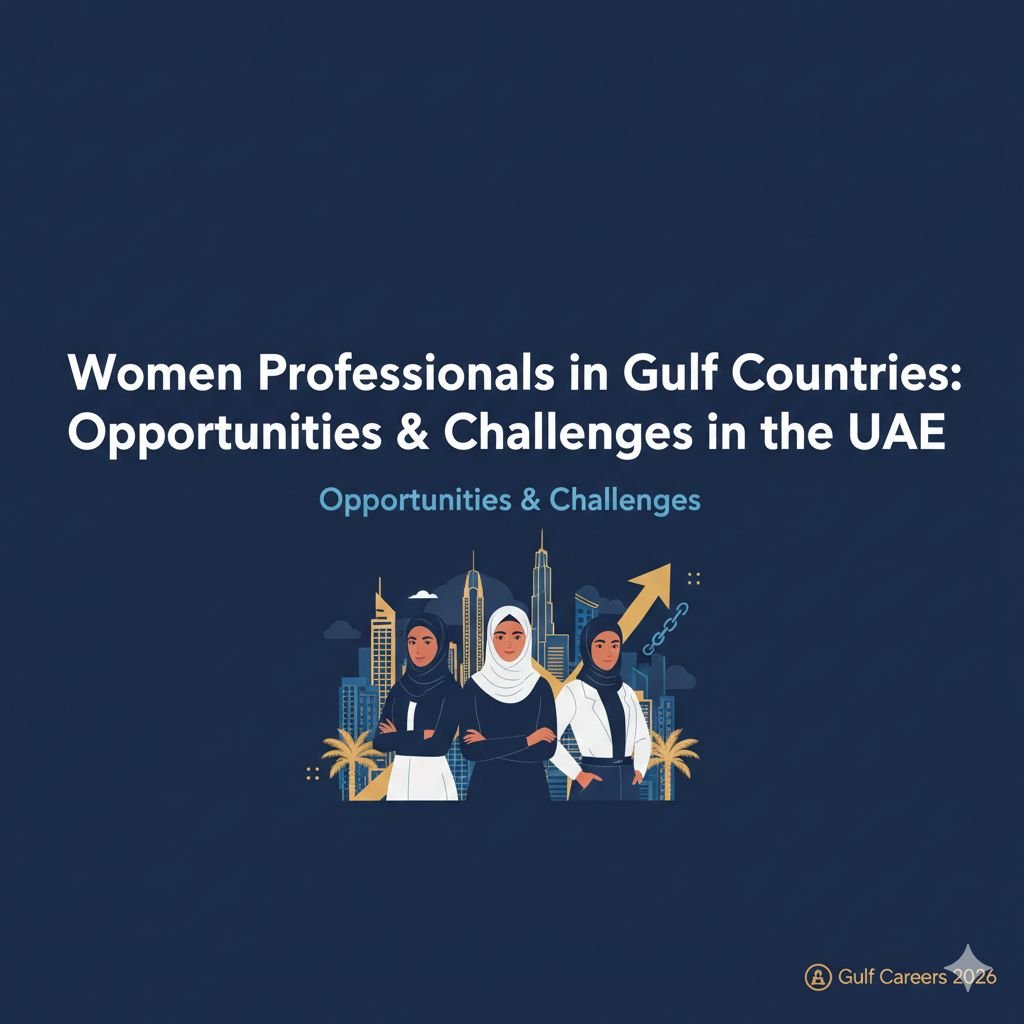
Women Professionals in Gulf Countries: Opportunities & Challenges in the UAE

Gulf Career Advice 2026 | Women Professionals in UAE: Opportunities & Challenges

In 2026, the UAE stands as a regional leader in gender balance, ranking first in the Middle East and North Africa in the 2025 Gender Inequality Index issued by the United Nations Development Programme . This progress reflects decades of strategic investment in women’s education and employment. This guide offers practical Gulf career advice for women professionals looking to build successful careers in the UAE.

Part 1: The Landscape of Opportunity

Government Vision and Strategic Support

The UAE has embedded women’s empowerment into its national strategy. The UAE Gender Balance Council Strategy 2026 aims to further reduce the gender gap across all sectors, enhance the UAE’s ranking in global competitiveness reports, and achieve gender balance in decision-making positions .

Key pillars of this strategy include:

  • Economic Participation: Growing women’s participation, retention, and leadership in the economy
  • Entrepreneurship: Increasing women’s presence in the entrepreneurial sector
  • Financial Inclusion: Improving women’s financial literacy
  • Wellbeing and Protections: Ensuring gender-equitable health support and legal protections 

Impressive Statistics Tell the Story

The numbers speak volumes about women’s progress in the UAE:

  • 70% of university graduates in the UAE are women, with 46% specialising in Science, Technology, Engineering and Mathematics (STEM) fields 
  • Women account for around 50% of the workforce in the UAE National Space Programme and nearly 80% of the scientific team behind the Emirates Mars Mission “Hope Probe” 
  • In the private sector, Emirati women hold 54.9% of leadership roles occupied by nationals 
  • Women account for 94.1% of Emiratis employed in private-sector education and 91.2% in healthcare professions 

High-Growth Sectors for Women Professionals

For women seeking Gulf career advice, targeting the right sectors is essential. These fields show strong demand and growth potential:

1. Technology and AI
The UAE’s focus on leading AI initiatives globally has created significant opportunities. Programmes like the ‘sAIdaty’ AI initiative have enabled 500 women to acquire skills in AI and cloud computing . Women now represent 56% of those enrolled at 42 Abu Dhabi, a coding school .

2. Healthcare
Medical specialists, particularly surgeons and consultants, consistently rank among the highest-paid professionals. Entry-level salaries range from Dh12,000 to Dh20,000 monthly .

3. Finance and Accounting
Finance degrees lead to strategy and C-level roles. With certifications like CFA or CPA, women can aspire to become chief financial officers or senior investment bankers .

4. Engineering
With major development projects across the UAE, engineers remain in high demand. Adding qualifications like PMP can significantly boost earning potential .

5. Space and Nuclear Energy
The UAE has made remarkable progress in training women in these cutting-edge fields, with women comprising half of the space programme workforce .

Part 2: Navigating the Challenges

Despite progress, women professionals in the Gulf still face significant hurdles. Understanding these challenges is crucial for anyone seeking authentic Gulf career advice.

The Participation Gap

While women excel in education, workforce participation tells a different story. The female labour participation ratio remains below 30% in some Gulf countries . In the GCC, only 9% of senior positions are held by women, compared to 35% in the Americas .

The Leadership Ceiling

Women’s representation on corporate boards ranges from just 0.01% in Saudi Arabia to 1.7% in Kuwait, while globally, 17% of board members are female . This gap persists despite women’s qualifications and ambitions—62% of women in the GCC aspire to management roles within seven years .

Work-Life Balance Pressures

Many women juggle demanding careers with family responsibilities. However, research shows that only 7% of women in the GCC work exclusively for financial gains—most are motivated by career fulfilment and ambition .

Access to Mentorship

Finding mentors remains challenging for women entrepreneurs and professionals. In Bahrain, 57% of male entrepreneurs report having access to a mentor, while only 38% of female entrepreneurs report the same .

Stereotypes in Male-Dominated Industries

Women entering traditionally male fields still encounter stereotypes. As one Emirati aerospace engineer noted: “Earlier, the stereotype was that girls should be doctors, teachers, or limited to certain fields. But we had the support of a nation that gave us all the backing we could ask for, and Emirati women were able to make their mark” .

Part 3: Practical Gulf Career Advice for Women Professionals

1. Strategic Education and Skill Development

The right qualifications open doors. Top certifications for the UAE market include:

FieldRecommended Certifications
Banking/ComplianceACAMS, ICA, AML certifications
FinanceCFA, FRM
Project ManagementPMP
HRCIPD
TechnologyAI, data science, cybersecurity certifications 

2. Master the UAE Job Application Process

CV Strategy:

  • Keep it to 1–2 pages, clean and simple
  • Include a UAE mobile number and Dubai location to increase callback chances
  • Highlight GCC experience and use keywords from job descriptions—ATS (applicant tracking systems) is strict 

Where to Apply:
Apply directly on company websites for banks, airlines, healthcare, tech, and real estate firms. Best platforms include LinkedIn, Bayt, Naukri Gulf, and Dubizzle Jobs for entry-level roles .

Timing Matters:
Peak hiring months are January–April and September–November. Avoid slow periods like Ramadan and December .

3. Build a Powerful Network

The UAE job market runs heavily on references—25% of all jobs are filled through referrals . To build your network:

  • Attend networking events, career fairs, and industry seminars
  • Use LinkedIn to send personalised messages to HR professionals and hiring managers
  • Join UAE-based groups focused on your industry
  • Post 2–3 times weekly about your field to increase visibility 

4. Prepare for UAE-Style Interviews

Interviewers look for:

  • Professional communication
  • Cultural awareness
  • Teamwork and people skills
  • Ability to work in fast-paced environments

Be ready for questions like:

  • “Why UAE?”
  • “Tell me about a challenge you solved at work.”
  • “Why did you leave your last job?” 

5. Embrace Continuous Learning

Panelists at recent forums emphasised that staying updated and acquiring critical skills are central to professional advancement. As one aviation training specialist explained: “Innovation never stops. Aviation is constantly evolving, so continuous learning is essential” .

6. Be Flexible in Your Career Path

Many successful professionals start with contract roles, temporary jobs, or entry-level openings. The UAE rewards adaptability—people often start small and grow quickly .

7. Protect Yourself From Scams

No genuine company asks for money, visa fees, or medical fees. Only trust:

  • Company HR emails
  • Interviews conducted through official channels 

Part 4: Success Stories and Inspiration

Women in Space and Science

Emirati women have achieved remarkable milestones in space exploration. They comprise nearly 80% of the scientific team behind the Emirates Mars Mission “Hope Probe” . This achievement demonstrates that women can lead in the most challenging scientific fields.

Breaking Barriers in Aviation

Women like Saleheh Ali Reza Badpa, an Operational Training Specialist, and Marwa Al Mamari, an Aerospace Engineer, are proving that women can excel in aviation—a traditionally male-dominated industry .

Entrepreneurs and Innovators

Despite challenges in accessing capital and mentorship, women entrepreneurs across the GCC are launching successful ventures. Programmes like the “Investment Readiness Accelerator for Female Entrepreneurs” are helping women gain the expertise needed to lead technology start-ups and attract investment .

Conclusion: The Future Is Bright

The trajectory for women professionals in the UAE is undeniably positive. With strong government support, world-class education, and changing social attitudes, opportunities continue to expand. The challenges—from the leadership gap to work-life balance—are real but surmountable with the right strategy and support.

As one Emirati leader reflected: “There are no limits here—in aviation, communication, media, or any other industry. Every field is welcoming if you step up your game. With technology and innovation, women can always extend their reach and redefine what is possible” .

For women seeking Gulf career advice, the message is clear: prepare thoroughly, build your network, embrace continuous learning, and pursue your ambitions with confidence. The UAE offers a landscape rich with possibility for those ready to seize it.


Frequently Asked Questions (FAQs)

1. What are the best industries for women professionals in the UAE right now?

Technology, healthcare, finance, engineering, and education are currently the strongest sectors for women professionals. STEM fields offer particularly strong growth potential, with government initiatives actively supporting women’s participation in AI, space, and renewable energy .

2. How can I find a mentor as a woman professional in the UAE?

Start by attending industry networking events and conferences. Use LinkedIn to connect with senior professionals in your field and send personalised, respectful messages expressing your interest in learning from their experience. Many professional organisations and industry groups also offer formal mentorship programmes 

3. What salary can I expect as an entry-level professional in the UAE?

Salaries vary by industry. Entry-level ranges include: Technology (Dh10,000–18,000/month), Healthcare (Dh12,000–20,000), Finance (Dh10,000–14,000), and Engineering (Dh8,000–15,000). Remember that many factors influence offers, including qualifications, experience, and the specific employer 

4. Do I need to speak Arabic to work professionally in the UAE?

While many multinational companies operate in English, Arabic proficiency is a significant advantage, especially for roles in government, education, and local companies. For legal, healthcare, and client-facing roles, Arabic skills can be essential and command higher salaries 

5. How do I balance career ambitions with family expectations in Gulf culture?

This balance varies for each individual. Many successful women professionals in the UAE manage both careers and families with support systems in place. Flexible working arrangements are increasingly available, and government policies are evolving to support working mothers. Open communication with family about career goals is essential, as is building a strong support network 

From Entry to Executive: Your Complete Career Growth Blueprint for Saudi Arabia (2026)

Gulf Career Advice 2026 | From Entry Level to Executive in Saudi Arabia

If you’re building a career in Saudi Arabia right now, you’ve picked the right moment. The numbers don’t lie: unemployment has dropped to 2.8%, female employment has tripled since 2015, and over half of all Saudis in work are now in the private sector . This isn’t just a job market—it’s a national transformation happening in real time.

Part 1: The Entry Level – Starting Strong in 2026

The Landscape

Good news first: companies are hiring. 66% of employers increased headcount in 2025, and demand for fresh talent remains high . But here’s what’s different: employers are pickier. They want graduates who can contribute from day one, not just “potential.”

What Entry-Level Looks Like Now

Entry-level salaries for Saudi nationals vary by sector, but here’s a realistic benchmark:

Role TypeMonthly Salary (SAR)Notes
Engineering (Water/Process)10,000 – 12,000Recent posting from Riyadh 
Business/Finance Grad8,000 – 12,000Varies by company size
Sales/Marketing (Entry)5,500+Minimum for Saudization quota 

Three Rules for Entry-Level Success in 2026

1. Target the right sectors. Technology, healthcare, finance, and logistics are where the growth is . Construction hiring has slowed; AI and data science hiring is up 26-39% year-on-year .

2. Get comfortable with AI. 66% of professionals already use AI tools regularly at work . If you’re not experimenting with ChatGPT, Copilot, or data analytics tools, you’re falling behind before you start.

3. Understand Saudization—and use it. The new 60% Saudization targets for sales and marketing roles (effective April 2026) mean companies are actively looking for Saudi talent . This isn’t just compliance; it’s your leverage.

Real Example: JLL recently advertised an “Early Career Opportunity” in Riyadh specifically for KSA nationals. No prior experience required—just a degree, strong communication skills, and willingness to learn . These roles exist. You just need to find them.

Part 2: Mid-Career – The Critical Climb

Where Most People Get Stuck

Mid-career in Saudi Arabia (typically 5-12 years experience) is where careers either accelerate or stall. The challenge? Employers prioritize direct industry experience . A project manager from banking will struggle to move into healthcare. A construction salesperson won’t easily switch to pharma.

But here’s the reality: the old model of staying in one silo for 20 years is dying. With automation and AI reshaping industries, career transitions are becoming necessary—and possible.

What Actually Works for Career Switchers

1. Focus on transferable skills, not job titles.
You weren’t “just” a salesperson. You managed client relationships, negotiated contracts, forecasted revenue. Those skills translate across industries. Reframe your CV to highlight what you accomplished, not where you did it.

2. Certifications open doors.
Gulf employers value credentials. A PMP for project management, a CFA for finance, a Certified Digital Marketing Professional—these signal commitment and bridge the experience gap .

3. Internal mobility is your secret weapon.
Already employed? Check internal vacancies first. Switching departments within the same company means keeping your visa, your tenure, and your network .

4. Network with purpose, not desperation.
In the Gulf, relationships matter. Attend industry events, connect on LinkedIn, ask for informational interviews. Don’t ask for a job; ask for advice. The job often follows.

Salary Reality Check:

LevelAnnual Salary (SAR)Notes
Mid-Level Manager180,000 – 300,000Varies by sector
Senior Manager/Associate Director300,000 – 450,000Strong digital/AI skills command premiums 

Part 3: Executive Level – Leading the Transformation

This is Not Your Father’s Executive Market

Here’s the most important thing to understand about executive hiring in Saudi Arabia right now: it’s a seller’s market.

79% of employers are actively recruiting for permanent positions. C-suite compensation has reached world-class levels: CEOs in the SAR 850,000 – 1.4 million range, Executive Directors between SAR 300,000 – 550,000+ . Some CFOs in PIF-backed entities now earn more than their global counterparts.

But here’s what’s really changed: the best Saudi executives aren’t chasing money anymore.

What Actually Closes the Deal

According to executive search specialists who’ve placed hundreds of Saudi leaders, the winning packages include :

Non-Negotiables:

  • Competitive base salary (benchmarked globally, not just locally)
  • Performance bonus tied to measurable impact
  • Comprehensive family benefits (education, healthcare)

Differentiators:

  • Executive education opportunities (top-tier MBA programmes)
  • Board observation or committee participation
  • Clarity on the role’s strategic importance to Vision 2030
  • A genuine leadership mandate, not a figurehead position

The Mindset Shift

“Saudi executives aren’t short of options,” says one veteran headhunter. “What makes them move isn’t just money—it’s the opportunity to shape their country’s future at a pivotal moment in history.” 

If you’re targeting executive roles, your narrative must reflect this. You’re not looking for a job. You’re looking for impact.

Skills That Command Premiums in 2026:

Skill AreaWhy It Matters
Digital TransformationEvery organisation is modernising
AI Strategy & ImplementationNot just using AI—leading AI adoption
Sustainability & ESGAligned with Saudi Green Initiative
Bilingual LeadershipArabic fluency + global business English
Giga-Project ExperienceNEOM, Red Sea, Diriyah—these are career-defining

The Big Picture: What Success Looks Like in 2026

Here’s what the data tells us:

  • The private sector is now the engine of Saudi careers. 52.8% of Saudis work in private companies—a structural shift from the public sector dependency of the past .
  • Women’s career trajectories have transformed. From 11% employment in 2015 to 32% in 2025. Among working mothers: from 8% to 45% .
  • Youth unemployment (NEET) has halved from 40% to 25% .
  • AI fluency is now baseline. 66% of professionals use AI regularly. Those who don’t will be left behind .

This isn’t just statistics. It’s proof that the barriers that once limited careers in Saudi Arabia are falling.

Final Advice: Your Career is a Strategy, Not a Hope

If you’re entry-level: be intentional. Target growth sectors, build AI skills, and don’t wait for perfect opportunities—create them.

If you’re mid-career: be adaptable. Your experience is valuable, but your willingness to learn is more valuable. Certify your skills, network strategically, and don’t fear a lateral move if it opens a better long-term path.

If you’re executive-level: be purposeful. You have the rare privilege of leading during one of history’s most ambitious national transformations. Choose roles where you can build, not just manage.

The Saudi job market in 2026 is the most dynamic it has ever been. The opportunities are real. The question is: what will you do with yours?


Frequently Asked Questions

1. What are the best entry-level jobs in Saudi Arabia right now?

Technology, finance, healthcare, logistics, and specialised engineering (water treatment, process engineering) are hiring actively. Entry-level process engineers in Riyadh are seeing offers between SAR 10,000–12,000 . Sales and marketing roles are also expanding due to new Saudization targets .

2. How do I switch careers in the Gulf without starting over?

Focus on transferable skills, earn a recognised certification in your target field, and consider internal transfers if you’re already employed. Networking with purpose—seeking advice, not just jobs—is critical .

3. What salary should I expect as a mid-career professional in KSA?

Mid-level managers typically earn SAR 180,000–300,000 annually. Senior managers and associate directors range from SAR 300,000–450,000+. Professionals with AI, digital transformation, or sustainability skills command significant premiums .

4. Is it realistic to aim for an executive role as a Saudi national?

Absolutely—and companies are actively competing for Saudi leadership talent. With 79% of employers hiring and a limited pool of transformation-ready Saudi executives, the demand far exceeds supply. Compensation now matches global benchmarks .

5. How important is AI skills for career growth in 2026?

Non-negotiable. 66% of professionals already use AI regularly at work. Employers are prioritising candidates who can deploy AI for productivity, creativity, and decision-making. This applies at every career level 

Navigating Your Career in the Gulf: A 2026 Guide for Professionals from South Asia & Beyond

Gulf Career Advice for Professionals

For professionals across South Asia and the Middle East, the Gulf region—especially the UAE, Saudi Arabia, Qatar, and Oman—remains a land of incredible opportunity. With mega-projects like Saudi Vision 2030 and the UAE’s economic diversification in full swing, 2026 presents a dynamic job market. But it’s also more competitive and complex than ever. Whether you’re in Pakistan or India looking to make the move, or you’re already in the UAE or KSA and aiming for that next promotion, generic advice won’t cut it.

The 2026 Gulf Job Market: What’s Changed?

To succeed, you must understand the landscape:

  1. Nationalization is Accelerating (Emiratization, Saudization): Programs like Nitaqat (KSA) and Emiratization (UAE) are creating more opportunities for local talent. For expatriates, this means roles are becoming more specialized. You are being hired for specific expertise you can’t find locally.
  2. The AI & Tech Transformation: Every sector, from construction to finance, is digitizing. Proficiency in AI tools, data analysis, and digital project management is no longer a “plus”—it’s expected.
  3. Sustainability is Central: With Gulf nations leading on green initiatives, expertise in renewable energy, sustainable urban development, ESG (Environmental, Social, and Governance), and circular economy is highly sought-after.
  4. Soft Skills are the New Hard Skills: In a diverse workplace, cultural agility, communication, adaptability, and problem-solving are what distinguish top performers.

Phase 1: Building Your Foundation (For Those Planning a Move)

If you’re in Pakistan (PK) or India (IN) and looking Gulf-ward, strategy is everything.

1. Target the Right Sectors for 2026

Don’t just look for “any job.” Align yourself with national visions.

  • Saudi Arabia (KSA): Focus on gigaprojects (NEOM, Red Sea Project, Qiddiya), tourism & hospitalityrenewable energyadvanced manufacturing, and logistics.
  • UAE: Look beyond oil to AI & technology (Dubai’s AICampus), logistics & trade (strengthened by new corridors), fintech and financial services (Abu Dhabi Global Market), and advanced healthcare.
  • Qatar & Oman: Tourism, logistics, and niche manufacturing are key growth areas post-World Cup and with Oman’s 2040 Vision.

2. Develop “T-shaped” Skills

Become deeply expert in one area (the vertical bar of the T) but also capable across related disciplines (the horizontal bar).

  • Example: Be a world-class Digital Marketing Manager (vertical) who also understands e-commerce logistics in the Gulf, basic data analytics, and CRM platforms used in the region (horizontal). This makes you adaptable and valuable.

3. Build a “Gulf-Ready” CV & Online Presence

  • CV: Highlight not just achievements, but transferable skills relevant to Gulf projects. Quantify everything (e.g., “Increased efficiency by 20%,” “Managed a team of 8 across 3 nationalities”).
  • LinkedIn: This is your digital handshake. Optimize your profile with keywords like your profession + “UAE,” “KSA,” “Middle East.” Follow target companies and engage with content from Gulf industry leaders. A strong LinkedIn profile is often more important than a CV for mid-senior roles.

Phase 2: Accelerating Your Growth (For Those Already in the Gulf)

You’ve secured the job. Now, how do you move from being an employee to an indispensable asset?

1. Master Cultural & Workplace Intelligence

Success in the Gulf workplace hinges on understanding unspoken rules.

  • Hierarchy & Respect: Titles and seniority matter. Communication is often indirect. Learn to read the room and show respect for structure.
  • Networking (Wasta): While merit matters, relationships are crucial. Build a genuine professional network. Attend industry events, conferences (like GITEX, LEAP), and Chamber of Commerce mixers.
  • Communication Style: Be diplomatic, patient, and avoid public confrontation. Building trust is the foundation of all business.

2. Invest in Continuous, Relevant Upskilling

Your education doesn’t stop with your degree. The market in 2026 rewards learners.

  • Pursue Local Certifications: Certifications from UAE or KSA-based institutions (e.g., in project management, cybersecurity, sustainability) carry significant weight and show commitment to the region.
  • Learn the Language Basics: While English is the business lingua franca, learning basic Arabic greetings and phrases (السلام عليكمشكراً) demonstrates respect and can open doors.
  • Stay Ahead of Tech: Dedicate time weekly to learn about AI tools relevant to your field, even at a user level.

3. Develop a Strong Internal Brand

Visibility within your company is key for professional development in the Gulf.

  • Volunteer for Cross-Functional Projects: This exposes you to other departments and senior leaders.
  • Become a Knowledge Sharer: Offer to lead a lunch-and-learn on a new tool or trend. Position yourself as a go-to person.
  • Seek a Mentor: Find a senior leader (expatriate or national) within your organization who can provide guidance and advocacy.

Phase 3: Long-Term Career & Life Strategy

Think beyond the next bonus. Build a life, not just a resume.

  • Financial Planning: The Gulf offers tax-free salaries but also a high cost of living. Work with a financial advisor to plan for savings, investments (explore local markets), and long-term goals, whether that’s property back home or in the region.
  • Build a Transferable Legacy: Document your achievements and build a portfolio. The skills and experience you gain in the Gulf’s high-paced, mega-project environment are valuable globally.
  • Understand Visa & Residency Pathways: Stay informed about changing residency laws (like UAE’s Golden Visa, KSA’s Premium Residency). These can offer unprecedented stability and open doors to entrepreneurship.

The Mindset for 2026: Agility & Resilience

The Gulf market is dynamic. Companies pivot, projects evolve, and economic priorities shift. The professionals who will thrive are those who:

  • Embrace Change: See market shifts as opportunities to learn and pivot.
  • Are Digitally Fluent: Comfortably adopt new platforms and ways of working.
  • Cultivate a Strong Network: Your community is your safety net and your opportunity radar.

Conclusion: Your Gulf Career is a Project—Manage It

Viewing your career as a project to be actively managed is the key difference between those who just work in the Gulf and those who build a legacy there. It requires research (understanding the market), planning (skill development), execution (excellent performance), and risk management (financial and career planning).

In 2026, the Gulf rewards the strategic, the culturally intelligent, and the continuously curious. Whether you’re taking the first step from Karachi or Mumbai, or you’re navigating the corporate corridors of Dubai or Riyadh, the opportunity is vast for those prepared to meet the moment with the right plan.

Start today. Your future in the Gulf is waiting to be built.


Frequently Asked Questions (FAQs)

1. What are the most in-demand jobs in the Gulf for 2026?

For 2026, demand is highest in Technology & AI (AI Specialists, Data Scientists, Cybersecurity Analysts), Project Management (especially in construction and megaprojects), Renewable Energy & SustainabilityHealthcare (specialized doctors, healthcare administrators), and Digital Marketing & E-commerce. Roles requiring a blend of technical skill and regional understanding are particularly valuable.

2. Is it still possible for Pakistani and Indian professionals to get jobs in the UAE and KSA with nationalization policies?

Yes, but the bar is higher. Nationalization policies prioritize citizen hiring for entry and mid-level roles. Expatriates are now primarily hired for: 1) Specialized senior expertise not available locally, 2) Niche technical skills (in tech, engineering, healthcare), and 3) Roles in new economic sectors where a local talent pool is still developing. Your application must clearly demonstrate this unique, high-level expertise.

3. How important is a master’s degree or MBA for career growth in the Gulf?

An international MBA or specialized master’s from a reputable university is still a strong differentiator, especially for leadership roles in multinationals or large local conglomerates. However, in 2026, specialized certifications, demonstrable project experience, and a proven track record often carry equal or more weight. The key is relevant, applied knowledge.

4. What is the biggest cultural mistake expatriate professionals make?

The biggest mistake is ignoring or disrespecting local customs and the hierarchical business culture. This includes being overly direct/confrontational, failing to observe religious practices (like reduced hours during Ramadan), dressing inappropriately, or not showing proper deference to seniority and titles. Cultural sensitivity is a career-critical skill.

5. Should I focus on job portals or networking to find a job in the Gulf?

You must do both, but prioritize networking. While portals like Bayt, LinkedIn Jobs, and Gulftalent are useful, many senior and specialized roles are filled through referrals and networks (wasta). Build your LinkedIn presence, connect with recruiters and professionals in your field, and if possible, attend industry conferences in the region. A referral often gets your CV to the top of the pile.

Gulf Jobs 2026: Your Guide to the Latest Opportunities in the UAE, Saudi Arabia, Qatar, and Oman

Gulf Jobs 2024: Latest Opportunities

Are you looking for the next step in your career, one that offers growth, opportunity, and a dynamic professional environment? Look towards the Gulf. As we move through 2026, the Gulf Cooperation Council (GCC) nations—especially the United Arab Emirates (UAE), the Kingdom of Saudi Arabia (KSA), Qatar, and Oman—are not just recovering post-pandemic; they are aggressively building the future.

Why the Gulf is a Global Jobs Powerhouse in 2026

The transformation is structural and long-term:

  • Economic Diversification: Massive investments are moving away from oil dependence into sectors like renewable energy, fintech, AI, logistics, and entertainment.
  • Mega-Projects Galore: From Saudi Arabia’s NEOM and The Line to Qatar’s ongoing FIFA 2030 development and Oman’s Vision 2040, these projects need millions of skilled workers.
  • Pro-Business Reforms: New visa schemes (like Saudi Arabia’s Premium Residency, UAE’s Golden Visa, Qatar’s freelancer visa) are making it easier for global talent to live, work, and build a life in the region.
  • A Focus on “Saudization,” “Emiratisation,” etc.: While nationalization programs prioritize local talent, they also create a huge demand for international experts to train, manage, and bring specialized knowledge.

Country-by-Country Breakdown: Where the Opportunities Lie

1. UAE Jobs 2026: The Innovation Hub

The UAE, particularly Dubai and Abu Dhabi, continues to be the region’s gateway for trade, tourism, and technology.

  • Top Sectors Hiring:
    • Technology & AI: Roles in cybersecurity, data science, blockchain, and AI development are booming, supported by hubs like Dubai Internet City and Abu Dhabi’s Hub71.
    • Renewable Energy & Sustainability: With the UAE hosting COP28 and aiming for net-zero, jobs in solar energy, environmental science, and sustainable urban planning are critical.
    • Logistics & Supply Chain: As a global trade crossroads, Dubai needs experts in logistics tech, port management, and e-commerce fulfillment.
    • Healthcare & Biotech: Post-pandemic expansion and world-class hospital projects are driving demand for specialists, researchers, and healthcare administrators.
  • Key Tip: Networking is crucial in the UAE. Use platforms like LinkedIn and attend industry events in Dubai and Abu Dhabi.

2. Saudi Jobs 2026: The Transformation Epicenter

Saudi Arabia is undergoing the most ambitious economic and social transformation in the world. Saudi jobs are not just plentiful; they are at the heart of future-facing industries.

  • Top Sectors Hiring:
    • Giga-Projects: NEOM, The Line, Red Sea Project, Qiddiya. These require everything from architects and engineers to project managers, tourism specialists, and tech innovators.
    • Mining & Industry: With vast mineral resources, there’s a push for mining engineers, metallurgists, and industrial operation managers.
    • Entertainment & Tourism: New stadiums, festivals, and tourism destinations need event managers, hospitality leaders, and entertainment professionals.
    • Finance & Banking: As Riyadh aims to be a financial hub, fintech experts, investment bankers, and Sharia-compliant finance specialists are in high demand.
  • Key Tip: Demonstrating cultural adaptability and a long-term commitment to the Kingdom’s vision is highly valued. Learning basic Arabic is a significant advantage.

3. Qatar Jobs 2026: Building on Global Success

Following the FIFA World Cup 2022, Qatar is leveraging its world-class infrastructure and global visibility to drive its National Vision 2030.

  • Top Sectors Hiring:
    • Infrastructure & Facility Management: Maintaining and operating stadiums, metro systems, and new urban developments.
    • Healthcare & Education: Expansion in leading hospitals (Sidra, Hamad) and universities creates demand for medical professionals, academics, and administrators.
    • Sports & Events Management: Capitalizing on its sporting legacy, roles in sports marketing, event organization, and venue management are growing.
    • LNG & Energy Technology: As a top LNG exporter, there’s a focus on engineers and technicians for energy efficiency and new technology.
  • Key Tip: The job market can be formal. Ensure your CV is meticulously detailed, and qualifications are attested. Patience with process is key.

4. Oman Jobs 2026: The Sustainable Growth Story

Oman, with its stunning natural beauty and strategic location, is focusing on sustainable growth under Vision 2040.

  • Top Sectors Hiring:
    • Tourism & Hospitality: Eco-tourism, adventure tourism, and luxury hospitality projects are creating jobs for hotel managers, tour operators, and sustainability experts.
    • Logistics: Leveraging ports like Duqm and Sohar, opportunities exist in port management, shipping, and supply chain logistics.
    • Mining & Green Hydrogen: Oman is investing heavily in copper mining and positioning itself as a prime producer of green hydrogen, needing engineers and scientists.
    • Manufacturing: Focus on downstream industries and local manufacturing creates demand for plant managers and process engineers.
  • Key Tip: Oman offers a high quality of life. Highlighting experience in culturally respectful environments and project-based work is beneficial.

The Most In-Demand Skills for Gulf Jobs in 2026

Beyond sector-specific knowledge, these transferable skills are your ticket in:

  1. Digital Literacy & Tech Savviness: Proficiency in data analysis tools, basic coding, or digital marketing is expected across most roles.
  2. Sustainability & ESG Knowledge: Understanding Environmental, Social, and Governance principles is a major advantage.
  3. Adaptability & Cultural Intelligence: The ability to work in multicultural teams and adapt to fast-changing environments is critical.
  4. Project Management: With so many mega-projects, certifications like PMP or Agile are highly valued.
  5. Bilingual Communication (Arabic/English): While not always mandatory, fluency in both languages dramatically widens your opportunities and earning potential.

How to Land Your Gulf Job in 2026: A 5-Step Action Plan

  1. Target Your Search: Don’t spray your CV everywhere. Pick one or two countries and sectors that align with your skills and research the key companies (e.g., Saudi Aramco, NEOM, ADNOC, Qatar Airways, Oman Air).
  2. Optimize Your CV for ATS (Applicant Tracking Systems): Use keywords from the job description (e.g., “project management,” “sustainability,” “data analysis”). Keep the format clean and professional. Crucially: Ensure all educational and professional certificates are attested (this process varies by country).
  3. Master the Digital Hunt:
    • LinkedIn is King: Ensure your profile is complete, uses keywords, and highlights relevant projects. Connect with recruiters in your target region.
    • Use Local Job Portals: Beyond Bayt.com, GulfTalent, and LinkedIn, use NaukrigulfWazeef, and company career pages.
  4. Understand Visa Sponsorship: Most Gulf jobs require employer sponsorship. Be clear on your requirements. Research the new visa types (like the UAE’s Green Visa for skilled professionals) which offer more flexibility.
  5. Prepare for the Interview: Be ready to discuss not just your skills, but your understanding of the local market, your reasons for wanting to relocate, and your long-term commitment. Interviews may involve several rounds, including virtual and in-person.

Navigating Challenges: Real Talk for 2026 Applicants

  • Competition is Fierce: You’re competing with global talent. Differentiate yourself with unique skills and a clear value proposition.
  • Salaries are Evolving: While tax-free income is a draw, packages are becoming more structured. Research realistic salary ranges for your role and experience level on sites like Glassdoor.
  • Cultural Adaptation is Real: Research local customs, workplace culture, and living standards. Be prepared for a period of adjustment.

Conclusion: Your Future is in the Gulf

The Gulf jobs 2026 landscape is brimming with possibility for those who are prepared, skilled, and proactive. This is a region betting on the future, and it needs talent to build it.

Whether you’re drawn to the high-tech vision of the UAE, the transformative scale of Saudi jobs, the modern infrastructure of Qatar, or the sustainable growth of Oman, your opportunity awaits. Start by refining your skills, targeting your search, and presenting yourself as a solutions-oriented professional ready to contribute to the next chapter of the Gulf’s story.

The projects are announced. The investments are made. Now, they need you to help build them.


Frequently Asked Questions (FAQs)

01. Do I need to know Arabic to get a job in the Gulf?

For many professional, private-sector roles in multinational companies or specific sectors like tech and engineering, fluent English is sufficient. However, learning Arabic is a significant advantage that demonstrates commitment, aids in daily life, and opens doors to government roles and positions requiring local client interaction. Basic conversational Arabic is always appreciated.

2. What is the most effective way to find a job in the Gulf from abroad?

LinkedIn is the most powerful tool. Optimize your profile with keywords, actively connect with recruiters and HR professionals at your target companies in the UAE, KSA, Qatar, or Oman, and engage with relevant content. Additionally, use reputable regional job portals like Bayt.com and GulfTalent, and apply directly on the career pages of major companies (e.g., NEOM, ADNOC, Qatar Airways).

3. How does the visa sponsorship process work?

Typically, a company that wishes to hire you will act as your sponsor. They will initiate the work permit and residency visa process. This requires providing them with attested documents (educational certificates, professional degrees, marriage certificate if applicable). The process is handled by the company’s PRO (Public Relations Officer) or a government-services partner. Do not pay an agent for a job or a visa sponsorship; this is often a scam.

4. What are the key benefits usually included in a Gulf employment package?

A standard competitive package for expatriates often includes:
Tax-free salary
Annual flight tickets to your home country
Furnished housing or a housing allowance
Medical insurance for you and sometimes your family
Education allowance for children (in mid-to-senior roles)
End-of-service gratuity (a lump sum paid upon completion of your contract)

5. What is “attestation” and why is it important?

Attestation is the official authentication of your educational and personal documents by authorities in your home country and the Gulf embassy, and finally by the Ministry of Foreign Affairs in the Gulf country you’re moving to. It is a mandatory legal requirement for processing your work visa. Start this process early, as it can be time-consuming.

Introducing additional triggers for your vignette ads – you’re eligible for automatic enrollment.

New Google AdSense Triggers: What Publishers Need to Know

If you manage a website like Gulf Careers Hub, your primary focus is connecting job seekers with opportunities in the dynamic Middle Eastern market. To sustain this valuable service, monetization through platforms like Google AdSense is essential. Recently, Google announced a significant update: the introduction of additional triggers for Vignette ads, with automatic enrollment for eligible publishers.

This isn’t just a minor tweak; it’s a powerful enhancement designed to maximize your ad revenue while maintaining a quality user experience. For a niche content hub like yours, understanding and leveraging these updates can mean the difference between modest earnings and a robust, sustainable income stream. This guide will break down everything you need to know, from the technical details to strategic implementation for your career-focused audience.

What Are Vignette Ads? A Quick Refresher

Before diving into the new triggers, let’s clarify what Vignette ads are. Introduced as a premium, user-friendly format, Vignette ads are short, non-interstitial video ads that appear during natural transition points as users navigate your site.

Key characteristics:

  • Format: Primarily 15-second or shorter video ads (with a skip option after 5 seconds).
  • Placement: They appear as a user moves between pages or is about to leave a site (on click-away).
  • User Experience: Designed to be less intrusive than full-page interstitials. They cover only 70% of the screen, keeping the underlying page visible.
  • Value: They typically offer higher CPMs (Cost Per Mille) than standard display ads due to their engaging video format and premium placement.

For Gulf Careers Hub, where users are actively reading blog posts like “Top 5 Interview Tips for Gulf Job Seekers,” Vignette ads can be a perfect fit—appearing as they finish an article and consider clicking to another, without brutally interrupting their reading flow.

The Big News: What Are the “Additional Triggers”?

Previously, Vignette ads were primarily triggered during two specific user actions:

  1. Page-closing (Click-away): When a user shows intent to leave your site.
  2. Navigational transitions: When a user clicks an internal link to move to another page within your site.

The new update introduces a third, powerful trigger: scrolling.

How the New Scroll Trigger Works

Google’s enhanced system now allows Vignette ads to be triggered after a user has scrolled through a significant portion of your content. This is a game-changer for content-rich sites.

The Logic: The ad system intelligently determines a “natural breakpoint” in the user’s journey. For a long-form, 1500-word blog post on your site, this might occur after the user has scrolled through 60-75% of the article. The ad serves at this moment of high engagement, recognizing that the user is invested in the content, rather than waiting until they’ve already decided to leave.

Why This Matters for Gulf Careers Hub:

  • Increased Impression Opportunities: Not every user clicks to another page or exits immediately. The scroll trigger captures a vast audience that was previously unreachable by this premium format.
  • Contextual Relevance: An ad appearing to a user deeply engaged in a post about “Saudi Vision 2030 Careers” is more valuable than one served at a random exit. Advertisers pay more for this engaged attention.
  • Automatic Enrollment: If you’re already using AdSense and are eligible, this feature is automatically enabled. There’s no need for you to manually adjust code or settings. Google’s AI optimizes when and where these scroll-triggered Vignettes appear.

The Eligibility Criteria & Automatic Enrollment

You’re likely wondering, “Is my site eligible?” Google has set specific, quality-focused criteria for automatic enrollment:

  1. AdSense Policy Compliance: Your site must be in full compliance with Google’s Program Policies. This includes having original, high-quality content (which your career guides should be!), a good user experience, and no policy violations.
  2. Traffic and User Engagement: While Google doesn’t publish exact thresholds, sites with consistent, quality traffic and reasonable user session durations are prioritized. A niche authority site like Gulf Careers Hub is an ideal candidate.
  3. Technical Readiness: Your site must be able to support the ad format without breaking functionality.
  4. No Active Opt-Out: You must not have previously disabled Vignette ads in your AdSense settings.

Action Step: The best way to confirm your status is to log into your Google AdSense account. Navigate to Ads > Overview. If you’re eligible and enrolled, you should see Vignette ads listed among your active ad units, and you may notice a gradual increase in impressions and revenue from this format.

Strategic Benefits for a Niche Career Website

How does this translate into tangible benefits for your business?

  1. Maximized Revenue from High-Value Content: Your in-depth, SEO-optimized career guides require significant effort. The scroll trigger ensures this premium content generates premium ad revenue by capturing users at peak engagement.
  2. Improved User Experience over Pop-ups: Compared to aggressive pop-ups, Vignettes are less disruptive. A user learning crucial interview tips won’t have their flow completely broken, reducing bounce rates while still generating income.
  3. Enhanced Value for Advertisers: By serving ads to a targeted, professionally-minded audience (Gulf job seekers), you increase the likelihood of high conversion for advertisers. This can lead to increased competition for your ad space, driving up CPMs over time.
  4. Automatic Optimization: You don’t need to be an ad tech expert. Google’s machine learning determines the optimal scroll depth for each piece of content, whether it’s a short news update or a comprehensive “How to Write a CV for the UAE” guide.

Best Practices for Gulf Careers Hub: Balancing Revenue & UX

While enrollment is automatic, success isn’t passive. Follow these best practices:

  • Prioritize Page Speed: Ensure your site loads quickly. Heavy ads can slow down performance, hurting both UX and SEO—your two most important assets. Use tools like Google PageSpeed Insights and leverage caching.
  • Monitor Performance Metrics: In your AdSense dashboard, keep an eye on key metrics for Vignette ads: Impressions, CPM, and Revenue. Also, monitor site-wide metrics like Session Duration and Bounce Rate in Google Analytics to ensure the new triggers aren’t causing negative side effects.
  • Content is King, Now More Than Ever: The new trigger rewards deep engagement. Continue creating comprehensive, valuable, and long-form content (like this 1500+ word guide) that keeps users scrolling. The more they read, the more eligible moments for a tastefully placed ad.
  • Consider Ad Density: Even with automatic triggers, be mindful of overall ad density. A page cluttered with display ads and a Vignette can feel spammy. Maintain a clean, professional layout befitting a career resource.
  • Transparency with Users: Consider a brief note in your privacy policy or FAQ about using ads to support the free service you provide. Trust is paramount with an audience seeking career advice.

Looking Ahead: The Future of Ad Formats

Google’s move signals a continued shift towards intent-based, user-respectful advertising. The future lies in formats that feel like a natural part of the content consumption journey, not an obstacle.

For publishers like you, this means:

  • Focus on Audience Value: Your revenue is directly tied to how much genuine value you provide to your readers.
  • Embrace Automation: Trust in AI-driven optimization for ad placement, but stay vigilant with your own data analysis.
  • Diversify Responsibly: Vignette ads are a powerful tool, but they should be part of a balanced monetization mix that may also include standard display, native ads, and affiliate marketing for relevant career services or courses.

Conclusion: A Seamless Step Forward in Monetization

The introduction of additional scroll triggers for Vignette ads represents a significant and positive evolution in Google AdSense. For Gulf Careers Hub, this update is a powerful opportunity to increase revenue from your hard-earned traffic without sacrificing the professional, trustworthy environment your job-seeking audience requires.

By being automatically enrolled, you’re positioned to benefit from this enhanced technology immediately. Your role now is to continue doing what you do best: producing outstanding, SEO-friendly content for the Gulf job market, while monitoring your analytics to ensure this new feature works in harmony with your site’s goals. This is how you build a sustainable, reputable, and profitable online resource in the competitive world of career guidance.


FAQs on Additional Vignette Ad Triggers

Can I disable the new scroll trigger if I think it’s too intrusive for my audience?

Yes, you retain full control. You can disable Vignette ads entirely in your AdSense settings under “Ads.” However, it’s recommended to monitor performance data (revenue vs. user behavior metrics) for at least a few weeks before making a decision.

 Will these new triggers lead to more ads per page for a single user?

Google’s system is designed to manage ad frequency. There are limits in place to prevent ad fatigue, such as a cap on how often a Vignette ad can be shown to the same user within a certain time period on your site.

My site has both long articles and short pages. How will the trigger work?

Google’s AI assesses content length and user engagement patterns. On a short page, a scroll trigger may not fire at all, or only if the user spends a significant amount of time there. The system aims to identify a genuine moment of engagement, not just a mechanical scroll point.

Do these new triggers affect my site’s mobile experience?

Absolutely, and this is crucial. Vignette ads are designed for both desktop and mobile. With the majority of web traffic coming from mobile devices, especially for job seekers, the scroll trigger is optimized for mobile browsing behavior. Ensure your site is fully responsive.

I haven’t seen an increase in Vignette revenue yet. Why might that be?

Eligibility and enrollment are gradual. It can take time for the system to optimize. Also, revenue depends on advertiser demand (which can be seasonal) and your traffic volume. Focus on driving qualified traffic to your content through SEO and marketing; the ad system will work more effectively with a larger, engaged audience.

UAE Companies Offering Free Work Visa in 2026

UAE Jobs with Free Visa Sponsorship in 2026

The United Arab Emirates continues to be the undisputed hub of career opportunity in the Middle East, attracting global talent with its tax-free income, dynamic cities, and visionary projects. For job seekers, one of the most attractive prospects is securing a position where the employer sponsors the full cost of the work visa. As we look ahead to 2026, the UAE’s labor market is evolving, with specific sectors aggressively hiring and offering these comprehensive packages to secure the best international talent.

Understanding “Free Work Visa” Sponsorship in the UAE

In the UAE, the “work visa” is formally known as the Employment Residence Visa. It is tied directly to your employer, who acts as your sponsor. The process involves several costs, including:

  • Visa Application & Processing Fees
  • Emirates ID Fees
  • Medical Fitness Test Fees
  • Work Permit (Ministry of Human Resources & Emiratisation – MoHRE) Fees
  • Potential Agency Fees

When a company advertises a “free work visa,” it typically means they will bear the financial burden of these government and processing fees on your behalf. This is a standard and expected practice for mid-to-senior level professional roles in most multinational corporations and reputable local conglomerates. It signifies a serious commitment from the employer to invest in you.

However, for certain entry-level or blue-collar positions, some employers may attempt to recoup these costs through salary deductions or fees—a practice that is illegal under UAE law. Knowing your rights is crucial.

The 2026 Landscape: High-Growth Sectors Driving Sponsorship

The UAE’s economic diversification strategy, focused on sectors beyond oil, is creating immense demand for skilled professionals. Companies in these sectors are actively sponsoring visas to build their workforce.

1. Technology & Artificial Intelligence

A cornerstone of the UAE’s future, with hubs in Dubai (Dubai Internet City, DIFC) and Abu Dhabi (Hub71).

  • Top Companies: G42 (Abu Dhabi), Careem (Dubai), DarkMatter (Abu Dhabi), Amazon Web Services (Dubai), Microsoft Gulf, and scores of fintech and blockchain startups.
  • In-Demand Roles: AI/ML Engineers, Data Scientists, Full-Stack Developers, Cyber Security Specialists, Cloud Architects, DevOps Engineers.
  • Visa Practice: Major tech firms universally offer full visa sponsorship, relocation assistance, and competitive benefits as they compete for global talent.

2. Renewable Energy & Sustainability

With the UAE hosting COP28 and targeting net-zero by 2050, this sector is booming.

  • Top Companies: Masdar (Abu Dhabi), DEWA (Dubai), Taqa (Abu Dhabi), Emirates Water and Electricity Company (EWEC), and major EPC contractors like L&T and Siemens Energy.
  • In-Demand Roles: Renewable Energy Engineers, Sustainability Consultants, Grid Management Specialists, Environmental Project Managers, Solar/Wind Technicians.
  • Visa Practice: Government-owned entities (like Masdar, DEWA) and large international contractors offer comprehensive visa and benefits packages.

3. Healthcare & Life Sciences

The UAE aims to be a leading medical tourism and research hub.

  • Top Companies: SEHA (Abu Dhabi Health Services), Dubai Health Authority (DHA) facilities, Cleveland Clinic Abu DhabiMayo Clinic (partnership in Abu Dhabi), VPS Healthcare, and Pfizer Gulf.
  • In-Demand Roles: Specialist Physicians, Surgeons, Registered Nurses, Medical Researchers, Lab Directors, Hospital Administrators.
  • Visa Practice: Reputable healthcare providers always handle full visa sponsorship for licensed medical staff, often including family sponsorship.

4. Logistics & Supply Chain

The UAE’s geographic position makes it a global logistics powerhouse.

  • Top Companies: DP World (Dubai), Emirates SkyCargo (Dubai), Etihad Cargo (Abu Dhabi), Maersk regional offices, DHL Middle East HQ.
  • In-Demand Roles: Supply Chain Managers, Logistics Analysts, Port Operations Managers, Aerospace Engineers, Procurement Specialists.
  • Visa Practice: Large multinational logistics firms have standardized global relocation policies that include full visa sponsorship for eligible roles.

5. Hospitality & Mega-Event Planning

With a relentless calendar of events (e.g., Expo 2025, World Cup 2034 preparations), the sector is in perpetual growth.

  • Top Companies: Jumeirah GroupEmaar HospitalityAtlantis The RoyalMeraas/DXB Entertainments, and major international hotel chains (Marriott, Hilton, Accor).
  • In-Demand Roles: Hotel General Managers, Executive Chefs, Event Directors, Guest Experience Managers, Marketing Directors.
  • Visa Practice: Standard for managerial and specialized roles. Always confirm the package details for more junior positions.

Your Action Plan: How to Secure a Job with Free Visa Sponsorship in 2026

Step 1: Optimize Your Professional Profile

  • Tailor Your CV: Format it for the UAE market. Prominently feature keywords from the job description. Clearly state your notice period and visa requirement (e.g., “Requiring Employment Visa Sponsorship”).
  • Master LinkedIn: Set your location to “Dubai, UAE” or “Abu Dhabi, UAE.” Follow target companies. Engage with content from UAE industry leaders. A complete, professional profile is non-negotiable.

Step 2: Execute a Targeted Job Search

  • Primary Job Portals: Use LinkedIn JobsBayt.comGulfTalent, and Indeed.ae.
  • Company Career Pages: The most reliable method. Identify your top 20 target companies from the sectors above and apply directly on their websites.
  • Recruitment Agencies: Reputable agencies like Michael PageHaysCharterhouse, and BAC Middle East work on behalf of employers who pay the fees, including visa costs.

Step 3: Ace the Interview & Negotiate the Offer

  • Interview Preparedness: Research the company’s recent projects in the UAE. Be ready to discuss how your skills contribute to national agendas like “We the UAE 2031” or “Dubai Economic Agenda D33.”
  • The Crucial Offer Discussion: When an offer is made, the visa sponsorship terms will be in the employment contract. Verify that it states: “The Company will bear all costs associated with the Employee’s work visa, residency permit, and medical testing.” Do not accept verbal assurances.

Critical Legal Rights and Red Flags

Your Rights:

  • The employer is legally responsible for your visa sponsorship and associated costs for the role they hired you for.
  • They must provide you with health insurance.
  • They cannot legally hold your passport; you have the right to keep it in your possession.

Red Flags to Avoid:

  1. Any Request for Payment: A legitimate company will never ask you to pay for your own work visa, “processing fees,” or “visa deposit.”
  2. Salary Deductions for Visa Costs: This is illegal if not explicitly agreed upon in a very specific, legal manner (which is rare and not standard for professionals).
  3. Vague Contract Language: Avoid contracts that are unclear about who bears visa costs, insurance, or flight tickets.
  4. Unlicensed Recruiters: Verify the credibility of any recruitment agency or individual contacting you.

The Future of Work Visas: The UAE Green Visa

For 2026, also be aware of the UAE Green Visa. This is a 5-year self-sponsored residency permit for skilled professionals, freelancers, investors, and entrepreneurs. While not employer-dependent, it represents a significant shift in UAE policy, offering greater job mobility. You can be hired on a Green Visa, meaning the employer does not need to sponsor you, potentially making you an even more attractive candidate.

Conclusion: Your Pathway to a Sponsored Career in the UAE

The UAE job market in 2026 is characterized by strategic growth in knowledge-based and service industries. Companies at the forefront of this transformation are not just offering jobs; they are offering complete career packages, with full work visa sponsorship being a fundamental component.

Success requires a professional, focused approach: target the right sectors, engage with reputable companies, and secure clear contractual terms. By leveraging this guide, you are positioning yourself to not only find a job in the UAE but to build a long-term, thriving career in one of the world’s most forward-thinking nations.

Begin your targeted application process today—your sponsored role in the dynamic UAE awaits.

Frequently Asked Questions (FAQs)

1. Is it really “free,” or will the visa cost be deducted from my salary?

In a legitimate professional role, the employer pays the visa costs directly to the government and does not deduct them from your salary. This should be explicitly stated in your employment contract. Any deduction for visa costs without prior, clear contractual agreement is illegal under UAE labor law.

2. Does free visa sponsorship include my family (spouse and children)?

Typically, the employer-sponsored visa covers only the employee. To sponsor your family (spouse and children under 18), you must meet a minimum salary threshold (often AED 4,000-5,000 or higher, depending on housing allowance) and you, as the sponsor, will bear the costs for their visas, medical tests, and Emirates IDs. Some senior-level packages may include family sponsorship.

3. What documents are required for a UAE work visa sponsored by a company?

Common requirements include: attested educational certificates and degree, passport copy, passport-sized photographs, a signed employment contract, and a medical fitness test certificate (completed in the UAE). Your employer’s PRO (Public Relations Officer) will guide you through the specific process.

4. How long does the work visa process take with a company in 2026?

From offer acceptance to visa stamping, the process typically takes 2 to 6 weeks, assuming all documents are in order. It involves securing an entry permit, entering the UAE, completing a medical test, and finally receiving your Emirates ID and residency visa stamp.

5. Can I switch jobs if my visa is sponsored by my current company?

Yes, UAE labor law allows job mobility. You can switch employers once you complete your standard probation period (usually 6 months). The new employer will initiate a visa transfer process. Since 2023, the ability to switch jobs has become more streamlined, especially for skilled professionals.

Urgent Hiring With Free Food & Housing 2026 (Oman)

Urgent Jobs in Oman with Free Food & Housing - Apply Today

Oman’s vibrant economy, rich cultural heritage, and strategic development plans have made it a beacon for career opportunities in the Gulf region. For job seekers, few offers are as compelling as those that include free food and housing—benefits that significantly boost your savings and provide immediate stability. Today, numerous sectors in the Sultanate are engaged in urgent hiring, actively seeking skilled and unskilled professionals to contribute to ambitious national projects like Oman Vision 2040.

Why Free Food and Housing Matters in Oman

For expatriate workers, accommodation and daily living costs are the two largest expenses. An employment package that includes these benefits is not just a perk; it’s a transformative financial advantage.

  • Major Cost Savings: Removes the stress and high cost of renting in urban centers like Muscat, Sohar, or Salalah. It also ensures a reliable, culturally appropriate daily meal provision.
  • Immediate Stability: Provides security from day one, allowing you to focus on your job performance and integration into the community.
  • Standard in Many Sectors: Particularly in hospitality, construction, oil & gas, healthcare, and domestic/retail services, these benefits are often standardized, especially for camp-based or live-in roles.

It’s crucial to understand that the offer of these benefits is often formalized within your employment contract and is governed by Omani labor law, which we will explore later.

Understanding the Omani Labor Market and “Urgent Hiring”

The term “urgent hiring” in Oman typically signals a few key scenarios:

  1. Project-Based Needs: Rapid mobilization for new construction, oil & gas, or infrastructure projects.
  2. Seasonal Peaks: Especially in tourism and hospitality, aligning with cooler months and festival periods.
  3. Replacement Roles: Quick hiring to fill positions left vacant due to contract endings or attrition.
  4. Skill Gap Fillers: Addressing immediate shortages in specialized technical or medical fields.

Top Sectors with Urgent Hiring & Comprehensive Packages (2024-2025)

Here is a breakdown of industries where offers with free food and housing are prevalent, along with the types of roles in urgent demand.

1. Construction & Engineering

Oman’s infrastructure development is relentless, with mega-projects in tourism, transport, and urban development.

  • Sample Roles: Civil Engineers, Project Managers, Quantity Surveyors, HVAC Technicians, Heavy Vehicle Drivers, Skilled Laborers (Welders, Electricians).
  • Benefit Structure: Typically camp-based accommodation with full catering (mess hall) provided near project sites outside major cities. For senior staff, a housing allowance might replace free housing.

2. Hospitality & Tourism

With luxury resorts, new hotels, and a push to become a top tourist destination, this sector is booming.

  • Sample Roles: Hotel Managers, Chefs, Wait Staff, Housekeeping Supervisors, Recreation Staff, Tour Guides.
  • Benefit Structure: Often includes shared staff accommodation (usually gender-segregated) and staff meals (at least one per shift) within the hotel or resort compound.

3. Oil, Gas & Energy

A traditional powerhouse of the Omani economy, always in need of technical expertise.

  • Sample Roles: Petrochemical Engineers, Maintenance Technicians, Safety Officers, Geologists, Rig Operators, Logistics Coordinators.
  • Benefit Structure: Excellent camp facilities in remote locations (e.g., in the interior or near Fahud). Packages almost universally include high-quality catering, recreation facilities, and housing.

4. Healthcare

Oman’s public and private healthcare network is expanding, requiring a steady influx of medical professionals.

  • Sample Roles: Doctors (Specialists & GPs), Registered Nurses, Lab Technicians, Radiographers, Paramedics.
  • Benefit Structure: Major government hospitals and private groups often provide furnished housing or a generous housing allowance and may offer food stipends or on-duty meals. This is a key part of competitive recruitment for international staff.

5. Domestic & Retail Services

This includes roles in private households, retail chains, and facility management companies.

  • Sample Roles: Domestic Helpers, Drivers, Security Guards, Retail Sales Associates (in large malls), Cleaners.
  • Benefit Structure: For live-in roles (like domestic helpers or drivers), free housing and food are contractual standards. Large retail or security companies often provide shared accommodation and food allowances.

The Legal Framework: Your Rights to Housing and Food

Omani Labor Law (Royal Decree No. 53/2023 and its executive regulations) sets clear expectations regarding worker welfare.

  • Accommodation: Employers recruiting workers from abroad must provide suitable accommodation that meets health and safety standards. For those recruited locally, it can be provided or substituted with a housing allowance, as stipulated in the contract.
  • Food: While not always a legal mandate for all roles, if the nature of work requires the employee to reside in remote areas, camps, or provided housing, the employer typically must arrange for food or provide a food allowance.
  • The Contract is Key: The specifics of free food and housing MUST be clearly detailed in your official, Ministry of Labour-approved employment contract. Do not accept vague promises.

Step-by-Step Guide to Securing an “Urgent Hire” Job in Oman

Step 1: Target Your Job Search Effectively

  • Use Specific Keywords: Search for “Oman job free accommodation,” “camp jobs Oman,” “live-in position Muscat.”
  • Leverage the Right Portals: Focus on Oman-specific platforms:
    • Tanqeeb
    • Oman Jobs
    • LinkedIn (Set location to ‘Muscat, Oman’)
    • Bayt.com
    • Company career pages of major Omani firms (e.g., OQ, Omran, ASYAD).

Step 2: Scrutinize the Job Offer & Contract
An “urgent” offer should not mean a rushed or unclear agreement. Look for:

  • Clear mention of “provided accommodation” or “housing allowance.”
  • Details on “food provision,” “meal allowance,” or “mess facilities.”
  • Description of the accommodation type (shared, single, furnished).
  • Location of housing relative to worksite.

Step 3: Understand the Visa and Recruitment Process

  1. You receive a formal job offer.
  2. The Omani employer applies for your Work Visa and Resident Permit (RP).
  3. You will likely undergo a medical examination in your home country and upon arrival.
  4. Your employer sponsors your visa and is responsible for your legal status.

Step 4: Prepare for the Cultural & Professional Environment

  • Respect Hierarchy: Omani workplace culture is respectful and hierarchical.
  • Professional Attire: Dress modestly and professionally.
  • Patience with Processes: Government and administrative procedures can be detailed and require patience.

Red Flags to Avoid in Your Job Search

  1. Requests for Money: Legitimate employers never ask for payment for a visa or job offer.
  2. Vague Contracts: Avoid offers where benefits are promised verbally but not in writing.
  3. Unverified Recruiters: Check the credibility of recruitment agencies with reviews and their official licensing.
  4. Pressure to Rush: Be wary of extreme pressure to sign or send documents without due diligence.

Conclusion: Launch Your Omani Career with Security

Oman presents a unique opportunity for professionals seeking career growth combined with a high quality of life and significant financial savings. The current climate of “urgent hiring,” particularly in roles offering free food and housing, is a golden chance to secure a stable and rewarding position in a dynamic and welcoming country.

Your success depends on a targeted, informed approach. Focus on the high-demand sectors, use the right job portals, and, most importantly, ensure every benefit is explicitly stated in your signed contract. By doing so, you can confidently embark on your new career journey in the Sultanate of Oman, starting with the security of a home and meals provided.

Start your search today—your ideal Omani job, complete with these key benefits, is waiting.

Frequently Asked Questions (FAQs)

1. Is free food and housing taxable in Oman?

No, Oman does not currently impose personal income tax on employees. The value of provided accommodation and food is considered a non-monetary benefit and is not taxed, making it a pure financial benefit for the worker.

2. Can I choose a housing allowance instead of company-provided accommodation?

This depends entirely on your employer’s policy and what is negotiated in your contract. For senior-level positions, a tax-free housing allowance is common. For many camp-based or entry-level positions, provided accommodation is standard and non-negotiable.

3. What is the typical standard of provided accommodation?

Standards vary by company and position. Large international firms and oil/gas camps often provide high-quality, furnished apartments or rooms with amenities. For other roles, it may be simpler shared accommodation. Always ask for details or photos during the interview process.

4. If I get free food, does it cover all my meals?

Usually, it covers the meals you consume during work hours or while at the company facility. For live-in camp roles, it often means three meals a day from a mess hall. For hotel roles, it may be one meal per shift. Your contract or offer letter should specify the arrangement.

5. How long does the “urgent hiring” visa process take for Oman?

With all documents in order, the process from job offer to visa issuance can take approximately 3 to 8 weeks. “Urgent hiring” means the employer is motivated to expedite the process, but government processing times and medical checks are fixed variables.

Australia Hiring International Workers in 2026

Australia Jobs 2026: Visa Sponsorship for International Workers

The Australian job market is booming, and its doors are wide open for skilled professionals from around the globe. With ambitious infrastructure projects, a thriving tech scene, and a robust healthcare system, Australia faces a significant skills shortage, making 2026 a prime year for international talent to secure a life-changing career down under.

Understanding Australia’s Skills Shortage & Migration Strategy

Australia’s economy is built on a foundation of skilled migration. The government actively uses its migration program to fill critical gaps in the labour market that cannot be met by the domestic workforce alone. This is formalised through official Skilled Occupation Lists, which are your roadmap to sponsorship opportunities.

Key Lists to Know:

  • Medium and Long-term Strategic Skills List (MLTSSL): Occupations in long-term shortage. Priority for permanent residency visas like the Subclass 189 (Skilled Independent) and 190 (Skilled Nominated).
  • Short-term Skilled Occupation List (STSOL): Occupations in shorter-term shortage. Often tied to temporary visas like the Subclass 482 (Temporary Skill Shortage) visa, which can lead to permanent pathways.
  • Regional Occupation Lists (ROL): Specific to designated regional areas, offering more visa options and incentives for migrants willing to live outside major cities like Sydney, Melbourne, and Brisbane.

Top Sectors Hiring International Workers in 2026

If your skills align with these sectors, your chances of receiving an invitation and sponsorship are significantly higher.

1. Healthcare & Social Assistance: An evergreen sector with critical demand.

  • Roles: Registered Nurses (Aged Care, Mental Health, Critical Care), General Practitioners, Psychologists, Aged & Disabled Carers, Sonographers.
  • Why: An ageing population and expanded healthcare services drive continuous need.
  • Visa Path: 189, 190, 491 (Skilled Work Regional), and employer-sponsored 482 and 186 (Employer Nomination Scheme) visas.

2. Information Technology & Cyber Security: The digital economy’s engine room.

  • Roles: Software Engineers, DevOps Engineers, Cyber Security Analysts, Data Scientists, IT Project Managers, Systems Analysts.
  • Why: Rapid digital transformation across all industries and a national focus on sovereign cyber capabilities.
  • Visa Path: Strong presence on MLTSSL; excellent prospects for 189, 190, and direct employer sponsorship.

3. Engineering & Construction: Fuelled by nation-building projects.

  • Roles: Civil Engineers, Structural Engineers, Electrical Engineers, Project Managers, Surveyors, Urban Planners.
  • Why: Major investments in renewable energy infrastructure, transport links (like rail and roads), and housing.
  • Visa Path: High priority on skilled lists; common routes via state nomination (190, 491) and employer sponsorship.

4. Education & Training: Shaping the future workforce.

  • Roles: Secondary School Teachers (especially STEM), Early Childhood Teachers, University Lecturers, Special Needs Teachers.
  • Why: Teacher shortages are a national concern, with many states offering targeted migration programs.
  • Visa Path: Often state-nominated (190, 491); requires skills assessment from AITSL.

5. Trades & Technical Services: The backbone of the economy.

  • Roles: Electricians, Plumbers, Carpenters, Diesel Mechanics, Chefs.
  • Why: Chronic shortages in qualified tradespeople for construction, maintenance, and hospitality.
  • Visa Path: Strong regional demand (491 visa), and employer sponsorship (482/494).

Key Visa Pathways for International Workers in 2026

Choosing the right visa is critical. Here are the primary pathways:

A. Points-Tested Skilled Visas (You apply independently):

  • Subclass 189 (Skilled Independent Visa): Permanent residency. No sponsor or nominator required. Highly competitive; you need a high points score for an invitation.
  • Subclass 190 (Skilled Nominated Visa): Permanent residency. Requires nomination by an Australian state or territory government.
  • Subclass 491 (Skilled Work Regional Visa): A 5-year provisional visa leading to PR. Requires nomination by a state/territory or an eligible family member in a designated regional area.

B. Employer-Sponsored Visas (Job offer required):

  • Subclass 482 (Temporary Skill Shortage Visa): The main temporary work visa. Allows you to work for an approved sponsor for up to 4 years. Can be a pathway to permanent residency.
  • Subclass 186 (Employer Nomination Scheme Visa): Permanent residency directly through an employer.
  • Subclass 494 (Skilled Employer Sponsored Regional Visa): A 5-year provisional visa for regional employers, leading to PR.

Critical Deadlines and Timelines for 2026

“Apply Before Deadline” refers to several key dates and processes you must not miss:

1. Expression of Interest (EOI) Submission Deadline: For points-tested visas (189, 190, 491), you must submit your EOI in SkillSelect well before invitation rounds. States often have limited nomination quotas that fill up fast. Action: Submit your EOI by Q1 2026 (January-March) to be considered for the financial year’s quotas.

2. State Nomination Windows: Australian states open and close their nomination programs throughout the year based on quota availability. Some, like Tasmania and South Australia, can close unexpectedly when full.

  • Priority: Research your target state’s migration website and prepare to apply the moment their 2026-27 program opens (typically July 2026).

3. Skills Assessment Validity: Most visas require a positive skills assessment from the relevant assessing authority (e.g., Engineers Australia, ACS for IT, ANMAC for nursing). These assessments have a validity period (usually 3 years). Ensure yours is current at the time of visa application.

4. Visa Application Caps and Processing Times: Migration program numbers are set annually. Applying early in the program year (July-December) can mean faster processing before administrative queues lengthen.

Your 5-Step Action Plan to Apply Before the Deadline

Step 1: Skills Assessment (Start Now)
This is the most time-consuming step. Identify your assessing authority, gather documents (qualifications, employment proofs), and apply. Target: Complete by end of 2025.

Step 2: English Language Test
Take PTE Academic or IELTS to achieve a competent or superior score for maximum points. Target: Have results ready by Q1 2026.

Step 3: Calculate Your Points & Submit EOI
Use the official points test. Aim for a score above the current invitation thresholds (typically 85+ for 189, but varies by state and occupation for 190/491). Submit a detailed and accurate EOI in SkillSelect. Target: EOI live by March 2026.

Step 4: Pursue State Nomination or Job Offer

  • For State Nomination (190/491): Actively monitor your chosen state’s migration portal. Prepare any additional documents they require (e.g., commitment letters, research on the region).
  • For Employer Sponsorship: Optimise your LinkedIn profile for Australian recruiters, use job platforms like SEEK and Indeed, and clearly state your right-to-work status (e.g., “Requiring 482/186 sponsorship”).

Step 5: Visa Application Lodgement
Upon receiving an invitation (for 189/190/491) or a nomination certificate (from employer/state), you typically have 60 days to lodge a complete visa application with all supporting documents. Missing this deadline means forfeiting the invitation.

Common Pitfalls to Avoid

  • Underestimating Processing Times: Skills assessments and visa processing take months. Start early.
  • Incorrect Points Calculation: Be brutally honest. Overclaiming points leads to refusal and a 3-year ban.
  • Generic Applications: For state nomination, tailor your application to show genuine commitment to that state.
  • Letting Documents Expire: Ensure passports, English tests, and skills assessments are valid throughout the entire process.

Conclusion: Your Australian Career Awaits

2026 presents a structured yet time-sensitive opportunity for skilled workers to build a future in Australia. The process is competitive but transparent. Success belongs to those who prepare meticulously, act decisively, and respect the crucial deadlines outlined by the Department of Home Affairs and state governments.

The deadline is not a single date but a series of strategic milestones. Begin your journey today. Secure your skills assessment, ace your English test, and position your EOI to be at the top of the pile when the next round of invitations is issued. Your Australian career story starts now.


Frequently Asked Questions (FAQs)

1. What is the most important deadline for skilled migration to Australia in 2026?

The most critical timeline is to have your Expression of Interest (EOI) submitted in SkillSelect by early 2026 (January-March). This ensures you are in the pool for state nomination and invitation rounds when the new migration program year begins in July. Missing this window could delay your application by a full year if state quotas fill.

2. Can I apply for an Australian work visa without a job offer?

Yes. The Skilled Independent visa (Subclass 189) and state-nominated visas (Subclass 190 and 491) do not require a job offer. They are points-tested based on your age, skills, English proficiency, and experience. However, employer-sponsored visas like the Subclass 482 and 186 do require a formal job offer from an approved Australian employer.

3. How many points do I need to get an invitation for an Australian skilled visa in 2026?

Competitive points thresholds vary by visa and occupation. Historically, 85 points or higher is a strong target for the Subclass 189 (Independent) visa. For state-nominated visas (190/491), requirements can be lower (often 65+ points), but you must meet specific state criteria. Points are dynamic, so aim for the highest score possible.

4. What is the fastest way to get an Australian work visa in 2026?

The Temporary Skill Shortage (TSS) visa (Subclass 482) is often the fastest route if you secure a job offer from a licensed sponsor. Processing times are generally shorter than permanent skilled visas. For permanent residency, state-nominated visas (190 or 491) can be faster than the independent 189 if your occupation is in high demand in that region.

5. Do I need to be in Australia to apply for these work visas?

No. Most skilled and employer-sponsored visas can be applied for from outside Australia. The process is designed for offshore applicants. Once the visa is granted, you then have a specified period (usually up to a year) to enter Australia and activate your visa.


Post a Job Opening

Fill in the details below. Your job posting will be reviewed by our team.

Basic Information

Specify years of experience required

Location & Salary

Qualifications & Skills

Specify educational requirements
Separate skills with commas

Company Details

Job Details

Contact Information