Gulf Careers Hub

Top International Companies Hiring Remote Workers in 2026: A Global Guide

Top International Companies Hiring Remote Workers

The world of work has undergone a seismic shift. Remote and hybrid work models are no longer a pandemic-era contingency but a permanent, strategic feature of the global job market. For professionals in the Gulf and beyond, this revolution unlocks unprecedented access to careers with world-leading companies—without ever needing to relocate.

This guide explores the top international companies actively hiring remote workers in 2026, the roles they’re filling, and the skills they value most. We’ll also provide actionable strategies for landing these coveted positions and navigating the practicalities of working for a global firm from your home base.

The State of Remote Work in 2026: Beyond the Hype

By 2026, remote work has matured. It’s no longer just about where you can work, but about building sustainable, productive, and inclusive distributed teams. Key trends shaping the landscape include:

  • Asynchronous Communication as Standard: Teams spanning multiple time zones rely on tools like Slack, Notion, and Loom to collaborate without requiring real-time overlap.
  • Focus on Outcomes, Not Hours: Performance is measured by deliverables and impact, not online presence or screen time.
  • Digital Nomad Visas & Compliance: Countries and companies are formalizing arrangements for globally distributed employees, though tax and legal complexities remain.
  • Specialized Remote-First Recruitment: Companies are developing expertise in hiring, onboarding, and managing talent they may never meet in person.

Top International Companies Hiring Remote Workers (2026)

The following companies have not only adapted to remote work but have embedded it into their operational DNA. They offer robust remote infrastructures, strong cultures, and career growth opportunities for distributed employees.

1. Technology & Software Giants

These companies were pioneers of distributed work and continue to offer the largest number of remote opportunities.

  • GitLab: The world’s largest all-remote company. With over 2,000 team members in 65+ countries, GitLab has written the handbook on remote work. They hire extensively in engineering, marketing, sales, and people ops. All processes are transparent and documented.
  • Automattic (Parent company of WordPress.com, Tumblr, WooCommerce): A fully distributed company since its 2005 founding. They look for “code wranglers, support heroes, and design divas” who are passionate about making the web a better place. Hiring is global, with a strong focus on writing and communication skills.
  • Shopify: Embraced “digital by default” in 2020. They hire remote workers globally for roles in software engineering, data science, UX design, and merchant support. Their culture emphasizes impact and entrepreneurship.
  • Dropbox: Adopted a “Virtual First” model, with remote work as the primary experience. They hire for technical and non-technical roles, offering “Dropbox Studios” as optional co-working spaces in some cities.

2. Professional Services & Consulting

The client-service model has successfully transitioned to a remote-first approach.

  • Deloitte, PwC, EY, KPMG (The Big Four): All have significantly expanded their remote and flexible work policies. They hire for remote roles in consulting, advisory, risk analysis, and internal functions like IT and HR. Often, roles are tied to a regional “home office” but allow for predominantly remote work.
  • Accenture: Has a “Omni-connected” model, expecting most of its workforce to work remotely at least 25-50% of the time. They offer a wide array of remote opportunities in technology strategy, cloud migration, and digital transformation.

3. Financial Technology (FinTech) & Services

This fast-moving sector thrives on digital talent, regardless of location.

  • Stripe: A financial infrastructure platform for businesses. They are known for hiring exceptional remote engineering and product talent globally. Their remote setup is highly polished, with a focus on deep work and clear documentation.
  • Coinbase: The cryptocurrency exchange has a “remote-first” policy, allowing employees to work from anywhere within their country of employment. They hire for security, engineering, legal, and finance roles.
  • Wise (formerly TransferWise): With a mission of money without borders, they naturally embrace a borderless workforce. They offer remote roles in many of their operational markets.

4. Marketing, Content & Creative Agencies

Creative collaboration has found its digital groove.

  • Buffer: A fully remote social media management platform and a thought leader in transparency and remote culture. They hire for roles in customer advocacy, engineering, and marketing, with salaries tied to role and experience, not location.
  • Zapier: An automation tool that connects apps; the company is 100% remote. They are famous for their asynchronous work culture and hiring for “Zapiens” across the globe in engineering, marketing, and support.
  • HubSpot: Offers a flexible “3:2 hybrid model” but has a growing number of roles classified as “remote.” They are a major hirer in inbound marketing, sales, and CRM software development.

5. Healthcare & EdTech

Mission-driven sectors leveraging remote talent to scale impact.

  • Khan Academy: A non-profit educational platform. They hire remote professionals in content creation, software engineering, and partnership roles to further their mission of free, world-class education.
  • Teladoc Health: A leader in virtual healthcare. They hire clinicians, software developers, and customer service representatives for remote roles to support their telemedicine platform.

How to Find and Land a Remote Job with a Global Company

1. Optimize Your Presence for Remote Hiring

  • LinkedIn Profile: Use headlines like “Remote Software Engineer | Open to Global Opportunities.” Highlight experience with asynchronous tools (Slack, Asana, Jira, Notion) and self-management.
  • Digital Portfolio: For creatives, developers, and writers, a strong personal website or GitHub profile is non-negotiable.
  • Resume/CV: Include a “Remote Work” section showcasing successful remote projects, highlighting skills like “self-motivated,” “excellent written communication,” and “time-zone flexibility.”

2. Target the Right Job Boards

Move beyond generic sites. Use platforms built for remote work:

  • We Work Remotely: One of the largest and most reputable remote-only job boards.
  • Remote.co: Curated remote jobs across categories.
  • FlexJobs: Screened listings for remote and flexible jobs (subscription-based).
  • AngelList: For startup roles, many of which are remote-friendly.
  • Company Career Pages: Always check the “Remote” or “Location: Anywhere” filter on the career sites of the companies listed above.

3. Ace the Remote-Focused Interview Process

  • Showcase Communication Skills: Your application and interviews must demonstrate crystal-clear, concise communication—the lifeblood of remote work.
  • Prepare for Asynchronous Tests: You may be asked to complete a project or respond to emails/Slack messages on your own time as part of the assessment.
  • Demonstrate Proactivity & Tool Proficiency: Be ready to discuss how you manage your time, avoid burnout, and collaborate digitally. Mention specific tools you’re adept with.
  • Ask Insightful Questions: “How does the team build trust and rapport remotely?” “What does your asynchronous communication workflow look like?” “How is performance evaluated for remote team members?”

Critical Considerations for Remote Global Work

  • Tax Implications: Working for a company in another country can create complex tax liabilities in both your country of residence and the company’s base. Consult a tax professional.
  • Legal & Compliance: Ensure the company is legally set up to hire in your country (often as a contractor) or can sponsor you as an official employee. Many use Employer of Record (EOR) services like Remote.com, Deel, or Oyster to handle this.
  • Salary Benchmarks: Salaries can be location-adjusted, tied to a global pay band, or based on the company’s home country. Research the policy during negotiations.
  • Time Zone Management: Be realistic about working hours if your team is 8+ hours away. Some overlap is usually required.

The Future is Distributed

The barrier between you and a dream job at an innovative global company is no longer geographic—it’s about skills, preparation, and mindset. By targeting truly remote-first organizations, honing the specific competencies of distributed work, and navigating the logistical details wisely, you can build a world-class career from anywhere, including right where you are.

The companies leading this charge are not just offering jobs; they are offering a new way of living and working. In 2026, your professional network and opportunities are truly global.

5 Frequently Asked Questions (FAQs)

1. Do international remote jobs pay less if I live in a lower-cost country?

It depends on the company’s policy. There are three main models: 1) Location-Adjusted Salary: Salary is based on your local market (common at large tech firms). 2) Global Pay Band: Same salary range for a role regardless of location (common at remote-first pioneers like GitLab, Buffer). 3) Home-Country Based: Salary is based on the company’s headquarters location. You must research and ask about the policy during the hiring process.

2. Will I be hired as an employee or a contractor?

This is a crucial distinction. Many companies hire remote workers internationally as independent contractors for simplicity. This means you are responsible for your own taxes, benefits, and insurance. Some companies use an Employer of Record (EOR) service to hire you as a formal, legal employee in your country, providing benefits and handling payroll taxes. Always clarify the employment status.

3. How do I handle visa and legal right-to-work issues?

In most cases, you are working remotely from your country of legal residence. The company is not sponsoring a work visa for you to live elsewhere. If you wish to be a digital nomad, the onus is on you to secure a visa that permits remote work in your chosen country (e.g., Portugal’s D7, Spain’s Digital Nomad Visa, UAE’s Remote Work Visa). The company must agree to your location for tax/legal reasons.

4. What are the biggest challenges of working remotely for a global company?

Isolation & Culture: Building relationships and feeling connected to company culture requires extra effort.
Communication Overhead: Misunderstandings are more common without face-to-face cues. Over-communication is key.
Time Zone Fatigue: Early morning or late-night calls can lead to burnout if not managed carefully.
Home Office Setup: You are responsible for a reliable internet connection, power backup, and a professional workspace.

5. Can I work remotely for a US or European company from the Gulf?

Yes, it is increasingly common. However, key considerations include: 1) Time Zone Overlap: You may need to be available for meetings during some late evening or early morning hours. 2) Internet Reliability: Ensure you have a business-grade, redundant connection. 3) Company Policy: The company must be willing to hire in your country of residence (often via an EOR or as a contractor). 4) Local Law: Ensure your residence visa in the Gulf permits remote work for a foreign entity (most do, but check).

How Much Can You Earn in Gulf IT Jobs in 2026? A Salary Forecast for Tech Professionals

How Much Can You Earn in Gulf IT Jobs in 2026?

The Gulf Cooperation Council (GCC) is no longer just an oil and gas powerhouse—it’s a burgeoning global hub for technology and innovation. With Dubai’s Metaverse Strategy, Saudi Arabia’s $6.4 billion investment in AI and tech, and Qatar’s focus on smart cities, the demand for IT talent has never been higher. For professionals worldwide, this raises a critical question: How much can you actually earn in a Gulf IT job in 2026?

This comprehensive guide analyzes salary trends across key Gulf markets (UAE, Saudi Arabia, Qatar), breaks down compensation by role and seniority, and provides a strategic outlook for the coming year. Whether you’re a software developer, cybersecurity expert, or AI specialist, this is your data-driven roadmap to understanding your worth in one of the world’s most dynamic tech landscapes.

The 2026 Gulf IT Market: A Perfect Storm of Demand

Three key factors are driving unprecedented salary growth for IT professionals in the Gulf:

  1. Vision-Led Digital Transformation: National agendas like Saudi Vision 2030 and UAE’s We the UAE 2031 mandate a shift to digital-first economies. Every government entity and major corporation is investing heavily in tech infrastructure.
  2. Global Talent Competition: Gulf nations are competing directly with Silicon Valley, Europe, and Asia for the same limited pool of top tech talent. To attract experts, companies are offering globally competitive, tax-free packages.
  3. Specialization Premium: There is a massive shortage of professionals in niche, high-impact areas like Artificial Intelligence, Cybersecurity, and Cloud Architecture. This scarcity commands significant salary premiums.

Gulf IT Salary Breakdown by Country (2026 Forecast)

Salaries vary significantly by country due to economic strategy, cost of living, and market maturity. All figures are monthly, tax-free, and represent total cash compensation (base salary + average allowances).

1. United Arab Emirates (Dubai & Abu Dhabi)

The most mature and diverse tech market, acting as a regional headquarters for global firms.

  • Market Vibe: Stable, cosmopolitan, high cost of living (especially housing). Best for those seeking a blend of career opportunity and lifestyle.
  • Salary Growth Forecast: 5-8% average increase, with spikes of 10-15%+ for niche roles.
  • Sample Monthly Salaries (AED):
    • Software Engineer (Mid-Level): 18,000 – 28,000
    • Data Scientist: 25,000 – 40,000
    • Cybersecurity Analyst: 22,000 – 35,000
    • DevOps Engineer: 20,000 – 32,000
    • IT Project Manager: 30,000 – 50,000
    • Cloud Solutions Architect: 35,000 – 60,000+
    • AI/Machine Learning Engineer: 30,000 – 55,000+

2. Saudi Arabia (Riyadh, Jeddah, NEOM)

The most aggressive and fastest-growing market, driven by sovereign wealth investment and giga-projects.

  • Market Vibe: Transformative, fast-paced, lower cost of living than UAE, with immense project scale. Offers the highest salary growth potential.
  • Salary Growth Forecast: 7-12% average increase, with critical roles in giga-projects (NEOM, Qiddiya) commanding premiums 20-30% above market rates.
  • Sample Monthly Salaries (SAR):
    • Software Engineer (Mid-Level): 18,000 – 26,000
    • Data Scientist: 22,000 – 38,000
    • Cybersecurity Specialist: 20,000 – 35,000
    • DevOps Engineer: 19,000 – 30,000
    • IT Project Manager: 28,000 – 45,000
    • Cloud Solutions Architect: 32,000 – 55,000+
    • AI/Machine Learning Engineer: 28,000 – 52,000+

3. Qatar (Doha)

A high-income, stable market focusing on smart infrastructure and fintech, with sustained post-World Cup momentum.

  • Market Vibe: High-income per capita, significant government IT spending, focused on security and efficiency.
  • Salary Growth Forecast: 4-7% average increase.
  • Sample Monthly Salaries (QAR):
    • Software Engineer (Mid-Level): 16,000 – 24,000
    • Data Analyst/Scientist: 20,000 – 32,000
    • Cybersecurity Analyst: 18,000 – 30,000
    • IT Manager: 25,000 – 40,000
    • ERP Consultant (SAP/Oracle): 22,000 – 38,000

Salary Determinants: What Truly Impacts Your Paycheck

Beyond location, five key factors will determine your 2026 Gulf IT salary:

  1. Specialization & Skills: The “hot” skills command massive premiums.
    • Top Tier (Highest Pay): AI/ML Engineering, Cybersecurity (Offensive Security/Threat Intelligence), Cloud Architecture (AWS/Azure/GCP certified), Blockchain.
    • High Demand: Data Science, DevOps, Full-Stack Development (modern frameworks), IoT Engineering.
    • Established Demand: Network Engineering, IT Support, SAP/Oracle Administration.
  2. Experience & Seniority: Gulf markets highly value proven experience, especially with recognizable global brands or major regional projects.
    • Junior (0-3 yrs): Competitive entry-level packages.
    • Mid-Level (4-8 yrs): Strong growth phase; where specialization starts to pay off.
    • Senior (9-15 yrs): Leadership and architect roles with top-tier compensation.
    • Executive (15+ yrs): CTO, CIO, Head of Digital roles with packages often exceeding AED/QAR 70,000+ or SAR 80,000+ per month, plus significant bonuses.
  3. Employer Type:
    • Multinational Corporations (MNCs): Offer structured, globally-benchmarked packages with strong benefits. Salaries are very competitive.
    • Large Local Conglomerates & Government-Linked Entities: May offer higher base salaries and exceptional job security. Benefits (housing, flights) are often generous.
    • Tech Startups & Scale-ups (especially in KSA & UAE): May offer slightly lower base cash but compensate with equity/shares, performance bonuses, and dynamic work environments.
  4. Qualifications & Certifications: Gulf employers place a high value on credentials from top universities and industry certifications, which are seen as objective proof of skill.
    • Gold-Standard Certs: AWS/Azure/GCP Solutions Architect Professional, CISSP, PMP, and specialized AI/Data science credentials from recognized bodies.
  5. The Total Package: Remember to negotiate the entire offer.
    • Base Salary: Your core, tax-free income.
    • Housing Allowance: Typically 30-50% of base salary, either as a cash allowance or company-provided accommodation.
    • Annual Airfare: For you and often your family.
    • Education Allowance: Crucial for those with families; can cover $15,000 – $30,000+ per child annually.
    • Performance Bonus: Becoming more common, ranging from 10-30% of base salary.
    • Other Benefits: Health insurance, transport allowance, end-of-service gratuity.

The Hottest Gulf IT Jobs of 2026 & Their Earning Potential

  1. AI/ML Engineer: The undisputed king of salary premiums. Working on national AI initiatives or for a tech-driven giga-project like NEOM can push total compensation to the very top of the ranges mentioned.
  2. Cybersecurity Architect/Head of Security: With increasing digitalization comes greater cyber risk. Professionals who can build and defend enterprise-scale systems are invaluable.
  3. Cloud Solutions Architect: As migration to cloud accelerates, certified architects who can design, deploy, and manage cloud infrastructure are in chronic short supply.
  4. Full-Stack Developer (Modern Stack): Proficiency in frameworks like React, Node.js, and cloud-native development is essential for building the digital products and platforms of the future.
  5. Data Scientist/Analyst: The ability to turn data into actionable insights for business strategy, smart cities, or customer experience is a core competency for all major Gulf firms.

Strategic Advice for Maximizing Your 2026 Gulf IT Salary

  • Upskill Strategically: Invest now in certifications for AI, cloud security, or data engineering. This directly translates to higher earning potential.
  • Build a “Gulf-Relevant” Profile: Highlight any experience with large-scale projects, cross-cultural teams, or sectors like finance, energy, or government in your CV.
  • Master the Art of Total Package Negotiation: Don’t fixate only on the base. A slightly lower base with a generous housing and education allowance may yield a better quality of life and higher savings.
  • Leverage Multiple Offers: The Gulf IT market is candidate-favored for in-demand skills. Having competing offers is the single strongest leverage in negotiation.
  • Use Accurate Data: Refer to 2025/2026 salary surveys from Michael Page, Hays, Bayt.com, and GulfTalent during negotiations. Presenting data strengthens your position.

Conclusion: A Land of Opportunity for the Skilled

The 2026 outlook for IT professionals in the Gulf is exceptionally bright. While competition is fierce, the rewards for those with the right skills are substantial and growing. Salaries are not just keeping pace with global trends; in strategic areas and in Saudi Arabia particularly, they are setting new benchmarks.

By understanding the market dynamics, specializing in high-value niches, and approaching your job search and negotiations with a data-driven strategy, you can secure a compensation package that rewards your expertise and supports a prosperous life in one of the world’s most dynamic regions. The digital future of the Gulf is being built now, and the builders are being paid handsomely for their work.

5 Frequently Asked Questions (FAQs)

1. Are IT salaries in the Gulf really tax-free?

Yes. For expatriate employees, there is no personal income tax on salaries in the UAE, Saudi Arabia, Qatar, and other GCC states. This means your gross monthly salary is your net take-home pay, making the total compensation highly attractive compared to taxed economies.

2. Which Gulf country offers the highest IT salaries in 2026?

For most roles, Saudi Arabia is currently offering the highest growth and potential premiums, especially for roles tied to Vision 2030 projects. However, the UAE (particularly Dubai) offers very competitive salaries with a more established cosmopolitan lifestyle. For senior niche roles, top-tier compensation can be similar, with KSA sometimes offering higher base cash to offset lifestyle perceptions.

3. Do I need a local degree or Arabic language skills to get a high-paying IT job?

No and No. While a local degree can be beneficial, degrees from recognized international universities are highly respected. Arabic is not a requirement for most private sector IT roles, as English is the primary business language. However, basic Arabic or familiarity with the culture is a valuable soft skill that can enhance your profile.

4. How important are certifications compared to experience?

In the Gulf, both are critical. Experience is paramount, but certifications (like AWS, CISSP, PMP) act as a trusted validator of your skills and are often explicitly listed in job requirements. They can be the deciding factor between two similarly experienced candidates and can directly justify a higher salary offer.

5. Can I work remotely for a Gulf company from my home country?

This is evolving but still limited. Most Gulf companies require physical residency due to sponsorship laws and a strong culture of in-office presence. However, some multinationals and tech startups offer hybrid models (e.g., 3 days in office). Fully remote roles based outside the country are rare and usually not eligible for the full local benefits package.

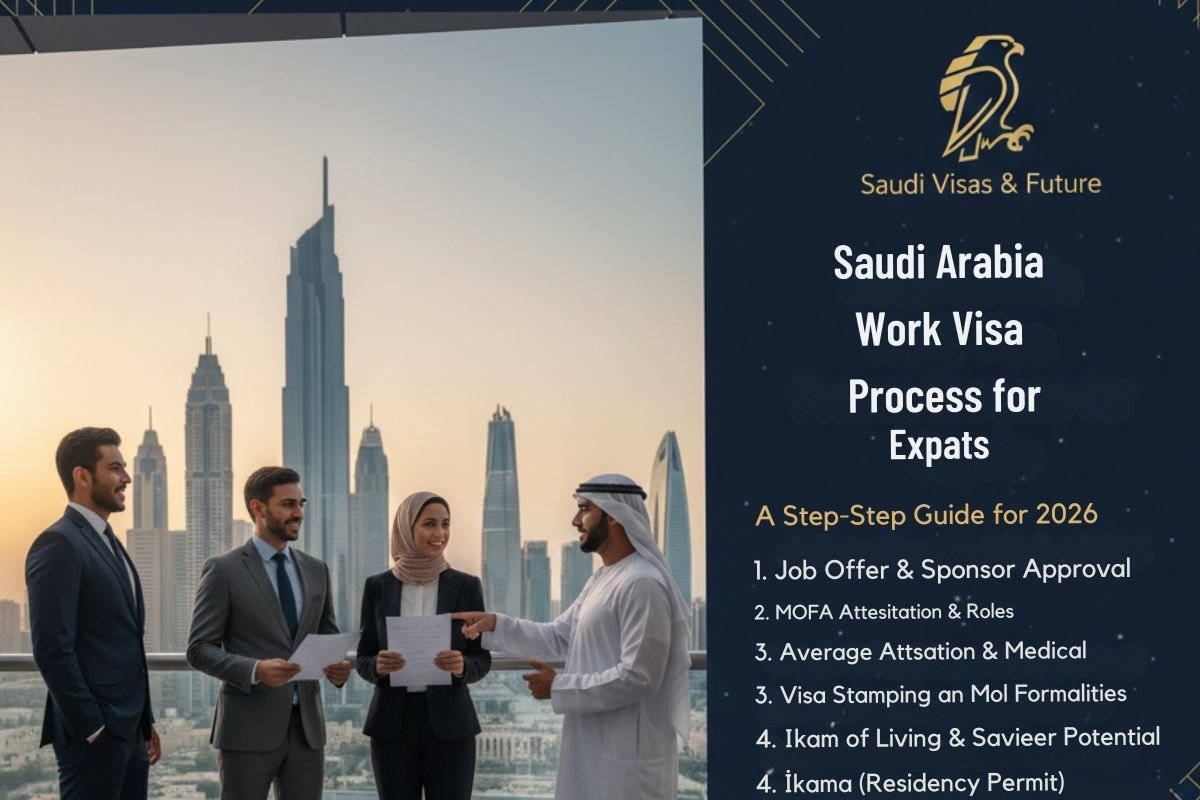
Saudi Arabia Work Visa Process for Expats: A Complete 2026 Guide

Saudi Arabia Work Visa Process for Expats

Securing a work visa for Saudi Arabia is the essential first step for expatriates aiming to build a career in the Kingdom. As Saudi Arabia accelerates its Vision 2030 transformation, opportunities for skilled professionals are expanding rapidly across sectors like construction, technology, healthcare, and tourism. However, navigating the visa process can seem complex.

This comprehensive guide breaks down the Saudi Arabia work visa process for expats in 2026, providing clear, step-by-step instructions, outlining the latest requirements, and offering expert tips to ensure a smooth application journey.

Understanding the Saudi Work Visa Landscape

The Saudi work visa, officially known as the Work Visit Visa (or Employment Visa), is your legal gateway to employment. It is tied to a specific employer and position. The process is highly systematic and relies heavily on the sponsoring employer, known as the “Kafeel.”

Key Players in the Process:

  1. The Expat Employee: You, the applicant.
  2. The Saudi Employer (Kafeel): Your sponsor, who must be a licensed entity in Saudi Arabia.
  3. The Ministry of Human Resources and Social Development (MHRSD): Issues work permits and labor approvals.
  4. The Ministry of Foreign Affairs (MoFA): Oversees visa issuance.
  5. The Saudi Embassy/Consulate: Where you submit your final application.

Step-by-Step: The Saudi Work Visa Process for Expats (2026)

The journey begins with your employer in Saudi Arabia and ends with a visa stamp in your passport. Here is the detailed flow:

Phase 1: Employer-Side Preparation (Initiated by Your Kafeel)

Step 1: Job Offer & Contract
You receive a formal, signed job offer from a Saudi company. Ensure the contract details are clear: position, salary, benefits, working hours, and contract duration.

Step 2: Labor Approval (Work Permit)

  • Your employer applies online through the MHRSD’s Qiwa platform.
  • They must demonstrate a genuine need for your role (proving no qualified Saudi candidate is available for the position, per Saudization rules).
  • Upon approval, the MHRSD issues a Work Permit (also called a Block Visa or Mission Number). This is pre-approval from the labor authorities.

Step 3: Visa Authorization

  • Your employer submits the Work Permit to the Ministry of Foreign Affairs (MoFA) for visa authorization.
  • Once approved, MoFA issues a Visa Authorization Number. This number is critical for the next phase.

Phase 2: Expat Application & Documentation

At this stage, your employer sends you the Visa Authorization Number and a copy of the company’s commercial registration (CR). You can now begin your part of the process.

Step 4: Gather Required Documents
You will need to prepare a precise set of documents, typically including:

  • Passport: Original passport, valid for at least six months beyond your application date, with at least two blank visa pages.
  • Visa Application Form: Completed online via the MoFA’s Enjaz platform or the KSA Visa Portal. Your employer usually provides the login details linked to the authorization number.
  • Photographs: Recent professional, passport-sized photos on a white background.
  • Employment Contract: Signed by you and your employer, attested by the Saudi Chamber of Commerce and the Ministry of Foreign Affairs.
  • Educational & Professional Certificates:
    • All academic degrees and professional qualifications (e.g., engineering licenses, nursing certificates).
    • These documents require legalization: attested by your country’s Foreign Ministry, the Saudi Embassy/Consulate in your home country, and finally by the Ministry of Foreign Affairs in Saudi Arabia upon arrival.
  • Police Clearance Certificate: A criminal record check from your home country (and sometimes from any country you’ve lived in for the past 5 years), attested similarly to your degrees.
  • Medical Reports: A comprehensive medical check-up from an approved medical center, confirming you are free from contagious diseases (like HIV/AIDS, Tuberculosis, Hepatitis B & C). This is often done after a visa is issued but before travel in some home countries.

Phase 3: Submission, Stamping, and Entry

Step 5: Submit to the Saudi Embassy/Consulate
Submit all your attested documents, passport, and application forms to the designated Saudi diplomatic mission (Embassy or Consulate) in your country of residence. You will pay the visa fee at this stage.

Step 6: Visa Stamping
The embassy processes your application, conducts any necessary verifications, and stamps the work visa in your passport. Processing times vary but average 1-4 weeks.

Step 7: Travel to Saudi Arabia
Once your visa is stamped, you are cleared to travel. Your visa is typically valid for entry for 90 days from the date of issue.

Phase 4: Post-Arrival Formalities in Saudi Arabia

Your visa process is not complete upon landing. You have crucial steps to finalize within your first weeks.

Step 8: Medical Check in Saudi Arabia
Within 10 days of arrival, you must undergo another medical test at an accredited health center in Saudi Arabia (this often includes fingerprinting and biometrics).

Step 9: Fingerprinting & Biometrics
You will visit the Passport Office (Jawazat) or a designated center to provide fingerprints and biometric data for your residence permit.

Step 10: Issuance of Iqama (Residence Permit)
After passing the local medical and biometrics, your employer applies for your Iqama. This is your national ID card in Saudi Arabia, proving your legal residency and right to work. It includes your Unified Number and must be carried at all times.

Step 11: Getting Your Work Permit Card
The final step is the physical Work Permit Card, issued by MHRSD, which you should keep with your Iqama.

Key Changes and Trends for 2026

  • Digitalization & Qiwa Platform: The entire process is increasingly paperless and managed through the Qiwa and Absher platforms. Expats must activate their Absher accounts (with employer sponsorship) to manage services.
  • Premium Residency (Privileged Iqama): For high-net-worth individuals and investors, Saudi Arabia now offers a Premium Residency scheme, which provides greater flexibility and independence from a specific employer/sponsor.
  • Family Visa Regulations: Rules for sponsoring dependents (spouse and children) are becoming more streamlined, often linked to your profession and salary threshold (usually a minimum monthly salary of SAR 3,500-5,000).

Common Challenges & How to Avoid Them

  1. Document Attestation Delays: Start the attestation process for your degrees and police clearance immediately upon receiving your job offer. It is the most time-consuming step.
  2. Medical Test Failures: Ensure you are in good health and aware of the medical requirements. A positive test for a prohibited disease will result in immediate deportation.
  3. Miscommunication with Employer: Maintain clear, regular communication with your HR or PRO (Public Relations Officer) in Saudi Arabia. They are your guide.
  4. Using the Wrong Visa Type: Ensure your employer applies for the correct Work Visit/Employment Visa, not a Tourist or Business Visa.

Conclusion

The Saudi work visa process for expats is a structured, employer-driven procedure that demands accuracy and patience. While it involves multiple steps across different ministries, understanding the flow—from the Qiwa platform labor approval to the final Iqama issuance—empowers you as an applicant.

Success lies in partnering with a reputable employer, meticulously preparing and attesting your documents, and staying informed about the latest digital procedures. As Saudi Arabia continues to open its doors to global talent under Vision 2030, a smooth visa process is your first step toward a rewarding career in one of the world’s most dynamic economies.

5 Frequently Asked Questions (FAQs)

1. Can I apply for a Saudi work visa without a job offer?

No. It is impossible. A Saudi work visa is 100% employer-sponsored. You must have a signed employment contract with a licensed Saudi company (your Kafeel or sponsor) to begin the process. They initiate and manage the majority of the application.

2. How long does the entire Saudi work visa process take?

From job offer to receiving your Iqama, the process typically takes 2 to 4 months. The timeline varies based on document attestation speed in your home country, embassy processing times, and your employer’s efficiency. The post-arrival steps to get the Iqama take about 3-4 weeks.

3. What is the difference between the Visa, Iqama, and Work Permit?

Work Visa: The sticker in your passport allowing you to enter Saudi Arabia for employment.
Iqama: Your residency identity card issued after you arrive, proving your legal status to live and work.
Work Permit: The official authorization from the MHRSD that allows you to perform a specific job for your sponsor.

4. Can I change jobs in Saudi Arabia on a work visa?

Yes, but the process (called transfer of sponsorship) has specific rules. You generally need your current employer’s consent (a No Objection Certificate or NOC), or you must complete a certain period of service (often one year) to transfer without consent under newer labor reforms. The new employer must initiate a new visa process.

5. Can my family join me in Saudi Arabia?

Yes, expats meeting a minimum salary requirement (usually SAR 3,500-5,000 per month, depending on the employer’s policy) can sponsor their spouse and children. You apply for family visit visas initially, which are then converted to dependent residency (Iqama) after they arrive and complete medicals.

Salary Trends in UAE & Saudi Arabia for 2026: A Strategic Guide for Job Seekers and Professionals

The Gulf Cooperation Council (GCC) job market is in a period of transformative growth, driven by ambitious national visions. For professionals considering a move or planning their next career step, understanding the salary landscape is crucial. This comprehensive analysis breaks down the projected salary trends in the UAE and Saudi Arabia for 2026, offering insights into the highest-paying sectors, the impact of localization policies, and strategic advice for salary negotiation.

Executive Summary: The 2026 Salary Outlook

The overarching theme for 2026 is differentiation. While the era of blanket, high expatriate packages is evolving, exceptional opportunities and competitive salaries remain for skilled professionals in strategic sectors. Overall, salary increases are projected to be moderate but targeted, with growth heavily favoring specific industries and high-demand skill sets.

  • UAE: Expect steady, inflation-adjusted increases averaging 3-5% across sectors, with significant spikes (8-15%) in high-demand tech, engineering, and healthcare roles. Dubai and Abu Dhabi will continue to lead in offering competitive, tax-free packages.
  • Saudi Arabia: More aggressive salary growth is anticipated, averaging 5-7%+, fueled by massive government investment and a competitive war for specialized talent to fulfill Vision 2030 projects. Riyadh and the Eastern Province are key hubs.

Key Drivers Shaping 2026 Salaries

  1. Vision-Led Economic Diversification: Both UAE’s “We the UAE 2031” and Saudi Arabia’s “Vision 2030” are moving beyond oil. Salaries are rising in the non-oil sectors driving this shift: technology, renewable energy, tourism, logistics, and advanced manufacturing.
  2. Localization Policies (Saudization/Emiratization): These policies are fundamentally reshaping compensation structures. While creating opportunities for national talent, they are making the expatriate hiring process more selective. Companies are willing to pay a premium for expats who possess critical, niche skills not yet available locally and who can play a role in knowledge transfer.
  3. The Global Competition for Tech Talent: The Gulf is in direct competition with Europe, North America, and Asia for top tech talent. To attract experts in AI, cybersecurity, data science, and fintech, companies are offering globally aligned, attractive salary packages and benefits.
  4. Cost of Living Adjustments: Particularly in the UAE, employers are increasingly factoring in housing and living costs (which have risen) into their compensation planning, especially for mid-level roles.

Sector-by-Sector Salary Trends for 2026

1. Technology & Digital Transformation

This is the undisputed leader in salary growth for both countries.

  • In-Demand Roles: Artificial Intelligence/Machine Learning Engineers, Cybersecurity Specialists, Data Scientists, Cloud Architects, Blockchain Developers, Full-Stack Engineers.
  • UAE 2026 Outlook: Salaries are highly competitive with global markets. Senior AI specialists can command AED 45,000 – 70,000+ per month. Strong demand in Dubai’s tech hubs and Abu Dhabi’s focus on smart government.
  • Saudi 2026 Outlook: Even more aggressive due to the establishment of tech hubs like NEOM’s OXAGON and the King Abdullah Financial District (KAFD). Premiums of 20-30% above base packages are common for urgent hires. Senior tech roles can reach SAR 40,000 – 65,000+ per month.
  • Key Driver: Every company is becoming a tech company. NEOM, Dubai’s Metaverse Strategy, and national AI initiatives are creating unprecedented demand.

2. Engineering & Project Management (Mega-Projects)

The backbone of Gulf infrastructure growth.

  • In-Demand Roles: Project Directors, Construction Managers, Renewable Energy Engineers (Solar/Wind/Hydrogen), Civil/Mechanical Engineers with giga-project experience, BIM Managers.
  • UAE 2026 Outlook: Steady demand linked to projects like Dubai Urban Plan 2040 and UAE Net Zero 2050. Senior Project Directors can earn AED 50,000 – 80,000+. Niche engineering in sustainability commands a premium.
  • Saudi 2026 Outlook: The hottest market globally. Salaries for experienced project professionals on giga-projects (NEOM, Red Sea Project, Qiddiya, Diriyah Gate) are at a premium. Roles often come with hardship allowances and enhanced benefits. Packages for senior roles can exceed SAR 55,000 – 90,000+ per month.
  • Key Driver: Saudi Arabia’s estimated $3+ trillion in projects under development.

3. Healthcare & Life Sciences

A perennial high-demand sector with renewed focus post-pandemic.

  • In-Demand Roles: Consultants (Specialists), Biomedical Engineers, Genomics Specialists, Hospital Administrators, Experienced Nurses.
  • UAE 2026 Outlook: Strong, stable demand with a push for medical tourism. Specialist doctors can earn AED 60,000 – 100,000+ depending on specialty and facility.
  • Saudi 2026 Outlook: Massive expansion of healthcare infrastructure under Vision 2030. Significant investment in new hospitals and medical cities. Salaries are rising rapidly to attract global talent, often matching or exceeding UAE benchmarks.
  • Key Driver: Demographic growth, rising quality standards, and strategic investment in healthcare as an economic sector.

4. Finance & Investment

Evolving from traditional banking to fintech and investment management.

  • In-Demand Roles: Fintech Developers, Investment Professionals (especially in VC/PE for tech), Mergers & Acquisitions (M&A) Advisors, Risk and Compliance Experts in digital assets.
  • UAE 2026 Outlook: Dubai (DIFC) and Abu Dhabi (ADGM) are competing for finance talent. Fintech and sustainable finance roles are seeing the highest growth. Senior investment roles range from AED 40,000 – 70,000+, often with significant bonus potential.
  • Saudi 2026 Outlook: Riyadh’s financial center is growing rapidly. Roles linked to Public Investment Fund (PIF) initiatives and Saudi capital market expansion are highly lucrative.
  • Key Driver: The Gulf’s emergence as a global fintech and alternative investment hub.

5. Logistics & Supply Chain

The Gulf’s geographic position as a global logistics hub is being supercharged.

  • In-Demand Roles: Supply Chain Digitalization Experts, E-commerce Logistics Managers, Air and Sea Cargo Specialists.
  • UAE 2026 Outlook: Dubai (DXB, DWC, Jebel Ali) and Abu Dhabi remain central. Salaries are stable with growth for roles integrating AI and automation into logistics (AED 25,000 – 45,000 for managers).
  • Saudi 2026 Outlook: Massive investments in ports and logistics infrastructure as part of Vision 2030’s goal to become a global logistics gateway. Competitive packages are emerging to build this expertise locally.

The Evolving Compensation Structure: Beyond Base Salary

The total reward package in the Gulf is changing. While the tax-free base salary remains the cornerstone, professionals must evaluate the entire package:

  1. Housing Allowance: Often a separate, significant part of the package (typically 30-50% of base salary). Clarify if it’s a lump sum or company-provided accommodation.
  2. Education Allowance: For families, this is critical. Many companies cover 1-3 children’s tuition up to a specified annual limit.
  3. Annual Airfare: Typically provided for employee and sometimes family.
  4. Bonus & Incentives: Performance-linked bonuses are becoming more common, especially in finance, sales, and project-based roles.
  5. New Benefits: Wellness allowances, remote/flexible work options (growing post-pandemic), and professional development budgets are increasingly used to attract top talent.

Regional Variations: UAE vs. Saudi Arabia

  • UAE (Dubai/Abu Dhabi): Offers a highly developed, stable, and cosmopolitan living environment. Salaries are competitive, but the cost of living (particularly housing) is a key factor in negotiations. The market is mature and selective.
  • Saudi Arabia (Riyadh/Eastern Province): Offers higher potential salary growth and savings potential due to lower living costs in many areas. The trade-off can be a more conservative environment and rapid pace of change. The “hardship” premium for remote project sites is significant.

Strategic Advice for Professionals in 2026

  • Upskill for Priority Sectors: Invest in certifications and skills relevant to digital transformation, sustainability, and mega-project management.
  • Quantify Your Impact: When negotiating, frame your expected salary around the value you deliver, not just your past salary. Use project metrics and achievements.
  • Research Thoroughly: Use platforms like GulfTalent, Bayt.com, LinkedIn Salary Insights, and Michael Page salary surveys to get accurate, role-specific data for your experience level and target city.
  • Negotiate the Total Package: Look beyond the base monthly figure. A slightly lower base with a generous housing allowance, education support, and a strong bonus potential may be better overall.
  • Understand the “Why”: For Saudi roles, demonstrate how your skills align with Vision 2030 goals. For UAE roles, highlight your ability to contribute to innovation and sector growth.

Conclusion

The 2026 salary landscape in the UAE and Saudi Arabia is one of opportunity tempered by selectivity. Broad-based increases are giving way to strategic, skill-driven premiums. Professionals with expertise in technology, engineering for giga-projects, healthcare, and next-generation finance are positioned to command excellent, tax-free compensation.

Success will belong to those who align their skills with the strategic priorities of the region, conduct meticulous research, and negotiate their total package wisely. The Gulf remains a land of extraordinary professional opportunity, and 2026 will reward those who approach its market with insight and preparation.

5 Frequently Asked Questions (FAQs)

1. Are salaries in the Gulf still tax-free in 2026?

Yes, for the vast majority of expatriate employees in the UAE and Saudi Arabia, personal income tax remains zero. This is a foundational advantage of working in the region. However, always review your contract, as some indirect taxes (like VAT) exist, and corporate tax structures are evolving.

2. Which pays more in 2026: UAE or Saudi Arabia?

It depends on the role and sector. Saudi Arabia is currently offering higher salary growth and premiums for in-demand, specialized talent, especially for roles directly linked to Vision 2030 projects. The UAE offers highly competitive, stable salaries with a potentially higher cost of living. For senior, niche roles, total compensation can be similar, with Saudi sometimes offering higher base cash.

3. How much should I expect as a housing allowance?

This varies by company, role, and location. A common rule of thumb is 30-50% of your base salary. In high-cost areas like central Dubai or Abu Dhabi, employers often provide a defined amount (e.g., AED 120,000 annually) or company housing. Always clarify this during offer negotiations.

4. Is it still possible to save money while working in the Gulf?

Absolutely, but it requires budgeting. The key advantage is the tax-free income. Your saving potential depends on your lifestyle choices, family size, and whether you receive allowances (housing, education) that cover major expenses. Professionals often save a significant portion of their income by managing discretionary spending.

5. How do localization policies affect my salary as an expat?

Localization (Emiratization/Saudization) makes the expat hiring process more selective. It does not cap expat salaries; in fact, it can have the opposite effect. Companies are often willing to pay a premium for expats who bring critical, verified expertise not available in the local market and who can help develop national talent. Your unique skills and experience are your leverage.

10 Common Interview Questions in Gulf Companies: How to Answer & Impress in 2026

10 Common Interview Questions in Gulf Companies

Securing an interview with a Gulf company is a significant achievement. Whether you’re targeting Dubai’s dynamic tech scene, Riyadh’s mega-projects, or Doha’s energy sector, the interview is your pivotal moment to shine. The Gulf’s unique blend of international business practices and strong local culture creates a distinct interviewing style. Being prepared for the specific questions you’ll face is the key to converting that interview into a job offer.

This guide details the 10 most common interview questions asked by Gulf companies, explains why they ask them, and provides you with a strategic framework for crafting winning answers that will resonate with hiring managers from Abu Dhabi to Jeddah.

Understanding the Gulf Interview Mindset

Before we dive into the questions, it’s crucial to understand what Gulf employers are looking for:

  • Cultural Fit & Adaptability: Can you thrive in a highly diverse, often hierarchical, and fast-paced environment?
  • Stability & Commitment: Are you looking for a long-term career, or just a short-term stint? High turnover is costly.
  • Respect & Professionalism: Do you understand the business etiquette and cultural norms of the region?
  • Delivering Results: Beyond qualifications, can you handle responsibility and deliver on major projects?

With this in mind, let’s explore the questions.

1. “Tell me about yourself.” (The Opening Pitch)

  • Why they ask: This is not an invitation to your life story. They want a concise, compelling professional summary that connects your past experience directly to the role you’re interviewing for. It sets the tone for the entire interview.
  • How to answer (The Present-Past-Future Formula):
    1. Present: Start with your current role and key responsibility. “I’m currently a Senior Project Engineer with X Constructions, where I lead the mechanical systems delivery for large-scale commercial developments.”
    2. Past: Highlight 2-3 key achievements from your past that are most relevant to this Gulf role. Use numbers. *”Over the past five years, I’ve specialized in managing multi-disciplinary teams, most notably delivering a $50M hotel project in Dubai 15% under budget.”*
    3. Future: Explicitly connect your goals to this specific company and role in the Gulf. “I’m now looking to bring my expertise in sustainable MEP solutions to a visionary developer like yours, particularly as I’m impressed by your NEOM/Sustainability City portfolio and believe I can contribute significantly.”
  • Gulf-Specific Tip: Mention any prior GCC experience or cross-cultural work you’ve done. If you don’t have it, express your researched understanding of the market.

2. “Why do you want to work in the UAE/Saudi Arabia/Qatar?” (Testing Your Motivation)

  • Why they ask: They need to know your move is well-considered. They want to filter out candidates who are just attracted by “tax-free salaries” and seek those genuinely interested in contributing to the region’s growth.
  • How to answer (Combine Professional & Personal Insight):
    • Professional Pull: Reference the company’s specific projects, the country’s vision (e.g., Saudi Vision 2030, UAE Centennial 2071), or the sector’s growth. *”Saudi Arabia’s Vision 2030 and its focus on giga-projects is reshaping the global construction landscape. I want to be part of this transformative period with a market leader like yours.”*
    • Cultural Interest: Show genuine curiosity and respect. “I’m deeply impressed by the blend of innovation and heritage in the Gulf. Professionally and personally, I see it as a unique environment to grow.”
  • Avoid: Saying only “for the tax-free income” or “for a better lifestyle.” While understood, it shouldn’t be your primary stated reason.

3. “Why do you want to work for our company specifically?” (Testing Your Research)

  • Why they ask: This separates the generic applicants from the truly interested ones. In the competitive Gulf market, knowing the company’s projects, values, and recent news is non-negotiable.
  • How to answer (The “I Have Done My Homework” Answer):
    • Mention a specific recent project, initiative, or award they’ve received.
    • Align your skills with their stated values or strategic goals“I’ve followed your company’s shift towards smart city technologies. My experience in IoT integration for facility management aligns perfectly with your new ‘Future Living’ division announced last quarter.”
    • If it’s a family-owned Gulf business, acknowledge its reputation and legacy respectfully.

4. “Describe a challenging work situation and how you handled it.” (Behavioral & Problem-Solving)

  • Why they ask: Gulf projects are large, complex, and involve diverse teams. They need proof you can handle pressure, solve problems, and navigate difficulties professionally.
  • How to answer (Use the STAR Method):
    • Situation: Briefly describe the context. “While working on a tight-deadline tower project in Doha, our main subcontractor suddenly failed to deliver.”
    • Task: What was your specific responsibility? “I was tasked with finding a solution without delaying the critical path.”
    • Action: What steps did YOU take? This is the core. “I immediately audited local supplier options, negotiated a new contract within 48 hours, and reorganized the team’s schedule to absorb the initial delay.”
    • Result: Quantify the positive outcome. *”We secured a more reliable partner and completed the phase only 3 days behind the original schedule, avoiding a potential 3-week delay and significant cost overrun.”*
  • Gulf-Specific Tip: Choose an example that highlights cross-cultural communication, adapting to client needs, or managing strict compliance/regulations.

5. “How do you handle working in a multicultural team?” (Cultural Competence)

  • Why they ask: Your colleagues and clients will likely be from dozens of nationalities. The ability to work harmoniously is critical for productivity and workplace morale.
  • How to answer (Show, Don’t Just Tell):
    • Provide a specific example of a successful multicultural collaboration. *”In my last role, my team comprised 12 nationalities. I learned that clear, written communication combined with regular in-person check-ins was key to ensuring everyone was aligned, regardless of their first language.”*
    • Emphasize active listening, patience, and respect for different working styles and communication norms.
    • Express it as a positive advantage“I find diverse teams bring a wider range of solutions, which ultimately leads to more innovative outcomes.”

6. “Where do you see yourself in 5 years?” (Long-Term Commitment)

  • Why they ask: Recruitment and visa sponsorship are significant investments for Gulf companies. They want to know you plan to grow with them, not use them as a stepping stone.
  • How to answer (Align with the Company’s Growth):
    • Frame your ambitions within the context of the company’s trajectory“In five years, I see myself having grown into a leadership role within the project management office, contributing to the expansion of your business in the Saudi market, and mentoring new talent joining the company.”
    • Show a desire for continuous learning and deeper contribution. Avoid mentioning plans to move to another company or country.

7. “What are your salary expectations?” (The Negotiation Question)

  • Why they ask: To see if your expectations align with their budget and the market rate for the role in that specific Gulf country.
  • How to answer (Do Your Research & Be Strategic):
    1. Research: Know the market rate for your role, experience, and the specific city (e.g., salaries differ between Dubai and Abu Dhabi, Riyadh and Al Khobar). Use platforms like Bayt.com, GulfTalent, and LinkedIn Salary.
    2. Defer if Possible: If early in the interview, you can say: “Based on my research and the responsibilities outlined, I’m confident we can reach a competitive number. Could you share the salary range you have budgeted for this role?”
    3. Give a Range: If pressed, provide a researched, realistic range based on the total package (basic salary, housing allowance, transportation, flight tickets, etc.). “Considering the comprehensive package, I am looking for a range between AED 25,000 to AED 30,000 per month, which I believe is aligned with the market for this level of responsibility.”

8. “How do you deal with a disagreement with your manager or a client?” (Professionalism & Hierarchy)

  • Why they ask: Gulf corporate culture can be hierarchical. They need to know you can handle disagreements with utmost respect and professionalism, without causing conflict.
  • How to answer (The Respectful Resolution Framework):
    • Emphasize private communication and seeking first to understand“I believe in addressing concerns directly but respectfully. I would request a private meeting to understand their perspective fully, then present my data or viewpoint calmly, focusing on finding the best solution for the project or company.”
    • Always conclude with deference to final decision-making authority. *”Ultimately, I respect the chain of command and would support the final decision once made.”

9. “What do you know about our work culture/local business practices?” (Local Awareness)

  • Why they ask: To gauge how quickly you can integrate and whether you’ll experience severe culture shock.
  • How to answer (Demonstrate Informed Respect):
    • Mention observable practices: “I understand the workweek in KSA is Sunday-Thursday,” or “I appreciate the importance of building strong personal rapport with clients and colleagues in the region.”
    • You can discuss the blend of global standards with local traditions“I see that your company operates with international best practices while maintaining a strong focus on local partnership and community engagement, which I admire.”

10. “Do you have any questions for us?” (Your Final Opportunity to Impress)

  • Why they ask: It tests your engagement and critical thinking. Having no questions is a major red flag.
  • How to answer (Ask Insightful Questions):
    • Ask about growth: “Can you describe the career path for someone who excels in this role?”
    • Ask about team dynamics: “How would you describe the culture of the team I’d be joining?”
    • Ask about expectations: “What would you define as success in this position over the first 6 months?”
    • Ask about challenges: “What are the biggest challenges the department is facing right now that this role will help solve?”

Final Tips for Gulf Interview Success

  • Dress Conservatively: Opt for formal business attire. When in doubt, it’s better to be overdressed.
  • Punctuality is Sacred: Being on time is a sign of respect. For virtual interviews, test your tech early.
  • Mind Your Body Language: Offer a firm handshake if appropriate (note: some conservative settings may avoid handshakes across genders; follow the interviewer’s lead). Maintain respectful eye contact.
  • Send a Thank-You Email: Within 24 hours, send a polite email thanking the panel, reiterating your key strength, and your enthusiasm for the role.

By mastering your answers to these 10 common questions, you demonstrate not just your professional competence, but also your cultural intelligence and commitment—the exact combination that makes an expat professional successful in the Gulf.

5 Frequently Asked Questions (FAQs)

1. Are interviews in the Gulf more formal than in Western countries?

Generally, yes. The tone is typically more formal and respectful, especially in initial meetings. Hierarchy is acknowledged. It’s advisable to use titles (Mr., Ms., Dr., Eng.) unless invited to use first names. Dress is always formal business attire.

2. How many interview rounds can I expect for a Gulf job?

It’s common to have 2-4 rounds. This may include a phone screening with HR, a technical interview with a department head, an interview with senior management, and sometimes a final meeting with a sponsor or CEO, especially for senior roles. The process can take several weeks.

3. Should I bring hard copies of my documents to the interview?

Always. Bring multiple, neatly organized copies of your CV, educational certificates, professional licenses, and passport. This shows preparedness and is often expected, even if you submitted them online.

4. Is it appropriate to discuss salary and benefits in the first interview?

Let the interviewer lead. If they ask, be prepared. If not, it’s often best to wait until a later round (e.g., second interview or offer stage) to discuss details, unless you have a specific deal-breaker. Your initial focus should be on proving your value.

5. How important is it to have a “wasta” (connection) in Gulf interviews?

While professional merit is increasingly paramount, especially in large multinationals and government-linked entities, networking and referrals (“wasta”) can certainly help get your foot in the door. However, it will not substitute for being unprepared or unqualified in the interview itself. Focus on building a genuine professional network.

How to Get a Qatar Employment Visa Quickly: A Step-by-Step Guide for 2026

How to Get a Qatar Employment Visa Quickly

Securing a Qatar employment visa is the essential first step for thousands of professionals heading to one of the world’s fastest-growing economies. With the momentum from the FIFA World Cup 2022 continuing into major diversification projects under Qatar National Vision 2030, the demand for skilled talent remains high. However, navigating the visa process can be daunting. This comprehensive guide provides a clear, actionable roadmap to not only understand the Qatar work visa process but to navigate it efficiently and avoid common delays, helping you secure your visa as quickly as possible in 2026.

Understanding the Qatar Work Visa Ecosystem

The Qatar work visa, officially an Employment Visa, is a residence permit tied to your employer (sponsor). The process is highly systematic, involving multiple government portals, and is almost entirely initiated and managed by your Qatari employer. Your speed hinges on their preparedness and your ability to provide flawless documentation.

Key Authorities Involved:

  • Ministry of Interior (MOI): Ultimate authority for visa issuance and residency.
  • Ministry of Labour: Issues the initial work permit and manages employment contracts.
  • Metrash2 & MOI Portals: The primary online platforms for all visa and residency transactions.
  • Your Employer (Sponsor): The legal entity that must hold a valid commercial registration and be authorized to hire expatriates.

The Fast-Track Blueprint: Step-by-Step Visa Process

To expedite the process, every party must act correctly and in sequence. Here is the detailed, optimized workflow.

Phase 1: Pre-Arrival & Employer Initiation (The Foundation for Speed)

This phase is critical. Delays here cascade through the entire process.

Step 1: Secure a Job Offer & Authenticated Contract

  • You must have a formal, signed job offer from a licensed Qatari company.
  • The employment contract (often in Arabic and English) must be authenticated. Your employer submits it to the Ministry of Labour for approval. This creates your official Work Contract in the system.
  • Your Speed Tip: Ensure all details in your offer letter (name, passport number, qualifications) are 100% accurate to avoid rejection later. Promptly return any documents your employer needs.

Step 2: Work Permit Application (By Employer)

  • Your employer applies for a Work Permit through the Ministry of Labour’s online system.
  • They must demonstrate the need for your role and provide your authenticated contract.
  • Approval times can vary but typically take 5-10 business days if documentation is perfect.
  • Your Speed Tip: Confirm with your employer that their commercial registration and chamber of commerce membership are up-to-date. An expired commercial license is a major roadblock.

Step 3: Visa Application & Entry Permit Issuance

  • With the approved Work Permit, your employer applies for an Entry Visa (also called Visa Authorization) through the MOI’s online portal.
  • Once approved, they receive a Visa Notification Number. This is your golden ticket.
  • Your Speed Tip: This step is often where fingerprints are registered in the system. Ensure your employer has your correct biometric data if required.

Phase 2: Your Actions – Documentation & Medical (The Applicant’s Responsibility)

Upon receiving the Visa Notification Number and a copy of the Entry Permit, you must act swiftly.

Step 4: Gather & Attest Your Core Documents
Prepare these documents meticulously:

  1. Original Passport: Valid for at least 6 months, with blank pages.
  2. Passport-Sized Photographs: Recent, white background, professional.
  3. Educational & Professional Certificates:
    • This is the most common cause of delay. All degrees and professional licenses (e.g., engineering, medical, accounting) require chain attestation:
      • Notarization in your home country.
      • Attestation by your country’s Ministry of Foreign Affairs.
      • Attestation by the Qatar Embassy or Consulate in your home country.
    • Start this process the moment you accept the job offer. It can take weeks.
  4. Police Clearance Certificate (PCC): A criminal record check from your home country (and sometimes from countries you’ve lived in for the past 5+ years). It also requires attestation by your Foreign Ministry and the Qatari Embassy.
  5. Medical Check-Up (Pre-Arrival): Some nationalities may require a preliminary medical check (for HIV, TB, Hepatitis) from approved centers in their home country before the visa is stamped.

Step 5: Submit to Qatar Visa Center (QVC) or Embassy

  • Many countries now have Qatar Visa Centers (QVCs) managed by VFS Global or similar partners.
  • You must book an appointment online at your designated QVC or Embassy.
  • Submit all original attested documents, your passport, and the visa notification slip.
  • Provide biometrics (fingerprints, photo) at the center.
  • Your Speed Tip: Book the earliest possible appointment. Have a perfectly organized file with both originals and copies. Any missing stamp or signature will cause rejection and reset the clock.

Step 6: Visa Stamping & Travel

  • After successful submission, the embassy/QVC will stamp the Entry Visa in your passport.
  • Processing can take 3-10 working days.
  • This visa typically allows entry into Qatar within 30-90 days from issuance.

Phase 3: Post-Arrival in Qatar (Finalizing Residency)

You are not done upon landing. These steps are mandatory and time-sensitive.

Step 7: Medical Test in Qatar (Within 7 Days)

  • You must undergo a medical examination at a government-approved health center in Qatar.
  • Tests include chest X-ray (for TB) and blood tests (for HIV, Hepatitis B & C).
  • Your Speed Tip: Schedule this appointment for your first or second day in Qatar. A clean bill of health is required for the next step. Results are digitally linked to your file.

Step 8: Biometric Registration & Fingerprinting

  • Visit a designated MOI Service Center (e.g., in Madinat Khalifa) to provide fingerprints and a photo for your Qatar ID (QID).

Step 9: Apply for the Residence Permit (RP) & QID

  • Your employer’s PRO (Public Relations Officer) submits the medical results and biometric data to apply for your Residence Permit.
  • Once approved, you will be issued a Qatar Identity Card (QID). This is your most important document in Qatar, proving your legal right to live and work.
  • Your Speed Tip: Follow up politely but consistently with your company’s HR/PRO to ensure they submit your RP application immediately after you pass the medical.

Step 10: Receive Your QID & Finalize

  • Your QID will be ready for collection or delivery. The entire post-arrival process (Steps 7-10) should ideally be completed within 2-3 weeks.

The “Quickly” Strategy: 5 Pro Tips to Accelerate Your Visa

  1. Start Document Attestation Immediately: Do not wait for the Work Permit. Begin the notarization and attestation of your degrees and Police Clearance Certificate the day you sign your offer. This is the single biggest time-saver.
  2. Ensure Employer Preparedness: During interviews, ask about their experience with the visa process. A company with an efficient PRO/HR department is invaluable. Confirm they have an active Commercial Registration and Computer Card.
  3. Perfect Your Documents: Any discrepancy—a misspelled name on a degree vs. passport, an expired document, a missing stamp—will cause rejection and add weeks. Triple-check everything.
  4. Use the Metrash2 App Proactively: Once you have your visa number and later your QID, download the MOI’s Metrash2 app. It allows you to track application status, renewals, and other services, keeping you informed.
  5. Plan Your Arrival Timing: Avoid applying during major holidays (Eid, National Day) or the summer months when government offices may have reduced hours or staffing.

Common Delays & How to Avoid Them

  • Delay: Incomplete or un-attested certificates.
    • Solution: Use a professional attestation service in your home country if necessary.
  • Delay: Employer’s commercial license issues.
    • Solution: Potential employees can’t fix this, but you can ask HR to confirm their documents are valid.
  • Delay: Failed medical test in Qatar.
    • Solution: Be aware of the health requirements. If you have a known condition, seek advice confidentially beforehand.
  • Delay: Administrative errors in name spelling or passport number.
    • Solution: Scrutinize every document the employer prepares with your details on it.

2026 Updates & Digitalization

Qatar is continuously streamlining its processes. By 2026, expect:

  • Further integration of all services on the MOI and Metrash2 platforms.
  • Increased use of pre-arrival digital registration to reduce post-arrival steps.
  • Continued emphasis on the Qatar Visa Center (QVC) model for overseas applications, making submissions more standardized and efficient.

Conclusion

Getting a Qatar employment visa quickly is a test of meticulous preparation and proactive partnership with your employer. The process is well-defined but demands precision. By understanding the sequence, starting your document attestation immediately, choosing an employer with a strong operational record, and meticulously following each step, you can significantly reduce processing times.

The typical timeline from job offer to having your QID in hand can range from 8 to 14 weeks, with the pre-arrival attestation being the most variable factor. By employing the strategies in this guide, you position yourself at the faster end of that spectrum, paving the way for a smooth and swift transition to your new career in Qatar.

5 Frequently Asked Questions (FAQs)

1. Can I speed up the process by paying extra for “fast-track” visa service?

No, Qatar’s government visa process does not have an official “fast-track” fee option for standard employment visas. The speed depends on the accuracy of documents, employer efficiency, and standard processing times at each department. Beware of any agent or individual claiming they can expedite it through unofficial means.

2. What is the single most important document for attestation?

Your highest educational degree certificate (Bachelor’s, Master’s, etc.) is the most critical. The Police Clearance Certificate is equally mandatory but can sometimes be processed concurrently. Without perfectly attested educational certificates, your visa application will not proceed.

3. Can I enter Qatar on a tourist visa or visa-on-arrival and change it to a work visa?

No, this is not permissible. You must apply for and obtain the Employment Entry Visa from outside Qatar (via an embassy/QVC). Attempting to convert a tourist or visit visa to a work visa inside Qatar is extremely difficult, often requires exiting the country, and is not a recommended or reliable strategy.

4. How long is the Qatar work visa valid?

The initial Residence Permit (RP) linked to your employment is typically valid for 1-2 years, depending on your contract. It is renewable as long as you remain employed with the sponsoring company.

5. Can my family join me immediately?

Not immediately. You must first receive your own Residence Permit (QID). After that, you can sponsor your family (spouse and children) provided you meet the minimum salary requirement (usually QR 10,000 per month, as set by your company’s policy) and secure suitable accommodation. This is a separate application process.

Australia Job Openings for Skilled Professionals: Your 2026 Pathway to Success

Australia Job Openings for Skilled Professionals

Australia continues to be one of the world’s most sought-after destinations for skilled professionals. With its robust economy, high standard of living, diverse culture, and stunning landscapes, it offers an unparalleled career and lifestyle package. For skilled individuals around the globe, Australia’s systematic migration programs present a clear, though competitive, pathway to employment and permanent residency.

This comprehensive guide delves into the Australian job market for skilled professionals in 2026, covering in-demand sectors, the crucial visa process, and actionable strategies to secure your role Down Under.

Why Australia? The Appeal for Skilled Talent

Australia’s appeal is multifaceted:

  • Strong Economy & Job Security: With low unemployment rates and consistent growth in key industries, Australia offers stable career prospects.
  • World-Class Work-Life Balance: Australian culture famously prioritizes a healthy balance between professional and personal life, with generous leave entitlements.
  • High Quality of Life: Consistently top-ranked cities, excellent healthcare (Medicare), top-tier education, and abundant outdoor activities contribute to an enviable lifestyle.
  • Pathway to Permanent Residency: Many skilled work visas are designed as direct routes to becoming a permanent resident and, eventually, a citizen.
  • Targeted Skill Shortages: The Australian government actively identifies and recruits talent for specific occupations in need, making the process more accessible for those in targeted fields.

Part 1: Top In-Demand Sectors for Skilled Professionals (2026 Outlook)

Australia’s job market is driven by both long-term national strategies and evolving global trends. Here are the sectors with the strongest demand for skilled international professionals:

1. Healthcare & Social Assistance

A perennial high-demand sector due to an aging population and expanding services.

  • Roles: Registered Nurses, General Practitioners, Specialist Physicians, Psychologists, Aged & Disabled Carers, Medical Laboratory Scientists.
  • Key Points: Most healthcare roles are on the skilled occupation lists, and many are prioritized for visa processing.

2. Information & Communication Technology (ICT)

Australia’s digital transformation fuels demand across the tech spectrum.

  • Roles: Software Engineers, Cybersecurity Analysts, Data Scientists, DevOps Engineers, ICT Project Managers, Systems Analysts.
  • Key Points: Tech hubs are expanding beyond Sydney and Melbourne to cities like Brisbane, Perth, and Adelaide.

3. Engineering

Infrastructure projects and the energy transition are major drivers.

  • Roles: Civil Engineers, Mining Engineers, Electrical Engineers, Mechanical Engineers, Environmental Engineers.
  • Key Points: State-specific nominations are common, with different states prioritizing engineers for their major projects.

4. Construction & Trades

A booming housing and infrastructure market creates sustained demand.

  • Roles: Construction Project Managers, Surveyors, Electricians, Plumbers, Carpenters.
  • Key Points: Trade occupations often require skills assessments and licensing, which must be researched early.

5. Education

Growing populations require more educators, especially in certain disciplines.

  • Roles: Secondary School Teachers (especially in Maths, Science, Technology), University Lecturers and Tutors, Early Childhood Teachers.

Part 2: Navigating the Australian Visa System: A Skilled Professional’s Roadmap

The cornerstone of working in Australia is the General Skilled Migration (GSM) program. Understanding this points-based system is critical.

Key Skilled Visa Subclasses:

  1. Skilled Independent visa (Subclass 189): The “gold standard” for points-tested migration. It does not require state or family sponsorship but does require an invitation to apply. You must nominate an occupation on the relevant skilled list.
  2. Skilled Nominated visa (Subclass 190): A permanent residency visa where you are nominated by an Australian state or territory government. This adds 5 points to your score and can provide a pathway for occupations needed in specific regions.
  3. Skilled Work Regional (Provisional) visa (Subclass 491): A 5-year provisional visa for those sponsored by a state/territory or an eligible family member to live and work in designated regional areas. It’s a key pathway to permanent residency (Subclass 191) after meeting conditions.

The Step-by-Step Visa Process:

  1. Skills Assessment: Before anything else, you must have your skills and qualifications formally assessed by the designated authority for your occupation (e.g., Engineers Australia, ACS for IT, ANMAC for nursing). This is non-negotiable.
  2. Submit an Expression of Interest (EOI): Create and submit an EOI through the online SkillSelect system. You state your skills, qualifications, and nominated occupation. You are then ranked on a points score.
  3. Receive an Invitation to Apply (ITA): The Department of Home Affairs issues ITAs to the highest-ranked candidates in SkillSelect rounds.
  4. Lodge a Visa Application: Once invited, you have a limited time to lodge a formal visa application with full documentation, including health and character checks.

The Points Test:

You score points for:

  • Age (25-32 years scores highest)
  • English language proficiency (Proficient or Superior scores)
  • Skilled employment experience (in Australia and overseas)
  • Educational qualifications
  • Study in regional Australia
  • Partner skills
  • Professional year in Australia
  • Nomination/sponsorship (for 190/491)

Goal: Aim for a competitive points score (currently 85+ for many occupations is competitive, but this fluctuates).

Part 3: How to Find and Secure Australian Job Openings

While a visa can be obtained without a job offer (for 189/190/491), securing employment greatly eases the transition.

Job Search Strategies:

  • Leverage Major Job Portals: SEEK (the #1 platform), IndeedLinkedIn Jobs. Use filters and set up alerts for your occupation.
  • Target Companies Directly: Research leading firms in your sector in Australia and apply via their career pages.
  • Use Specialist Recruitment Agencies: Many Australian agencies specialize in placing skilled migrants in sectors like healthcare, engineering, IT, and finance. They understand visa pathways.
  • Network Strategically on LinkedIn: Connect with industry professionals, recruiters, and hiring managers in Australia. Join Australia-focused industry groups.
  • Attend Virtual Career Fairs: Many organizations host fairs specifically targeting skilled overseas professionals.

Tailoring Your Application for the Australian Market:

  • Resume/CV: Keep it concise (3-4 pages max), achievement-oriented, and tailored to the job. Include a summary at the top. Omit personal details like age or photo.
  • Cover Letter: Address key selection criteria if listed. Explain your right to work (e.g., “I am in the process of obtaining a Subclass 190 visa nomination” or “I hold a valid Subclass 482 visa”).
  • Interview Prep: Research the company thoroughly. Be prepared for behavioral questions (“Tell me about a time when…”). Australian interviews can be informal in tone but professional in content.

Part 4: Crucial Considerations Before You Move

  • Cost of Living & Salaries: Research salaries on sites like Payscale and Glassdoor. Factor in the high cost of living in major cities like Sydney and Melbourne, but balance this with typically higher wages.
  • Licensing & Registration: Many professions (healthcare, engineering, trades) require state-based licensing or registration to practice. Start this process early, as it can be lengthy.
  • Cultural Workplace Norms: Australian workplaces value collaboration, direct (but polite) communication, initiative, and a degree of informality. Punctuality is expected, and a positive, “can-do” attitude is highly regarded.

Conclusion: Your Australian Dream is a Plan Away

Securing job openings in Australia as a skilled professional is a structured journey that rewards preparation and persistence. By aligning your skills with in-demand sectors, mastering the points-based visa system, and executing a targeted job search, you can successfully navigate the path to a rewarding Australian career.

The process demands patience and attention to detail, but for thousands each year, it culminates in a life-changing opportunity. Start by reviewing the skilled occupation lists, initiating your skills assessment, and taking that first decisive step into the SkillSelect pool. Your future in Australia awaits.

5 Frequently Asked Questions (FAQs)

1. Can I get an Australian work visa without a job offer?

Yes, for permanent residency pathways like the Skilled Independent (subclass 189) or Skilled Nominated (subclass 190) visas, you do not need a job offer at the time of application. You need an invitation based on your points score in SkillSelect. The Temporary Skill Shortage (subclass 482) visa does require a sponsoring employer.

2. What is the minimum points required for an Australian skilled visa?

You must score at least 65 points to be eligible to submit an Expression of Interest (EOI). However, due to high demand, the actual “invitation score” for most occupations is significantly higher (often 85-95 points). Points are awarded for age, experience, English proficiency, and other factors.

3. How long does the skilled visa process take?

The timeline varies greatly. A skills assessment can take 3-4 months. After submitting an EOI, you could wait months or even years for an invitation, depending on your points and occupation. Once invited, visa processing can take another 6-12 months. The entire process can take 1.5 to 3 years.

4. Is it easier to get a visa if I move to a regional area?

Yes. The Skilled Work Regional (subclass 491) visa has lower points requirements and more occupation options. State governments for regional areas are often more active in nominating candidates. This is a very popular pathway.

5. Do I need to use a migration agent?

It is not mandatory, but a registered Migration Agent (MARA) can be invaluable. They help navigate complex rules, avoid costly errors, and prepare a strong application. For straightforward cases with high points, you may do it yourself, but professional advice is often recommended.

5 CV Mistakes That Will Get You Rejected in Gulf Jobs

5 CV Mistakes That Will Get You Rejected in Gulf Jobs

Landing a job in the Gulf Cooperation Council (GCC) countries—Saudi Arabia, UAE, Qatar, Kuwait, Oman, and Bahrain—is a goal for millions of professionals worldwide. The region offers tax-free salaries, high-profile projects, and rapid career growth. However, the gateway to these opportunities, your CV, is also where countless applications fail before they even begin.

The Gulf job market is unique, with specific cultural expectations and hiring practices. A CV that might succeed in Europe or North America can instantly disqualify you here. After reviewing thousands of applications common to the region, recruiters and HR managers consistently flag the same critical errors.

Here are the 5 CV mistakes that will guarantee your rejection for Gulf jobs, and exactly how to fix them.

Mistake #1: Using a Generic, One-Size-Fits-All CV

The Mistake:

You have one “master” CV that you send for every job application, from a Dubai-based marketing role to a Riyadh engineering position. It’s not tailored, doesn’t speak to the specific job description, and fails to highlight why you are the perfect fit for this role in this company.

Why It Gets You Rejected in the Gulf:

  1. High Volume & Low Patience: Gulf job markets, especially in hubs like Dubai and Doha, receive an immense volume of international applications. Recruiters spend an average of 6-8 seconds on an initial scan. A generic CV is immediately obvious and easy to discard.
  2. Keyword-Scanning Technology: Large companies and recruitment agencies use Applicant Tracking Systems (ATS). These systems scan for keywords from the job description. A generic CV lacking these specific terms will be filtered out before human eyes ever see it.
  3. Lack of Demonstrated Interest: Sending a generic CV signals that you are mass-applying without genuine interest in the company or role. Gulf employers value candidates who have researched their organization and understand its regional context.

The Fix: Tailor Strategically

  • Dissect the Job Description: Identify the top 5-6 hard skills and keywords (e.g., “ERP implementation,” “P&L management,” “ASHRAE standards”). Ensure these terms are naturally woven into your “Skills” section and bullet points.
  • Customize Your Professional Summary: The top 3-4 lines of your CV should be rewritten for each application. Mention the target job title, your relevant years of experience, and one key achievement that mirrors the role’s requirements.
  • Research the Company: Mention a key project, the company’s values, or its regional expansion plans in your cover letter (and subtly in your summary) to show you’ve done your homework.

Mistake #2: Including a Photograph, Personal Details, or Inappropriate Information

The Mistake:

Your CV includes a photo, your date of birth, marital status, nationality, passport number, or even your religion.

Why It Gets You Rejected in the Gulf:

This is a critical area of cultural and legal nuance.

  1. Professional Standards: In most professional sectors in the Gulf (with exceptions for frontline roles like cabin crew or hospitality), including a photo is seen as unprofessional and outdated. It opens the door to unconscious bias, which forward-thinking HR departments actively seek to avoid.
  2. Anti-Discrimination Policies: Companies, especially large multinationals and government entities, have strict policies against CVs with photos to ensure fair hiring practices. Submitting one flags you as unaware of modern corporate norms.
  3. Privacy & Security Risk: Sharing passport details or an ID number on an initial CV is a major security risk. This information is only required later in the process for visa paperwork.
  4. It Wastes Precious Space: The top of your CV is prime real estate. Using it for personal details steals space from your professional summary and key skills.

The Fix: Keep it Professional and Private

  • No Photo: Unless explicitly requested in the job ad (rare for corporate roles), never include a photograph.
  • Limited Personal Details: Include only: Name, Professional Phone Number (with country code), Professional Email Address, and LinkedIn Profile URL. Optionally, you can list your current city/country of residence.
  • Omit: Date of birth, marital status, nationality/ethnicity, religion, passport details, father’s name, or family information.

Mistake #3: Writing Long, Dense Paragraphs Instead of Achievements

The Mistake:

Your work experience section reads like a copied-and-pasted job description: “Responsible for managing a team… Duties included budget oversight… Handled client communications.” It’s written in dense paragraphs that are difficult to scan.

Why It Gets You Rejected in the Gulf:

  1. Achievement-Oriented Culture: Gulf employers, particularly in project-driven industries like construction, energy, and finance, are obsessed with delivery and results. They hire problem-solvers and achievers, not just people who fulfilled duties.
  2. Scanability: Recruiters need to find evidence of your success quickly. A wall of text hides your accomplishments.
  3. Lack of Quantifiable Impact: Vague statements don’t differentiate you. In a competitive market, you must prove your value with numbers.

The Fix: Use the SAR/STAR Method and Bullet Points

  • Structure with Bullets: Under each job title, use 4-6 bullet points maximum.
  • Start with a Power Verb: “Led,” “Engineered,” “Increased,” “Reduced,” “Streamlined.”
  • Quantify Everything: Use metrics, percentages, and dollar amounts.
    • BAD: “Managed social media accounts.”
    • GOOD: “Grew LinkedIn company page following by 45% (from 10K to 14.5K) in 6 months through a targeted content strategy.”
  • Contextualize for the Gulf: If you have regional experience, highlight it. “Managed a diverse team of 15 across 3 GCC nationalities…” or “Delivered a project 10% under budget for a major Saudi Aramco subcontract.”

Mistake #4: Poor Formatting, Spelling Errors, and Unprofessional File Names

The Mistake:

Your CV has inconsistent fonts, awkward spacing, spelling/grammar mistakes, or is saved as “CV.pdf” or “Resume_2024_New_Final_v2.docx”.

Why It Gets You Rejected in the Gulf:

  1. Attention to Detail: In a region known for luxury, grand projects, and high-stakes business, meticulous presentation is non-negotiable. A sloppy CV implies you will be sloppy in your work.
  2. First Impression is Everything: Your CV is a direct reflection of your personal brand. Poor formatting makes it look unprofessional and hastily prepared.
  3. File Management: A recruiter downloading 100 CVs for a role will see “CV.pdf” 50 times. Yours gets lost. It also suggests a lack of basic organizational skills.

The Fix: Polish to Perfection

  • Formatting: Use a clean, modern template. Ensure consistent font (Calibri, Arial, Garamond), heading sizes, and margin alignment. Use whitespace effectively.
  • Proofread, Then Proofread Again: Use spellcheck, then read it aloud. Have a friend or mentor review it. Triple-check for the correct spelling of Gulf company names, cities (Dubai, not Dubay), and job titles.
  • Use a Professional File Name: Format: FirstName_LastName_CV_TargetJobTitle.pdf
    • Example: Ahmed_Khan_CV_Senior_Project_Manager.pdf
  • Save as PDF: Always send a PDF unless the job ad specifically requests a Word document. This preserves your formatting across all devices.

Mistake #5: Ignoring the Keywords & Skills That Gulf Recruiters Seek

The Mistake:

Your CV lacks the specific terminology and transferable skills that are gold in the Gulf market. You don’t highlight your experience with major regional companies, mega-projects, or cross-cultural environments.

Why It Gets You Rejected in the Gulf:

Recruiters are scanning for specific signals that you understand and can thrive in the Gulf work environment.

  • Missing Key Phrases: Lack of terms like “GCC experience,” “client-facing,” “multi-national team,” “megaproject,” “compliance,” or “stakeholder management.”
  • Omitting Prestigious Employers: Not highlighting past work with recognized regional entities (e.g., Aramco, ADNOC, NEOM, SABIC, Emaar, Qatar Airways, etc.).
  • Neglecting Soft Skills: The Gulf work environment is highly relational. Not demonstrating skills like “adaptability,” “cultural sensitivity,” “diplomacy,” or “negotiation in a multi-cultural setting” is a missed opportunity.

The Fix: Speak the Gulf’s Professional Language

  • Incorporate a “Key Skills” Section: Near the top, include a bulleted list of hard and soft skills. Tailor this list for each application.
  • Name-Drop Strategically: If you’ve worked for or with major regional brands, ensure the company name is clearly visible and you detail your role in their projects.
  • Showcase Cultural Intelligence: In your bullet points, mention experience working with diverse teams, clients, or regulators in the Middle East.
  • Highlight Relevant Compliance & Standards: Mention knowledge of specific standards (e.g., ISO, PMP, CFA) or local regulations that are valuable in your field.

Conclusion

Your CV is not just a list of past jobs; it is your personal marketing document for the Gulf job market. By avoiding these five critical mistakes—staying generic, including personal details, listing duties instead of achievements, tolerating sloppy presentation, and ignoring key regional keywords—you move from being part of the rejection pile to the shortlist.

The Gulf market rewards candidates who are professional, precise, and results-driven. Take the time to refine your CV with these insights.

5 Frequently Asked Questions (FAQs)

1. Should I put my nationality on my CV for a Gulf job?

No. It is not necessary or recommended on an initial CV. While visa sponsorship is tied to nationality later in the process, including it upfront can lead to unintended bias. Your skills and experience should be the sole focus for the first screening.

2. What is the ideal CV length for Gulf jobs?

For professionals with under 10 years of experience, aim for a strict 2-page maximum. For senior executives with 15+ years, 3 pages may be acceptable. Concise, impactful writing is valued far more than exhaustive detail. Recruiters prefer a CV they can digest quickly.

3. Is it okay to use a creative/designer CV template for corporate roles in the Gulf?

Generally, no. For fields like engineering, finance, law, project management, and most corporate roles, a clean, classic, and professional template is best. Creative templates can be difficult for ATS systems to read and may be viewed as unprofessional. Save creativity for portfolios in design-specific fields.

4. How important is it to mention Arabic language skills?

It is a significant advantage, even if basic. If you have any proficiency, include it in your skills section (e.g., “Arabic: Professional Working Proficiency”). For client-facing or government liaison roles, it can be a decisive factor. If you don’t speak Arabic, emphasize your experience in multicultural environments.

5. Can I mention my current salary or salary expectations on my CV?

Absolutely not. Never state your current or expected salary on your CV. Salary negotiations happen at the offer stage, after you have demonstrated your value. Putting it on your CV can either rule you out prematurely or weaken your negotiating position later.


UK Jobs for International Candidates: A Complete Guide 2026

UK Jobs for Foreigners 2026 | Visa Sponsorship Guide

Landing a job in the United Kingdom is a dream for countless international professionals. With its dynamic cities, world-renowned industries, and rich cultural tapestry, the UK offers incredible career opportunities. However, navigating the job market, visa requirements, and cultural nuances from abroad can feel overwhelming. This complete 2026 guide is designed to demystify the process and provide you with a clear, actionable roadmap to securing your dream UK job as an international candidate.

Why Consider a Career in the UK in 2026?

The UK remains a global powerhouse with significant advantages for skilled workers:

  • Thriving Sectors: The UK boasts strength in finance (London is a world financial capital), technology (with major hubs in London, Manchester, Edinburgh, and Cambridge), engineering, life sciences, creative industries, and renewable energy.
  • Skill Shortages: The UK government publishes an official “Shortage Occupation List” (SOL). Jobs on this list have a more straightforward visa path, as the country actively seeks these skills. Key sectors for 2026 include healthcare (nurses, doctors), STEM (engineers, IT professionals, data scientists), and education.
  • Competitive Salaries & Benefits: Many roles offer competitive international salaries, strong workplace benefits, and a focus on work-life balance.
  • Gateway to Europe & Beyond: While no longer in the EU, the UK maintains its global connectivity and offers a fantastic platform for an international career.

Step 1: The 2026 UK Visa Landscape for Job Seekers

Understanding the visa system is your critical first step. Here are the main work visa routes for 2026:

1. The Skilled Worker Visa (The Primary Route)

This is the most common path for those with a confirmed job offer from a UK employer licensed by the Home Office as a Sponsor.

  • Requirements: A job offer from a licensed sponsor for a role that meets the minimum skill and salary threshold (generally £26,200 per year or the “going rate” for the job, whichever is higher). Roles on the Shortage Occupation List may have a lower salary threshold.
  • Key Action: Your focus must be on finding employers who hold a Sponsor Licence. You can find the official register of licensed sponsors on the UK government website.

2. The Health and Care Worker Visa

A specific, fast-tracked, and cost-friendly visa for qualified medical professionals (doctors, nurses, allied health professionals) with a job offer from the NHS, an NHS supplier, or in adult social care.

3. The High Potential Individual (HPI) Visa

A fantastic option for recent graduates from top global universities (as listed on the UK government’s eligible institutions list). It allows you to live and work in the UK for 2-3 years without a prior job offer. This is a golden opportunity to search for employment from within the UK.

4. The Graduate Visa

If you complete a degree at a recognised UK university, you can apply to stay and work (or look for work) for up to 2 years (3 years for PhD graduates) post-graduation.

5. Global Talent Visa

For recognised leaders or potential leaders in academia, research, arts and culture, or digital technology. You will need to be endorsed by a designated approving body.

Pro Tip for 2026: Always check the official UK government website (GOV.UK) for the most current visa rules, fees, and application processes, as these can change.

Step 2: Crafting Your Winning UK Job Application

CV/Résumé Adaptation

  • Format: Use a clear, reverse-chronological format. UK CVs are typically concise (2 pages).
  • Language: Use British English spelling (e.g., “centre,” “organise”).
  • Crucial Details: Include your nationality, right to work status (e.g., “Require Skilled Worker visa sponsorship”), and location. Be upfront but positive about sponsorship needs.
  • Tailor Your Profile: Highlight skills and achievements relevant to the UK market and the specific job description. Use metrics to quantify success.

The Cover Letter That Opens Doors

A well-crafted cover letter is non-negotiable. It must explain why you want to work in the UKfor that specific company, and how your international experience is an asset, not a hurdle. Address your need for sponsorship confidently and positively, framing it as a mutual investment.

Step 3: The Job Search Strategy for International Candidates

  1. Leverage the Right Platforms: Use major job boards like LinkedIn, Indeed, and Reed.co.uk. Filter searches with keywords like “sponsorship,” “Skilled Worker visa,” or “international applicants.”
  2. Target Licensed Sponsors Directly: Research companies in your field that are on the official Sponsor Licence list. Apply directly through their career pages.
  3. Network Strategically: LinkedIn is your best friend. Connect with recruiters, hiring managers, and professionals in your UK target industry. Join relevant groups and engage in discussions.
  4. Consider Recruitment Agencies: Many UK agencies specialise in placing international candidates. Look for those with a strong reputation in your sector.
  5. Prepare for the Virtual Interview: Be ready for competency-based questions (“Tell me about a time when…”). Research the company deeply, practice your answers, and ensure you have a professional, quiet setting for video calls across time zones.

Step 4: Succeeding in the UK Workplace Culture

  • Communication: British communication can be indirect and polite. Pay attention to nuance, use polite phrases, and develop active listening skills.
  • Hierarchy & Etiquette: While increasingly informal, there is still a respect for structure. Punctuality is essential, and meetings often have a clear agenda.
  • Banter & Humour: Light-hearted banter is common but avoid sensitive topics initially. Self-deprecating humour is often appreciated.
  • Networking & Relationships: Building professional relationships is key. Participate in informal team socials (“pub lunches”) to build rapport.

Common Challenges & How to Overcome Them

  • “We don’t sponsor visas”: This is frequent. Persistently target licensed sponsors and use your cover letter to pre-empt concerns, highlighting your long-term value.
  • The Cost: Visa applications, the Immigration Health Surcharge (IHS), and relocation are expensive. Plan your finances meticulously.
  • Cultural Adjustment: Research thoroughly and be open-minded. Connect with expat communities for initial support while you build local networks.

Conclusion: Your UK Career Journey Starts Now

Securing a UK job as an international candidate in 2026 is a challenging but immensely rewarding process. Success lies in a strategic approach: master the visa requirements, relentlessly target the right employers, and tailor every application to demonstrate your unique value. The UK market is competitive but hungry for skilled, motivated talent from around the world. With meticulous preparation, resilience, and the insights from this guide, you can transform your ambition into a thriving UK career.

Start your journey today. Update your LinkedIn profile, research your first 10 target companies, and take that first confident step.

5 Frequently Asked Questions (FAQs)

1. Can I apply for UK jobs without a work visa?

Yes, you can apply, but you must be transparent in your application. State clearly that you require visa sponsorship. The job offer must come first from a licensed sponsor before you can apply for the Skilled Worker visa. Visas like the High Potential Individual (HPI) or Graduate Visa allow you to be in the UK to job hunt.

2. Which UK companies sponsor work visas the most?

Major sponsors include the NHS, multinational corporations in finance (e.g., banks, insurers), tech giants, large engineering firms, and universities. The best strategy is to consult the official government list of licensed sponsors and filter by your industry.

3. What is the average processing time for a UK work visa in 2026?

Processing times can vary. Under standard service, Skilled Worker visas are typically decided within 3 weeks if applying from outside the UK. Priority services are often available for an extra fee to get a decision in 5 working days. Always check the latest processing times on GOV.UK.

4. Can I bring my family with me on a UK work visa?

Yes. Holders of Skilled Worker, Health and Care Worker, and other main work visas can usually bring dependent partners and children. They must apply for dependent visas and meet financial maintenance requirements.

5. Is it harder to get a UK job from abroad post-Brexit?

The system has changed, not necessarily become harder. The points-based system is more structured. The key challenge is finding an employer with a Sponsor Licence. For roles in shortage occupations or for highly skilled candidates, the process can be very streamlined.

Career Opportunity: Chief Technology Officer (CTO) – Transactional Systems (Dubai Based)

Chief Technology Officer (CTO) Jobs in Dubai | Tech Leadership

Human-Craft FZCO is publishing this search on behalf of a confidential client seeking an elite Chief Technology Officer (CTO). This is not a traditional CTO role focused on general IT or writing code. This is a senior-level, hands-on architectural leadership position with one core mission: to build, operate, and own mission-critical, transactional systems where reliability, security, and correctness are non-negotiable. Think payments, bookings, and financial states—systems where failure has real financial and legal consequences.

Apply now

Position Overview: CTO – Transactional Systems

The client is searching for a CTO who is an architect of reliability. You will be the ultimate owner and accountable leader for designing and launching transactional infrastructure, including payments, bookings, and status management systems. Your expertise must lie in state machines, event-driven architecture, idempotency, and financial-grade security. You are responsible for ensuring systems operate flawlessly, securely, and with full auditability 24/7. This role offers high autonomy, direct impact on core product architecture, and a quality-driven engineering environment.

Key Responsibilities & Ownership Areas

As the accountable leader, you will own the following critical domains:

  • Transactional Infrastructure: Design and launch the core infrastructure for payments, bookings, and transactional statuses.
  • System Architecture: Build and govern state machine and event-driven architectures to ensure data consistency and recoverability from failures.
  • Financial Integrity: Implement idempotent operations to prevent double charges and integrate payment providers with robust webhook, retry, and reconciliation logic.
  • Security & Governance: Ensure full auditability, traceability, role-based access control (RBAC), and secrets management for legally sensitive data.
  • Production Accountability: Organize production support, define SLAs, lead incident response and post-mortems, and be ultimately responsible for system reliability.

Candidate Requirements (Mandatory Experience)

Requirement CategorySpecific Qualification
Core Domain ExpertiseProven, hands-on experience with payments, webhooks, idempotency, and transaction reconciliation. Must understand that an HTTP 200 response does not equal a successful transaction.
ArchitectureDemonstrated experience in designing and operating state machines and event-driven systems. Ability to explain system states and failure recovery in detail.
Security & ControlHands-on experience with RBAC, audit logs, and secrets management for systems handling financially or legally sensitive data.
Production MindsetExperience running live production systems with SLAs, managing incidents, and conducting post-mortems. A strong ownership mindset for system reliability is paramount.
LanguageFluent English is mandatory.

Strong Advantages (Preferred Profile)

  • Experience in FinTech, escrow, booking platforms, or wallet-based systems.
  • Background in regulated or quasi-banking environments.
  • A track record of scaling transactional platforms.
  • Direct involvement in incidents with real financial impact (and the learnings from them).

Profiles That Are Not a Fit

This role is highly specialized. It is not suitable for professionals whose experience is limited to:

  • Marketing websites, landing pages, or CRM/admin panels.
  • Primary focus on UI/UX with limited backend/system ownership.
  • No exposure to real-money transactions or production incidents with financial consequences.

Frequently Asked Questions (FAQs)

1. Is this a hands-on coding CTO role?

No. This is an architectural, governance, and ownership role. You are responsible for ensuring systems are built and operate correctly by the engineering team, not for writing the code yourself.

2. Why is the client confidential?

The client is likely a high-growth startup or established firm in a sensitive sector (FinTech, regulated platform) preparing for a major launch or scale-up, requiring discreet hiring for a pivotal leadership position.

3. What does “transactional systems” specifically refer to?

It refers to systems that process business-critical transactions where money or valuable assets change hands, such as payment processing, booking engines, escrow services, or wallet transfers. Data consistency and auditability are paramount.

4. What is the most critical skill for this role?

Ultimate accountability for system outcomes. The ideal candidate has a proven track record of owning the reliability and security of systems where mistakes cost real money, and possesses the architectural depth to prevent those mistakes.

Post a Job Opening

Fill in the details below. Your job posting will be reviewed by our team.

Basic Information

Specify years of experience required

Location & Salary

Qualifications & Skills

Specify educational requirements
Separate skills with commas

Company Details

Job Details

Contact Information