
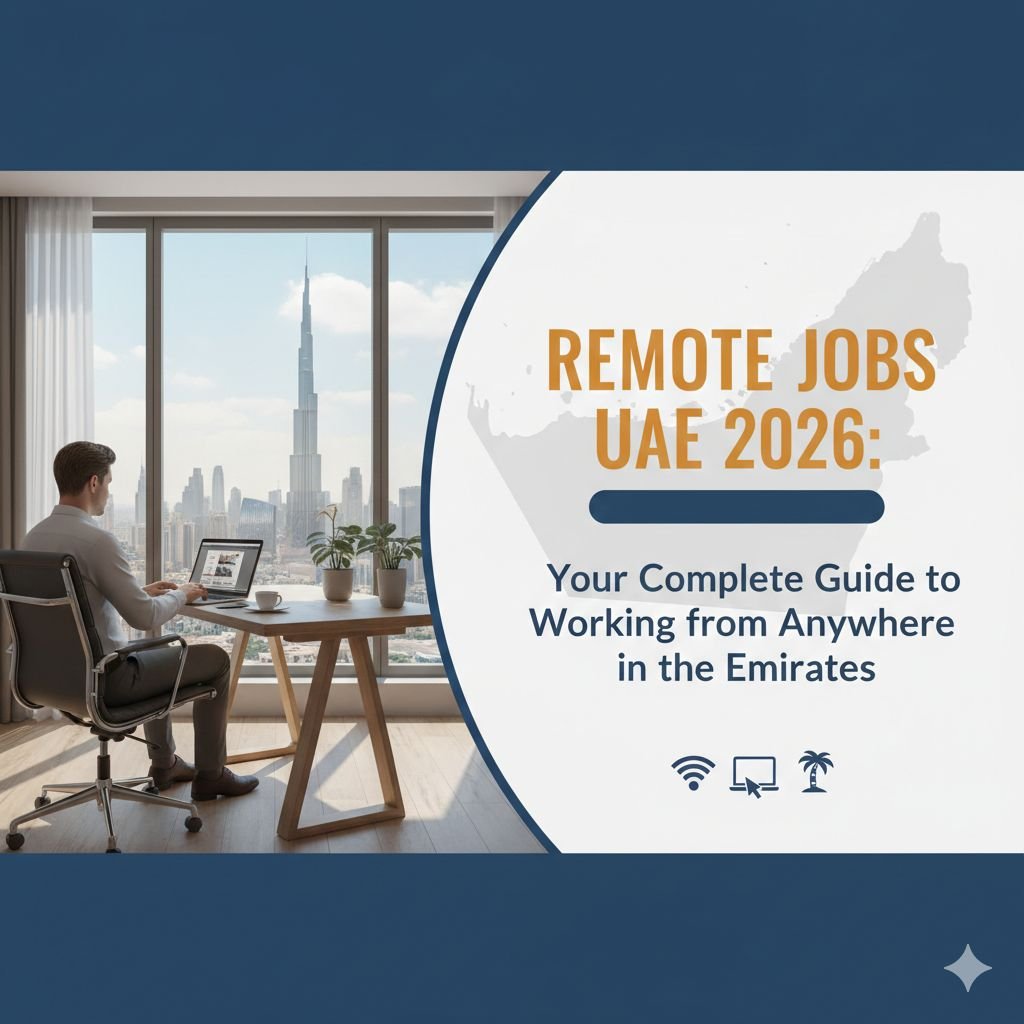
This isn’t a fantasy. In 2026, thousands of professionals are doing exactly this through remote jobs UAE. Whether you’re a British marketer, an Australian engineer, a Pakistani developer, or a digital nomad from anywhere, the United Arab Emirates has transformed itself into the world’s premier hub for location-independent careers.
The UAE Remote Work Revolution in 2026
The numbers tell an extraordinary story. The UAE now ranks second globally among the most attractive destinations for digital nomads and remote professionals . This isn’t accidental. Through strategic visa programs and world-class infrastructure, the country has deliberately positioned itself as the bridge between East and West—a time-zone advantage that allows remote workers to collaborate with Europe, Asia, and Africa all in one day.
What makes the UAE unique? Unlike Singapore or Hong Kong, the cost of living outside central Dubai remains surprisingly accessible. Unlike European digital nomad hubs, there’s zero personal income tax. And unlike remote work hotspots in Southeast Asia, the UAE offers First World healthcare, infrastructure, and political stability.
But 2026 has brought important changes. The digital nomad visa UAE program has evolved, with stricter income verification designed to attract serious professionals rather than short-term travellers . Understanding these new rules is essential before you pack your bags.
2026 Update: UAE Remote Working Visa Rules Tightened
If you’re planning to relocate to the UAE while working for an overseas employer, listen carefully. As of January 27, 2026, the documentation requirements have become more rigorous .
What’s Changed in 2026
| Requirement | Old Rule (Pre-2026) | New Rule (2026) | Impact |
|---|---|---|---|
| Bank Statements | 3 months | 6 months | Doubled; proves stable income |
| Minimum Salary | ~US$3,500/month | ~US$3,500/month (unchanged) | Still required |
| Employment Proof | Employer letter | Employer letter + 6 months salary deposits | Freelancers face higher bar |
| Processing Time | 5-7 days | 5-7 days (unchanged) | Fast turnaround |
The key change: you must now provide six months of bank statements showing regular salary deposits from your overseas employer . This effectively means you need to have been employed for at least six months before applying. Freelancers and recent hires take note—you may need to wait or provide additional documentation.
What Hasn’t Changed
- Visa Duration: One year, renewable
- No Local Sponsor Required: You don’t need a UAE employer
- Family Sponsorship: You can bring your spouse, children, and parents
- Tax-Free Living: Your foreign income remains non-taxable in the UAE
- Application Fee: Approximately US$81 (excluding medical and ID fees)
Minimum Salary Threshold
The magic number remains US$3,500 per month (approximately AED 12,800) . This is the minimum you must earn from your overseas employment to qualify. However, for a comfortable lifestyle in Dubai or Abu Dhabi—especially if you’re supporting a family—aim significantly higher.
Where to Find Legitimate Remote Jobs UAE in 2026
Finding authentic, high-paying remote jobs UAE requires knowing the right platforms. Based on extensive research and current hiring data, these six platforms consistently deliver roles with salaries above AED 20,000/month .
1. Bayt.com: The Middle East’s Largest Job Portal
Best for: Professionals with GCC experience, long-term UAE settlement plans
Bayt.com is the undisputed king of Middle Eastern job boards. Unlike global platforms, Bayt has deep relationships with UAE employers across both government-linked entities and the private sector. The platform has significantly expanded its remote and flexible job listings, particularly for:
- Administration and customer experience
- Digital marketing and HR operations
- Finance support and regional sales management
- Technology and project management
Why it works: Employers on Bayt are legitimate, licensed companies. The risk of scams is minimal. Candidates with demonstrated Gulf Cooperation Council (GCC) experience find particular favour here, as UAE recruiters value regional knowledge .
2. LinkedIn: Direct Access to Decision-Makers
Best for: Technology, consulting, finance, marketing professionals
LinkedIn remains the single most powerful platform for work from home Gulf positions. Many UAE-based companies now post remote or hybrid roles exclusively on LinkedIn before listing elsewhere. The platform’s strength lies in direct access—you can message hiring managers, follow specific companies, and build visibility months before applying .
Salary reality: Experienced professionals applying through LinkedIn regularly secure packages exceeding AED 20,000 per month, particularly for regional or global roles where Dubai is listed as the base market.
3. FlexJobs: Premium, Scam-Free Remote Listings
Best for: Professionals prioritizing legitimacy and stability
FlexJobs operates on a paid subscription model—which actually works in your favour. Every listing is manually vetted, virtually eliminating fake jobs. Many international companies hiring through FlexJobs are explicitly open to UAE-based candidates .
Strong sectors: Software development, cybersecurity, digital marketing, content strategy, UX/UI design, finance, and project management.
4. We Work Remotely: Global Salaries, UAE Lifestyle
Best for: Technology, engineering, product, customer success roles
One of the world’s largest remote-only job boards, We Work Remotely connects you with US, European, and global companies that pay competitive international salaries. For UAE-based professionals, this creates a powerful arbitrage opportunity: earn in dollars or euros, pay zero income tax, and enjoy Dubai’s relatively lower cost of living compared to San Francisco or London .
5. RemoteOK and Remotive: Startup & Scale-Up Opportunities
Best for: DevOps, data science, engineering, growth marketing
These global remote-job aggregators are free to use and specialize in fully remote positions across multiple time zones. Many companies listing here are actively seeking talent in the UAE’s time zone to overlap with European and Asian markets .
6. Upwork: From Freelance to Full-Time
Best for: Building UAE-relevant portfolios, transitioning to long-term contracts
While Upwork is traditionally viewed as a freelancing platform, many professionals use it as a springboard. Start with smaller projects, build relationships with clients, and scale to long-term contracts that meet the visa income requirements. Some eventually convert to full-time remote roles with employer-sponsored visas .
What About Ajman? The “Waterfront-From-Home” Lifestyle
Here’s something interesting happening in 2026. As remote professionals gain the freedom to live anywhere, many are looking beyond Dubai’s crowded centres to neighbouring emirates—particularly Ajman .
Why Ajman?
- Lower cost of living: Significantly cheaper rents than Dubai or Abu Dhabi
- Space and lifestyle: Lagoon-front communities, walking tracks, pools, outdoor cinemas
- Connectivity: 10 minutes to Sharjah, 30 minutes to Dubai International Airport, 35-40 minutes to Dubai Downtown
Tiger Downtown Ajman has emerged as a favourite among remote workers, offering fully furnished units starting from approximately AED 420,000 with flexible payment plans . For remote professionals earning in foreign currency, this represents both a primary residence and an investment asset with yields reportedly in the 8-10% range.
This trend—”waterfront-from-home”—reflects how deeply remote work has reshaped the UAE’s real estate and lifestyle landscape.
Target Country Spotlight: UK, AU, PK
For UK Professionals
British professionals are particularly well-positioned for UAE remote work. The four-hour time difference allows overlap with both European and Asian markets. Many UK-based companies with global operations are open to UAE-based remote employees, particularly in finance, consulting, and technology. The tax savings alone (0% UAE vs. up to 45% UK) make relocation extraordinarily attractive.
Action step: Focus on LinkedIn and FlexJobs. Emphasise your ability to work UK hours while being based in the UAE—many employers value the “follow the sun” coverage.
For Australian Professionals
The time difference is significant (approximately 6-8 hours depending on daylight saving). However, this can work in your favour for roles requiring overnight coverage or handover periods. Australian professionals in engineering, mining services, and technology find strong demand in the UAE market.
Action step: Target multinational companies with both Australian and Middle Eastern operations. Your understanding of both markets is a genuine competitive advantage.
For Pakistani Professionals
Pakistan remains one of the largest talent pipelines for the UAE. The cultural affinity, language familiarity, and established diaspora networks create unique opportunities. However, the 2026 visa rule changes mean you must demonstrate six months of consistent salary deposits—a higher bar than previously required.
Action step: Bayt.com should be your primary platform. If you’re currently employed in Pakistan with a reputable company and meet the salary threshold, you are well-positioned. Be meticulous with your documentation.
Step-by-Step: Your Remote UAE Relocation Plan
Month 1-2: Secure Your Remote Job
- Target the platforms listed above
- Verify salary meets the US$3,500/month threshold
- Obtain an official employer letter confirming remote work approval
- New rule: Ensure you have six months of employment history
Month 3: Prepare Documentation
- Collect six months of bank statements showing salary deposits
- Obtain UAE-compliant health insurance (many international providers offer plans specifically for visa applicants)
- Passport validity: minimum six months
Month 4: Apply for the Visa
- Submit online via the Federal Authority portal or through accredited typing centres in Abu Dhabi
- Pay the ~US$81 application fee
- Complete medical examination and Emirates ID processing upon approval
Month 5-6: Relocate and Settle
- Book accommodation (consider short-term rental initially while you explore neighbourhoods)
- Open a UAE bank account (required for salary transfers and daily life)
- Register for utilities and telecommunications
Frequently Asked Questions (FAQs)
1. Can I apply for the UAE Remote Working Visa if I’m a freelancer or business owner?
Yes, but the bar is higher. You must demonstrate a consistent monthly income of at least US$3,500 over the six-month period (new 2026 requirement). This means providing six months of bank statements showing regular client payments or business revenue. Freelancers should also provide client contracts and, if applicable, business registration documents from their home country. The UAE wants proof that your income is stable and sustainable .
2. What’s the difference between the Remote Working Visa and Dubai’s Virtual Working Programme?
The Remote Working Visa is a federal UAE program valid across all emirates (Dubai, Abu Dhabi, Sharjah, Ajman, etc.). Dubai’s Virtual Working Programme is a separate, emirate-specific scheme launched in 2020. Both allow remote work for overseas employers, but eligibility criteria and application processes differ slightly. For most professionals, the federal Remote Working Visa is the simpler, more flexible option .
3. How do employers in the UK, Australia, or Pakistan view employees relocating to the UAE?
This varies by company policy and industry. Some global companies actively encourage UAE relocation because it reduces their office costs while retaining talent. Others have strict data residency or security requirements. The key is transparency: discuss your plans with your employer before applying for the visa, and provide them with official information about the program. Most employers appreciate the initiative when presented professionally.
4. Can I switch from a Remote Working Visa to a standard UAE employment visa?
Yes, this is a common pathway. Many professionals initially relocate on the Remote Working Visa, then transition to a traditional employment visa if they secure a position with a UAE-based company. The process involves your new employer sponsoring your visa change. Your existing residency status actually simplifies this transition compared to applying from outside the country.
5. Is AED 20,000+ per month a realistic salary for remote jobs targeting the UAE?
For experienced professionals in technology, engineering, senior marketing, finance, and consulting roles—absolutely yes. Multiple platforms list positions at this level, and the 2026 visa income requirement (approx. AED 12,800) is well below what senior professionals should target . Entry-level and junior roles pay less; the AED 20,000+ threshold is realistic for mid-to-senior professionals with 5-10+ years of experience and in-demand skills.