
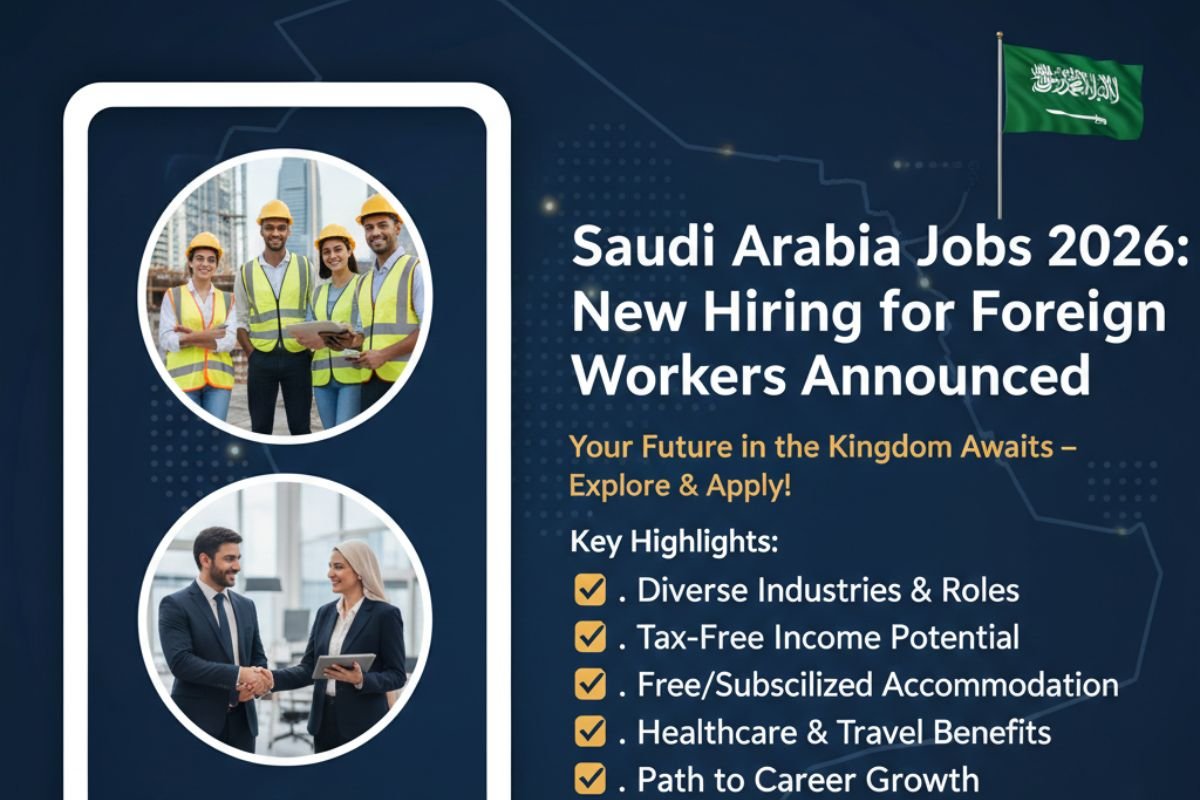
The 2026 Hiring Boom: Your Gateway to a Saudi Career
As Saudi Arabia charges forward with the execution phase of its historic Vision 2030, the job market for foreign workers is entering its most dynamic and opportunity-rich period yet. For skilled professionals worldwide, 2026 represents a pivotal window—a time of new hiring announcements for foreign workers across groundbreaking sectors. The Kingdom is not just building infrastructure; it’s building entire new industries, and it needs global talent to make it happen.
Why 2026 is a Landmark Year for Foreign Workers in Saudi Arabia
Vision 2030 has moved decisively from blueprint to construction site. The giga-projects that once captivated the world’s imagination are now active, multi-billion-dollar employment engines. This transition creates two simultaneous demands:
- Construction & Engineering Expertise: To physically build NEOM, The Red Sea Project, Qiddiya, and Diriyah.
- Operational & Knowledge Talent: To run the advanced hospitals, resorts, tech hubs, and financial centers within these projects once they open.
The Saudi government and private sector are launching coordinated international recruitment campaigns to meet this unprecedented need, making 2026 the prime time for foreign professionals to explore Saudi careers.
Top Sectors Announcing New Hiring for Foreign Workers
1. Giga-Project Construction & Engineering
The physical creation of Vision 2030’s landmarks requires tens of thousands of skilled professionals.
- New Hiring Focus: Senior Project Managers, Construction Directors, Civil & Structural Engineers, MEP (Mechanical, Electrical, Plumbing) Managers, BIM (Building Information Modeling) Specialists, and Quantity Surveyors.
- Key Projects: NEOM (including THE LINE, Oxagon), The Red Sea Global, Qiddiya (entertainment city), Diriyah Gate, Roshn (housing).
- Action Point: Target the websites of the principal developers and the international engineering consultancies and contractors they have partnered with (e.g., Bechtel, Jacobs, Dar Al-Handasah, Samsung C&T).
2. Tourism, Hospitality & Leisure
With the first destinations opening and a target of 100 million annual visitors by 2030, the need for world-class hospitality talent is exploding.
- New Hiring Focus: Hotel General Managers, Executive Chefs, Guest Experience Directors, Tourism Development Managers, Luxury Retail Managers, and Entertainment Facility Operators.
- Key Projects: The Red Sea (luxury resorts), Sindalah Island (NEOM), Diriyah cultural hub, Riyadh Season events.
- Action Point: Monitor career pages of global hotel chains (Four Seasons, Ritz-Carlton, Marriott) expanding in KSA, and the operating companies of the new destinations.
3. Technology & Digital Transformation
Saudi Arabia is building a digital economy from the ground up, with a national priority on tech sovereignty.
- New Hiring Focus: Cybersecurity Architects, AI/Machine Learning Engineers, Data Scientists, Cloud Solutions Architects, Software Developers, and IoT Specialists.
- Key Hubs: NEOM’s advanced tech ecosystem, Riyadh’s tech valley, King Abdullah Financial District (KAFD).
- Action Point: Explore opportunities with the Ministry of Communications and IT (MCIT), Saudi tech startups (many funded by PIF), and global tech giants (Google, Microsoft, Oracle) establishing major regional hubs in Riyadh.
4. Advanced Manufacturing & Logistics
As part of diversifying beyond oil, Saudi Arabia is becoming a regional hub for advanced industries and global supply chains.
- New Hiring Focus: Industrial Engineers, Supply Chain Directors, Automotive Engineers (especially for EV), Renewable Energy Manufacturing Experts, and Quality Assurance Managers.
- Key Initiatives: EV manufacturing (Ceer, Lucid Motors factory), Solar panel production, Pharmaceuticals manufacturing, Logistics hubs at major ports.
- Action Point: Research companies within Economic Cities (like KAEC) and Special Economic Zones, and major logistics firms (Saudi Logistics, Aramco’s supply chain).
5. Healthcare & Life Sciences
A rapidly growing population and a drive for medical tourism excellence are fueling massive investment in healthcare infrastructure.
- New Hiring Focus: Consultant Physicians (all specializations), Specialist Surgeons, Registered Nurses (ICU, Oncology, Cardiology), Hospital Administrators, and Medical Researchers.
- Key Locations: Expansion of King Faisal Specialist Hospital, new medical complexes in NEOM and The Red Sea, and network growth of private hospital groups.
- Action Point: Check career portals of the Saudi Ministry of Health, major private hospital operators (Dr. Sulaiman Al-Habib, Dallah Health), and new specialist medical centers.
The 2026 Saudi Work Visa & Iqama Process: Streamlined for Talent
Understanding the process is key to a smooth transition. It remains employer-sponsored but is increasingly digital.
- The Job Offer: You must secure a formal offer from a Saudi company licensed to hire expatriates.
- Work Permit (Qiwa): Your employer obtains your work permit through the Ministry of Human Resources’ Qiwa platform.
- Document Attestation (Critical): You must attest your educational and professional certificates via your home country’s Foreign Ministry and the Saudi Embassy. Start this immediately upon receiving an offer.
- Entry Visa & Arrival: Your employer issues an entry visa. You enter KSA and undergo a medical test.
- Iqama (Residence Permit): Your employer processes your Iqama, your official ID card for living and working.
New for 2026: Continued digitization on the Absher and Qiwa platforms makes tracking your application easier. For top-tier talent, the Premium Residency (Privileged Iqama) offers a long-term, more flexible residency option.
How to Find These New Job Announcements: A Proactive Strategy
- Target Company Career Pages Directly: This is the most effective method. Identify the top 20-30 companies leading projects in your field and monitor their “Careers” sections weekly.
- Leverage LinkedIn Strategically:
- Set your location to “Riyadh, Saudi Arabia” or “NEOM”.
- Follow key companies and giga-projects.
- Use hashtags like #HiringSaudi, #JobsKSA, #Vision2030Careers.
- Turn on “Open to Work” for recruiters.
- Partner with Specialized Recruitment Agencies: Reputable international agencies (e.g., Michael Page, Hays, Brunel, Charterhouse) have dedicated desks for Saudi Arabia and receive direct mandates from companies.
- Attend Virtual Saudi Career Fairs: Many are organized by the Saudi Ministry of Human Resources and major chambers of commerce to connect global talent with employers.
Preparing for the Saudi Job Market: Cultural & Professional Readiness
- Cultural Adaptability: Demonstrate respect for local customs and a willingness to adapt. Research Saudi business etiquette.
- Long-Term Mindset: Employers seek candidates committed to the long-term journey of Vision 2030. Express this in interviews.
- Competitive Compensation: Packages include tax-free salary, housing allowance, education for children, annual flights, and healthcare. Negotiate your total package.
Conclusion: Your Role in Building the Future
The new hiring for foreign workers announced for 2026 is more than just job vacancies; it’s an invitation to participate in one of the most ambitious national transformations of the 21st century. For engineers, tech experts, healthcare professionals, and hospitality leaders, Saudi Arabia offers a unique combination of career-defining projects, competitive remuneration, and the chance to leave a tangible legacy.
By strategically targeting the high-growth sectors, meticulously preparing your application, and understanding the streamlined visa process, you can successfully secure your place in the exciting next chapter of Saudi Arabia’s story. The future is being built now—ensure you have a role in it.
5 Frequently Asked Questions (FAQs)
1. Is it true that Saudization (Nitaqat) will reduce jobs for foreigners in 2026?
Saudization prioritizes Saudi nationals in the workforce, but it actually increases demand for specialized foreign expertise. The policy focuses on replacing expatriates in more general or administrative roles. For the highly skilled, niche positions required to build and operate giga-projects and new industries, foreign hiring is not just ongoing—it’s accelerating. Your specialized skill is the key.
2. What is the minimum salary required to get a Saudi work visa in 2026?
There is no universal minimum salary set by the government for a standard work visa. However, the ability to sponsor family members (spouse and children) requires meeting a minimum salary threshold, which is often set by the employer’s corporate policy (typically around SAR 3,500 – 5,000 per month). For the Premium Residency Visa, specific higher salary brackets (e.g., SAR 14,000-16,000+ per month) are one of the eligibility criteria.
3. Can I switch jobs (change my sponsor) in Saudi Arabia easily in 2026?
Labor reforms have made job mobility easier. Under current law, you can transfer your sponsorship to a new employer after completing one year of service with your current sponsor. The process requires following specific procedures, and a No Objection Certificate (NOC) from your current employer, while no longer always mandatory, can still facilitate a smoother transfer. Always check the latest regulations on the Ministry of Human Resources website.
4. Do I need to speak Arabic to work in Saudi Arabia?
For most professional, private-sector roles in international companies or giga-projects, Arabic is not a requirement. The business language is often English. However, learning basic Arabic is highly recommended and respected, as it greatly aids daily life, cultural integration, and can be a significant advantage for client-facing roles or positions within government-linked entities.
5. Are there opportunities for remote work with Saudi companies?
While the predominant model is on-site due to the project-based nature of the work, remote and hybrid roles are emerging, particularly in the technology, consulting, and education sectors. Many global consultancies working with Saudi entities have teams serving the account from abroad. However, for roles directly involved in the core operations, construction, or management within the Kingdom, physical presence is generally required.