
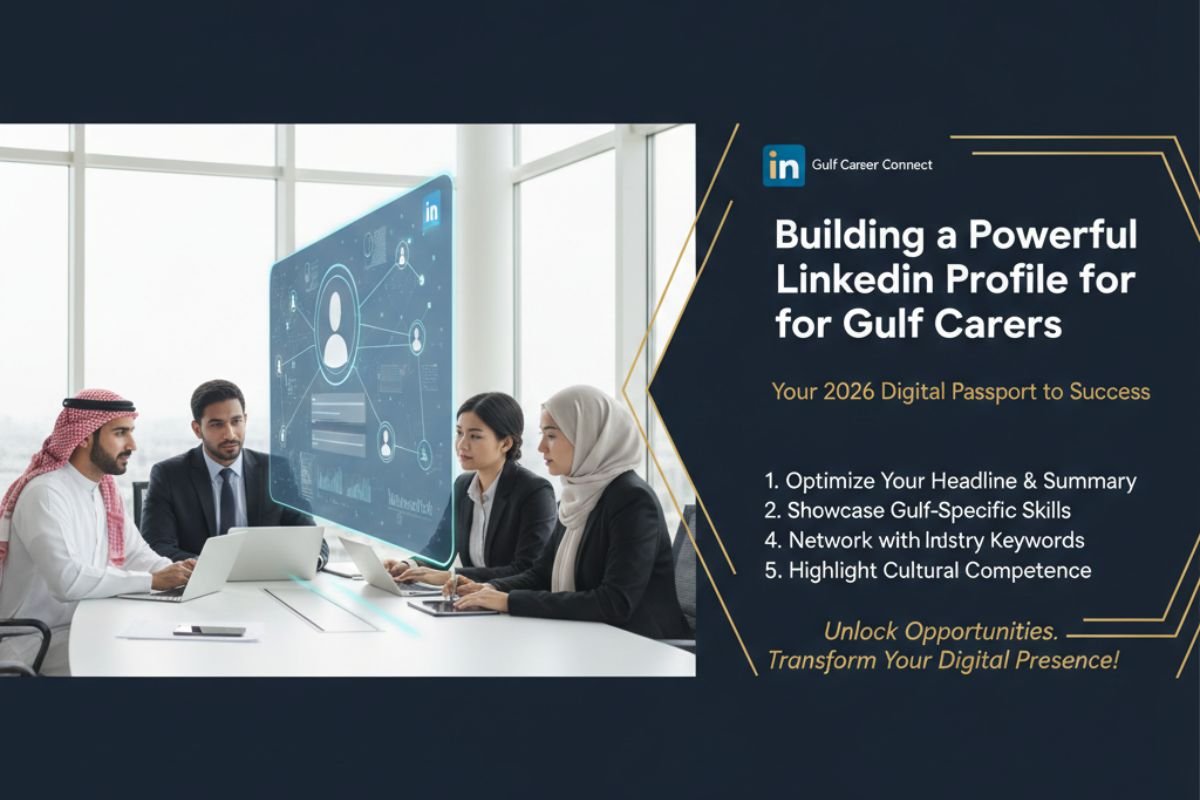
In the competitive Gulf job market, your LinkedIn profile is no longer just a digital resume—it’s your professional passport, your personal branding headquarters, and your most powerful networking tool. For recruiters and hiring managers in Dubai, Riyadh, Doha, and beyond, LinkedIn is the first place they look to validate, vet, and discover talent. A weak or generic profile can mean missed opportunities, while a strategically crafted one can attract unsolicited interview requests and lucrative offers.
This comprehensive guide will walk you through building a LinkedIn profile specifically optimized for the Gulf career landscape in 2026. We’ll cover cultural nuances, keyword strategies for Gulf recruiters, and actionable steps to transform your profile into a career magnet.
Why LinkedIn is Non-Negotiable for Gulf Job Seekers
The Gulf recruitment ecosystem heavily relies on LinkedIn for several reasons:
- The Primary Sourcing Tool: Over 90% of recruiters and HR professionals in the GCC use LinkedIn to find candidates. They search by keyword, location, and current company.
- Cultural Validation: In a relationship-driven business culture, seeing your network, recommendations, and activity provides social proof and builds trust before the first meeting.
- Efficiency for Sponsorship: For roles requiring visa sponsorship, recruiters can quickly assess your international experience, qualifications, and professional demeanor from your profile.
- The Digital First Impression: Your profile is often viewed before your CV is even opened. It sets the tone for your entire application.
Section-by-Section Guide to a Gulf-Optimized LinkedIn Profile
1. The Profile Photo & Background Banner
- Photo: Use a high-resolution, professional headshot with a neutral or blurred office background. Dress as you would for a senior interview in the Gulf—formal business attire. Maintain a confident, approachable expression. Avoid casual wear, selfies, or distracting backgrounds.
- Background Banner: This is prime branding real estate. Don’t leave it blank. Use a custom graphic that includes your professional title, key skills (e.g., “Digital Transformation Leader | Project Director”), or a skyline of your target Gulf city. It shows tech-savviness and attention to detail.
2. The Headline: Your 220-Character Value Proposition
Don’t just state your current job title. This is your most important keyword field and should be packed with value.
- Bad: “Project Manager at ABC Corp”
- Good: “Senior Project Manager | Infrastructure & Mega-Projects | 12+ Years in GCC | PMP, PMI-SP | Seeking Director Role in Riyadh/Doha”
Formula: [Your Core Title] | [Specialization/Industry] | [Key Achievement or Skill] | [Location Target/Keyword]
Gulf-Specific Tip: Include keywords like “GCC Experience,” “KSA Market,” “UAE,” or “Cross-Functional Leadership” if applicable.
3. The “About” Section: Your Strategic Narrative
This is your elevator pitch. Write in first person (“I am…”) to sound engaging.
- First 3 Lines (The Hook): These are visible without clicking “see more.” Start with a powerful statement of your expertise and the value you bring. Example: “Award-winning Digital Marketing Director with a proven track record of scaling e-commerce revenue across the MENA region. I specialize in building high-performance teams to launch brands in Saudi Arabia and the UAE.”
- Middle Paragraphs (The Proof): Bullet points work well here. Highlight 3-4 key achievements using the CAR method (Challenge, Action, Result). Quantify everything.
- Closing (The Call to Action): Clearly state your career focus. Example: “I am currently exploring leadership opportunities within visionary tech companies in Dubai or Abu Dhabi driving AI innovation. Open to connecting with industry leaders and recruiters.”
- Keywords: Naturally integrate terms recruiters search for: “Vision 2030,” “Saudization partnership,” “multicultural teams,” “budget management,” etc.
4. The “Featured” Section: Your Proof Portfolio
Use this section to showcase work that validates your “About” section.
- Add links to major projects you’ve worked on (e.g., a NEOM project portfolio, a company case study).
- Upload presentations, whitepapers, or articles you’ve authored.
- Include media coverage or award announcements.
- For Gulf roles, showing work related to major regional projects or initiatives is incredibly powerful.
5. Experience Section: Achievements, Not Duties
For each role, go far beyond the job description.
- Use bullet points, not paragraphs.
- Start each bullet with a strong action verb (Led, Engineered, Grew, Reduced, Transformed).
- Focus on quantified achievements. Instead of “Responsible for sales,” write “Grew regional sales by 42% in 18 months by launching a new partner network across Kuwait and Oman.”
- Highlight Gulf/MENA-specific results: “Managed a diverse team of 25 across 8 nationalities…” or “Delivered a $15M project for a leading UAE government entity 3 weeks ahead of schedule.”
- If you have experience with major regional entities (Aramco, ADNOC, QNB, Emaar, etc.), ensure the company name is clearly visible.
6. Skills & Endorsements
- List 15-20 relevant skills. Prioritize a mix of technical/hard skills (ERP Implementation, Python, Financial Modeling) and soft skills (Stakeholder Management, Cross-cultural Leadership).
- Get strategic endorsements. Politely ask former colleagues, managers, and clients—especially those with reputable profiles in the Gulf—to endorse you for key skills. Reciprocate.
- Take Skill Assessments: LinkedIn’s skill quizzes (like for Microsoft Azure or Project Management) add a verified badge to your profile, increasing credibility.
7. Recommendations: Your Social Proof
These are critical in the Gulf’s relationship-based culture.
- Aim for 3-5 strong, detailed recommendations.
- Request them from former managers, senior colleagues, or clients who can speak to your work ethic, achievements, and ability to thrive in an international environment.
- Provide them with bullet points about what you’d like them to highlight (e.g., “our work on the Saudi project,” “my leadership during the Dubai expansion”).
- Offer to write one in return.
8. Education, Licenses & Certifications
- Fully complete this section. Gulf employers value formal qualifications.
- For certifications, add all relevant ones: PMP, CIPD, ACCA, CMA, CFA, and any technology certifications (AWS, Cisco, SAP). These are massive keyword drivers.
- If you have completed any training related to Gulf business practices or regulations, include it.
The “Activity” Factor: Becoming a Visible Authority
A static profile is not enough. You must be active to appear in feeds and algorithms.
- Strategic Content Sharing & Creation:
- Share relevant articles about your industry’s trends in the Gulf (e.g., “Saudi Arabia’s Green Hydrogen Strategy”).
- Write short articles or long-form posts on LinkedIn Pulse about your expertise. For example: “3 Lessons from Managing Remote Teams Across the GCC.”
- Comment thoughtfully on posts by industry influencers, company pages, and recruitment firms in your target region.
- Network with Purpose:
- Connect with recruiters specializing in your field and location (search “Recruiter | Technology | Dubai”).
- Follow and engage with target companies (e.g., NEOM, Mubadala, stc).
- Personalize connection requests. A simple “I admire your work at [Company] and am also passionate about the fintech landscape in Riyadh” is far more effective than the default message.
- Optimize Your Profile for Search (SEO):
- Sprinkle location keywords in your headline, about, and experience sections: “Dubai,” “Riyadh,” “Qatar,” “MENA,” “GCC.”
- Include variations of your job title (Head of IT, CIO, Technology Director).
- Use the skills section as a keyword repository.
Cultural Nuances for the Gulf LinkedIn Profile
- Professionalism Over Personality: While showing personality is fine, maintain a consistently professional tone. The Gulf corporate culture is generally more formal.
- Highlight Stability: Emphasize tenure in previous roles. Job-hopping can be viewed negatively. If you have long stints, make them prominent.
- Respect Privacy: It’s not necessary or recommended to list personal details like marital status, age, or religion.
- Showcase Adaptability: Demonstrate through your experience and content that you understand and respect the business culture in the region.
Common Mistakes to Avoid
- An Incomplete Profile: A profile strength of “All-Star” is non-negotiable.
- Using a Non-Professional Photo.
- A Passive, Empty “About” Section.
- Listing Only Job Duties in Experience.
- Being a “Lurker” with Zero Engagement.
Conclusion: Your Profile is a Living Document
Building a powerful LinkedIn profile for a Gulf career is an ongoing process, not a one-time task. By strategically crafting each section with the Gulf recruiter in mind, actively engaging with your network, and consistently demonstrating your expertise, you transform your profile from a digital CV into a dynamic career engine.
In 2026, the best opportunities in the Gulf won’t just be found—they will find you. Make sure your LinkedIn profile is ready to welcome them.
5 Frequently Asked Questions (FAQs)
1. Should I have my profile in both English and Arabic?
For most professional roles, a strong English profile is sufficient and expected, as it’s the primary business language. However, if you are fluent in Arabic, creating a parallel Arabic headline and “About” section can be a significant advantage, especially for roles requiring client-facing work with government entities or local companies. It demonstrates deep cultural integration.
2. Is it appropriate to connect with senior executives (like a CEO) at my target Gulf company?
Yes, but personalization is critical. Never send the default request. Mention a specific piece of company news, their recent interview, or a shared group/interest. Frame it as an admiration for their leadership and a desire to learn about the company’s direction. Be respectful and don’t ask for a job in the connection request.
3. How do I handle not having direct Gulf work experience on my profile?
Focus on transferable achievements. Quantify your global experience and frame it as relevant. In your “About” section and headline, express a targeted interest (“Seeking to apply 10 years of fintech expertise in the Saudi market”). Engage with content from the region, and highlight any experience working with international or diverse teams.
4. Should I state that I “need visa sponsorship” on my LinkedIn profile?
Do not put this in your headline or “About” section. It can prematurely filter you out. This is a detail for later-stage conversations. Instead, focus on selling your skills. You can indicate your location as “Open to work in Riyadh, Saudi Arabia” using LinkedIn’s “Open to Work” feature (visible only to recruiters), which implicitly signals your mobility.
5. How often should I update my LinkedIn profile?
At minimum, quarterly. Update it with any new achievement, certification, or project completion. Regularly refresh the content you share and engage with to keep your profile active in network feeds. Before any active job search, do a comprehensive audit using this guide.